




Abstract
Purpose
This study aimed to explore how educational technology influenced a preparatory teacher education program using heteroglossic and global approaches.
Design/Approach/Methods
The researchers drew upon the theoretical framework of multilingual digital storytelling (MDST), which emphasizes the intercultural awareness attributes of multilingual learners (MLs) and takes a heteroglossic perspective in linguistic pedagogy. This qualitative case study examined the experiences of 11 U.S.-based preservice teachers (PSTs) and 12 MLs elementary students in Korea in the MDST project of a TESOL methods course.
Findings
The findings showed that PSTs and MLs enhanced their appreciation for educational technology, multilingualism, and intercultural awareness. Although the project aimed to decenter English as a hegemonic language, both PSTs and MLs maintained traditional discourses that privileged English over MLs’ home language and targeted literacy correctness in written English only, moving away from the heterogeneous goals of the course project. PSTs and MLs also faced challenges in navigating technological tools, which negatively affected their perception of the project.
Originality/Value
This study contributes to heteroglossic approaches in preparatory TESOL teacher education programs and improves the understanding of challenges in educational technology use for global multilingual exchanges to promote global citizenship.
Keywords
Introduction
Digital technologies with innovative and critical approaches offer meaningful teaching and learning opportunities, such as connecting local and global communities, expanding students’ worldviews, and promoting intercultural understanding and anti-bias education. Attaining intercultural competence through these opportunities is an educational goal required by national standards (e.g., the International Society for Technology in Education [ISTE]) in the United States; however, pre-service teachers (PSTs) often do not receive enough support and knowledge to become globally minded intercultural educators, especially as the creation of a globalized curriculum for students—including multilingual learners (MLs)—through innovative digital literacy practices is rare (Jiang et al., 2021; Leh et al., 2015). Although studies have focused on how PSTs learn through multimodal, digital, and multilingual approaches in their teacher education courses, most of them have not provided global and heteroglossic perspectives, such as translanguaging.
Research on digital literacy has investigated how digital story (DS) projects provide MLs with international experiences (Clarke, 2020) and transformative learning practices (Park, 2019), which require the use of multimodal texts for appropriate learning opportunities. However, these projects have not taken heteroglossic approaches (Bakhtin, 1981) to MLs’ education to emphasize the appreciation of all languages and incorporate differing views and cultural practices embedded in the voice of “others” in teaching. Recent research has focused on multilingual digital storytelling (MDST) as a heteroglossic framework for teaching and learning (Anderson & Macleroy, 2016) because it allows the use of translanguaging strategies. MLs use their rich linguistic repertoires that include multiple languages as well as linguistic and non-linguistic modalities (e.g., drawings, video, and gestures) in communication. For example, MLs tend to use their heritage language (HL) directly or indirectly to build content knowledge and enhance target-language acquisition. Translanguaging encourages MLs to draw upon their diverse linguistic and cultural identities in meaning-making practices (García, 2009); in doing so, they foster heteroglossia—the presence of multiple voices and perspectives relayed through using their non-dominant languages. Bakhtin (1981) suggests that heteroglossia is a dialogic principle that counters monologism (or single-thought discourse), fosters a multiplicity of views and beliefs, and uses diverse language conventions in the classroom. MDST projects have had a significant impact on knowledge, language, and literacy but have mainly focused on adult learners’ education (Nuroh et al., 2021). Little is known about how MDST can provide international collaboration, intercultural communication, and heteroglossic language learning experiences between PSTs and elementary-level MLs in TESOL teacher education courses.
The current study draws upon the theoretical framework of the MDST (Anderson & Macleroy, 2016) to examine the experiences of PSTs in the United States and elementary school students in Korea. First, we present the theoretical framework and literature review pertinent to the discussion of how MDST projects provide learning opportunities for teachers and students in various global contexts. Then, we present the findings and discussion as they are related to our research questions: (a) how the PSTs and their partners in Korea engaged with the MDST project, which aimed to promote heteroglossic and global perspectives in a TESOL teacher education course, and (b) how educational technology used for the MDST project facilitated or hindered their engagement in the MDST project.
MDST framework
The MDST framework (Anderson & Macleroy, 2016) draws upon social, cultural, critical, digital, and multimodal theories as well as Bakhtin's (1981) theory of dialogism, focusing on heteroglossic approaches and the use of translanguaging (García, 2009). More particularly, MDST is grounded in the five principles of (a) critical literacy, 1 (b) sociocultural theory and dialogism or use of different viewpoints or texts, (c) multiliteracies framework, 2 (d) theories of additional language acquisition and multilingualism, and (e) principles and methods of community language teaching. In this framework, language learning practices “move beyond a narrow, instrumental approach to one which is based on principles of dialogue, personalized meaning-making, and intercultural exchange” (Anderson & Macleroy, 2017, p. 494). In other words, language learning and teaching occur through social interactions that promote dialogue between multiple perspectives and subjective worlds across local and global communities. Furthermore, digital and multimodal aspects of teaching and learning provide heteroglossic perspectives on MLs’ education and facilitate the understanding of culture, identity, and agentive practices in the world of MLs. They also resist monoglossic ideologies that marginalize the use of languages other than English, thus advocating MLs’ rights to use non-dominant languages and validating their multilingualism in everyday school practices. The use of translanguaging and engagement with cross-cultural content in education supports students’ linguistic development and fosters intercultural and metalinguistic awareness.
Background literature
This literature review discusses critical digital literacy projects (CDLs) that promote intercultural communication and support student–teacher collaboration for global understanding in schools and universities, particularly in teacher education programs (Beal et al., 2012; Fernández et al., 2016). Digital literacy refers to the ability to use and understand digital media creatively and critically by reflecting on social perspectives regarding digital activities. After presenting CDLs that cultivate cross-cultural understanding by early childhood and elementary level students and their teachers in schools, we focus on CDLs that facilitate intercultural competence by taking heteroglossic approaches to literacy and language, such as translanguaging and DSs.
CDLs in educational institutions
To deepen early childhood and elementary level students’ awareness and understanding of global issues and cross-cultural communication, researchers (e.g., Clarke, 2020; Delacruz, 2019) have examined how teachers collaborated with students in CDLs that took place in schools. In Delacruz's (2019) study, K-5 grade-level students and their teachers created and utilized school-based virtual field trips through which students deepened their content knowledge, collaborative skills, and global understanding as they interacted with others across the globe. Similarly, Clarke (2020) created the Walk a Day in My Shoes project to provide a starting point for teachers to cultivate cross-cultural understanding among elementary students. The students used photos of their shoes as storytelling devices to create DSs about their lives and shared them with students in five different classrooms in other countries. This project harnessed the power of digital technology to explore other cultures and increase students’ experiences with people other than themselves without leaving their classrooms.
Heteroglossic approaches in CDLs
Researchers (e.g., Anderson et al., 2018; Chung, 2016; Matsouka, 2021; Nuroh et al., 2021) have also focused on heteroglossic approaches—particularly translanguaging strategies—as an innovative way to develop elementary graders’ intercultural competence through CDLs, such as MDST. Chung (2016) and Anderson et al. (2018) implemented MDST projects with teachers working in community-based schools in and around London as well as in other countries/regions (i.e., Algeria, Palestine, and China). These projects, which involved a wide range of languages, enhanced the connections between schools, diverse cultures, communities, and homes, and provided ways for parents to support learners linguistically and culturally.
Creating DSs encouraged students to explore culture and identity on their own terms in flexible and non-essentialized ways. They also actively imagined other cultural lives, developed empathy in language learning, improved intercultural communication skills, and helped to challenge stereotypes in different cultures. Matsouka (2021) also explored whether the attitude of migrant pupils toward the host country was affected by the intercultural educational intervention that had taken place in a class for the education of refugees in Greece. The findings confirmed that using the web and translanguaging practices in the classroom can enhance the intercultural communication competence of migrant pupils and their positive attitude toward the host country. Nuroh et al.'s (2021) study is more pertinent to the current research as the researchers used an MDST project in Indonesia to teach students English and promote multiculturalism. The students co-created DSs as multimodal texts and reflected on multiliteracy—communicating meaning across a variety of visual, oral, corporal, musical, and alphabetical forms in education (Müller et al., 2009). They used a variety of multilingual (e.g., Javanese, Bahasa Indonesia, and English), visual, and technical resources, which enabled them to effectively communicate their real-life experiences through DSs.
DS projects in teacher education programs
Studies (e.g., Watt, 2019) have focused on teacher education programs aimed at developing PSTs’ video or DS production as critical digital literacy practices, cross-cultural communication, and cultural understanding of the world. Watt (2019) explored the challenges and possibilities experienced by 40 PSTs in creating videos as CDLs in their language arts education coursework. PSTs faced challenges in video production but changed their attitudes toward digital literacy, developed their teacher identities, and engaged in cross-curricular perspectives. They learned the skills to critique digital texts, through which they interrogated the self and the world.
Few studies have examined how PSTs in TESOL teacher education programs produce DS in relation to raising cultural awareness and global understanding in teaching and learning. For example, Park (2019) examined how PSTs in TESOL learned from their DS projects that required them to critically reflect on their learning in language, culture, education, and technology. Through DSs, PSTs raised awareness of cultural issues in language teaching and became more active writers and storytellers as they included their own HLs in DSs. Although this was an empowering experience for PSTs, they were concerned that they did not manage the technology efficiently and did not have sufficient content knowledge to engage in meaningful discussions. More recently, in an elementary teacher education program, Kolano and Sanczyk (2021) implemented a DS project that required PSTs in TESOL to work with MLs in the field to learn about immigrant issues. In this project, PSTs engaged in authentic learning and examined the issues of power, race, and privilege. At the end of the course, PSTs transformed their attitudes toward immigration and MLs as they developed asset-based perspectives for the latter.
Although the studies above provide an understanding of how PSTs learn through multimodal, digital, and multilingual approaches in their teacher education coursework, most of them did not engage both PSTs and their students with international CDLs that foster global and heteroglossic perspectives, such as translanguaging. PSTs have little knowledge of how they can collaborate with elementary students to promote global citizenship via CDLs (Delacruz, 2019). To address this gap in the literature, our study drew upon MTSD to explore the experiences of PSTs in the United States and elementary school students in Korea in a semester-long international partnership implemented in a TESOL methods course, particularly in relation to affordances and challenges of the educational technology used for virtual exchanges. We ask the following research questions: (a) how did PSTs from the United States and their assigned elementary students in Korea engage with an MDST project that aimed to promote heteroglossic and global perspectives in a TESOL teacher education course? (b) How does educational technology facilitate or hinder engagement in the MDST project?
Methodology
To investigate how PSTs in the United States and elementary school students in Korea interact and collaborate using educational technology in the MDST project, we designed a qualitative case study that provides a rich description of complex and realistic situations in a bounded system (Yin, 2015). This case study was bounded by one TESOL method course in spring 2019 taught by one instructor (second author) who also collected data. Co-researchers later engaged in an in-depth analysis of the case, which allowed them to capture the contextual conditions of the international partnership between PSTs in the United States and MLs in Korea, as well as the complexity of the collaborative work and communication process facilitated through educational technology.
Context
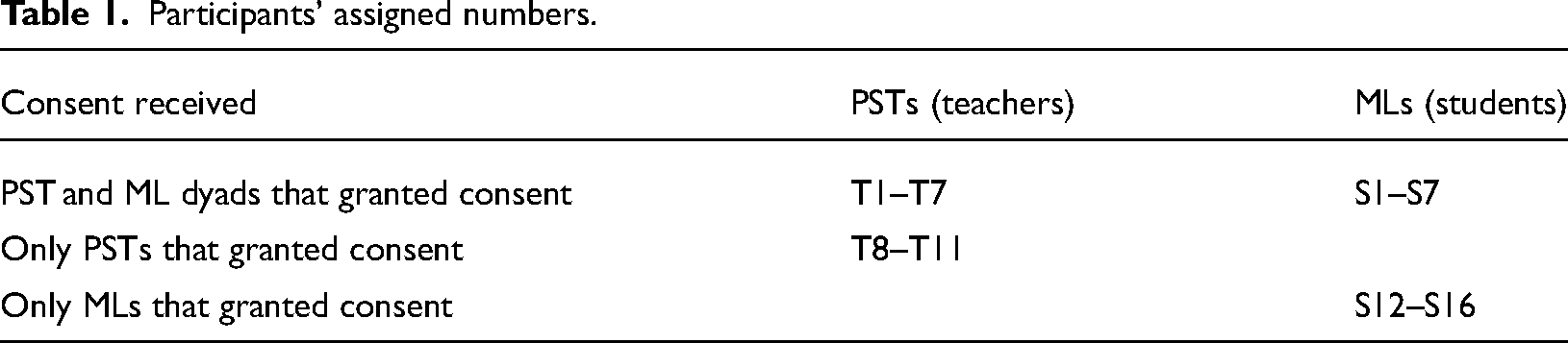
We invited PSTs in elementary and early childhood education in a U.S. teacher education course at a southeastern university during spring 2019 and multilingual English learners in an elementary school in Korea to participate in the MDST projects. Eleven PSTs (all female and in their early- or mid-20s), 12 MLs (eight females and four males), and their parents consented to data usage after the course ended. The Korean students in a private elementary school were aged between 7 and 12 years and received instruction in both English and Korean. After the course ended, all of them provided the written informed consent to participate in the study. All MLs who consented were literate in Korean and had a fair command of English. We did not collect detailed data on the proficiency levels of the MLs in English; however, the collaborating teacher in the elementary school had selected students who could communicate with English speakers at a basic level for the project. Among 11 English-monolingual PSTs, two PSTs gave consent for an interview. Table 1 shows how each PST and ML student was assigned a participant number, such as T1 or S1.
Participants’ assigned numbers.
The TESOL methods course
The course, offered as an ESOL endorsement course for elementary education majors, addressed effective teaching methods for teaching MLs in K-5 by primarily utilizing the Sheltered Instruction Observation Protocol (SIOP) 3 in conjunction with the WIDA 4 English Language Development standards. Major course activities and assignments centered around SIOP-based lesson plans, SIOP activity demonstrations, and evaluation of proficiency levels of MLs’ English. To challenge the English-only curriculum in TESOL, the instructor intentionally embedded heteroglossic perspectives into the course by creating a presentation assignment, whereby PSTs read and discussed articles related to translanguaging, and requiring the PSTs to incorporate translanguaging into their lesson plan analysis and creations (Angay-Crowder et al., 2023). Another translanguaging-infused course component was the MDST project, as seen in the researcher's journal: “In terms of the international project within the course, it is well aligned with translanguaging and basically translanguaging in action in its simplest form, although there is separation of languages” (February 22, 2019).
MDST project: co-creating multilingual digital storybook through translanguaging
The purpose of this project was for PSTs and MLs to co-create a Korean–English DS on a website (http://www.scribjab.com) through translanguaging. Each PST was paired with one elementary school student in Korea who was taking an “English as a Foreign Language (EFL)” course. To complete the project, PSTs were expected to tutor MLs 5–6 times for 30 min during the semester, although some reported exceeding the required meeting times. The PSTs utilized the sessions to help MLs choose the topic for the book and provide feedback on the story. The instructor provided PSTs with MDST project samples and guidelines for tutoring sessions, such as questions about culture, customs, introduction to the Korean Language, and so on. Through the tutoring sessions, the PSTs and MLs were encouraged to share their knowledge, brainstorm ideas for the digital book, ask questions about their cultures, and discuss how to express the topic in Korean and English. After completing the tutoring session, the MLs published their multilingual digital storybook on the website and received feedback from the PSTs.
In addition, to explain the MDST project to students, parents, and teachers in Korea, the instructor visited the elementary school 1 month prior to the project and gave a presentation to the students and their parents on how to structure tutoring sessions, use ScribJab to create digital multilingual storybooks, and create the expected timeline for the project. Figure 1 shows two slides from the multilingual presentation, which were also shared with the PSTs in the course.
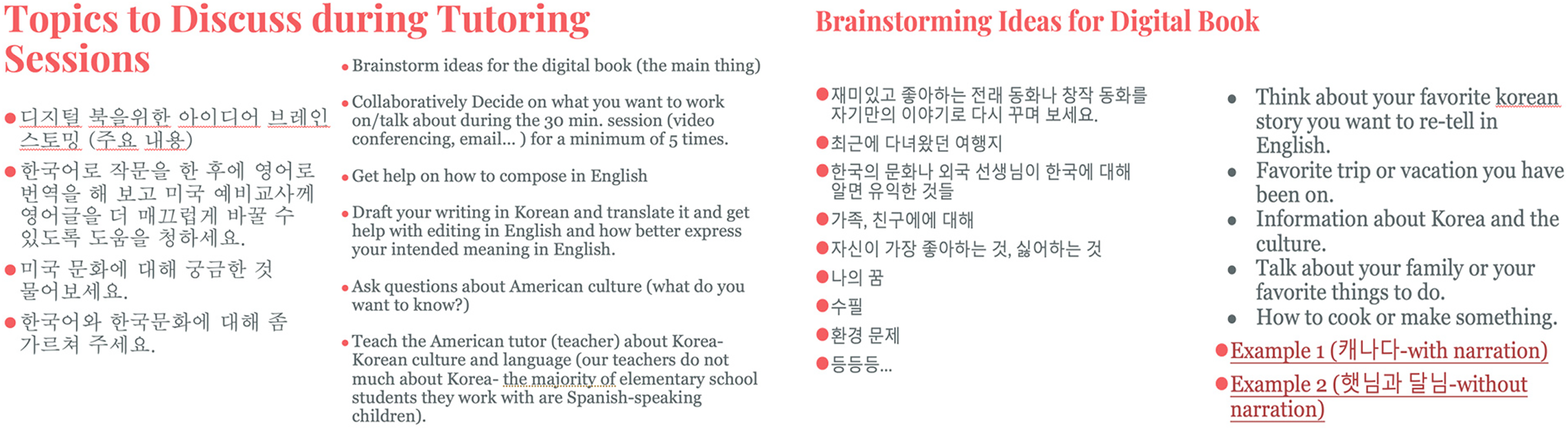
Slides used to explain the MDST project to the Korean participants.
Educational technology: ScribJab and KakaoTalk
ScribJab is a free website and iPad application that provides an online space for MLs to compose, illustrate, and narrate their own stories in two languages, utilizing multilingual and multimodal resources such as text, illustrations, and audio recordings. ScribJab was developed in 2018 by professors and language educators, Kelleen Toohey and Diane Daganais, with a heteroglossic perspective to foster multilingual writing. The website states, “we have provided space for children to discuss their stories with one another in whatever language(s) they wish. We envision all children to benefit from contributing, as they endeavor to find means to tell their stories multilingually” (Retrieved from https://www.scribjab.com/en/about/about.html on November 28, 2021). Since their vision aligned with the instructor's intention and purpose for using the MDST project for an international partnership between PSTs and students in Korea, the instructor decided to implement this educational technology to create DSs in English and Korean. Figure 2 shows a screenshot of the webpage generated after searching for Korean stories.
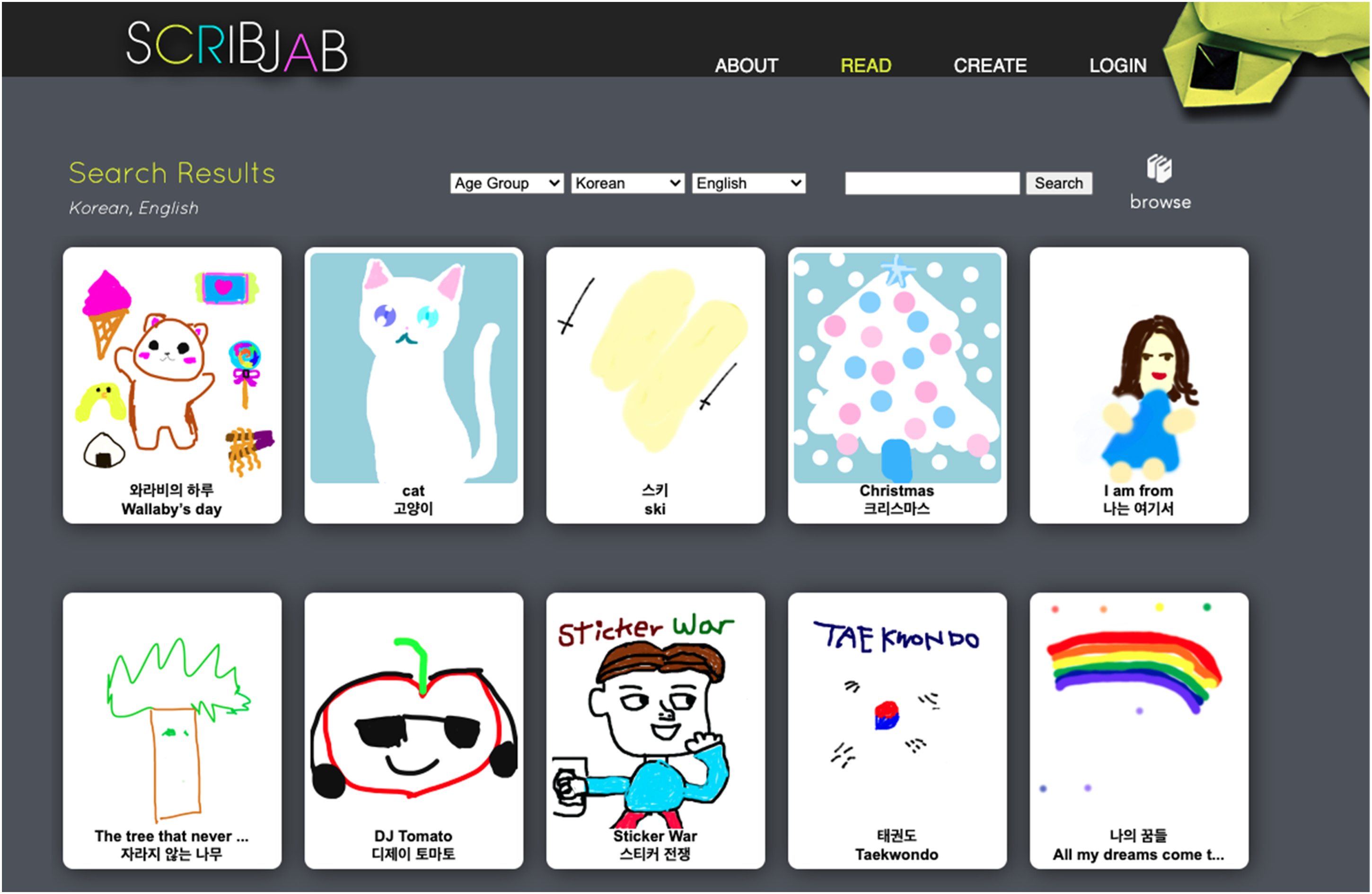
Scribjab—READ page with a Korean–English search option.
KakaoTalk (https://www.kakaocorp.com), developed by a Korean company, is a widely used online messaging application that includes the functions of sharing texts, images, files, voice, videos, and emoticons. This application also enables users to live chat with voice or video for free. To facilitate communication between PSTs and MLs, PSTs were guided to use emails and KakaoTalk. While the instructor could have chosen a different messaging application that is more familiar to U.S.-based PSTs, she selected this to accommodate the Korean partners, who use this app daily.
Data collection and analysis
Data sources included 11 PSTs’ tutoring logs (6–12 logs per PST), 30-min interview recordings, and transcripts from two PSTs through video conferencing, KakaoTalk exchanges, and multilingual digital storybooks in ScribJab. The interview questions were:
What are some of the takeaways from MDST project in general? More specifically, what were the successes and difficulties that you experienced when communicating with the ML? Can you tell me how translanguaging played a role in the MDST project?
The researcher's journals maintained by the instructor and materials used for the presentation of the MDST project at an elementary school in Korea were also used.
Data were collected systematically throughout the Spring 2019 course, and the interaction and social relationships between PSTs and MLs were analyzed using a constant comparative method where the researchers viewed raw data multiple times and discussed similar themes that emerged from the initial coding (Lincoln & Guba, 1985). Researchers initially examined each data set individually using Endnotes or google doc and created categories under similar themes by adding quotes from text exchanges between PSTs and MLs in KakaoTalk app, PSTs’ interview transcripts, tutoring logs, and reflections. Researchers met once a week to construct the findings collaboratively by sharing interpretations of the data sources and comparing the initial findings. For example, researchers read PSTs’ tutoring logs and discussed the initial findings that PSTs experienced using educational technology during the DS project. The initial themes generated were “using traditional methods in teaching writing,” “using ML's full language repertoires,” “translating as a translanguaging strategy,” “empowering MLs’ cultural identities,” “challenges with technology,” and “exercising agency with addressing challenges.” The researchers then compared what was found in the PSTs’ interview data under similar themes or categories. By doing so, the researchers achieved a collective understanding of the data, which increased the credibility and validity of the research findings.
Findings
In this section, we address the research questions: “How did PSTs from the U.S. and their assigned elementary students in Korea engage with an MDST project, which aimed to promote heteroglossic and global perspectives in a TESOL teacher education course?” and “How did educational technology facilitate or hinder their engagement in the MDST project?” The findings revealed that despite intentions to promote heteroglossic and global perspectives through the MDST project, most PSTs and Korean students maintained hegemonic discourses of English. In addition, while educational technology facilitated the participants’ cultural exchanges and multilingual perspectives, it was limited in the sense that, complicated by other uncontrollable factors, it did not promote active engagement among them.
Heteroglossic and global perspectives through the MDST project
(De-)centering English hegemonic discourses through the MDST project
Although the MDST project aimed to promote heteroglossia, which involved decentering English through translanguaging in action, PSTs did not fully embrace translanguaging in both ideological and practical terms to meet project expectations. They could not move away from their English-hegemonic stance because they did not adapt to the project's unfamiliar cultural demands. For example, although the instructor aimed for a dialogic relationship between PSTs and MLs by giving directions that “students will teach the EFL learners English and learn Korean from their tutees” (project description document), PSTs did not make much effort to learn Korean, and the conversations and questions mainly focused on teaching and learning through English only. Thus, the PSTs maintained the hegemonic discourse of English through traditional power dynamics and roles in communication.
Likewise, Korean students preferred communicating in English, and they did not attempt to teach or introduce Korean to the PSTs, although the instructor encouraged the pairs to use and teach Korean by giving direct instructions as well as the presentation during class in Korean. Moreover, Korean students’ stories centered on translating Korean stories based on existing books in English instead of creating an original story in Korean. The ML tutored by T6 translated the sentences from a central storyline in a Korean book into English by adding his own drawings. He named his story “Sticker War”—“a children story book in Korea” (KakaoTalk message). Thus, both PSTs and MLs seemed to focus on translation instead of the original composition despite the heteroglossic goals and framing of the project as an MDST.
In addition, Korean elementary students preferred to use self-assigned English nicknames. In the exchanges in KakaoTalk, S6 introduced himself to the paired PST, T6, with an English name: “My name is S6 (his Korean name), just call me Paul.” In this sense, they seemed to be predisposed to accommodating the English-speaking PSTs despite the conversations taking place in the context of a multilingual DS exchange. Although S6 introduced his English name, T6 did not refer to him with the English name; instead, used the Korean name in her tutoring log, “S6 (in his Korean name) is 9 years old.” Similarly, S9, paired with T9, preferred to communicate with his English name, Eric (pseudonym), instead of his Korean name. Unlike T6, T9 used the English name, Eric, when referring to her pair: “talked about a book over another country, recycling, sports, etc. Eric decided to go with [the topic of] recycling.” Accepting English names and not challenging Korean students’ naming preferences did not serve the purpose of the heteroglossic project but contributed to maintaining symbolic American–English cultural and linguistic dominance in the context of the learning process.
Following the instructions in the tutoring project, PSTs also took on the traditional role of a teacher as they provided feedback on English grammar in MLs’ stories. For example, T4 felt that the story was ready for publication after her edits on the language use: “Okay, I have made a few edits to the book, but it looks great, and it is ready to be published …” Instead of facilitating discussion about the book, T4 focused more on conventionally correct English, reinscribing English as a hegemonic language in the project. In her tutoring log, T8 drew attention to the fact that the Korean student's English was “broken”: It was apparent in the students’ messages that they could write in broken English ... When I asked the students what they wanted to write their book on, he kept changing it back and forth between Korean traditions and pollution. The student would send short messages but only a few at a time. I reviewed the slides, and the story book had a consistent theme, but the sentences were very broken and sometimes hard to follow.
Some PSTs also took deficit perspectives on MLs’ work, which hindered learning opportunities for MLs and negatively affected their identities. For example, T7 addressed her ML's challenges only, instead of making recommendations for them or discussing how she helped her ML overcome challenges: The student faced difficulty in creating a ScribJab account and took a long time to tell me they did not have an email and still could not create an account … The student was very indecisive about their writing topic and was only engaged in this activity for a short while and then would take days before responding. I still tried to get the student to create an email, to create the ScribJab account.
Bringing asset-based perspectives to MLs’ identities through the MDST project
Nevertheless, in some instances, PSTs decentered traditional discourses of English as a hegemonic culture and met the project's heteroglossic purposes when they shifted their perceptions of MLs’ proficiency in both English and Korean. The shift took place as PSTs showed an extra effort in reading and listening to the Korean script of the DSs instead of just reading and listening to the narration of the English script, even when they did not have prior knowledge of the Korean language. For instance, T4 wrote in her tutoring log: “I loved seeing S4's book and hearing her read it in English and Korean. This has been a great experience!” T7 similarly wrote in her tutoring log: “It was cool to hear her [S7] speak Korean easily. She was also very good at English.” These reactions show that PSTs started to view MLs through asset-based perspectives after reviewing the MLs’ stories at the end of the project. However, the above description of T7, about the student's Korean ability to “speak Korean so easily,” suggested that the PST was not expecting this fluency from the language learner. Thus, some PSTs exhibited mixed attitudes toward the MLs’ language abilities from both asset-based and deficit-oriented perspectives. For instance, although T7 highlighted her student's best qualities in creating the DS, her remark about the student's ability to “speak Korean so easily” also revealed her surprise at the language learner's home language fluency. Similarly, T8's tutoring log entry indicates her unexpected discovery of the extent to which the young student was involved in extracurricular activities: “The student shared with me that they played basketball and instruments. I was very surprised with how involved a young student was in extracurricular activities.” The PSTs’ reflections on their exchanges with Korean students reveal their potentially biased dispositions against multilingual children regarding the students’ proficiency in their home language or their involvement in extracurricular activities at their schools or community. At the same time, the PSTs’ written statements show their enhanced understanding of the linguistic and cultural assets of the MLs through the MDST project.
PSTs also decentered MLs’ identities when they took asset-based perspectives on MLs. T1, for example, brought a strength-based vision to her ML's learning experience by positioning them as a capable and successful learner: “The student is very interested in BTS and is excited to write about them … I think she did a good job writing in English, and it was nice to see her excited to write about BTS.” In another week, she made another reflection on her tutoring log: “The student has shown great progress so far.” Similarly, T6 also took asset-based positioning in her ML's work: He seems to be doing very well reading my messages in English and responding to them in English. I wonder if he is using a translator. He said he really enjoyed reading English books, and that he has been studying English for two years … I was finally able to see his book and the work he has done. Most of it was only in Korean, but there were photos on each page, and it looked like he had been working very hard (tutoring log). We are all done! I wish she would have added some pictures to her final project, but that is okay. I think she did a pretty good job with writing in English, and it was nice to see her excited to write about BTS.
Positioning her ML as a “good” writer, T1 contributed to the development of their writing identity in English. T6 took one step further when appealing to the ML's identity, asking questions about his cultural celebrations and English experiences:
We talked about the Lunar New Year holiday and how he visited family in Seoul to celebrate. We also discussed his feelings toward the English language, how comfortable he feels speaking it, if he can read or write in English, etc.
This quote shows how T6 and her ML focused on ML's cultural assets and multilingual strengths. With this asset-based approach to language learning, the ML was positioned as a competent language learner. After asking her ML how he felt about English, she complimented his proficiency in oral and written English, enhancing his English-speaking and writing identity.
Facilitating cultural understanding through the MDST project
Aligned with the project's intended purpose and process-oriented nature, PSTs came out of their comfort zones, and both PSTs and MLs reflected on identities. They did not have to focus only on the product, which was the creation of DSs, and enjoyed exchanging cultural information and developing identities in the process. T11 reflected on the project during the interview: I loved this project. I thought it was a wonderful idea and it was a lot of fun. It was obviously difficult to communicate but it pushed [us] out of our comfort zones and made us search for ways to really communicate with these students. (Written response to the interview) I just remember being so excited to work with someone all the way [across the] world. My biggest takeaway was that this is such a cool opportunity … I think, in all probability, she and I were successful in crossing cultural boundaries or barriers, whatever you want to call it, but I need that experience in ESOL, while she (S5) wants experience in English. So as to say, oh, this is a little challenging, but together, we can do this. We can accomplish something like that, it is worth it.
T6 explained how she “accomplished” the MDST project by “crossing cultural boundaries,” which represented the challenges that they experienced due to cultural differences and unfamiliarity, identities, and/or expectations.
In addition to interviews, anonymous course evaluations provided evidence that PSTs “really enjoyed the tutoring project” and developed intercultural awareness as they “felt that [the project] made [them] much more culturally aware of who [they] could be teaching.” The course reflections also showed that PSTs’ experiences were “transformative,” “beneficial,” and “eye-opening” (T6).
The PSTs’ reflections in the course also revealed that they enhanced their cultural understanding through the MDST project. For example, T6 and S6 exchanged cultural knowledge initiated by T6's question about Korean culture: “Would you introduce me to your country's history and culture? What do you think is important in your country's culture?” T6's positioning herself as a learner and using her agency to ask questions to learn about her ML culture was also seen in her tutoring log: I also asked him to share three important things about the culture of Korea … We discovered we both really enjoy animals and the outdoors. I learned from his writing that collecting stickers is very popular amongst the children at his school.
T8, similarly, enjoyed learning about differences, which she found interesting, from not having had prior contact with the culture. T8 wrote in her tutoring log: “I really like my student. He has a lot to share about his culture, and it is so different in Korea, where he lives … My student loves his school friends and teachers. Pictures of his classroom were very interesting.” Although T8 appreciated learning the differences, in another entry of the log, she found similarities between Korean Thanksgiving, Chuseok, and Thanksgiving in the United States: “The student told me about Korean Thanksgiving, and I was excited to know that we had some things about each other in common.” The findings show that the questions and conversations aimed at cultural understanding contributed to PSTs’ cultural awareness, and they addressed both, differences and similarities.
PSTs also tapped into the cultural identities of their students to establish social relationships, build background knowledge, and guide them with topic selection for DSs. During the KakaoTalk conversation, for instance, T7 focused on topic generation and brainstormed ideas for the MDST project by asking the student about personal interests. In the end, she led her student, S6, to decide on composing a story about Tae Kwon Do:
Do you have a good idea for the story? I can think of some ideas. Do you draw well?
Yes.
That's good then. What are the things you like? So I can think of some ideas.
I like exercise and art.
Do you play sports or do gymnastics?
I play a sport call Taekwondo.
Oh, that is cool! Perhaps you can do a story about this?
Ok! Let me think. I like Taekwondo and play every day.
As seen above, PSTs assisted MLs with topic generation by engaging in conversations about culture and personal interests. Figure 3 is the second page of S7's DS titled “태권도 TAEKWONDO” on ScribJab, where she wrote and narrated in both languages that accompanied her own drawing:
Guided by T6, S7 chose a topic that interested her and also represented Korean culture as Taekwondo is a traditional Korean martial art. Her short DS, which includes three pages excluding the cover page, concisely delivers tips for Taekwondo beginners, intended for a global audience.
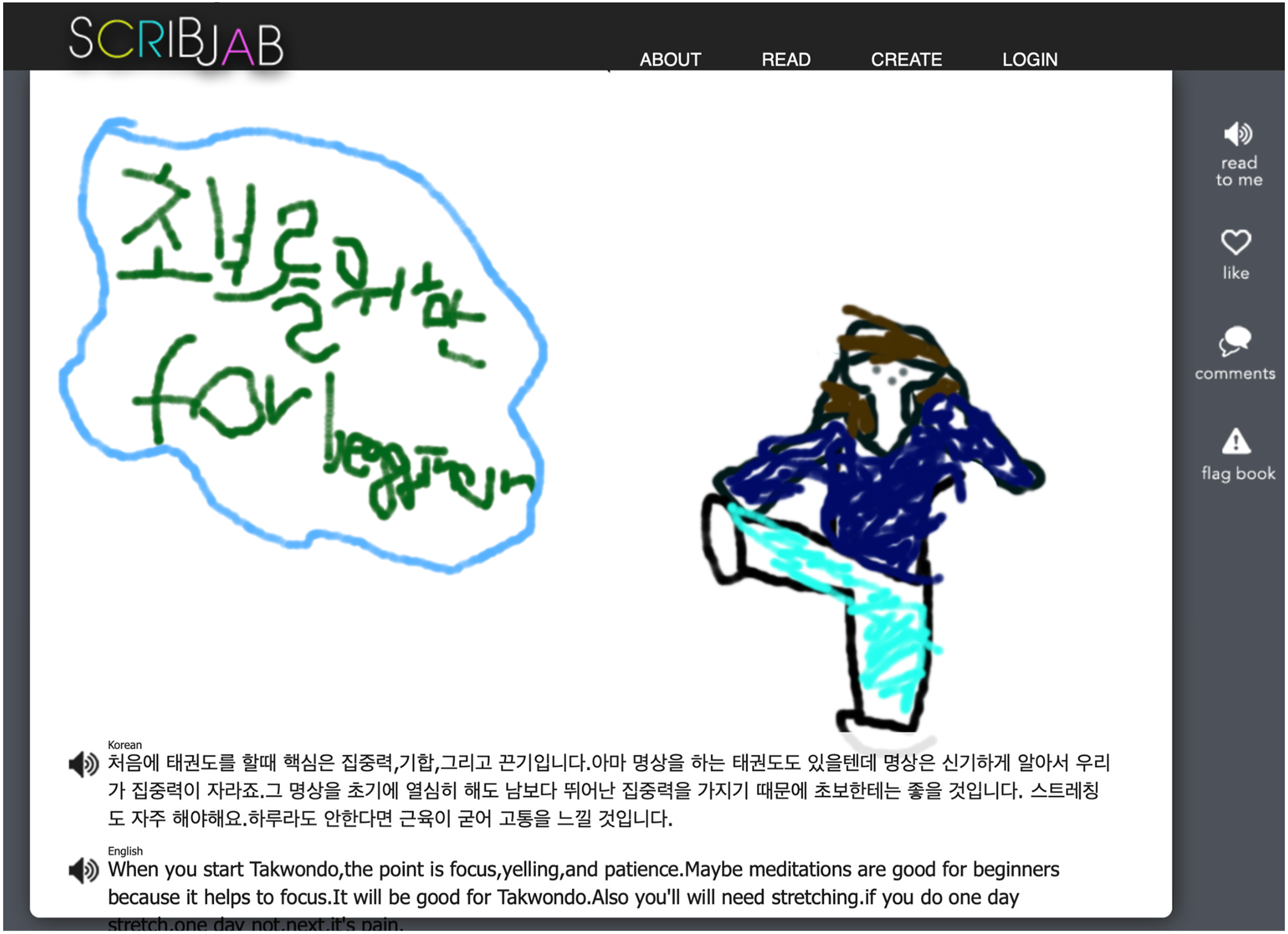
S7's DS titled “태권도 Taekwondo.”
PSTs’ limitation of gaining cultural awareness through MDST project
Despite the cultural awareness and global perspectives that PSTs gained by engaging with the MLs from Korea in this project, the topics discussed between the pairs remained at the surface level, by focusing on holidays and customs. The topics and contents of DSs were limited to families, places in Korea, factual information about Korean culture, such as K-pop, and stories reflecting ML's personal interests, such as insects, sports, and the environment. PSTs did not encourage MLs to choose critical topics, such as race, culture, class, or ethnicity, which could have revealed power dynamics, social (in)justice, or identity issues in relation to language learning. In other words, the DSs that the MLs composed demonstrated a limited view of criticality. In other words, PSTs did not consider a transformative agenda for social change, as expected in an MDST project (Anderson & Macleroy, 2017). In this respect, the MDST project did not contribute to the aim of heteroglossic pedagogy.
One example illustrating PSTs’ response to foreign domains—an important indication of their intercultural dispositions—was their initial hesitancy to use the messenger application KakaoTalk, a Korean technology with which they were not familiar. The PSTs communicated their concerns about privacy issues as they were not sure whether the application would access their private information. Accordingly, the foreignness of the app made the PSTs hesitant to accommodate a common and convenient platform for Korean partners. Although the instructor introduced this new messaging application to PSTs, some of them were reluctant to download the application and suggested using other messaging applications that were more predominantly used in the United States; however, the instructor persuaded them to step out of their comfort zone and try to accommodate MLs who were unfamiliar with these messaging applications. After downloading the app, most of the interactions were done through KakaoTalk rather than via emails, and the PSTs used this platform to provide audio and written comments about DSs and build teacher–student rapport despite time zone differences. For example, T2 expressed her thoughts by stating, “My student and I talked throughout the day [using KakaoTalk] and we thanked each other for cooperating so well and for sharing life stories and facts about our countries” (T2's tutoring log). The initial hesitancy shown by PSTs in using the foreign messaging app suggests that the teachers did not easily embrace differences and novelty from another country, which is an important attribute in cultivating global perspectives. However, PSTs’ active use of the app through video and text chats later, while communicating with the MLs, indicates a positive gain despite the initial struggle to convince the PSTs.
The role of educational technology in the MDST project
Technology enhancing participants’ engagement in the MDST project
Using educational technology tools across both countries has enabled monolingual PSTs and MLs to interact and communicate to learn aspects of Korean culture, language, and literacy. In her interview, T5 reflected that this experience helped her expand her boundaries working with MLs outside of the United States. T5 also stated that she enjoyed the MDST project despite some of the PSTs not liking the project as much, mainly because of how difficult it was to communicate with the Korean students due to the time difference. Thus, T5 sought ways to use technological tools for her advantage and ventured out of her comfort zone. She stated that she gained confidence in collaborative projects through international partnerships despite the geographical distance.
In addition, the purposeful use of the ScribJab application, which has a premade template in which the user must create a story multilingually, reinforced the use of both, Korean and English languages, thus shaping the PSTs’ heteroglossic perspectives. Other PSTs who used PowerPoint slides, which do not have a built-in multilingual component, did not seem to be highly engaged in multilingual writing practices. For instance, S5, after failing to make the ScribJab app work on her device, ended up writing her story titled “Locket through PowerPoint.” Figure 4 is the first slide of S5's story, written only in English without Korean.
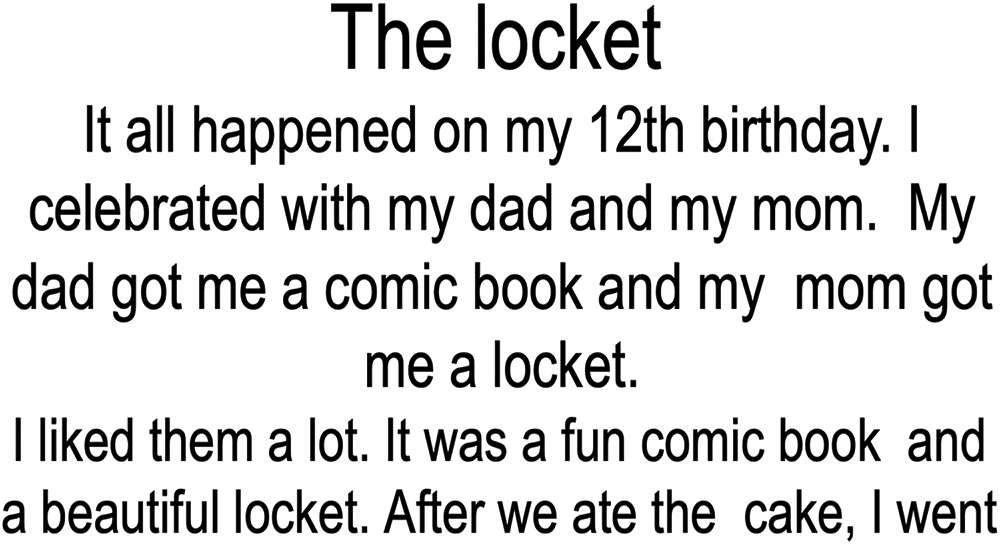
S5's English-only story composed in PowerPoint as ScribJab failed.
S5's story composed through PowerPoint shows that MLs’ stories could be easily written only in English, the language of the PowerPoint, without the reinforcement of the template that required multilingual text and narration.
Technology prohibiting participants’ engagement in the MDST project
Although educational technology facilitated participants’ engagement in the MDST project, PSTs and MLs faced several technological challenges. One prominent problem that both groups faced with ScribJab was that it was cumbersome for the pair to create a group where both could collaborate in composing the story. The PSTs were instructed to create a group account on ScribJab and subsequently invite their students to join the group. In this way, each PST could play a major role in the ML's creation of the story on the platform. However, the MLs’ acceptance of the invitation took a long time, and some MLs did not even have an email address to join the platform. For instance, T6 and S6 had difficulty gaining access to ScribJab accounts and sharing a storybook between themselves. The pair tried to permit each other to see the story and collaborate via KakaoTalk messages, but to no avail: T6: I cannot see your book when I get on ScribJab. Did you receive an email invitation to join the group I created?
S6: I did not receive an email invitation. Can you send an email again if possible?
Other pairs also experienced similar challenges with ScribJab. T4 left a text message to S4 by asking, “Can you send me the email you used to sign up for ScribJab? I have sent a request to your email so I can join your ScribJab. Once you approve the request, I will be able to see your book.” This repeated access issue delayed the stories’ progression and hindered the pairs’ collaboration. For the T6 and S6 pair, however, this problem seemed to have been resolved after much persistence and the instructor's visit to the elementary school in Korea. T6 wrote in the tutoring log:
It seemed that we (my student and I) were both slightly frustrated with ScribJab and accessing the book; it took multiple messages to finally figure it out. I was happy to hear that after the professor's trip to Korea, S6 had begun his book and was excited about writing.
However, the lack of collaboration in story creation between the pairs limited the PSTs’ role as topic generators in the beginning, and editors at the end of the DS, restricting the creation process. Technological hinderances prohibited the pairs from collaborating on story flow, organization, and content development, which are important aspects of the MDST project. Often, MLs ended up composing the DS without substantial assistance from the PSTs. T7 stated:
At this time, I asked her (the student) email and added her to the group on ScribJab. However, after waiting for a few weeks, I just asked what her Username and Password was, so I could look over the story. I wished it would have worked before, so I could have spent more time with her on the story. (tutoring log)
The data suggest that PSTs missed teaching moments when communication was erratic due to time differences or technical difficulties. The PSTs did not spend much time discussing the content of the multilingual storybook at the beginning; instead, they mainly focused on providing grammatical corrections and were hesitant to provide constructive feedback or make critical comments to DSs when they were already completed.
Discussion
This study aimed to infuse multilingualism into language courses and creatively and critically engage teachers and students in the curriculum to challenge extant monolingual views on critical literacy, as suggested by Anderson and Macleroy (2016). In addition, the intent was to introduce PSTs into an international classroom to foster cross-cultural connections through digital storytelling (see also Green et al., 2017). Thus, the MDST project increased awareness of how learners leverage their knowledge and diverse multilingual resources, such as ScribJab and KakaoTalk. The findings revealed that utilizing technology for educational tools across national borders has its benefits but also involves unintended constraints. Both apps afforded the use of multiple languages, providing opportunities for Korean students to share their initial ideas, exchange cultural information, and—with the support of the PSTs—realize their emerging English literacy goals. Most Korean students produced a finished multilingual DS, thus fulfilling the primary “educational” goal.
Similar to Clarke's (2020) and Delacruz's (2019) studies on teachers’ collaboration with students in CDL projects, this study expanded the potential for exploring cultures from different countries and enhanced learning experiences using digital educational technologies across global boundaries. By co-creating a digital storybook through tutoring sessions in an exchange of culture and languages, PSTs gained some intercultural awareness and global perspectives and focused more on ML's assets or strengths in English and their cultural capital in Korean. These findings align with Matsouka's (2021) research on translanguaging practice, which enhanced the intercultural communication competence of MLs and developed a positive attitude toward their home country. Although PSTs and MLs in this project faced organizational challenges caused by the 14-h time zone difference between Korea and the United States, PSTs developed their tutor–teacher identity (Watt, 2019) and engaged in the heteroglossic approach to the MDST project.
An important lesson to consider, however, is that the use of digital tools for educational purposes requires considerable groundwork and organizational setup before actual collaboration begins. For international collaboration using new technology, running a pilot study in a small group setting prior to the actual project would be helpful in minimizing the concerns and technical issues caused by the digital platform or time zone difference. The participants of the MDST project, such as those in Fernández et al. (2016), became both consumers (e.g., learning from others’ stories, learning how to use technological devices) and producers of knowledge (e.g., writing their narratives, creating their DSs) and thus, improved their collaboration and communication skills (see also Beal et al., 2012). However, the importance and process of communication between the project participants must be emphasized. The course instructor could introduce appropriate strategies to facilitate communication between participants, check their progress, and reinforce the mindset that participants would need extra time and effort to work through unforeseen challenges in global partnerships.
Apart from these organizational challenges, a bigger question arises about the efficacy of using educational technology and the opportunities that this project provided for critical outcomes and cross-cultural awareness. The use of digital technology for educational purposes and its efficacy in producing critical outcomes depends heavily on the overall design of the project. The design of this study required monolingual English-speaking PSTs to collaborate with elementary-aged Korean multilinguals to further support their English proficiency in a contact zone (Pratt, 1991) mediated by technology. It proposed that the primary goal of Korean students and their parents was to increase English language proficiency and was inadvertently framed within neoliberal discourses that perceived multilingualism as a useful and marketable commodity in a globalized economy (Flores, 2015). The monolingual PSTs readily took on the active (and hegemonic) role of “English tutor” offering their “expertise” to further the English development of Korean students. This is evident as their work mainly involved reworking and editing the English-translated versions of the finished Korean stories presented to them by the students.
Similar to the study by Kolano and Sanczyk (2021), PSTs transformed their perceptions about students, which was empowering for themselves and the students. During the KakaoTalk discussions, PSTs expressed some deficit views that reproduced and re-inscribed the English hegemony that the project sought to challenge and denounce. They also did not encourage students to select critical topics related to the language issues of race, culture, and identity for their MDST projects, which would contribute to the purpose of heteroglossia. The issue of topic selection is related to the limitation of the course design, as it did not incorporate features that would counter the hegemonic influence in terms of further educational resources and/or critical discussions and support for monolingual PSTs. Merely connecting the two cultural agents vis-à-vis the technological tools did not result in critical outcomes. The larger lesson is that educational technology is only a medium and platform in service to the project design. It is incumbent on the course design to determine how critical outcomes may be realized in tandem with the multilingual potential of the apps being used.
Conclusion
In seeking a path to bring multilingualism into the center of the curriculum of the TESOL methods course, this study navigated the possibility of using educational technology in an international partnership between monolingual PSTs and MLs in Korea to create a multilingual digital storybook collaboratively. Drawing from the MDST framework, which consists of five principles—critical literacy, sociocultural theory, multiliteracy framework, multilingualism, and community language teaching—we found that PSTs have expanded the boundaries of learning and teaching outside the United States in different forms and relationships. They challenged themselves to use foreign technology, KakaoTalk, to reach out to MLs and designed multimodal texts using the ScribJab website. PSTs and MLs exchanged different viewpoints from their cultures and demonstrated the dynamic process of teaching and learning languages. While creating the DS collaboratively, the PSTs learned how to harness the potential to connect pedagogy and MLs’ cognitive knowledge in the service of learning.
In this study, we found that educational technology enhanced language learning and cultural awareness as the instructor intended, despite some challenges, and these findings align with previous literature (Green et al., 2017; Watt, 2019). This study contributes to the understanding of how PSTs learn multimodal, digital, and multilingual approaches in their teacher education coursework and demonstrates ways to collaborate with multilingual elementary students to promote global citizenship through CDL.
In addition, careful attention to project design is warranted when choosing educational technology tools for international CDL projects, specifically considering variances such as cultural differences between international participants, and alignments and divergences regarding educational beliefs or the use of electronic devices, as these contextual factors influence outcomes. As this study was conducted before the pandemic, tools and platforms such as Zoom, Microsoft Teams, and Google Meet can be alternatives for MLs to use from abroad.
This study has implications for teachers and educators who plan to infuse heteroglossic perspectives into CDLs by using educational technology. The MDST project is an example of successful collaboration across two countries that connected international participants and introduced multilingualism into the curriculum. The project also demonstrates an effort to introduce monolingual PSTs to identity work and intercultural awareness. We propose that future work on MDST projects may need to consider how to design ways to advance PSTs’ agency and introduce critical perspectives in project design to increase the efficacy of technology across borders and its use for educational purposes.
Footnotes
Contributorship
All authors contributed to writing on an equal basis. Ji Hye Shin was responsible for writing the methodology, findings, and conclusion, revising and finalizing the paper, and responding to reviewers’ comments. Jayoung Choi collected the data, refined the flow of the paper, and wrote the introduction and findings. Tuba Angay-Crowder teased out background literature related to the multilingual digital storytelling framework and critical digital literacy. Nihal Khote contributed to the study by presenting a heteroglossic approach and writing the discussion and conclusion.
Declaration of conflicting interests
The authors declared no potential conflicts of interest with respect to the research, authorship, and/or publication of this article.
Ethical statement
All participants provided written informed consent for this study. This study was approved by the IRB at Kennesaw State University.
Funding
The authors disclosed receipt of the following financial support for the research, authorship, and/or publication of this article: This work was supported by the Kennesaw State University (grant number Division of Global Affairs - Internationalization).
