




Abstract
Purpose
Artificial intelligence (AI) chatbots, such as ChatGPT and GPT-4, developed by OpenAI, have the potential to revolutionize education. This study explores the potential benefits and challenges of using ChatGPT in education (or “educative AI”).
Design/Approach/Methods
This paper proposes a theoretical framework called “IDEE” for educative AI such as using ChatGPT and other generative AI in education, which includes identifying the desired outcomes, determining the appropriate level of automation, ensuring ethical considerations, and evaluating effectiveness.
Findings
The benefits of using ChatGPT in education or more generally, educative AI, include a more personalized and efficient learning experience for students as well as easier and faster feedback for teachers. However, challenges such as the untested effectiveness of the technology, limitations in the quality of data, and ethical and safety concerns must also be considered.
Originality/Value
This study explored the opportunities and challenges of using ChatGPT in education within the proposed theoretical framework.
Introduction
The use of artificial intelligence (AI) in education has gained significant attention in recent years, with a growing number of educational institutions and organizations exploring the potential benefits of AI-driven technologies (Dwivedi et al., 2021; Su & Yang, 2022). One such technology is ChatGPT, a state-of-the-art natural language processing (NLP) model developed by OpenAI in 2019 (Lebrenz et al., 2023; Lund & Wang, 2023). ChatGPT is a form of generative AI that uses algorithms to generate new text similar to what a human might write. It is a language model that uses deep learning to generate human-like responses to natural language queries. ChatGPT is designed to be used in a conversational setting, allowing users to interact with the model naturally and intuitively. As a powerful AI application, ChatGPT can answer questions, write stories, summarize documents, and compose essays. On March 14, 2023, OpenAI released GPT-4, an upgraded version of ChatGPT.
ChatGPT has recently been used in a variety of fields, including library services (Lund & Wang, 2023), healthcare (Aydın & Karaarslan, 2022), and education (Baidoo-Anu & Owusu Ansah, 2023; Rudolph et al., 2023). In the field of education, ChatGPT can be used to create virtual tutors, answer student questions, and provide personalized learning experiences. It may also be used as a real-world AI application to empower teachers and students to develop their AI literacy, which refers to the ability to understand, use, and critically evaluate AI technologies and their impact on society (Ng et al., 2021; Su et al., 2022). It encompasses a range of skills and knowledge, including the ability to comprehend AI concepts, techniques, and algorithms as well as the ability to analyze and evaluate AI systems and their applications (Su & Zhong, 2022; Yang, 2022). AI literacy also involves understanding the ethical, legal, and social implications of AI, and the ability to communicate effectively about AI issues and ideas (Su et al., 2023). As a user-friendly AI application, ChatGPT can be used as an educational tool to foster teachers’ and students’ abilities to navigate and engage with the rapidly changing world of AI with confidence and understanding.
Following this line of argument, this conceptual paper has the following objectives: (1) to propose a theoretical framework for guiding the use of ChatGPT and other generative AI in education (or “educative AI,” which refers to the use of AI in educational settings to enhance teaching and learning outcomes) and (2) to illustrate ChatGPT's potential benefits and challenges for use in the field of education. This study also provides recommendations for future research, policy, and practice in the area of educative AI.
What is ChatGPT?
ChatGPT is a type of large language model (Thorp, 2023). Large language models are a type of AI that use deep learning techniques to analyze and generate text (Shen et al., 2023). ChatGPT is a type of large language model created to generate human-like text in NLP tasks (Shen et al., 2023). It is designed to generate human-like text based on a large corpus of text data and is trained to perform various language tasks, such as answering questions, writing stories, composing code, and generating essays. The foundation of ChatGPT is GPT-3, the third model developed for NLP projects (Entrepreneur, 2023; Thorp, 2023), which was recently upgraded to GPT-4. We requested that ChatGPT explain itself. I am ChatGPT, a large language model developed by OpenAI. I am designed to generate human-like responses to a wide range of natural language input, including questions, statements, and commands. I am trained on a vast amount of text data from the internet, including books, articles, and websites, using a deep learning algorithm called a transformer. As a result, I can understand and respond to a wide range of topics, including science, history, current events, and popular culture. My purpose is to provide helpful and informative responses to users, and to assist in a variety of tasks that require natural language processing. (ChatGPT, February 21, 2023)
We then asked, “How does ChatGPT work?” ChatGPT gave the following answer: ChatGPT works by using a deep learning algorithm called a transformer to process natural language inputs and generate human-like responses. Here's a brief overview of how it works:
Preprocessing: Before I can start generating responses, the input text is preprocessed to make it easier for the transformer to understand. This involves converting the text into a numerical representation called a token, which captures the meaning of each word.
Encoding: Once the input text has been tokenized, it's passed through a series of encoding layers. These layers use attention mechanisms to help the model focus on the most relevant parts of the input text.
Decoding: Once the input text has been encoded, the model generates a response by decoding the encoded text into natural language. This is done using a similar set of attention mechanisms as in the encoding step, which helps the model choose the most relevant information to include in the response.
Postprocessing: Finally, the generated text is postprocessed to remove any unnecessary tokens and formatting, and presented to the user as a natural language response. The transformer architecture used by ChatGPT is highly sophisticated and allows the model to generate complex and nuanced responses to a wide range of input text. It's trained on a massive dataset of text data from the internet, which enables it to understand and respond to a wide variety of topics and styles of language. (ChatGPT, February 21, 2023)
We asked the follow-up question, “What are the limitations of ChatGPT?” ChatGPT provided the following answer: As an AI language model, ChatGPT has several limitations, including:
Lack of Common Sense: While ChatGPT has access to a vast amount of data, it lacks common sense and may sometimes generate responses that are technically correct, but do not make sense in the real world.
Limited Understanding of Context: ChatGPT's understanding of context is limited, and it may sometimes struggle to understand the broader meaning of conversations. It may also fail to pick up on nuances or subtext in a conversation.
Biased Data: ChatGPT is only as unbiased as the data it is trained on, and if the data contains biases or inaccuracies, it may replicate those biases in its responses.
Inability to Perform Physical Tasks: ChatGPT is a language model and cannot perform physical tasks, such as cooking or cleaning.
Lack of Emotional Intelligence: While ChatGPT can generate responses that appear to convey emotions, it does not actually experience emotions and may struggle to understand or respond appropriately to emotionally charged conversations.
Vulnerability to Adversarial Attacks: ChatGPT can be vulnerable to adversarial attacks, where the input data is specifically designed to cause it to generate incorrect or harmful responses. Overall, while ChatGPT is a powerful tool for generating human-like responses to a wide variety of inputs, it has several limitations that must be considered when using it. (ChatGPT, February 21, 2023)
The IDEE framework for using ChatGPT in education
The following theoretical framework (Figure 1; the IDEE Framework) can be used as a guide while utilizing ChatGPT and other generative AI in education:
Identify the Desired Outcomes: Before using ChatGPT or other generative AI in education (or “educative AI”), it is important to identify the objectives of the application. This ensures that the use of technology aligns with desired outcomes. Determine the Appropriate Level of Automation: Depending on the objectives, it may be appropriate to fully automate the teaching or learning experience using educative AI or to use it as a supplement to traditional teaching methods. Ensure Ethical Considerations: The ethical implications of using educative AI must be carefully considered, including potential biases, and their impact on teachers and students. Evaluate the Effectiveness: It is important to evaluate the effectiveness of educative AI in achieving the desired outcomes.
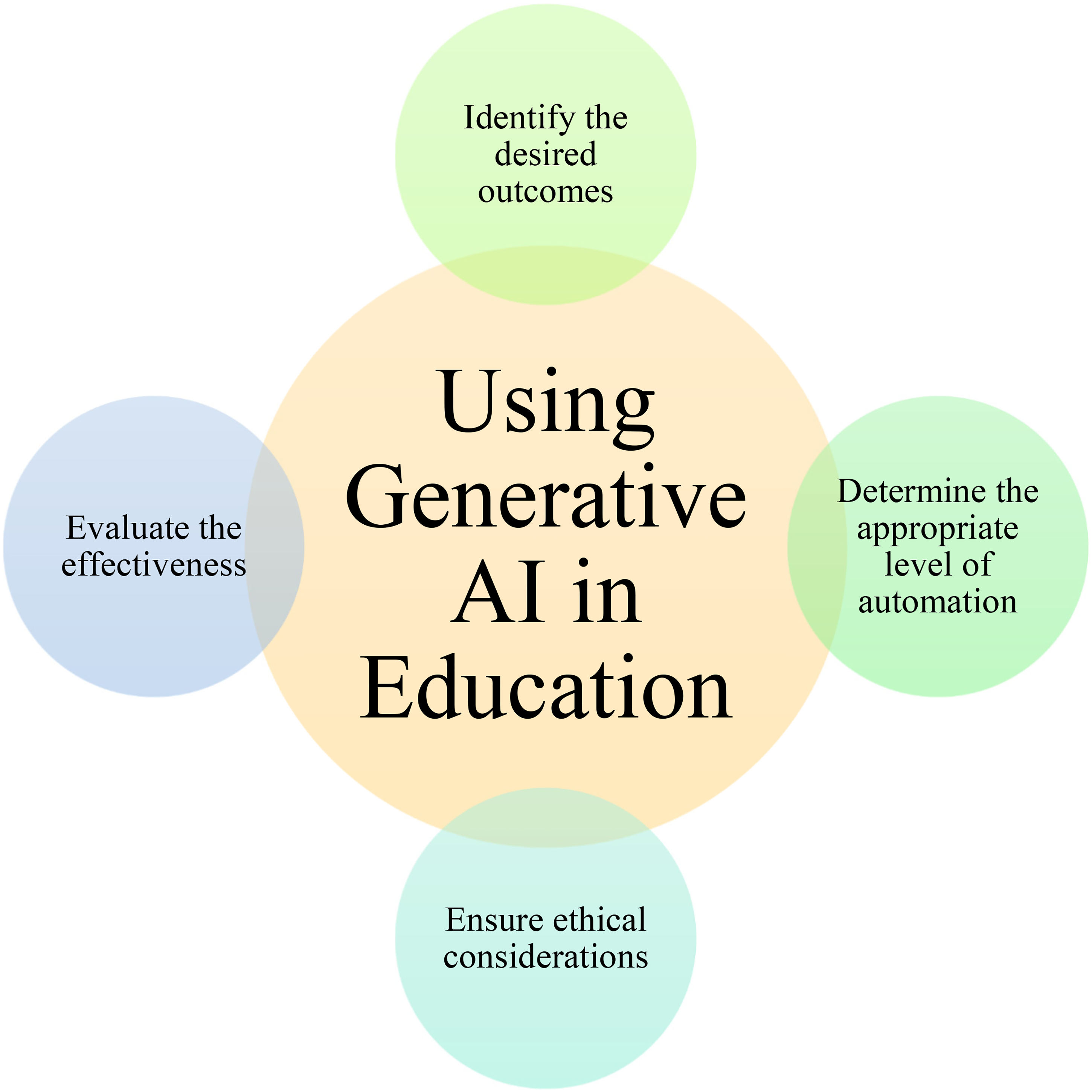
Theoretical framework for using generative AI in education. Note. Permission is granted to incorporate the diagram into a work, subject to certain conditions. Firstly, neither the publisher nor the user may assert any copyright claims over the image. Secondly, the language below must be used to label or cite the image. Revised version of the IDEE Theoretical Framework for Using Generative AI in Education. © Jiahong Su & Weipeng Yang, 2023. Reproduced with permission. Su and Yang (2023). Unlocking the power of ChatGPT: A framework for applying Generative AI in education. ECNU Review of Education.
An inspiring example of the use of ChatGPT in education is the development of virtual tutors for language learning. Using ChatGPT, a virtual tutor can provide personalized feedback and conversation practices for language learners. The virtual tutor can also adapt to the learners’ level and pace, thereby providing a highly customized learning experience. This can be especially helpful for learners who do not have access to in-person language tutors or prefer to learn on their schedule.
In one of our current research projects, we are trying to use ChatGPT to help coaches provide responsive and timely feedback to early childhood teachers. Below, we detail how the framework can be applied to the example of using ChatGPT to facilitate coaches in providing responsive and fast feedback to early childhood teachers:
Identify the Desired Outcomes: The objective, in this case, is to provide early childhood teachers with targeted and timely feedback on their teaching practices to improve the quality of early childhood education. Determine the Appropriate Level of Automation: ChatGPT can be used to automatically generate feedback based on observations made by the coach during classroom observations. This feedback can be customized to the specific needs and challenges of each teacher, providing a highly tailored and efficient coaching experience. Ensure Ethical Considerations: It is important to ensure that the feedback generated by ChatGPT is free from bias and is based on objective observations. Additionally, the use of ChatGPT should not replace the important role of human coaches in providing support and guidance to early childhood teachers. Evaluate the Effectiveness: The effectiveness of using ChatGPT to facilitate coaching can be evaluated by analyzing the impact of feedback on the teaching practices and outcomes of early childhood teachers. This can be achieved through teacher evaluations, feedback surveys, and other assessment tools.
To facilitate the coaching of early childhood teachers, ChatGPT can be applied in the development of a virtual coach that can provide immediate feedback to teachers during classroom observations. For example, if a virtual coach observes that a teacher does not use enough open-ended questions to promote critical thinking, it can provide feedback on the importance of using open-ended questions and suggest specific examples that the teacher can use in future lessons. This can help early childhood teachers improve their teaching practices and ultimately enhance the learning outcomes of young children.
Key issues of using ChatGPT in education
In this section, we highlight several potential benefits, limitations, challenges, future research directions, and suggestions associated with the use of ChatGPT in education, which can be generalized to other educative AI.
Potential benefits
The use of ChatGPT in education could provide several benefits. First, it can provide a more personalized learning experience for students. ChatGPT can encourage teachers to reflect on educational content and trust between teachers and students. By using ChatGPT to create personalized recommendations and virtual tutors, students can receive more targeted instruction tailored to their individual needs. For instance, if students need assistance with a math problem, the ChatGPT can offer detailed instructions on how to solve the issue.
Second, ChatGPT can make it easier for teachers to answer students’ questions. By using ChatGPT to generate answers to students’ questions, teachers could save time and energy, which could be better spent on other tasks. For example, do students ask teachers about game-based learning? ChatGPT can answer this question: “Game-based learning is an educational approach that uses games and game mechanics to enhance learning outcomes. It involves the use of digital or nondigital games as part of the learning process to help learners develop their knowledge, skills, and attitudes. In game-based learning, the game serves as a tool for engaging learners and provides a fun, immersive, and interactive learning experience. The game can be used to teach a wide range of subjects, from mathematics and science to social studies and languages. Game-based learning is an effective way to promote active learning, increase motivation and engagement, and improve knowledge retention. It is often used in both formal and informal learning settings such as schools, museums, and training programs.” (ChatGPT, February 21, 2023)
Third, ChatGPT can provide a more engaging learning experience for students. ChatGPT can improve teaching models, assessment systems, and education ecology by empowering the teacher-student-technology triad structure. By using ChatGPT to create virtual tutors and personalized recommendations, students can have a more interactive and enjoyable learning experience.
Fourth, ChatGPT can provide useful suggestions for teachers. ChatGPT can accelerate the transformation of AI by assisting and coordinating virtual and physical relationships within the current institutional system for deep involvement in various directions, expanding the broad network, and forming a new ecology of education. For example, we asked ChatGPT about “how to teach young children about AI.” ChatGPT provided the following answer: “Teaching young children about AI can be a fun and interesting way to introduce them to the world of technology and innovation. Here are some ideas for teaching young children about AI:
Start With the Basics: Begin by explaining what AI is and how it works. You can use simple examples to illustrate the concept, such as a talking toy or a smart home device.
Use Age-appropriate Language: When teaching young children about AI, it is important to use language and concepts that they can understand. Avoid using technical jargon and focus on simple explanations that relate to their everyday experiences.
Demonstrate AI in Action: Show children examples of AI in action, such as virtual assistants or chatbots. You can also let them interact with simple AI-powered toys or games to help them understand how it works.
Explain the Benefits of AI: Talk to children about the many ways that AI can be used to help people, such as by improving healthcare or making our lives easier and more convenient.
Discuss the Ethical Implications of AI: It is important to teach children about the ethical considerations of AI, such as the need to ensure that it is used in a responsible and fair way.
Encourage Curiosity: Encourage children to ask questions and explore AI on their own. Provide them with resources, such as books or online tools, to help them learn more about this exciting and rapidly evolving field. By introducing young children to the concepts and applications of AI in a fun and engaging way, you can help inspire their curiosity and interest in this important field of technology. (ChatGPT, February 21, 2023)
Fifth, the ChatGPT could provide useful suggestions for writing an essay. ChatGPT can assist students in writing essays by recommending topics, outlining structures, providing ideas, and improving their academic writing. For example, a student can ask for help in writing an essay on early childhood education and ChatGPT can provide suggestions for statements and potential topics for body paragraphs. On this basis, students can combine their thoughts and viewpoints to complete their essays. However, students’ critical thinking is required to ensure the accuracy of writing.
Potential limitations
The use of ChatGPT in education has some limitations. First, ChatGPT is still an emerging technology and its effectiveness has not been fully tested. While the studies mentioned above suggest that the ChatGPT could be a useful tool for education, more research is needed to determine its effectiveness in different contexts.
Second, ChatGPT can be limited by data quality. If the data used to train the model is of low quality, the responses of the model may not be accurate or reliable. ChatGPT may have negative effects and implies the need to adjust educational goals, methods, and ethics education.
Third, ChatGPT can be limited by the complexity of the tasks it is asked to perform. Although ChatGPT can generate human-like responses to simple queries, it may struggle with more complex tasks.
Challenges
Cost
An important aspect to consider is the cost of implementing the ChatGPT in education. This technology requires significant investment in terms of both hardware and software as well as ongoing maintenance and support. This may present a challenge for some educational institutions, particularly those in lower-income areas, and it is important to find ways to make the technology more accessible and affordable.
Ethical and safety issues
The use of the ChatGPT in education also raises ethical and safety issues. First, there is the potential for technology to be used to manipulate or deceive students. If the model is not properly monitored and regulated, it can be used to provide inaccurate information or lead students down the wrong path. Second, there is the potential for technology to be used to invade students’ privacy. If the model is not properly secured, it can be used to collect sensitive information from students without their prior knowledge or consent. Third, there is the potential for technology to be used to discriminate against certain students. If the model is not trained on data that are representative of all students, it can be used to provide unequal access to education.
Challenging the existing assessment system
Many educators, academic institutions, and schools are concerned about students using ChatGPT to complete their homework. Consequently, local educational authorities around the world often prohibit the use of ChatGPT in schools. For example, the University of Hong Kong has temporarily prohibited students from utilizing ChatGPT and other AI-based tools in their academic assignments (Yau & Chan, 2023). In the long term, ChatGPT may lead people to believe that knowledge is no longer important.
Future research directions
First, future research should focus on developing and evaluating AI-based educational applications and exploring the potential benefits and challenges of using this technology in different educational contexts and settings.
Second, it is also important to conduct studies that examine the impact of ChatGPT and/or other generative AI applications on student learning outcomes, such as academic achievement, motivation, and engagement. Furthermore, future research should continue to explore the ethical and social implications of using AI in education, including its potential impact on human teachers and the need for appropriate regulations and policies.
Third, further research is needed to fully understand the potential of this technology and identify effective strategies for its use in education. It is important to stay up-to-date with the latest developments in AI.
Fourth, informed by the IDEE framework, further research is needed to determine the effectiveness of ChatGPT in different contexts (e.g., teacher education, professional development, early childhood education, formal schooling, lifelong learning, special education, and online learning) and to ensure that the technology is used responsibly and ethically. In the context of early childhood education, for instance, ChatGPT can be used by young children who cannot read and write through voice-activated interfaces, such as smart speakers or virtual assistants. Children can ask ChatGPT questions or give commands through voice, and the AI model can respond with audio outputs. Thus, children who are not yet able to read and write can still interact with and benefit from technology. However, it is important to note that the use of AI technology in young children should be carefully monitored and guided by adults to ensure safety and well-being.
Suggestions for policy and practice
It is important to establish policies and standards for cultivating digital literacy, optimizing the curriculum system, innovating teaching methods, and adhering to evaluation guidance. To fully realize the potential of generative AI in education, it is important to involve educators, students, and other stakeholders in the development and implementation processes within the proposed theoretical framework. This will help ensure that the technology is designed and used in a way that meets the needs of all parties and supports student learning and success.
Furthermore, the issue of data privacy and security in the use of generative AI in education is crucial. The use of AI in education generates a large amount of data on students, including their academic performance, learning preferences, and personal information. It is crucial to ensure that the data are protected and used responsibly and ethically.
In addition, it is important to consider the ethical implications of using generative AI in education. These may include issues related to fairness, bias, and accountability. For example, it is important to ensure that generative AI is not biased toward certain groups of students and that it provides equitable learning opportunities for all students.
Another important aspect to consider is the issue of personalization when using generative AI in education. Personalized learning has been shown to have positive effects on student achievement and engagement, and generative AI has the potential to provide students with highly personalized educational experiences. However, it is important to ensure that the use of generative AI in education does not lead to increased inequalities and that students from all backgrounds have access to this technology and its benefits.
Finally, it is important to consider the role of human teachers in the integration of generative AI into educational practices. Teachers play a crucial role in ensuring that students receive high-quality education and foster positive learning experiences, and their perspectives and expertise are essential for ensuring that generative AI is used effectively and responsibly in education. It is also important to consider the potential impact of generative AI on teachers’ roles and the teaching profession. While generative AI has the potential to facilitate and enhance teaching and learning, it is also important to consider how it may change the role of teachers and the skills they need to be effective in the classroom.
Conclusion
The use of ChatGPT and other generative AI in education, or “educative AI,” can provide students with highly personalized and interactive learning experiences; however, it is important to approach its integration into educational practices responsibly and ethically, with the support of a sound theoretical framework. This will ensure that educational institutions can take advantage of new advances and keep pace with the changing landscape of education. This paper explores several potential benefits, limitations, challenges, future research directions, and suggestions for using ChatGPT in educational settings. This study highlights three key advantages of incorporating ChatGPT in educational settings: a personalized learning experience for students, improved support for teachers in answering student questions, and assistance with writing essays. Future research in this field includes developing and evaluating AI-based educational tools, exploring the benefits and challenges in various educational contexts, assessing the impact on student learning outcomes, making ethical considerations, and examining their effectiveness in different situations.
Footnotes
Contributorship
Jiahong Su was responsible for conceptualization, methodology, as well as writing the original draft and reviewing and editing the manuscript. Weipeng Yang contributed to the conceptualization, writing the original draft, and reviewing and editing the manuscript.
Declaration of conflicting interests
The authors declared no potential conflicts of interest with respect to the research, authorship, and/or publication of this article.
Funding
The authors received no financial support for the research, authorship, and/or publication of this article.
