




Abstract
Highlights
The Ministry of Education Research Center for Online Education conducted a national survey of university administrators of learning and teaching. The survey results showed that (a) the universities in eastern China had developed and introduced more massive open online courses (MOOCs) than those in the central and western regions; (b) of the various measures for blended learning, the universities tended to focus on supporting hardware development before providing training and incentive measures to teachers; and (c) the universities had widely used hybrid learning approaches. In relation to hybrid learning, Tsinghua University explored infrastructure upgrades, teacher training, and the optimal use of the rain classroom and its clone class, and launched the global hybrid classroom and global open courses. In the future, it will be necessary to further promote education equity in line with national policies and provide and perfect incentives to improve the quality of blended learning and expand hybrid learning while improving interaction through technology.
Introduction
In early 2020, the sudden outbreak of the pandemic posed enormous challenges to higher education worldwide. On February 5, 2020, the Ministry of Education of the People's Republic of China (MOE) responded by issuing a guideline on the organization and management of university online teaching amid the pandemic, which set a goal of suspending classes without suspending teaching or learning (MOE, 2020).
At the end of 2021, seeking to understand and learn from Chinese universities' emergent technology-supported teaching models, the Ministry of Education Research Center for Online Education conducted a national survey of university administrators of learning and teaching. This study was commissioned by the Ministry of Education, and the principles of voluntary participation and anonymity of participants were adhered to during the research process. One hundred and sixty-six questionnaires were returned, of which 150 were valid, for a response rate of 90.4%. Of the universities that participated in the survey, 56 (37.3%) were in eastern China, 38 (25.3%) were in central China, and 56 (37.3%) were in western China. The average university size, measured by the number of undergraduates, was 17,866 (±12,099), and the average number of courses offered to undergraduates was 2,023 (±1,656). The survey focused on the status of technology-supported university teaching models in China, especially on the development of massive open online courses (MOOCs), blended learning, and hybrid learning during the pandemic.
The three main findings of the survey were (a) that more MOOCs had been developed and introduced in the universities in eastern China than in those in the central and western regions; (b) that the universities tended to focus on supporting hardware development before providing training and incentive measures to teachers in terms of the various measures for blended learning; and (c) that hybrid learning approaches had been widely used among universities. In relation to hybrid learning, Tsinghua University explored infrastructure upgrades, teacher training, the optimal use of the rain classroom and its clone classes, and launched the global hybrid classroom and global open courses. Future care should be taken to further promote education equity in line with national policies and provide and perfect incentives to improve the quality of blended learning and expand hybrid learning while improving interaction through technology.
Results of the survey
Accelerated growth of MOOCs
The survey results indicated that 94% of the universities had developed their own MOOCs. Specifically, 54.0% of the universities had developed between one and 50 MOOC(s), 19.3% had developed between 51 and 100, and 20.7% had developed more than 100. The universities in eastern China had developed more MOOCs than those in the central and western regions: 50% of the universities in eastern China, 42.1% in central China, and 28.6% in western China had developed more than 50 MOOCs.
In addition to developing MOOCs independently, 98% of the surveyed universities had introduced MOOCs from other institutions. Specifically, 41.3% of the universities had introduced between one and 50 MOOC(s), 24.7% had introduced between 51 and 100, and 32.0% had introduced more than 100. Again, the universities in eastern China introduced more MOOCs than those in the central and western regions: 60.7% of the universities in eastern China, 47.4% in central China, and 58.6% in western China had introduced more than 50 MOOCs.
Various measures for blended learning
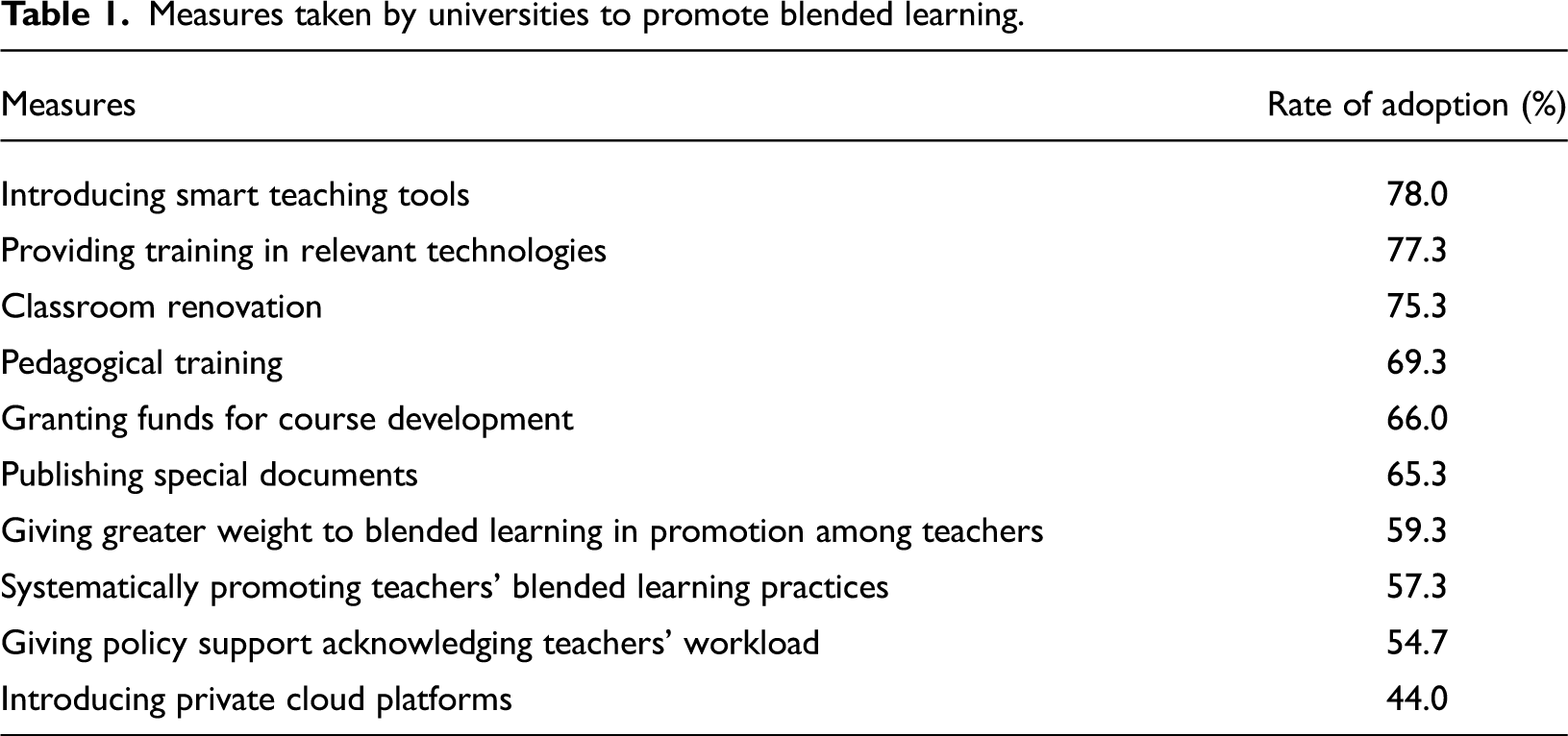
Chinese universities have implemented a range of measures to promote blended learning. The survey results showed that 14.0% of the universities had adopted one to three supportive measures for blended learning, 33.3% had adopted four to six measures, 39.3% had adopted seven to nine measures, and 13.3% had adopted between 10 and 12 measures. The measures the surveyed universities implemented to promote blended learning are listed in Table 1, from the most to the least prevalent. The results showed that the universities tended to focus on supporting hardware development before providing training and incentive measures to teachers.
Measures taken by universities to promote blended learning.
Extensive application of hybrid learning
Chinese universities have widely implemented hybrid learning and used their experiences to deepen their understanding of the hybrid teaching model. The survey results showed that 86% of the universities were allowing students to learn in hybrid learning modes to make their courses available to those who could not be physically present in the classroom during the pandemic. Of the surveyed university administrators of teaching and learning, 88.7% believed that hybrid learning had become the new normal in higher education. Based on their experience in recent years, 82.7% of the administrators believed that leadership at the university and departmental levels had developed a deep understanding of hybrid learning, and 82% believed that university teachers had a deep understanding of hybrid learning. Tsinghua University is among the Chinese universities that have made particular efforts to implement and improve their provision of hybrid learning in recent years.
Tsinghua University's hybrid learning practices
To ensure that all courses are given on time and that students are catered for both on and off campus, Tsinghua University built a system of online and offline hybrid learning in 2020 and has made the following efforts to support the initiative.
Infrastructure upgrades
Tsinghua University has renovated and upgraded 311 classrooms, including installing high-definition cameras, wireless microphones, and electronic education systems to work alongside the existing multimedia devices. These classrooms are equipped for online and offline hybrid learning. Meanwhile, Tsinghua University continues to maintain and upgrade its software, such as applications for online classrooms and videoconferencing, to create a better learning environment and experience for students and ensure the smooth development of hybrid learning.
Teacher training
Tsinghua University promptly formed an expert group on hybrid learning to guide its teachers in designing diverse teaching plans based on hybrid learning and provide teachers and teaching assistants with technical training on hybrid learning, demonstration course resources, trial teaching opportunities, and so on.
Optimizing the use of the rain classroom
Using the rain classroom, Tsinghua University's teachers can send videos, exercises, audio explanations, and other materials to students and show slides in classes. Meanwhile, students can use Danmu (a form of video commentary used on online videos comprising scrolling through viewer messages posted on top of the video in real time) to give feedback to teachers, answer questions, and express any difficulties they are having understanding the topic; teachers can see students’ answers and learning records and use these data for real-time interactions (Wang, 2017). In the fall semesters of 2020 and 2021, three times as many of Tsinghua University's courses were given via the rain classroom than in the fall semester of 2019, and there were four times as many classroom interactions between teachers and students. The average number of replays per course was about 10 (Wang, 2021).
Using the rain classroom's clone classes
The rain classroom allows for duplication of Tsinghua University's on-campus teaching scenarios in the digital world through clone classes that take place outside of the university. Students from outside of Tsinghua University can join Tsinghua classrooms remotely without interfering with on-campus teaching and engage in extensive real-time synchronous learning, communication, and interaction, an ability that represents an innovative model of “synchronous and remote” teaching (Li & Qiao, 2020). At the beginning of 2022, Tsinghua University had offered 101 undergraduate and postgraduate clone classes, attracting nearly 10,000 students and nearly 5,000 teachers throughout China.
Launching the global hybrid classroom and global open courses
Tsinghua University invites students from other Chinese and foreign universities to join Tsinghua classrooms online so that students at home and abroad can attend the same class. Approximately 680 students from Tsinghua University, Nanyang Technological University, Politecnico di Milano, University of Chile, Mongolian University of Science and Technology, and other universities have made online academic visits and had academic credit recognition from participation in global hybrid classrooms. Meanwhile, global open courses have attracted 7 million learners from around the world.
Discussion and future prospects
Advancement of education equity in line with national policies
On December 27, 2021, the Department of Higher Education of the Ministry of Education issued a proposal for revitalizing higher education and promoting quality development in central and western China. The proposal aimed to leverage the advantages of teaching and technology in eastern China to empower education by connecting the eastern and western regions and facilitating the sharing of quality teaching resources between universities in eastern and western China. Twelve alliances, organizations, and institutions, including the East and West University Courses Sharing Alliance and UOOC (university open online course), have been established to share curriculum resources and experimental teaching resources with western universities and provide them with technical support (MOE, 2021). In the future, more efforts can be made to advance educational equity by facilitating the sharing of resources among eastern, central, and western universities while bringing out the inherent power and development vitality of central and western universities.
Providing and perfecting incentives and improving the quality of blended learning
To support the development of blended learning, universities are currently giving priority to the upgrading and installation of hardware and facilities, and teacher training and incentives need to be strengthened. The development of blended learning usually occurs in several stages. At first, universities pay more attention to the development of infrastructure. Gradually, however, the focus needs to shift from information technology to improving the development process of blended courses, teacher training and incentives, and other endeavors (Graham et al., 2013). For example, in the future, the use of blended learning could be considered when determining teachers’ workloads and promotions, and more specialized training, awards, and promotions for blended learning could be launched to incentivize the development of more high-quality blended courses.
Expanding hybrid learning and improving interaction through technology
Presently, hybrid learning is mostly focused on the “hybrid” modes of students online and teachers and students offline. Both parties can use information technology to access the classroom to participate in real-time interactions and discussions. In the future, the hybrid learning concept could be expanded to update educational concepts and models. For example, hybrid learning could refer to international, intergenerational, interdisciplinary, inter-sector, and interpersonal hybrids (THUNews, 2021) and to the hybridization of different information technologies, such as a hybrid of “virtuality and reality” in the context of the metaverse and the application of a broader range of artificial intelligence, virtual reality, augmented reality, and other technologies to improve the sense of reality and interaction in online classrooms. In the future, universities should prioritize the iterative upgrading of technologies, combining new technologies with curriculum design and training objectives, and improving training quality.
In recent years, China's higher education system has achieved remarkable results and successes through the development of MOOCs, blended learning, and hybrid learning. In 2019 and 2020, China hosted the Chinese MOOC Conference and the Global MOOC Conference, published China MOOCs Action Declaration and Beijing Declaration on MOOC Development, and established the Global MOOC and Online Education Alliance, showcasing robust development and application of online open courses and technologies. More than 52,000 MOOCs have been offered in China, attracting 800 million visits. MOOC credits were issued to students over 330 million times. China is ranked first in the world for the number and scale of MOOCs (MOE, 2022). After nearly 10 years of continuous development, especially after the extensive practice of online teaching since 2020, online learning, online and offline blended and hybrid learning, and other new models have gradually become the new normal for university education. In the future, Chinese universities will accelerate the development and application of MOOC resources and develop various teaching and learning modes through the application of digital technologies and resources to promote education equity and quality. China's ideas and solutions on this front will further contribute to higher education and online education worldwide.
Footnotes
Contributorship
Xiaoxiao Wang was responsible for the survey design, devising the overall idea, writing the bulk of the main body of the paper, finalizing the paper, and responding to reviewers’ comments. Shuangshuang Guo was responsible for the literature review, data analysis, and part of the writing.
Declaration of conflicting interests
The authors declared no potential conflicts of interest with respect to the research, authorship, and/or publication of this article.
Ethical statement
This research was carried out in full compliance with the APA ethical principles of psychologists and code of conduct.
Funding
The authors received no financial support for the research, authorship, and/or publication of this article