




Abstract
Purpose:
A growing body of research has focused on the topic of inclusive education for ethnic minorities in Hong Kong. At the same time, few scholars have explored the role technology can play in enhancing inclusivity within the context of quality education. This study examines how the differentiated use of technology that takes into account disparities in prior knowledge can benefit students of different learning backgrounds.
Design/Approach/Methods:
This study adopted an experimental design to investigate how content-specific and content-neutral technologies can be strategically used to support the classroom discussions of Chinese and ethnic minority students’ learning Chinese language and mathematics. One hundred and twenty-one secondary school students participated in the study. Each student was randomly assigned to a condition, in a 2 (ethnicity: Chinese vs. ethnic minority) × 2 (content: content-specific first vs. content-neutral first) design.
Findings:
The study found that (a) for Chinese language lessons, ethnic minority students preferred to learn with content-neutral and content-specific technologies in prediscussion and postdiscussion activities, respectively; whereas the Chinese students’ preferences were the opposite and (b) for mathematics lessons, both groups of students performed better when content-specific and content-neutral technologies were used in prediscussion and postdiscussion activities, respectively.
Originality/Value:
The study presents five practical suggestions for the strategic use of technology in inclusive classrooms in Hong Kong.
Inclusion is an essential component of equity in education. Demand for inclusive education drives major education reforms throughout the world. Hong Kong is no exception. The Hong Kong Education Bureau has adopted an inclusive education policy designed to ensure equal access to quality education for all students in the public school sector (Education Commission of Hong Kong SAR, 2017, 2018; Fang, 2011). One of the aims of this inclusive education policy is to integrate ethnic minority students into mainstream schools (schools with a Chinese majority). In Hong Kong, non-native-Chinese speakers, including Indians, Pakistanis, Filipinos, Thais, and Indonesians, are considered ethnic minorities in schools. The proportion of ethnic minority students enrolled in public secondary schools (government or government-aided) is around 1.5% (Hue & Kennedy, 2013, 2014). Although this proportion is relatively small, it has been increasing (Hue & Kennedy, 2013, 2014). Many of these students in the public schools are from low socioeconomic backgrounds, have difficulty learning Chinese, and are academically at risk (Crabtree & Wong, 2010; Hue & Kennedy, 2014).
Schools should adapt to the educational needs of all students by implementing different styles of learning and assessment methods (Grönlund et al., 2010) to improve educational attainment. The Education Bureau has expressed its commitment to supporting and encouraging the integration of ethnic minority students into the school community (Education Commission of Hong Kong SAR, 2017; Fang, 2011). During the last decade, the Bureau has made substantial investments to support ethnic minority students’ learning of mathematics and Chinese (Fang, 2011) in public schools (Education Commission of Hong Kong SAR, 2017, 2018; Hue & Kennedy, 2013, 2014). However, additional research is needed to determine how ethnic minority students could be better supported in mainstream schools. The prevailing view in Hong Kong is that ethnic minority students are undersupported and that their teachers lack the knowledge and skills needed to engage them.
Teachers and principals in Hong Kong experience considerable difficulty managing the diverse learning needs of Chinese and ethnic minority students. They have recognized the need to create adaptive learning environments for these students to support their learning. For example, certain educators have considered tailoring the current curricula, using different teaching strategies, and offering after-school tutorials (Hue & Kennedy, 2013, 2014). Educational technology can play an important role in creating such adaptive learning environments (Chiu & Churchill, 2015; Chiu & Mok, 2017; Ng & Chiu, 2017), especially when teaching students with diverse educational needs, including ethnic minorities (Nketsia et al., 2016; Starcic, 2010). The application of technology to education has the potential to benefit all students academically (Du et al., 2004). Students from minority groups are more likely to receive the same quality of education as their peers when appropriate technology addresses their diverse learning needs (Gladieux & Swail, 1999).
In Hong Kong schools, teaching strategies that generally favor Chinese students have been adopted for both Chinese and ethnic minority students (Hue & Kennedy, 2013, 2014). The strategic use of educational technology has the potential to cater to the learning needs of ethnic minority students that may differ from those of their Chinese counterparts. Moreover, research suggests that cultural background often influences how educational technology is perceived and used by the two groups of students (Lai et al., 2015; Melis et al., 2011; Peng et al., 2010). For example, ethnic minority students are more likely than Chinese students to enjoy learning from videos on Hong Kong history as the latter may find these videos tediously familiar; the latter may prefer to express their ideas in discussion forums or share their points of view on social media. This suggests that cultural background may influence student choice with respect to educational technology, including those that are content-specific (e.g., ebooks and videos) and content-neutral (e.g., mind maps and online forums; Polly, 2011).
Our study approaches this topic from a different perspective—using technology with the intention of treating cultural background as a type of prior knowledge and learner expertise. Our goal is to suggest how to use technology with different content levels to support teaching in inclusive classrooms. We examine the use of content-specific and content-neutral technology to address the learning needs of ethnic minority students studying Chinese language and mathematics in Hong Kong secondary schools. We hope this study will guide teachers to reflect upon their existing practices and consider the use of technology to cater to the learning needs of ethnic minority students in inclusive classrooms.
Literature review
This study draws upon the concept of learner expertise to investigate how ethnic minority students learn with technology. The theoretical framework supporting the study is grounded in the expertise reversal effect (Kalyuga, 2007, 2008, 2014), explained by cognitive load theory (Sweller, 2010), and the principles of two cognitive learning theories: Mayers’ cognitive theory of multimedia learning (CTML; 2009, 2014) and Morenos’ cognitive-affective theory of learning with media (CATLM; 2009).
Learner expertise and technology
Research suggests that learner expertise should be considered when designing instructional activities with and without technology (Chiu & Churchill, 2015; Chiu & Mok, 2017; Kalyuga, 2014; Mayer, 2009, 2014; Moreno, 2009). This view is supported by a variety of cognitive learning theories, such as Mayer’s CTML (2009) and Morenos’ CATLM (2009). These theories suggest that the cognitive capacity available in working memory critically influences the effectiveness of instructional designs and educational technology. In the learning process, students select and organize messages from instructional designs and then integrate them with prior knowledge recalled from long-term memory (Mayer, 2009); that is, the construction of new knowledge involves prior knowledge recalled from long-term memory (Cobern, 2012). Therefore, the level of prior knowledge and the process through which such knowledge is recalled directly influence the effectiveness of the integration process (i.e., acquiring new knowledge). This, in turn, suggests that students’ prior knowledge is one of the key factors influencing instructional design with and without technology. It also reflects the key principles of CTML and CATLM, individual differences, and personalization. Students with different levels of expertise respond differently to a particular instructional design (see the individual difference principle in Mayer, 2009). A similar concept underlies Kalyugas’ expertise reversal effect (2007, 2014).
The “expertise reversal effect” refers to the negative effects instructional design can have on students with different levels of expertise (Kalyuga, 2007; Kalyuga et al., 2012; Kalyuga & Sweller, 2014). The main recommendation is that instructional design must be customized to support student learning in specific domains (Kalyuga, 2007; Kalyuga et al., 2012). Instructional design that benefits novice students may not benefit advanced students. Novice students may experience greater difficulty recalling prior knowledge as compared to advanced students. Design that is used to support novice students’ cognitive processing may be unnecessary (and even counterproductive) for advanced students. An example is when students are provided visual aids that include prior knowledge when learning the concepts of graphs and equations in mathematics lessons. The visual aids facilitate novice students’ learning but may impede the learning of more advanced students. The novice students are more likely to find it difficult to recall what they have already learned. With the aids, they take less time or fewer steps to find the learning messages that help them see the connections between the graphs and the equations (e.g., the relationships between intercepts and coefficients). In contrast, advanced students may find the aids redundant and even distracting, thereby impeding their learning. The expertise reversal effect holds that understanding how much support different types of students need is one of the key factors in designing instruction.
The literature suggests that content-specific and content-neutral approaches may be adopted to integrate technology into teaching content-based curricula in schools (NCTM, 2015). Content-specific technology may promote meaningful subject matter knowledge. Content-neutral technology (including communication and collaboration tools and web-based digital media) is more open-ended and promotes inquiry (Harris et al., 2009; Lin et al., 1999; NCTM, 2015). For example, a content-specific technology (e.g., Geogebra, learning objects, videos, and ebooks) that presents subject matter knowledge is more likely to benefit novice students than advanced students. Conversely, a content-neutral technology (e.g., discussion forum and mind map) that allows for authoring, discussing, and sharing is a good choice for students with relevant prior knowledge (Chiu & Mok, 2017; Liu et al., 2014; Melis et al., 2011; NCTM, 2015).
Numerous empirical studies conducted by education researchers over the last two decades have supported the expertise reversal effect (Chiu & Mok, 2017; Kalyuga, 2007, 2008, 2014; Kalyuga et al., 2000; Kalyuga et al., 2013; Lee & Kalyuga, 2011; Leslie et al., 2012; Rey & Fischer, 2013; Spanjers et al., 2011). In these studies, learner expertise includes student information technology experience, age, grade level, self-reported ability, and academic performance but not cultural background. We believe that treating cultural background as part of learner experience can help expand the theory while also promoting inclusivity in schools by providing valuable insights into the learning needs of ethnic minority students.
Learner expertise and ethnic minority students
Students have diverse learning needs due to their ethnicity, gender, socioeconomic status, preferred learning styles, abilities, and interests (Strand, 2014; Yuen, 2013). Numerous studies have examined the educational attainment of ethnic minority students in K-12 settings (Crabtree & Wong, 2010). In many societies, such as the U.S., the U.K., and Hong Kong SAR, ethnic minority groups are often perceived as underprivileged because they have different educational needs from the dominant group (Crabtree & Wong, 2010; Hue & Kennedy, 2014). In Hong Kong, the academic performance of ethnic minority students is often lower than that of Chinese students. One reason for this is students’ cultural differences that may influence their prior knowledge (Floyd & Carrell, 1987; Garth-McCullough, 2008; Peng et al., 2010).
The literature suggests that, with respect to acquisition of cultural knowledge (e.g., language), there is an observable relationship between a student’s culture and his/her prior knowledge (Chung, 2008; Floyd & Carrell, 1987; Garth-McCullough, 2008; Peng et al., 2010). However, this is not the case for noncultural domain knowledge (e.g., rules and facts; Peng et al., 2010; Saxe, 2015). For example, Garth-McCullough (2008) found that culturally bound prior knowledge supports students’ reading comprehension in language instruction. Peng and colleagues (2010) showed that culture affects student perceptions of the Chinese language and determines the effectiveness of learning Chinese characters. However, student culture has less impact on learning noncultural domain knowledge such as mathematics rules and principles. For example, Saxe (2015) explained that students’ background has little effect on learning mathematics through formalized and in-school mathematics education but does affect real-life problem-solving skills. These studies imply that a student’s culture has a large influence on his/her language learning but less or no effect on learning mathematics.
However, the way in which cultural background influences the formation of prior knowledge (and the role technology may play in assisting learners of different backgrounds) remains unclear and understudied. To address this issue, it is necessary to include cultural background in learner expertise when investigating how to teach ethnic minority students using technology. This study examines how content-specific and content-neutral technology can be used in Hong Kong classrooms to address the different learning needs of Chinese and ethnic minority students.
This study
Previous research has indicated that the learning needs of ethnic minority students differ from those of Chinese students due to the differences in cultural backgrounds and language proficiency. The strategic use of technology in classrooms can address this learning diversity. However, researchers have done little to examine how technology-enabled learning environments can be designed to include low-achieving ethnic minority students. Based on the expertise reversal effect, the content-level dependency of technology should address the learning needs of both Chinese and ethnic minority students.
This study examines how content-specific and content-neutral technologies can be strategically used to support the learning needs of Chinese and ethnic minority students in Chinese language (comprehension skills) and mathematics (noncultural domain knowledge, e.g., fact and rules). We adopted an experimental study, a 2 × 2 between-subjects factorial design with the factors being ethnic group (Chinese: “C” vs. Ethnic minority: “NC”) and the order of use of two different types of technology (content-specific first [“SN”] vs. content-neutral first [“NS”]), to understand how the treatment impacts classroom discussions in Chinese and mathematics classes. The content-specific technology was a video that presented subject knowledge; the content-neutral technology was a mind map application. “SN” indicated that the participants watched the video first (prediscussion activities), followed by classroom discussion and then used the mind map application (postdiscussion activities) to reflect on their learning. “NS” indicated that the mind map application was used for prediscussion activities and the video was used for postdiscussion activities.
Students’ prior knowledge is a key factor influencing the learning outcomes of classroom discussions (Chiu & Mok, 2017; Chiu & Hew, 2018; Kayulga, 2009, 2014). The Chinese language proficiency of the ethnic minority group was weaker than that of the Chinese group, suggesting that the ethnic minority group had weaker prior knowledge in the Chinese language but not necessarily in mathematics. Therefore, based on the expertise reverse effect, we hypothesized that:
We expect the findings from this study to contribute to the design of technology-enabled learning environments such as blended learning, online courses, and reflective learning in inclusive classrooms and to provide insights into the expertise reversal effect and other cognitive learning theories.
Method
Participants and assignment to treatment
We selected a Hong Kong government-subsidized (public) school that was designated to accommodate ethnic minority students. We used a stratified procedure to select the participants. The participants were 121 junior secondary students, aged 11–14 years. The participants were racially diverse (50.4% Chinese and 49.6% non-Chinese) and 60% of them were boys. According to the pretests, the academic performance levels in Chinese language of the Chinese (M = 4.2, SD = 1.6) and non-Chinese (M = 2.3, SD = 0.8) groups were significantly different, p < .001. The pretest performance levels in mathematics of the Chinese (M = 3.21, SD = 1.14) and non-Chinese (M = 3.15, SD = 0.95) groups were similar, p = .08.
In our experiments, we used content-specific and content-neutral technology. We employed a quasi-experimental design, randomly assigning students to one of the following four experimental conditions: the Chinese group learning with content-specific technology first; the Chinese group learning with content-neutral technology first; the ethnic minority group learning with content-specific technology first; and the ethnic minority group learning with content-neutral technology first.
We also specifically analyzed the two different subject domains: Chinese language and mathematics.
Resources
The experiment used content-specific and content-neutral technology and assessment materials. The content-specific technology was a subject video: a Chinese language video aimed at deepening comprehension skills—explaining how to use a Chinese phrase appropriately in the proper context. The mathematics video aimed to develop better problem-solving skills for equations—explaining how different parameters of equations affect their shape. The videos were designed and developed based on the studies of Chiu and Churchill (2015), Chiu and Mok (2017), and Chiu et al. (2020). Each video was approximately 25 min long. The content-neutral technology was a mind map application. All of the participants had previous experience using the mind map application. Therefore, there were no technical skill limitations.
The assessment materials included a pretest, a posttest, and a questionnaire. The pretest assessed prior knowledge in the relevant subjects; the posttest assessed the content knowledge learned during the experiment. Each of the tests included 15 Chinese language and 15 mathematics multiple-choice questions. The test questions were designed based on the studies of Schneider and Stern (2005), Chiu and Churchill (2015), Chiu and Mok (2017), and Chiu et al. (2020).
The responses to the questionnaire were given on a 5-point Likert type scale intended to measure the mental effort invested and intrinsic motivation experienced during learning. The questions were designed by Paas (1992). The mental effort invested reflected the actual cognitive capacity that was allocated to process information during the learning process.
Here is a relevant excerpt from the questionnaire: Please respond to the following question using the scale. In the learning task just finished, I invested (1) a very low level of mental effort to (5) a very high level of mental effort. I found learning the material (1) very boring to (5) very fun.
Experimental procedure
The experiment was conducted in the participants’ school. We first outlined the purpose of the experiment and obtained the consent of all the participants. We then explained to the participants the procedures to be used in the experiment. We provided passive consent forms to the participants and requested that they give them to their parents. The parental consent forms provided an overview of the experiment but did not require parent signature.
Due to the difference in Chinese language proficiency between the Chinese and the ethnic minority groups, the medium of instruction was crucial to the study. Hence, the Chinese and mathematics lessons were taught in Cantonese and English, respectively.
Before the experiment, we administered the paper-based pretests in the classrooms, each of which lasted around 30 min. These pretests covered Chinese language comprehension and mathematics problem-solving skills. The treatment (the order of using the video and mind map applications) was implemented over three school days during the daily 40-min Chinese language and mathematics lessons. In the first lesson, each experimental group commenced learning with the specific technology assigned. Two groups watched the video for 20 min, then finished a worksheet including three questions in 20 min. The video contained all the information the students needed to answer the questions. The other two groups used the application to draw individual mind maps that showed what they knew about the topics and reflected what they learned. The students were encouraged to express their ideas freely. In the second lesson, the students engaged in discussion. In the last lesson, each group learned with the technology previously used by the opposite groups.
After the three lessons, the participants completed a 30-min posttest on Chinese language comprehension and mathematics problem-solving skills, together with a 10-min self-reported questionnaire. The students were then thanked for their participation.
Results and discussions
The experiment was designed to investigate how the order of using two technologies with different content-level dependencies affected Chinese and ethnic minority students learning Chinese language and mathematics.
To analyze the data, we used SPSS 21 to conduct (a) 2 (ethnicity: Chinese vs. ethnic minority) × 2 (order: content-specific first vs. content-neutral first) analyses of covariance (ANCOVAs) with Chinese language comprehension and mathematics problem-solving skills as the dependent variables and the participants’ prior knowledge as covariates and (b) 2 × 2 analyses of variance (ANOVAs) with mental effort and intrinsic motivation as the dependent variables. Each of the dependent variables met the assumption of homogeneity of variance, where all p values > 0.05 complied with Levene’s tests. Table 1 presents the descriptive statistics for each of the four experimental groups.
Descriptive statistics for the four experimental groups.
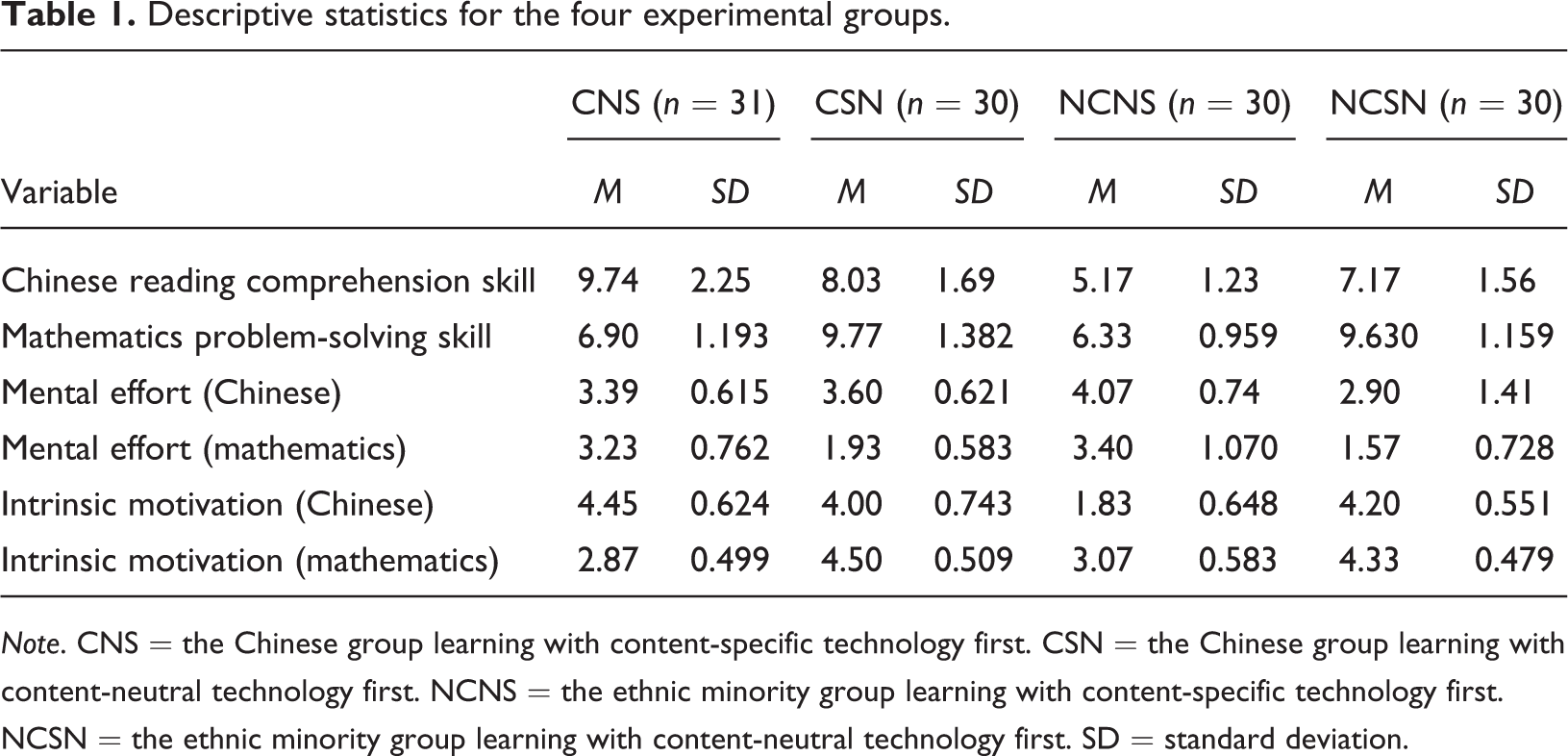
Note. CNS = the Chinese group learning with content-specific technology first. CSN = the Chinese group learning with content-neutral technology first. NCNS = the ethnic minority group learning with content-specific technology first. NCSN = the ethnic minority group learning with content-neutral technology first. SD = standard deviation.
As predicted, students’ ethnic background had an impact on the effectiveness of the design of the technological learning environment. This study has three main findings: one for Chinese language comprehension skills, one for mathematics problem-solving skills, and one for technologically enhanced learning designs for inclusive classrooms. Based on these findings, we offer five practical suggestions for teachers and instructional designers.
Chinese language comprehension skills
The first main finding shows the different preferences of the Chinese and ethnic minority groups with respect to pre- and postclassroom discussion technologies when developing Chinese language comprehension skills. These preferences were supported by the results of mental effort invested and intrinsic motivation in the experiment.
ANCOVA indicated that there were no significant effects for order, F(1, 120) = 0.002, p = .965, partial η2 = .00, but there was a significant effect for ethnicity, F(1, 120) = 31.947, p < .001, partial η2 = .216. A significant interaction effect was found, F(1, 120) = 39.647, p < .001, partial η2 = .255. A significant simple effect was found for the Chinese group, who learned better using mind maps first (M = 9.74, SD = 2.25), F(1, 60) = 15.62, p < .001, partial η2 = .21. A significant simple effect was found for the ethnic minority group, who learned better using videos first, F(1, 59) = 29.81, p < .001, partial η2 = .34. A significant simple effect was found for learning with mind maps first, such that the Chinese group learned better than the ethnic minority group, F(1, 60) = 60.50, p < .001, partial η2 = .27. No significant simple effect was found for learning with videos first, F(1, 59) = 0.08, p = .773, partial η2 = 0.001.
With respect to the mental effort invested in learning Chinese, ANOVAs indicated that there was a significant interaction effect, F(1, 120) = 98.40, p < .001, partial η2 = .46. No significant simple effect was found for the Chinese group, F(1, 60) = 1.81, p = .184, partial η2 = .03; however, a significant simple effect was found for the ethnic minority group, F(1, 59) = 132.56, p < .001, partial η2 = .70, such that those learning with videos first (M = 1.73, SD = 0.83) invested less mental effort than those learning with mind maps first (M = 4.07, SD = 0.74). A significant simple effect was found for the mind map first group, F(1, 60) = 115.26, p < .001, partial η2 = .21, such that the Chinese group (M = 3.39, SD = 0.62) invested less mental effort than the ethnic minority group (M = 4.07, SD = 0.74). A significant simple effect was found for the videos first group, F(1, 59) = 97.58, p < .001, partial η2 = 0.63, such that the Chinese group (M = 3.6, SD = 0.62) invested more mental effort than the ethnic minority group (M = 1.73, SD = 0.83).
With respect to intrinsic motivation in learning Chinese, ANOVAs showed that there was a significant interaction effect, F(1, 120) = 144.45, p < .001, partial η2 = .55. A significant simple effect was found for the Chinese group, F(1, 60) = 6.63, p = .013, partial η2 = .10, such that those who learned with mind maps first (M = 4.45, SD = 0.62) had higher intrinsic motivation than those who learned with videos first (M = 4.00, SD = 0.74). A significant simple effect was found for the ethnic minority group, F(1, 59) = 232.42, p < .001, partial η2 = .80, such that those learning with videos first (M = 4.20, SD = 0.55) had higher intrinsic motivation than those learning with mind maps first (M = 1.83, SD = 0.65). A significant simple effect was found for the mind map first group, F(1, 60) = 258.62, p < .001, partial η2 = .81, such that the Chinese group (M = 4.45, SD = 0.62) had higher intrinsic motivation than the ethnic minority group (M = 1.83, SD = 0.65). No simple significant effect was found for the videos first group, F(1, 59) = 1.40, p = .241, partial η2 = 0.02.
The above results demonstrate that the Chinese group preferred to learn Chinese language with the mind map application first (H1). This may be because their higher Chinese language proficiency allowed them to meaningfully discuss relevant topics in class. With additional prior background in Chinese culture, the students did not require new external information to construct meaning from the lesson (Chung, 2008; Floyd & Carrell, 1987; Garth-McCullough, 2008; Peng et al., 2010). After the classroom discussions, watching the video acted as a reflective tool that provided the group further learning opportunities to consolidate new knowledge (H2). A plausible explanation is that the video served as a stimulant that facilitated the reflective process by encouraging the Chinese students to think about the content on a deeper level (Chiu & Mok, 2017; Chiu et al., 2020). These explanations were echoed by the results for intrinsic motivation: The Chinese group had more fun learning with the mind map application first (H3). Watching the video was boring for those with stronger language skills and was viewed as a repetitive learning activity.
Conversely, the ethnic minority group learned better when watching the video first (H1). As they had more limited prior cultural experience, the video was crucial in allowing them to build the prior knowledge they needed to engage in meaningful classroom discussions (Chung, 2008; Floyd & Carrell, 1987; Garth-McCullough, 2008; Peng et al., 2010). The ethnic minority students preferred technology for prediscussion activities that provided additional subject content they could use to construct (or activate) their prior knowledge.
These results support the findings of other related studies (e.g., Chiu & Hew, 2018; Chiu & Mok, 2017; Chiu et al., 2020; Sun et al., 2018; Topcu & Ubuz, 2008) that have indicated that possessing more prior knowledge can facilitate discussion. The results also indicated that it would have been unlikely for the ethnic minority group to conduct effective classroom discussions without having relevant prior knowledge. We found that the ethnic minority group expended more effort on reflecting and recalling their learning when they used the mind map application first (H4). This effort was unnecessary and irrelevant, resulting in less intrinsic motivation that possibly discouraged them to think.
Mathematics problem-solving skills
The second finding demonstrates the shared preferences of the Chinese and ethnic minority groups for pre- and postclassroom discussion technologies when developing mathematics problem-solving skills. These preferences were supported by the results of mental effort invested and intrinsic motivation in the experiment.
ANCOVA revealed a main effect of order, F(1, 120) = 214.83, p < .001, partial η2 = .65, indicating that the videos first group (M = 9.70, SD = 1.27) performed significantly better than the mind map first group (M = 6.62, SD = 1.11). There were no significant main effects for ethnicity, F(1, 120) = 2.58, p = .114, partial η2 = .02, and no significant interaction effect was found, F(1, 120) = 0.14, p = .246, partial η2 = .01.
For the mental effort invested in learning mathematics, ANOVAs showed that the main effect of order was found, F(1, 120) = 113.95, p < .001, partial η2 = .49, indicating that the videos first group (M = 1.75, SD = 0.68) invested significantly less mental effort than the mind map first group (M = 3.31, SD = 0.92). Neither a significant main effect for ethnicity, F(1, 120) = 0.43, p = .512, partial η2 = .004 nor a significant interaction effect was found, F(1, 120) = 3.41, p = .067, partial η2 = .03.
For intrinsic motivation in learning mathematics, ANOVAs showed that the main effect of order was found, F(1, 120) = 238.36, p < .001, partial η2 = .67, indicating that the videos first group (M = 4.42, SD = 0.50) had higher intrinsic motivation than the mind map first group (M = 2.97, SD = 0.55). There was no significant effect for ethnicity, F(1, 120) = 0.02, p = .88, partial η2 = .000. No significant interaction effect was found, F(1, 120) = 3.69, p = .057, partial η2 = .03.
The above results show that learning mathematics with the video first (a) benefited both the Chinese and ethnic minority groups’ learning outcomes (H5), (b) motivated both groups to think (H6), and (c) made the lessons more fun (H6). The results also indicate that beginning with reflections in the mind map application complicated the mathematics learning of both groups. A plausible explanation is that without receiving or activating prior knowledge, the groups were unable to conduct effective mathematical discussions (arguments and reasoning) in their lessons. Mathematics is a well-structured subject domain based on facts, rules, and theories. New knowledge must be built on prior knowledge, which requires the processing of a more cognitive load (Chiu & Mok, 2017; Chiu et al., 2020). Therefore, having relevant prior knowledge is crucial to discussion. Accordingly, the mind map tasks that placed a heavier cognitive load (Chiu & Churchill, 2015; Chiu & Mok, 2017) on the students did not favor them when the learning process included activating prior knowledge. Alternatively, watching a video that could activate prior knowledge offered greater available cognitive capacity to the students for their discussions (Chiu & Churchill, 2015; Chiu & Mok, 2017), that is, the video first group who already held relevant prior knowledge had additional spare cognitive capacity to discuss the lessons.
Learner expertise and technology for inclusive education of ethnic minority students
Overall, our results show that (a) in learning Chinese language, the ethnic minority group performed better with the video first while the Chinese group performed better with the mind map application first; (b) the video first group learned mathematics better than the mind map first group; (c) the ethnic minority group learned more easily when they watched the video first; and (d) the video first group found the mathematics lessons more fun.
These findings provide several insights as to how students’ ethnic backgrounds and learner expertise can influence the effectiveness of technology-enhanced learning environments. Between the Chinese and ethnic minority groups, the role of the technological learning design in developing Chinese comprehension skills was different but was similar with respect to the design’s role in developing mathematics problem-solving skills. The results indicated that when teaching with technology, teachers can use similar strategies to teach both Chinese and ethnic minority groups in noncultural areas but not in cultural knowledge domains. Many of the studies conducted by scholars over the last 20 years used a concept of learner expertise that included student information technology experience, grade level, self-reported ability, and academic performance (Chiu, 2017, 2018; Chiu & Churchill, 2016; Chiu & Mok, 2017; Chiu et al., 2020; Kalyuga, 2007, 2008, 2014; Knörzer et al., 2016; Leslie et al., 2012; Park et al., 2015; Rey & Fischer, 2013). These studies often suggested that designers of effective technological learning environments should consider differences in learner expertise. However, these scholars did not take students’ ethnic backgrounds into account when studying technology-enhanced learning designs. This study approached the topic from a different perspective, expressly focusing on how ethnicity contributes to the expertise reversal effect and other theories related to learner expertise. Our findings showed that the effects of using technology in teaching varied for students with different ethnic backgrounds in cultural but not noncultural domain knowledge. Consequently, this study supports the individual difference assumption and suggests that technological learning environments have diverse effects on students from different ethnic backgrounds.
Practical suggestions
This study offers five practical suggestions for the use of educational technology in inclusion classrooms, particularly in the Hong Kong context. Table 2 summarizes our suggestions on the preferred technologies for prediscussion and postdiscussion activities for both groups. Finally, we suggest a general principle for instructional designers to follow in creating technological learning environments (e.g., blended learning, reflective learning, and flipped learning).
Summary of our suggestions regarding preferred technologies.
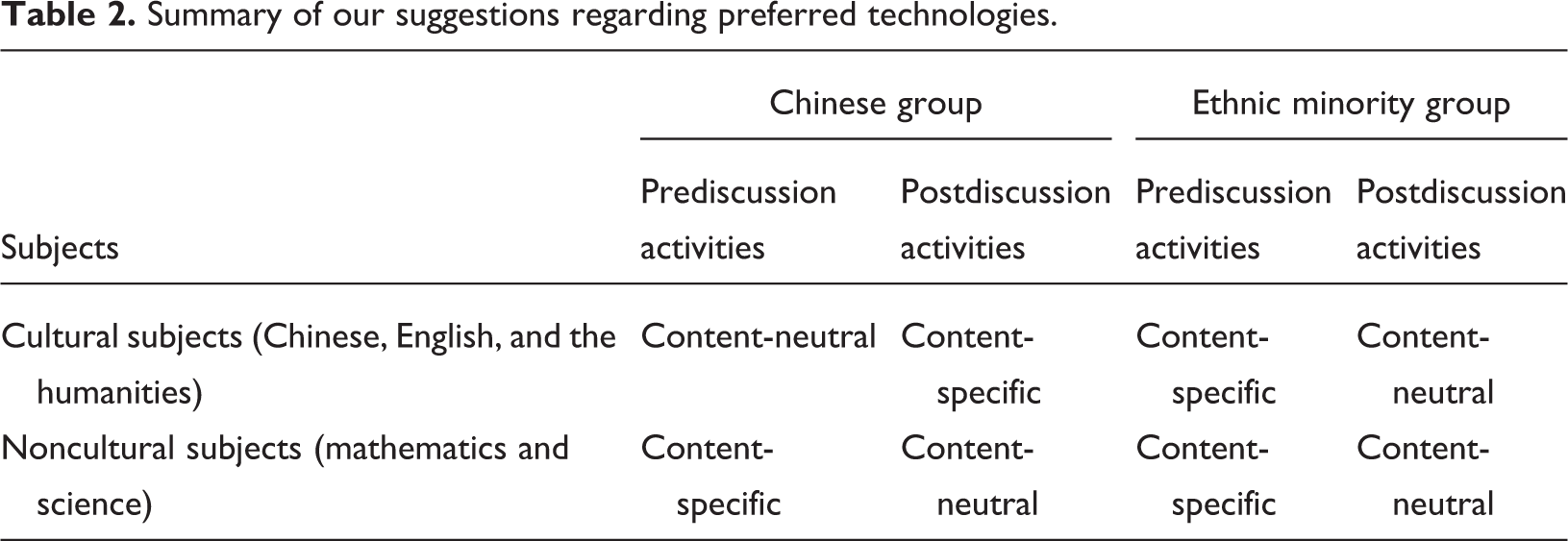
1. Technology for cultural knowledge (Chinese, English, and the humanities)
Content-specific technology, including ebooks, videos, and games, is more effective in preparing students with weaker relevant cultural backgrounds for meaningful classroom discussion (prediscussion activities). Teachers should allow the weaker students to access digital subject content during lessons. For example, offering mobile devices with relevant content to the weaker students in classes. The students should be free to watch or read the content whenever they feel it is needed.
Content-specific technology benefits students with stronger relevant cultural backgrounds during the reflective process (postdiscussion activities). Teachers are recommended to use watching videos and reading digital articles as homework assignments, instead of traditional work—completing exercises printed in textbooks or composition. These homework assignments are more likely to provide students greater autonomy and thinking spaces.
Content-neutral technology (such as authoring software, mind maps, and portfolios) can help students with weaker relevant cultural backgrounds to reflect/share/communicate following discussions (postdiscussion activities). Therefore, we recommend teachers to encourage their ethnic minority students to create artifacts with the technology and continue to introduce their own cultures and languages to their classmates to promote cross-cultural and cross-linguistic experiences.
Content-neutral technology effectively activates prior knowledge in students with stronger relevant cultural backgrounds allowing them to use their past experiences prior to discussions (prediscussion activities). Teachers are encouraged to ask students with stronger relevant cultural backgrounds to prepare the lessons by creating digital content instead of reading articles and doing exercises. This will help stimulate their higher-order thinking skill—creativity.
2. Technology for noncultural domain knowledge (mathematics and science)
Our results showed that the ethnic minority and Chinese students have similar preferences with respect to content-level dependency of technology for pre- and postlesson activities. We suggest that teachers should use (a) content-specific technology to consolidate their knowledge before discussions and (b) content-neutral technology such as reflective tools for learning activities after discussions.
3. Technology for curriculum design in Hong Kong
In Hong Kong, many teachers and other curriculum designers use level-up assignments to cater to learning diversity in inclusive classrooms. For example, an assignment may be divided into three levels—easy (fewer words, more guidelines, and images), medium, and difficult (more words, fewer guidelines, and images). However, teachers rarely use different levels of technology to teach their students. Therefore, we encourage Hong Kong teachers and other curriculum designers to use students’ learning abilities to determine the content-level dependency of classroom technology. For example, Hong Kong public examinations use a 5-level grading scale (level 1: lower and level 5: higher academic performance); therefore, teachers can create a 5-level content-dependency system for videos (level 1: more content-neutral, less informed and level 5 more content-specific, well-informed) to match the public examination grading levels. In inclusive classrooms, teachers can give students videos on the same level to conduct self-study to maximize their learning.
4. Aids when using content-neutral technology in Hong Kong
Teachers often set a problem or topic for their students when using content-neutral technology. We suggest that appropriate aids or hints should be given to students with less relevant prior knowledge to avoid meaningless discussions. For example, prior to a classroom discussion on how the Bank of China Building reflects Chinese culture, students should be provided with aids including videos about Chinese architecture or blogs about the history of the Bank of China. The students can watch or read the information when they feel they have nothing to contribute to the discussion. We also recommend that the aids should include different content levels and should be labelled accordingly. The labels will assist the students to choose the content they need.
5. Semi-open content of content-specific technology in Hong Kong
The content-specific technologies that Hong Kong teachers often use in classrooms are descriptive and tell the whole story—from beginning to end and from questions to their answers. In other words, the content includes all the facts the students need for the exercises or activities and is presented in linear form. We suggest that teachers make the content semi-open by presenting some, but not all, of it to the stronger students in nonlinear form. For example, teachers can give students mathematics tasks that leave out certain variables/parameters, instead of providing comprehensive tasks (i.e., tasks that include all the variables/parameters); and then the students can manipulate a dynamic diagram in GeoGebra (an interactive geometry, algebra, statistics, and calculus application) to complete the tasks by contributing the missing variables/parameters.
In conclusion, the findings from this study should contribute to the learning design of inclusive classrooms. A single technology-enhanced multimedia learning design cannot fit all students (Chiu et al., 2020; Kalyuga, 2014; Mayer, 2009; Ng & Chiu, 2017). Students have their own preferences regarding technology. Offering the right technology to students is very important. We suggest that teachers should consider learner expertise, the content-level dependency of technology, and the nature of the subjects when designing technological learning environments.
Limitations and future directions
This study has certain important limitations. Like many empirical studies, the findings of this study have limited generalizability. First, additional research should be carried out to validate our findings and refine our suggestions. Second, our study focused on a particular point in time; we did not measure the ongoing learning process. It would be especially interesting to see how students change the mental effort they invest and their motivation over longer periods. Third, further research should be carried out to investigate how technology influences the effectiveness of different learning tasks other than classroom discussions. Such an investigation would be particularly valuable because it would help test Chiu and Mok’s (2017) suggestion that the structure of learning tasks determines the choice of the appropriate technology to use for less knowledgeable students. Finally, this study aimed to add ethnic background to learner expertise as a consideration when designing technological learning environments for inclusive classrooms. Future research is needed to investigate how ethnic background as part of learner expertise affects the other assumptions of cognitive learning theories.
Footnotes
Declaration of conflicting interests
The author(s) declared no potential conflicts of interest with respect to the research, authorship, and/or publication of this article.
Funding
The author(s) received no financial support for the research, authorship, and/or publication of this article.