



Abstract
The aim of this article is to develop knowledge on how moral challenges affect officers’ well-being and professional performance. Building on existing research on adverse work experiences and the developing literature on moral injury, we examine 150 Canadian federal parole officers’ experiences of moral distress at work as distinct from traumatic stress and emotional stress. We unpack the process of how officers experience and manage moral distress and its aftermath in interaction with their social, organizational, and professional context. Our findings are crucial for addressing PPOs’ adverse work experiences, and for recognizing barriers to supporting clients’ rehabilitation and reintegration in penal settings. Therefore, we suggest a conceptualization specific to the moral aspects of challenges at work – moral labour – to further theorize and examine the relationship between moral distress at work, contextual conditions for managing the distress, and adverse work outcomes such as moral injury, burnout, and compassion fatigue.
Introduction
The rapidly expanding literature on moral injury is providing new perspectives on how witnessing or committing moral transgressions can create lasting distress (Litz et al., 2009; Williamson et al., 2025; Čartolovni et al., 2021), with a new scale for measuring moral injury among public safety personnel having been developed and tested among police officers (Battaglia et al., 2025). The penal system is of particular interest for moral injury, with its combination of punishment, rehabilitation, and moral communication (Duff, 2001), and the emotional toll of parole and probation work has been well observed and linked with burnout (e.g. Kwak et al., 2018; Lewis et al., 2013; Phillips, 2020; Westaby et al., 2020). However, we lack research on the specific moral dimensions of this work, and how this moral toll is managed in the interaction between the individual PPO and their context. In this article, we argue that thinking in terms of moral distress and moral injury will broaden our understanding of the key challenges facing those working in penal contexts, by looking specifically at the implications of adverse work experiences on the PPOs sense of moral self: their self-concept, self-esteem and sense of belonging in community. We review research on probation and parole, recognizing that, in Canada, parole officer (PO) is the terminology used to refer those working in the federal correctional system, while probation officer is the terminology used in Canadian’s provincial and territorial systems (see Ricciardelli et al., 2024). Collectively, we use the acronym PPO to refer to parole and probation officers, albeit that the empirical data is drawn from interviews with federal parole officers. The PPO roles are overlapping with different responsibilities in different penal jurisdictions.
The challenges of PPO work
Working in parole and probation involves a range of challenges connected to both the role itself and its contextual conditions (Norman and Ricciardelli, 2022). Role-related challenges include conflicting demands (Lindberg et al., 2010; Norman and Ricciardelli, 2022; Todd-Kvam, 2020), exposure to physical and psychological trauma, and high-stakes decisions (Schaufeli and Peeters, 2000). In terms of contextual conditions, PPOs describe challenges including excessive workload, and negative organizational climate and culture (Finney et al., 2013; Konyk et al., 2021). These challenges take a toll on PPOs’ emotional, social and physical capacities in ways extending beyond the immediate here-and-now of the work tasks (Konyk et al., 2021; Schaufeli and Peeters, 2000).
Many of these costs of PPO work have been extensively researched. For instance, research employing the concept of emotional labour (Hochschild, 1983) finds that it is relevant for describing the prison and probation officers’ work experiences, both in terms suppressing the display of situationally inapposite emotions (surface acting) and working to change one’s emotional display from within through changing one’s appraisal of the situation (deep acting) (Hochschild, 1983; Nylander et al., 2011; Westaby et al., 2020). Emotional labour is consequential because using emotions, including moral emotions such as anger and resentment (Nylander et al., 2011; Westaby et al., 2020), is a key part of PPO work (Fowler et al., 2020). Moreover, emotional labour is exacerbated by conflicts between role-related expectations (occupational display rules), social expectations (societal display rules) and organizational demands (organizational display rules) (Westaby et al., 2020), and by organizational factors including a lack of ‘backstage space’ hindering opportunities to recover (Nylander et al., 2011). Excessive degrees of surface and deep acting in a professional role may lead to adverse work outcomes like compassion fatigue, emotional exhaustion, alienation, and depersonalization (Fowler et al., 2020; Hochschild, 1983; Kwak et al., 2018; Lewis et al., 2013; Nylander et al., 2011; Phillips et al., 2020). However, we argue below that surface and deep acting with regards to moral emotions have distinct implications for the PPOs self-concept, self-esteem and sense of belonging beyond those of emotional labour in general.
Another well examined aspect of both prison and PPO work is the exposure to psychological trauma (Konyk et al., 2021; Norman and Ricciardelli, 2022). PPOs are exposed to trauma by being the victim, a witness, or reading/hearing about the incident, which can lead to posttraumatic stress symptoms such as hypervigilance, sleep problems, and continuous heightened sympathetic activation (Wilson, 2004). Beyond the strains these symptoms have on PPOs physical health, PPOs also run a larger risk than the general population of developing severe mental health problems such as posttraumatic stress disorder (PTSD) or injuries (PTSI) (Konyk et al., 2021).
These strands of research demonstrate how tasks requiring personal resources (like managing emotions and embodied reactions) take a toll on PPOs mental and physical health beyond the work situation.
Our aim with this article is to examine how POs experience morally challenging aspects of their work – how PPOs navigate work that can violate their morality, values, and ethics. We argue this moral dimension is an overlooked but important aspect of the job and, through its examination, can we specify distinct aspects of adverse experiences and their long-term consequences, including burnout and moral injury (Williams et al., 2020; Williamson et al., 2025).
Moral distress and moral injury
Moral distress
Conceptualizations of moral distress tend to encompass the notion of a ‘moral event’ (analogous to PMIEs below) and of psychological distress (Morley et al., 2019): of ‘knowing the right thing to do while being in a situation in which it is nearly impossible to do it’ (Williams et al., 2020: p. 65, citing Jameton (1984)) Connecting it to work experiences, Kolbe and De Melo-Martin (2023) argue that moral distress ‘derives from workplaces’ illegitimate constraints on individuals’ moral agency’ (p. 54). We here define moral distress broadly, as the painful dissonance we feel when there is a discrepancy between our appraisal of our experiences, actions, personal characteristics, or reactions (i.e. what is), and our deeply held moral beliefs about ourselves and the world (i.e. what ought to be). Our definition encompasses distress in relation to one’s sense of self, and the distress we feel when the world does not live up to our expectations of morality and justice. We extend the scope beyond established definitions (Čartolovni et al., 2021) to include situations of painful moral dissonance (Weber, 2016) regardless of context and contextual conditions. Steinmetz and Gray (2015, p. 700) emphasized the weight of the task in noting: ‘the psychological process of reconciling discrepant ways of seeing the self and the world creates emotional turmoil and distress, and the accommodation process can consume psychological and emotional resources’. The stakes are amplified in roles where moral distress is connected to situations with possible serious consequences for the professional, their clients, and the wider public.
Moral injury
Moral injury can be broadly described as ‘the lasting psychological, biological, behavioural and social impact of perpetrating, failing to prevent, or bearing witness to acts that transgress deeply held moral beliefs and expectations’ (Litz et al., 2009: p. 697). This captures two central aspects of moral injury: the potentially morally injurious event (PMIE) (Litz et al., 2009: p. 700) and the event’s lasting implications. The subjective experience of moral distress is central to the former: not external assessments of responsibility/morality. That is, an event is a PMIE if the person experiences the event as an act (or failure to act) that goes against their own deeply held moral beliefs and ideals. In terms of the latter, the harmful ‘lasting impact’ of moral distress is neither caused by the event, nor the individual, but results from occurrences where individuals’ coping strategies interact with their context in ways that hinder reconciliation and self-forgiveness (Litz et al., 2009; Steinmetz and Gray, 2015). Finally, whilst the original research on moral injury, from the military setting, focused on single or few intense PMIEs, there is an argument for including, in civilian jobs, the repeated occurrence of less intense PMIEs or their accumulation. For instance, Čartolovni et al. (2021) portrayed experiences of insufficiency and of witnessing unnecessary patient suffering as part of nurses’ morally painful experiences. Both Williamson et al. (2025) and Čartolovni et al. (2021) call for more research into how such moral distress develops into moral injury.
Probation and parole as morally challenging work
Morality protects ‘what is most important for peaceful community’ (Gert and Gert, 2002), and transgressing moral boundaries puts belonging, moral self-concept and thus self-esteem (i.e. one’s moral self) at stake. Self-esteem and belonging are central identity needs (Vignoles et al., 2006), underpinning Weber’s (2016) argument that moral distress is intrinsically harmful, violating the person’s sense of integrity and self. As such, moral distress may affect the individual PPO’s personal and professional functioning beyond the morally distressing situations, and beyond consequences of any trauma and emotional labour also associated with morally distressing situations. This latter specification is key, as moral distress is distinct from both emotional labour and trauma: it is not about the emotion but about the self-violation that occurs when someone is mandated to act in conflict with their deeply held moral beliefs. Research on moral injury (Litz et al., 2009) pinpoints this distinction and emphasizes its clinical importance: interventions targeting PTSD may be ineffective or at worst harmful when dealing with moral injury (Steinmetz and Gray, 2015).
Existing research suggests morality constitutes a dimension of the PPO role, making moral injury a relevant concern (Ricciardelli et al., 2024). First, PPOs occupy a dual role as public safety personnel (Konyk et al., 2021) and as social workers (Matejkowski et al., 2014), with demands, expectations, and tasks flowing from both sides of the duality. This involves a double and, sometimes, seemingly contradictory responsibility. On the one hand, there is an imperative to rehabilitate and reintegrate into society and to treat each client with compassion and hope. On the other, there is an imperative to protect society from these same clients’ potential misdeeds. While tension between care and control has been extensively studied (Maier et al., 2023; Matejkowski et al., 2014; Todd-Kvam, 2020), morality constitutes an important but underappreciated aspect of the care-control tension, with its dilemmas of values, approaches, and aims. Second, PPOs are often involved in high-stakes decisions and situations, which carry significant consequences for clients, for themselves, and for public safety (Maier et al., 2023; Perry and Ricciardelli, 2021). Third, because PPOs both supervise people who have committed moral transgressions, and see these same people treated in ways that also counter their morals, this creates potential for feeling morally conflicted. Finally, in structural terms, PPOs may feel responsibility for the consequences of deep-seated inequalities, discrimination, and other harms where state actors have played an active or negligent role. For example, Norman and Ricciardelli (2022) describe how POs feel frustrated by rehabilitatory ambitions being thwarted by excessive caseloads and control measures, and Ricciardelli et al. (2024) expand on how these conflicts can lead to moral harm, moral distress, and moral injury amongst correctional officers.
Extant research thus demonstrates a need for more knowledge about the specific moral toll of PPO work, and the association to moral injury (Williamson et al., 2025).
Current study
In sum, perspectives from the psychology of morality, including injury and distress, enable us to describe how moral tensions integral to the PPO role have the potential to challenge central psychosocial needs such as self-esteem and belonging (i.e. their sense of moral self). Whilst experiences that invoke moral distress might also be experienced as traumatic and evoking emotional labour, a moral lens enables us to understand more about how PPOs may endure a threat to their self-concept and thus self-esteem (who am I if I don’t condemn this action/speak out about this injustice?) and a weakened sense of belonging to both their own communities and society at large. Moreover, the perspective emphasizes that the process of reconciling with the aftermath of morally distressing events can lead to adversity, including burnout or moral injury (cf. Williams et al., 2020). Taken together, the emphasis on person–context interaction in the conceptualization of moral injury, research on organizational and operational stressors in the work of POs (Norman and Ricciardelli, 2022), and Nylander et al.’s (2011) finding that prison officers often lament the lack of space to recover from the strains of emotional labour, all point toward the importance of examining both experiences of moral distress and the contextual barriers to reconciling this distress. Therefore, we asked the following research questions: • What experiences of moral distress at work do POs describe? • How do POs describe moral distress as affecting them beyond the adverse work situation, and how do they describe contextual conditions as hindering or promoting recovery?
Methods
Data
We use data from a large-scale project examining work experiences of Canadian federal parole officers (POs). The material consists of interviews with 150 POs, covering topics such as how respondents viewed their responsibilities, the challenges and rewards of their work, their interpretations of their clients and safety, and the effects of COVID-19.
Both the Union for Safety and Justice Employees (USJE) and Correctional Services Canada supported participant recruitment by distributing written information about the study in English and French (Canada’s official languages) to their respective POs. Additional recruitment occurred via snowball sampling.
Demographics, sample of IPOs and CPOs.
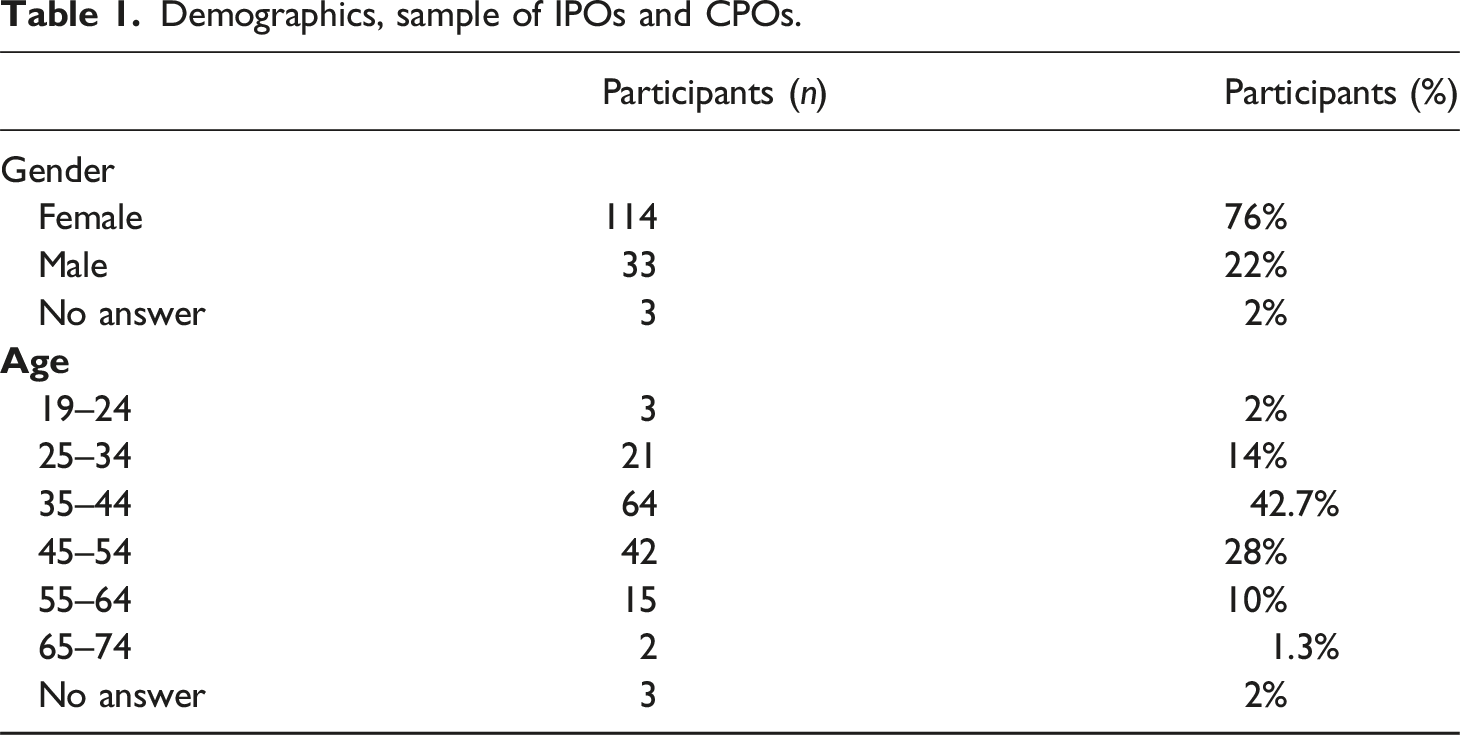
The participants came from a range of racial and ethnic backgrounds, though the majority identifying as white (85.3%). The study was approved by the relevant research ethics board.
Analysis
Each participant was anonymized with a number, as pseudonyms may cause implicit bias about gender and race/ethnicity from the researchers as well as readers. We only disambiguated POs working in the community/an institution if there were discernible differences, which were almost non-existent in the current analysis. Interviews were transcribed verbatim manually and coded with NVivo for primary codes and manually for secondary and tertiary codes. The primary coding involved multiple researchers each reading five transcripts and noting emergent themes. These themes across all researchers were then organized into a codebook, organized by code title, operationalization of the code, and a quote for an example of how the code materializes in participant words. We then coded all transcripts in their entirety according to the codebook. We engaged in manual secondary and tertiary coding, by approaching the data with the aim of gaining more nuance about the negative implications of PO work, including burnout, so we analyzed nodes with relevance for these themes. Using an abductive approach (i.e., an iterative process between themes emerging from data and relevant theoretical concepts), we noted POs discussed these issues in starkly moral terms. As the literature suggested trauma and moral injury often overlap, we went back to the coded data and expanded out with the data to incorporate analytic categories where POs discussed traumatic experiences. Next, we used moral injury and moral distress as sensitizing concepts (Charmaz, 2013) to frame our analytic focus. We were careful to distinguish morality and resulting feelings of distress from emotional labour and traumatic stress by selecting only interview segments where the PO described their adverse work experiences in terms of morality or implications for their sense of moral self (including fear of having done wrong, fear of being (seen as) a morally bad person) in addition to/instead of being a victim of trauma. We excluded segments where participants uniquely described fearing for their life and health, vicarious trauma, and PTSIs.
Our interview segments described moral distress through descriptions of distressing events and navigating their aftermath, or the challenge of finding the space and time to do the moral work of coping with the aftermath. Therefore, we categorized excerpts into experiences of moral distress and contextual conditions and then categorized these subsets into the themes presented. Some segments would cover both these overarching categories and thus be included in both – by virtue of describing both moral distress and contextual hinders in one account.
Findings
We present two overarching themes: (i) experiences of moral distress and (ii) contextual conditions (see Figure 1). We then discuss these findings by launching the new concept of moral labour to better understand how moral distress and pain lead to moral injury and other adverse work outcomes. Findings.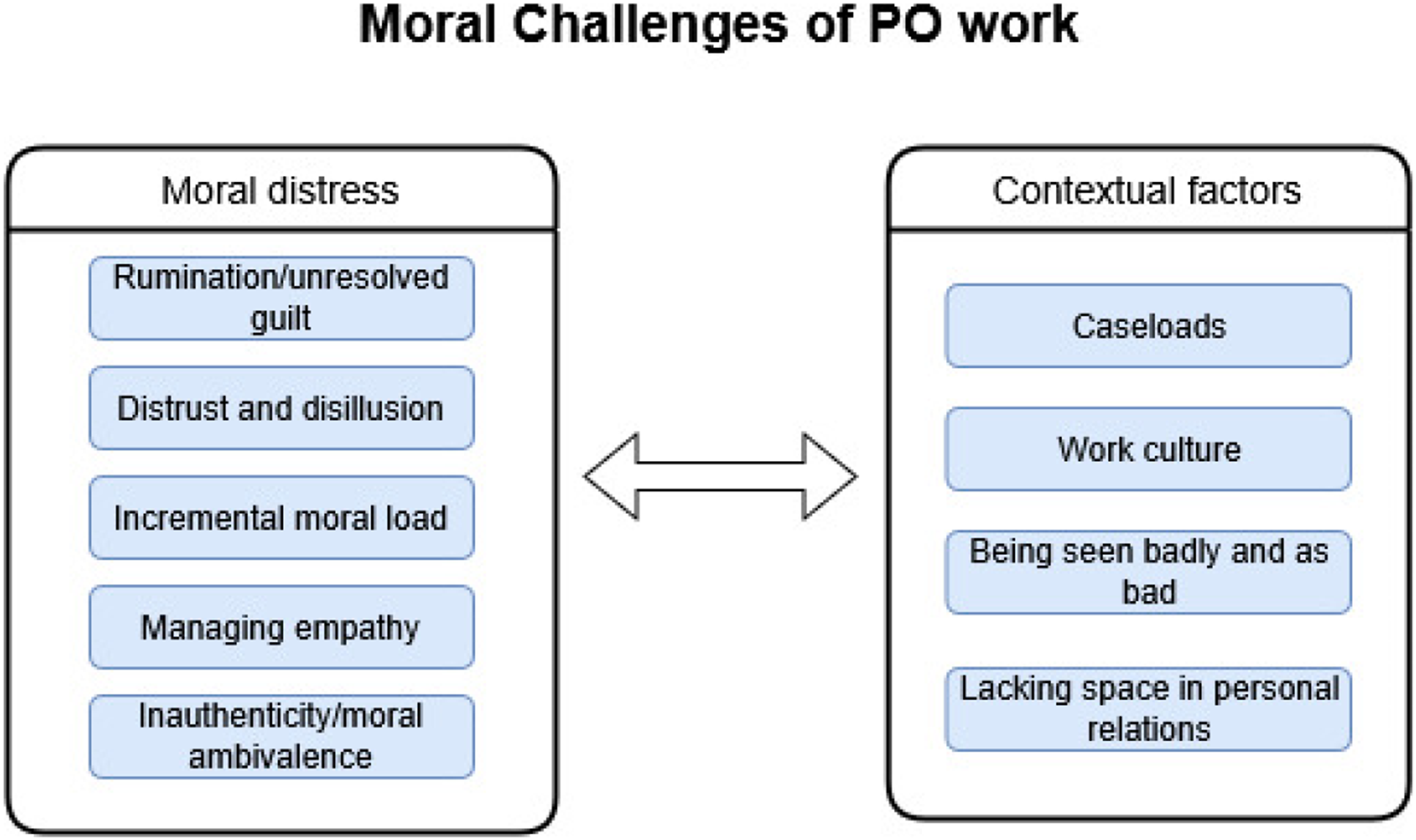
Experiences of moral distress
Our participants described multiple experiences that either immediately or incrementally added to the intensity of moral distress in the PO role, categorized as: (1) rumination and unresolved guilt, (2) distrust and disillusion, (3) incremental moral load, (4) managing empathy, and (5) inauthenticity and moral ambivalence.
Rumination and unresolved guilt – ‘Did I miss something?’
The experiences described here chime with Litz et al. (2009)’s definition of PMIEs. The potential for moral injury is present in the many high-stakes situations that are part of the PO role. For instance, the exercise of professional discretion in high-stakes settings often involves having to make assessments about the probability of outcomes one cannot control (Wallander and Molander, 2014). Here, we show how discretion also takes a strong moral toll, even despite established methods for managing decision-making and of ‘knowing logically’ there was nothing they could have done differently. Participants explained the ongoing feeling of moral responsibility (and even guilt) following a parolee’s actions that they failed to predict when under their supervision: We were called to the hospital to see a victim of domestic violence and she was terrified. I don’t think I’ve ever seen anybody that scared to this day. She said very little to the police, she ended up at the hospital because her mom went to pick her up because her husband was, um she had [health condition] and he was restricting her medication so she couldn’t move. […] Anyway, um [sigh] she wouldn’t talk to the police, so there wasn’t much they could do, and he was a correctional officer, and she decided to get a restraining order, she thought she was safe in the hospital and then he came to the hospital and killed her and her mom. So that stuck with me for, probably to this day, right? Like, you know we think we have a role to play and then it doesn’t matter, people are gonna do what they’re gonna do. USJE_019_JP_ I think the year before, when I was burning out, I had 2 cases that really went sideways in a bad way. And that was really hard, I’ve kind of felt like, I started to wonder what could I have done differently, did I handle the situation well, in both cases. There was not even an investigation, they do the preliminary and they see OK [you have] done everything you were supposed to do, and they didn’t even proceed, but it’s just me being hard on myself, ‘why didn’t I see this’. So I found that that was really, really tough. USJE_005_EC_ There’s that level of guilt that you should have seen something or you should have picked up on it, and I mean at the end of the day I know logically that there was nothing, there was nothing that would have given any indication but still you carry that. USJE_033_EC_
Across these excerpts, the participants narrate how these (impossible) assessments create a sense of moral responsibility when things go wrong, even if they are aware of the limited power of their role as POs (‘people are gonna do what they’re gonna do’). Agency is a central aspect of appraisals and behaviours connected to moral transgression (Gausel and Leach, 2011; Leach and Cidam, 2015), but the participant shows here how expectations of agency do not necessarily align with realistic capacity and room for manoeuvre (‘we think we have a role to play’). One consequence of the discrepancy is continuing distress and rumination – even after formal processes clear POs of formal responsibility. The participants’ words reveal the lingering effect of not being able to prevent future harm caused by those on their caseload through judgemental voices morally questioning their prior actions against an ideal of an ideal PO who is capable of hindering (all) harm (‘why didn’t I see this’, ‘you should have picked up on it’). They ‘carry that’ experience of moral responsibility for their clients’ actions, which nags away at them despite their actual lack of responsibility or ability to prevent such actions. One participant explicitly described how the experience of guilt, due to their recommendation for release as per policy, continues to affect their work performance: So I went from being pretty open minded and liberal in my recommendations to certainly one of the most conservative parole officers at [place] now. And I realized last year that uh a lot of that is because I don’t want to make another mistake. I don’t want to recommend somebody get out of prison and be responsible for somebody else getting hurt. So yeah, certainly that incident changed how I do my job fairly dramatically. USJE_001_AC_
Overall, participants described experiences of moral distress connected to high-stakes assessments in the penal context. They show how experiences of agency and moral responsibility – often misaligned with realistic room for manoeuvre – lead to rumination, questioning themselves and experiencing guilt for irreparable damage. Whilst rumination is a common reaction to stress, the participants’ experiences of moral responsibility for dire outcomes – both in the situation and afterwards – has specific implications for their sense of self. Moreover, the dissonance between their sense of moral responsibility and their actual room for manoeuvre makes the moral distress of rumination particularly demanding to resolve.
Distrust and disillusion – ‘That’s kind of depressing in a way, right?’
Our participants also described experiencing breach of trust in the justice system. One described people receiving sentences he thought too short relative to the moral transgression of the crime: He got two years. Two bloody years. And its things like that, that have completely eroded my belief in our entire criminal justice system. And I don’t just mean corrections, I mean courts, police. All of it. USJE_031_CM_
This participant, echoing others, described the moral distress that arises when they perceive systematic and structural processes as failing to hold people accountable for their actions. This is akin to Shay’s (2014) definition of moral injury, which focuses on betrayal by higher authority. Compounding the injury is how the responsibility for community supervision is known to fall on the backs of POs when injustice is served. In Canada, a 2-year sentence means the recipient is eligible for parole after serving one third of their sentence and statutory release after serving two thirds, thus the community PO is then responsible for the actions of the parolee after less than a year spent in prison for a crime they believe warranted a longer sentence. The POs described moral distress of witnessing injustice being caused by the very systems that are supposed to implement the moral code of society. This is difficult to reconcile because they are powerless to change the system but must witness and even implement the consequences of the system’s moral dysfunction.
Incremental moral load: ‘I guess the stabbings and the murders the suicides and the unknown deaths kind of have an impact on you’
Beyond specific events, participants described the effect of repeated exposure to morally distressing tasks. Tasks included reading casefiles/victim statements and directly witnessing moral transgressions at work, while trying to align their experiences with their faith in morality and justice. Here, in response to a question of whether they had any traumatic experiences at work, the participant listed the incremental load or accumulation: I guess in 12 years there’s been so many things. Let’s see, I’ve had an offender murder another offender in the gym where I had to watch the video so I could report exactly what he did in writing for my recommendation for him to go to the SHU [Special Handling Unit]. I had another offender, like I said, beat some guys head in with a cup and that got recommended for the SHU, I have a transgender person try to kill herself over and over. I had to talk her out of that. One of my offenders did die of unknown reason. I’ve been part of board of investigations about twelve of them cause every time one of your offenders is seriously injured or dies or tries to kill somebody else there’s a board of investigation to try and see not so much if I’ve done something wrong but to try and see if there was anything we could’ve done differently that would have had a different outcome. USJE_115_KW_
In addition to being potentially psychologically traumatic, the participant’s account shows the accumulation of moral distress associated with witnessing the effects of moral transgressions (‘I had to watch the video’) and the moral stakes of the job (‘I had to talk her out of that’), overlayed with constant examinations of whether one could have prevented harmful outcomes.
Another example of accumulated moral distress is navigating the repeated experiences of powerlessness. Participants describe a clash between their ambitions, expectations, and standards, and their lack of real agency to change the actions or circumstances of another human being. The following participant highlighted the moral distress when parolees struggle to participate in the PO’s rehabilitatory project: Especially when you don’t – they’re not willing to work with you either because they kind of see you as being the person that’s standing in their way because they don’t want to admit, they don’t want to look into themselves and what they’ve done, to get them there. So I just found it was very – there wasn’t a lot of movement and I just found that kind of taxing right? USJE_123_JP_
What the participant describes as ‘kind of taxing’ is the repeated powerlessness in feeling unable to perform their professional role because the person whose rehabilitation they are trying to support is not playing their part in the process. This rehabilitatory ambition forms a fundamental part of the value base of PPO work (Matejkowski et al., 2014) and is described as an important part of the job by many POs (Norman and Ricciardelli, 2022). This makes lack of success morally taxing work, not least given potential future harm. Repeated experiences of being without the agency to live up to one’s own moral standards can increase vulnerability to moral disengagement (Bandura, 2002). Higgins et al. (2022) starkly illustrate this with prison officers describing keeping ‘the nightmares in their cages’. Such dehumanization and moral disengagement can be interpreted as attempting to avoid moral distress. The alternative is to recognize the desire to not be powerless, and the moral standards for the role as being about supporting change and preventing further harm. This recognition also means recognizing failure (whatever the cause) to live up to such standards – moral distress.
Whilst repeated exposure to traumatic content can harm one’s outlook on the world in terms of security (e.g. people cannot be trusted), the consequence we described here is akin to moral disillusionment: there is no justice or true morality. As such, the category shows how the incremental load of moral distress, from sources like repeatedly witnessing injustice or failing to live up to one's professional moral standards, in itself makes maintaining hope and professional self-regard extra demanding.
Such incremental experiences supplement descriptions of intense moral distress, predominant in literature on moral injury in a military setting, and thus widen and nuance our concept of moral distress and the association of moral distress with moral injury in civilian contexts.
Managing empathy: ‘I just can’t stand the humanity of it all’
Several informants highlighted a link between being overwhelmed by the suffering of the incarcerated people and their victims (i.e. ‘it’s a heart-breaking job’, ‘you see it, you see photos’), and detachment (i.e. ‘you think that you wanna be immune’, ‘bitterness, jaded’). Caring too much clearly comes at a great personal cost, but detachment was also described as problematic: It’s a heart-breaking job and you and then when you see it in your own life it kind of breaks your heart even more and you think that you wanna be immune to it because I don’t want to be what I see in here. USJE_003_AC_ But then you – the veil comes off and you see it, you read it, you see it, you see photos, you talk to these guys, you’ve heard their account of it, you hear their absence of insight and the absence of their accountability like it’s just again bitterness, jaded. USJE_121_JP_
One way such jadedness is problematic is in how it can create dissonance between who they are and who they want to be for those they work with. POs must balance caring too much versus too little in each parolee relation, and in each interaction. The balancing act has a stark moral dimension: the cost of detachment is a threat to one’s moral integrity and even one’s belief in humanity. These experiences of moral distress are demanding to reconcile because they put the POs in an almost existential dilemma: either they work hard and risk burnout, moral injury, and compassion fatigue to live up to their professional values, or they avoid this effort and lose themselves through becoming jaded and uncaring.
Moral inauthenticity and ambivalence: ‘It really kind of takes a chunk out of your soul’
Participants also described experiences of moral emotions they struggle to reconcile. One aspect was working to adjust their own reactions to parolees’ moral transgressions in efforts to build a working alliance: It’s reading what these guys have done and then having to interview them and talk to them as if they’re a normal human being. And listen to them talk about their offence like ‘oh’ and their offending patterns and they’re talking about it as if it’s normal. In a lot of cases. Like you want to so... that’s the stuff that I just hide deep inside and then it explodes. USJE_001_AC_ It’s not my job to judge what they’ve done, it’s my job to help them reintegrate into [society], but I mean sometimes it’s very hard to put that away. USJE_033_EC_
Another aspect is feeling ambivalent and conflicted about building alliances with, and helping and supporting, people who have inflicted harm: I haven’t just met the bogeyman – I actually helped him. USJE_003_AC_ Reading what they did on paper and then having them sit in front of you […] most of the guys that I’ve seen have done very, very horrible things and here I am sitting face to face with them and I’m trying to help them so it’s kind of trying to reconcile that too. USJE_118_KW_
Here, tasks associated with Hochschild’s definition of emotional labour gain moral momentum. Feelings resulting from witnessing moral violations, such as anger and contempt, are not only challenging to combine with ‘sustaining outward countenance’ (Hochschild, 1983: p. 7), but doing so may have implications for the POs sense of moral self. First, the other-directed moral emotions (i.e. anger, contempt) participants described are in stark contrast to emotions required for rehabilitative actions (i.e. empathy, compassion) and thus, the core values of the profession (Matejkowski et al., 2014). Anger and contempt, when evoked, make experiencing/feeling empathy and compassion more challenging (Haidt, 2003). As such, experiencing anger and contempt threatens POs’ capacity to live up to their professional moral standards.
Second, experiencing and showing contempt performs a function for the self by confirming personal distance from the action, and taking a morally superior position (Haidt, 2003). Beyond professional role implementation then, not expressing – perhaps not even experiencing – anger or contempt may threaten the sense of moral self. (e.g. a PO feeling empathy as opposed to contempt for a person whose actions starkly misalign with their moral standards) – even making one feel inauthentic or disingenuous. POs, resultantly, may question their own morality both during and after the interaction (who am I if I don’t condemn these actions?) Suppressing feelings evoked by witnessing moral violations can also feel like a moral transgression.
A fifth theme in the POs described experiences of moral distress then, are the painful conflicts emergent between contempt and anger for acts of harm, and the professional and even personal empathy, compassion, and engagement bound up in helping. These conflicts are hard to reconcile because the tension is intrinsic to the role, but still puts the POs moral self at stake.
In sum, these five different themes – (1) rumination and unresolved guilt, (2) distrust and disillusion, (3) incremental moral load, (4) managing empathy, and (5) inauthenticity and moral ambivalence – all involve resolving a painful moral distress. The POs are working through experiences of themselves and the world, trying to fit them to a moral view of themselves, their role and the world that they can live with. This is hard work at a high price: their sense of self and belief in morality itself is at stake.
Contextual conditions
Molendijk et al. (2022, p. 2) define contextual factors as ‘the circumstances that, in interaction with each other and with individual factors, shape the development of moral injury, and in terms of which moral injury can be more fully understood’. In this section, we analyze how POs describe such contextual conditions as directly increasing moral distress and/or contributing to an experience of lacking support and space. We develop four sub themes: (1) caseloads, (2) work culture, (3) being seen badly and as bad, and (4) lack of space in personal relations.
Caseloads: ‘Our job never stops’
Participants described experiencing their caseload increasing and thus adding to the moral distress via the sheer number of cases: A few years back just yeah you know I wasn’t taking breaks I was just definitely taking the job like just completely I don’t know I wasn’t taking breaks I think was of the biggest things for me (okay) um and just soaking the work in and even working at home as well like I was getting paid but I was trying to work at home to try to keep the caseload up to date and you know trying to keep up so I think that created a lot of anxiety too. USJE_030_KW_ But it was that expectation of coming back to work and toughing through it I think was probably – like I bought into it. I, I could have stayed at home longer, I could have done what I needed to do but there – because everyone’s so overworked, there’s that expectation that you don’t drop the ball because someone else has to pick it up. USJE_117_CM_
They narrate a chronic, heightened, almost ever-increasing stress level that hampers stopping to recognize and address one’s moral distress. Thus, without ‘breaks’ POs lack of time and energy to do their reconciliation work. Furthermore, participants described how the structural condition of large caseloads affect the work culture (i.e. ‘there’s that expectation that you don’t drop the ball because someone else has to pick it up’) and prevent their taking of any room to make the time to recover – even when they recognize their need (i.e. ‘I could have done what I needed to do’). Thus, the participants describe lack of time to reconcile with moral distress, leading to a continuous and strenuous experience of violated sense of moral self. Excessive caseloads also exacerbate the dilemma of empathy work as morally painful: putting in major effort to reconcile with the moral distress versus the feeling of losing oneself.
Work culture: ‘My boss said: Well I just don’t let it get to me’
Culturally, POs related experiencing informal norms and assumptions as a hindrance to working through their moral distress, chiming with Westaby et al.’s (2023) analysis of controlling norms on emotion display and management. First, as the subtitle alludes, many participants experience cultural invalidation of their needs and effort to reconcile with their moral distress. As a consequence, many hid their reactions: I’ve certainly gone to my car and cried. After crappy interactions. Gone to my car and cried because I felt so badly for someone. And that’s a part of the job we’re not even allowed to admit to […] because you’re not allowed to say those things at work it’s like ‘oh well, geez keep going’. USJE_003_AC_
Cultural invalidation can be understood as an example of (non-)display rules (i.e. ‘you´re not allowed to say these things’, ‘a part of the job we’re not even allowed to admit to’) characterizing interaction between colleagues rather than with clients. In our participants’ descriptions, these non-display rules covered a range of reactions to adverse work experiences, including experiences of moral distress. Moreover, many POs described an experience of their moral distress as being regarded as inferior to that of correctional officers or first responders. In line with Ricciardelli et al.’s (2020) findings, our participants describe this cultural devaluation in the organization’s handling of the aftermath of adverse experiences, which may involve both traumatic stress and moral distress: But there should be support for the rest of us and the very fact that you don’t even have, you didn’t even invite us to any of the debriefs. I understand the first debrief is just for the direct responders, it always has been and so it should be but there should have been second debrief for the rest of us because we were affected too and the very fact that you didn’t even invite me to the meeting tells me that you think I wasn’t affected and yet I was. USJE_012_AC_ And I feel that the violence and the impact that that has on us, I think definitely we are seen as somewhat in the shadows of the [correctional] officers or the impact that the people will consider on officers since it’s indirect. We’re not considered, I think, as having directly experienced it so the impact is considered to be much less where we’re sort of in the shadows, no one’s really interested in that and it’s mostly ‘you’ve chosen that profession so you have to able to live with it’ USJE_FG1_AC_
These examples showed how contextual conditions such as invalidation (i.e. ‘not allowed to admit to’, ‘geez, keep going’, ‘live with it’) and devaluation (i.e. ‘seen in the shadows of’) encourage unhealthy coping strategies. For instance, not seeking or acquiring the necessary support (i.e. ‘gone to my car and cried’, ‘you didn’t even invite me to the meeting’). Frost (2016) points to social and structural misrecognition – a ‘consequence of institutionalized patterns of interpretation and evaluation that constitute one as comparatively unworthy of respect or esteem’ (p. 433, citing Fraser, 2013) – as damaging to the individual’s psyche and self. Cultural invalidation and devaluation contribute to a lack of recognition or even misrecognition – both from others and from oneself – that can encourage powerlessness, self-blame, and shame. POs may then find it difficult to seek support and recognize to themselves the moral distress they are experiencing – fundamentally hindering their recovery from it. There is a resemblance here to Litz et al.’s (2009) and Steinmetz and Grey’s (2015) descriptions of concealment and avoidance as a hinder to self-forgiveness and connection. Reconciling with moral distress does not just require time, but also space in the form of acceptance and recognition from the self and the surrounding organization.
‘I’m like public enemy number two’: Being seen badly and as bad
Socially, POs describe experiences of being seen or labelled by wider society as either insufficient: I mean like more like the general public like I was saying earlier they have high expectations of us but sometimes it feels like we have a crystal ball and that we can read the future. USJE_140_KW_ …or bad: it was very, very hard for us as parole officer to deal with that because our it seems like when you’re a parole officer nobody knows that you exist first unless something like this happens and then you only get you know critique […] but when something happens then we’re really bad workers and we should have seen it coming and so that’s definitely something that affected me a lot, a lot USJE_140_KW_
These are experiences of impossible expectations (i.e. the ‘crystal ball’) and of only being seen when they do not live up to expectations (i.e. ‘nobody knows that you exist unless…’) – only being seen as bad. Furthermore, they described an experience of little opportunity to repair their social image, which was represented in discourses beyond their reach. In line with both Gausel and Leach’s (2011) model and Leach and Cidam’s (2015) analysis of powerlessness as conducive to avoidance rather than repair behaviours, this contextual condition has potential of thwarting self-forgiveness and connection(Litz et al., 2009). In line with Mears et al. (2023), these maloptic (cf. McNeill, 2019) effects of POs being seen badly or as bad may affect how they see themselves and how they conduct their work (Mears et al. describe prison staff who experience their own form of Sykes’ ‘moral rejection’ from society due to their role). Again, contextual conditions are described by our participants as negatively affecting their social and personal space for reconciling with moral distress and recovering their sense of moral self – both through discouraging a warm and accepting attitude towards oneself, and through leaving the POs feeling powerless to make amends.
Lacking space in personal relations: ‘My boyfriend didn’t really get it’
Our participants describe how the nature of their work prevented them from experiencing support in their close relationships. Their exclusion is in part due to the often-disturbing details of their work: Most people, when you talk about some of the more specific things you do or they ask you and you start to talk to them about it and sometimes I forget the audience and then I can see it on their face the shock or the disgust or this are you serious look and so uh that’s [when] I know I’ve gone too far at that point in time in terms of talking about my job. USJE_120_JP_
And the more fundamental experience of alienation: My friends will talk about certain things they’ve read in the news and how disturbing they are and I mean they are disturbing but I’m like that’s not even – that doesn’t even scratch the surface of what I deal with, right? USJE_123_JP_ Our family they’re not equipped or know about our environment or to understand what we’re going through. USJE_FG1_AC_
For these POs, finding space in their personal life to talk about one’s experiences (‘I’ve gone too far’) or to feel understood (‘they’re not equipped to know’, ‘that doesn’t even scratch the surface of what I deal with’) is difficult. Such an experienced imperative towards carrying the burden alone can lead to concealment and withdrawal (Steinmetz and Gray, 2015), and thus loss of sources of support like friends and family.
In sum, these themes illustrate how POs experience some of the conditions they work and live in as hindering their capacity to reconcile with their moral distress and thus recover or heal their violated sense of moral self. These contextual conditions both affect their efforts to reconcile with themselves (self-concept and self-esteem) and their perceived opportunities to gain support, recognition and acceptance from others (belonging).
Discussion
Our aims with the current article were to broaden our empirical understanding of the key challenges of parole and probation work by shedding light on PO experiences of moral distress and moral injury. Viewing PO adverse work experiences through a lens of morality revealed some specific aspects of how these work experiences are painful and intrinsically harmful in the here-and-now, with implications for longer term adverse work outcomes such as burnout and moral injury (cf. Williams et al., 2020). Moreover, whilst moral distress is subjective, resolution happens in interaction with professional, relational, and social contexts. Our analysis did not only specify particular experiences of moral distress, but also point out how managing this distress is an intrapersonal and relational process situated in a systemic context. That is, our informants describe both characteristics of the contexts in which moral distress happened, and how these contextual conditions specifically affect their capacity to reconcile with the implications of moral distress for their sense of moral self (e.g. self-concept and sense of belonging).
Moral labour: A suggested concept to address the process of healing from moral distress
Based on this observation, we argue that we must understand more about this contextually situated process of protecting and recovering one’s moral self: how moral distress may lead to adverse work outcomes such as moral injury, burnout, and compassion fatigue (Williamson et al., 2025). To grasp the distinct process, we suggest the term moral labour to refer to the cognitive, emotional, and social process of managing the implications of morally distressing experiences. Moral labour describes the process by which moral distress may lead to adverse work outcomes, if PPOs find themselves lacking in organizational, cultural, and social support to do this moral labour (as our participants did). Looking at our findings with the concept of moral labour in mind, we can reorganize our model: We place the participants’ descriptions of moral distress as subjective experiences (although being brought about by external events), and place the process of moral labour – exemplified here as five ‘subtasks’, that these experiences of moral distress necessitate for the POs to recover a sense of moral self – within the contextual conditions that affect it. These examples show how even though moral labour is often invisible, it is a real task that requires time and space that may be hindered by contextual factors (Figure 2). Moral distress and moral labour.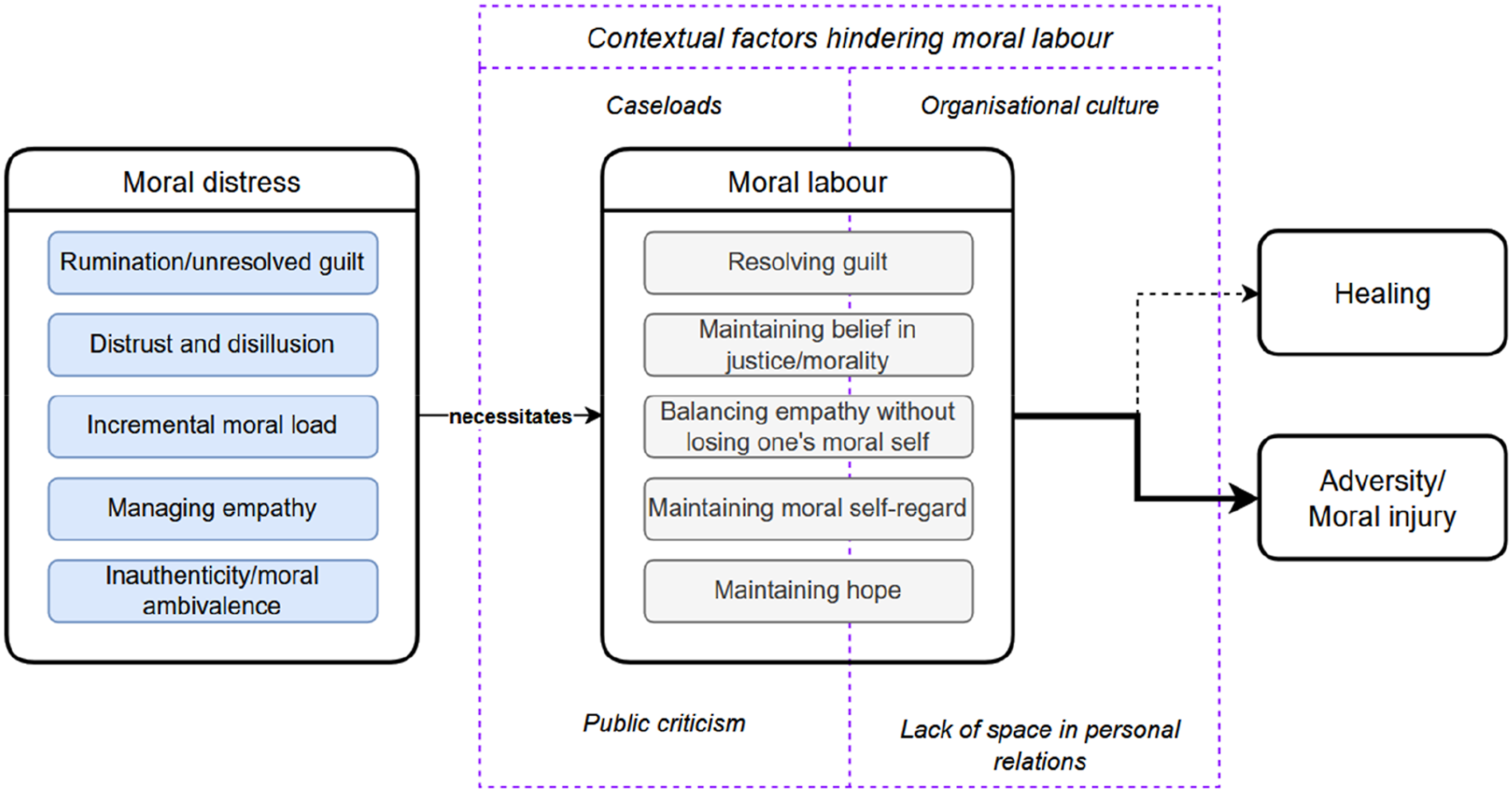
In developing the concept moral labour, we hope to provide recognition of a hitherto under-played aspect of PPO work and start a conversation about this for PPOs and others, particularly those working in prisons where the very conditions of confinement can impose human suffering which is morally violating for all. The concept neighbours emotional labour in its focus on the costs of emotion-work in a professional setting but is unique because the labour is rooted in moral violations, that has specific consequences for the participants’ sense of self (who am I if I don't condemn this action?) and belonging (am I a morally sound person, do I belong in the moral community?). We believe this concept describes a process that is both broader (in terms of variety of tasks, and how each involves continuous emotional, cognitive and relationally contingent processes beyond specific interactions) and deeper (in terms of the implications of moral violation for self-concept and belonging). Moreover, we believe the concept of moral labour adds to the moral injury literature by describing a dimension along which the processes that lead to moral injury can be understood. For instance, the informant who found it morally painful to help the person whose actions were hard to see past (p. 13), may have to work on their felt and expressed emotions during the interaction (morally painful emotional labour) and its implication for their sense of moral self in the aftermath (morally painful identity work). Both these forms of moral labour require time, support, and relational/emotional space (Williams et al., 2020), which if frustrated by excessive caseloads, lacking organizational support, invalidating work culture or being seen badly and bad by the wider society, may potentially lead to moral injury. Finally, we contend that moral labour adds to both these research areas through its capacity to direct focus on both specific moral pains and contextual factors affecting their resolution. We hope moral labour as a concept lays the ground for developing transferable knowledge on how interactions in themselves can be contributors to adverse work impacts and thus targets of preventative measures.
By including ample examples of quotes, we hope to achieve two things. First, to give voice to the lived experience of our participants. Second, to anchor our analysis empirically in a way that enables the reader to assess the intersubjective adequacy of interpretation (Morrow, 2005) as relevant to their context. Our analysis was co-created in the interaction between the purpose and context of the study, the authors’ academic and professional backgrounds and our empirical data. Recognizing this embeddedness, we nevertheless argue our analysis can be relevant beyond the Canadian and the PPO context, in particular to other areas characterized by moral tensions and the dilemma and double role of care and control, for instance in nursing, policing, firefighting, and other public safety and public health professions.
In addition, our approach enables understanding the moral strains and conflicts that serve as the backdrop for PPOs as they are trying to enable their clients’ moral labour. A key task in probation work is to support clients/parolees in managing their moral violations and resultant feelings regarding their transgressions in ways supportive of change. Moral violations can be managed to translate into pro-social and self-improving behaviour (Gausel and Leach, 2011; Leach and Cidam, 2015). Here, criminological research predominantly focuses on those punished (Ahmed et al., 2001; Ievins, 2018; Maruna and Mann, 2006), yet future research is warranted that explores how those working in penal contexts experience the dynamic of morality – and how this affects their interaction with clients.
PPOs and others working with persons who have committed severe moral transgressions are taking on an immensely challenging and complex social responsibility. To constructively engage with such efforts, we must take a broad approach to understanding the working conditions that enable professionals to stay, thrive, and be productive in this line of work. Staff quality affects programme effectiveness (Makarios et al., 2016) and, more specifically, we argue excess moral labour can reinforce the dynamic Warr (2020) describes, in which staff’s preoccupation with the moral dissonance of their own role can provoke moral blindness to the suffering of their incarcerated clients. Thinking in terms of moral distress and injury also raises the need to consider how and why structural conditions create such repeated, churning experiences of moral pain and distress for victims, those subject to punishment, and those tasked with the implementation of consequences.
There are multiple issues to address in further research on this topic, including gendered aspects of moral distress/labour, a further exploration of agency and moral labour, and the interaction between commodified moral labour and quality of life.
Practice implications
The concept of moral labour can inform practice by helping identify, recognize and provide support for common experiences of moral distress in a specific role. Support measures could focus on fostering connectedness among staff and focussing attention on positive achievements and opportunities to focus on what one can control (as opposed to for instance the parolee’s behaviour) (see also Williams et al., 2020). More research – such as on what ‘subtasks’ moral labour may entail, whether POs, PPOs and other relevant professionals themselves find the concept a useful way to put words to their experiences, and analysis of how measured moral distress, contextual hinders and potential interventions to support moral labour affect prevalence of adverse outcomes such as burnout and moral injury – is truly needed before we can make clear and firm recommendations for applied practice.
Conclusion
Overall, we have unpacked a crucial, but often invisible part of the PO role. Moral distress cannot be prevented altogether. As our article’s title implies, it is not unwelcome, but bears witness to our humanity. However, the moral labour of resolving it can be a heavy burden to carry that requires structural, cultural, social, and relational support. In recognition of that, we conclude this article with the full quote from the title: P: If it didn’t screw me up then I would be screwed up, so I guess I’m glad that I find it so difficult. I: Yeah absolutely. P: But I still have to deal with it.
Footnotes
Acknowledgements
The authors would like to thank Clara Iversen for her helpful comments on an early draft of this article.
Declaration of conflicting interests
The author(s) declared no potential conflicts of interest with respect to the research, authorship, and/or publication of this article.
Funding
The author(s) disclosed receipt of the following financial support for the research, authorship, and/or publication of this article: This work was supported by the Union for Safety and Justice Employees (USJE) funded the original study.
Ethical statement

Data Availability Statement
The interview data used in this study contain sensitive personal information. As such, the transcripts are not publicly available.