




Abstract
The enactment of Framework Decision 2008/947/JHA encounters numerous impediments, with Spain representing a particularly instructive case. Although transposed into Spanish legislation in December 2014, the utilisation of this instrument remains notably infrequent. This scarcity in application is, in part, due to its omission in cases of conditional release, where there is a marked preference for pre-transposition statutes in affording such benefits to EU citizens. Nonetheless, insights from the annual meeting of Penitentiary Surveillance Prosecutors herald a pivot towards a mandatory engagement with Framework Decision 2008/947/JHA. This anticipated shift portends a broader adoption of this legal mechanism in the coming years, especially concerning conditional release. This paper delves into the challenges inherent in implementing Framework Decision 2008/947/JHA, with a particular focus on the Spanish jurisdiction. Following a thorough examination of relevant data and scholarly discourse, this study proposes a suite of recommendations aimed at enhancing the utility of this legal tool.
Keywords
Introduction: Utilization and status of implementation of Framework Decision 2008/947/JHA
Brief overview of Framework Decision 2008/947/JHA: Genesis, aims, extent, and principal elements
In 1999, “the Tampere European Council decided that judicial cooperation in criminal matters between the Member States should be based on the principle of mutual recognition of decisions in criminal matters” (Nauta et al., 2018: p. 3). The underlying premise posited that mutual recognition would forge a more expeditious and efficacious modus operandi for cooperation than the conventional legal instruments hitherto employed. The principle of mutual recognition necessitates that Member States within the European Union (EU) acknowledge and enforce judicial decisions made in one Member State with the equivalence accorded to decisions rendered within their own jurisdiction (Marguery, 2016).
The array of Framework Decisions (FDs) advancing the mutual recognition principle in criminal matters, particularly with regard to penal resolutions pertaining to accused, suspects, or convicts, encompasses: - Council Framework Decision 2008/909/JHA on the application of the principle of mutual recognition to judgments in criminal matters imposing custodial sentences or measures involving deprivation of liberty for the purpose of their enforcement in the EU (FD 909). - Council Framework Decision 2009/829/JHA of 23 October 2009 on the application, between Member States of the EU, of the principle of mutual recognition to decisions on supervision measures as an alternative to provisional detention (European Supervision Order, FD 829). - Council Framework Decision 2008/947/JHA of 27 November 2008 on the application of the principle of mutual recognition to judgments and probation decisions with a view to the supervision of probation measures and alternative sanctions (FD 947).
The background for FD 947 is to be found in the Council of Europe Convention on the Supervision of Conditionally Sentenced or Conditionally Released Offenders (1964), which aimed to provide mutual assistance in the social rehabilitation of offenders (this Convention was only ratified by 20 EU Member States). FD 947 broadens the ambit to include the mutual recognition of suspended sentences, conditional sentences, and alternative sanctions, as well as decisions regarding conditional release, thereby incorporating probation measures and alternative sanctions within its purview.
This FD aims to facilitate the social rehabilitation of sentenced persons, improve the protection of victims and of the general public, and facilitate the application of suitable probation measures and alternative sanctions, in case of offenders who do not reside in the sentencing State (Art. 1 FD 947; see Montero and García, 2021; Faraldo Cabana, 2021a).
In order to achieve these objectives, this FD is applied to the mutual recognition of judgments and probation decisions, the transfer of responsibility for the supervision of probation measures, and alternative sanctions. Consequently, a suspended sentence, conditional sentence, or any alternative to custodial sentence—collectively known as probation measures at the European level—would be encompassed by this FD.
Criminal judgments imposing custodial sentences or measures involving deprivation of liberty and financial penalties (including confiscation orders) are outside the scope of application of this legal instrument.
To encapsulate, FD 947’s pivotal features include establishment of a procedural system based on the sending of a certificate using direct contact among competent authorities; the capacity to initiate proceedings at the behest of the implicated individual or Member State (Art. 5 FD 947). This FD mandates the acceptance of a resolution transfer (Art. 7 FD 947), unless grounds for refusal can be applied (Art. 11 FD 947), and precludes any obligation on the issuing State’s part to transfer a probation or alternative measure or sanction—effectively, the sentenced individual does not possess a transfer entitlement. Double criminality checks are dispensed with for a catalog of 32 offenses (Art. 10 FD 947). Additionally, FD 947 stipulates stringent temporal constraints (Art. 12 FD 947), mandating the executing State’s competent authority to render a prompt decision, within a 60-day frame post-receipt of the judgment and, where applicable, the probation decision, alongside the certificate, on whether to acknowledge the judgment. Sentence adaptation is permissible solely if its essence or duration is discordant with national statutes (Art. 9 FD 947), and subsequent to recognition, the administration and application of probation measures and alternative sanctions will be governed by the legislation of the executing State (Art. 13 FD 947). Consultations between competent authorities are foreseen (Art. 15 FD 947), as an evaluation of the individual’s social rehabilitation is deemed imperative (see Durnescu, 2017).
Given the substantial rise in the implementation of alternative sanctions and measures since the 1990s (refer to Aebi et al., 2015; Aebi and Hashimoto, 2022, 2023; Aebi et al., 2023) and the considerable mobility within the European Union’s populace 1 , an increasing number of individuals are subject to alternative sentences and measures in EU Member States alien to their origins.
In such a milieu, FD 947 assumes a crucial role within the European judicial landscape. Its purpose centered on the social reintegration of the convicted individual, means that effective operation of this statute permits the person to fulfill the sentence or measure in the country where they maintain social bonds and envisage their life’s trajectory. This provision is designed to avert the dislocation of the sentenced individual from their societal roots. It is anticipated that FD 947, still to unleash its full potential, will enhance its functional capacity, yielding considerable dividends for the communal safety.
Status of the implementation of the Framework Decision 2008/947/JHA in the international context
FD 947, promulgated on the 16th of December 2008, came into immediate effect and was stipulated for incorporation into national statutes by no later than the 6th of December 2011. This directive allotted slightly less than 3 years for all EU member states to undertake necessary measures for the Decision’s enactment and its integration into their respective legal frameworks. Merely two Member States succeeded in meeting this imperative by the specified deadline.
Equally, as of 2014, the enactment level of this juridical instrument was considerably suboptimal, with transpositions by EU Member States often being partial and at times incomplete. The European Commission, in its report to the European Parliament and the Council dated the 5th of February 2014, observed that numerous Member States were yet to fulfill their obligations to transpose FD 947 at that juncture (European Commission, 2014).
Subsequently, on the 4th of November 2016, the General Secretariat of the Council of the European Union disseminated a report to delegations, highlighting a discernible increase in transpositions: the communique from the General Secretariat indicated that, by then, 19 Member States, namely, Belgium (BE), Bulgaria (BG), Czech Republic (CZ), Germany (DE), Denmark (DK), Spain (ES), Croatia (HR), Cyprus (CY), Lithuania (LT), Latvia (LV), Hungary (HU), the Netherlands (NL), Austria (AT), Poland (PL), Romania (RO), Slovenia (SI), Slovakia (SK), Sweden (SE), and Finland (FI), had embedded the FD within their national legal infrastructures (Council of the European Union, 2016).
Presently, FD 947 has been duly transposed across the judicial frameworks of all EU Member States, a fact corroborated by the European Judicial Network. 2
Nevertheless, mere transposition into national statutes does not necessarily equate to the FD’s correct application within the practical realm. According to the questionnaire performed by the European Judicial Network (EJN) for the 51st Plenary Meeting of this Network (on 22–23 November 2018 in Vienna), about the Application of European Legal Instruments Based on Mutual Recognition in Criminal Matters, FD 947 is underused: To the question “how often have you been concerned with the application of the FD 2008/947/JHA as contact point or in any other function since its implementation” 97 Member States contact points (or competent or involved authorities in the application of this FD) were able to reply and over 3/5 of them had never been concerned with the application of this FD, nearly 1/3 were rarely consulted and less than 1/10 were consulted more often (European Judicial Network, 2018).
Concurrently, in September 2018 at the fourth edition of the FDs Expert Meeting, orchestrated by the Confederation of European Probation (CEP) in Brussels, a survey regarding the implementation of FD 947 and FD 829 was applied to the 33 participants from 17 countries who had gathered. The majority of those asked about their experiences in the implementation of FD 947 acknowledged having little experience. 3 This sentiment was echoed at subsequent CEP expert assemblies on the aforementioned FDs, held in Leuven on the 24th of September 2019, virtually on the 29th of September 2021, and latterly in Brussels on the 14th of September (Confederation European of Probation, 2022). 4 Despite the significant evolution in probation measures and alternative sanctions, it was noted that numerous legal systems still only sparingly utilize FD 947 (Aebi et al., 2015; Aebi and Hashimoto, 2022, 2023). Notable among the 2022 meeting’s deductions was the necessity for amplified mutual trust among Member States, enhanced direct communication among pertinent authorities, and strategies to surmount linguistic hurdles and the disparate levels of proficiency among the professionals engaged with this legal tool. One issue of particular salience is the challenge presented by the disparate national legislations which encompass an extensive variety of alternative penalties and measures, divergent across states and labeled differently. A deficiency in the understanding of the punitive systems amongst Member States, as well as the presence or absence of equivalence between penalties and measures, engenders significant mistrust. 5 Undoubtedly, mutual recognition instruments presuppose a degree of homogeneity within the criminal domain across the European Union, a presumption that is not borne out in practice. The penal systems of Member States, particularly regarding alternative sanctions and measures, display profound variations (see Montero Pérez De Tudela, 2021).
According to Appendix I to the Council of Europe’s Recommendation CM/Rec (2010), probation “relates to the implementation in the community of sanctions and measures, defined by law and imposed on an offender. It includes a range of activities and interventions, which involve supervision, guidance, and assistance aiming at the social inclusion of an offender, as well as at contributing to community safety.” Adding the Council of Europe’s Recommendation CM/Rec(2017), that “the expression ‘community sanctions and measures’ means sanctions and measures which maintain suspects or offenders in the community and involve some restrictions on their liberty through the imposition of conditions and/or obligations.” Consequently, the Council of Europe endorses expansive interpretations of probation and community sanctions and measures, thus affording Member States considerable leeway in the election and governance of these penalties and measures.
The following sections will delve deeper into the various impediments contributing to the underutilization of FD 947. However, it can be confidently asserted at this juncture that despite FD 947 being formally transposed into the domestic legislations of all Member States, its practical application remains limited. Spain, as we will explore in subsequent passages, serves as a particularly illustrative example.
Framework Decision 2008/947/JHA in Spanish context
This examination is underpinned by an array of sources, encompassing extant legislation, statistical insights furnished by the General Council of the Judiciary, the Spanish National Institute of Statistics, the General Secretariat of Penitentiary Institutions, as well as antecedent studies and reports—including those classified as gray literature—focusing on the execution of FD 947 within the Spanish jurisdiction.
In Spain, FD 947 was transposed into national law through the enactment of Organic Law 23/2014 of 20 November 2014, concerning the Mutual Recognition of Judicial Decisions in Criminal Matters within the European Union, which came into effect on 11 December 2014 (LRM). 6 This Organic Law transposes several relevant EU legal instruments in criminal matters.
According to the Spanish transposition of the FD 947, Art. 93 states that: “the sentences whose regime of recognition and execution is regulated by this Title are final resolutions handed down by the competent authority of a Member State imposing a custodial sentence or a measure of deprivation of liberty or any of the measures foreseen in Article 94 on a natural person, when the following is resolved in relation to serving thereof: a) conditional release on the basis of that sentence, or by a subsequent probation decision; b) suspension of the sentence, either partially or totally, imposing one or more probation measures, that may be included in the sentence itself, or be determined in a separate probation decision; c) substitution of the penalty by another imposing deprivation of a right, an obligation or a prohibition that does not constitute a custodial sentence or a measure of deprivation of liberty or a financial penalty; and d) pursuant to the laws of the issuing State, a conditional sentence by means of which one or more probation measures are imposed, being able, when appropriate, to differ from the conditional form of the custodial sentence imposed.”
Probation measures which can be forwarded to another EU Member State (Art. 94 LRM, see Faraldo Cabana, 2019a) are the obligation of the sentenced person to inform a specific authority of any change of residence or working place; the obligation not to enter certain localities, places, or defined areas in the issuing or executing State; the obligation imposing limitations on leaving the territory of the executing State; instructions relating to behavior, residence, education, and training; leisure activities or containing limitations on the modalities of carrying out a professional activity; the obligation to report at specific times to a specific authority; the obligation to avoid all contact with specific persons or with specific objects; the obligation to financially compensate for the prejudice caused by the offense and/or to provide proof of compliance with such an obligation; the obligation to carry out community service; the obligation to cooperate with a probation officer or with a representative of a social service having responsibilities in respect of sentenced persons; and the obligation to undergo therapeutic treatment or treatment for addiction.
Within the Spanish legal framework, conditional release is governed by Art. 90 of the Spanish Penal Code (SPC). It is characterized as a suspension of the enforcement of a custodial sentence, conditional upon a range of stipulated prohibitions and duties. This suspension may be granted after an inmate has served half of their sentence, provided it is their first incarceration and the term does not exceed 3 years. Alternatively, conditional release may be afforded after two-thirds of the sentence has been served if the individual has consistently engaged in labor, cultural, or vocational activities, or after three-quarters of the sentence in other cases. 7 The adjudication of conditional release is vested in the Penitentiary Surveillance Judge (sp. Juez de Vigilancia Penitenciaria).
In addition to the conditional release, in the Spanish legal system, the following can be considered Penalties and Alternative Measures
8
: - Suspension of the sentence, regulated by Art. 80 SPC. According to this provision, the judge (or Court) may agree to the suspension of the custodial sentence not exceeding 2 years (even not exceeding 5 years in the case of drug addicts) when it is reasonable to expect that the execution of the sentence is not necessary to prevent the commission of new crimes (by the convicted person). This measure is conditioned to the non-commission of new crimes and the judge can condition the suspension of the sentence to the fulfillment of some prohibitions and duties (Art. 83 SPC). - Security measures not involving deprivation of liberty regulated in the Art. 95 and followings of the SPC. The non-custodial measures are the professional disqualification, the expulsion from the country (for foreigners not legally residing in Spain), the supervised freedom, the family custody, the deprivation of the right to drive motor vehicles and mopeds, and the deprivation of the right to possess and carry weapons (Art. 96.3 SPC). - The supervised liberty regulated in the Art. 106 SPC. It is a non-custodial security measure which can be applied instead of a custodial penalty (as an alternative to a prison sentence) for persons immune from prosecution (non-criminally responsible). It can also be imposed after the execution of a prison sentence, in case of some serious crimes. This measure consists in subjecting the convicted person to judicial supervision by means of compliance with one or more of the measures provided for in the aforementioned article (e.g., the obligation to be always reachable by electronic devices allowing their permanent monitoring, the obligation to appear periodically at a place fixed by the judge or court or the prohibition to approach the victim). - The open regime or semi-freedom, regulated in the Spanish Prison Rules (SPRs), is a way of implementing a custody sentence—being in semi-liberty—and is considered as a probation measure by a lot of authors. There are several modalities of open regimen, and some of them are truly similar to the conditional release (below). - Community work regulated in the Art. 49 SPC, which implies the performance of public utility activities without remuneration. - and permanent localization, commonly known in the EU context as “home detention,” which is considered in Spain a deprivation of liberty penalty (Art. 37 SPC) consisting in the obligation of staying at home or other place designed by the judge or the Court during the period established in the sentence.
Pursuant to the LRM (Art. 95), the competent judicial authorities in Spain for the implementation of FD 947 are those Judges or Courts responsible for overseeing the execution of the sentence or probation decision.
This provision delineates two potential scenarios: - Where probation measures are prescribed as an alternative to incarceration—such as community work or suspension of sentence with associated conditions—the FD 947 shall be invoked by the sentencing judge or court. - Conversely, in instances of conditional release, which constitutes a partial suspension of the prison sentence during the final phase of custody, the Penitentiary Surveillance Judge holds the requisite authority.
The Central Criminal Court is the designated authority responsible for the recognition and enforcement of probation decisions issued by the competent bodies of another EU Member State. Should the probation decision pertain to a minor, the Central Court for Minors is vested with the requisite jurisdiction.
As delineated by the LRM in its expository memorandum, jurisdiction over the transmission and execution of various mutual recognition instruments is shared between the Judiciary and the Public Prosecutor’s Office. The legislation stipulates a mandatory consultation with the Prosecutor in instances where a Judge or Court is deliberating on any of the said instruments. Specifically, for the transmission or acknowledgment of judgments or probation decisions concerning the oversight of probation measures and alternative sanctions, the procurement of the Prosecutor’s opinion is compulsory. Furthermore, within the process of granting conditional release, with or without recourse to FD 947, an evaluative report from the Surveillance Prosecutor is invariably requisite.
Yet, despite its comprehensive assimilation into the Spanish legal framework, the utilization of FD 947 remains negligible, as evidenced by the data from the Spanish General Council of the Judiciary (see also Faraldo Cabana and Fernandez-Bessa, 2019).
Penalties and measures not involving deprivation of liberty in Spain.
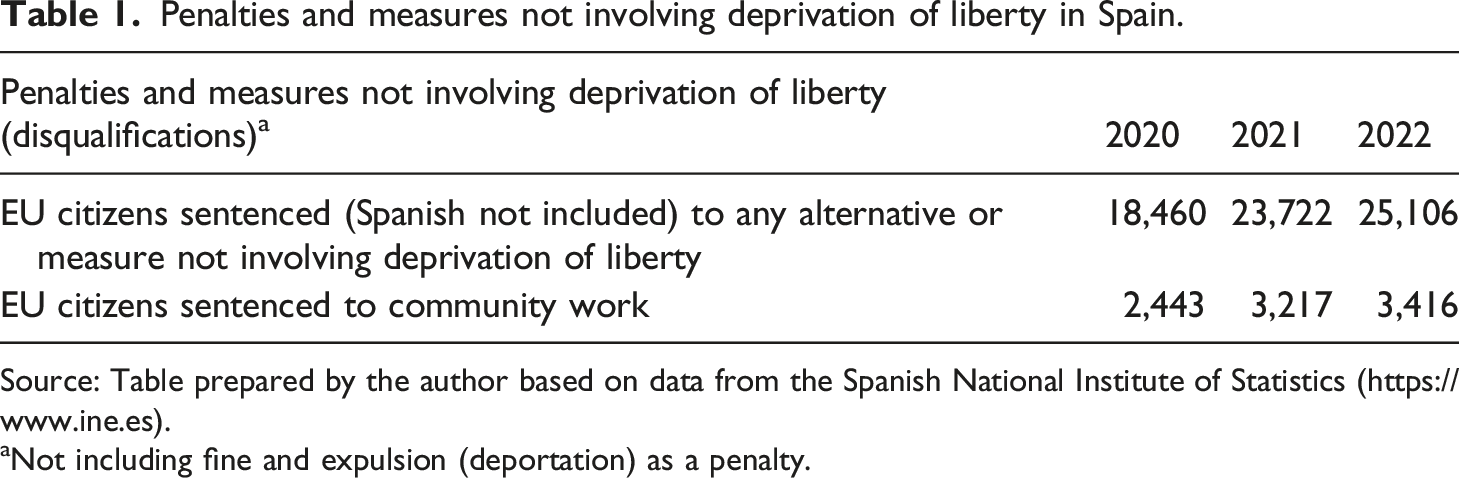
Source: Table prepared by the author based on data from the Spanish National Institute of Statistics (https://www.ine.es).
aNot including fine and expulsion (deportation) as a penalty.
European probation orders issued by and received in Spain.
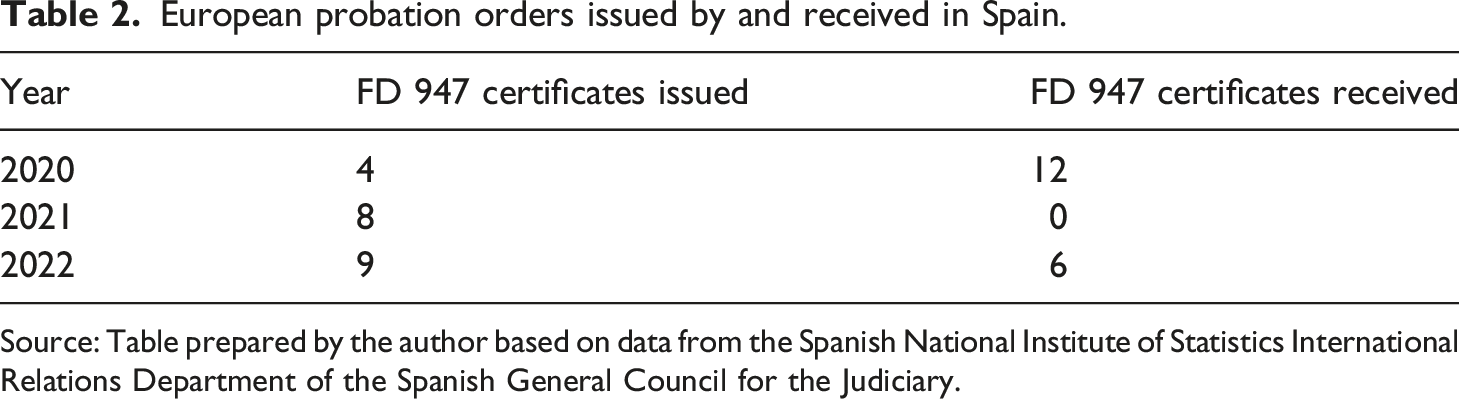
Source: Table prepared by the author based on data from the Spanish National Institute of Statistics International Relations Department of the Spanish General Council for the Judiciary.
As depicted in Figure 1, the apex of FD 947 utilization was attained in 2022, with a mere nine certificates dispatched. FD 947 certificates issued (emitidas) and received (recibidas) in Spain from 2018. Source: Figure extracted from bulletin n° 103, issued by the General Council of the Judiciary, on statistical information on the recognition instruments mutual criminal resolutions of the EU (2023, p. 4).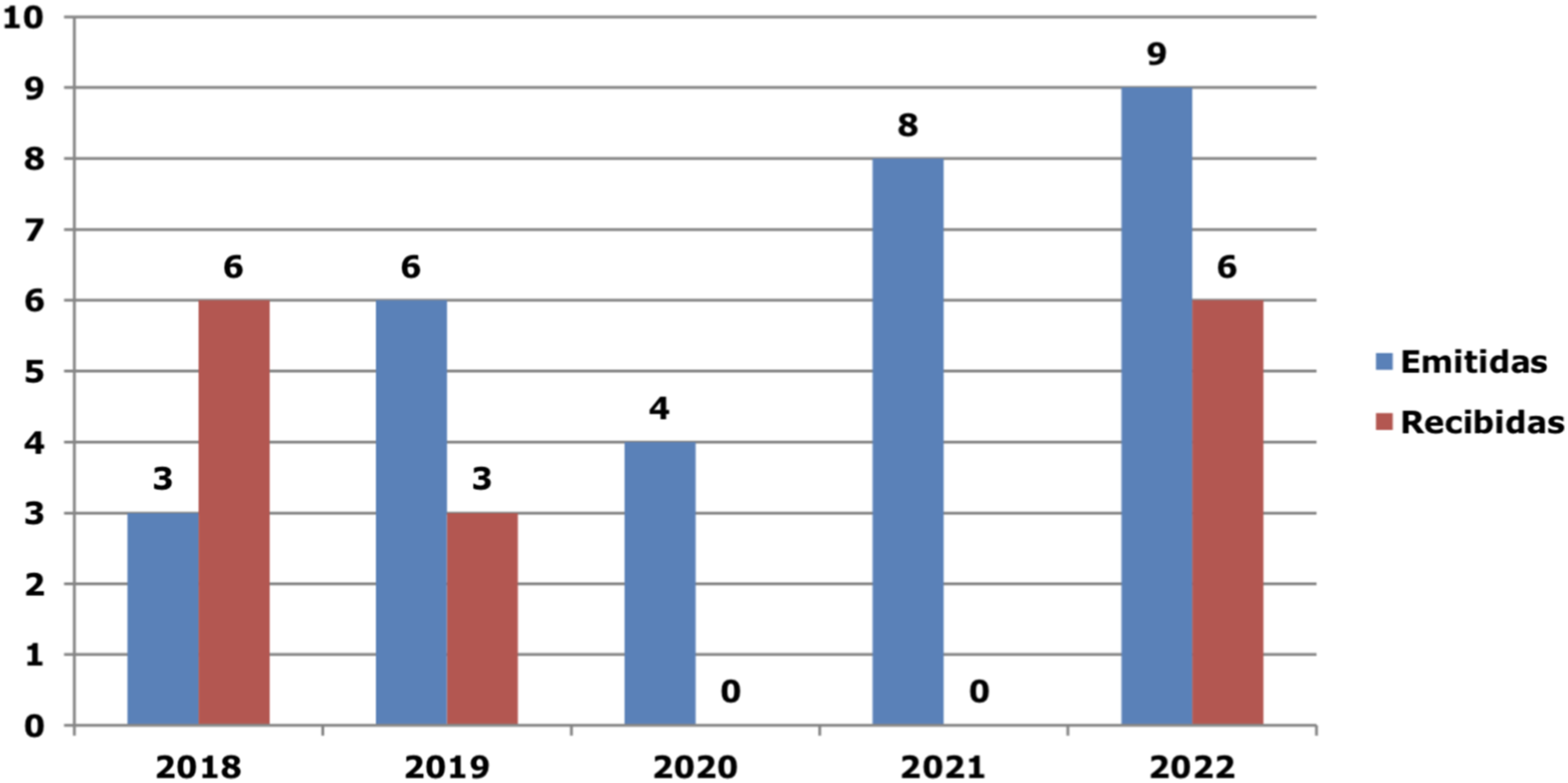
The 9th round of Mutual Evaluation on Mutual Recognition Legal Instruments related to deprivation or restriction of liberty, conducted in May 2022 in Spain by an evaluation team from the General Secretariat of the EU Council, found the application of FD 947 by Spanish authorities to be markedly scant (General Secretariat of the Council of the European Union, 2022). Notably, Penitentiary Surveillance Judges did not utilize the framework; the four certificates issued in 2020 originated from three Criminal Courts and one Provincial Court. 10 Hence, FD 947 was not employed for the processing of conditional releases within the countries of origin or residence of EU citizens.
Despite the underutilization of FD 947, data from the Spanish Penitentiary Institution indicate that EU citizens incarcerated in Spain routinely obtain conditional release, with a number of them opting to serve this phase in their home countries or countries of residence. From January 2021 through August 2023, it is reported that at least 50 EU nationals serving custodial sentences in Spain have been granted conditional release to be exercised in another EU Member State. 11
The prison computer system data for 2022 indicate that 21 EU citizens were granted conditional release to be served in their respective countries of nationality, origin, or residence within the EU. However, it should be considered that these figures are likely underestimated. The data, sourced from the Spanish Penitentiary Information System, often do not delineate whether the conditional release is to occur in another EU state. Consequently, it bears emphasizing that “at least” 50 EU citizens serving sentences in Spanish institutions were granted conditional release in other EU Member States from 2021 to mid-2023. The actual figure is expected to exceed this count substantially.
Nevertheless, this was achieved without resorting to FD 947, leading us to a critical inquiry explored in the forthcoming section: “What Doesn’t Work?”
What doesn’t work? “A lot of work for such a small penalty”
Turning our attention to Spain, we can identify, on one hand, the challenges associated with the broad application of FD 947, which subsequently impacts its utility in the context of conditional release. On the other hand, there are the particular challenges associated with deploying this FD in instances of conditional release.
With regard to the initial category, the barriers to the implementation of FD 947 within Spain share commonalities with those encountered throughout other EU Member States, notwithstanding certain nuances—chiefly concerning the array of available probation measures.
In an effort to facilitate the implementation of FD 947, among other instruments, the European Commission, via the Directorate-General for Justice Grants, allocated funding in 2019 for the project “Probation Observatory: Network and Training” (PONT), 12 which reached completion in 2021. Employing a hybrid methodology that incorporated both quantitative and qualitative approaches, 13 the findings revealed that the competent authorities perceive FD 947 as time-consuming—rendering compliance with prescribed timelines a near-impossibility—as well as complicated and confusing (see Durnescu, 2019; Durnescu et al., 2020; Montero Pérez De Tudela et al., 2019; Montero Pérez De Tudela, 2021; Montero Pérez De Tudela and García Ruiz, 2023). In addition, competent authorities said “not being sure about the legal options in the Executing State,” “not being sure that the obligations will be carried out in the Executing State,” and “not having clear standards of how to measure the rehabilitation prospects and so on.” Practical challenges were also highlighted, notably issues such as completing the certificate, adapting the sentence or decision, and identifying the competent authority in the Executing State (Montero Pérez De Tudela and García Ruiz, 2023: pp. 7, 8). During this research, seven interviews were carried out with Spanish judges and prosecutors, 14 whose input corroborated these findings.
The insights provided by the interviewed judges and prosecutors shed light on the aforementioned barriers. One Spanish judge remarked that the deficiency in understanding the legal options available (such as conditions to impose during suspension) and the consequences of non-compliance posed significant difficulties; she explained that: “I would like to know the consequences of the revocation (of a suspension) in the other country. Normally I know how they are going to adapt the control measures, if they have them, if they will respect the time—the period-imposed for the control—etc., but I don’t know what will happen if the convicted person does not comply with the conditions, with the imposed rules…” Along these lines, another Spanish Judge pointed out that “the great problem that exists is the enormous ignorance about how things work in other countries, because oneself knows how things work in one’s own country, what the infrastructures are… (. .); but really, when you don’t know how other systems work, when you lack information, you tend not to use those tools (legal tools).” The authority further elaborated that, particularly in reference to countries like Romania or Bulgaria, about which there was a lack of familiarity and an absence of knowledge concerning their legal mechanisms, the difficulty in utilizing the tool (referring to FD 947) was notably heightened. As an International Legal Cooperation Prosecutor summarized, “the other European systems continue to be seen as something distant.”
Correspondingly, the 9th round of Mutual Evaluation on Mutual Recognition Legal Instruments report (General Secretariat of the Council of the European Union, 2022) reflects that, from the perspective of the Spanish authorities, “the diversity of the probation measures and alternatives to detention in national legal systems makes it difficult to transfer such measures to another the Member State” (p. 90).
Indeed, insufficient knowledge of other nations’ legal systems adversely affects mutual trust, which is a cornerstone of international legal cooperation. This deficiency in trust can be especially pronounced in relation to certain states whose legal systems diverge significantly from that of the issuing state, leading to varying degrees of mutual trust (Montero Pérez De Tudela, 2020a).
In relation to the objective of promoting the social reintegration of the sentenced person, one of the obstacles often mentioned by the competent authorities is the lack of clear standards to assess the prospects for social rehabilitation (Montero Pérez De Tudela and García Ruiz, 2023; see also Faraldo-Cabana, 2019). A particular observation within the scope of the PONT project by a Spanish judge was that the incorporation of FD 947 into Spanish legislation, under the mutual recognition law, does not mandate judges to prognosticate on the potential for social reintegration within the executing state—a requirement that differs from the transposition of FD 909. As such, not only does the Spanish mutual recognition law omit this forecasting for FD 947, but it also lacks defined guidelines (such as which factors should be considered) for determining the suitability of applying FD 947 (see also Garciamartin Montero, 2021; Marguery, 2018; Martufi, 2019; Montaldo, 2019).
Throughout the PONT project interviews, as well as in the associated literature review (Montero Pérez De Tudela et al., 2019), “time” emerged as a recurring obstacle in various contexts, both internationally and within Spain. The time required to fill out the certificate, systematic failures to meet the FD’s deadlines, protracted waits at each procedural stage, and delays incurred by document translation—which extended the process considerably—all contributed to the challenges of employing FD 947 effectively. Particularly, Spanish authorities voiced concerns over the prolonged durations for receiving responses from the executing State’s competent authorities and noted how these delays detrimentally impacted the convicted individuals. This issue was magnified in the context of conditional release, where the individual remains incarcerated until the issuance of the mutual recognition resolution allowing them to return to their country to avail the said benefit.
In summary, as explained by a Spanish Prosecutor, 15 the use of the FD 947 is “a lot of work for such a small penalty.” In Spain, alternative sentences and measures typically have brief durations. The LRM states in its Art. 105 the reasons for “denial of recognition and execution of a probation resolution,” stating in section d) that the Central Criminal Judge will deny the recognition and execution of probation resolutions, when the duration of the probation measure of supervised release or alternative sentence is less than 6 months. Under Art. 33 SPC, “community work” may be classified as a “less serious” penalty, lasting from 31 days up to a year, or as a “light” penalty, ranging from 1 day to 30 days. Generally, these penalties do not surpass 6 months in duration, 16 and thus, as a rule, fall beyond the ambit of the LRM’s application. 17
According to the stance of the Spanish authorities, which was conveyed during the 9th round of Mutual Evaluation on Mutual Recognition Legal Instruments in 2022, the application of FD 947 may be deemed impractical in certain instances. This is because the sentences meted out are of a brief duration or they lack cross-border implications, as documented in the report by the General Secretariat of the Council of the European Union (2022, p. 90).
In Spain, some measures considered “alternatives to prison” are custodial, and others are not contemplated in the FD 947 (see, Faraldo Cabana, 2019a), and it must be taken into account the profile of the EU citizen: some EU citizens subject to some “probation” measure decide to continue residing in Spain during the execution of the sentence (General Secretariat of the Council of the European Union, 2022: p. 87). Deportation can be agreed upon as a substitute measure for the execution of the custodial sentence (analyzed below), but as explained in the report itself, it is used very restrictively in the case of EU citizens (p. 87).
As pointed out in the aforementioned evaluation report by judicial authorities, in Spain, alternative sentences and measures are short, and, in addition, other measures very common in other EU countries (such as house arrest or telematic control measures) are methods for the enforcement of custodial sentences. For example, the “permanent location” (above), penalty known in the international context as “house arrest,” is a custodial sentence, 18 and telematic control is a modality of serving the prison sentence (applicable usually in the last phase of execution of the custodial sentence; see Montero Pérez De Tudela, 2020b).
The Spanish penitentiary system is structured into three “degrees” or regimes, each corresponding to a different level of penitentiary treatment. Depending on profile of the offender, the individual will be classified in one of the three penitentiary treatment degrees (Cid Moliné, 2002; Montero Pérez De Tudela and García, 2016: p. 4; Nistal Burón, 2016): - The first degree is reserved for the most dangerous offenders and prioritizes security and restricted movement. Inmates in this degree are subject to a closed regime. - The second degree is the standard regime, applicable to the majority of inmates. It is characterized by greater freedom of movement within the institution and access to a variety of activities. - The third degree, or open regime, allows for a semi-free lifestyle (see Cid Moliné, 2005).
Within the Spanish penitentiary system, there are various forms of the third degree, some of which might correspond to the concept of “probation” as it is understood in the rest of Europe and the United States—where probation consists of a set of measures and sanctions that are alternatives to imprisonment, involving the offender’s supervision within the community (Van Kalmthout and Durnescu, 2008). However, in practice, an inmate classified under the third degree in Spain is serving their sentence under a semi-freedom regime.
In practice, the circumstances outlined create obstacles to the application of FD 947. However, in the context of “suspension of execution of custodial sentences,” which typically vary from two to 5 years, FD 947 can be pertinent. Nonetheless, for sentences of up to 2 years, the suspension of sentence execution, provided there is no criminal record or the record is not serious, is nearly automatic under Art. 80 SPC. This does not involve any measures or conditions (lack of control) during the suspension period, other than the obligation to pay civil liabilities and the stipulation to refrain from committing new offenses, which is often not proactively monitored. Therefore, if there are no movement restrictions, a convict who has been granted a suspension of sentence execution is not obliged to report address changes to any authority nor is there any restriction on their place of residence. This enables the EU citizen to travel to their country of origin, nationality, or residence during the suspension period without necessitating the intervention of Spanish judicial authorities through FD 947. Consequently, as noted in the evaluation report by the General Secretariat of the Council of the European Union (2022), one of the primary reasons Spanish judicial authorities abstain from using FD 947 is because certain measures, deemed “probation” measures, “not involve cross-border implications” (p. 90).
Indeed, conditional release, which is the suspension of the execution of a sentence during its final phase, inherently necessitates oversight and regular monitoring. However, aligning with the approach taken for other types of sentence suspension, FD 947 is not typically employed in cases of conditional release of an EU citizen.
This issue brings us to the secondary set of challenges mentioned earlier concerning the application of FD 947 to conditional release. Spain exhibits a specific circumstance in this regard.
According to the latest report from the 9th round of Mutual Evaluation on Mutual Recognition Legal Instruments, there is no recorded instance of Penitentiary Surveillance judges in Spain using FD 947. The primary obstacle deterring the application of this FD in instances of conditional release is the preexistence of other regulations within Spain. These prior regulations, which were in place before the transposition of FD 947, are easier for Penitentiary Surveillance judges to implement.
According to Article 197 of the SPR, in situations involving foreign inmates not legally resident in Spain or Spanish nationals living abroad, the inmate’s conditional release file must be presented to the Surveillance Judge. The purpose is to seek authorization for the inmate to enjoy this status in their country of residence, along with any necessary measures to ensure the effective enjoyment of this freedom in the designated country.
However, the actual practice extends beyond the language of the article. It encompasses all foreigners with legal residency, allowing them to benefit from conditional release in their country of residence. Before the implementation of FD 947 into Spanish law, EU citizens were equated by Penitentiary Surveillance Judges to “Spanish nationals residing abroad” or to legal foreigners (see Montero Pérez De Tudela, 2019; Nistal Burón, 2018; Consejo General De la Abogacía Española, 2018).
In Spain, Penitentiary Surveillance Judges convene annually to define uniform action criteria. During these meetings, they reach consensus on procedural approaches relevant to the duties conferred upon them by Spanish law.
According to the criteria they have established (specifically, criteria number 94 19 ), the use of FD 947 is deemed unnecessary when granting conditional release to EU citizens. The issuance of the FD 947 certificate is reserved for instances where the conditions of release are beyond the control of the Surveillance Judge. Consequently, if the sole condition imposed is the prohibition of returning to Spain, Art. 197 of the SPR may be applied instead.
The interpretation that FD 947 is not required for the control of conditions under Spanish conditional release is misconceived. Within the Spanish legal framework, the non-commission of new crimes is a mandatory condition when granting conditional release. This condition cannot be monitored from Spain by Penitentiary Surveillance judges. Furthermore, if authorities in the Member State where the convicted person resides are unaware of their conditional release status because the FD 947 certificate was not issued, they cannot enforce this condition.
As a result, if an EU citizen convicted in Spain commits an offense while under conditional release in another EU Member State, the Spanish judicial authorities remain uninformed, and the authorities in the executing state will not report this either. Consequently, there is no effective supervision of EU citizens under conditional release when they are in another Member State.
This assumption of the Penitentiary Surveillance Judges, negating the necessity for FD 947, is also reflected in the findings from the “Rehabilitation of foreign inmates within the scope of Framework Decision 2008/909/JHA” project, also known as the Reunion Project. 20 This EU co-funded initiative aims to improve the implementation and understanding of FD 909, in conjunction with FD 947 and FD 829. Research from this project included two international surveys conducted via the EU platform: one aimed at competent authorities such as judges and prosecutors, and the other targeted lawyers and penitentiary professionals. 21 The surveys yielded 133 responses from 20 EU jurisdictions, with 83 responses from the first survey covering 16 jurisdictions, and 50 from the second survey covering 11 jurisdictions.
Regarding Spain, 26 competent authorities were surveyed for the study. Due to the language barrier, as some judges did not speak English, six Penitentiary Surveillance Judges were directly interviewed by the author of this article. Interestingly, none considered themselves as competent authorities concerning FD 947 22 ; their responses only pertained to FD 909, which addresses the mutual recognition of penalties and custodial measures.
It is noteworthy that one cited reason for the lack of FD 947 use, generally and specifically concerning conditional release, is the substantial delays experienced by sentenced individuals during the processing of their cases. When focusing on conditional release, one judge explicitly stated a preference for not using FD 947 to avoid prejudicing the inmate. They pointed out that until the probation resolution is recognized by the executing state (in this case, the recognition of the order for conditional release), the convicted person would remain incarcerated. Therefore, to favor the re-education and reintegration of the convicted individual and to prevent unnecessary extended prison time, the use of pre-existing Spanish legislation—before the transposition of FD 947—was advised. This perspective was echoed by at least 10 of the judges involved in the aforementioned international projects.
The view of authors like Faraldo Cabana and Fernández Bessa (2019) is that FD 947 is underutilized in Spain because of a frequent reliance on the expulsion or deportation of offending foreigners. However, the evidence amassed from official sources—including the Spanish penitentiary system and the Ministry of the Interior—as well as findings from recent international initiatives (specifically, the Project Pont and Project Reunion, as mentioned earlier) does not corroborate this stance. In Spain, the conversion of a custodial sentence into a judicial expulsion means that, by judicial decree, the incarceration is not executed, and the foreign national is instead expelled from Spanish territory. Governed by Article 89 SPC, this provision is sparingly applied to citizens of the European Union due to the challenges presented by open borders, making it difficult to guarantee the execution of a non-entry sanction. Moreover, there’s an argument that resorting to expulsion for an EU citizen could be viewed as discriminatory compared to Spanish nationals who are obliged to fulfill their custodial sentences (Gonzalez Tascón, 2016, p. 189; Fernández-Arévalo, 2017, p. 14 et seq; Montero Pérez De Tudela, 2019; see also Fiscalía General del Estado, 2015). Art. 89 SPC establishes the expulsion of the community citizen as an exceptional measure. 23 This approach is supported and validated by the Attorney General’s Office of the Spanish State. 24
Even if judicial expulsion were frequently used as a substitute for custodial sentences for EU citizens in Spain—which it is not—the FD most likely to be affected would be FD 909. Indeed, the use of expulsion from Spanish territory as a complete or partial substitute for prison sentences for EU citizens would likely contribute to the underutilization of FD 909.
Now, in addition to the total or partial substitution of imprisonment with expulsion from the national territory, Art. 89 SPC also prescribes the replacement of the sentence with expulsion “upon granting access to the third degree (open regime) or to conditional release.” As previously observed, classification in the third degree or open regime constitutes a modality of serving the custodial sentence (Montero Pérez De Tudela, 2020b), which, while potentially aligning with the definition of “probation,” in practice remains a variant of custodial sentencing. Nevertheless, should the remainder of the custodial sentence be substituted with expulsion from Spanish territory “at the juncture of accessing conditional release,” then the applicability of FD 947 might indeed be implicated.
Judicial expulsions—substitutes for the custodial sentence—of EU citizens.
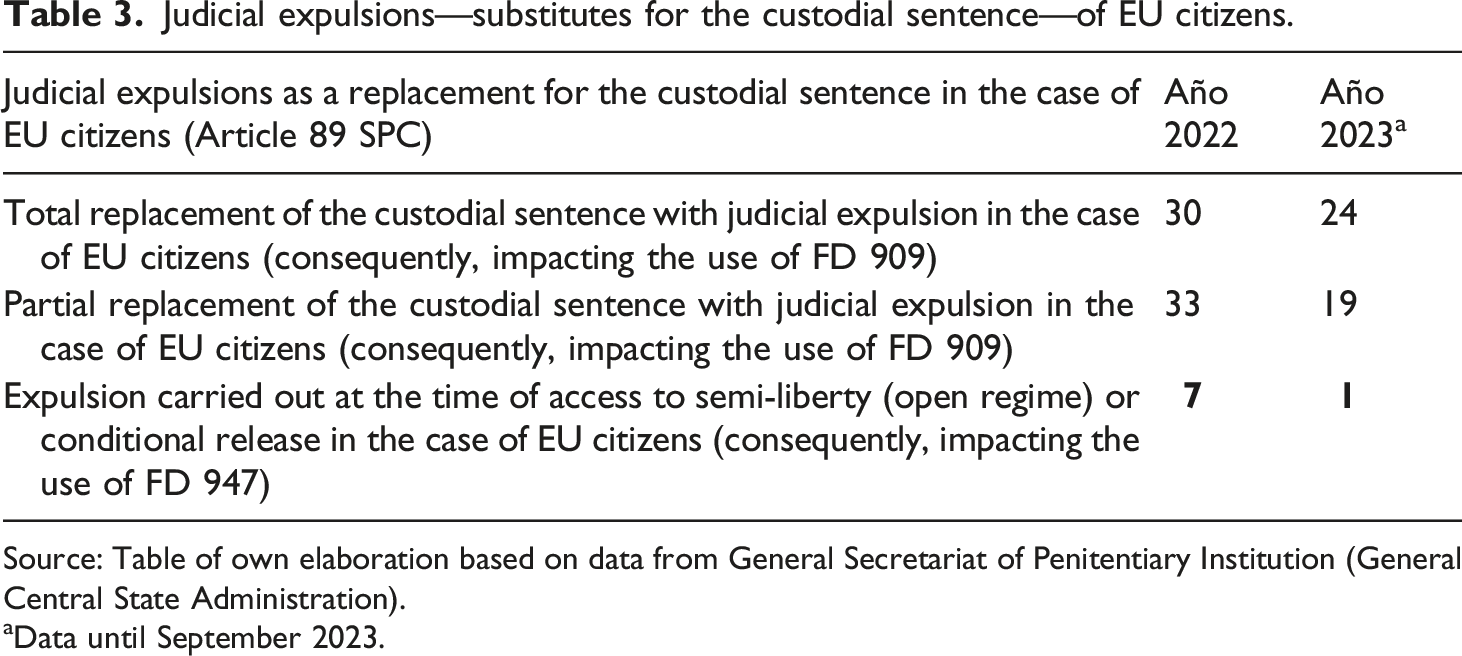
Source: Table of own elaboration based on data from General Secretariat of Penitentiary Institution (General Central State Administration).
aData until September 2023.
The data provided do not differentiate between cases of expulsion at the time of access to the third degree or the semi-open regime and cases of access to conditional release. Nevertheless, even if both instances were to be regarded as forms of probation, they represent a minimal number of occurrences.
In summary, the notion that the expulsion of EU nationals contributes to the underutilization of FD 947 warrants a significant counterargument. It is imperative to consider that EU citizens who are subject to judicial expulsion—typically due to factors such as a lack of social ties, absence of a fixed residence, or the gravity of the crime—are often not suitable candidates for alternative sentencing or measures, by simple logic.
Regarding administrative expulsions referenced by the authors in question, these are enacted post-sentence completion and thus have no adverse effects on the deployment—or lack thereof—of mutual recognition instruments within international legal cooperation. Contrarily, an existing administrative expulsion decision or order can actually facilitate the utilization of such international legal cooperation tools. For instance, as per Article 6 FD 909 (and Art. 67 of the LRM), in instances of an expulsion order, an EU citizen may be transferred to the country of deportation “without his or her consent.” However, such transfers are exceedingly rare within the Spanish legal framework. As the latest evaluation reports conducted in Spain by the General Secretariat of the Council of the European Union (2022) have shown, the transfer of sentenced individuals typically does not proceed without the individual’s consent.
Recent events: Forced change in trend
Similar to the practice of Penitentiary Surveillance judges, the Penitentiary Surveillance prosecutors in Spain convene annually to establish a uniform approach to their duties. In the 2023 assembly, one of the pivotal resolutions made was the mandatory invocation of FD 947 in instances involving the conditional release of an EU inmate to be executed in another Member State. Pursuant to criterion 86, 25 “the conditional release regime for EU nationals as delineated in Law 23/14 (LRM) precludes the invocation of Art. 197 of the SPR, save for scenarios where the remainder of the sentence is less than 6 months” (Ministerio Fiscal, 2023: p. 78). This edict stems from the universal adoption of FD 947 by all EU States. Since Art. 197 of the SPR has not been annulled, if the possibility of conditional release within the resident country is not acknowledged, it could, especially in such instances, result in a comparatively disadvantageous predicament for the EU national vis-à-vis the non-EU foreigner.
Criterion 87 adds that: conditional release necessarily entails the application of some of the supervised freedom measures included in article 94 of the Mutual Recognition Law (LRM, above), since some of them are part of the essence of the former, and they must be stated in the court order that grants it for its transmission. This criterion explains in its motivation that (as has been indicated) there are certain regulated conditions of conditional release that, because they are inherent to conditional release, are not normally included in the order approving it. To this end, it is worth remembering that conditional release always entails a certain degree of supervision and control. Therefore, said obligation is also susceptible to transmission. As well as the restrictions that the court may have established regarding the establishment of residence. Other measures that are imposed in the individual program and monitoring plan are also susceptible to transmission, such as the obligation of the convicted person to notify a specific authority of any change of address or place of work. In short, any condition that could be imposed and that would have a place in the conditional release would be susceptible to transmission and all of them must be expressly stated in the order approving the conditional release.
The Penitentiary Surveillance Prosecutors in their 2023 deliberations asserted definitively (as per Criterion 88) that the procedures outlined in the Legal Recognition Model (LRM), which assimilates FD 947 into the Spanish legal framework, are intended to govern adherence to the period of conditional release in the EU country where the convicted person habitually resides. Unfortunately, this process is manifesting as ineffectual and is leading to considerable difficulties in terms of interpretation and practical application (Ministerio Fiscal, 2023: p. 79).
Nonetheless, the Penitentiary Surveillance Prosecutors in Spain have determined (as per Criterion 89) that, even though the sole condition imposed during the conditional release may be to exit Spanish territory and abstain from re-entry during the suspension period—besides the overarching condition not to commit any further crimes—the process of conditional release must still adhere to the transfer procedures set out in the LRM, in alignment with FD 947. In this regard, the Penitentiary Surveillance Prosecutors call attention to the Sentence of the Court of Justice of the EU of March 26, 2020 (issued in Case C-2/19), which mandates the application of FD 947. This decision clarifies that FD 947 is required even when the sole stipulation during conditional release is the commitment to not engage in further criminal activities (Ministerio Fiscal, 2023: p. 80; see Faraldo Cabana, 2021b).
In conclusion, the Penitentiary Surveillance Prosecutors have unanimously agreed to report unfavorably any conditional release in the country of origin (nationality or residence) of an EU citizen if the procedure established in FD 947 is not duly followed.
Conclusions and recommendations
The situation in Spain highlights a broader issue impacting the legal frameworks within the European Union: the divergence among penal systems across member states. Mutual recognition instruments hinge on the principle of penal homogeneity, a principle that presupposes consistency across these systems. Yet, such uniformity is absent, as each nation’s legal system exhibits unique characteristics. This divergence leads not only to the general challenges encountered in deploying instruments for international legal cooperation, such as FD 947 but also to particular hurdles intrinsic to each member state’s legal infrastructure.
In Spain, the recent mandate from Penitentiary Surveillance Prosecutors regarding the application of FD 947 in the context of conditional release for EU citizens is anticipated to result in a heightened utilization of this instrument. As previously discussed, the prosecutorial report constitutes an obligatory element within the procedure as per the Spanish legal framework. Consequently, this directive is poised to augment the frequency of FD 947’s deployment.
It is evident that the timeframes established in FD 947 are frequently unmet, leading to procedures that extend well beyond their intended span. The resultant lengthy delays render the application of this mechanism counterproductive for the involved parties: individuals convicted are forced to endure prolonged periods of waiting within the Issuing State, a situation that starkly contradicts the principles of social reintegration. This is particularly counterproductive in scenarios of conditional release, where the individual convicted typically remains in detention during the prolonged wait for resolution.
The enforced shift in Spain’s approach, initiated by the Prosecutor’s Office, ought to be accompanied by measures to expedite the process and thus prevent detriment to the convicted individual. It stands to reason that an increased application of FD 947 could eventually lead to the expertise of legal practitioners, the establishment of swifter and more automated procedures, and perhaps, ultimately, an enhanced efficacy of this instrument for mutual recognition.
In addition to the customary suggestions posited to ameliorate the usage of FD 947—derived from scholarly research—there are two particular recommendations that could augment the application of this legal cooperation instrument with respect to conditional release.
It is widely suggested in various studies (O'Donovan, 2009; Durnescu et al., 2020; Durnescu et al., 2017; Marguery 2018; Montero Pérez De Tudela, 2021; Montero Pérez De Tudela and García Ruiz, 2023; McNally, G. & Burke, 2023; Faraldo-Cabana, 2019; Montaldo, 2019; Martufi, 2019, among others) that enhancing the implementation of FD 947 could be achieved by increasing the legal community’s knowledge and awareness of this instrument for international cooperation. Promoting training and specialization for those involved in mutual recognition processes, and improving information and communication systems between authorities, are key steps forward. There is a consistent call for a deeper understanding of the penal and probation systems across member states—for example, how different jurisdictions implement various probation measures and how conditional release functions. This could be facilitated through the development of international workshops, the creation of common platforms like the EJN, and the provision of national and international information desks. Making available the contact details of EJN and Eurojust’s “contact points” to legal practitioners is also recommended. Furthermore, enhancing legal assistance and information for sentenced individuals, establishing action guidelines to aid authorities in evaluating social reintegration prospects, and ongoing research dissemination are, among several proposed recommendations, crucial measures to bolstering mutual trust and efficiency in international legal cooperation within the EU.
Taking into account the Spanish experience, one key recommendation is to develop a practical EU-wide guide for applying FD 947, which outlines the equivalences between various measures. Such a guide would be an invaluable resource for authorities and professionals across member states, facilitating the FD’s application and fostering a better understanding of the diversity of penal and alternative measures throughout the EU. This could significantly enhance mutual recognition and enforcement of probation decisions and alternative sanctions. Given the potential benefits, this recommendation is indeed applicable and beneficial to all EU Member States.
Given the significant delays associated with the mutual recognition procedure for probation measures, particularly regarding conditional release, it is imperative to expedite the process. Judicial authorities, such as Penitentiary Surveillance Judges in Spain and Criminal Enforcement Judges elsewhere, must issue conditional release orders well in advance. Starting the FD 947 process six to 10 months prior to the projected date for conditional release can prevent unnecessary holdups. This proactive approach requires the penitentiary administration to anticipate and request this benefit timely, ensuring that all procedures align seamlessly with the scheduled release date. Consequently, competent authorities would have ample time to complete the necessary steps under FD 947, facilitating the timely release of the sentenced individual. The persistent inability to meet the deadlines specified in FD 947 constitutes a significant impediment that affects all EU Member States’ competent authorities. Consequently, the recommendation to initiate the FD 947 procedure well in advance for conditional releases is not only pertinent to the Spanish legal framework but should also be considered by other EU member states to streamline their criminal legal processes. This approach would potentially mitigate the delays and align with the overarching aim of enhancing efficiency across EU criminal justice systems.
The file content highlights a constructive proposition urging a collaborative effort involving penitentiary administrations and legal representatives in the preparation for the conditional release of inmates.
Spanish statistics indicates that there is a disparity in the number of transfer petitions across Spanish prisons, a variable linked to the initiative of prison staff (Garciamartin Montero, 2021; see; Ruiz Yamuza, 2015). It underscores the importance of enhanced training for prison professionals who interact closely with inmates, such as educators, social workers, and legal counselors, to increase the application of mutual recognition instruments. Moreover, it suggests an “ex officio” approach, where EU inmates are inquired well in advance about their preference for serving conditional release in their country of origin, nationality, or residence, enabling timely commencement of the necessary procedures. This practice, if universally adopted within EU prisons, is expected to improve outcomes for the convicted individuals.
It is certainly crucial that the Spanish Penitentiary Surveillance Prosecutors’ new requirement to utilize FD 947 in the process of granting conditional release for EU citizens be underpinned by a robust and automatic procedure. Instituting such a procedure, potentially through a formal “Instruction” or a “Service Order” issued by the Spanish General Secretariat of Penitentiary Institutions, could effectively mitigate against any procedural delays. These delays have the potential to impact negatively on the incarcerated individual, thwarting their rehabilitation and re-entry into society. An automatic mechanism would ensure that the application of FD 947 is efficient, timely, and conducive to the reintegration goals that underpin the conditional release process.
Indeed, findings from international projects such as the Pont and Reunion projects indicate a notable gap in awareness among lawyers regarding the workings of mutual recognition instruments. Comprehensive training, specialization, and active participation of defense lawyers in this domain are essential to promote and expedite the processing of procedures under FD 947. The necessity for inclusive engagement across European legal systems is becoming increasingly apparent. Establishing networks for communication, information exchange, and training is imperative for all legal practitioners significantly engaged in the mutual recognition process. 26
In conclusion, the exigency for amplified cognizance among legal operatives engaged in the FD 947 process cannot be overstated. There is a paramount need for enhanced training and specialization. Additionally, it is imperative to ensure the concerted participation of all the actors involved in the process governed by FD 947, to achieve the intended objectives of this framework decisively.
Footnotes
Declaration of conflicting interests
The author(s) declared no potential conflicts of interest with respect to the research, authorship, and/or publication of this article.
Funding
The author(s) received no financial support for the research, authorship, and/or publication of this article.
