




Abstract
Foreigners in prison and probation are formally protected by the same rights that are applicable to Italian citizens but official statistics actually offer a different panorama. In fact, no social bonding, scarce or no financial resources, the lack of a permanent domicile and of any regular work activity, heavily affect the access of foreigners to probation regimes. The most evident and direct consequence is that more foreigners are kept inside prison walls than in the probation regime, while an indirect and still understudied aspect is the high percentage of suicides among foreigners in prison. The authors, after presenting the main difficulties experienced by foreigners in accessing the Italian probation system, consider the possible link with the suicide rate, and underline the need for further specific research into this worrying topic.
Introduction
The Italian penitentiary system has been plagued for more than 20 years by chronic overcrowding, that is, of course, the primary cause of most of the problems: the lack of financial and human resources, old facilities, mental disorders, and alcohol and drug addiction are just some of the difficulties faced by prisoners and prison staff in their everyday lives.
All these components, that warrant ample discussion, have an impact on the (possible) application of probation or other available alternative sanctions, in different ways that will be considered in the present paper.
Before entering into a specific reading of the conditions of foreigners in the Italian system of enforcement of penal sentences, it is worth taking into consideration some useful data.
With a prison population of 56,524 persons held in 198 facilities, Italy needs to manage a foreign prisoner population of 17,882 (31.6%), coming from 146 different countries (https://www.giustizia.it/, January 2023). This means dealing with many difficulties due to language barriers, cultural differences and specific religious habits on both sides, prison inmates, and professional staff.
The fact that the foreign prison population has different and specific needs compared to the national population is well-known, and the subject of both a specific United Nations document (UNDOC, 2009) and an ad hoc recommendation by the Council of Europe (CM/Rec(2012)12).
The existence of specific needs while in prison multiplies the difficulties in gaining access to alternative sanctions and being able to positively benefit from this open regime.
In the following sections, the authors will explore the questions of how and why foreigners in prison in Italy pose a tricky element, and generally fail to access probation or any other of the available alternative sanctions.
The length of the remaining sentence and of the imposed sentence: Italians versus foreigners
Overcrowding has multiple causes, but it is certainly affected by the length of the sentence imposed as well as of the remaining period still to be served, because these two elements both influence the terms for the application for alternatives to prison sentences.
Thus, analyzing above all the length of the residual sentences, through the data provided by the Ministry of Justice and updated to June 2022, it appears that the period still to be served is less than 3 years for more than half (51%) of the prison population.
Regarding nationality, 46% of this large group of prisoners are Italians, while 64.2% are foreigners. Among the above 51% of subjects, 17.9% still have to serve a sentence of 1 year or less (this is the case for 15% of Italians and for 24.6% of foreigners).
This group of offenders includes people that—at least as regards the limits imposed by law—are potentially eligible (or will soon be eligible) to apply for probation or another alternative sanction. However, as will be explained below, this will actually benefit far fewer foreigners than Italians.
The residual sentence of 1 year is particularly relevant (for both Italians and foreigners) because it concerns people that have got to the stage where they may be tested outside to see if they are ready to desist from crime and take up a normal life at the end of their sentence. However, this specific time interval, if not immediately intercepted, risks becoming a paradox. The problem is that it should lead to the application of an alternative measure but the order for such an alternative generally takes the competent authority at least 7–8 months, due to the lengthy judicial procedure (except for the quickest case of the application of home detention pursuant to article 199 of the criminal code: enforcement of this demands a shorter procedure). The resulting risk is that, since the residual sentence is too short for the regular procedure for the application of an alternative sanction to be feasible, the person finds himself/herself serving the entire sentence in prison. This entails not only all the relative stigma, negatively affecting the possibility of reintegration but also, in practice, substantial discrimination as compared to those who, “thanks to” longer sentences, have the time to start the procedure in question. A residual sentence lasting between 3 and 5 years is the second most common situation, affecting 19.7% of inmates (20.3% of Italians and 18.3% of foreigners). This range is interesting because it includes people who, by taking advantage of early release (45 days of sentence reduction every 6 months of correct behavior) could quickly fall within the time limits provided by law for the application of an alternative measure.
The above-mentioned intervals are therefore particularly significant because they represent the access thresholds to alternative measures (home detention and probation). Even eliminating the percentage of those that, due to impediments provided by law, will never be in the position to enjoy alternative sanctions, there is still a proportion of prison inmates that, provided they have a home and a suitable working activity, could complete their sentence outside prison walls.
In this regard, it should be remembered that the socio-economic obstacles that make it difficult to enjoy the alternative measures are attributable to the lack of a suitable domicile (for home detention and for probation) and employment (only for probation). Both these requisites are present in proportion to the greater or lesser level of social inclusion of the individual.
It is easy to understand, therefore, that the more marginalized the subject’s situation, the more difficult it will be for that subject to enjoy the application of an alternative measure.
For foreign prisoners, a fortiori, these requirements often constitute insurmountable obstacles to access to rehabilitation paths.
Remaining prison sentence at June 2022.
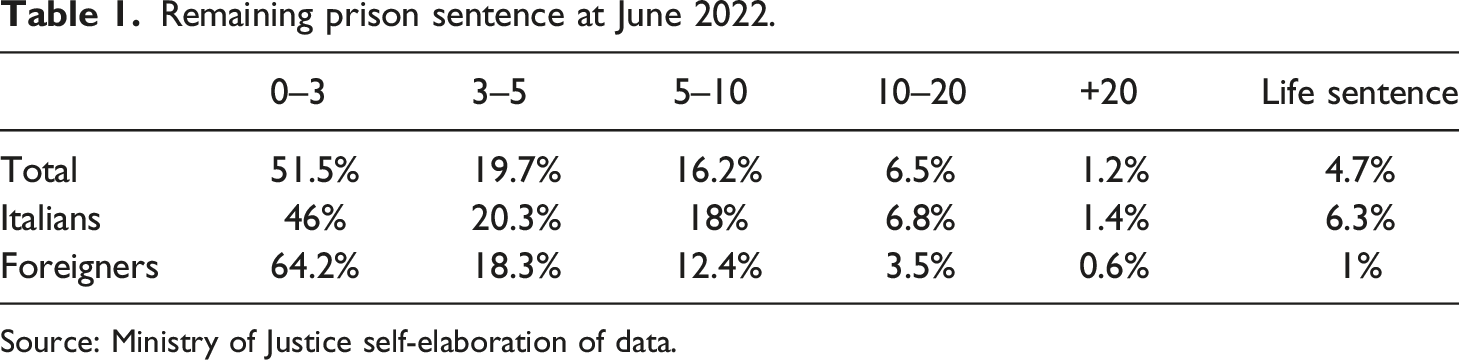
Source: Ministry of Justice self-elaboration of data.
Reflection on the data relating to the residual sentence becomes pivotal for planning a subject’s gradual return to the community, through the application of sanctions which facilitate the transition from a complete deprivation of freedom to the return to a completely free existence, at the end of the sentence. The importance of this transition, in relation to possible recidivism or, hopefully, a desistance path, is well described in the relevant literature. Nevertheless, an ethnographic study carried out on a sample of prisoners released from prison without passing through the filter of alternative measures may be of particular interest, due to its empirical rather than purely theoretical nature (Durnescu, 2019).
The study highlights the finding that the period within which the greatest risk of recidivism is observed is limited to the first 4 weeks after the release from prison. Analysis of the possible risk factors that can affect a smooth desistance process has recognized elements that profoundly affect the possibility of realizing a new life project, depending on how long the interval is between the date of release and a successful reintegration within a legal circuit. These elements have been identified as a perception of the impossibility of rebuilding a legal life through employment that can allow the ex offender to maintain himself/herself and his/her family, the consequent rapprochement with the old deviant groups to which they belonged (seen as the only environment where they can play a role, obtain support and therefore gain a livelihood), and reinforcement of the conviction that they cannot shrug off the ex-convict label, in the face of rampant prejudice (Dal Lago, 1999).
From this point of view, alternative sanctions are a vehicle which may solve at least some of the above-listed difficulties but their implementation is subordinate to the availability of a home and of regular employment.
Total length of the inflicted sentence. June 2022.
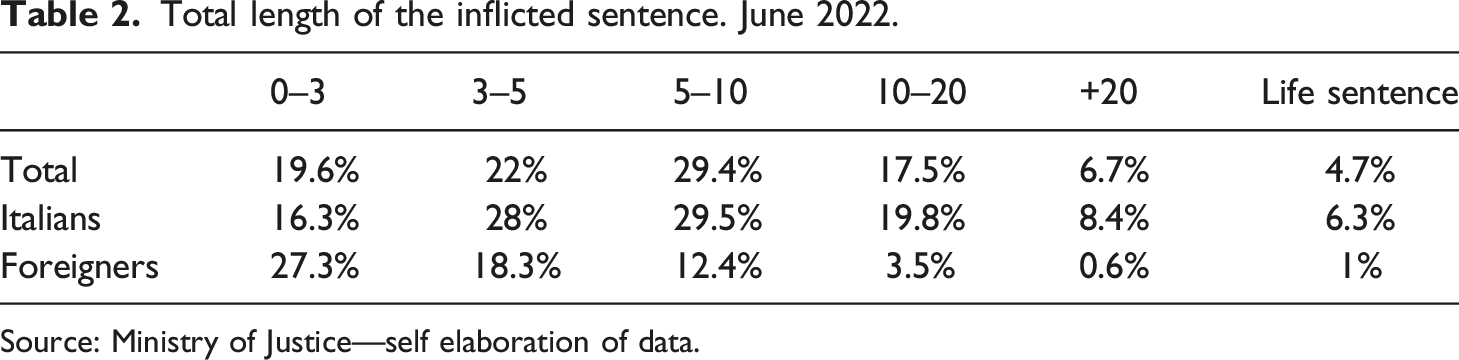
Source: Ministry of Justice—self elaboration of data.
The most common group includes prisoners who have been sentenced to serve between 5 and 10 years, followed by those serving between 3 and 5 years, and between 0 and 3 years. It appears that Italians tend to serve sentences that are on average longer than those imposed on foreigners. This means that foreigners are generally imprisoned for less serious crimes than Italians.
Foreigners on remand in prison, official numbers
Overcrowding data are certainly also linked to the legal position of inmates (prisoners awaiting trial and prisoners with a final sentence), above all in Italy. At the end of 2022 (https://www.giustizia.it/), prisoners awaiting the first judgment or appellants accounted for 28.7% (15.7% awaiting the first trial and 12.9% waiting for a definitive sentence or in a mixed position). In the previous year, the figure had reached 30.6% (16.2% awaiting the first judgment, 14.4% waiting for a definitive sentence or in a mixed position) (https://www.giustizia.it/).
The registered decline is part of a trend that has been underway for some years, which has seen a reduction in the use of prison as a precautionary measure, especially since the beginning of the COVID-19 pandemic (with the aim of preventing as much as possible any mingling of prisoners with outside society, in the attempt to reduce the risk of reciprocal contagion) (Picotti and Ravagnani, 2022) but prisoners in remand still account for a consistent proportion of the total prison population. Instead, the data relating to previous years had recorded very high percentages, above the European average, arousing strong concern both in the academic and in the professional sphere. (Walmsley, 2020).
Although the positive trend towards the reduction of the use of precautionary measures seems to be confirmed, subdivision of the data by nationality continues to reveal a situation of de facto discrimination against foreigners that is strictly linked to the problem related to the application of alternative measures, discussed below.
In fact, while the overall percentage does not exceed 27.4% for Italians, it rises to 31.6% for foreigners. When the data are further broken down, the following outcomes can be discerned: 31.6% can be subdivided into 56.8% of people awaiting first judgment and 43.1% of people with no definitive sentence or holding a mixed position. For Italians, the breakdown is as follows: 27.4% can be subdivided into 53.7% of people awaiting first judgment and 46.3% of people awaiting a final sentence or in a mixed position. Although the trend of application of remand in prison has been decreasing for some years, at least two critical issues appear to emerge immediately from the reading of these data: (1) a greater difficulty of access to precautionary measures other than remand in prison for foreigners compared to Italians and (2) regardless of nationality, the use of remand in prison for subjects awaiting the first judgment seems to be disproportionate, above all in view of the fact that people awaiting a first trial (a category that accounts for more than half of the total number of non-definitive prisoners) are still potentially innocent.
The reasons supporting an excessive use of prison for foreigners (Gonnella, 2013) are strictly attributable to the content of the relevant laws and their often distorted interpretation in regard to this specific category of offenders.
Art 274 of the Italian criminal procedural code (precautionary requirements), for example—allows for the application of remand in prison in three specific circumstances: (1) when there are specific and mandatory requirements relating to the investigations, posing a real and present danger to the acquisition of proof or serving to preserve the genuine evidence; (2) when the accused has absconded or there is a real and present danger that he/she will abscond; (3) when there is a real and present danger that the alleged offender will commit a serious crime involving the use of weapons or other means to commit violence against him/herself or others, or directed against the constitutional order, or as a member of organized crime, or of the same kind of crime as that for which they are currently under investigation.
Point n. 2) is a tricky point for foreigners with no social links, families, home, or employment, which makes the risk of escape much more realistic than in the case of an Italian alleged offender who can count on social resources. This means that, for the same crime, foreigners are more likely to end up in prison while awaiting trial than nationals. These elements generate the perception among foreigners that they are treated differently and have no hope of staying out of prison (Tararà, 2013).
It is also important to remember that even the application of conditional suspension of a sentence no longer than 2 years (provided by art. 163 and in compliance with the Italian penal code) and of the other available alternatives for short sentences (art. 53 and in compliance with law 689/1981) can be influenced by their lack of a permanent address. In fact, art. 164 of the penal code demands a positive evaluation in terms of non-commission of new crimes, that is, instead, negatively affected by inclusion in the category of homeless persons.
Foreigners in probation in Italy: A system of substantial discrimination?
A similar situation is also linked to the application of alternative sanctions (like probation or home detention) to non-nationals who must serve their final sentence.
The law, in these cases, again stipulates specific requirements in order to avoid prison.
The two relevant articles of the penitentiary law (L. 354/75) that refer to such alternatives are art. 47 ter and art. 47 OP. The first article allows offenders with a certain amount of remaining sentence to serve it in their own home or in another public place of care, assistance, and reception. Surveillance magistrates have added some more specific requisites: the place must be considered suitable for hosting the offender: for example, no other offender should be living there, nor the victim of the crime, nor can it be located in a place with easy links to criminal groups, etc. Evaluation of the suitability of the place is strictly at the Magistrate’s discretion and this can create additional problems for offenders looking for a home. The second article, although it does not specifically refer to the housing element, is based on the availability of a place where the sentenced person can live and on employment that can help him/her to stay away from crime while serving the sentence outside prison. Also in this case, therefore, the availability of accommodation is decisive for the application of this alternative measure.
These data seem therefore to suggest that for foreigners, serving the whole sentence in prison is highly probable, much more so than for Italian nationals (Daraio, 2017).
As explained above, foreigners tend to be vulnerable from this perspective even if the Constitutional Court has clarified, in repeated pronouncements, that the alternatives to prison are applicable also to people with no regular documentation and who are illegal immigrants to Italy. The reason given by the Court was that “the lack of a residence permit is not uniquely symptomatic of a particular social risk, incompatible with the pursuit of a re-education path through any alternative measure, nor of the certain absence of a connection with the territory that prevents a profitable application of the measure itself” (Corte Cost n. 78/2007).
The National Guarantor for the rights of people deprived of their liberty has just confirmed, in a recent opinion (13.01.23, https://www.garantenazionaleprivatiliberta.it/) that even people without a residence permit must be registered in the registry office of the municipality in which the penitentiary institution where they are serving their sentence is located, in order to guarantee access to services linked to residence. This opinion, alongside the pronouncements of the Constitutional Court, confirms that the status as an illegal immigrant should not prevail over the preparation of a re-educational path aimed at social reintegration, making use of all the available infra and extra moenia tools.
Practice, however, is very different. According to the data presented in the Italian probation system report, (https://www.giustizia.it/) dated 15th December 2022, of the entire number of offenders serving alternative sanctions in Italy, only 18.9% are foreigners. Comparing this percentage with that for foreigners in prison (33.5%), it is clear that some structural obstacle is preventing these offenders from being authorized to serve their sentence outside the prison. In short, there is substantial discrimination.
Foreigners with no social bonds are normally the most marginalized and economically deprived subjects, and are seen as a danger to the community. According to Boone and Herzog-Evans (2013), the ethnic background can be a significant factor also in decision-making, when the competent authority has to decide about the application of probation or of another alternative sanction in a highly precarious situation. So, for foreigners, a prison sentence almost always means perpetuating the situation of marginalization already present prior to the conviction and thereby making it definitive: for these subjects, the re-educational principle does not seem to be applicable in practice.
On the contrary, since the probation system has been created to mitigate the criminogenic effect that prisons inevitably exercise on offenders, it should be applicable in particular to those that are most in need of rehabilitation, such as people who were marginalized even before entering prison, (including foreigners). Instead, on the basis of the available data, offenders who lack social inclusion are those most likely to continue to be excluded from the more efficient system of alternative sanctions. They will be probably end up in the condition of returning to their illegal life, after the prison sentence, without having enjoyed any positive chance of achieving desistance. The special needs linked to the experience of socio-economic marginalization should be taken into due consideration when considering resocialization strategies (UNODC, 2009: 73).
Moreover, considering at least one of the meanings attributed by McNeill (2006) to Rehabilitation—so-called “Social rehabilitation,” regarded as possible when the personal and social means are sufficient to reach a social status (Van Zyl Smit and Snacken, 2009) and the “informal social recognition and acceptance of the formed ex-offender” (McNeill, 2006)—it appears evident that this path is still very far from within the foreign offender’s grasp.
Considering the wording of art 3.2 of the Italian Constitution (it is the task of the Republic to remove the economic and social obstacles which, by limiting the freedom and equality of citizens, impede the full development of the human person and the effective participation of all workers in the political, economic and social organization of the country), the substantial discrimination related to foreign offenders seems even more worrying.
The equality principle should protect people from any kind of discrimination but this does not seem to work in the case of the probation system: by stipulating requisites that are based on economic resources and social bonds, the law seems to be de facto responsible for exacerbating pre-existing marginalization and deviance. According to Margara (2015), the law on alternative sanctions seems to negatively affect offenders belonging to the so-called “social detention” group, composed of the poorest and most marginalized persons in society. Even the other elements that can positively influence the decision by the competent authority about the application of an alternative sanction (Ravagnani et al., 2018) contribute to the problem: in most of the relevant literature, there are references to the role of employment in promoting a positive rehabilitation path. For example, Lipsey (1995) focused on the role of the kind of employment, pointing out how relevant it is to be able to count on meaningful employment. Sampson and Laub (1993) were persuaded that it is not enough to find employment to increase the chances of a good outcome of the rehabilitation path but that this employment should also satisfy the offender. This position is easily sustainable from the perspective of the principle of individualization of the treatment path, explained in art. 1 of the Italian Penitentiary Law and considered to be the basis of the whole system. Attributing importance to personal skills, school certificates, expectations, and social context when thinking about suitable employment can raise the level of compliance to the proposed treatment by the offender (Uggen, 2000). But for foreigners, these speculations tend not to be applicable because, if they were not in the condition to find an employment before entering the prison for a certain number of common reasons (no documents, no family, an expulsion sentence…), they will certainly not find themselves in an easier starting point while in prison. Therefore, they will probably finish the whole sentence intra moenia instead of under some kind of external supervision.
As to the other positive elements such as family (La Vigne et al., 2006), friends and peers (Shapland and Bottoms, 2011) and inclusive communities (Hipp et al., 2010), considered, when present, to be endogenous drives towards desistance, the conclusions for this particular group of offenders are equally discouraging.
Moreover, when an expulsion order is added to the prison sentence, foreigners are almost always excluded from any possibility to enjoy an alternative sanction because, due to the scarcity of available resources (in terms of social housing and employment offered by the few specialized cooperatives that offer employment to offenders) the professionals involved tend naturally to select people that have a chance to remain on the Italian soil, after rehabilitation. Clearly, this practice is not supported by the law nor the above-mentioned pronouncement by the Supreme Court, but seems to be a direct practical consequence of the lack of resources.
Foreigners in probation: Specific difficulties and challenges
When foreigners actually get the chance to serve a sentence outside prison walls, in probation or under another alternative sanction, this does not unfortunately mean that the challenge has been overcome.
Firstly, they have to face a kind of double stigma, as both offenders and foreigners (Ravagnani and Romano, 2017). In a world that struggles to accept intercultural interchange as a resource, in which foreigners are seen as an added value for the entire community rather than a threat to be protected against, and so instead of trying to manage intercultural conflicts (Ahmed et al., 2020), foreigners speaking a different language (especially Arabic—Ravagnani and Romano, 2021) are normally viewed with suspicion, even if they are not linked to the criminal system. When the labels “criminal” and “foreigner” are combined in the same individual, the situation becomes even more complicated and the stigma that normally surrounds prisoners is accentuated.
This also means that they face even worse difficulties at the end of the sentence in finding employment and a home, especially if they have been unable to enjoy any prior transition to freedom managed under the rules and restrictions of an alternative measure (Ravagnani and Policek, 2019).
Moreover, language barriers and cultural differences often prevent foreigners from being able to fully understand the limits and prohibitions contained in the magistrate’s prescriptions. As a consequence, unintended violations of these provisions can trigger a recall of the measure itself and hence a return to prison (Ravagnani et al., 2017).
In the attempt to avoid this kind of negative consequences, probation staff should be trained and made more aware of the different cultural backgrounds, in order to help foreign offenders developing a desistance path to gain self-confidence and the ability to face discrimination (UNODC, 2009: 67).
For this reason, the rehabilitation programmes offered should take into consideration the specific cultural background, including a gender-oriented perspective, of the person serving an alternative sanction, because the imposition of specific prescriptions can have different interpretations, according to the different cultures.
If, as stated by Maruna et al. (2009), an important support for a positive rehabilitation path is, of course, based on self-transformation and a personal decision-making process, some external elements can surely help the offender’s reinforcement path and offer support of the change (Giordano et al., 2002). Support by the ethnic community to which the offender belongs can be a relevant starting point promoting a positive outcome of the enforcement of an alternative sentence outside prison walls. In fact, being able to count on some significant other people (McNeill, 2006), to fight against the sense of loneliness that often affects foreigners during their sentence in prison and that tends actually to be exacerbated by the isolation implicit in a home detention or probation order, may make the difference.
The lack of nearby family members, the need to avoid former friends still involved in criminal behavoiur and the strict sense of permanent control, linked to the prescriptions ordered by the surveillance court magistrate, can become a double-edged sword threatening the outcome of a good desistance path (Nugent and Schinkel, 2016).
But the involvement of the ethnic community is not always easy because, depending on cultural and religious rules, some specific crimes are considered to be a violation of divine precepts and so even more serious than illegal behavior. In these cases, the community would prefer not to be involved in the rehabilitation path. The perpetuation of negative experiences of refusal will naturally foster a sense of hopelessness; this is considered by Nugent and Schinkel (2016) to be one of the pains of desistance.
In the scenario described, it is easily understandable that all three aspects of a desistance process (Maruna and Farral, 2004) are put at serious risk. The first two of these include succeeding in staying away from crime (primary desistance) despite the lack of a stable home and employment, and in bringing about a change in self-identity to one based on a non-delinquent picture of oneself (secondary desistance) despite no success in solving—through legal approaches—the basic problems of daily life. Consequently, the success of the third aspect, namely, the possibility that others will abandon prejudice and recognize the new identity (tertiary desistance) is highly remote.
Suicide in prison: An emergency as regards foreigners?
The suspicion of substantial discrimination in regard to foreigners seems to be supported also by the statistics for suicide in prison. In fact, in 2022, 84 people took their lives in prison, the highest number since 1990 (first year of available data). In short, every four and a half days, one person inside Italian prison facilities committed suicide. The suicide rate outside prison in the Country is 0.71 per 10,000 inhabitants (WHO—Suicide Worldwide, 2021), whereas in the prison environment, it rises to 15.5 deaths per 10,000 inmates. It therefore seems undeniable that prison induces a high risk of suicide (people commit suicide in prison 20-fold more frequently than in society outside prison walls (Antigone, 2022).
Since the year 2000, 1240 people have committed suicide in prison, while more than a thousand acts of self-harm are recorded every year. Knowing something more about these people can be useful to understand the elements that can influence the suicide choice. The average age of people who took their own lives is 37 years, followed by those aged between 20 and 29 (Antigone, 2022). As regards gender, 5% of women inmates, although they account for only a minimal percentage of the total prison population (about 4.2%), took their own lives during the year 2022. This outcome is particularly worrying, especially when compared with those of previous years during which only one case was recorded or, in 2019, none at all (https://www.ristretti.org/).
The fact that women’s incarceration determines more complex dynamics of pains compared to men’s experience does not, however, have a clear impact on the suicide rate. A reflection on the point is certainly necessary since the new, dramatic surge in female self-harm actions signals, once again, the trend in the Italian penitentiary system, as it is configured today. Regarding nationality, it should be noted that 40.5% of those who committed suicide were from another country and, also in this case, comparison of the figure with the average presence of foreigners in Italy (today settled at 31%) reveals a threatening panorama.
Investigating the reasons why foreigners have such a high suicide rate is not an easy task, because personal, cultural, and situational elements blend together and depend on the individual’s personal, emotional, and criminal history. In any case, the widespread sense of discrimination and hopelessness prevalent among this specific group of prisoners inevitably plays a significant role.
Among the principal alarming factors, Antigone (2022) offers an interesting evaluation of the incidence of psychiatric disorders and addiction problems in cases of suicide: of the 59 cases recorded in August 2022, 18 had a mental health disorder.
Furthermore, the difficulty often faced by psychiatrists in diagnosing a specific disease without all the factors required to delineate the specific pathology, does not exclude the possibility that there are situations in which the sense of desperation, although not formally defined, is attributable to a series of exogenous and endogenous factors of undoubted importance.
In the case of foreigners, the very scarce availability of good practices that take into account their cultural context and, consequently, the rare involvement of ad hoc trained operators, pose the risk of exacerbating their distress. Projects based on an ethno-psychiatric approach are still an exception in the landscape of the Italian penitentiary system.
Antigone (2022) reports that, based on the visits made in the first 8 months of the year, the data collected offer a worrying panorama: - 10.5 serious psychiatric diagnoses per 100 inmates, - 20.5 prisoners out of 100 are users of mood stabilizers, antipsychotics, and antidepressants - almost 40 inmates out of 100 are users of hypnotics or sedatives.
Much needs to be said about this last point. While there is no doubt that the doctor's assessment of the advisability of administering such drugs is unquestionable by non-experts, one cannot fail to notice that some inmates clearly believe that the use of these drugs is a way to escape the sufferings of incarceration and palliate the emptiness of their days, that pass slowly, without any goal (Ravagnani, 2022).
This specific reading cannot leave us indifferent because it perfectly describes the failure of the penitentiary system as structured today. A sentence intended to promote rehabilitation, as a time for the reintegration of the offender—as required by the Constitution—has undoubtedly lost its efficacy if those who are serving it need to find correctives, including pharmacological ones, to protect themselves from the daily void.
Lastly, Antigone breaks down the data related to substance addiction: for every 100 inmates, 19 are drug addicts undergoing treatment and, among the suicides, at least 5 were full-blown drug addicts and 2 alcoholics. While, on the one hand, it would not be correct to go into the merits of individual events because there would be the risk of belittling, trivializing, or misunderstanding the highly personal motivations underlying the suicide gesture, on the other hand, it is clear that the statistics run the risk, once again, of failing to offer a full understanding of the extent of suffering experienced by those who have not managed to continue detention. They imply that suicide in these contexts should be considered as inevitable, collateral damage, closely related to the prison model applied in the country. It is important to remember, therefore, that the numbers correspond to faces, sufferings, human vicissitudes that undoubtedly affect a much higher number of people than those who ultimately succeed in committing suicide, and not to lose sight of what should be the ultimate goal: to contribute to the implementation of a useful sentence, that respects the dignity of the individual, and human rights in general.
Conclusions
Foreign offenders are considered equal to Italians by the relevant laws and jurisprudence, in accordance with article 3 of the Italian Constitution that states the non-discrimination principle.
However, practice seems to offer a completely different panorama: higher levels of remand in prison and lower levels of access to alternative sanctions contribute to keep foreigners inside prison walls, substantially discriminating against them in regard to possible rehabilitation paths.
The reasons for this discrimination are rooted in the prejudice and stigma that often surround this group of subjects, as well as in the disadvantaged socio-economic situation in which they often live, that prevents them from reaching the required standards for the application of a community measure.
The high suicide rate recorded in 2022 among foreigners in prison is a clear indicator that alternative measures are urgently needed and must be implemented as soon as possible, with the aim of promuting all of the three different levels of desistance and social inclusion envisaged by law.
When this last possibility is completely excluded (due to the application of an expulsion order at the end of the sentence) or due to specific obstacles that cannot be removed, a reinforced application of FD 947/2008, as well as 909/2008, should be considered.
This involves looking at these two instruments as positive opportunities for the social rehabilitation of the offenders involved and not as exclusion tools. Work to promote the good application of the two FDs, also through the direct involvement of offenders themselves, Ngos and CSOs that work in the involved countries, could prepare a better return to the country of origin, granting higher levels of success in terms of rehabilitation and desistance.
At a national level, instead, there is still the need to fight against stigma and prejudice, in order to eliminate (or at least reduce) the substantial discrimination which, in practice, excludes foreigners from access to the implementation of a socially inclusive rehabilitation program.
Moreover, reinforcement and enlargement of the social housing network for homeless people (above all for foreigners) as well as a more complete implementation of the already existing good practices for the elimination of substantial discrimination in regard to foreign offenders, would help to remove the socio-economic obstacles that too often fight against their chance of completion of a good desistance path.
Footnotes
Declaration of conflicting interests
The author(s) declared no potential conflicts of interest with respect to the research, authorship, and/or publication of this article.
Funding
The author(s) received no financial support for the research, authorship, and/or publication of this article.
