




Abstract
Probation is a tool to decrease the severity of the legal system. In theory, more instruments of probation mean fewer people deprived of liberty. However, Poland previously faced a paradoxical situation: there was a significant crime rate drop and a growing number of suspended punishments, but—at the same time—the incarceration rate was high. Many argued that the cause of this state of affairs was the overuse of probation instruments. Almost half of suspended punishments of deprivation of liberty were ultimately enforced. The 2015 reform of the Polish criminal law aimed to decrease the statutory possibility of using probation. This study compares trial outcomes from before and after the reform. We examine files from district courts in 13 cities in Poland for two offences: drug possession and drunk driving. We conclude that the limit on probation decreases the severity of the legal system.
Keywords
Introduction
Probation is a perceived as a penal instrument that allows offenders to remain in the community and avoid harsher sentences, under the requirement that the offenders are placed under supervision and fulfill specific conditions for a given period (Canton and Hancock, 2007). The historical roots of probation trace back to the middle of the 19th century (Diana, 1960), and even further to the middle ages (Nair and Raghavan, 2017). Probation is a very flexible instrument, and there are various models of probation (see e.g., Schwalbe, 2012; Weiss and Wozner, 2002).
Probation serves as an alternative to incarceration for specific categories of offenders, mostly in less serious crimes (Hamai et al., 1995; Morris and Tonry, 1991; cf. Tonry, 1996). It is especially important and widely used in countries with high imprisonment rates, due to higher awareness of the costs of imprisonment and greater cost-effectiveness of probation (Wodahl et al., 2011). It is for these reasons that in 2018 over 3.5 million adults in the US were under probation (over 1% of the population), which was still the lowest level in over a decade (Kaeble and Alper, 2020). Probation is also widely used in Europe, especially in Poland, which in 2019 had Europe’s highest probation population rate, with over 646 probationers per 100,000 inhabitants (over 0.6% of the population; Aebi and Hashimoto 2020). Wide use of probation can be seen as a positive development, a means to fight overincarceration. In theory, more instruments of probation mean fewer imprisonment sentences. Instead of going to prison, offenders can remain in their environment and even serve the community. Unfortunately, probation can ultimately sustain overincarceration (Doherty, 2016). One reason for this phenomenon is increasing punishments for lower-level crimes, for which long-term incarceration should not be an option often imposed in judgments for crimes with that gravity (Phelps, 2013). Furthermore, offenders can be incarcerated for violations of a variety of rules during probation (Klingele, 2013). The breach of the probation rules may lead to the enforcement of suspended deprivation of liberty. In this way, probation can function as a delayed channel into prison (Clear and Austin, 2009). Phelps pointed out that almost a quarter of state prison admissions in 2017 were for probation violations (Phelps, 2020). Probation is thus often seen as “part of the continuum of excessive penal control,” rather than an alternative to incarceration (Doherty, 2016). Doherty refers to the phenomenon of hypersupervision outside of prison that is embedded in probation. In the same vein, the study by Aebi et al. analyzing the evolution of imprisonment and community sanctions in Europe led to the suggestion that probation has contributed to widening the net of the European criminal justice system and not just served as an alternative to imprisonment (Aebi et al., 2015). This penal phenomenon of massively increasing the use of probational instruments is beginning to be called “mass supervision” (see, e.g., McNeill, 2018, 2019) or “mass probation” (see, e.g., Phelps, 2017, 2020).
Probation is generally considered a lenient penal instrument, especially compared to prison; however, it needs to be emphasized that this is not a measure free of pain. The study conducted by Hyes suggests “that community penalties can involve a number of different pains, which can have a profound effect upon the lives of offenders whilst they serve their sentence—and thereafter” (Hayes, 2015: 99; see also Van Ginneken and Hayes, 2017). Durnescu refers in the context of the pains of probation to the frustrations and deprivations experienced by individuals and identifies eight main types of them (e.g., deprivation of autonomy or stigmatization effects) (Durnescu, 2011). Some supervision programs can be harsher and more demanding on the offender than prison itself (Petersilia, 1990). Long-term probation can be disruptive for mental health and can lead to suicide rates even higher than in prison (Phillips et al., 2018).
The positive effects of probation and restraint on rules violations and recidivism is a very complex issue. One critical factor is the relation between probationer and probation officer (Okonofua et al., 2021; Sturm et al., 2020). A good relationship with probation officers is important to probationers, who want to be heard, helped with practical problems, emotionally supported, and seen as individuals (Appleton, 2010; Broussine and Wakefield, 1997; Healy & O’Donnell, 2008; McNeill, 2018, 2019). Probation effectiveness also depends on the judge’s behavior and practice when determining the conditions of probation (Perlin, 2017; Wexler, 2010). Probation success and reduction in the probability of recidivism are connected with the assigned conditions of probation, which should be individualized to the risk and needs of the probationer (Viglione et al., 2015).
The aim of this study is to explore the paradoxical Polish case of overuse of probation. There was a significant crime rate drop in Poland and a growing number of suspended punishments; however, at the same time, the incarceration rate remained high. For example, in 2003, there were 1, 466, 643 crimes in Poland, and in 2016 about half that number—748 459 (Dryszel, 2018). In the same years, there were on average 81, 321 people in prisons in 2003 and 71, 456 in 2016. 1 The literature suggests that the cause of this state of affairs was the overuse of probation instruments, particularly suspended deprivation of liberty (Mycka and Kozłowski, 2013). The 2015 criminal law reform sought to stop the overuse of probation (Zoll, 2015). Probation was overused in the sense that before 2015, judges were suspending imprisonment punishments, which were a penal response to crimes with gravity that did not justify the imprisonment in the first place. Judges developed a practice that the suspended deprivation of liberty becomes an independent kind of punishment that was not grounded in the binding law. The justification of the reform was that “almost half of the inmates in prisons (out of 85,000 people) are there due to ordering the execution of a previously suspended deprivation of liberty […]” (“Justification of the Bill, Sejm RP VII Kadencji, Nr Druku: 2393”, 2014). The legislators aimed to limit the possibility of using suspended deprivation of liberty, not to increase the system’s severity, but to achieve the opposite. The hope was that if judges cannot suspend the punishment of imprisonment, they will use other, softer punishments (e.g., fines).
This study compares trial outcomes from before and after the 2015 reform. We examine files from district courts in 13 cities in Poland for two offences: drug possession and drunk driving. Our findings indicate that the reform changed the structure of punishments. There are fewer suspended deprivation of liberty and more non-custodial penalties.
The article is organized as follows. The next section is devoted to detailing the Polish legal context. The methodology employed in this study is then explained in the following section. Finally, the results are discussed.
Polish legal context
According to Polish criminal law, one of the basic rules of imposing punishment is to prioritize non-imprisonment punishments. Imprisonment is treated as a last resort (Kaczmarek and Zalewski, 2017: 35). This preference has been embedded in various criminal code provisions since 1997, when the new criminal code replaced the criminal code from the communist era. One example of the change in priority is the change in the order of listed punishments. In the criminal code from the communist era, the enumeration started with imprisonment. In the current criminal code, imprisonment is at the end. This shift was intended to encourage judges to start considerations of punishment with the mildest punishments (Wróbel and Zoll, 2014). The punishments are fines, limitation of liberty, and three varieties of deprivation of liberty: deprivation of liberty from 1 month to 15 years, deprivation of liberty for 25 years, and deprivation of liberty for life (Article 32). The punishment named “limitation of liberty” is, in principle, social work, and the name does not represent the content of this punishment. The deprivation of liberty is imprisonment. What is more, the criminal code also directly requires that the judge should prefer punishments other than imprisonment. According to Article 58 § 1, if a statute provides for various types of penalties for a crime and a crime is subject to the penalty of deprivation of liberty not exceeding 5 years, the court should impose the penalty of deprivation of liberty only if no other penalty or penal measure can meet the aims of the punishment (Wróbel et al., 2014).
Probation is a continuation of the philosophy that imprisonment should be a last resort. According to the Polish Criminal Code, probation can be used at different phases of the criminal procedure (Goniewicz, 2017). Before sentencing, when the proceeding is suspended (i.e., the judge “conditionally discontinue [s] the criminal proceedings”) the offender is not sentenced (Article 66 § 1), and no negative consequences result related to having a criminal record. The offender is not treated as convicted and is not listed in the criminal record as a sentenced criminal, which often leads to job loss or difficulties finding a job and other collateral consequences (cf. Hoskins, 2018, 2019). The second instrument is suspended deprivation of liberty, which is applied during sentencing and before enforcement of the sentence. The last instrument is to “conditionally release a person sentenced to the penalty of deprivation of liberty from serving the remainder of the penalty.”
The following paragraphs briefly explain both mechanisms: discontinuance of the proceeding and suspended deprivation of liberty. Both mechanisms appear in Chapter VIII of the Polish Criminal Code, entitled “Probationary measures.”
According to Article 66 § one,
“The court may conditionally discontinue the criminal proceedings if the perpetrator's fault and social harmfulness of the act are not substantial, the circumstances of the committed crime are indubitable, and due to the demeanour of the perpetrator, who has not been previously sentenced for an intentional crime, his characteristics, personal conditions and previous way of life, it is reasonable to expect that, in spite of the discontinuance of the proceedings, he will respect the legal order, especially by not committing a crime” (translation: Wróbel et al., 2014).
Discontinuation is for a “test period” that lasts from 1 year to 3 years (Article 67). As previously noted, the most significant advantage for the offender is not being treated by the system as sentenced and not being placed in the public criminal register. Guilt is not yet decided, and there is no certainty that the court will decide that the perpetrator is guilty in the future sentence. The risk for the perpetrator is the potential continuance of suspended proceedings and the lack of concrete punishment, because at this stage there is not yet any punishment.
According to Article 69, “The court may conditionally suspend the enforcement of the imposed penalty of deprivation of liberty not exceeding 1 year if the perpetrator has not been sentenced to the penalty of deprivation of liberty while committing a crime and it is sufficient to meet the aims of the punishment with regard to the perpetrator, especially to prevent his relapse to crime” (based on: Wróbel et al., 2014). In short, the judge can suspend punishment when it is imposed. There should be two steps. First, the judge considers which punishment is deserved for the crime at hand. At this stage, a judge has to take into consideration all directives on imposing punishment, including those which establish a preference for non-isolative measures. If the judge decides that the deserved punishment is the deprivation of liberty, he or she can consider whether this punishment could be conditionally suspended. In theory, applying the Criminal Code literally, if there was no possibility of suspension of imprisonment, then the imposed category and severity of punishment would be the same because the offender deserves that punishment for the evaluated crime. Yet judges did not act in that way. According to a study focused on the perceptions of the practitioners on, among others, suspended deprivation of liberty, when imposing punishment, judges were thinking about the possibility of suspension (Kucyper et al., 2017). Thus, they were not treating suspended sentences as custody and, therefore, as sentences of last resort, but rather as a sort of non-custodial sentence. In fact, this procedure clearly contradicted the criminal code. The text of Article 69, provided above, was written after the 2015 reform. Before 2015, the suspension of deprivation of liberty was possible in a broader range of cases, there was a higher limit on punishment that could be suspended (2 years of imprisonment), and there was no exclusion for previous convictions and sentences of deprivation of liberty. Therefore, in practice, there were criminals who had numerous convictions and sentences to deprivation of liberty which were suspended (Łukaszewicz, 2013; see also Wróbel, 2015). The revocation of suspended punishment was because of breaching obligations of probation. Sometimes, the judge is obliged by law to enforce suspended punishment, for example, when a similar intentional crime is committed (Article 75 § 1). 2
It was a common belief among experts that that the probation mechanism was overused. The intent of probation was distorted in practice; instead of making criminal justice milder, it caused many people to end up in jail who did not deserve the punishment of deprivation of liberty (Mycka and Kozłowski, 2013).
The change in the criminal code, which tightened the conditions on suspensions of deprivation of liberty, was not based on theoretical logic, but on the belief that the criminal code functions in real life. There was no certainty around how judges would react to the changes. The reaction could have been that the system became more severe. In this study, we illustrate how the changes impacted sentencing from the perspective of the chance to receive milder or harsher punishment. To do so, it is first important to explain some technical issues regarding criminal law.
In Poland, the judge issues decisions about guilt and punishment. The procedural principle of legalism (Waltoś and Hofmański, 2020) means that the accuser is obliged to initiate proceedings in the case of each crime prosecuted publicly (Art. 10 § 1 of the Code of Criminal Procedure). We present research on two crimes, drunk driving and possession of drugs, and both of which are prosecuted publicly. Crimes in Poland are listed in the criminal code, as well as in other acts. Drunk driving is a crime according to the criminal code (Art. 178a § 1), and the possession of drugs is a crime according to the Act on Counteracting Drug Addiction (Art. 62 § 1 and 3).
Data and methods
The aim of this research is to examine what impact the 2015 reform of the criminal code, which limited the possibility of using probation, had on the structure of penalties imposed by courts (see also: Mamak et al., 2022a; 2022b).
According to the data gathered by the Polish Ministry of Justice before the reform, suspended deprivation of liberty was the most common sentence given by Polish courts prior to the reform (60% of cases in which the court decided to impose a penalty; “Justification of the Bill, the Polish Sejm, No. 2393” 2014). Polish legislators wanted to encourage courts to apply milder penalties. However, due to the lack of detailed analysis on the reasons for suspending deprivation of liberty by the courts, the result could have been the opposite: when it is impossible to suspend the sentence, the courts can decide not to use any probation at all and send the perpetrator straight to prison.
In order to properly research the subject and obtain as detailed and representative data as possible to compare the situation before and after the 2015 reform, it was necessary to collect data from as many courts as possible in various regions of Poland. Therefore, courts from various parts of Poland were chosen, while also accounting for research convenience (such as accessibility to accommodation near courts). The choice of cities was not random, but instead was dictated by the fact that permission was needed from each court. We took care of those courts that would be distributed in diverse geographical regions of Poland. This is why we collected samples in most Polish districts (voivodships)—9 out of 16. We also excluded courts in Warsaw, the capital city of Poland, because Warsaw has unique jurisdiction. In the course of this research, the researchers visited 14 district courts in 13 cities.
This research is based on the cases that went to court, and a sentence was issued. Hence, cases that ended without sentence were not examined (e.g., when the prosecutor decided to discontinue the proceeding). All data of each case were gathered individually. There was not at that time (and there is not yet) a centralized system that contains all information about the judicial cases. On the Ministry of Justice website, there were only data sets with limited information about cases. The most significant advantage of our research is that we could analyze a significant amount of information regarding specific cases.
The collection process of the data was between February and May 2017. Thirty-seven law students from a Polish university in their final years were filling out standardized templates in which there were questions regarding the cases. Students' role was twofold. First, they needed access to the physical court files selected according to the study's design. Second, they were filling prepared questions based on obtained files. Each student selected about 100 cases from the list of cases prepared by the court's secretariat. Half of the cases should concern the period before and another half after reform from 2015. Students chose n'th case from the list. The “n'th” was dependent on the number of cases in each court that fulfilled the criteria. The “n'th” cases differ in each court, depending on the number of cases. For instance, the “n'th” case in one court might be every 30th case on the court's provided list, while it might be every 50th in another. We initially wanted to review three offenses, but we had to discard one (theft) due to the low number of cases that filled our criteria. The total number of cases was around 3500, approximately 1500 cases of drunk driving, and approximately 1000 cases of the remaining two crimes—possession of drugs and theft. Collection of the equal number of each crime was not possible because in some courts, there were not an equal number of cases from each type of crime.
For this research we chose cases that were as similar as possible. Therefore, we rejected cases with factors that could bias the study results, such as cases with recidivism, mitigation, and aggravating factors indicated by law (e.g., crime was committed in an organized criminal group), and the court need to take them into account while selecting punishment. For example, there might be a necessity of imposing imprisonment without suspension in a case that would, most probably, end up with probational instruments if the perpetrator commits a crime for the first time. We also rejected cases with additional legal classifications, namely, those with multiple acts or multiple crimes committed (following the suggestion by Vibla, 2015). In addition, we rejected cases with crimes committed by women, first owing to the low number of such cases and, second, because gender is a strong factor influencing sentencing disparities (Cassidy and Rydberg, 2020; Doerner and Demuth, 2010; Freiburger and Romain, 2018). We also rejected cases with inconsistencies or missing data. Finally, we decided to exclude property theft. We ended up with 1,797 cases: 1,179 cases of driving under the influence and 618 cases of drug possession.
Results
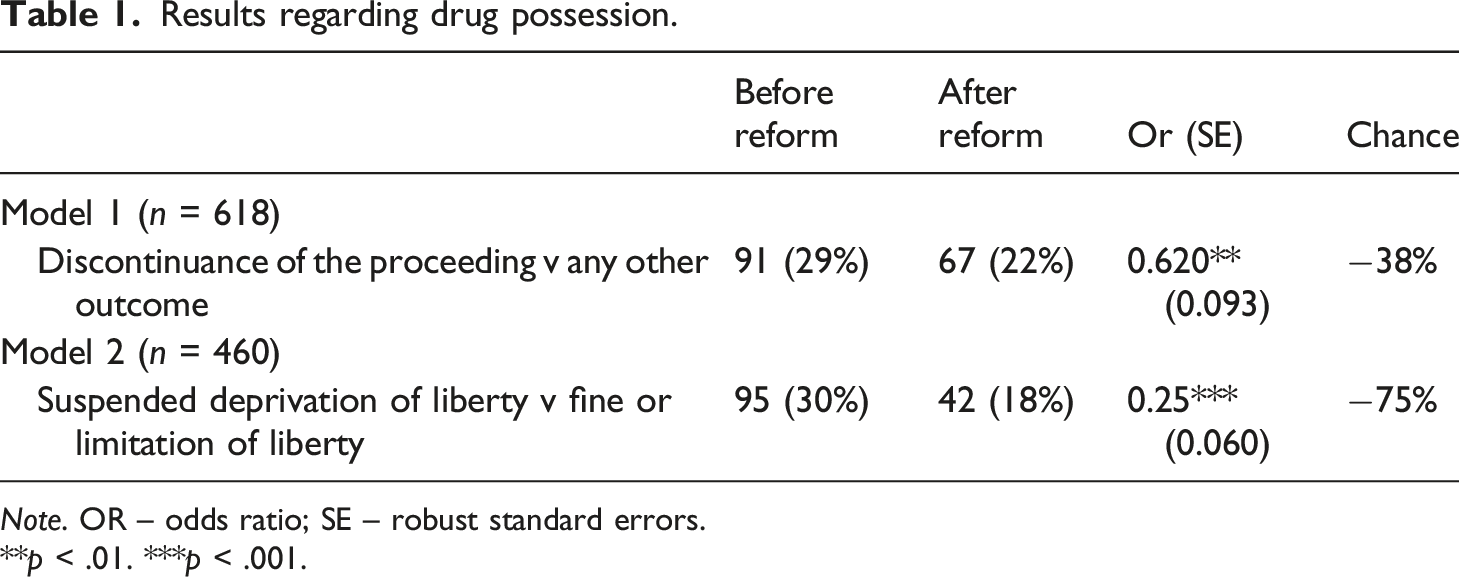
Results regarding drug possession.
Note. OR – odds ratio; SE – robust standard errors.
**p < .01. ***p < .001.
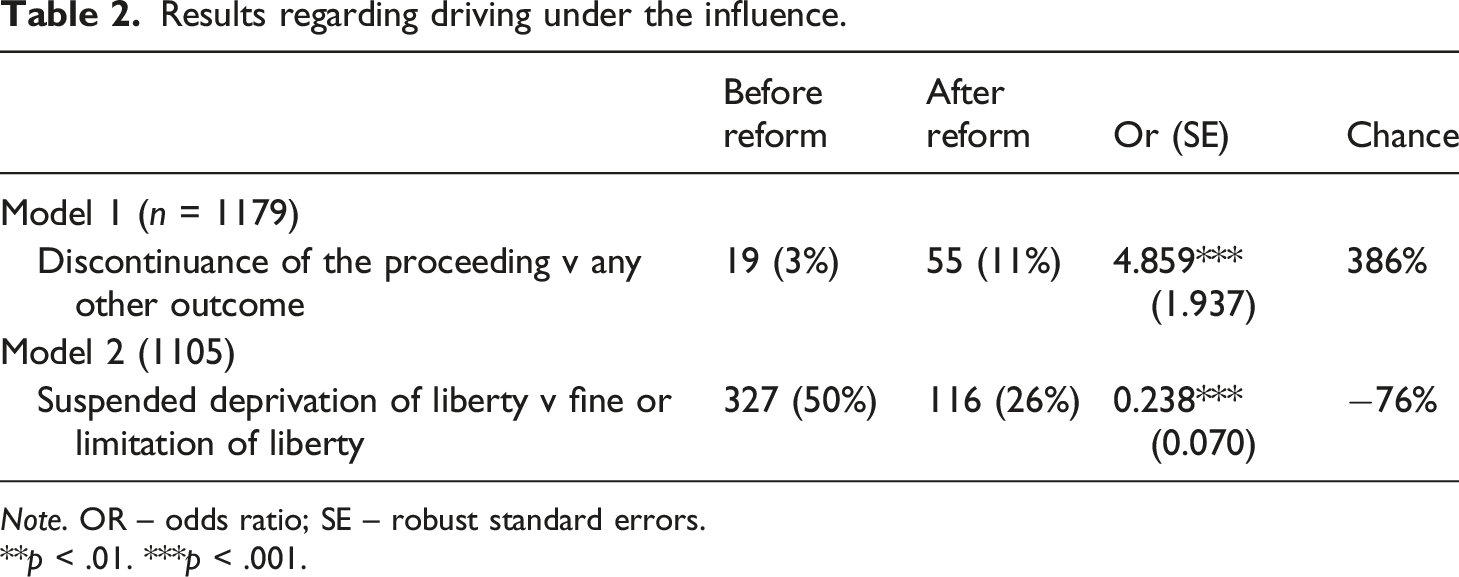
Results regarding driving under the influence.
Note. OR – odds ratio; SE – robust standard errors.
**p < .01. ***p < .001.
In the next model (Model 2), we excluded those cases resolved with conditional discontinuance of proceedings. The change in probability from before to after the reform of a sentence of suspended deprivation of liberty vs. fine or limitation of liberty was estimated. In both drug possession and driving under the influence cases, the chances of suspended deprivation of liberty as compared to fine or limitation of liberty after the reform dropped by 75%–76%.
These results can be supplemented by nationwide open-source statistics (Statistics of Ministry of Justice, 2021) on the structure of imposed penalties over the years. The table below presents the number of convicts and the number and percentage of different types of penalties imposed in Poland by regional courts from 2001 to 2020. These statistics show a general impact of the 2015 reform on penalties imposed in Poland. Until 2015, there was a stable structure of imposed penalties: 60%–70% deprivation of liberty (80%–90% of which were suspended), 10%–13% limitation of liberty, and 21%–23% fine. After the reform, a significant change in the structure of penalties can be observed. In 2016, the percentage of deprivation of liberty was 41% (62% of which were suspended), limitation of liberty was 22%, and fine was 36%. In 2019, the percentage of deprivation of liberty had dropped to 35% (49% of which were suspended), the percentage of limitation of liberty had grown to 30%, and the percentage of fine was 34%. The 2015 reform, which limited the possibility of suspension of deprivation of liberty, resulted in a drop in deprivation of liberty, an even more significant drop in suspension of liberty, and an increase in softer penalties (limitation of liberty and fines).
Discussion
The structure of imposed penal measures.
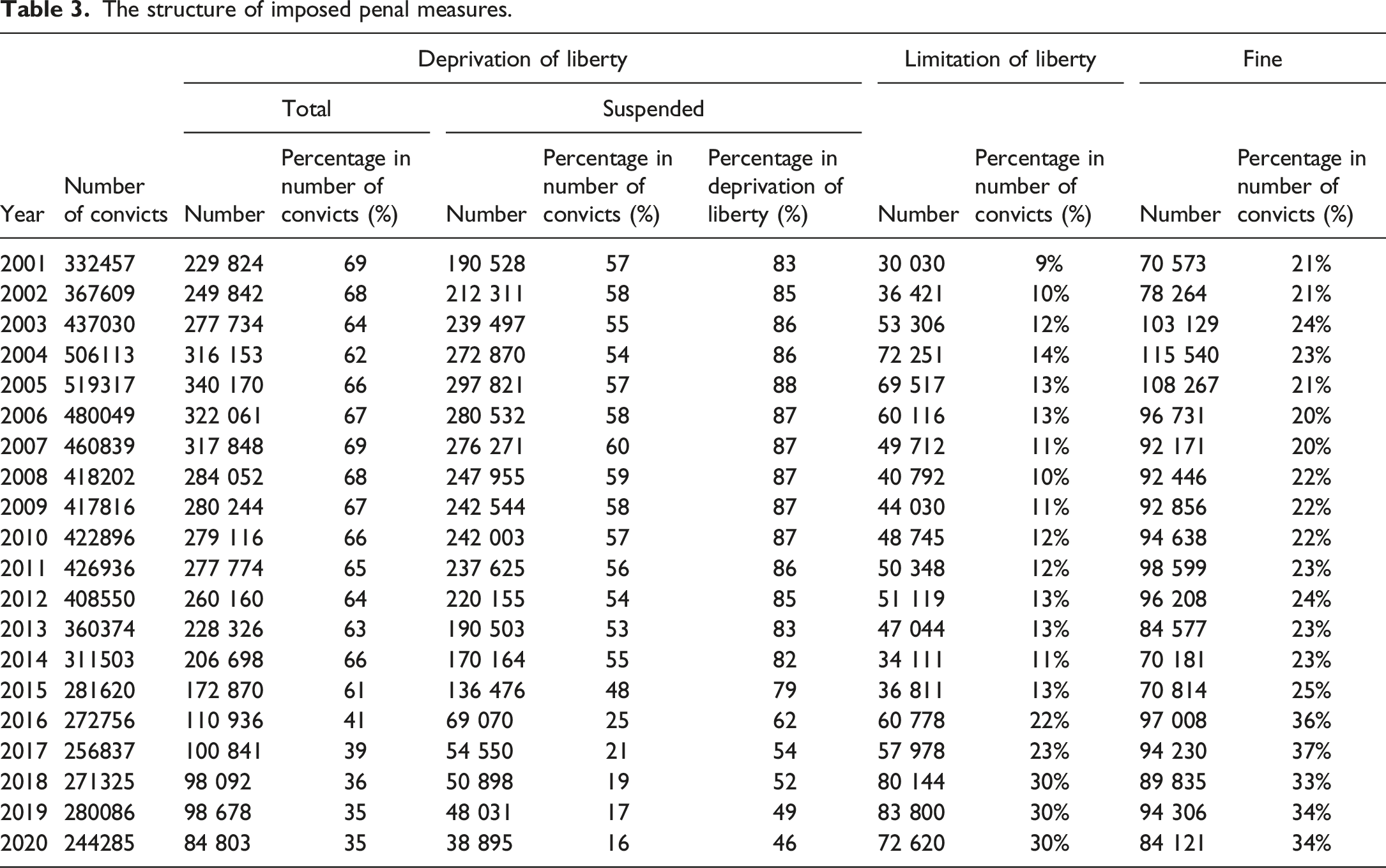
The impact of the reform also confirms that the judges were previously imposing punishments of deprivation of liberty (which were later suspended) that were not deserved for certain crimes. If just after the reform the punishments for similar crimes were milder, this means that the reason for imposing the punishment of deprivation of liberty was different than it should have been under criminal code provisions, under which the deprivation of liberty should be imposed only if any other punishment could not suffice.
A further general conclusion that can be drawn is that the presence in the legal system of probation instruments, which are easily available and widely used by judges, alone does not ensure that imprisonment will not be overused. One could say that the probation instrument fulfilled its role, as judges did not directly impose deprivation of liberty; however, from a broader perspective, the end results were devastating for the legal system. Almost half of the suspended punishments ended up with a decision to enforce the suspended deprivation of liberty. It is important to note that effective probation—that which avoids recidivism, violation of the conditions of probation, and incarceration—is strongly associated with appropriate probation control, and cooperation with probation officers. McNeil suggests three principles for better probation: “urging parsimony in its use, proportionality in its demands and productiveness in its design and delivery” (McNeill, 2018, 14). Effective probation is thus impossible, for example, without a sufficient number of probation officers. A probation officer who has dozens of probationers under his or her supervision cannot devote sufficient time to each probationer. Without appropriate supervision and appropriate conditions of probation (in Poland, conditions of probation were not established at all in a large number of cases), resocialization and achieving the other aims of punishment may be hindered. This can result in feelings of impunity, especially among those offenders who received suspended punishment multiple times. There were 30 convicts with more than 20 judgments with suspended imprisonment and 700 with more than 8 (Łukaszewicz, 2013). These effects can cause overuse of probation instruments by judges to enforce the intent of judgments. On the one hand, suspended deprivation of liberty was imposed to criminals, who did not deserve deprivation of liberty at all. On the other hand, suspended deprivation of liberty was often a harsher sentence than without suspension. 3 All of these phenomena suggest that probation can actually function as a delayed channel into prison (Clear and Austin, 2009).
The lesson from the paradoxical situation in Poland should be that the hope that a law change will easily transform the legal system could be too optimistic. The legislation has the power to transform how judges operate. Still, the direction in which judges move with the new normative situation could differ from legislators’ assumptions. Our results indicate that the aim of decreasing the use of suspended deprivation of liberty was similarly achieved for the two crimes. For drunk driving and possession of drugs, the probability of a suspended sentence of deprivation of liberty decreased by 76% and 75%, respectively. However, the use of discontinuance of proceedings, another probative measure, also changed as a result of the reform. In the case of drunk driving, the probability of this result increased by 386%. In the case of possession of drugs, the probability decreased by 38%. This result indicates that the intentional change in one instrument of the criminal law system can lead to an unexpected change in another. Legislators were not expecting that this instrument would change; the relevant provisions were not changed, nor was there deliberation about that instrument before the reform. The focus of the reform was solely on suspended deprivation of liberty.
That the instrument of discontinuance of proceedings changed in the opposite direction in the case of the two crimes may relate to the penal measure of “prohibition from operating vehicles.” This penal measure is, in many circumstances, mandatory, which means that if there is a conviction for drunk driving, the judge is obliged to prohibit the offender from operating vehicles. However, if there is a discontinuance of the proceeding, there is no conviction, and this penal measure is available, but optional. In other words, the decision to discontinue the proceeding gives the possibility of not imposing this penal measure, which would be obligatory otherwise. This means that if someone is a professional driver or if driving a car is necessary for his or her job or life (e.g., if he or she lives in an area where there is no public transport or must care for dependents), the discontinuance of the proceeding will not severely impede his or her job or personal life. If judges consider this effect of conviction, it could mean that the provisions that cover “prohibition from operating vehicles” are leaving insufficient space for decisions. Legislators should then allow more space for decisions on penal measures for judges, because in other cases, they are using other instruments to avoid the necessity of using penal measures. This case illustrates the complex and interconnected nature of the criminal law system.
The outcomes of the studies depicting the Polish experience may also inspire consideration of legislative reform that alters the status quo by adopting actions that appear to contradict the desired outcome. In the case of discussed reform, a decision was made to restrict the ability of suspending imprisonment. The overall objective was to soften the Polish legal system. This legislative action could have resulted in additional incarceration, but it did not.
The results of this study can be read within the scope of the broader problem of the lack of alternative punishments to imprisonment in cases of less serious crimes. The literature emphasizes that the lack of alternatives to deprivation of liberty is a common problem and not only specific to Polish criminal justice (Caruso and Pereboom, 2020; Frost, 2008; Mamak, 2021; cf. Morris and Tonry, 1991; Tonry, 1996). Facing a lack of alternatives, judges can adopt other criminal law instruments to serve as alternatives punishments, even in contradiction to their normative purpose. One of the reasons for the overuse of suspended deprivation of liberty in Poland was that the judges treated “suspended deprivation of liberty” as a separate kind of punishment (Kucyper et al., 2017), which contradicted the law. If there were alternative punishments suitable for given crimes, then there would be no overuse of probationary instruments, which leads to over incarceration. There should be further studies on proposing new alternative punishments to avoid the problems that occurred in Poland. There have been attempts to propose new punishments in connection with the development of technologies, such as based on electronic monitoring (cf. Arnett, 2019; Vanhaelemeesch et al., 2014), which is used in different ways in different jurisdictions (cf. Nellis et al., 2012), including in Poland (cf. Mamak, 2017, 2019; Mamak and Zając, 2015), “deprivation of the internet” (Bagaric et al., 2018), or “cyber banishment” (Mamak, 2023). In other words, a wider choice of punishments in the legal system might decrease the chances of choosing suspended imprisonment as a punishment.
To conclude, our paper fits into critical literature that draws attention to the possible negative consequences of using probation tools. Our studies also show how the legislative change of the existing law may hinder such negative effects. We also point out that the law change is not entirely predictable and can lead to unanticipated consequences. We also believe those experiences strengthened the justification for seeking alternatives to imprisonment.
Footnotes
Acknowledgements
We would like to thank Reviewers for taking the necessary time and effort to review the manuscript. We sincerely appreciate all your valuable comments and suggestions, which helped us in improving the quality of the manuscript.
Declaration of conflicting interests
The author(s) declared no potential conflicts of interest with respect to the research, authorship, and/or publication of this article.
Funding
The author(s) disclosed receipt of the following financial support for the research, authorship, and/ or publication of this article: This article uses results of a research project financed by the National Science Centre, Poland, granted pursuant to Decision No. DEC-2013/11/N/HS5/04235.
