




Abstract
Probation staff in Norway are responsible for implementing the continuation of sentences following imprisonment, such as in drug rehabilitation institutions, electronic monitoring, home detention, and early release on parole. The Norwegian Correctional Service aims to support positive change and provide training in change-focused dialogue. However, little is known about the content of meetings between formerly imprisoned persons and probation staff following imprisonment. Our analysis is based on 19 interviews conducted within the first year after release or transition from prison to the community and highlights the participants’ lived experiences of these meetings. We show their perceptions of the value of this dialogue, especially as it delves into the circumstances contributing to the offence, how the offence affects their self-concept and challenging barriers to approaching society. This interaction often developed within sustained relationships. Despite this, some were disappointed with a discrepancy between their longing for help and their experience of control practices. We elaborate on how the interaction facilitates and frustrates desistance processes during resettlement.
Introduction
More than two decades of research on supported desistance has offered valuable knowledge on how correctional service staff can facilitate and frustrate desistance processes (Farrall et al., 2014; McNeill, 2006; Rex, 1999). Relationships between staff and sentenced persons have also shown to be of great importance in a resettlement context (Maguire and Raynor, 2006). This is known to be a challenging transition where staff are perceived to be both arranging and hindering pathways away from crime. Probation staff in Norway are responsible for implementing sentences which continue after imprisonment, such as in drug rehabilitation institutions, electronic monitoring, home detention and early release on parole, and for supporting people from prison to the community. One of the main ambitions of the Norwegian Correctional Service is to support positive change (Kriminalomsorgsdirektoratet, 2021), and the course descriptions of the University College of the Norwegian Correctional Service demonstrate an ambition to facilitate change-focused dialogue in the education of prison and probation staff. For example, one of the aims of the course ‘Russamtalen’ is to provide basic skills in the use of BaM (Improving self-efficacy) in conversations about substance abuse and crime (University College of the Norwegian Correctional Services, 2023). Meetings between formerly imprisoned persons and probation staff are central to post-prison measures. They often take place weekly or fortnightly and last for up to an hour. However, little is known about the content and emphasis in these meetings, or the topics of conversation.
This article analyses lived experiences of meetings with probation staff, based on 19 interviews during the first year following imprisonment. We emphasize the participants’ perceived value of these meetings and conversations, and show how interaction often developed within sustained relationships. Despite these positive experiences, we also present the frustrating potential of this interaction. We elaborate on these findings drawing on concepts and theories of desistance, with a particular focus on supported desistance.
Background
The conceptual framework of supported desistance
In a historical context, desistance research initially considered how people stopped committing criminal acts. However, researchers have later increasingly investigated dynamic processes towards identity change (Maruna and Farrall, 2004) and belonging (McNeill, 2016a). These understandings underline that people might have crime-free periods in their lives for various reasons, without having undergone deeper changes in identity or increased their sense of belonging to a community. Similarly, Nugent and Schinkel (2016) developed the concepts of ‘act-desistance’, ‘identity desistance,’ and ‘relational desistance’, where act-desistance described non-offending, identity desistance expressed the internalization of a non-offending identity and relational desistance applied to the recognition of change by others. They highlighted that the two first dimensions were under some control of the individual, while the third could be seen as more dependent on others. In this article, we build on the definition of desistance as ‘a dynamic process of human development – situated in and profoundly affected by its social contexts – in which persons move away from offending and towards social re/integration´ (McNeill, 2016b: 277). Fundamental to this article is the understanding that pathways away from crime might be initiated, assisted and hindered within relationships in a correctional context. The article leans on the understanding of supported desistance as working with a person, within a relationship, to develop identity change and social rehabilitation (Koffeld-Hamidane et al., 2023).
The Norwegian probation services’ follow-up after imprisonment
One of the main goals for Norwegian Correctional Service staff in general is to facilitate rehabilitation during imprisonment and throughout the sentence, and to support convicted persons in making their own efforts to change their criminal behaviour patterns and to live crime-free lives. At the same time, interventions aim to ensure safety and security for the public (Justisdepartementet, 2001). Interaction between probation staff and persons in resettlement is therefore based on both control and support during the vulnerable transition from prison to community. The Norwegian Probation Service manages a number of non-custodial penal sanctions including community sentences, programmes for those convicted of driving while intoxicated, community service in lieu of a fine, early release on parole and sentences served outside of prison (such as in drug treatment institutions, on electronic monitoring and home detention). Parole and alternatives to prison might be implemented following imprisonment, to approach the goal of a gradual transition to society.
According to the Norwegian Execution of Sentences Act, the Correctional Service can release imprisoned persons on parole when two-thirds of their sentence and at least 60 days have been served. Parole shall not be granted if the circumstances, after an overall assessment, make release inadvisable. The Correctional Service must place particular emphasis on the convicted person’s behaviour during imprisonment, and whether there is reason to assume that further criminal offences will be committed during the probationary period. If it appears necessary to implement the parole in a secure manner, the person must appear before the Probation Service for a limited period. Additionally, the Correctional Service can decide that a convicted person who has served one-third of an unconditional prison sentence can serve the remainder of the sentence outside of prison, with or without electronic control (Justis- og Beredskapsdepartementet, 2001). Early release on parole and alternative sanctions are implemented as continuations of imprisonment, in order to facilitate gradual transition to society. However, 76% of the 4622 persons who were released or transferred to the community after serving sentences in prison in 2021 (the year participants in this study left prison) walked through the prison gate without any further control or support from the Correctional Service. As the Correctional Service has a strong focus on whether there is reason to assume that further criminal offences will be committed when considering early release on parole, it is natural to presume that some of those who served their full sentences in prison did so because the Correctional Service believed they would commit further criminal acts after release. This means that only 24% were subject to post-prison measures by the Probation Service, 1 where they had regular meetings with probation workers.
Emphasis on desistance-supporting dialogues in policy and education
When the Execution of Sentences Act of 2001 was implemented in 2002, the need for structured rehabilitative conversations both in prison and probation was recognized. In consultation with the staff of several probation offices and the Directorate of Correctional Services, a handbook in BaM was published (Brumoen and Højdahl, 2007). The book was especially designed for individual interviews and reflections on the offence for probation workers. However, the content was later adapted to different areas of prison and resettlement work, and implemented in the education of prison officers. A main point in these conversations was that staff should strive to establish trusting relationships and support people in taking responsibility for behavioural change, to stimulate their resources, confidence and competence (Højdahl, 2013). During this period, the Correctional Service also invested heavily in providing employees and students with skills in motivational interviewing (MI), a coping and resource-oriented approach to motivate change processes through collaboration and conversation (Kriminalomsorgen, 2023b). BaM is not taught to students as part of any main course in their education today, but still forms an important part of the further education and additional courses offered at the University College. This illustrates how the Correctional Service has emphasized desistance-supporting conversations for more than two decades, and how they have facilitated formal frameworks for these conversations.
The ambition to encourage and improve change-focused dialogue is still alive, as shown in the priorities of the University College of the Norwegian Correctional Service. The University College offers the only basic education for prison officers in Norway in the form of an accredited 2-year programme and supplementary courses leading to a bachelor’s degree in Correctional Studies. They also plan, teach and host courses and conferences for employees of the Correctional Services and partner organizations (Kriminalomsorgen, 2023a). This year, they provided essential qualifications in motivational interviewing, and offered and delivered courses and programmes based on and inspired by MI and BaM. This educational training was particularly aimed at staff who had structural conversations with people who had used drugs or were convicted of sexual offences, and staff involved in programmes especially designed for women (Kriminalomsorgen, 2023b). This focus on desistance-supporting dialogue illustrates the Correctional Services’ emphasis on the role of staff in motivating change in behaviour, attitude and lifestyle.
The correctional service staff’s practice of desistance-supporting interaction during resettlement
People in Norwegian prisons often feel that they are kept safely, in decent and harmless conditions. Nevertheless, they also describe imprisonment as empty, careless, negligent and meaningless (Ievins and Mjåland, 2021). Despite the investment in structural conversations and tools like BaM, conversations about the person’s offence rarely take place in practice (Mjåland, 2022). Researchers have argued that the Norwegian Correctional Service thus gives imprisoned persons considerable freedom and great responsibility to bring up the subject of the moral aspects of their punishment themselves (Ievins and Mjåland, 2021; Mjåland, 2022). Research on convicted men in Norway who have acknowledged committing sexual offences shows how interaction with prison staff sometimes proved fruitful for reflection and rehabilitation. Some of them told stories of being encouraged by staff not to disclose their criminal acts during imprisonment, and many of them emphasized how this lack of opportunity to re-evaluate their self-perception and to process their offence had led to continued offending behaviour (Kruse, 2020). Snertingdal (2021) argues that the voices of people with lived experiences of imprisonment are central to understand the debate of incarceration and prison pain. In her review of literature where these voices are included, she shows that despite the often short sentences, high material standards and more open conditions in Norwegian penal execution when compared to other countries, prison pain is still a highly relevant topic. In a broader resettlement context, people with lived experience tell personal stories of recognition, closeness, belonging, continued relationships and de-stigmatization from prison and probation staff. However, these stories are often overshadowed by other narratives of frustrating ignorance, misrecognition and fragmentation (Koffeld-Hamidane et al., 2023). Probation staff have also expressed their frustration at an increased risk focus in their daily work, and a decreased ability to assist with positive change following release (Koffeld-Hamidane et al., 2023).
Within resettlement contexts, there is little research on the focus and content of probation meetings. In the light of the emphasis on structured change-oriented dialogue in policy and education and the potential for supported desistance, we explore the lived experiences of people in resettlement of the content of these meetings and conversations during probation. We also elaborate on how this interaction intertwines with processes of desistance.
Methodology
The methodological approach of this study rests on an interactionist perspective, where we understand the meaning of an action or a phenomenon as created in the interaction between people. Meaning is thus a relational phenomenon that is produced and understood situationally within a given context (Järvinen and Mik-Meyer, 2005), and knowledge is seen as co-created in every step of our research. In the following, we present our methodological choices and reflections in line with this, paying particular attention to why and how we included reflexive thematic analysis and narrative thematic analysis within this interactionist framework.
We used a qualitative, exploratory design to study the poorly researched topic of experiences of staff support for desistance in the transition from prison to community. Further, a longitudinal approach enabled a focus on how these processes developed over time, as well as on participants’ understandings of these trajectories. It also gave us an opportunity to study interaction and relationships as they unfolded (Farrall et al., 2014). To synthesize and present the data, we were inspired by reflexive thematic analysis (Braun and Clarke, 2019) and narrative thematic analysis (Riessman, 2008). Drawing on Braun and Clarke’s portrayal of qualitative data analysis as a telling of ‘stories’ and of interpreting and creating themes, we initiated the process by adopting a reflexive thematic approach. We then gradually included elements of narrative thematic analysis in the presentation of the findings, to better reflect relevant developments due to the longitudinal approach and the second wave of narrative interviews.
Recruitment and participants
Participants were recruited from three probation offices and three penal voluntary organizations. The first author initially discussed the aims of the research project and the criterion for inclusion of interviewees with management and staff in the six sections of recruitment. These management and staff acted as gatekeepers and door openers and helped us to come into contact with participants. In order to involve a diverse sample encompassing different perspectives and trajectories of our topic, there was no criterion that participants had expressed a desire to change their lifestyle. Those who had stated their interest in participation were approached via phone messages to arrange the interviews.
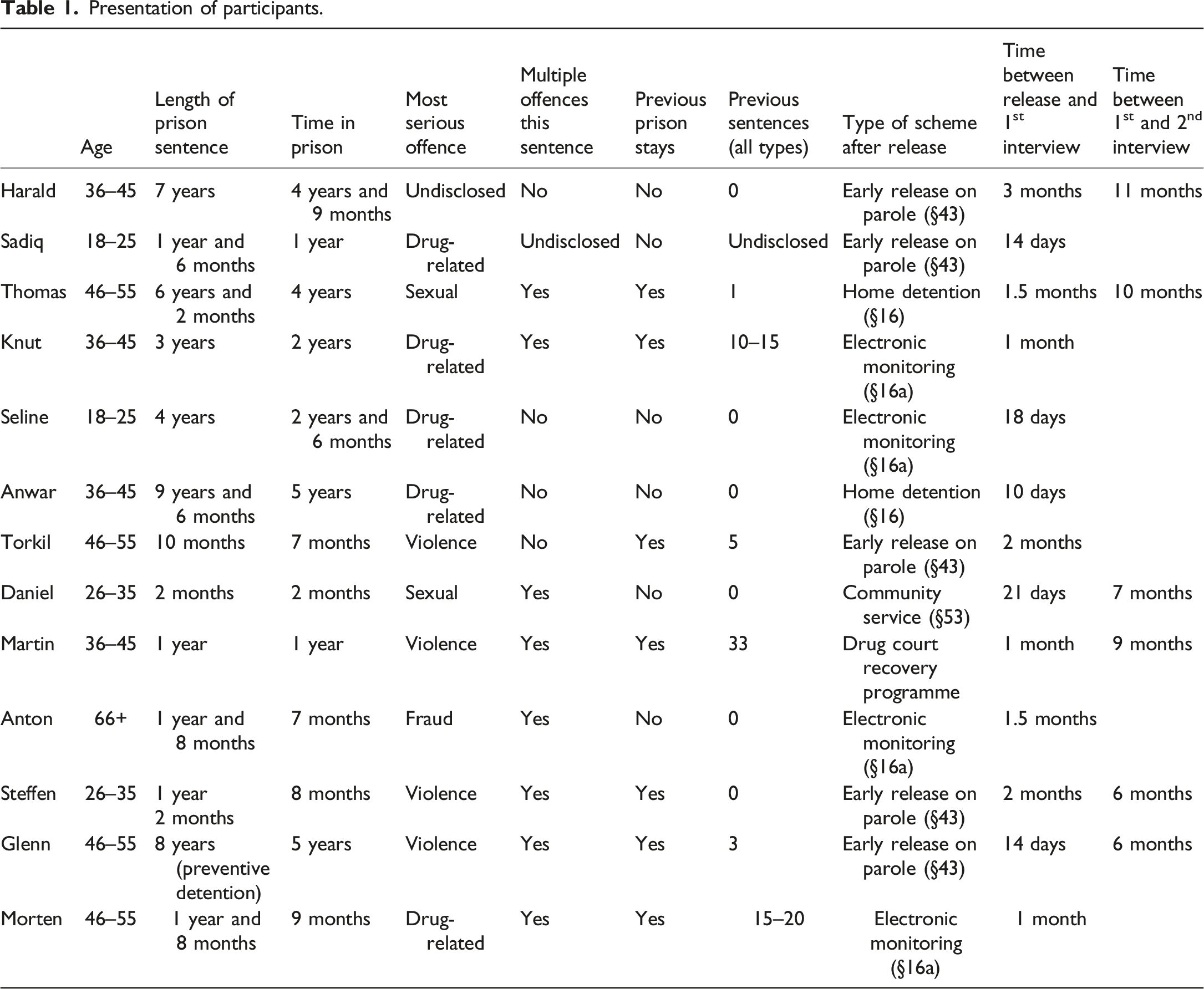
Presentation of participants.
Interviews
The interviews lasted for 40–120 min and were conducted face-to-face. Most took place in meeting rooms at the University of South-Eastern Norway or in libraries close to where the participants lived. Three were conducted in cafés, two at participants’ workplaces, and one in a private home. The first wave took place from April to August 2021, and the second from January to March 2022. Participants were interviewed 10 days to 3 months after release, and again between 6 and 11 months later.
At the first interview, participants were informed in more detail about the study. They signed an informed consent and completed a background form in dialogue with the first author. These initial steps facilitated informal chats, establishment of rapport, and careful approaches to the research topic. Information and interviews focused on motivation for and possibilities to lead ‘law-abiding lives’ following imprisonment rather than using the more academic term `desistance’, based on earlier meetings and discussions with representatives from WayBack (a non-profit foundation whose members had lived experiences of resettlement, which had an advisory capacity in the research project (Roche et al., 2010)). Interviews started broadly, allowing participants to talk about whatever they found important and relevant for the topic. Gradually questions narrowed down to how relationships with staff motivated or hindered their processes away from crime, both during the last period in prison and at the time of the interview. Participants were asked if they had been in situations following imprisonment where they normally would have committed criminal acts, and if so, what affected their actions in the situation. Questions also related to how they envisioned themselves in the future. The follow-up interviews aimed to explore how participants’ thoughts and perceptions unfolded over time. Narrative interviews with few questions and invitations to talk more freely, as well as questions related to ‘future selves’ (Giordano et al., 2002), were intended to elicit narratives of what had been and was of importance to them. All interviews were recorded and transcribed before analysis.
Analysis
The initial coding of the material was performed separately by two of the authors, in order to develop a richer and more nuanced reading of the data (Braun and Clarke, 2019). As a second step, the same researchers discussed the developed categories, the relations between them, and how they related to the research topic. In this process, as we analysed the second wave of interviews more deeply, we found reflections on more positive experiences of the interactions than we did in the first interviews with the same participants. For example, Thomas did not mention conversations with probation staff in the first interview, but was keener to talk about what penal voluntary organizations helped him with, which were things ‘one would normally expect the Correctional Service to do’. In the second interview it became clear that he had had great benefit from therapy-like conversations with his probation worker, which he had missed and worked for during most of his time in prison. Similarly, the second interview with Harald revealed decisive talks with his probation worker even after he finished his sentence. Hence, through our analysis of follow-up interviews, we developed preliminary themes such as ‘care and help through availability and lasting relationships’, which would not have appeared without a longitudinal approach. However, some of these changes towards more positive reflections, such as a perceived shift from duty to great benefit, sometimes also appeared towards the end of the first interview. In both examples, these reflections shed light on how interaction with staff affected desistance processes over time.
The longitudinal research design was intended to enable reflection on participants’ dynamic perceptions of the impact of the staff over time (Farrall et al., 2014). Additionally, efforts to develop rapport with participants might have gradually led to conversations that were safer, more open, and more conducive to reflection (Dickson-Swift et al., 2007), despite the challenges of establishing this kind of interaction with people who are often characterized as ‘criminals’ (Sandberg, 2010). These factors might have encouraged a setting for the participants’ stories that they might previously have longed for (Gålnander, 2020). We illuminated the relevance of the temporal aspect in two steps. First, through a collaborative approach between the researchers, we generated broader themes to shed light on, such as ‘necessary factors/prerequisites for the interaction to be perceived as significant’, how ‘meaningful dialogue facilitated supportive relationships’, and how time tended to ‘nuance the early negative experiences of the interaction’. Second, we included longer extracts of participants’ stories in the presentations of our findings. This differed from the initial reflexive thematic analysis, where we focused mainly on content and categories in the interviews; now these temporal aspects were highlighted by keeping the stories more intact and theorizing from each case (Riessman, 2008). Hence, in this section, stories that unfolded over the course of the interview(s) with each participant are presented to illustrate more general patterns.
Findings
Participants spoke of varying expectations, wishes and knowledge of the supervision at the end of imprisonment. Those on electronic monitoring tended to talk about early contact with staff and several long explanatory conversations. People on early release, on the other hand, often had little knowledge of the content of their parole, despite having occasional contact with the probation worker during the last part of their prison sentence. Harald, who had served almost 5 years, was uncertain as he approached release: ‘I knew little about the parole. Only that it was something I had to do.’ He was still clear about his needs after release: ‘I know what I need. A conversation partner. Someone who cares and who is genuinely interested in helping me’. Despite their rather low expectations for their post-prison supervision, many called for practical support, guidance and reassurance to prevent them from committing new criminal acts.
Varied focus on topics related to the offence
Overall, our data show that participants valued conversations with probation staff, especially as they explored the circumstances contributing to the offence, how the offence affected their self-concept and how to challenge barriers to approaching society. Sometimes this interaction developed into sustained relationships. Several participants underlined that they rarely or never talked with staff about these topics during imprisonment. Although this was mainly brought up as a curiosity or paradox by some, it was something many of them had longed for. Steffen had struggled with this during his 4 years of imprisonment, but finally established such conversations with his probation worker: I served more than four years in prison, and I never talked about my sentence or what had led up to it. Not once. But I brought it up with my probation worker. Because I’ve served so many years, and I’m supposed to be rehabilitated, and I think that’s an important thing, to get people back to normal. Not just the offence, but what led to the acts I’m responsible for. It’d be nice if someone was a bit involved in my thoughts after serving this long time. You should understand a person to be able to help him, I think.
Such topics were frequent and essential in meetings with probation staff, but were often initiated by the participants themselves. Many reflected on how to keep clean from drugs, avoid certain criminal networks, and stay away from crime more generally. One of these was Martin, who highly valued a feeling of safety with his probation worker and others representing different organizations and welfare institutions in his aftercare group. The group followed him closely, and challenged and supported him. His probation worker knew a great deal about him and his crimes due to his repeated sentences over a long period, including the connection between his substance addiction and his crimes. As regular urine tests were carried out post-release, it was natural to approach this topic in their meetings: My probation worker is outstanding. She understands things. I like it best when they can look the other way a bit, and don’t punish you as soon as you do something wrong. She’s read my whole story and everything, and she’s seen my changes. But she also helps me keep off drugs, and tells me when I’ve done something wrong. Then she tries to keep me out of prison. And now I’ve been out for almost a year. I can’t remember the last time I was. They’re supportive, so it’s not just chitchat. Things would be disastrous without them. So I need them to rein me in a bit.
Here, Martin describes how conversations with his probation worker and the aftercare group help him stay away from substance abuse and criminal acts by ‘reining him in’. Conversations about his crimes and illegal acts, and how they might send him back to prison, seem to support his struggles for recovery and desistance. However, merely focussing on abstinence and a known risk of offending, rather than a commitment to leading the new and fuller life the person desires, might be a `shaky peg’ on which fragile transformations sometimes hang (Schinkel, 2015).
In addition to this asset of support for desistance from crime, Martin elaborates on parts of the conversations that facilitate identity desistance and belonging. Like most of the participants, he emphasizes the impact of being seen for more than his crimes, as his probation worker read and knew ‘the whole story’. Anton and Steffen also highlighted the necessity of open conversations where probation staff had time to get to know who they really are, ‘not only through their papers’. Such conversations often appeared as therapy-like and decisive. Daniel was one of the participants who wondered whether or how their crimes related to their current identities. To him, the probation worker’s counselling and recognition helped him see himself beyond his conviction for sexual assault: There are certain times when I suddenly have a flashback and I’m reminded that - ok, yes. I’m ... It’s easy to be stigmatized, because of what I’ve done. But my probation worker said: “You must remember, Daniel, that your offence is not you. It's something you've done. It doesn’t describe you as a person”.
He had been advised by prison officers not to reveal his offence during imprisonment, and had overheard some of the men he served with going into detail about what they would like to do to ‘sexual offenders’. He practically put a lid on his offences during imprisonment, as do many others sentenced for committing similar acts (Kruse, 2020). Daniel explained how he was eager to explore if he would be tempted to repeat his offence after imprisonment, and he put himself in situations that could have tempted him to find out. Being able to delve into this with his probation worker facilitated this quest. The probation worker indicated that there was no point in Daniel emphasizing this as he faced society. The participants often compared these destigmatizing conversations to their opposite experiences from imprisonment. Now they were to a larger extent recognized for being more than the crime they had committed (see also O’Sullivan et al., 2020). The feeling of being appreciated beyond the nature of their crimes might have been especially important for those convicted of sexual offences. Blagden et al. (2016) emphasize how a non-judgemental social environment in a prison for people convicted of sexual offences laid the foundation for feelings of safety, as people did not have to portray other identities or live in constant anxiety. Hence, recognition from staff for who they were, as well as who they might become, influenced how participants felt, acted, and thought of themselves. Feelings of normality allowed for experiences of change in self-narratives (Blagden et al., 2016; Kruse, 2020; O’Sullivan et al., 2020). In a similar vein, Villeneuve et al. (2021) show how sentenced persons tend to be ‘between two selves’, where they do not yet feel like citizens nor offenders, and how seeing the good in people over time is required for changes to take place.
Safe havens for proving change and removing lids
Despite many participants’ perceived benefit of these interactions with staff, they felt that some basic conditions were necessary for the conversations to be valuable to them. It was essential that probation staff were generous with time and availability, that they genuinely cared about and wanted the best for them, and that they were flexible and did not always ‘go by the book’. This interaction, built on flexibility, trust, care and frankness (see also Kruse, 2020; Ugelvik, 2021), was often framed in everyday settings such as informal chats over a cup of coffee. Over time, these valuable meetings tended to develop into sustainable relationships. Steffen’s commitment to stay away from crime helped him come across as a credible and reliable person to his probation worker: She (the probation worker) knew I was in a motorcycle club. I’ve resigned from the position I used to have, because I used to do lots of illegal stuff. She asked: “How’s it going? Have you returned full-time to the club?” I replied: “No, I haven’t. I mostly keep to myself.” Now I’m just an ordinary member of the MC community and come and go as I want. I: But what made you leave that position? It’s because me and (name of probation worker) agreed that it was perhaps the best, because otherwise I’d have gone back to where I left off. So I promised her I’d step down from the position, which the others respected. I’m proud that I’ve lived up to what I’d promised her.
Steffen’s experience of help and care over time guided him into a sustaining relationship with his probation worker. He found it satisfying to keep his promise to her. What he perceived as her feeling that he had become a responsible, desisting person made him feel the same way about himself. Similar strong incentives to change were found in positive interactions with probation staff in a scoping review by Villeneuve et al. (2021). In some cases, these sustainable relationships extended beyond the formal duty of the staff. In the first interview with Harald, when 3 months remained of his parole, he expressed his concern about having no one around him in the community: You don’t have anything when you’re released. Apart from probation, you don’t have anything else out there. You’re released with absolutely nothing. You become sort of left alone.
In the next interview, he elaborated on how his probation worker supported him as he felt left alone and faced obstacles, even after his parole was over: I went from August to the end of October without anything. But there was a period when it was hard to cope. I decided to call her for help. I: Yes, and when you say October, you had finished your parole a few months earlier, hadn’t you? So you got back into regular meetings with her then? Yes, just like once a week on the phone for a period. She did it on a voluntary basis. It wasn’t something she had to do, so it was really cool. (…) I wanted help because I had to start paying compensation. There was a message sent to my employer stating that some money, a compensation for the offence I’d committed, had to be withdrawn from my salary. So, when I got to work, the manager said: “What’s this all about?” I went numb and didn’t really want to say anything. So, I called her. Fortunately, she answered the phone, and we agreed that I should go and speak to the manager. So I did, and I told him what had happened. He said: “Ok, now I know. I’ll put it behind me. It’s between the two of us. No problem”. So I sort of got some help.
Even though Harald stated that he had not committed criminal acts since release and did not self-identify as a person who would commit the type of offence he was convicted of, he felt distressed and upset that the claim of compensation could cost him his job. He felt that the future of his job lay in the hands of his employer. He was stressed about his manager’s knowledge of his offence towards somebody else, and was embarrassed to talk to him about it. Thanks to his former parole worker responding when he reached out to her, he was given the tools and courage to begin a dialogue about the ‘afterlife’ of his sentence (Miller, 2021). He had been able to develop an identity by gaining legitimate employment in the first place, which has been shown to require struggles with structural barriers (King, 2013; Kruse, 2020; Koffeld-Hamidane et al., 2023). The example of Harald shows how this challenge also applies to the maintenance of such identities. Harald’s former parole worker stood up for him beyond their formal relationship. This was decisive for keeping his job and his feeling of wellbeing and belonging, and was a key factor in his sustained pathway away from crime. Harald underlined that this was something the parole worker wanted to do, not something she had to do. The value of such continued relationships for desistance processes in resettlement contexts has been pointed out by Collica-Cox (2018) and Meek and Lewis (2014). Their studies relate to the experience of establishing post-release support, to enable people to have someone they knew and trusted in the community. In line with our findings, those lasting relationships were dependent on people having the feeling that staff were encouraging and caring, practised an open door policy, and went beyond their job duties. Continued relationships were considered key factors in assuring long-term support, in motivating people for life changes, and in building social capital (Collica-Cox, 2018; Meek and Lewis, 2014). When participants felt that they were seen as whole persons, they felt comfortable in talking about whatever they wanted without being judged. This enabled staff to be reliable stepping stones who provided hope for crime-free futures (Meek and Lewis, 2014).
Frustration and ambivalence of being ‘captured in freedom’
Even though most participants expressed positive experiences with the interaction with probation staff, some were indifferent to it. A few reflected on feelings of obligation and control during parts of their probation period. For them, meetings appeared as limitations and drawbacks in everyday life, which led to feelings of being unfree despite not being imprisoned. Sadiq experienced this as being ‘captured in freedom’: In half a year from now, I’ll no longer have the damn parole. Well, it’s very nice to talk to the probation worker and so on, but the prison thoughts keep coming back every time I do. You’re free, but it’s like... (grinning)… every time: “Oh, hello, it’s me from the probation office.” I just think: Oh, shit! Then I kind of must talk to them (grins) for half an hour, or however long it is. It’s quite ok with me. At least I get a break from work. But I’m not gonna expect those calls in half a year from now (laughs). Then I’ll no longer be captured in freedom. Now I’m free, but I don’t feel completely free. I don’t.
Sadiq presents a liminal feeling of freedom. He is in some kind of limbo where he is released but still unfree. To him, conversations with his probation worker take him mentally back to prison, and remind him of where he has come from. His description of being ‘captured in freedom’ reflects how this interaction constrains his growth, despite the kindness of his conversation partner. Hence, it seems to frustrate his trajectory towards a stable everyday life. Similar feelings of liminality, wasteful penal processing and a yearning for freedom have been expressed in a Scottish parole context. As in our findings, this involved reminders of otherness, and of being a criminal convict even after release (McNeill, 2019). The balancing of surveillance and rehabilitation has been shown to frustrate desistance, as people face multiple obstacles to access full citizenship and feelings of freedom (Villeneuve et al., 2021).
For some, the initial phase of supervision mainly provided constraint, but many reported a favourable experience after interacting with staff over time. Meetings with staff started out as something they had to do, but eventually developed into something meaningful. Glenn was among those who expressed disappointment at the distance between the help he desired and daily life on parole: ‘I wanted support from the Correctional Services, to stay away from crime upon release. Not a limiting device. I wanted help, not control’. In the second interview, he reflected on how his applications for long-distance travel to visit his family were rejected at the start of his parole, and how his feeling that he was not trusted gradually changed: ‘They got to know me better and started to let go of me a bit’. Even though this gradual movement towards freedom might reflect how the Correctional Services practice their aim, it could also mirror a delayed feeling of support (Farrall et al., 2014). For others, who mainly experienced the benefits of support, ambivalent feelings were related to a relief at having completed their parole coupled with a desire to continue the valuable conversations. Daniel referred to this as a double-sided experience.
In this article, we aimed to investigate lived experiences of the content and focus of meetings with probation staff after imprisonment, and how these intertwined with processes of desistance. Overall, our data show that participants perceived this dialogue to be valuable, especially as it explored the circumstances contributing to the offence, how the offence affected their self-concept and how to challenge barriers to approaching society. Sometimes this interaction developed into sustained relationships, which in at least one case extended beyond the formal parole period. However, some also expressed their disappointment at the discrepancy between their longing for help and their feeling of being controlled. Despite these differences, the probational supervision was not perceived as either valuable or constraining and unfree. We show two-sided perceptions related to the temporal aspect and to ambivalence. The former applies where the experience transforms from control to support, and the latter shows the yearning for a combination of freedom and continued conversations. Through this analysis, we have also exemplified how the dialogue and interaction seemed to facilitate and frustrate desistance processes.
Discussion
Our analysis describes what conversations and meetings with staff contain as people approach the community after imprisonment. It shows how the offence per se is discussed to a varying extent. From a Norwegian prison context, however, Mjåland (2022) shows a clear pattern of the offence being scarcely discussed between prison officers and imprisoned persons. Additionally, in our article, the contributing circumstances of the offence and its impact on self-concept and barriers to society are often explored and highly valued in conversations after imprisonment. Kruse (2020) points out that people imprisoned for sexual offences often perceived interaction with staff as fruitful for reflection and rehabilitation. Experiences of ‘friction’, described as ‘meeting a certain type of resistance or challenge to their reasoning and storytelling about their lives and violations’ (Kruse, 2020: 202), sometimes evolved in dialogue with prison officers. However, many felt encouraged by staff not to disclose their criminal acts during imprisonment, and emphasized how this lack of friction hindered them from re-evaluating their self-perception and from processing their offence. In view of this lack of focus on the offence during imprisonment, our study shows how conversations and meetings with trusted probation staff outside the prison walls are often long-awaited and liberating as people face uncertainty and prejudice in approaching the community.
We argue that an awareness of act-desistance and identity desistance might be the most important and relevant priority in what Mjåland (2022) has introduced as an often ‘here-and-now’ focused context of imprisonment, as these dimensions are largely in the hands of imprisoned persons themselves (Nugent and Schinkel, 2016). Our findings suggest approaching the contributing circumstances of offences and their impact on self-concept and barriers to society, and framing this approach within sustainable relationships, in order to facilitate identity and relational desistance. Probation staff and penal voluntary organization staff have emphasized a similar ideal of establishing close and continued relationships during resettlement, to promote the resources of released persons and thus enable support in challenging barriers to society (Koffeld-Hamidane et al., 2023). The probation staff also expressed frustration at low organizational priority to practice in line with the ideal. Despite staffs’ similar perceptions of desistance support and hindrances, only penal voluntary organization staff managed to practise close to the ideal. They often made themselves available even in their spare time, to try to assist resettling persons when they needed their support the most. We have shown how the need to reflect on identity and individual change appeared evident as people served the last part of their sentence in the community. Drawing on the thoughts of Nugent and Schinkel (2016), we highlight how the transition from prison to society represents the first real opportunity for persons in resettlement to explore their processes of relational desistance, which strongly depend on people around them. Support for relational desistance and belonging was cherished as people faced both expected and unexpected challenges following imprisonment.
Our findings underline the importance of framing desistance-supporting conversations in safe, sustained and partially reciprocal relationships, beyond the more strategic and instrumental conversational toolkits of BaM and MI. Similar advantages of such framing were shown in a study of women’s perceptions of participation in a motivational and gender-sensitive programme (Højdahl et al., 2014). The VINN programme, partly inspired by the above-mentioned toolkits, aimed to motivate women to explore what ‘quality of life’ meant to them, to increase their sense of coherence, and to develop confidence to desist. Based on 13 group interviews with 65 participants in prison or on probation in Sweden, Denmark, Russia, Estonia and Norway, Højdahl et al. (2014) showed participants’ enhanced motivation for change as well as their specific plans to enable change. Moreover, participants increased their confidence in their ability to desist from crime and substance abuse. However, the participants also underlined the significance of the accepting group atmosphere, which largely rested on the facilitators’ role modelling through resource focussing and careful listening. Likewise, positive relationships, as well as experiences of being seen and taken seriously, have been highlighted as a basic foundation for the facilitation of participants’ desistance processes in the above-mentioned ‘russamtale’ (Aagesen and Martinsen, 2016). Much in line with the findings in our study, this suggests the importance of resource focus, trust and relationships to facilitate desistance.
As shown by Mjåland (2022) and Ievins and Mjåland (2021), the Correctional Service tends not to be interventionist with regard to people’s thoughts and feelings related to the offence and imprisonment. Following this, Crewe and Ievins have pointed out how grips of penal power in prisons can be ‘loose’ or ‘tight’ in desirable or undesirable ways, and that a lack of attention and intervention can be frustrating and harmful (Crewe and Ievins, 2021). Our study demonstrates how conversations and interaction with staff are often highly appreciated as they take place following imprisonment. However, post-prison measures by the probation service are the prerequisite for this support and the framework where it takes place. We have mentioned how such schemes only applied to 24% of those released or transferred from prison to the community in 2021. As many as 76% walked through the gates without these often appreciated, treasured and desistance-supporting meetings with the Correctional Service. Building on the reasoning of this paragraph, we suggest that an increase in the proportion of people granted early release on parole or other transitions to the community under the Probation Service could provide resettling persons with long-awaited desistance support.
Footnotes
Acknowledgements
We are very grateful to Thomas Ugelvik for valuable comments on earlier draft versions of this article.
Declaration of conflicting interests
The author(s) declared no potential conflicts of interest with respect to the research, authorship, and/or publication of this article.
Funding
The author(s) disclosed receipt of the following financial support for the research, authorship, and/or publication of this article: This work was supported by the Norwegian DAM foundation.
