



Abstract
This article introduces and evaluates Trauma-Informed Narrative Inquiry (TINI), developed as a dual-role methodology combining narrative inquiry and trauma-informed psychotherapy. It examines how this approach supports identity reconstruction, transformation, and meaning-making in trauma-saturated contexts, that is settings where experiences of violence, loss or chronic threat are pervasive and ongoing, while maintaining ethical care and researcher reflexivity. The paper outlines the theoretical foundations and practical processes of TINI, illustrates its development through a case study and evaluates its methodological and ethical contributions to qualitative research. Developed through doctoral research with individuals disengaging from violent extremism, TINI addresses limitations in qualitative approaches that separate therapeutic care from analytic rigour and overlook the emotional and embodied dimensions of fieldwork. Building on recent reflexive and trauma-informed qualitative research, TINI reframes emotional attunement and relational safety as foundations for analytic insight. Rather than conflating research and therapy, it combines psychotherapy, reflexive ethics and narrative pacing within longitudinal inquiry. As a therapist–researcher, the author employed clinical and research supervision, staged consent and institutional oversight to safeguard participant and researcher wellbeing. By positioning narrative transformation as both an ethical and epistemic outcome, TINI advances trauma-informed and psychosocial research. It offers transferable tools such as co-constructed timelines, narrative revision and structured methods of emotional stabilisation, enabling participants to engage safely and meaningfully in emotionally attuned, relational and rigorous inquiry across trauma-affected contexts.
Keywords
Rethinking research and care
Contemporary qualitative research increasingly recognises the emotional and relational dimensions of inquiry, yet practices of care often remain peripheral to methodological design. Researchers working in trauma-saturated contexts face a persistent tension between ethical responsibility and analytic rigour. Trauma-Informed Narrative Inquiry (TINI) was developed in response to this tension, integrating narrative inquiry with trauma-informed psychotherapy to create a framework where care and knowledge production are mutually reinforcing. Its development and application, examined through doctoral research with individuals disengaging from violent extremism, highlight new possibilities for ethically attuned, relational and methodologically robust inquiry in trauma-affected settings. In this article, I use the term ‘trauma-saturated’ to describe research settings in which experiences of violence, loss, chronic threat or structural harm are not isolated events but ongoing features of everyday life. In such contexts, distress may be recurrent, narratives fragmented, and trust in institutions fragile. Attending to these conditions is essential for both ethical responsibility and analytic rigour.
This work is grounded in several intersecting critical traditions that inform its ethical and methodological foundations. Feminist critiques of extractive research (Haraway, 1988; Harding, 1991) expose the illusion of objectivity and foreground researcher positionality, making reflexivity central to TINI. Decolonial scholarship (Smith, 2021; Tuck and Yang, 2012) challenges dominant epistemologies that reproduce colonial power relations and calls for reciprocal, relational approaches that resist appropriation. Trauma-informed qualitative research (Alessi and Kahn, 2025; Diab and Al-Azzeh, 2024; Etherington, 2000; Isobel, 2021) extends this ethic of care by prioritising safety, trust and emotional regulation. In what follows, I use attunement to describe the researcher’s capacity to notice, tolerate and respond to participants’ emotional states in the moment, and I use containment to refer to the researcher’s capacity to remain regulated and responsive in the presence of intense emotion, thereby supporting participants to express and organise difficult feelings without overwhelming either participant or researcher. Taken together, these traditions inform the ethical commitments that underpin TINI.
Within this critical landscape, conventional qualitative research has historically maintained a rigid separation between therapist and researcher roles (Beauchamp and Childress, 1994; Kitchener, 1988). While this distinction clarifies boundaries and power dynamics, it can also oversimplify lived experience. In trauma-saturated contexts, such rigid divisions risk obscuring the relational processes through which meaning is produced. TINI responds to this tension by recognising that emotional and ethical complexity is not a methodological liability, but a condition of inquiry that must be approached with clarity, reflexivity and care.
At the same time, it is important to acknowledge that qualitative research has evolved significantly in the past two decades. Reflexive thematic analysis (Braun and Clarke, 2006, 2019), interpretive phenomenology (Smith et al., 2009) and relational ethnography (Desmond, 2014) have challenged post-positivist assumptions of detachment by positioning researchers as co-constructors of meaning. These newer traditions emphasise transparency, reflexivity and affective engagement, values that resonate with TINI’s epistemology. TINI therefore does not reject qualitative research but extends its most relational and trauma-informed developments.
Participatory and reflexive methodologies have advanced collaborative knowledge production (Benjamin-Thomas et al., 2018; Finlay, 2002; Groot et al., 2022; Liamputtong, 2025; Pillow, 2003). Table 1 summarises how TINI aligns with and diverges from adjacent qualitative and therapeutic methodologies, highlighting the role of emotional depth, containment and dual-role reflexivity. However, few methodologies explicitly prioritise participant transformation as a methodological goal. In many qualitative approaches, opportunities for participant meaning-making and identity reconstruction within research encounters are often missed. TINI responds to this gap by supporting participants to revisit, reinterpret and refine their narratives over time.
Comparative overview of methodological orientations highlighting how TINI integrates emotional depth, ethical containment and dual-role reflexivity while recognising plural developments in qualitative research.
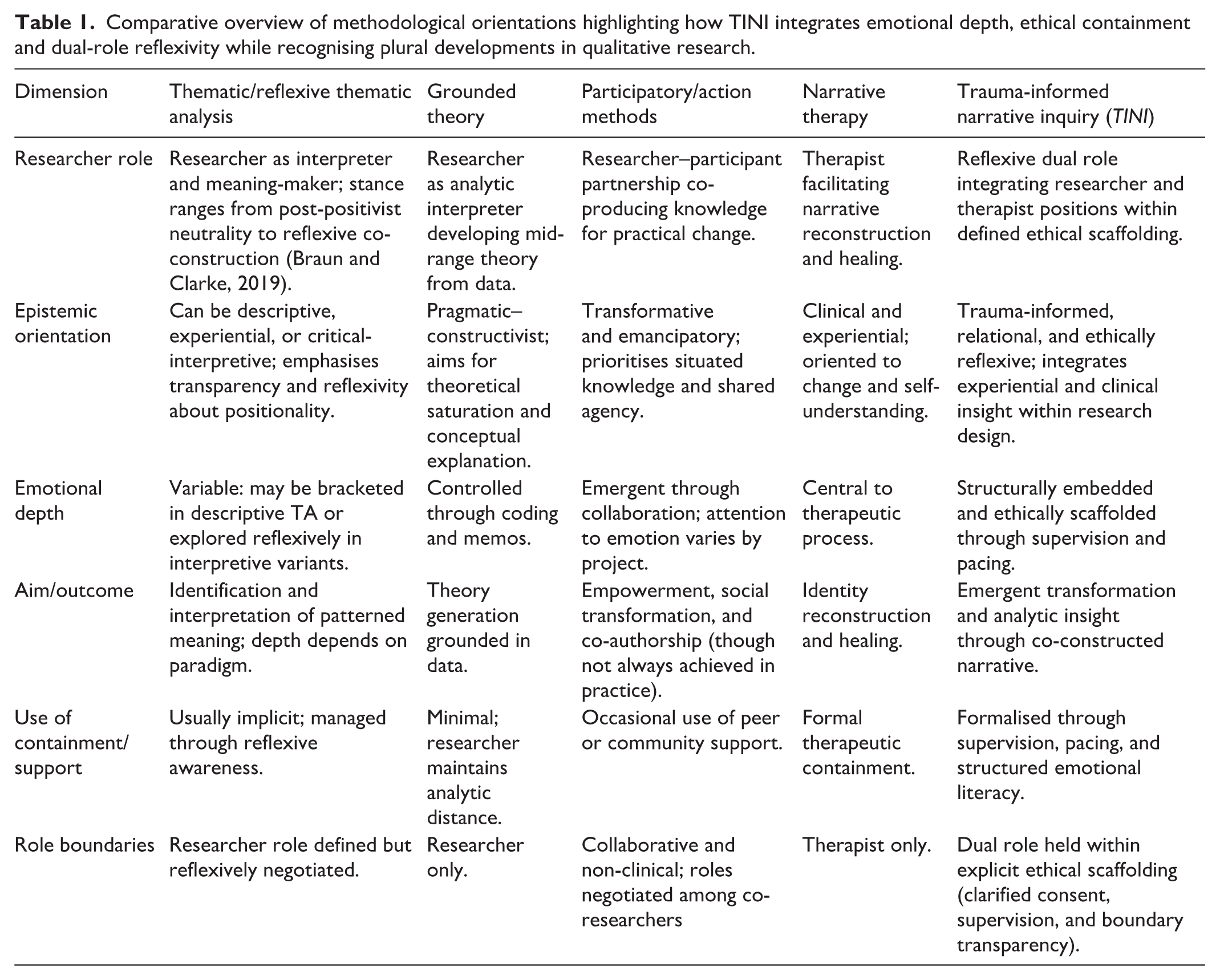
Trauma-Informed Narrative Inquiry (TINI) responds to these gaps by re-positioning the therapeutic concepts of attunement, pacing and containment as ethical assets within inquiry. It brings together narrative ethics and dual-role reflexivity to support forms of inquiry that remain responsive to emotional complexity while maintaining clear ethical commitments. In this way, TINI offers a framework capable of sustaining depth, safety and reciprocity in trauma-affected contexts.
In practice, TINI embeds therapeutic containment within longitudinal narrative research to explore how trauma survivors reinterpret experience. It prioritises narrative transformation over static description, enabling participants to re-engage with their stories in ways that support agency and coherence.
The aim of this paper is to articulate the theoretical foundations and ethical commitments of TINI, to illustrate its application through a longitudinal case study, and to evaluate its methodological contribution to trauma-informed and psychosocial research.
Together these methodological principles enable TINI to establish conditions in which participants can engage emotionally, reflectively and with agency over time. It diverges from existing models by explicitly scaffolding emotional depth and framing transformation as a legitimate methodological outcome.
Through this framing, TINI is positioned as part of the broader evolution of qualitative inquiry towards relational, ethical and emotionally literate methodologies. At its core, the method embeds the narrative research process, characterised by longitudinal engagement and dual-role reflexivity, within an ethical-relational scaffold of supervision, containment and ongoing attention to wellbeing. These interlocking layers enable participant transformation, fostering coherence, identity shifts and psychological growth (Moran and Asquith, 2020; Thomas-Hughes, 2018). Therapeutic engagement is not ancillary but integral to maintaining safety and generating insight, ensuring that both care and analytic rigour are achieved simultaneously (Frank, 2012; Moran and Asquith, 2020).
The following section outlines how TINI was designed and implemented in practice, tracing its theoretical rationale, ethical scaffolding and procedural structure. It moves from conceptual foundations to the practical dynamics of conducting trauma-informed narrative research.
Trauma-informed narrative inquiry (TINI): Theory, ethics and design
Designing from within the messiness
Building on the principles outlined above, trauma-informed research must be designed from within the emotional and relational complexity of lived experience rather than imposed through procedural frameworks (Alessi and Kahn, 2025; Diab and Al-Azzeh, 2024; Isobel, 2021). In trauma contexts, stories are fragmented and affect-laden. Conventional methods that privilege coherence or abstraction risk flattening this complexity (Frank, 2012; Neimeyer, 2006).
TINI integrates constructivist and psychosocial paradigms with trauma-recovery principles to sustain ethical responsiveness and emotional attunement (Fleet et al., 2016; Moran and Asquith, 2020). Central to this design is the researcher’s dual positioning as therapist–researcher, reframed here as a site of epistemic depth and ethical obligation rather than liability.
TINI is concerned not only with what is narrated, but with how storytelling becomes possible. It begins by establishing conditions that allow distressing material to surface safely: regulated pacing, deep listening and co-construction of meaning. These practices make questions of power, role boundaries and researcher responsibility explicit rather than implicit (Bahner and Lindroth, 2023; Kinitz, 2022).
A core innovation lies in embedding therapeutic containment within a longitudinal design. This does not turn research into therapy or imply treatment outcomes. Instead, it recognises that participants in trauma-saturated settings are not recounting events at a distance but re-entering emotionally charged experiences. Therapeutic scaffolding such as grounding, regulation and containment enables participants to revisit these experiences with agency and safety. Without such supports, overwhelm or dissociation might otherwise halt the process (Alessi and Kahn, 2025; Etherington, 2004).
TINI moves beyond retrospective narration to support real-time narrative revision. Across repeated interviews, participants revisit earlier accounts, add nuance, challenge self-blame and experiment with alternative positions – for example, I wasn’t a bad kid, I was protecting myself; I wasn’t just radicalised, I was grieving. This aligns with Neimeyer’s (2010) view of narrative as relational and reconstructive but extends it by showing how the researcher’s regulated presence, clinical skill, and emotional literacy hold that reconstruction in place over time (Fleet et al., 2016; Neimeyer, 2010; Olmos-Vega et al., 2023).
In TINI, emotional labour becomes knowledge work. The researcher’s affective responses of protectiveness, unease, sadness are not dismissed as contamination but noted, supervised and analysed as data when made reflexive and accountable (Kinitz, 2022; Lumsden et al., 2019; Moran and Asquith, 2020). Emotional containment functions as methodological structure rather than private coping. Competence therefore entails not only procedural ethics but also the capacity to notice escalation, slow the pace, ground participants and remain present without collapsing into rescue or withdrawal (Hollway and Jefferson, 2013b; Shaw et al., 2020).
These competencies, however, sit within a complex dual-role structure that demands ongoing ethical vigilance.
Managing the dual role: Ethics, safety and supervision
The dual-role model inevitably raises tensions around power, transference, dependency and boundary clarity. TINI does not deny these tensions; it makes them visible and governable (Binder, 2025; Moran and Asquith, 2020). Safeguards are embedded at multiple levels:
TINI acknowledges that these supports are not always available in all settings. Where the researcher does not have clinical training, TINI can be adapted through co-research teams that combine research expertise and therapeutic expertise, or through external supervision structures (Liamputtong, 2025). The model is therefore portable, but it must never be clinically uncontained.
Integrating therapeutic tools such as grounding exercises or EMDR therapy techniques (Shapiro and Maxfield, 2002) inevitably blurs traditional boundaries between research and therapy (Alessi and Kahn, 2025). Critics may view this as overreach. TINI’s position is that in trauma-saturated work, emotional regulation and safety are preconditions for ethical participation, not optional ‘extras’. These tools are applied with clear limits and with participant choice about which experiences to approach. Transformation remains self-directed, not imposed (Kavanaugh et al., 2006).
Through these safeguards, TINI sustains a balance between therapeutic sensitivity and methodological discipline, enabling dual-role inquiry that is both ethically grounded and epistemically transparent.
Structured tools for containment and narrative change
Following the safeguards outlined above, TINI employs structured, repeatable tools to track and support narrative change over time. These tools provide containment, facilitate meaning-making and ensure that emotional safety is sustained throughout the research process.
○ Example: one participant identified ‘fear of being alone again’ as a key factor that impeded disengagement from the extremist group as he connected it with his experiences of feeling utterly alone having been rejected on three separate occasions across his lifetime by his birth parents (participant paraphrase; all excerpts paraphrased for clarity and confidentiality – see note in Section 3).
TINI also acknowledges the limitations of these tools. They may privilege participants with higher verbal or emotional literacy, raising questions of inclusion and epistemic justice (Fricker, 2007; Groot et al., 2022; Serrant-Green, 2010). To address this, TINI actively integrates emotional literacy-building into the process by naming physical sensations, slowing the pace and modelling language for internal emotional states. This is not merely supportive care; it is a means of generating access to experience that might otherwise remain unreachable.
Methodological significance and rationale
TINI produces data that is not merely descriptive but actively tracks transformation. Participants do more than recount events; they reconfigure their relationship to those events through dialogue (Frank, 2012; Neimeyer, 2010). In trauma contexts, this shift, from being fixed in a story of rupture (‘I am broken’) to exploring alternative self-understandings (‘I survived; I adapted; I grew’), is a core methodological strength rather than a therapeutic side-effect (Alessi and Kahn, 2025; Etherington, 2000; Schwartz, 2021). It enables the researcher to trace identity change as it unfolds, both ethically and relationally (Geelhoed et al., 2024; Moran and Asquith, 2020).
The distinctiveness of TINI lies in how it engages emotional depth, scaffolds transformation and navigates role boundaries. Adjacent approaches, such as narrative therapy (White et al., 1990), participatory methods (Kindon et al., 2007) and traditional narrative inquiry (Clandinin and Connelly, 2000), each offer valuable tools. Yet few combine therapeutic containment with longitudinal narrative research. Narrative therapy focuses on identity change; participatory methods emphasise co-authorship and social transformation but often lack built-in emotional regulation; and traditional narrative inquiry privileges meaning-making but rarely provides in-the-moment containment for traumatic material. TINI holds these elements together. It embeds containment, pacing and dual-role clarity into the research architecture, treating emotional resonance as integral, not antithetical, to epistemic rigour (Fleet et al., 2016; Geelhoed et al., 2024; Hollway and Jefferson, 2013a; Moran and Asquith, 2020).
This builds towards a broader claim: narrative inquiry is uniquely suited to trauma-saturated domains because it embraces temporality, reflexivity and identity reconstruction rather than assuming linear coherence. By contrast, many mainstream qualitative methods such as more coding-driven forms of thematic analysis, grounded theory and discourse analysis tend to prioritise categorisation, coherence and abstraction (Braun and Clarke, 2006; Gee, 2010; Glaser and Strauss, 2017). This risks flattening fragmented, affectively saturated accounts (Kurtz, 2018; Nadal and Calvo, 2014). Recent developments in reflexive thematic analysis complicate this trajectory, and I acknowledge that strands of contemporary qualitative research increasingly attend to emotion, embodiment and co-construction (Benjamin-Thomas et al., 2018; Braun and Clarke, 2021; Diab and Al-Azzeh, 2024; Isobel, 2021). TINI aligns with this movement while making emotional stabilisation and containment non-negotiable design features in high-risk, trauma-saturated contexts (Diab and Al-Azzeh, 2024; Isobel, 2021).
The following section translates these methodological principles into practice. It outlines how TINI was operationalised through a two-phase design that integrates narrative inquiry and optional therapeutic engagement within a coherent ethical and relational framework.
Phased design and relational ethics in practice
The study was structured in two linked phases that were relationally continuous but contractually and ethically distinct:
Phase 1: Narrative Inquiry (research only)
Phase 2: Optional Therapeutic Intervention (research +therapy)
Movement from Phase 1 to Phase 2 required re-consent, explicit discussion of boundaries, and a clinical assessment to ensure safety.
Although a chronological frame (‘birth to now’) was offered to support coherence and safety, participants were free to tell their stories in their own way. Some moved back and forth in time; others followed a linear sequence. The goal was not linear reconstruction but grounded self-definition.
Together, we co-created a visual timeline to map key moments, times when participants first felt unsafe or powerless, turning points such as ‘I knew this could not go on’, and moments of belonging, protection or loss. The timeline functioned as an anchor and externalised narrative object rather than a script. Figure 1 presents the visual timeline used in Phase 1. This tool provided an externalised scaffold for memory-making and supported participant choice over how much detail to revisit at any point.
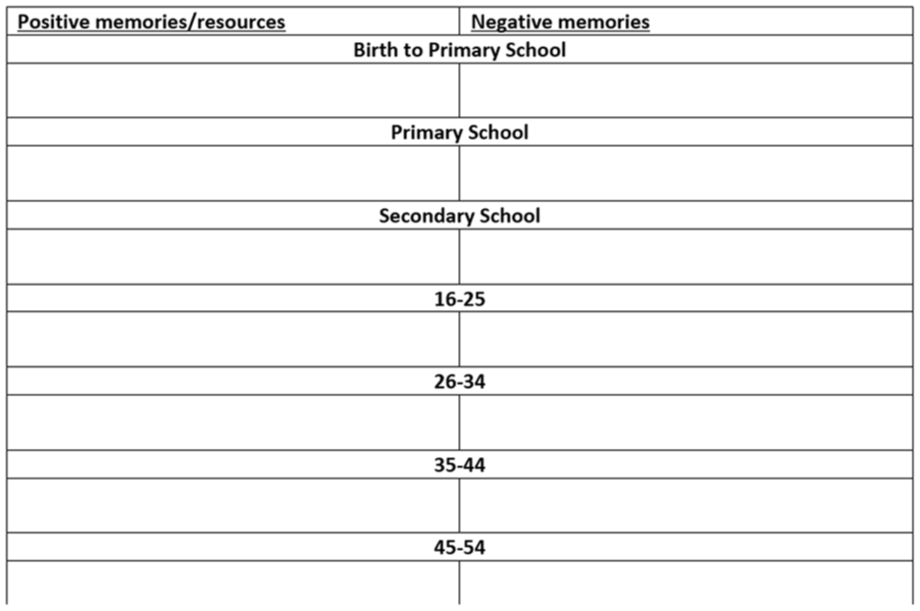
Timeline template. The visual tool structured participant memory-making while preserving narrative agency, aligning with the framework’s emphasis on participant-led meaning-making.
The first interview prioritised uninterrupted participant voice. My role was one of active witnessing and emotional regulation, not analytic probing. Psychoeducation and self-regulation tools were introduced only when distress escalated, used not as therapy, but to help participants remain safe enough to continue at their chosen depth (Alessi and Kahn, 2025; Clandinin and Connelly, 2000; Gilbert, 2014; Porges, 2011).
After a period of reflection, a second narrative interview revisited and elaborated earlier material. Changes in self-positioning (‘I thought I was just bad; now I know I was trying to survive’), coherence, tone and moral stance were treated as data on ongoing identity reconstruction (Frank, 2012; McAdams and McLean, 2013). These shifts were treated as data about ongoing identity reconstruction.
Therapeutic work drew on EMDR protocols (Shapiro, 2007), Internal Family Systems (Schwartz, 2021) and Acceptance and Commitment Therapy (Hayes et al., 2013). Autonomy was central: participants decided which memories to explore and could halt or defer any material. Two follow-up interviews documented how narratives shifted after therapeutic processing, and a final meeting offered closure and reflection on future-facing identity – who I am now/who I am becoming.
Throughout both phases, there were two continuous safeguards:
This dual-supervision model directly addresses the concern that a dual-role researcher might drift into uncontained therapeutic practice. It keeps the work accountable in both registers at once (Fleet et al., 2016; Hanna and Hall, 2025; Moran and Asquith, 2020). Figure 2 illustrates how the narrative process is embedded within layers of ethical containment and relational safety that make depth and transformation possible.
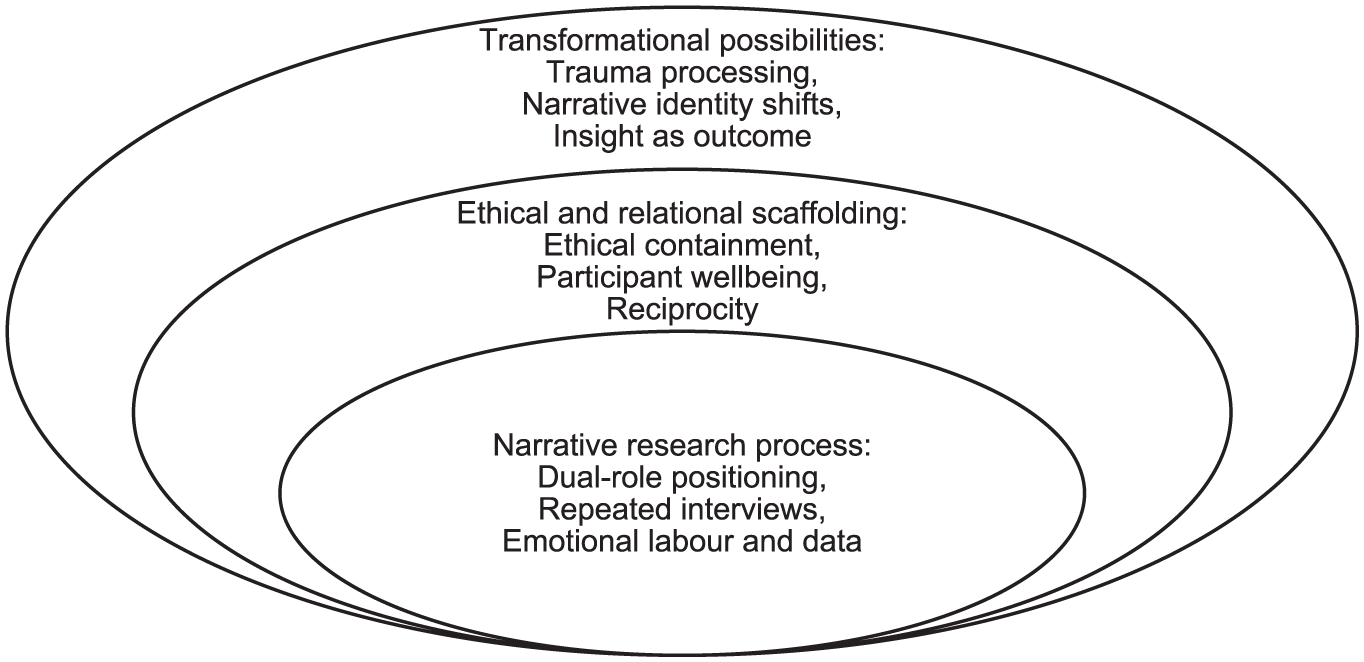
Summary of the layered architecture of TINI. This diagram illustrates how the narrative process is embedded within ethical and relational scaffolding that enables transformation. It shows that transformation depends on the integrity of the inner layers: ethical structure and relational safety are not peripheral supports but the very conditions that make depth and change possible.
Figure 3 translates this layered architecture into a procedural sequence, mapping how the ethical and relational scaffolding unfolds across the research and optional therapeutic phases.
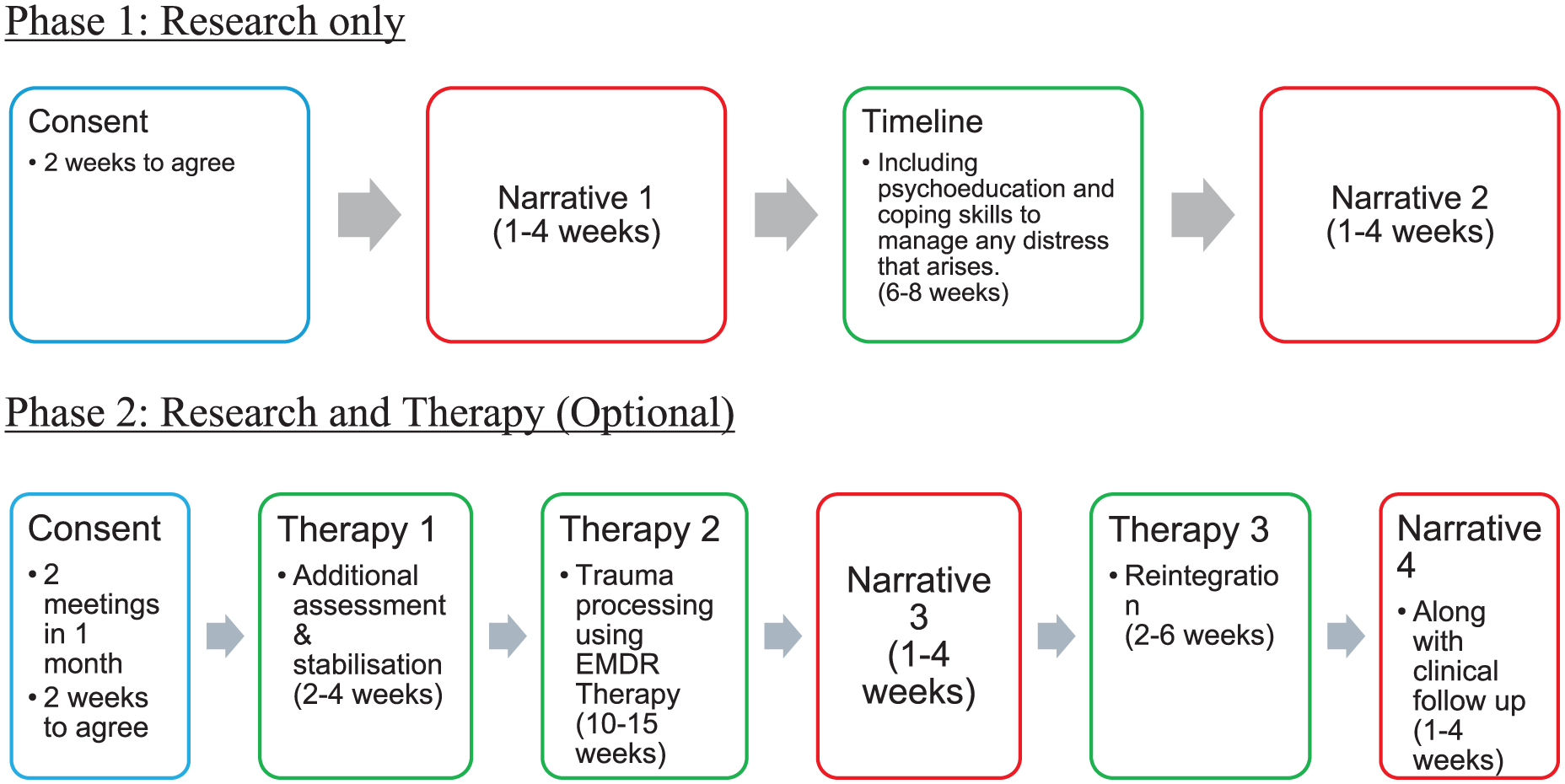
Outline of the phased progression. This figure translates the layered model into procedural form, showing how ethical and relational scaffolding are enacted step-by-step, from the 2-week consent period through the narrative-inquiry phase and, where chosen, the optional therapeutic component. Although supervision is not depicted, it remains continuous and critical throughout, supporting ethical integrity and participant wellbeing. Phase 1: Research only. Phase 2: Research and Therapy (Optional).
Together, these figures demonstrate how TINI integrates conceptual, procedural and ethical design elements.
The layered design of TINI is sustained not only by procedural safeguards but by an ongoing ethic of reflexivity and reciprocity. The next section turns to these lived ethical practices, showing how the framework attends to power, trust and epistemic justice throughout the research encounter.
Ethical reflexivity, reciprocity and epistemic justice
TINI treats the integration of clinical knowledge into research as a methodological advance, not a compromise (Liamputtong, 2025). While in this study the researcher held dual qualifications, the model supports collaborative teams in which therapeutic containment and analytic responsibility are shared across individuals rather than vested in one.
Consent is treated as iterative and relational rather than procedural (Alessi and Kahn, 2025; Finlay, 2002; Shaw et al., 2020). ‘Slow consent’ is used where a participant’s verbal reassurance (‘I trust you, that’s enough’) is met with boundary clarity (‘I trust you too, and I also want to keep that trust safe by making sure you fully understand what happens to this recording’). Ambivalence and hesitation are not seen as obstacles; they are treated as ethically meaningful data about safety, power and readiness.
Relational reciprocity and epistemic justice are built in. Transcripts, interpretations and early analytic framings were returned to participants for comment and revision. Disagreement was not coded as ‘resistance’ but treated as further data in line with Screaming Silences methodology (Serrant-Green, 2010). This acknowledges participants as co-authors of meaning, not simply as sources of extractable narrative (Fricker, 2007; Groot et al., 2022).
TINI therefore positions emotional and ethical labour as infrastructure. It demonstrates that trauma-informed narrative work can be both caring and rigorous, provided that containment, supervision and boundary clarity are structurally embedded rather than improvised (Binder, 2025; Fleet et al., 2016; Moran and Asquith, 2020).
The principles outlined above were developed and tested through a doctoral study that applied TINI to the lived experiences of people disengaging from violent extremism. The next section illustrates how the framework operated in practice, showing how trauma-informed narrative work unfolds across real relationships, data collection and analysis.
Selected verbatim excerpts were retained with participant consent when phrasing itself carried interpretive or emotional significance.
Case application: Supporting disengagement through narrative inquiry
This section illustrates how Trauma-Informed Narrative Inquiry (TINI) was applied in a doctoral project exploring how trauma shaped the life histories, identities and disengagement processes of former extremists.
Note. Most participant excerpts are paraphrased for clarity and confidentiality. A small number of brief verbatim quotations are included where the exact wording is central to meaning. These are anonymised and identified by participant and narrative number (e.g. P3, Narrative 4). All material is used with informed consent and in line with approved ethical protocols.
Ten participants, recruited via snowball sampling across three continents, engaged entirely online for accessibility and safety (Diab and Al-Azzeh, 2024; Isobel, 2021). All had disengaged from far-right, Islamist, or Incel-aligned milieus for more than 2 years and were actively reflecting on identity, belonging, rupture and harm. Ethical approval was granted by The Open University’s Human Research Ethics Committee.
Across these diverse trajectories, TINI supported identity reconstruction and meaning-making in ways that were observable and traceable over time. It did so by (a) creating a safe relational frame that allowed participants to approach traumatic material with regulation and choice, (b) revisiting and revising personal narratives across repeated interviews and (c) supporting participants in reinterpreting past actions and affiliations in ways that opened different futures. These shifts were treated as data, not incidental by-products (Alessi and Kahn, 2025; Fleet et al., 2016).
Holding dual roles: Ethics and narrative transformation
The researcher held a dual role as both investigator and therapist. This was made explicit to participants from the outset and re-clarified at key points. Boundaries, supervision and consent were built into the design rather than assumed. Participants were told what the research space was (narrative inquiry) and was not (therapy), and that if they wished to engage in therapeutic processing, they would re-consent before doing so (Alessi and Kahn, 2025; Fleet et al., 2016).
This clarity around role and safety had methodological consequences. Participants described the interview space in terms that emphasised trust and non-judgement. One participant said this process offered ‘free space to say whatever I wanted to without being judged’ (P1). Another noted that being able to ‘slow down’ made it possible to speak about material they had ‘never actually said out loud before’. That pacing was not incidental; it was an explicit technique to prevent overwhelm and to maintain agency (Kinitz, 2022).
Dual-role practice was continuously held through layered supervision. Clinical supervision focused on participant safety, regulation and the therapist–researcher’s own emotional load. Research supervision focused on analytic transparency, reflexivity and boundary integrity. Peer reflection and reflexive journaling supported ongoing monitoring of transference, protectiveness and emotional pull (Binder, 2025; Finlay, 2002; Hanna and Hall, 2025; Moran and Asquith, 2020; Thomas-Hughes, 2018). Participant safety and researcher safety were actively maintained through training, supervision, staged consent and pace control.
In addition to formal supervision, structured self-care practices such as reflective journaling and planned rest periods, with full supervisor support, were used to mitigate vicarious trauma and sustain researcher wellbeing across the longitudinal engagement.
Longitudinal narrative work and identity reconstruction
Narrative transformation emerged across repeated interviews conducted over 3–12 months. Participants first narrated core life events, critical ruptures and resources. They then revisited these accounts in later interviews, sometimes after optional, contained trauma-processing work (Alessi and Kahn, 2025). Over time, many moved from defensive or minimising narration (‘it was just normal back then’) to more reflective and accountable positions (‘I was violent because I thought it was the only way I wouldn’t get hurt, but that’s not me now’).
For example, one participant initially described severe childhood abuse in almost affectless terms, narrating it as background rather than causal. Later in the process, after feeling more regulated in session and having time to reflect between interviews, the same participant said: ‘My past was there. It happened. It doesn’t really affect my future anymore. . . I’m a lot more stable. . . I’m a lot less violent’ (P3, Narrative 4).
That shift was not treated as evidence of ‘successful therapy’. It was analysed as a transformation in self-positioning: from a traumatised, defensive narrative (‘violence is inevitable, I can’t help it’) towards a stabilised, agentic narrative (‘I am actively choosing something else’). In practical terms, this reframed disengagement not as moral conversion or deradicalisation, but as trauma adaptation and relational reorientation. That is methodologically significant: the data captured identity work in motion, rather than assuming it was complete or coherent at the outset (Geelhoed et al., 2024; Moran and Asquith, 2020).
Other participants described a shift from viewing extremist networks as sources of protection and belonging towards seeing them as sites of coercion, dependency or emotional capture. That re-interpretation often sat alongside emergent commitments to repair and contribution (e.g. ‘I bought my Chinese neighbours’ kids some selection boxes because I regard them as like nephews. . . .That just shows how much I’ve changed. Ten years ago, I wouldn’t have even engaged with them; they would have been [racial slur] or subhumans’ (P3, Narrative 4)). These shifts were documented across interviews, grounded in the participant’s own language and traced against the co-constructed timelines.
Importantly, these changes did not come from persuasive challenge (‘why did you do that?’) but from supported narrative pacing: revisiting painful scenes only when emotional regulation was possible, naming shame without collapse, and explicitly acknowledging ambivalence. That structure, the containment and pacing, was the method (Isobel, 2021).
Emotional presence as epistemic practice
The researcher’s emotional presence was not an accidental by-product of access; it was part of the method. Feelings of protectiveness, discomfort or grief were actively tracked and brought into supervision. These responses helped identify ethical pressure points in the narrative (‘this is the moment I wanted to rescue them’, ‘this is where I felt angry on their behalf’) and signalled which story fragments carried unresolved harm. Rather than treating emotional involvement as a threat to neutrality, the study treated it as a source of analytic direction, provided it was held in supervision and made reflexive (Etherington, 2000; Kinitz, 2022; Moran and Asquith, 2020; Pillow, 2003).
Attunement and containment, terms often coded as therapeutic, functioned here as ethical and epistemic resources. Attunement meant staying with the participant without accelerating them past their window of tolerance; containment meant co-regulating and slowing when distress increased. These practices allowed traumatic material to surface without coercion. They also allowed participants to remain in contact with contradictory or morally difficult parts of their own story long enough to reinterpret them. That interpretive work is where meaning-making happens (Alessi and Kahn, 2025; Frank, 2012).
Methodological contributions, challenges and implications
Methodologically, the study demonstrates that TINI can (a) facilitate access to material that is often unspeakable in detached interviews, and (b) document narrative and ethical repositioning over time. Co-constructed timelines, open-ended prompts and explicit control over whether to engage in trauma-processing meant that participants, not the researcher, selected the turning points that mattered.
The longitudinal design also supported the gradual development of emotional literacy. Over time, participants began to name and locate their emotional states, for example, distinguishing fear from anger or desperation from loyalty. This, in turn, increased narrative coherence and accountability.
This case study shows that TINI not only supports disengagement from extremist identities through narrative reconstruction but also reshapes what counts as ‘data’ in trauma-saturated research. What is gathered is not just content (what happened), but movement (how the self in relation to that event changes across time) (Geelhoed et al., 2024).
These findings set the stage for a broader consideration of what TINI contributes methodologically and ethically to trauma-informed qualitative research. The following discussion synthesises these insights, situating TINI within wider debates about reflexivity, care and rigour in psychosocial inquiry.
Discussion: Method as relational practice
Trauma-Informed Narrative Inquiry (TINI) is not only a technique for researching morally complex domains, but a relational epistemology grounded in care, responsiveness and ethical reflexivity. In trauma-saturated research such as violent-extremism disengagement, claims to researcher neutrality are both ethically and methodologically inadequate. Detached approaches risk retraumatising participants and reducing layered, shifting experiences to static themes (Geelhoed et al., 2024). Echoing Pillow’s (2003) view that reflexivity is an ethical necessity, this study positions the researcher’s affective presence and moral accountability at the centre of inquiry (Alessi and Kahn, 2025; Isobel, 2021; Pillow, 2003).
Relational epistemology and narrative transformation
Methods that abstract data from the affective conditions of the interview can enact epistemic violence by silencing the context in which meaning arises (Fricker, 2007). TINI instead treats emotional attunement and mutual recognition as conditions for authentic narration. Knowledge is co-constructed through sustained engagement and ethical presence (Dempsey et al., 2016; Etherington, 2000; Groot et al., 2022; Liamputtong, 2025).
Identity and relational transformation emerges through dialogical witnessing rather than linear progression (Bruner, 1991; Lieblich et al., 1998). Repeated interviews and timeline co-construction trace evolving meanings, affective shifts and ethical repositioning over time, avoiding the ‘frozen snapshot’ typical of cross-sectional trauma studies (Diab and Al-Azzeh, 2024; Frank, 2010; Hydén, 2012; Kinitz, 2022). The work therefore sits at the intersection of trauma-focused inquiry and social reintegration, particularly in contexts marked by stigma, surveillance, incarceration, migration or intergenerational harm (Corner et al., 2019; Frosh, 2003; Taylor, 2017; Williams, 2024).
By documenting not only what participants narrate but how their narratives shift across time, TINI foregrounds movement as data. This relational epistemology extends trauma-informed qualitative research by integrating emotional presence into the conditions of analytic insight.
Ethical structure and dual-role safeguards
Such relational ways of knowing carry ethical implications, particularly for how the researcher’s presence, role and responsibility are understood. These considerations underpin the dual-role safeguards within TINI. Critiques of dual-role practice often cite risks of confusion or boundary breaches (Beauchamp and Childress, 1994; Kitchener, 1988).
These scaffolds transform potential liability into epistemic strength. These safeguards ensure that relational depth does not collapse into therapeutic overreach but remains accountable within a transparent ethical framework.
Emotional labour as epistemic labour
Building on this, TINI redefines emotional labour as a site of analytic insight. Practices such as reflexive journaling, supervision and emotional mapping transform affect from contamination into data that illuminate how meaning is produced within the research encounter (Etherington, 2000; Kinitz, 2022; Moran and Asquith, 2020).
Attunement must, however, be balanced with vigilance to avoid over-identification or compassion fatigue (Hanna and Hall, 2025; Hollway and Jefferson, 2013b; Lumsden et al., 2019). Emotional competence becomes the methodological skill of an ability to stay present, regulate, and interpret emotion as data. This reframing positions emotional labour not as a threat to rigour but as a core component of the epistemic work through which insight emerges in trauma-saturated contexts.
Tensions and limitations in dual-role inquiry
TINI recognises that dual-role inquiry inherent tensions. This approach is relationally intensive and emotionally demanding, requiring ongoing clarity around role and responsibility. It requires clear boundaries to prevent clinical overreach, including constant clarification of whether a given moment is research inquiry, therapeutic processing or both in sequence (Binder, 2025; Hanna and Hall, 2025; Hay-Smith et al., 2016; Liamputtong, 2025; Shaw et al., 2020).
Positionality further complicates this dynamic: emotional proximity coexists with structural power and authorship (Binder, 2025; Finlay, 2002; Rose, 1997). These dynamics require ongoing reflexive awareness, as well as a clear recognition that attachment, moral unease or protectiveness may shape how stories are heard and interpreted. Holding these tensions transparently, rather than resolving them, creates epistemic humility (May and Perry, 2017).
Depth also carries practical costs. The model’s longitudinal design requires time, continuity and organisational recognition of the emotional labour involved making institutional support critical (Thomas-Hughes, 2018). Without this, the sustainability of this approach might be compromised. Ethical responsibility therefore extends to researcher wellbeing and the collective capacity of research teams to hold emotionally intense material over time (Hanna and Hall, 2025; McCosker et al., 2001).
These tensions cannot be resolved, but they can be worked with transparently. Making them visible becomes part of the rigour claim for dual-role practice, rather than a threat to methodological integrity.
Broader implications
TINI extends trauma-informed and psychosocial research by demonstrating how care, containment and collaborative meaning-making can constitute methodological rigour rather than threaten it. By supporting participants to articulate and reinterpret their experiences in their own timing and on their own terms, the approach challenges extractive research norms that position participants primarily as data providers. In doing so, TINI responds to longstanding concerns about epistemic injustice, particularly in fields where marginalised groups are subject to pathologisation or securitisation or institutional surveillance (Groot et al., 2022; Serrant-Green, 2010; Shaw et al., 2020).
The framework also highlights how emotional and relational labour can generate epistemic insight when held within transparent ethical scaffolding. Rather than treating the conditions of narration as context to be bracketed, TINI integrates emotional attunement, pacing and co-construction into the analytic process. This enables access to forms of knowledge that are often obscured in detached or cross-sectional designs, including ambivalence, contradiction and narrative movement over time.
It also disrupts knowledge hierarchies that marginalise embodied experience, especially in politically sensitive fields such as extremism, incarceration or migration (Frank, 2010; Groot et al., 2022; Lee and Lee, 2012; Liamputtong, 2025; Serrant-Green, 2010). This counters extractive research norms and reframes participation as collaborative authorship rather than disclosure on demand (Groot et al., 2022).
Yet these commitments also strain institutional systems that privilege detachment and speed. Without structural recognition of supervision time, emotional labour and relational depth, the sustainability of trauma-informed inquiry remains precarious (Binder, 2025; Hanna and Hall, 2025; Lumsden et al., 2019; Moran and Asquith, 2020).
TINI therefore offers not a resolution of methodological tensions but a principled practice for working through them, holding care and critique, emotion and analysis, as interdependent dimensions of ethical knowledge production (Alessi and Kahn, 2025).
Together, these contributions position TINI as a distinctive approach within the evolving landscape of trauma-informed qualitative inquiry and psychosocial inquiry: one that reframes rigour through relational presence, ethical responsiveness and sustained engagement with the emotional complexity of lived experience.
Conclusion: Towards transformative, trauma-informed research
This paper has presented Trauma-Informed Narrative Inquiry (TINI) as a dual-role methodology designed to navigate the emotional, ethical and epistemic complexities of trauma-saturated research. Grounded in a case study of individuals disengaging from violent extremism, TINI demonstrates that care, containment and co-construction can be structurally embedded within rigorous qualitative inquiry, without collapsing the boundaries between therapy and research (Alessi and Kahn, 2025; Fleet et al., 2016).
By combining therapeutic reflexivity with narrative inquiry, TINI reframes research as a relational encounter rather than a detached observation. Inquiry becomes a process through which insight is co-produced and ethics are enacted, even in contexts shaped by shame, silence and moral ambiguity. This challenges paradigms that treat emotional attunement as a threat to rigour, instead positioning it as central to meaning-making and methodological integrity (Diab and Al-Azzeh, 2024; Groot et al., 2022; Isobel, 2021).
Although developed within a radicalisation context, the principles underpinning TINI extend to a wide range of trauma-affected domains, including addiction recovery, incarceration, forced migration and intergenerational trauma. Across these settings, core practices of staged consent, therapeutic containment, co-constructed timelines and reflexive supervision can be tailored to local ethical and emotional demands (Alessi and Kahn, 2025; Etherington, 2004; Hanna and Hall, 2025; Liamputtong, 2025; Serrant-Green, 2010; Shaw et al., 2020). The model’s phased structure and pacing enable participants to develop emotional literacy and narrative coherence gradually, supporting both ethical safety and analytic depth.
Crucially, this is not a call for researchers to adopt therapeutic identities, but for research cultures to acknowledge emotional labour as integral to ethical and epistemic responsibility (Binder, 2025; Kinitz, 2022; Moran and Asquith, 2020). Dual-role practice invites access to emotional truth while demanding vigilance around boundaries, supervision and care for the self as well as others. These tensions are not methodological flaws but constitutive features of trauma-informed inquiry, revealing where ethical and epistemic labour meet.
Ultimately, TINI reconceives research as a co-authored process of relational meaning-making. By integrating therapeutic and research roles within a coherent framework, it demonstrates that emotional literacy, reflexivity and ethical responsiveness are not oppositional to rigour but essential to it (Alessi and Kahn, 2025; Groot et al., 2022; Hanna and Hall, 2025). While TINI requires time, training, and institutional support, it offers a sustainable framework for emotionally literate, ethically rigorous research in trauma-affected domains. By positioning care and critique as co-constitutive practices, it reimagines rigour itself as relational, transforming how knowledge, ethics and emotion are understood within qualitative research.
Ethics approval: Ethical approval for this research was obtained from The Open University Human Research Ethics Committee. All participants provided informed consent through an iterative, trauma-informed process consistent with institutional guidelines.
Data accessibility statement: No research data are publicly available due to the sensitive and trauma-related nature of the material. Paraphrased excerpts are included in the article to illustrate findings, consistent with approved ethical protocols. Requests for further information about data handling or supervision procedures may be directed to the author, subject to institutional ethics approval.
Footnotes
Declaration of conflicting interests
The author declared no potential conflicts of interest with respect to the research, authorship and/or publication of this article.
Funding statement
This research was funded by the UKRI under grant number ES/P000649/1 and JeS reference number is K84354C.
Ethical considerations
The Human Ethics Review Committee at the Open University approved this research (approval: 4314) on 05/4/2022. All procedures conformed to institutional and professional ethical standards for trauma-informed research. Respondents gave written consent or oral consent for the recording and analysis of narratives and for those who went on to Stage 2, for participation in psychotherapy.
Consent to participate
Participants received a written overview of the research, which was discussed during an online meeting. Written consent was obtained from all except two participants, who gave verbal consent via Teams due to technical issues preventing them from signing and returning the form by email.
Consent for publication
All participants consented to publication, with all but two providing written consent. The remaining two gave verbal consent via Teams due to technical issues preventing email return of the signed form.

Data availability statement
The data supporting this study are not publicly available due to confidentiality and ethical restrictions. Paraphrased excerpts are provided within the article in accordance with approved ethical protocols.