



Abstract
Diary methods are recognized as a valuable tool in qualitative research, however researchers have yet to take advantage of the many possibilities offered by social media platforms. This article demonstrates the potential of social media-based diary methods, specifically WhatsApp and Facebook diary groups, for researching everyday lived experience, by outlining the key advantages that this methodological innovation offers. Researchers can obtain insight into everyday repetitive behaviors, like eating and cooking, they can benefit from real-time reporting since participants can share information as and when it happens, and they can gain access to multi-modal data, as social media platforms support a variety of data types, including text, photos, audio, and video. Social media-based diary methods also make data collection more practical since the platforms are widely known and interacted with, and where they are supported by both smartphones and computers, transcription becomes a straightforward process too. A final benefit which could be taken advantage of is group discussions, so this article also explores the benefits of conducting diary methods in a group setting. This article is based on a research project exploring the everyday lived experiences of faith vegans which made use of private WhatsApp and Facebook groups to collect diary data from participants, including photos of meals, reflections on events and experiences, and group discussions. The findings in this article are thus grounded in methodological innovation and advance current scholarship on diary methods in a way that aligns well with contemporary trends and preferences.
Introduction
As a data collection method, diary methods allow a researcher to collect qualitative data relating to a participant’s everyday life over a set period of time. They may be multi-modal and may be conducted in multiple different ways, for example by using pen and paper diaries, specific diary apps, or as this article will discuss, social media platforms. Diary methods can both complement other methods, such as interviews, or be the main method itself. As such, this method is shown to be a valuable, but often overlooked, tool available to qualitative researchers.
Diary methods are widely employed in the disciplines of psychology (Bolger et al., 2003; Day and Thatcher, 2009), health (Elliott, 1997; Mendoza et al., 2021; McCombie et al., 2024b), and increasingly education (Baker, 2023; Cao and Henderson, 2021), where topics such as mental health, health-related behaviors, patients’ experiences, higher education decision-making, and employability are explored. Studies employing qualitative diary methods remain minimal in sociology, however. This article thus contributes to the existing level of knowledge and provides additional insight into how diary methods may be employed in sociological research and beyond.
Furthermore, social media constitutes an underutilized tool for diary data collection and resultingly, there is a lack of methodological literature exploring social media-based diary methods. Given the steep rise in smartphone use and availability in recent years (Pew Research Center, 2016), coupled with the increased importance of digital methods since the COVID-19 pandemic (Kaiser-Grolimund et al., 2024; Ratten, 2023), there is much potential to expand this methodology in qualitative research. The aim of this article is to explore the advantages of social media-based diary methods and their potential for exploring everyday lived experience.
Diary methods
Diary methods refer to research techniques that utilize diary-keeping as a means of collecting data from participants. Typically, diaries are conducted over a period of time which could range from a couple of months (Welford et al., 2022) to over a year (Baker, 2023). They may also be structured in multiple ways, for example interval-contingent designs encourage diarists to report at regular, predetermined intervals, signal-contingent designs prompt diarists using a signaling device and may also relate to intervals, and event-contingent designs require diarists to report whenever a specific event occurs (Wheeler and Reis, 1991).
Where diaries are conducted over a set period of time, they offer more accurate insight into daily life (Hyers, 2018), so it is possible to gather data relating to practices, activities, and feelings (Alaszewski, 2006; Cucu-Oancea, 2013), especially those that tend to be taken for granted (Alaszewski, 2006). Thus, unlike interviews and focus groups, diaries offer a temporal advantage due to the immediacy of data gathering. Diary methods are therefore excellent for overcoming the memory problems which can arise during interviews (Alaszewski, 2006), since participants can share data in real time. This is especially useful for repetitive behaviors like meals, as diaries provide the opportunity to capture valuable data that would otherwise be difficult to track (Hyers, 2018). This all helps to increase accuracy and provide more reliable data, as the researcher can acquire a fuller picture of the “everyday,” as well as explore how experiences change over time (Cucu-Oancea, 2013).
Diaries offer much potential for exploring everyday experiences, although examples of how diary methods have been employed in this way are limited. Of the few studies that do employ them with this objective, we can see how diary methods may be centered around a theme, for example food (Atayee-Bennett, 2024), multiple disadvantage (Welford et al., 2022), marginalization (Seide et al., 2023), media use (Kaufmann and Peil, 2020), and sexual harassment (Albert et al., 2024). There is thus much potential for diary methods in social research exploring everyday lived experience, and this article will uncover the key advantages that social media-based diary methods in particular have to offer.
The format of diary methods has evolved considerably over the years. Studies on pen and paper diaries emerged as early as the 1940s (Allport, 1942; Stonborough, 1942), with this approach remaining dominant for many decades. A limitation of pen and paper diaries, however, is the risk of forgetfulness, particularly where participants are unlikely to have their diaries to hand at all times. Of those that do later remember to complete their diary entries, there is a further risk of retrospection errors and inaccurate reporting (Bolger et al., 2003).
As electronic opportunities arose around the turn of the millennium (Feldman Barrett and Barrett, 2001), new forms of diary methods entered scholarly discussion, offering functions that sought to overcome these limitations. Diary methods swiftly transitioned toward digital ways of operating, and could now be kept using desktops, handheld computers, or even smartphones; the latter especially provides notifications and is generally more portable and available (Schrock, 2015). Digital methods thus reduce retrospection errors and recall bias (Bhanye et al., 2024; Welford et al., 2022), as well as improve completion rates thanks to the real-time sending of notifications (Fitz et al., 2019). Further, for time-sensitive or event-contingent reporting, digital approaches offer time-stamping, allowing the researcher to verify compliance (Bolger et al., 2003). Thus, the use of technology in diary studies has increased considerably alongside the growing accessibility of and preference for portable electronic devices (Bartlett and Milligan, 2015).
Digital diary methods are not without their limitations though, with scholars highlighting in particular the potential for high costs (Alaszewski, 2006; Cucu-Oancea, 2013) due to factors such as software development, the need to train participants in how to use the platforms offered (Welford et al., 2022), and a lack of accessibility for certain demographics due to the digital divide (Friemel, 2016; Ragnedda, 2017). Many of these limitations however are associated with custom-made diary apps, and consequently can be mitigated through the use of free and familiar platforms, like WhatsApp (Chen and Neo, 2019). It is for this reason that Kaufmann and Peil (2020) argue that there is still much potential to be realized where smartphones in qualitative research are concerned.
Social media as a data collection tool
Diaries enjoy a “recognised status as a cultural form of personal expression” (Cao and Henderson, 2021: 841), whilst social media is regarded as a modern cultural form of personal expression (Humphreys, 2018). This is especially the case for the younger generation who were raised alongside the Internet, and for whom social media plays a key role in the formation and performance of self (Gorea, 2021). Social media is typically accessed via smartphones, a regular feature of our everyday lives that keeps us constantly connected to the world at large (Ling and Lai, 2016). Smartphones’ main advantages include portability, availability, locatability, and multimediality (Schrock, 2015) and consequently, they offer many possibilities for researchers. To date, there has been an overwhelming focus on quantitative data collection, with only a very recent move toward qualitative data collection (Kaufmann and Peil, 2020; Welford et al., 2022). Studies have noted how this oversight is significant given the versatility of smartphones, rendering them a promising site rich in qualitative data, particularly of a reflective nature (García et al., 2016).
There are only a handful of methodological papers that explore the use of social media as a tool for collecting primary data from recruited participants, as opposed to a source of secondary data, however. These explore, for example, how it may be used to conduct a netnography (Ma and Cai, 2023), focus groups (Chen and Neo, 2019), photo elicitation (Lunnay et al., 2015), and mobile instant messaging interviews (Kaufmann and Peil, 2020). Whilst these studies largely consider the effectiveness of and challenges associated with using social media in this way, Lunnay et al. (2015) expand on the ethical considerations, highlighting the importance of factors such as participant and researcher safety, privacy, and confidentiality. Further research on this topic is essential, however.
Social media platforms offer many benefits. Smartphones are typically always switched on and connected to the Internet (Ling and Lai, 2016), enabling notifications to be pushed to the smartphone’s locked screen demanding our immediate attention (Fitz et al., 2019); social media thus benefits from high engagement. This is further aided by its multimedia functions. Using WeChat to conduct ethnographic research and interviews, Ma and Cai (2023) found the hold-to-talk voice messaging, text messaging, and audio chatting functions appropriate for participants and less intrusive, as well as a quick and efficient use of the participants’ fragmented time. WhatsApp has also been used for interviewing purposes. Kaufmann and Peil (2020) developed the mobile instant messaging interview to explore everyday media technology use, combining diary methods with the mobile experience sampling method to exploit the app’s unique communication and multimedia features. When conducted in a group setting, like on WhatsApp, Chen and Neo (2019) further found app-based discussions to facilitate different chatting styles, with time lags and multiple conversations at once both possible, neither of which are practical in in-person settings. The authors also found group chats to facilitate group interactions and generate articulate responses, but less as effective as in-person interactions for obtaining quantity and richness.
Despite many benefits, limitations persist. As with electronic diaries more broadly, the digital divide remains a barrier for certain demographics, namely the older generation (Welford et al., 2022) and those without access to the Internet, rendering social media-based research in many ways exclusionary (García et al., 2016). Nevertheless, social media still has a huge user base, with Facebook and WhatsApp each with around three billion active monthly users in 2024 (Statista, 2024b, 2025). These platforms are free and easy to download, familiar, already widely used (Bartlett and Milligan, 2015), and the communication they facilitate is convenient and instantaneous (Chen and Neo, 2019). Messages may be sent between two individuals or within a group, and may comprise text-based messages, photos, hyperlinks, videos, emojis, GIFs, stickers, and voice notes. Users can also post statuses and conduct audio or video calls on these platforms (Chen and Neo, 2019; Kaufmann and Peil, 2020). Social media platforms thus offer direct and efficient communication between the researcher and participants, as well as ease of reporting (Bartlett and Milligan, 2015). Additionally, participants neither need to be trained nor incentivized to use the software (Chen and Neo, 2019). Social media therefore offers much potential for qualitative data collection; in this article, I explore the advantages of using social media-based diary methods for studies exploring everyday lived experience.
Study details
This article draws on my research exploring the everyday lived experiences and understandings of faith vegans in the UK (Atayee-Bennett, 2024). My overarching study aim was to explore the intersection between veganism and religion, given the secular bias in vegan studies and the resulting existence of a sizeable research gap. My central research question asked, how are Muslim, Jewish, and Christian vegans reshaping and redefining veganism and religiosity in late modern Great Britain?
I recruited 36 faith vegans (12 from each faith group), all of whom were over the age of 18 years and had lived in the UK for at least the past five years. Strict ethical measures were observed throughout the study (Wiles, 2013), including the provision of detailed participant information sheets to ensure informed consent, pseudonyms assigned from the outset to protect participant identity, and careful data storage, comprising the organized management of data and metadata, which were saved in separate locations on an encrypted drive to ensure confidentiality.
In this study, I adopted an interpretivist epistemology (Schwartz-Shea and Yanow, 2012) as I was interested in making sense of participants’ experiences and understandings (Lichtman, 2014), and as such, employed three qualitative methods: semi-structured interviews for exploring beliefs, understandings, and reported experiences (Edwards and Holland, 2013), virtual participant observation for exploring the intimate spaces where veganism was performed daily, namely the kitchen (Joose and Marshall, 2020; Wills et al., 2016), and social media-based diary methods for exploring everyday lived experience. These three methods provided me with considerable empirical insight into the faith vegan experience.
The study was conducted in two stages: a pilot stage with Muslim vegans in Spring 2021 and a second stage with Jewish and Christian vegans throughout the latter half of 2021. Within these stages, the diary groups ran for around three months, capturing everyday lived experience and one or more religious festival(s), with the exception of the Christian group which was conducted for three months over the summer and resumed for a month in December to capture Christmas. In the pilot stage, I was not sure whether to conduct the Muslim group on WhatsApp or Facebook, so I gave participants the choice. Six joined the Facebook group and ten joined the WhatsApp group, with four being in both groups. Whilst a few participants regularly posted in the Facebook group, interaction was lower than that of the WhatsApp group. The WhatsApp group was also easier to transcribe, as the ordering of posts would move around on Facebook depending on when interactions occurred, or comments were added.
Due to lower engagement in the Facebook group during the pilot stage, I decided not to offer Jewish and Christian participants a choice, instead stating that the diary group would be conducted on WhatsApp, and only if they had objections to joining, could they refrain from doing so. One Christian participant asked to be discounted for social anxiety reasons; instead, she kept a private diary. Prior to starting the diaries, I sent a guidance document to all participants with a list of ideas, so they knew what was expected of them (Alaszewski, 2006). This included prompts such as photographs of food or products, religious events, other celebrations or gatherings, meal diaries, activities, hobbies, and thoughts on different topics, among other points. It ended with a key question: does it relate to my experience as a Muslim/Jewish/Christian vegan?
The diary groups were transcribed into three Word documents, a task I worked on weekly throughout the duration of the diary study periods. I then uploaded these to NVivo and thematically coded them (Braun and Clarke, 2021); I applied codes and themes to the diary transcripts in the same manner as I did with the interview transcripts. I found this methodological approach to be hugely insightful for studying everyday lived experience, and I present the key advantages throughout the remainder of this article.
Advantages of social media-based diary methods
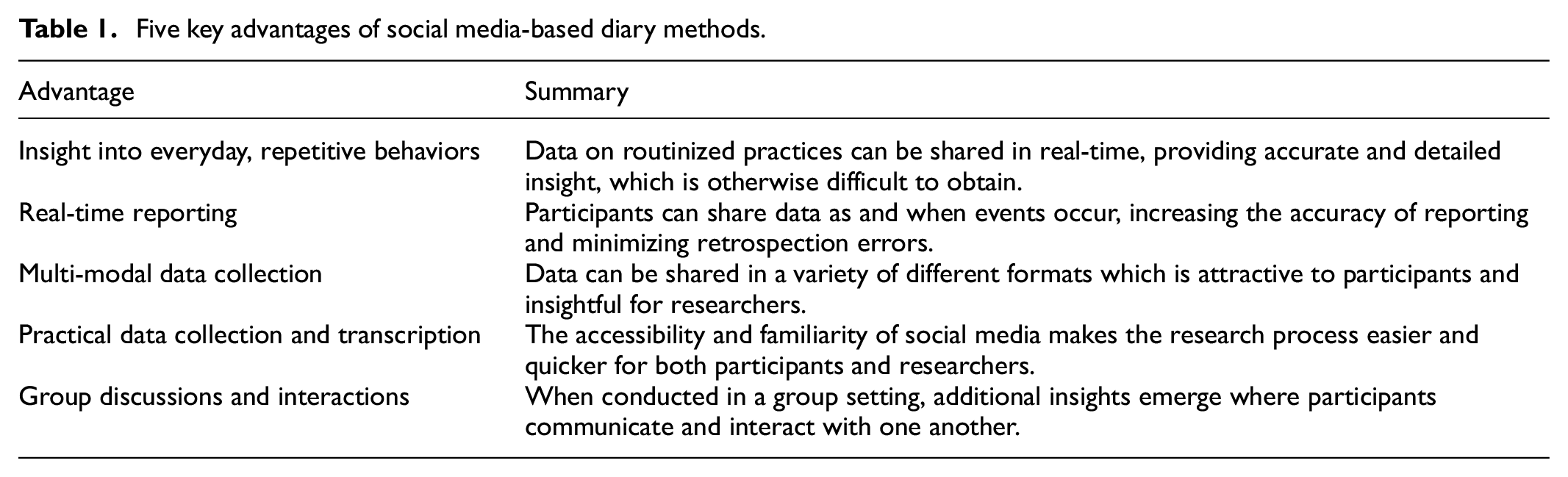
In combining social media and diary methods, a range of advantages arise that a researcher can benefit from, especially where studying everyday lived experience is concerned. These advantages pertain to increased insight, accuracy, flexibility, practicality for participants and researchers alike, and group interactions. In this section, I discuss five key advantages, which are summarized briefly in Table 1, before reflecting on this methodological approach overall.
Five key advantages of social media-based diary methods.
Insight into everyday, repetitive behaviors
In conducting diary methods, I was able to explore everyday, repetitive behaviors which are not so easy to report on in other methods, such as interviews and focus groups (Alaszewski, 2006). Examples of such behaviors include eating, cooking, shopping, and socializing. This is because such actions are likely to become routinized and performed unconsciously, making it challenging for participants to describe them accurately (Twine, 2018). To report on such behaviors in an interview or focus group would invite recall bias (Bartlett and Milligan, 2015), whereas the diary group provided an opportunity to report on these behaviors regularly and in real-time, a point I explore further below.
In her interview, Michelle described her lunches as “sandwiches, salad, maybe things like hummus wraps […] soup, salad, those sorts of things probably, cheese on toast sometimes, crumpets, I do like a good crumpet, bagels.” However, her diary entries painted a somewhat different picture, with wraps and sandwiches being far more common than the other lunches mentioned. She later reflected in the diary group: “Until doing this, I never quite realised how much I eat the same food every day.” Diaries thus facilitate helpful reflection (McCombie et al., 2024a) which can complement or even enhance the quality of data collected.
Particularly where my study explored food and eating practices, I was able to collect a large quantity of photographs and information relating to meals prepared and foods consumed. This provided more accurate insight into the everyday, repetitive behaviors of food preparation and eating, more so than one could achieve through an interview or focus group. In being conscious of the need to share diary entries, everyday practices that are often overlooked and performed at a subconscious level are brought to the fore (Alaszewski, 2006), fostering greater reflexivity on the part of the diarist, and facilitating greater insight for the researcher (Hyers, 2018). This is further aided by the sharing of visual data which reveals minute details that would likely be missed in text-based diary entries, and almost certainly missed when recalling information in an interview or focus group (Harper, 2002). By consistently sharing data on repetitive behaviors, it is also possible to identify similarities and differences, for example Michelle’s discovery of how similar her lunches turned out to be.
Real-time reporting
In other methods, such as interviews and focus groups, participants generally only have access to the researcher for the short space of time during which the interview or focus group takes place. Any information they think of later is unlikely to be taken into account in the research study. With social media-based diary methods however, participants enjoy extended access to the researcher and can share insights and thoughts at any time during the period of data collection (Chen and Neo, 2019). As we saw in the previous point, this is particularly beneficial for everyday, repetitive behaviors, such as cooking, eating, and shopping, which are reported upon more accurately when they can be shared in real-time. Participants can also share thoughts and experiences as and when they arise. Daniel read an article about how some Jews are anti fake pork which made him reflect on how they might not approve of him eating soya-based vegan sausages, whilst Nicola, who was on holiday visiting different churches, stopped in a village for a late lunch to find nowhere was serving food. Instead, she “went to a local corner shop and got hummus and wraps and we had them with crisps.”
Unlike event-contingent diary designs that only ask for diary entries around a particular event, or interval- and signal-contingent diary designs that only ask for diary entries at specific intervals (Wheeler and Reis, 1991), my diary group was open for the entirety of the data collection period, so participants could post at any time. This is especially important for any study exploring everyday lived experience, as a relevant experience could occur at any moment, so it is vital to provide participants with the space to share diary entries as and when they arise. This facilitates the capture of the immediacy of feelings (Welford et al., 2022), as well as the increased accuracy of experiences as real-time reporting avoids bias caused by retrospection. Moreover, it makes the study more flexible for participants, aiding with ease of reporting (McCombie et al., 2024a; Mendoza et al., 2021). In providing a space that is open for the duration of the data collection process, a wealth of data can be obtained, and a more detailed picture of everyday lived experience can be painted.
Multi-modal data collection
Social media platforms, like WhatsApp and Facebook, offer a wide variety of media types for users to engage with (Kaufmann and Peil, 2020). Within the private Facebook group, participants could post statuses and comments comprised of text, hyperlinks, photos, images, videos, or GIFs, as well as react to statuses and comments with a variety of emojis and reactions, including like, love, care, haha, wow, sad, and angry. They could also share the posts of others, to which other participants could respond, and tag other participants in responses. In WhatsApp meanwhile, participants could send messages comprised of text, photos, images, audio, videos, hyperlinks, GIFs, stickers, and emojis. They could reply to specific messages, tag other participants, and react to messages with an emoji of their choice.
Diary entries submitted in social media-based diaries can draw on any of these media types, introducing diversity and a broader range of ways to express one’s ideas into the study. McCombie et al. (2024a) highlight self-expression and flexibility as core values held by participants, rendering the multimodality of social media-based diary methods attractive to participants. Further, each of the media types offers their own benefits which participants can draw on, making the act of contributing even more accessible and practical.
Photos and images can be an efficient way to share information, as it is quicker for a participant to take a photo and share it as a diary entry than it would be to type out a detailed description. Additionally, visual data offers the researcher a fuller understanding of a given context, adding validity and reliability in ways text alone cannot (Harper, 2002). This is especially important for understanding everyday lived experience, since much of our everyday practices become so ingrained that they become difficult to report on (Twine, 2018).
Videos can offer even greater insight than photos as they not only provide visual insight into a context, but they also provide insight into sounds, conversations, emotions, body language, and movement. A couple of videos were shared in the Christian Christmas diary group of church services and the participants’ engagement with the community. These provided glimpses into the experiences of participants, in effect adding an ethnographic element to my research that facilitated greater knowledge sharing (Pink, 2021). A key consideration with visual data however is anonymity, so research ethics must be sufficiently considered in one’s research design (Wiles, 2013). Before commencing the diary study, I sent participants clear guidance around sharing images or videos which showed themselves or others, explaining that consent must be sought and that any such data would be deleted and replaced with a detailed description to ensure anonymity.
Audio recordings and voice notes can be quicker and easier for participants, as it can be more efficient for them to share their thoughts via a voice note than to attempt to type out a long message (Bernays et al., 2014), although many participants still willingly typed out long textual entries. With audio recordings, the fluidity of speech can increase authenticity and depth, giving the researcher access to additional features, such as tone, emphasis, and emotion (Bernays et al., 2014). Leah sent me some voice notes on her experiences of Rosh Hashanah and Yom Kippur, which were extremely helpful to me as someone who neither is of a Jewish background nor has experienced such holidays first-hand. Extended voice notes like these can therefore provide participants with the opportunity to share experiences efficiently and reflexively, in turn providing the researcher with excellent insight.
Emojis can indicate emotions and feelings without the need to express them in words (Bai et al., 2019). Sometimes food pictures were accompanied with or replied to with the emoji licking its lips or the drooling emoji to denote the participant’s perception of the food as delicious, whilst the prayer emoji or heart emoji were used when sending well wishes. Crying laughing emojis were regularly used to indicate laughter, whilst smiling emojis often completed sentences as if to soften the tone and highlight the diarist’s happiness (Boutet et al., 2021). Using emojis in this way can enhance the quality of textual data and provide greater depth of understanding, offering insight into emotions and feelings without the need for more intrusive visual methods.
A major challenge in diary methods is keeping participants engaged (Alaszewski, 2006) with (lack of) willingness, (lack of) self-discipline, and (not) being in the habit of diary-keeping influencing participant engagement levels (Alaszewski, 2006; Hyers, 2018). Social media platforms, with their multi-modal functionality, can provide a more inclusive way for participants to engage with the research (Bartlett, 2012); this has been noted as especially successful among vulnerable groups (Aldridge, 2014) and ethnic minorities (Carlson et al., 2006). Ensuring inclusivity by offering flexibility may therefore improve participant engagement, as it offers a multitude of different ways through which participants can engage with the study, empowering them to opt for the methods they are most comfortable with. Further, where social media platforms are most commonly accessed via a smartphone, a device which brings together multiple applications (Welford et al., 2022), participants can easily take photos with the camera and upload them to the group, access sites on their Internet browsing app and share links, or record voice notes within the social media platform via the smartphone’s microphone. All of these functions make reporting on everyday lived experience easy and practical for the diarist.
Practical data collection and transcription
Social media-based diary methods offer a practical solution to many of the limitations noted in relation to electronic diaries, such as high costs (Alaszewski, 2006; Cucu-Oancea, 2013), challenges associated with app design, development, testing, and training participants in their use (Welford et al., 2022), and participant engagement (Alaszewski, 2006). Statistics from 2024 show that there are over five billion active social media users across the world, with this number expected to rise (Statista, 2024a). Thus, not only do social media platforms already exist so there is no need to invest in app development, but they are also widely used, used regularly, familiar to participants, and free.
The portability of smartphones and regular engagement with social media more broadly (Welford et al., 2022) meant that participating in my diary group was not out of the ordinary or easy to forget, since participants would be regularly using their phones and receiving social media notifications (Fitz et al., 2019). Social media-based diary methods therefore facilitate practical data collection as participants can easily share details on their everyday lived experience at any time of day and in any place, subject to Internet connection.
For the researcher to access diary entries, a group or chat must be set up between the participant(s) and the researcher, thereby ensuring researcher presence throughout the diary period. I set up three diary groups, each with participants of the same religion and myself as the researcher. In this way, my presence and occasional interaction served as an easy and practical way to keep participants engaged, as I was able to gently nudge participants when the chats started to go quiet (Hyers, 2018).
My presence was useful in other ways. If I needed more information, I could ask in the diary groups, fostering an informal communication style and encouraging open discussion (Kaufmann and Peil, 2020; Mendoza et al., 2021). Similarly, diarists could benefit from direct contact with myself. Some participants asked me to clarify points, for example Mohammad asked, “was that the sort of thing you were looking for?” whilst Michelle asked, “is it ok to upload a document here, or do you need it emailing?” The diary groups also played a key role therefore in maintaining contact with the participants and addressing points outside of the actual data collection (Welford et al., 2022).
A limitation of some other forms of diary methods is the need to wait for the participants to return their diaries, thereby delaying the analysis process (Baker, 2023). With social media however, entries are received by the researcher in real-time, so analysis can commence immediately. I got into the habit of transcribing the diary groups on a weekly basis, which was not only more efficient as it meant I had a completed transcript no later than one week after each diary period ended, but it also made the process much more manageable and much less tedious.
Moreover, where Facebook can be accessed via an Internet browser, and where WhatsApp can be accessed via a desktop application, transcription became a simple task of copying and pasting, which was convenient and efficient; the convenience of the WhatsApp desktop version for transcription purposes has been noted elsewhere (Kaufmann and Peil, 2020). Conducting diary methods on social media also has practical benefits for the researcher therefore, facilitating a more efficient data collection and transcription process.
Group discussions and interactions
Social media-based diary methods could be conducted individually or in a group setting. I opted for the latter, although one Christian participant did request to keep a private diary due to social anxiety reasons, so she and I maintained a private WhatsApp chat. A couple of other participants also sent me some messages privately, for example Leah who shared extended voice notes around the Jewish High Holy Days in a private chat on WhatsApp.
In conducting diary methods in a group setting through private WhatsApp and Facebook groups, additional benefits became available in the form of group discussions and interactions. As such, I could access the benefits of both diary methods (Bartlett and Milligan, 2015) and focus groups (Chen and Neo, 2019). I could ask questions at any point during the data collection period, prompting an array of responses from multiple participants, but equally participants could pose questions to the other group members, again eliciting an array of responses.
Participants could build on others’ responses in either a synchronous (responding in real-time) or asynchronous (responding after a time delay) way (Chen and Neo, 2019). This enabled multiple conversations to occur at once, and also avoided any one participant becoming dominant and controlling the conversation, as everyone could type and respond at the same time. There were undoubtedly participants who were more engaged and posted more frequently than others, but I did not at any point get a sense of domination or that others felt reluctant to contribute.
Whilst the purpose of the diary groups was for me to obtain research data, they also offered benefits to the participants who appeared to use the groups for their own ends. Many asked questions, for example Isaac asked how others managed the Yom Kippur fast, Michelle asked how others navigated the Communion wine, and Zakir asked for advice relating to the Eid sacrifice. Some also used the group for inspiration, asking one another for the recipes of the meals they had photographed and shared in the group. Other studies have observed the therapeutic effects of diary participation, for example whilst recovering from surgery (Furness and Garrud, 2010) or a mental health challenge (Alexander et al., 2016). In my study, diary participation facilitated knowledge sharing, inspiration, identity consolidation, and a sense of support and belonging. Prior to closing the Muslim diary group, Aaliyah shared, “it just makes you feel so much better connecting and discussing with like-minded people and asking questions to see how everyone is getting along and sharing ideas.”
Studies have suggested that mobile messaging may be less conducive to rapport building, with reduced word counts making discussions less rich (Abrams et al., 2015), as well as reduced responses and inactivity (Moore et al., 2015). Whilst there were periods of inactivity in my study, I overcame these by sharing reminders or asking questions to encourage participants to re-engage with the study. On the other hand, the digital nature of interactions may increase a participant’s level of comfort to divulge sensitive information or disagree with others (Woodyatt et al., 2016). Beth, who sadly had to euthanize her dog during the diary study, shared, “I know I don’t actually know you guys but I do know you are Christian and animal lovers. Please can you pray for us today as at 5:35 we take our beautiful dog to be put to sleep.” This topic was a very raw and sensitive one, yet the rapport that had built up in the group gave Beth the confidence to share her heartbreak with her fellow study participants. Sympathy poured in, with a couple of participants even checking in on her a few days later to see how she was coping. Rapport was also evident at the end of the first Christian study, with participants bidding each other farewell until the study resumed. Michelle shared, “Just wanted to say how much I’ve enjoyed being part of this group and sharing the vegan Christian journey with you all. Looking forward to catching up in December!”
When diaries are conducted in a group, researchers can also explore social interactions (Chen and Neo, 2019). These can be conversational through text replies to others’ messages, or they can be through the reaction function on both Facebook and WhatsApp. In the Muslim Facebook group, reactions were widely used with “like” and “love” being the most common, although others were used too. Ibrahim shared how he had faced verbal scrutiny in a secular vegan community for airing unpopular views around not wanting to “force” his veganism on his children. Farah responded with the “care” reaction, indicative of support or sympathy. In another example, Ibrahim shared a photo of an impressive homemade Oreo cheesecake made by his wife, to which some participants responded with the “wow” reaction. Such interactions can foster the buildup of rapport within the group, which in turn can encourage greater posting (Ma and Cai, 2023). In this way, participants encourage each other to contribute more, thereby improving participant engagement. Reactions were less frequently used in WhatsApp, but textual responses were very common, with participants asking questions and chatting with one another like they would in any other group chat.
Group discussions can also highlight similarities and differences in lived experiences. In creating three diary groups, one for each religious group, I could ensure participants were in the same group as others with similar lived experiences. This gave them a confidence to discuss topics relevant to their practices and rituals and facilitated conversations around how each participant navigated a certain practice. In the run up to Rosh Hashanah, a time when it is traditional to consume honey cake, Leah asked for a good vegan recipe. Daniel responded with a handwritten recipe and later a link to an online recipe as well. Nearer to Rosh Hashanah, they also shared photos of their honey cakes and their different vegan honey substitutes. Ari and Jacob also joined in the conversation about Rosh Hashanah customs and their plans for the celebration. In a secular vegan group, it is likely these participants would not have found the confidence to discuss such topics due to concerns around cultural difference (Atayee-Bennett, 2024). In contrast, my diary group fostered a supportive environment based on shared experiences, thereby facilitating such conversations.
A potential downside to conducting diary methods in a group setting, however, could be added pressure to recruit participants quickly and launch the group in a timely fashion. I did not want to keep participants waiting too long, so I launched the diaries when I had completed a substantial number of interviews in each faith group. Where I launched the groups before recruitment concluded, it meant that a couple of participants were only able to contribute for around six weeks as opposed to the full three months, thereby limiting the amount of insight I could otherwise have obtained. I made this decision to avoid participant withdrawal or loss of interest.
Reflections
As with any kind of research intervention, the way in which this method is conducted may influence participant engagement and response behavior. In the diary groups, I occupied a dual role as both moderator and researcher, which may have influenced how participants engaged with them (Watts, 2011). Overall, there was significant variation in the level of contribution among participants, so no clear trends were observable. However, my presence likely introduced a degree of reactivity, whereby participants may have altered or increased their disclosures in response to my prompts and questions (Hyers, 2018).
At the start of the study, I consciously sought to build rapport with participants by sharing that I too was vegan and a person of faith. Although I did not share the same religion as all participants, we had a shared appreciation of faith and similar ethical frameworks. I hoped this would position me as an “insider,” helping participants feel more at ease to contribute (Bukamal, 2022); I believe it did. Additionally, in creating three separate groups, one for each faith, participants in each group shared similar understandings and practices. As I discussed in the previous section, this fostered a sense of belonging, built up rapport, and gave participants a confidence to discuss specific topics, all of which likely influenced participant engagement levels positively.
In the pilot (Muslim) study, I felt my insider positionality led me to over-participate, so I took deliberate steps to minimize my influence in the subsequent groups. My interactions in the Christian group were limited to essential tasks, such as clarifying prompts and encouraging participation, while in the Jewish group, I also asked questions to support my learning. Overall however, I was mostly an observer in these two groups. This was facilitated by strong participant engagement and by the diary guidelines I shared prior to the launch, which offered ideas, set expectations, and outlined basic housekeeping rules to foster a respectful and supportive environment. Nevertheless, I acknowledge that researcher presence can shape dynamics in subtle ways (Bukamal, 2022; Watts, 2011). Reflecting on how I managed my dual role has highlighted the need for transparency, careful boundary-setting, and ongoing reflexivity when using researcher-moderated digital spaces for qualitative research (Lunnay et al., 2015).
Social media-based diary methods offer advantages over other methods, like interviews and focus groups, which are typically time limited and often one-time only. As such, these methods are not optimal for studying everyday lived experiences and repetitive behaviors (May, 2011). To study such topics, extended contact with participants is necessary but this needs to be done in the least intrusive way possible; social media-based diary methods achieve the right balance between contact time, accessibility, and lack of intrusion (Ma and Cai, 2023). Moreover, with face-to-face methods, such as the aforementioned, participants cannot take advantage of multimedia functions, whilst researchers cannot take advantage of copy and paste functions when transcribing, for example. However, despite these advantages, there are nevertheless instances where social media-based diary methods would be less effective. For example, where a researcher wishes to obtain answers to specific questions with specific foci or where they wish to obtain deep biographical narratives, methods such as interviewing would be much more effective (Edwards and Holland, 2013). Meanwhile, studies aiming to explore social interactions, for example, would benefit from ethnographic methods (O’Reilly, 2012). However, multi-modal research would arguably provide the most comprehensive insight (O’Reilly and Kiyimba, 2015), so social media-based diary methods could be combined with other appropriate methods.
As this article has revealed, there are many benefits to this methodological approach, but it is important to recognize that there are key considerations associated with this method as well, a topic I explore in another article due to it not being within the scope of this one (Atayee-Bennett, 2025). Brief commentary on the importance of platform-specific ethical issues is warranted here, however, given their interconnectedness with this research method. When an individual creates a social media account, they must agree to the organization’s terms of usage, which often include provisions regarding data ownership, though not always the ownership of content. This agreement of the terms of usage, which are rarely reviewed in full (Obar and Oeldorf-Hirsch, 2020), indicates the individual’s consent for their data to be processed in certain ways. Such terms and privacy notices are regularly updated, underscoring the need for both researchers and users to stay abreast of changes. On the other hand, platform-specific ethical measures can offer an extra layer of security, such as WhatsApp’s automatic data encryption, an attractive feature for researchers and participants alike. Nevertheless, utilizing social media platforms for data collection requires more than mere compliance with institutional research ethics; it also demands ongoing engagement with evolving platform-specific policies.
This study focused on a UK-based, adult, digitally confident population with access to smartphones and social media. Given widespread and growing social media usage across the world (Statista, 2024a), social media-based diary methods are suitable for a range of research projects. However, their applicability is by no means universal, with inclusivity limited for certain demographics. Groups for whom this method may not be effective, or for whom additional, perhaps even creative, steps are necessary to improve inclusivity, include non-tech users, digital novices, those without access to a smartphone or the Internet, under 18s, and marginalized groups. Those lacking digital literacy may benefit from digital skills education—training is often provided where apps are designed especially for the study (Welford et al., 2022)—whilst those without access to a smartphone could be loaned one, although there are concerns around the impact this could have on response behavior (Walsh and Brinker, 2016). Research involving youth or marginalized groups also presents additional ethical challenges, such as access, parental or gatekeeper consent, and vulnerability to harms, such as the risk of online harms for children and teenagers, a topic in current political debate (Hansard HC Deb., 2025). While this article highlights the many benefits of social media-based diary methods in our technocentric society, it is important to recognize that this method remains partly exclusionary, much like all other digital methods (García et al., 2016), requiring researchers to think carefully about the efficacy of this method for their research aims and sample.
Limitations of this study include a small sample size and UK-only focus, which restrict the level of insight obtainable on the topic. Further, this article has only explored the use of private WhatsApp and Facebook groups, so future research could explore the use of other platforms, for example TikTok or YouTube for video diaries or Instagram for photo diaries, subject to ethical considerations. Thus, whilst this article offers a promising foundation for such methodology, more research is needed on the topic.
Conclusion
Diary methods are excellent for exploring everyday lived experience, but methodological studies exploring the potential of social media for conducting diary methods remain minimal. In my study drawing on social media-based diary methods, I find numerous advantages to using social media as a tool for diary data collection, including insight into everyday, repetitive behaviors, such as cooking and eating, real-time reporting where participants can share diary entries at any time, multi-modal data collection, where social media platforms support a variety of functions, practical data collection and transcription, and group discussions and interactions. Each of these benefits serves to increase the accuracy and validity of data collected, as well as offers the researcher greater insight into everyday lived experience. Furthermore, social media-based diary methods are more flexible than other methods, granting participants control over their own contributions and fostering a feeling of meaningful impact (McCombie et al., 2024a), especially in studies like my own that explore social change.
This article advances existing studies on diary methods (Bartlett and Milligan, 2015; Hyers, 2018) and the use of social media in qualitative data collection (Chen and Neo, 2019; Kaufmann and Peil, 2020; Ma and Cai, 2023) to uncover both the sociological potential of social media-based diary methods for exploring everyday lived experience, and the potential of social media as a tool for primary qualitative data collection.
Footnotes
Acknowledgements
I am grateful to my doctoral supervisors, Dr. Bindi Shah, Professor Emma Roe, and Dr. Heidi Armbruster for their guidance throughout my PhD, and for their support in shaping this methodological approach.
Declaration of conflicting interests
The author declared no potential conflicts of interest with respect to the research, authorship, and/or publication of this article.
Funding
The author disclosed receipt of the following financial support for the research, authorship, and/or publication of this article: The UKRI Economic and Social Research Council under grant number ES/P000673/1.
Ethical considerations
The study was approved by the Faculty Ethics Committee of the University of Southampton (ethics numbers 63913, 63913.A1, and 65033 approved on 18 March 2021, 24 June 2021, and 16 June 2021 respectively).
Consent to participate
Informed written consent to participate was obtained from all participants involved in the study by providing them with a comprehensive participant information sheet and asking them to sign a consent form. Upon participation, all participants were given pseudonyms so that they would not be identifiable. Such alterations have not distorted the scholarly meaning.
Consent for publication
Informed written consent for publication was obtained from all participants involved in the study by providing them with a comprehensive participant information sheet and asking them to sign a consent form.
