




Abstract
From early 2020, as the spread of COVID-19 and related restrictions intersected with everyday lives and, inevitably, social research practices, the ability to act and continue research was a significant concern in the social research community. In a project aimed at supporting methodological responses to the pandemic context the authors ran a series of online knowledge exchange workshops. The invitation to participate suggested researchers convey recent times of their research experiences by drawing and presenting a river sketch. The paper critically engages with the research rivers by creating a new interference pattern of a new materialist approach combined with experiences and project artefacts. The compatibility of new materialism and qualitative inquiry is discussed. Through an analysis focussed on two of the rivers, the ways the research river activity entangled matter and meaning is examined and the paper shows how a new materialist understanding of exclusion transforms the ethical dimensions of researchers’ methodological decisions. We conclude that research rivers produce particular forms of retrospective agency that highlighted affect throughout the pandemic and reframes the ethics for choosing and developing methods along an axis of inclusion and exclusion.
Capacity to research in the COVID-19 pandemic
From early 2020, as the global spread of COVID-19 and societal restrictions intersected with everyday lives and social research practices, the ability to act and continue research was a significant matter of concern among the social research community. Researchers used various means to connect, share resources and support one another. Modes of connection included blogposts, social media threads and circular emails, sharing ideas about how to adapt research and which methods might be most appropriate for the circumstances (see e.g. the crowd-sourced document Doing fieldwork in a pandemic (Lupton, 2020), the LSE Impact Blog,1 Methodspace1 and the Items blog1). In September 2020, as part of these modes of connection and support, we (the authors working within REDACTED), prompted by the Economic and Social Research Council in the UK, began hosting a series of online workshops for researchers to share practices. Agency – actions to make effects – was a key focus in our project (as in the pandemic more broadly), as researchers described whether, and in what forms, they could carry on or carry out, their research projects. This paper is concerned with research during the COVID-19 pandemic and how this research project produced particular capacities to act.
In a series of online knowledge exchange workshops, we invited researchers to present to the small group a sketch or drawing of a river to convey the last 12–18 months of their research. We initially imagined this as an icebreaker exercise but, as participants took up the drawing and talked with one another, the river sketches and participants’ accounts quickly morphed into the main feature of the workshops. It was the thing everyone continued to talk about and use in the workshops. The metaphorical, somewhat biographical, activity seemed to work extremely well as a means of taking stock of challenges, decisions and emotions surrounding researching in the pandemic. Hence, this is paper offers a critical analysis of the activity with an eye to helping researchers reflect on whether research rivers might be a good choice of method for them.
Our paper takes seriously the performativity and generativity of research method insofar as the methods we choose and use are not just practical epistemological techniques: they can be understood to generate the entities we write about (Barad, 2007; Law, 2004). Hence, methods are of part of particular assemblages that produce entities, for instance, where method assemblages of interviews produce interviewees and surveys produce respondents, each with different skills and knowledge in relation to the data generation practice (Law, 2009; Savage, 2010). In this paper, we examine how the research river activity produced researchers with particular agencies and produced the entities on which the activity ostensibly focussed: methods adaptations and the COVID-19 milieu.
To critically engage with research rivers we diffractively read the ‘ethico-onto-epistemological’ framework of ‘agential realism’ (Barad, 2007: 90) through our experiences and project artefacts. We discuss the problematic of employing new materialism (Barad, 2007), or what some call posthuman or postsocial approaches (Knorr Cetina, 2005) in qualitative inquiry. Some writers go so far as to describe ‘postqualitative’ inquiry (Lather and St. Pierre, 2013; St. Pierre, 2018) as theory-led research that is ‘anti-method’ in which, informed by writers like Michel Foucault, Jacques Derrida and Gilles Deleuze and Felix Guattari, research methods such as interviews are incompatible with such philosophies (St. Pierre, 2017). We, argue that such an approach need not be anti-method (see also (Fox and Alldred, 2023), but that it needs to explore and account for epistemological, ontological and ethical performativity charting the material-discursive practices of research that configure the entities we talk about. In this way, agential realism helps us to rethink the ethics of method selection, development and adaptation.
In the next section we outline the material-discursive philosophy underpinning the paper before detailing our method and aligning that philosophy with qualitative inquiry. Following on, we present analyses of two river image-accounts, drawing on discussions from the wider project, and close by returning to material-discursivity to explain why such a perspective on method is useful when considering what is included and excluded from the research rivers assemblage.
Enactment, intra-action and diffraction
Here we briefly outline key concepts we deploy throughout this paper. We draw on notions of enactment explored through science and technology studies, medical sociology and cognate areas where we take the position that entities and their meanings are produced in practical-material encounters (Barad, 2007; Mol, 2002; Woolgar and Lezaun, 2013). Applied to social science, we can understand methods as practical action and their status as an accomplishment, moreover, they are productive of the very entities that we investigate (Law, 2004; Savage, 2010). These are complex ontological points with a large and growing literature exploring and examining the implications of this stance. This means that online communicative technologies, the COVID-19 pandemic and researchers are brought into being, or enacted, through material-discursive practices and so, rather than having essential properties, the characteristics of entities are produced in generative encounters.
Following Barad (2007), the primary units of analysis are conceived not as discrete individuals and objects but as phenomena in which these entities emerge. Barad (2007) defines phenomena as ‘the ontological inseparability/entanglement of intra-acting ‘agencies’’ (p. 139) where: the neologism ‘intra-action’ signifies the mutual constitution of entangled agencies. That is, in contrast to the usual ‘interaction,’ which assumes that there are separate individual agencies that precede their interaction, the notion of intra-action recognizes that distinct agencies do not precede, but rather emerge through, their intra-action. (Barad, 2007: 33)
This means that agency is also not an absolute property, but is attributed to entities in processes of intra-acting differentiation (Barad, 2003). This subsequently means that there is no longer an a priori distinction between subject and object, but that ‘intra-actions enact agential separability – the condition of exteriority-within-phenomena’ (Barad, 2007: 140). The upshot here is that intra-action generates relations of observer and observed or investigator and investigated. In this way agency, or the capacity of an entity to act, emerges from material-discursive action.
In constructivist sociology, reflexive approaches to qualitative analysis have long entangled the researcher in the production of knowledge seeing self and methodological reflection as crucial (See (Lynch, 2000) for a critical take). Barad (2007), following Donna Haraway, uses the metaphor of diffraction to think about how knowledge and entities are produced. Whereas ‘reflexivity, like reflection, only displaces the same elsewhere… Diffraction, the production of difference patterns, might be a more useful metaphor…’ (Haraway, 2018: 16–34). The process of diffraction creates interference patterns, and it is these pattern that should be accounted for in writing up. In physics, diffraction is about the way waves (such as water or sound waves) combine, overlap, interfere and superimpose on one another. When two soundwaves coincide, for instance, a sound with greater amplitude is created. Applying this view to a social research assemblage of material discursive practices, means that, researchers, methods, concepts and other entities are emerging interference patterns co-creating one another by ‘creating superpositions rather than oppositions’ (Murris and Bozalek, 2019b: 883). In this way, the world is continually intra-acting through new configurations with entities-in-relation endlessly emerging through diffraction.
This is the methodological crux of Barad’s position: the investigative apparatus, an assemblage makes the methods, concepts, people, techniques, tools and so produces (rather than detects) the characteristic features of a phenomenon in relation to the apparatus. In this way, the investigative assemblage, or ‘intra-action’, makes a ‘cut’ producing investigator and investigated; subject and object in relation to one another (Barad, 2007). A consequence is that ethics becomes entangled with knowing and creation: Particular possibilities for (intra-)acting exist at every moment, and these changing possibilities entail an ethical obligation to intra-act responsibly in the world’s becoming, to contest and rework what matters and what is excluded from mattering. (
Barad, 2007: 178)
In this line of thinking research methods (as apparatuses) produce the entities we claim to know about and there is an ethical imperative to understand what is entangled through the assemblage of particular methodological apparatus and what is excluded. Later, we pick up on exclusions because research, by focussing on entanglement, has tended to exclude exclusion from analyses (Hollin et al., 2017). It is to this end we work: wanting to rethink the ethics of method selection and development.
Material-discursive qualitative inquiry
The diffraction of new materialism and qualitative inquiry requires articulation and so we describe the implications of this superposition for researching, analysing and writing up. One change in status comes from the attempts of new materialist writers to deflate the power of language and redistribute agency to nonhuman matter in qualitative inquiry. MacLure (2017: 50) writes: We would need to stop thinking of data as raw material for our own intellection. We would need to rethink our practices of interpretation and explanation, if these involve identifying ‘what is really going on,’ what something ‘really means,’ or uncovering something more significant (for example, more abstract; more general, more meaningful) beneath or above the surface messiness of talk or action. These customary understandings all assume a masterful human subject separate from the objects of her inquiry, which await her interventions in order to attain meaning. Analysis would become ‘diffractive’ – no longer a matter of magisterial interrogation by a human agent of her data, but an entanglement. (
MacLure, 2017: 50)
Diffractive methodology has been articulated and explored in qualitative studies with researchers using Barad’s agential realism for thinking through identity and power in activist research using autoethnography (Kara, 2017), ethnographic frameworks (Schadler, 2017), diffractively reading resistant data (Levy et al., 2015) and theory (Murris and Bozalek, 2019a, 2019b), and using vignettes as research tools (Jenkins et al., 2020). These approaches problematise conventional distinctions within qualitative research, questioning the status of a priori boundaries, and making new possibilities for objectivities.
The conventional objects of researcher, object and context are not predefined, but emerge through folding and refolding practices of research (Tamboukou, 2013). This means findings relate to entities that are continually diffracted, creating new interference patterns in relation to other entities. MacLure’s (2013: 660) critique takes to task a particular form of realism that appears immanent in some forms of research:
The materialist critique of representation would also confound interpretation, to the extent that this implies a critical, intentional subject standing separate and outside of ‘the data’, digging behind or beyond or beneath it, to identify higher order meanings, themes or categories… we are obliged to acknowledge that data have their ways of making themselves intelligible to us.
MacLure’s approach here locates agency in data concerns and thus creates a particular dance of agency (Pickering, 1995) between data and researchers. What MacLure highlights with regards to new materialism is the regression of material construction that means ‘the researcher’ and ‘data’ are produced through intra-action within a phenomenon, reciprocally emerging and becoming. Also important is MacLure’s prior agentic cut that appears to give data agency. By beginning with the entities ‘data’ and ‘interpreter’, she finds she has the capacity to distribute agencies between them, thus objectifying those entities and subjectifying her analytic position, while arguably leaving that position unexamined. See (Pratt and Rosiek, 2023). Accounting for our particular inclusions and exclusions, such as what comes to count and what does not, is something we hope to achieve through this diffractive analysis.
For us, what all of this ultimately means, is that accounting for research involves charting the apparatus involved in the production of data. In order to offer both substantive and methodological points about our study, since these are only separated by reporting methods we are using, we outline the project, then focus our analysis on two image-accounts chosen to explore a range of possible enactments. The methods we used are subject to this same analysis as being entities brought into being through material action and interaction.
Activity, platform and data
We now describe how the research rivers emerged through intra-activity comprising the phenomenon of the [REDACTED] project. One must begin with something. However, writing that beginning should not be read as somehow privileging that starting place beyond its usefulness as a particular point of entry. Indeed, all entities have histories and hinterlands recreated through infinite regressions of interferences, and we begin a new interference pattern, a new story, somewhere.
The idea for research rivers came to one of us who, years ago, had a conversation with a colleague. Then at the STEPS centre (Social, Technological and Environmental Pathways to Sustainability), the colleague described the ‘rivers of life’ exercise where participants are asked to represent their biographies as a river and are given some indications as to what features might be useful to them (Glover and Arora, n.d.; Moussa, 2009). For example, meanders, waterfalls, eddies, shoals and whirlpools could indicate changes in speed, direction or particular events. Rivers have different qualities depending on the focus of representation, and it is common to talk of timing flowing, giving rivers and time a certain equivalence (Smart, 1949). However, a river on a map or in drawings is a static entity. Whole rivers can move, largely through erosion as they carve deeper into the earth. Usually, the water is what moves through a river and carries things along, so we get to an ontological point – is the river the water, or the water and banks? Do we include the source, conjunction and estuary? What about the earth through which it travels? Where are a river’s boundaries? In the project, for instance, we had a beautiful cartoon of salmon swimming upstream. The analysis later explores how rivers and time are related, but not in a simple way.
An initial motivation for us using a visual metaphor activity in exploring methodological responses to the COVID-19 pandemic milieu was to help support researchers think through their ideas in advance of our online workshops. We planned for their presentation to be short and a part of researchers’ introductions to us and the other participants. However, as we explain below, the research rivers emerged with their own agency.
In regards to the material in this paper, we ran eight online knowledge exchange workshops, each focussed on a particular method or methodological theme and designed to generate both data and mutual support. We sought to explore the changes, adaptations and problems researchers had encountered in their research projects through the pandemic and to identify useful resources, ideas, considerations and strategies, so we designed the workshops with the intention of facilitating participants to generate data, support one another and collaborate on co-produced resources. The workshops often overlapped in terms of issues and concerns, but also developed distinctive points and seemed to engage different areas of the research community. In the project we experienced several of the issues our participants raised – the challenge of recruiting from a physically distanced position, collaborating remotely, having technologically mediated interactions and so on.
As we were planning elements of the project in August 2020, we appreciated the time pressure of busy researchers and so we allotted 1.5 hours to the main body of the workshop with an optional extra hour to continue discussion if desired. We felt that having researchers pre-think responses to questions would orientate them to the issues we hoped to discuss, and that this preparation might expedite the elicitation of various points. We initially planned that it might take each participant around 3 minutes to introduce themselves through the medium of the research river, and that then participants would be able to have a more free-flowing conversation. During our debriefing after the first workshop, we noted that (i) the research rivers took much longer to introduce than we anticipated as they generated rich accounts and dialogue, and (ii) most participants stayed for the additional hour of discussion. Therefore, for the remaining seven workshops we decided to allow the full first 1.5 hours for sharing rivers and to use the final (still optional) hour for discussion, which nearly all researchers chose to attend.
The 56 researchers who participated were from a range of disciplines, from varied institutions within and beyond the academy and from different career stages with a gender and nationality mix. All had some, often advanced, methods training and experience of deploying social research methods. Ethical approval for the study was given by University of [anonymised] (no.61089) and we have used pseudonyms for participants’ names. The researchers received participant information sheets explaining the research project aimed to engage the research community in learning and sharing positive methodological responses to, and possibilities within, the constraints of COVID-19 measures when conducting social research, and each gave written informed consent to participate.
Here, we briefly make explicit some other things acting upon the actions we study, most obviously our choice of platform communication technology. Zoom does certain things to create an online communicative space. It acts to produce its own ontology and ways of being social (see Ruppert et al., 2013). There can only be one host who has full control over the meeting, but there can be multiple co-hosts. It sets up a particular hierarchy in ways that some actions are reserved for only these actors, and these are reinforced in the way facilitators assign statuses for participants. For example, prior to an institutional change in default settings, we granted and withdrew screen sharing capabilities to participants as it was their turn to present, thus having power of their agencies and capacities to act on the platform. Moreover, university licensing, protocol and technological enabling shifted the functionalities for participants in meetings as the project progressed. These things led to particular forms of sequential interaction, that worked well for recording, but would have been quite different in an in-person workshop. Thus the nascent workshops emerged through these intra-actions.
Emerging data
As we have said, we treat data as diffraction patterns, unfolding and becoming in relation to other agencies in the project. The metaphorical river drawings were never intended to be standalone pieces of expression, but part of image-account assemblages in which researchers communicated method and experience aided by metaphor. During the workshops the data emerged partly as we made audio recordings and field notes to capture spoken text, our sense of atmosphere and interactions between participants; we saved the platform chat to capture the written communications, connecting these to the visual texts. The different data strands supported the intertextual work of exploring ‘deep and rich narrations’ (Keats, 2009: 188). This meant that the context for the visual texts – why they were created as they were – was retained as we examined the internal and external narratives as Banks (2018) advocates. Here, the (digital) data are not a representation of reality, but is material phenomena/diffraction pattern becoming through the intra-action of the meaning matter of methodology. Thus, the data do not represent some deeper reality but are an enacted reality (MacLure, 2013). The image-accounts emerged through diffractive assemblages of digital communication, instruction, arts-resource and researchers.
Some drawings were in colour, some sketched in pencil or pen, some were done on the computer, some were drawn well in advance and some were hastily sketched during the workshop while others spoke. Not everyone drew a river, and not everyone who presented an image shared it with us. In all, we collected 35 river images. Each of us (authors who were all present for the image-accounts, either facilitating, note-taking or supporting) identified several image-accounts we thought were interesting (see MacLure, 2013 for the agency of data) and then came to a group agreement about which to analyse. While we selected the two image-accounts presented here for holistic analysis, we also produced a cross-sectional analysis of all the images.
Megan’s first image (Figure 1) came from our first workshop (on interviewing); it was among the first images we saw. It shows several metaphorical conventions, and it is fairly straightforward to describe (interesting in and of itself). Megan stayed close to the guidance, using features to represent particular points of interest and annotating the diagram in response to our additional questions. On returning to the image-account, we found the image presented itself as it resonated with many of the issues and points that we discussed in our debriefing sessions and as we worked on other elements in the project, such as the rapid evidence review. Megan returned and participated in a second workshop and chose to present an adapted version of the image (Figure 2). Having analysed Megan’s data, we chose Rebecca’s image-account as it was rich in contributing to our aims of exploring adaptations in COVID-19 and we could see clear contrasting features that helped convey variability in the data we enact. The meanings of rivers, research and COVID-19 are bound up in the images and the ways that researchers talked about them. We chose these two images to juxtapose and to discuss variability in detail.
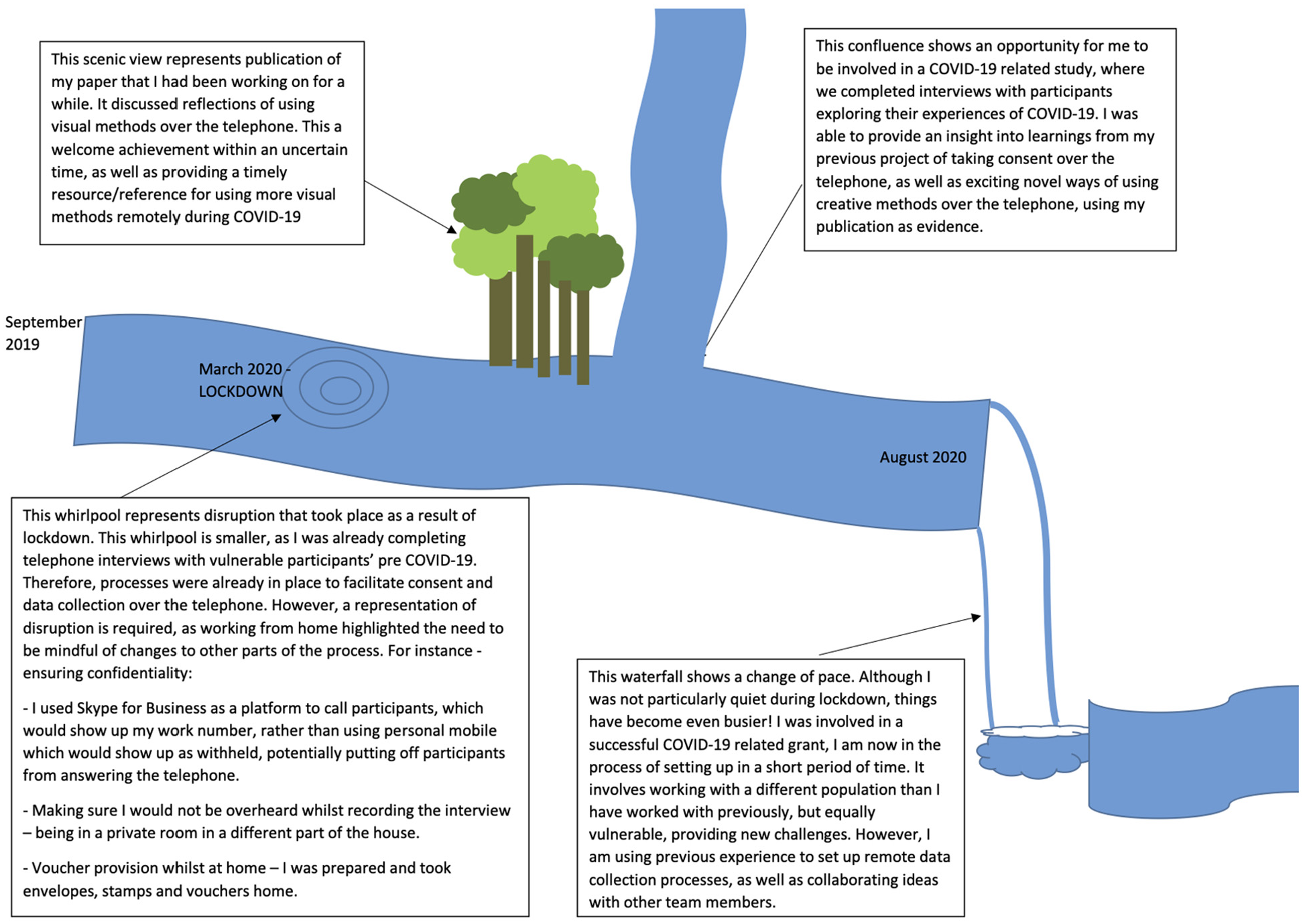
Megan’s image presented in the first workshop on interview methods (reproduced with permission).
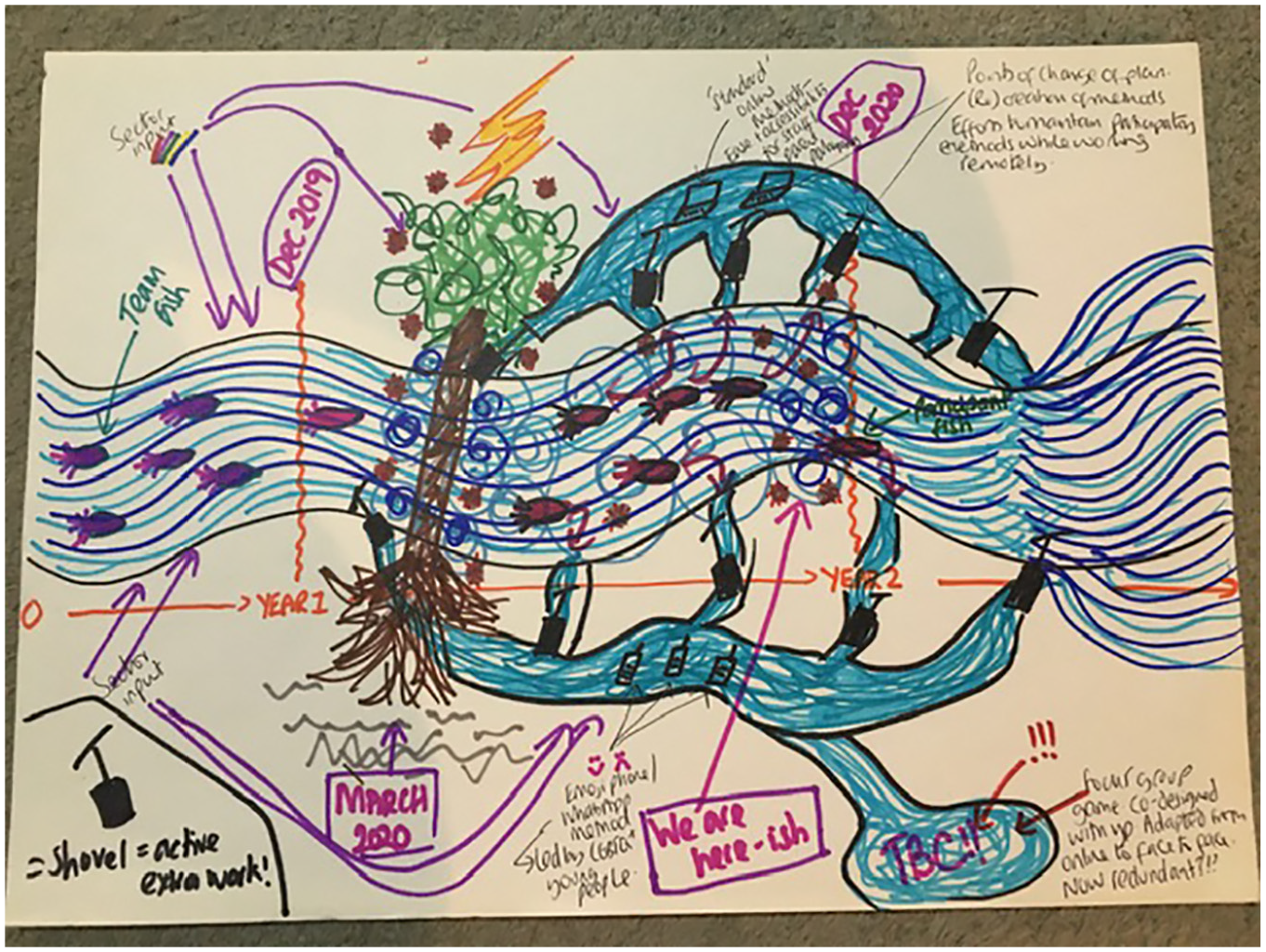
Rebecca’s image presented in the creative methods workshop (reproduced with permission).
Diffractive analysis
Our focus is on what is performed through actions in the workshops as researchers explored their experiences of method in the COVID-19 pandemic. Our primary analytical interest is not in the choice of metaphor and its symbolic function as separate from everything else. Instead, rather than treating metaphor as representational, we examine the ways metaphor is enacted, thus the way entangled apparatuses produced metaphor, researchers and milieu. In this paper, we have called these enactments ‘image-accounts’ and in so doing have bounded data in a particular way. Our analysis is not a breaking down of themes and points, but is intended to be additive and generative (Murris and Bozalek, 2019b). However, ‘diffraction phenomena will be an object of investigation and at other times it will serve as an apparatus of investigation; it cannot serve both purposes simultaneously since they are mutually exclusive’ (Barad, 2007: 73). This means we engage, at different times, in accounting for diffractive phenomena (e.g. the rivers method) and in diffractively reading texts (e.g. the ‘data’). In what follows we discuss further the specific configurations of this method, what these configurations generate. One of the ways we aim to do this is through how the data appear in the paper.
The two image-accounts we discuss are treated as diffractive entities, outcomes of intra-actions that produce writers, researchers, rivers, methods, accounts and all the other entities to which we refer. Thus, they are not referential, nor are they ‘cases’ (Lin and Law, 2022). Instead, they are created through diffractions of method, matter and meaning and are created anew by readers as they intra-act with them. Finally, there is an issue of representation in writing. Indeed, representation is a key target of new materialist challenges. For those writers there is only enactment. Thus, we can make decisions that make particular cuts. In an earlier draft of this paper, for example, we attributed ourselves a great deal more agency by claiming we made particular decisions. In this draft, we have redistributed agencies to other phenomena creating knowledge through a different diffraction pattern of meaning and matter. Thus, argument is further diffracted through the constrictions of peer review and publishing machineries.
We now turn to the agencies embedded within the image-accounts. In the next section, we consider the artefacts produced through the method and think through these as diffraction patterns.
Image-accounts
We now diffract two participant image-accounts through ideas of agencies, drawing on additional debates in regards to research productivity and material culture. Furthermore, in presenting this diffractive analysis we seek to generate a sense of what it was like to facilitate the workshops: An image would, typically, appear abruptly on screen using the share screen function accompanied the participant’s verbal introduction although, sometimes, a participant would hold a paper drawing to camera, pointing out particular elements. The exact temporal and material configurations were always different, but we the audience began interpreting the whole image while simultaneously listening to the narrative account of the author. We think of these diffraction patterns as enactments. For instance: I did mine on the computer [laughs] and I wish I drew it now because they look so good. Actually, from hearing everyone else’s journeys, I actually kind of realise that I’ve kept a lot of my, sort of, perhaps, personal experiences of how the pandemic has affected me personally out of it. And the only reason I can think of why I did that is because I’ve just come back from annual leave [laughs] and I probably feel a lot more like in my head that things have separated a little bit better… [interference]. Before that, I hadn’t had any annual leave since Christmastime because things have been so busy. So, before I went on that, all these things were very, very blurred and the boundaries quite blurred. I think if I had done this map before that you probably would have seen a lot more whirlpools. [Laughs.] So I just wanted to give a bit of context there as to why it’ll just kind of focus on my work journey. And, although it’s been really busy, there are kind of real sort of positives to my journey… (Megan, interviewing workshop, 24th Sep 2020)
These were Megan’s words as she introduced her image (Figure 1) in the first workshop, the image-account diffracting through what came before. Megan was the last person to present a river image in this session (three others shared experiences and thoughts afterwards but without an image). In this excerpt, Megan first reflects on other people’s maps, qualifies her own decisions, and describes the features of a counterfactual map that could have focussed more on her non-research biography. She opens by drawing attention to an aesthetic aspect of the metaphorical activity. She says (as others did) that her decisions (or skills) meant her map sketches were not as attractive as they might have been, or as aesthetic as those others had presented. Thereby, this image-account objectifies image and subjectifies researcher.
Megan explains that her project, given the vulnerabilities of her participants, was already set up for remote research. In this regard, she drew a whirlpool, but it is ‘smaller, as I was already completing telephone interviews’. The implication here was that ethical considerations needed attending to but that the main method of telephone interviews needed little adaptation. This river element acts as an object-container metaphor, where smaller = less (Lakoff and Johnson, 2003). Metaphor comes into being as it is articulated and specified (Nind and Vinha, 2016). Thinking, reasoning and explaining are practical-embodied activities (Myers, 2008). Doing the practical action of saying ‘river’ does some specification, for example, moving from a general water metaphor to one involving a natural watercourse. Specifying and linking the elements of the source and the target concepts is also practical action. Thus, the river metaphors in our project are not readymade entities, but are actively brought into being through their articulation and in-situ performance. The capacities produced through researcher-computer application intra-action, for example, combined with instructions that preparation could take about 10 minutes, combine to produce a clear schematic of Megan’s experience with four discrete elements. Indeed, Megan is herself critical of the clear demarcations, saying there would have been more blurriness had the image been created prior to her annual leave.
The image-account produces a researcher with the capacity to reflect on their experiences and identify ‘positives’ where Megan, as an agentic individual, was able to contribute to projects and a wider academic community and university, through meetings, funded proposals and publications. In COVID-19 lockdowns, researchers including us (the authors), felt we needed to show we had capacity for productivity. This suggests the image-account can be a neoliberal form of accounting and auditing (Shore, 2008; Shore and Wright, 1999; Strathern, 2000), where qualitative researchers need to be able to ‘play their game’ by justifying and narrating their work in terms of productivity metrics (Denzin and Giardina, 2017: 7). Knowing the systems in which research is entangled sets up an analysis of producing the most appropriate and tailored forms of qualitative research (Cheek, 2016). In this regard, the notion of methodological adaptation is connected to wider concerns about the structure and function of (UK) research during COVID-19 and the continued requirements of, and expectations for, research and researchers to be and feel, measurably productive.
We now turn to Rebecca’s image-account generated in the creative methods workshop.
Rebecca said:
…And can you see the terrifying mess on the screen, yeah?
There is big river and lots of colour and a fallen tree. There is a lightning strike and there is black orange purple pink and turquoise writing and wavy pen-strokes and squiggles and turbulent spirals and computers and phones. There are fish and shovels. The facilitator (first author) replied, ‘it’s not terrifying by the way’. They both laughed. The facilitator’s response was based on the interpretation that the statement regards artistic expertise and so aimed to make the researcher feel more comfortable sharing her image. However, Rebecca adds,
I feel, um, I kind of like, I was quite frightened after I’d done it, actually. It felt so frantic. But it was also very enjoyable so thank you for inviting us to do this activity because it meant [inaudible] which is one of my favourite things.
Rebecca reinforces the importance of terror and connects this to the process of doing the drawing. Her opening statement can be interpreted as a heuristic instruction for interpreting the image: ‘see this terrifying mess’. Rebecca locates the terror she refers to as emerging in the making of the image. She notes that doing the drawing produced an agitated anxiety that was, afterwards, fear. This fills a reading of the image with emotional content and links her experience of drawing with affect. Rebecca then expresses gratitude for the opportunity to do the elicitation exercise, which performs a similar role as Megan’s comments by valuing others, in this case us, the research team and the metaphor activity. Thus, the image-account works to shape the audience’s interpretive agencies with particular concerns for emotion.
Rebecca’s image-account does more work to guide the audience to understanding her use of the metaphor. She explains the various elements: the river is the course of the project; the fish are people, where some (pink and purple, blue outline) are researchers and some (red and navy outline) are participants. The fallen tree and storm is, ‘my representation of the natural chaos brought about by the arrival of Covid, not that it took me by any emotional way’, a comment that further focusses on affect. She explains the shovels digging channels represent extra work, including adapting and reapplying for ethics, and the ‘efforts to maintain participatory methods even working remotely’. Thus, like Megan, she narrates the image through the entities within it. Rebecca engages in a playful, exploratory way, adding motifs like the shovels and storm to further the metaphor performing creative research approaches.
Rebecca further deployed the river metaphor towards the end of her image-account: Ultimately, yeah, we’ve been in this absolute whirlpool, we’ve been in this whirlpool, we’ve been backwards and forwards, at different points of activity and amendment, and we’re now heading towards… this is the last year that’s expected which will start from January 2021, and that was all meant to be comfortably a waterfall as far as I was concerned, kind of represents where we’re heading towards, creating the outputs which will flow as they please a little bit more rather than the control that we were trying to exercise through this period which of course we actually don’t have.
Although her image does not feature a whirlpool, her image-account makes wider use of the metaphorical possibilities, talking of the tumult of the past time, but suggesting that period is (nearly) over and there is potentially a different kind of future ahead.
Rebecca’s image-account work attends closely to adapting methods as a temporal activity. The calm before the COVID-19 storm shows plans were in place and research with participants imminent. There were three groups of participants – youth worker staff, parents and young people. The image-account says the team had planned to use ‘traditional’ interviews with the first two groups, but that some work was needed to adapt them to the emerging situation:
So this shovel activity here was what we did to like liberate the water so we could carry on on this tributary to do the parent and staff interviews. And like I said they were planned as relatively traditional interviews, so actually translating those to do them online hasn’t been particularly problematic. We did have to go and re-get ethical approval and I think [a named participant] you mentioned earlier about some of the things around informed consent and how you can make sure you do that best in kind of remote settings, so we did create videos and put our forms and things in online formats which I think has definitely helped make it more accessible, engaging and facilitates confidence in people’s engagement with the information they need to have.
Thus, traditional interview methods, rather like adaptations in Megan’s example previously, were straightforwardly, albeit laboriously, moved online. The river course takes a ‘path of least resistance’ (facilitator’s in-session paraphrase) that still required ‘shovelling’ work to align the methods to make them work – to ‘free’ the water’s path to make a doable project (Fujimura, 1987). The kind of adaptation of moving interviews online and reapplying for ethics can be understood as routine adaptive work in that it did not appear to significantly disrupt the forms of engagement or the knowledge that would be produced.
In contrast, Rebecca’s image-account shows two methods that were planned for use with young people. The first method was mapping and drawing interviews, which Rebecca compared to the metaphor activity we are discussing here. According to Rebecca’s account, the research team adapted their method by drawing on their previous experience researching with young people. They designed and began using WhatsApp interviews that made use of emotional representation in texts through emojis. The team had been able to conduct two such interviews with young people. However, Rebecca also notes how difficult recruitment had become, with stakeholders feeding back that young people were much less engaged with their mental health services. This kind of change is non-routine adaptive work in the sense that the societal phenomena through which the research team intended to access changed substantively, meaning that modes of recruitment and engagement methods changed significantly, consequently changing the forms of knowledge that could be produced and the entities such knowledge concerned.
The second method for research with their young people participants was a specifically developed board game, and offers a third fate of method. Rebecca’s image-account detailed this was not an output, often seen in creative projects, but had been designed with young people and stakeholders as an elicitation method based on the ‘tower defence genre’ of online games 1 ; it. translated an online (or digital) game into a material, face-to-face focus group game. The team had a graphic designer produce the board and Rebecca had handmade three sets of the pieces. However, Rebecca says the game was now ‘in my cupboard’ and its future uncertain. Perhaps, she mused, the game might be re-repurposed as an output from the project after all. The game can be understood as a dormant thing (Woodward, 2015) – translated for a context in which face-to-face elicitation was possible – but currently in storage awaiting some future hoped-for eventuality. Not wanting it to waste, the game is in abeyance.
Rebecca’s image-account assemblage produces three fates of method: routine adaptation, substantive nonroutine adaptation and dormancy. The image account produces emotions in relation to agency – labour and fatigue; dormancy and frustration. Megan’s account was situated primarily in regards to routine adaption – her remote method of telephone interviewing and experiences of creative telephone interviewing was well suited continuing research in the context of COVID-19. This is important because, as we have argued, participating in the visual metaphor workshops was a practical mode through which researchers performed contributions to their academic communities.
In and out of the research assemblage
In the previous section we described two image-accounts and the material-discursive concerns they enact, which included the performance of an agentic neoliberal researcher and the entanglements of agency, emotion and fates of methods. Here we discuss how the river method assemblage produces particular entities. In other words, particular phenomenal configurations make entities in particular ways that, if set up differently, would produce other phenomena: it could be otherwise (Woolgar and Lezaun, 2013). All of this is important because, if research methods are deliberate and generative material-discursive practices, knowing how particular methods produce particular entanglements makes research an ‘ethico-onto-epistemology’ where these concerns are entangled and not separable (Barad, 2007: 90). By discussing the generativity of research rivers in this way we aim to help researchers decide whether this is world they would like to create through their own material-discursive practice, or whether to adapt and alter this approach.
Inclusion and emphasis
Firstly, a new materialist analysis highlights the humanism inherent in research rivers: by asking researchers to talk about their experiences the method enacts independent researchers who have emotions, experiences and capacities for action. However, while the image-accounts presented above involve narrative creation, affect emerges through and becomes-with material-discursive configurations – Megan says she is intentionally positive in the online workshop; Rebecca focusses on fear and anxiety and, later, hope. Affect is produced through intra-action simultaneously making researcher, arts resources, facilitators, participants and so on.
Conventionally, qualitative inquiry might claim that the rivers supported the production of participants’ narratives in their various forms and that this would be important because narratives are able to act both as a ‘means of knowing and a method of telling’ (Richardson, 1997: 58, cited by Keats, 2009: 181). As Keats (2009: 182) argues:
Offering participants multiple means of expressing stories around their observations, ideas, emotions, and activities can also expand a researcher’s opportunity to better understand the complex narrative participants construct about how they are living through experiences. … When a researcher is seeking to understand this complexity, multiple texts are an important option for recording and interpreting meaning for a single participant, as well as within a group of participants.
The implication here is that narrative is a complex yet single construct to which multiple texts would offer a better insight. New materialism departs from this in the sense that the narratives produced through the research rivers are part of the phenomenal arrangements and as such multiple texts enact narrative in particular ways – the image-accounts are constitutive of the narrative.
Secondly, the research rivers invited researchers to represent their worlds. This also situated some of the data generation beyond the workshops, producing researchers who were ‘else-when’ – the idea that the method produces other researchers who were in a temporally distal moment. By inviting accounts in the workshops, researchers thus spoke of prior experiences, feelings and capacities. In the time of COVID-19, with widespread disruption, stress, confusion and isolation, making a humanistic agential cut may have been why the method appeared to us to work so well and emerged as the dominant way in which people communicated within the project. Research processes such as interviews and drawing diagrams can help participants gain some power over understanding their worlds (Clark, 2010; Söderström, 2019). Thus, while a representational activity (research rivers) might seem at odds with new materialism in the sense that new materialism is performative rather than representational, using a representational method made a particular agential cut, creating agentic researchers at a time when other agencies were powerful. Drawing on Haraway’s (2018) point that a diffractive methodology is a critical way of making differences in the world, the research rivers diffracted understanding through metaphor and discussion.
How image-accounts perform and relate time in the context of researchers discussing their research methods is an important emphasis of the method and is intimately bound up in the production of agency. Both of the river metaphors we described have coherent ontological effects. The river drawing renders a researcher’s biography (Megan) and a research project (Rebecca) as entities existing in time. Lockdown is definable in the temporal context of the metaphor – it has start and end dates. Marking the pandemic with a lockdown gives some temporal organisation, allowing researchers to position their selves and their activities. The images both flow from left to right, diagrammatically comparable to the idea that ‘from our point of view, time goes past us from front to back’ (Lakoff and Johnson, 2003: 44). Thus, rivers are consistent with metaphors such as time as moving past us and container metaphors for entities (Lakoff and Johnson, 2003). The river metaphor in this practice produces particular understandings of entities and their features as a diffractive representation.
Thirdly, this particular methodological cut objectifies methods. The use of metaphorical visual icons bounds events. For instance, Megan’s March whirlpool symbolises ‘disruption that took place as a result of lockdown’ and the image-account binds it to a particular time in the image. In Rebecca’s image-account, river elements render projects as a manipulatable substantive entity, such that extra labour transforms not-doable methods into doable methods. The pandemic lockdown acts on method, and the researcher must respond. In these image-accounts, the methods could be aligned, or not so aligned, with an external world (Fujimura, 1987). The episodic feature of lockdown is reinforced by the following discussion of ethics, where the researcher had to consider her new domestic research setting. Methods then become material entities through which researchers do work.
The business of adaptation as constructed with the rivers, is of attending to flows of knowledge production. Slowness and whirling: trickles, dams, shallows, whirlpools, indicate a paucity of knowledge production. The work of adaptation can be about attempting to make knowledge production flow again. Ensuring ethics are checked for lockdown (Zoom calls in the home) is one place that routine adaptations can be done. Substantive adaptions mean changing the flow of the project, requiring theoretical and methodological changes that resume new flow. The image-accounts connected flows of knowledge production in COVID-19 and imbued them with affect.
We have shown how entities can be enacted through the image-accounts, both through narrative accounts of research processes, but also through reflexively considering the method itself, further showing how agencies change through the accounts and in the reflections upon the accounts. In this way, metaphor can be both the interiorised within a researcher-method assemblage and exteriorised from a researcher-method assemblage where, in this latter case, it becomes an object for study using other conceptual tools (e.g. related to positionality positionality). In this regard, ‘entanglements are both matters of fact and matters of care’ (Murris and Bozalek, 2019b: 882). All of this begs the ‘ethico-onto-epistemological’ question of what was excluded by these particular entanglements (Hollin et al., 2017)?
Exclusion
We have argued for an interpretation of metaphorical methods as making agential cuts in the world. This produces some entanglements in lieu of others, and therefore knowledge-objects. In these image-accounts, temporality and personal affect, biography and experience are foregrounded. And, given that our guidance to participants explicitly asked researchers to depict their experiences over an approximate time period, finding temporality in the data is unsurprising. Notably, however, there is broad absence of place relative to the rich explorations of time and show that spatiality was less clearly ordered or explored. This may be in regards to the wider lockdown milieu, where researchers were confined to their domestic settings and local neighbourhoods. Thus, the river metaphor method enhanced the temporal understanding of methods, while exploration of place and space may need more explicit direction or guidance.
Adaptation here involves continuity: as ontological metaphors, the rivers linked together events in a continuous stream meaning the river image-accounts produced research projects and biography as entities with substance and integrity. If flow ceased, it seemed the method or project work stream produced no knowledge, according to those participants. Megan’s boardgame method was inactive, completely unable to generate knowledge. It was excluded from knowledge production. Clearly other knowledge is made possible and develops, but those are not in the entanglement of the researcher-method-project because the method did not work in COVID-19 circumstances. Some participants talked about the productivity of pausing as stepping back from research facilitated an ability to reorientate their projects, ask new questions and produce lines of entanglement and that many explored other ideas for continuing projects in the workshops. Research rivers, as developed through our workshops, then and as evidenced in the image-accounts, appear well suited to ordering and producing temporal coherence. However, Rebecca’s image-account, with its main stream and parallel canals, with its three fates of method, produces multiple affective agencies, ones that care for methods but have greater or lesser capacity for that care to actualise particular methods, to make them doable. This means that methods and research projects are performed as fluid streams rather than multi-sited, non-contiguous bush fires (Law and Singleton, 2005). Bushfires help understand how some other objects or research interests are multiple and non-contiguous. This is ‘other’ to the continuity and contiguity that rivers seem to enable. In other words, a researcher wanting to emphasise non-contiguous multiplicity should reflect whether using rivers (and similar devices) will help explore that issue.
The river image-accounts are devices (in the sense of both method and design) through which researcher agency emerges – doing routine and substantive adaptations in work and achieving affective, experiential and practical contributions to the research community. We agree with Nardon and Hari (2021) that metaphor can be both impact and research as we simultaneously produce data for analysis and participants’ shape their own understandings and reflective practices. At the same time, there are arguably looser entanglements of participants who elect not to draw. They participate in the wider workshop, refracting their own experiences through the discussion and thus nuancing the exclusion/inclusion entanglement.
By describing the apparatus in the production of knowledge we have shown how knowledge cannot be separated from the processes of production. However, going further than previous arguments, we have shown the material-discursive processes and the production of different agencies through using rivers. Thirdly, these research rivers emphasise continuity, coherence and integrity. They seem less well adapted to producing multiplicity, non-coherence and non-contiguity. The river method therefore emphasises some ways of understanding biography, history and experience while excluding others. Perhaps, though, that very feature helps make them a useful tool for communication and learning. To researchers considering using metaphorical drawing with knowledge producers, then, we suggest it is important to attend to the ways that agencies are produced and what is exteriorised, and potentially excluded entirely, from particular methodological set ups. We have shown how new materialism is a useful diffraction methodology that critically examines methods by focussing on what is included and excluded from particular entanglements recasting the ethics of methodology as ethico-onto-epistemology. We sought to explain why the research rivers seemed to generate particularly rich exchanges, and suggest that other researchers may wish to pick them up in their own diffractive research and teaching practices, especially where they want to emphasise contingency, affect and time.
Footnotes
Declaration of conflicting interests
The author(s) declared no potential conflicts of interest with respect to the research, authorship, and/or publication of this article.
Funding
The author(s) disclosed receipt of the following financial support for the research, authorship, and/or publication of this article: This project was supported by the Economic and Social Research Council (Grant no. ES/T000066/1) as additional funding to the National Centre for Research Methods.
