




Abstract
Qualitative research methods have treated Western knowledge systems and Indigenous studies as polar opposites with asymmetrical power relations. Studies have documented the hegemonic dominance of Western science over Indigenous knowledge systems. Despite this tension, there is an opportunity to integrate Western science with Indigenous knowledges to bridge these discordant systems. This paper argues that Constructivist Grounded Theory (CGT), a Western-based version of grounded theory can be weaved with Indigenous research. CGT’s emphasis on co-construction, relationality, value-free inquiry, and social justice align with Indigenous research principles. Using examples from both CGT and Indigenous scholarship, the paper argues that CGT with its pragmatist and constructivist orientation can exist alongside an Indigenous research agenda. Furthermore, the flexible, emergent, and relativist nature of CGT aligns with some aspects of Indigenous research. The paper demonstrates that both knowledge systems can be treated on an equal par, engender methodological reciprocity and provide mutual benefits to each other. Weaving CGT and Indigenous research might provide new avenues of thinking about doing research with Indigenous communities and other marginalized communities.
Keywords
Introduction
The tension between Western and Indigenous research methods is well documented. Research has widely established that traditionally research has been conducted with a Western gaze that has excluded and peripheralized the work of non-Western scholars (Getty, 2010; Quinn, 2022; Singh and Major, 2017). Western science has dominated traditional thinking on how to do research and what becomes knowledge worthy. Massey and Kirk (2015) argue that “Western science has been used with a degree of exclusivity since the 20th century to refer to officially sanctioned knowledge of positivist inquiry, supported and acknowledged by governing bodies” (p. 2). Furthermore, Dentzau (2019) charges that one of the fundamental flaws with Western science is to treat Indigenous knowledge as imprecise, unscientific, and lacking in empirical rigor. In some cases, many Western-based researchers have extracted Indigenous knowledge to further settler colonialism. Despite the dominance of Western science, Indigenous scholars and other activists have over the years challenged this hegemony and called for the inclusion of non-Western actors and their lived experiences. There has been a direct demand to decolonize and indigenize research methods to create space for broader participation by Indigenous communities (Akena, 2012; Seehawer, 2018). The emphasis is for non-Indigenous researchers to not do research on, but with Indigenous communities. This is because doing research with Indigenous communities involves adopting culturally sensitive research, ensuring equitable partnerships and strictly following established protocols on doing research with Indigenous communities (Simonds and Christopher, 2013). Involving Indigenous communities in research designs and throughout the research process allows non-Indigenous scholars to gain entrée in the social worlds of local communities. It asks researchers to adopt respectful and culturally sensitive ways of doing research when they partner with Indigenous communities.
Although the tension between Western science and Indigenous knowledge has been noted, there has been some deliberate efforts to bridge them (Agrawal, 1995; Kadykalo et al., 2021; Muwanga-Zeke, 2009; Ryder et al., 2020). This body of work is broad and vast. Other studies have advocated for some qualitative methods like Community-based Participatory Research (CBPR) (see LaVeaux and Christopher, 2009) as approaches that align with Indigenous research. However, the literature in this area suffers from a lack of clarity and specificity about how Western qualitative approaches could be deployed alongside Indigenous research with the exception of Denzin (2007, 2010). Much of what is said about bridging Western and non-Western research approaches is notional at best.
In this article, I propose that Constructivist Grounded Theory (CGT), a Western-based version of grounded theory is a relevant approach that aligns with Indigenous research methods. I argue that CGT is a powerful tool that can be weaved with Indigenous research to strengthen each other. In this article, weaving refers to treating CGT and Indigenous research on an equal par, where knowledges from each system are reciprocal, enhance mutual learning and operate in a give-and-take fashion. As Henri et al. (2021) suggest, “weaving” goes beyond “combining” and “integrating” which might imply assimilationist thinking of Indigenous knowledge into CGT. The aim of this article is to distill some similarities between CGT and Indigenous work and propose that weaving them together provides several opportunities of mutual benefit. To achieve this, I first, provide a historical background of the development of grounded theory since its inception in the 1960’s. I show its different iterations over time including CGT and its basic assumptions. I then discuss Indigenous research methods, its scope, and main considerations. Thereafter, I demonstrate the methodological confluence of the two systems especially how and what they might benefit from each other. I draw from an emerging body of work among Indigenous scholars who have recently embraced CGT as a useful research tool. Some potential pitfalls and challenges of pairing the two knowledge systems are discussed. I conclude the article by making some suggestions about how weaving CGT and Indigenous research methods can offer new ways of thinking and counter the cartesian dualism that has traditionally dominated ways of doing social research.
Grounded theory: Historical overview
Grounded theory is a qualitative method that uses an inductive approach to systematically collect, analyze, and compare data to generate theory (Charmaz, 2014a). The approach can be traced to Glaser and Strauss’s work in 1960’s especially their pathbreaking book, Discovery of Grounded Theory (1967). Glaser and Strauss proposed grounded theory as a systematic method that could generate theories that are grounded in the data (Charmaz, 2014a). Grounded theory specifically focuses on developing a “substantive theory from the practical experience and knowledge of those directly involved in the phenomena under study” (McCalman et al., 2015: 2). Using an inductive approach was different from other qualitative theories at the time which deducted data from testable hypothesis. The original version proposed by Glaser and Strauss made significant advancements to qualitative research especially by centering an inductive approach in qualitative studies. Glaser and Strauss also embraced principles of positivism especially that social phenomena can be discovered through a systematic method. A typical grounded theory approach relies on the constant comparative method where “researchers build more and more abstract concepts that they eventually integrate around the core concept” (Martin, 2018: 12). Grounded theory studies usually follow some steps such as data collection (semi-structured interviews), open and focused coding, memoing (reflexive and analytical), and core category development as seen in Figure 1.
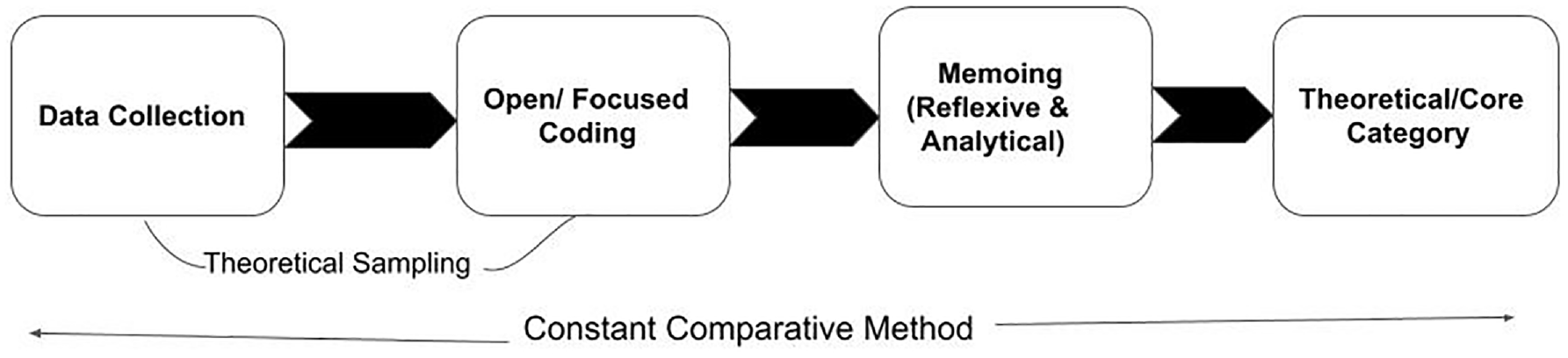
Grounded theory steps and procedures.
One of the proposals advanced by Glaser and Strauss was that in order to generate theory, grounded theory could have its own logic (Charmaz, 2014a). In essence, grounded theory work follows a set of logical steps that leads to theory generation. Grounded theory has since undergone further refinements after the original version by Glaser and Strauss. Other iterations of grounded theory have since been developed. For example, Strauss later developed the Straussian Grounded Theory with Juliet Corbin that was rooted in symbolic interactionism where people are perceived to create meanings through social interaction (Schreiber and Tomm-Bonde, 2015). The constructivist version is rooted in the constructivist school and expanded on both the original version and Straussian version of grounded theory.
Constructivist Grounded Theory (CGT)
CGT is an extension of the earlier versions of grounded theory. CGT has its roots on the pragmatist and constructivist schools. One of the main strengths of CGT is its concern with relativism and subjectivism in generating theory. An emphasis on a relativist ontology was overlooked by earlier versions of grounded theory especially the Glaser and Strauss version. In the CGT tradition, facts and values cannot be separated (Charmaz, 2014a). The value of CGT lies in its iterative nature that places emphasis on “action and meaning inherent in the pragmatist tradition” (Charmaz, 2014a: 13). People are treated as active participants in the construction of the social world among constructivist grounded theorists. Grounding theory in the experiences of participants is a key principle of CGT. Meaning-making between researchers and participants is a mutual exercise where both parties bring their values in the research process (Sebeelo, 2022). In other words, both the researcher and the participant are active participants in the research process. The emergent and constitutive nature of CGT distinguishes it from other versions of grounded theory. For example, the original version proposed by Glaser and Strauss (1967) treated the researcher as separate from the research process. The social world was viewed as out there to be discovered. CGT departs from this orientation and views the research process as emergent, fluid, and co-constructed between the researcher and the participant (Sebeelo, 2022).
The approach has gained widespread appeal among scholars doing qualitative research across various sub-fields such as nursing, journalism and communication studies, alcohol and drug policy, immigration, social work, and engineering amongst others. CGT’s emphasis on reflexivity, subjectivity and relativism appeals to scholars doing work concerned with social justice, marginalization, and power relations. In line with this thought, Charmaz (2017) argues that CGT can enhance critical inquiry as it “locates the research process and product in historical, social, and situational conditions” (p. 34).
Indigenous research methods
Indigenous research is an approach that centers the experiences and cultures of Indigenous people. It prioritizes Indigenous experiences and the connection between Indigenous people and their local environments (Ryder et al., 2020; Teariki and Leau, 2023). Dentzau (2019) argues that Indigenous knowledge “is grounded in place and an understanding of periodicity, seasonality, ecological relationships, sustenance, land ethics and sustainability” (p. 1032). It is a place-based knowledge system that is rooted on a deep understanding of people’s relationships and their sacred cultures (Dei, 2011). Although various Indigenous scholars differ in their approaches, it is widely acknowledged that much of the agenda in Indigenous research is to confront the taken-for-granted views that shape research methods especially the Western and Eurocentric paradigms that reify individualism (Chilisa, 2012). Mainstream research approaches are dominated by Western thought and have legitimized how we do research. Eurocentric frames about research have prioritized Western knowledge systems at the expense of the other, especially the Indigenous knowledge systems in non-Western contexts. The mainstream logic of qualitative research is one of dominance that has peripheralized Indigenous ways of knowing. Western science is treated as scientific, hypothesis-based, analytical, and factual while Indigenous knowledge is seen as anecdotal, oral, and unscientific (Reid et al., 2020). Indigenous research seeks to deconstruct such frames and dualistic constructions that have historically relegated non-Western thought to the peripheries of research.
Indigenous research seeks to empower and give the previously marginalized communities and people a voice in research. Some scholars view Indigenous research as an approach that engenders “conversations,” that gather “knowledge based on oral story telling tradition with Indigenous peoples” (Kovach, 2010: 40, emphasis added). A conversational approach within Indigenous research fosters a dialog between researchers and local Indigenous communities. For Indigenous communities, these knowledges are personal, oral, experiential, holistic, and expressed in narrative language (Castellano, 2000). The lived experiences of Indigenous people is at the core of Indigenous knowledge. In line with conversational approaches, Indigenous knowledge also relies on oral knowledge especially from elders. There is well-established research on the importance of elders in Indigenous communities (Braun et al., 2014; Iseke and Moore, 2011; Rowe et al., 2020). For non-Indigenous researchers, knowledge and understanding of Indigenous communities starts with talking to, and with elders about the culture of their communities. Crouch et al. (2023) posit that in Indigenous communities, elders are the reservoir of traditional knowledge and community values. They argue that “elders are most valued for their contribution of wisdom that supports the well-being and prosperity of the community, and their role guides the interests of the people’s future” (Crouch et al., 2023: 3). Oral tradition forms an important part of cultural knowledge and transmission in many Indigenous communities. A reliance on elders and oral tradition by Indigenous communities is contra Western discourses that gives weight to written and codified knowledge (Quinn, 2022).
It has been suggested that Indigenous research approaches also seek to decolonize existing worldviews (Martin et al., 2020; Zavala, 2013). Datta (2018) argues that “decolonization is an on-going process of becoming, unlearning, and relearning regarding who we are as a researcher and educator, and taking responsibilities for participants” (p. 2). A decolonization process seeks to open up spaces of participation and deliberation for local Indigenous communities. It “advocates building a coalition of knowledge, relevance and practical application (Bainbridge et al., 2013: 276 emphasis added).
Overall, Indigenous research approaches seek to find a voice for Indigenous communities who have been relegated to the peripheries of mainstream research approaches. In qualitative studies, this approach is very important given that most of the dominant approaches have adopted Euro-centric frames that mainly use Western tropes of knowledge. What Indigenous research scholarship attempts to do is to move away from this dominant worldview, decolonize it, and advocate for understanding contextually-relevant Indigenous experiences. It aims to create a space for Indigenous people to be co-producers of knowledge and play an active role in how they are being portrayed, understood, and researched.
How CGT aligns with Indigenous research methods
Although Western research methods have traditionally been used to marginalize Indigenous methods, there are some benefits from bridging these two seemingly antithetical knowledge systems. One of the main things to consider is that these two systems depart from different epistemological heritages and backgrounds. As previously stated, Western science values observation, hypothesis testing, empirical evidence, and quantitative reasoning while Indigenous knowledge value oral knowledge passed down through generations. To determine how to weave these two systems is to, first, acknowledge their historically tense and divergent heritages. More importantly, we have to also acknowledge the hegemonic power that has been enjoyed by Western science at the expense of Indigenous knowledge and other non-Western systems.
Despite these tensions, there are some benefits that these knowledge systems could learn from each other. Some principles within CGT can be carefully weaved with Indigenous research methods for the mutual benefit of these systems. Weaving them could adopt a “Two-eyed approach” that essentially means that “Indigenous and Western scientific knowledge systems contribute in parallel to produce an enriched picture and mutual understanding” (Reid, et al., 2020: 246). Some elements of CGT such as co-production, multiple realities, relativism, critical inquiry, and social solidarity accord with Indigenous research principles (Figure 2).
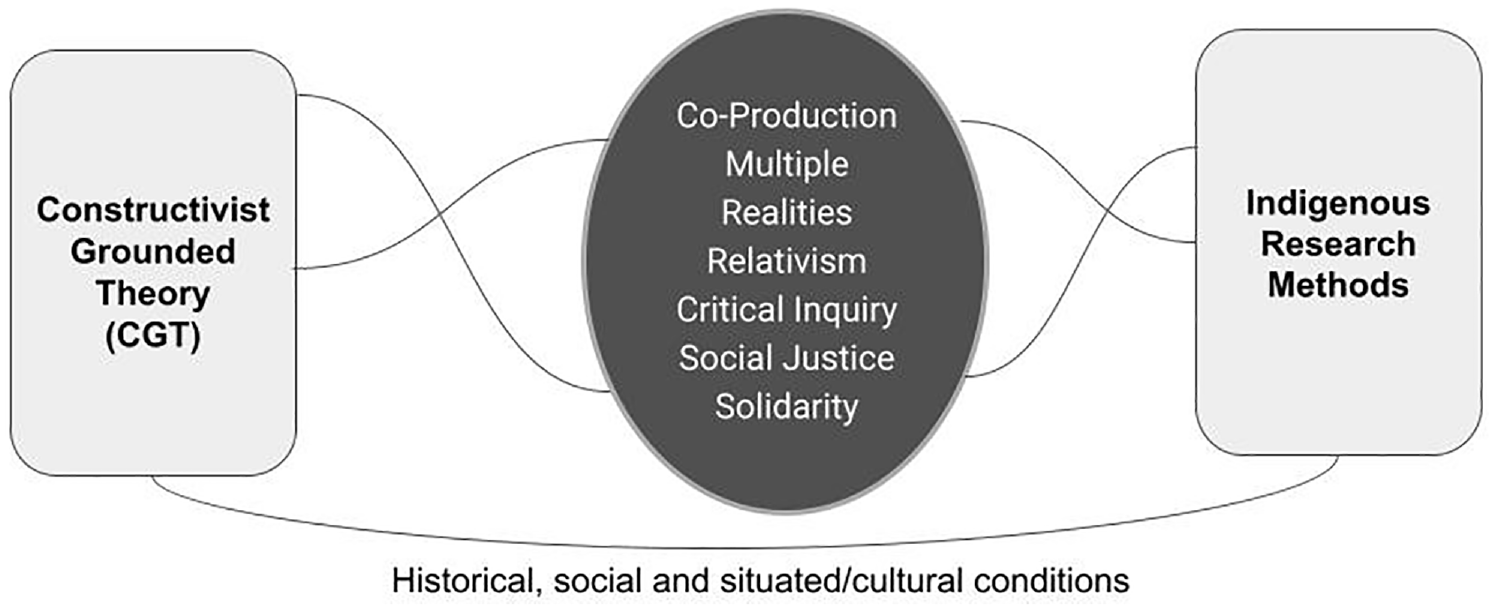
Constructivist grounded theory and indigenous research methods.
Emphasis on co-production and multiple realities
The appeal to give a voice to the voiceless aligns with CGT and its emphasis on co-production. The iterative nature of CGT, its flexible and pragmatic orientation pays attention to the role of participants in research. In doing research, constructivist grounded theorists reify the power of both the researcher and the participant. This aspect of CGT is important especially for populations that were previously marginalized, abused, and disempowered. The research process is undertaken in a symbiotic fashion where the researcher and the participant are continuously engaged in a mutual process of constructing the social world. One of the key principles of Indigenous research is promoting the voice of Indigenous communities and promoting self-determination. Bainbridge et al. (2013) argues that co-production is best performed by context-dependent research that allows research to be grounded in its unique circumstances. Research that pays attention to context parallels CTG’s contextual description of events. Bainbridge et al. (2013) emphasizes that context driven research gives space for Indigenous knowledge systems to be valued and linked with Western systems like CGT.
Co-production also promotes “dialogic relationships” (Stewart, 2007) between CGT researchers and Indigenous researchers. It also means that Indigenous ways of knowing are incorporated into the research process. Co-production of research also means avoiding “helicopter research” (LaVeaux and Christopher 2009) where some non-Indigenous researchers come as “experts,” collect data and fly away without involving local communities in the research process. A genuine and intentional effort to co-produce knowledge with communities makes CGT a relevant methodological approach that could be integrated with Indigenous research methods.
The critical role of a relativist ontology
One of the important concerns of Indigenous research is to acknowledge and contextualize historical events that have shaped the lived experiences of Indigenous people. For research purposes, this leads to an understanding that a relativist approach becomes relevant for understanding local Indigenous communities. A relativist ontology also means understanding that there are differences among and within Indigenous communities. That is, the lived experiences of Indigenous people vary according to different context, places, and spaces. Knowledge is context-specific and relies on the experiences of local communities. In line with this thinking, Sanga and Reynolds (2021) argue that “both traditional and indigenised knowledge are fluid and malleable elements in lives which are continually adjusting to find relevance” (p. 534). Knowledge creation is relative and a by-product of social and historical experiences. A good example that demonstrates how a relativist ontology might work in Indigenous research is through Talanoa which is a form of interaction that is common in most Pacific areas. In research, Talanoa fosters conversations and “involves dialogic empathetic engagement in a space safe for all participants (Sanga and Reynolds, 2021: 534). It gives Indigenous communities the platform and opportunity to articulate their lived experiences that are sacred to them. Farrelly and Nabobo-Baba (2014) further state that Talanoa methodology is based on emotions, spirituality, and empathy. Researchers and participants not only share information when they engage in Talanoa research, but they also connect emotionally and spiritually.
In the same accord, relativism is a central principle of CGT. How people make meaning, construct the social world, and frame these experiences in a socio-historic context, is central to constructivist grounded theorists. Constructivist grounded theorists focus on how research is produced and the material conditions that shape such production. For Charmaz (2020), “constructivist grounded theory calls for studying the meanings of participants in terms of scrutinizing the discourses they invoke” (p. 169). A relativist ontology of CGT and Indigenous research demonstrates methodological convergence. It shows that both knowledge systems can exist alongside each other. A focus on how people frame their social world and the values they bring to their experiences (such as Talanoa) demonstrates a confluence between CGT and Indigenous research.
Critical inquiry and concern with injustice
Grounded theorists aligned with the constructivist turn incorporate critical inquiry and social justice in their research agenda. A critical inquiry unsettles the taken-for-granted assumptions about knowledge-making practices. Charmaz (2017) argues that “critical inquiry begins from a researcher’s explicit value position that defines the meaning of the research question in advance of conducting the study” (p. 35). The values of the researcher are not separate from the research process. A critical inquiry departs from the position of doubt, where the taken-for-granted assumptions about reality are viewed as suspect. CGT researchers are sensitive to the conditions of knowledge production (Charmaz 2020) and emphasize reflexivity in research findings. More importantly, a critical inquiry can “move researchers to develop theoretical categories that situate their participant’s lives within larger social and political structures” (Charmaz, 2020: 174). Objective reality and “facts” are understood as mere constructions that are malleable and flux. A critical inquiry therefore leads to social justice that sometimes confronts power structures especially “truth regimes.” The concern with social justice might allow for some consilience between CGT and Indigenous research.
In a similar way, social justice is at the core of Indigenous research. This is primarily because most research methodologies, emanate from a deficit model that imposes Eurocentric frames on Indigenous research. Most Western approaches like CGT are based on individualism and undermine approaches that have communal orientations. A critical enquiry positions Indigenous communities at the core of the research where they are promoted as experts of their own lived experiences (Bainbridge et al., 2013). The socio-material conditions that have shaped local Indigenous communities become central to theoretical categories if combined with CGT. Although social justice might appeal to both CGT and Indigenous scholars, weaving them requires a careful navigation of these two systems. A social justice agenda within Indigenous postcolonial research means these Eurocentric frames and ways of knowing are decolonized and rendered passé. It means both knowledge systems find each other especially because what is justice to a CGT researcher might not be the same to Indigenous communities. In framing a social justice and decolonization agenda, experiences that acknowledge the socio-historical and material conditions of Indigenous people are made relevant. Local and Indigenous knowledges which have largely occupied the margins of research are brought back to the center and weaved with the experiences of CGT researchers. A concern with social justice has the potential to open-up spaces for engagement between CGT and Indigenous research and create new knowledges.
The reification of social solidarity
CGT research principles promotes solidarity. Solidarity is aligned with other facets of CGT such as co-production, open-ended dialog, and critical enquiry. A CGT scholar who pays attention to co-production, culturally sensitive ways of engaging participants can be in solidarity with Indigenous communities. This might require a careful negotiation of the experiences of participants. For example, Schreiber and Tomm-Bonde (2015), reported that using CGT allowed them to be in solidarity with their research participants as they shared resources such as transport and food to create a friendly and harmonious environment. Using Ubuntu, a shared cultural trait inherent in most African countries, Schreiber and Tomm-Bonde (2015) state that they were able to build solidarity with their African participants. This is primarily because, “Ubuntu encompasses a number of interrelated principles including solidarity, spirituality and harmony” (Schreiber and Tomm-Bonde, 2015: 658). In some cases, building solidarity between Western researchers and local communities might be more than sharing resources. It might entail building rapport and seeking buy-in from local Indigenous communities to gain acceptance. This is critical given the predatory and extortionate practices by many Western researchers in Indigenous communities (Brunette et al., 2014). In line with this thought, Chilisa (2012: 295) proposes some ways that researchers can build relationships and solidarity with Indigenous people:
Employ the worldviews, values, and cultures of indigenous peoples of the world, the formerly colonized, and historically marginalized communities to inform research methodologies.
Envision research methodologies built on worldviews that emphasize connectedness and the cyclical nature of human experiences.
Assume roles of transformative healers.
Resist colonizer/colonized relationships that embrace deficit theorizing and damage-focused research about the Other.
Promote a relational approach to research where consent to do research is sought at individual, community, and group levels and where consent is collective.
Practice researcher reflexivity informed by an “I/we” relationship.
Embrace ethical protocols that draw from cultural practices informed by connectedness and web of relationships.
A social justice agenda, a principle embedded in CGT and Indigenous research might provide some potential for both knowledge systems to exist side-by-side. Both systems stand in solidarity with participants and people whose voices have been rendered silent by dominant discourses. The emergent nature of both knowledge systems is acquiescent to a reciprocal process that builds solidarity with participants.
Weaving CGT and Indigenous research: Some examples
Since some CGT principles align with some Indigenous principles, weaving them together provides a good opportunity for mutual benefit. For Indigenous researchers, a process that allows Indigenous communities to be actively involved in the research process is ideal and suitable. There are examples of some existing research that has integrated CGT with Indigenous research to show their compatibility. For example, Roxanne Bainbridge, an Aboriginal Australian researcher integrated CGT techniques such as theoretical sampling and constant comparative method in 20 interviews with Aboriginal women from 14 different groups in Australia (Bainbridge et al., 2013). Centering the lived-experiences of Aboriginal women through CGT allowed her study to develop a model called “becoming empowered” and a core category of “performing Aboriginality.” She cogently argues that this integrated approach made unique contributions to the literature such as spiritual sensibility, cultural competence and ethics of care and morality (Bainbridge et al., 2013). In Canada, Kandasamy et al. (2017), integrated CGT and Indigenous epistemology amongst 18 grandmothers in their study of elder women’s perception of perinatal health. They report that their sampling strategy was guided by an advisory group of Six Nations in Indigenous communities who ensured equitable participation. Their research centered the experiences of elderly Indigenous women who were treated as valuable co-researchers in the project. More importantly, using elderly women, who are respected and valued in their communities, meant that the community would implement the research findings for their own benefit.
One of the recent examples that captures the fit between CGT and Indigenous research is the study by Wilson et al. (2022) amongst the Kaupapa Māori women in New Zealand. They integrated CGT and the Kaupapa Māori research methodology to enhance co-production and center the experiences of Māori women in their research approach. Indigenous women were involved in the research design, interviews, and data collection. The researchers also report that they used theoretical sampling, an important CGT technique to understand and explore emerging concepts about the experiences of Kaupapa Māori women. The researchers report that they acknowledged traditional knowledge in their efforts to understand Māori women in “unsafe” relationships. In synergizing these two systems, Wilson et al. (2022) demonstrate the utility of weaving these two approaches and ensure that they mutually benefit from each other. The researchers did not privilege CGT over the Kaupapa Māori’s traditional knowledge, nor did they use the traditional knowledge systems to dismiss CGT. This work best exemplifies how these two systems can be productively paired for research purposes.
Weaving CGT and Indigenous research also gives space for Indigenous communities to be treated as valuable and knowledgeable experts. It allows Indigenous communities to speak about their lived-experiences and stories. The synergy between CGT and Indigenous research methods is also illustrated by Unugunmerr-Baumann et al. (2022) concept of Dadirri among the Aborigines in Australia. They point out that Dadirri, is the art of being present, being still, connecting with yourself and the environment is such a profound way that it creates space for deep relationship. Dadirri encourages cyclical, deep listening, and reflection. Through Dadirri, relationships are built on trust and respect, which provides opportunities to create the co-directional sharing of knowledge and privileges Indigenous voices (Unugunmerr-Baumann et al., 2022: 96).
Using Dadirri, an Indigenous based research method among the Aboriginal community in the Northern territory of Australia, allowed researchers to speak and relate to Indigenous people. More importantly, Dadirri’s emphasis on listening allowed researchers and participants to build rapport with each other during the study. Unugunmerr-Baumann et al. (2022) state that using this approach meant that the Indigenous community was involved throughout the research process, from study design, interviews, and data analysis. Weaving Dadirri with CGT demonstrate how these relational frameworks can enhance each other. Similarly, Thurston et al. (2014) work with Indigenous populations in Canada sought to understand Indigenous people’s experiences with accessing arthritis care using CGT. First, they report that the research team was constituted by experts and specialties in rheumatology, physiotherapy, family medicine, Indigenous health, population health, and epidemiology among others. They state that two members of the team were Indigenous. The constitution of the research team speak to a collaborative effort that aims to elevate the voices of the Indigenous people. Furthermore, Thurston et al. (2014) report that they involved the Indigenous people throughout the research process, from data collection to analysis. By involving Indigenous people, the research team was able to understand and grasp culturally sensitive meanings about access to arthritis care in Canada. Deploying CGT and Indigenous knowledge systems made it possible for researchers to call for reform on the health care system in Canada to care for the minoritized Indigenous groups.
Weaving both approaches has great potential for research as they are complimentary and value the experiences of local communities. McCalman et al. (2013) provides another example that shows the utility of deploying CGT to understand youth binge drinking in an Aboriginal Australian community. In their study design, they used a Community Based Participatory Research (CBPR) approach and combined it with CGT in partnership with the Indigenous community. They state that these methods were suitable for research ethics that demand responsibility for Indigenous research work (McCalman et al., 2013). Overall, their project demonstrates the benefits of involving the local community especially during the planning and study design phases. They believe that there is a need for “project initiators to engage those targeted by a project as well as community stakeholders and researchers in its design and implementation; to analyse local understandings of the health issue and integrate these understandings with the scientific evidence” (McCalman et al., 2013: 8).
These brief examples demonstrate the methodological fit between CGT and Indigenous research principles. They show how both systems can be carefully weaved in a reciprocal way to benefit from each other’s strengths.
Potential challenges of weaving CGT and Indigenous methods
Although weaving CGT and Indigenous methods holds a lot of promise, there are some potential challenges that could be encountered by researchers. One of the biggest challenge stems from the fact that research methods are context-based and usually reflect the culture of the society wherein they are developed (Charmaz, 2014b). The nature and form of any given methodological approach reflects the context and society in which they were developed. Grounded theory as a Western-based method was developed in the United States (US) in a particular context and reflects the values of US culture. It promotes the ideals of meritocracy, individualism, and neoliberal rationality that is inherent in the American culture. The approach does not pay much attention to geographic or cultural borders (Sanga and Reynolds, 2021). On the other hand, Indigenous knowledge is based on place-based knowing, cosmology, and altruistic communal relationships. Knowledge is translated orally usually through elders in Indigenous communities. Indigenous knowledge values individualism and cultural sovereignty. Emotions, spirituality, and being one with land (Dentzau, 2019) is a fundamental part of Indigenous way of life. Weaving these two systems with divergent ontological orientations can pose several challenges. To address this collision, it is important to collapse the existing divide between Western science and other knowledge systems that were previously marginalized. Denzin (2010) charges that, “first, the legacy of the helping Western colonizing other must be resisted” (p. 298). There must a deliberate effort by Western scientists to do away and resist the colonizing mentality. Bala and Joseph (2007) further argue that there has to be a dialogue between Indigenous knowledge and science that leads to a radical revision in which science is distinguished from pseudo-science. That is, Western science needs to create spaces where bodies of knowledge that were previously undermined could be treated as equally important. Doing so, could potentially result in a mutually beneficial relationship between Western science and Indigenous knowledge systems.
There are inherent power balances between CGT and Indigenous knowledge. Traditionally, Western researchers have enjoyed hegemonic dominance over other researchers. This dominance relates to what is, what ought to, and what ultimately becomes “scientific” knowledge. Indigenous knowledge holders and local communities have not been afforded the space to effectively particulate in the knowledge-making decisions (Henri et al., 2021). This is primarily because Indigenous knowledge has been judged through Eurocentric prisms and viewed as lacking scientific rigor. In most cases, Western scientists have descended on Indigenous communities with vast financial resources as “experts.” These resources have been used to undermine the unique and sacred lived experiences of Indigenous communities. In some cases, these resources have been used to serve the agendas of Western scientists at the expense of Indigenous people. Addressing power asymmetries might not be an easy task. However, to integrate the two systems would entail confronting the power imbalances between Western scientists and Indigenous communities. Henri et al. (2021) proposes that dealing with power inequalities in the two systems might mean conducting research that might promote social justice and in some ways promote self-determination among Indigenous communities. Dealing with power issues means that Western scientists have to carefully navigate how they engage Indigenous communities and avoid tokenism where participation is evident but does not translate into tangible results. As Denzin (2010) notes, dealing with power asymmetries might also entail a deliberate and intentional commitment to transform institutions, machineries and research practices especially by non-Indigenous researchers. Respecting the views of Indigenous people might help in dealing with power imbalances. Dentzau (2019) argues that since Western scientists have traditionally had all the power, movement should come from their side if the two knowledge systems are to reach a mutually inclusive middle ground.
The other challenge that might be encountered in an effort to pair CGT and Indigenous research might be grasping the deep-seated cultural practices by some Indigenous communities. As earlier stated, culture, close-knit communal relationships, cosmology, and being one with land are some of the fundamental aspects of some Indigenous communities. Various Indigenous communities like the Aborigines in South Australia for example, have a deeper sense of knowledge about the properties and positions of stars that they apply to their everyday life (Hamacher, 2018). This knowledge is transmitted through oral tradition is unique and demonstrate the power of Indigenous knowledge that predates the discovery of stars by Western scientists (Hamacher, 2018). An understanding of such sacred knowledge by Indigenous communities might provide some challenges for non-Indigenous researchers who are not from these communities. Moreover, Western researchers who enter into Indigenous communities might only get a glimpse of the meanings and values of such sacred cultural knowledges. It is therefore important for Western researchers to dialog with, and listen to the views of Indigenous knowledge holders. Although this approach might not accord Western scientists an understanding of the deep-seated cultural meanings, it might be a first step toward gaining entrée into the worlds of Indigenous communities. In some cases, the use of an interpreter might not be a good idea because meanings might be lost in translation and some interpreters might gain privileged information that could undermine the research process (Charmaz, 2014b).
Conclusion
Although Indigenous research scholars have provided a corpus of work that promotes its status in research methods, there has not been a systematic effort to pursue avenues of collaboration with other research methods that share similar epistemological orientations. Western research approaches and Indigenous methods have traditionally been treated as inflexible antinomies with divergent intellectual heritages. This paper attempts to bridge this seemingly incongruent relationship between Western science and Indigenous methods. The paper has demonstrated that although these two knowledge systems depart from a divergent epistemological orientation, there are some ways in which they could be weaved to leverage and mutually benefit each other. The paper suggests that some aspects of CGT and Indigenous research have similarities that could be harnessed by researchers to benefit each other. Both knowledge systems consider the emergent, relational, co-production, and social justice agendas in their approaches. In the quest to weave the two research approaches, there might be some potential challenges that researchers might encounter especially understanding the unique and dynamic cultural practices in the local Indigenous communities such as ethical considerations, power asymmetries, and hegemonic dominance. An effective and workable relationship requires constant negotiation especially from non-Indigenous researchers. As Denzin (2010) cautions, “GT, without modification, will not work within indigenous settings (p. 298). Western researchers must be committed and intentional about a decolonization process. This requires valuing and appreciating the experiences of Indigenous communities. Overall, weaving together CGT and Indigenous research has immense potential to bring about a symbiosis of methodologies that can enhance both knowledge systems and allow them to mutually benefit from each other unencumbered by the existing dichotomous discourses.
Footnotes
Acknowledgements
I wish to thank and acknowledge the editors of Methodological Innovations and the two reviewers for their worthy critique of the earlier versions of this manuscript.
Declaration of conflicting interests
The author(s) declared no potential conflicts of interest with respect to the research, authorship, and/or publication of this article.
Funding
The author(s) received no financial support for the research, authorship, and/or publication of this article.
