




Abstract
Working on a participatory arts project with former child soldiers and young survivors of conflict in Colombia’s indigenous Nasa community led to the development of an alternative to the qualitative interview, which we call ‘storylistening’. Storylistening is a methodology for peacebuilding that took shape within a narrative based culture and embraces the importance of acknowledging the everyday, as perceived and lived by young indigenous people. Within the context of conflict and reintegrating former child soldiers, storylistening emerged from a strong oral storytelling tradition to offer a dynamic and local approach to peacebuilding. This methodology shaped the production of an animated documentary, El árbol del amor (The Tree of Love), which explores the world of forced recruitment and child soldiering. The storylistening concept contains elements of auto/biography, in that it engages with memory and identity, where space and time are important. Based on Durkheimian notions of the socioemotional, storylistening shows how sharing emotions contributes to creating, maintaining and strengthening social bonds that can inspire change. It is an active process and has a shared impact on the ‘listener’ and the ‘teller’, whereas storytelling is an individual process that does not always carry the guarantee of being listened to. For the individual, storylistening offers the potential of catharsis, while for the community, it offers the opportunity for collective reflection. In the particular case of former child soldiers, storylistening engenders effective reintegration and more broadly fosters reconciliation, which underpins peacebuilding at the community level.
Introduction
‘We learned to live with the war and likewise our land has become accustomed to it’.
These words are uttered by indigenous teenager, Sek, one of the main characters in the animated film El árbol del amor (The Tree of Love), as he stares at a green mountainous landscape, littered with the dead bodies of his neighbours. The film is set in Jambaló, in the southwestern Cauca region of Colombia, which is home to the Nasa people. Jambaló sits on the country’s margins, as one of its most dangerous places, the site of protracted conflict and constant threat. It is also a town grappling with the reintegration of ex-combatants, some of them former child soldiers.
Colombia constitutes ‘a prime example of a country currently challenged with the task of building peace amidst violence’ (Nilsson and González Marín, 2020: 238–239). The young ex-combatants, who participated in this project, face an ongoing threat of (re-)recruitment, either directly by the continued presence of armed groups in the region, or as a response to the stigma and prejudice they might face in their communities and even their families. Understanding the needs and challenges of reintegration are therefore considered essential for promoting reconciliation and peacebuilding (Denov and Marchand, 2014).
As Ripley (2009) notes, a ‘community narrative’ is often the very beginning of recovery in such peacebuilding scenarios. This idea underpinned the design of the El árbol del amor project, where the community narrative is constructed and expressed through the co-creation of an animation, produced by a partnership between researchers, practitioners, former child soldiers and young people caught up in violence. Martuscelli and Villa (2018: 388) stress the importance of including children and young people in specific peacebuilding projects and emphasise the need to create opportunities for their active participation and recognition as peace-builders. Such opportunities can be created through discerning children as ‘leaders of their communities’ in the peacebuilding process; through ‘peace education and reintegration efforts’ and ‘training in leadership, conflict resolution, communication skills and trauma resilience’ (Martuscelli and Villa, 2018: 399).
Led by a team of researchers and practitioners from Bournemouth University in the UK and in partnership with the Norwegian Refugee Council, and Colombian charities Fondación Fahrenheit 451 and Tyet, El árbol del amor is a project, funded by a grant from the UK government’s Global Challenges Research Fund. It involved a series of workshops over 3 months with children and young people between the ages of 9 and 24, some of whom were former child soldiers, but all of whom had grown up with and survived conflict.
Existing literature provides examples of how ‘young people build peace in their everyday lives’ by ‘perpetuating the rhythms of and relationships and practices of day-to-day life’, resisting marginalisation (Berents, 2018: 8–9). Storylistening is therefore presented as a methodology to access the everyday and young people’s interpretations of it, as well as a way of communicating this to a wider audience within the community and even society as a whole.
As a result, the decision not to use interviews as a methodological tool was key to the project. This chimes with Vietnamese film-maker Minh-ha’s (2018) idea of ‘speaking nearby’; allowing ourselves to be free of dominant language and fixed identities to imagine new ways of telling stories. The participants wrote the film’s script, created the characters and the animation, whilst the researchers were observers and facilitators, remaining aware of our own situatedness within the immersive process.
Storytelling is intrinsic to Nasa culture. The animation depicts this practice in a scene, where elders and our young protagonists sit around the tulpa, a fire built on three stones, which represent the father, the mother, and the grandmother. The fire symbolises life, strength and fortitude. The tulpa is where elder tribal leaders bestow their wisdom and disseminate the Nasa traditions. Rappaport’s (1990) research in the Cauca region analyses the role of oral storytelling among the Nasa and how they draw on historical memory to address current political challenges. However, as Chaves et al. (2018: 465) note, the overemphasis on indigenous political struggles with the state ‘eclipses the question of indigenous people’s everyday struggles for survival’.
The concept of ‘storylistening’ emerged from observational and ethnographic processes, and emphasises the idea of sharing and listening. This contrasts to storytelling, which can assume a hierarchical or ‘top down’ quality. Even more inclusive forms which bring together marginalised voices to construct narratives and build empathy, particularly in communities that have been affected by violence and sectarianism (see, e.g. Ataci, 2021; Maiangwa and Byrne, 2015; Opacin, 2021), are based on the assumption that the act of telling engenders listening, and that because narratives of life experience are voiced, they are heard and understood. However, this is not guaranteed.
The young participants in this research project, for example, expressed a sense of exclusion and marginality within their own storytelling traditions, which do not always provide the opportunity to explore their interculturality. Young people balancing their ancestral traditions with notions of western modernity and materialism can feel dislocated. Some community elders recognised how the everyday lived experiences of indigenous youth can be ignored in the wider quest to resist state power. For example, one head teacher explained how young people had often told their stories, but had rarely been listened to.
Storylistening is therefore an active process and has a shared impact on the ‘listener’ and the ‘teller’, whereas storytelling is an individual process that does not always carry the guarantee of being listened to. While we acknowledge the importance of storytelling in the peacebuilding process, we would contend that storylistening offers a contrast to storytelling through its focus on the listener’s response. This is not to detract from the importance of the story being told, but instead to amplify it to lead to mutual understanding. Storytelling methodologies that urge collaboration and include the voices of the marginalised can and do offer a collective response to peacebuilding, but storylistening with its focus on voices being heard and not only expressed creates opportunities to consider the impact of stories on a range of levels, as described in detail below. Much of the literature illustrates how storytellers can become empowered by sharing their narratives (Ataci, 2021; Opacin, 2021), but often less emphasis is placed on the impact for those listening to and hearing their stories. We make no great claims for storylistening, but we do see it as providing an opportunity to develop a more nuanced understanding of the power of stories within peacebuilding for both individuals and the wider community.
Storylistening is more than simple co-construction between the researcher and the researched. It is a bond forming process between research participants and between them and their wider community. It took shape within a narrative-based culture, but embraced the importance of acknowledging the everyday, as perceived and lived by young indigenous people. Within the context of conflict and reintegrating former child soldiers, storylistening emerged from a strong storytelling tradition to offer a dynamic and inclusive approach to local peacebuilding.
It is important to note that ‘active listening’ is a key component of best practice in interviewing generally (see e.g. Garman and Malila, 2017; Holstein and Gubrium, 1995), and that compassion and empathy can arise from the processes of listening and of telling. However, a distinctive feature of the storylistening experience is that it is bond forming. As Rimé (2007: 317) has noted, ‘sharing emotion has the same potential as collective rituals to bring participants closer to one another’. Rimé’s (2007) research is based on Durkheimian notions of the socioemotional process, which show how sharing emotions ‘contribute to maintaining, refreshing, and strengthening important social bonds’.
Our research shows how the nature of this shared experience varies depending on the relationship between the ‘teller’ and the ‘listener’ and whether or not they share similar narratives. Within the context of El árbol del amor the active storylistening process offered the same shared experience to those that had been recruited as child soldiers. Therefore, as they listened to each other’s stories, there was an element of catharsis and bonds were formed and/or reaffirmed. For those that had not had this experience – the researchers and others within the community – mutual understanding, or what Rimé (2007: 317) refers to as ‘mutual confidence and solidarity’, was created through education or a process of learning achieved through growing awareness. The agency afforded to the participants through the active process of storylistening built confidence for them to invite urgent self-analysis in the wider community to deconstruct victim/perpetrator binaries, avoid stigmatisation and foster reconciliation.
The lack of any ‘guide’ or pre-ordained script was important, so that the young people were free to create their own ‘community narrative’ to share their stories with the wider world (Ripley, 2009). This included the submission of the film as testimony to Colombia’s Truth Commission,
1
making a contribution to the country’s peace and reconciliation process. As one of our Colombian research colleagues, animator and academic, Albao (2019), noted: When you are doing something. . .from the root, it is important because you produce something from their real situation and not because someone is giving you a guide to follow.
This imperative encouraged us to consider different ways of eliciting the participants’ stories, through their own words and pictures. Thus, the project incorporates an auto/biographical approach to re-construct first-hand experiences of conflict and to highlight the challenges of reintegration. It presents the participants’ testimonies through the creation of a short, animated documentary. 2 Due to the limitations of space within this article, its focus is on the textual narrative construction of the artefact, which underpins the methodological approach we call storylistening. We have written in greater depth elsewhere about the use of imagery in this project (Charles and Fowler-Watt, 2020; Jukes et al, 2021).
The storylistening approach is presented as inclusive, involving young people in the creation of their own stories, through the production of artefacts: drawings, poetry, and human cartography, culminating in
Callus (2010: 64) states that ‘through animation we do see documents – in this case the pictures that document the children’s memories’. She is writing about animation as socio-political commentary in the work of Congolese film-maker, Jean Michel Kibushi, but her observations about memory and authorial voice have a wider resonance. In her analysis of a film drawn by children, where this is not explicitly conveyed, but evident through ‘their naïve aesthetic’, she notes that ‘the drawings – created by the children’s minds and hands – are indexical of their experiences, a trace of themselves’ (Callus, 2010: 64). This form of animation, where the images are created by the characters themselves, is explicitly subjective, she argues, lacking the faux objectivity of the filmmaker and a camera, creating a more authentic narrative.
Indeed, creative methods have proven particularly effective in working with young people, who have traditionally been represented as ‘passive’ and thus lacking agency within the research process (Veale, 2005). Instead, the participatory approach allows researchers to engage youth in the co-creation of knowledge, as opposed to its extraction (Chevalier and Buckels, 2019; Cornwall and Jewkes, 1995; Veale, 2005). Creative methods ‘offer constructivist tools to access children’s shared meanings’ (Veale, 2005: 265). The research process is therefore experienced as transformative, based on principles of social justice, non-hierarchical relationships and reciprocal learning between participants and researchers (Fals-Borda, 2001). In particular, there has been a considerable growth in the use of arts practices for ‘imagining alternative ways forward’ (see, e.g. the Changing the Story project at the University of Leeds). 3 Creating new and more positive social imaginaries has become especially important in post-conflict settings (Crossick and Kaszynska, 2016: 118; Charles and Fowler-Watt, 2020; Cooke and Soria-Donlan, 2020). El árbol del amor sought to effect such transformation through the construction of narratives of empathy and immersion based on storylistening.
This article therefore describes how the short animated film took shape, within a series of workshops held in Jambaló between October 2018 and January 2019, to illustrate how the storylistening methodology evolved. It also explores the ethical considerations attached to the film project and discusses the potential of storylistening as a tool for peacebuilding.
About the project
We set out the project’s aims to:
(1) involve and represent vulnerable and marginalised former child soldiers;
(2) provide a platform to mediate these marginalised voices;
(3) increase wider participation and social inclusion;
(4) promote a wider understanding of the challenges of reintegration;
(5) incentivise a wider audience to engage and empathise;
(6) provoke a change in behaviour and attitude, which promotes the consolidation of reconciliation;
(7) equip child participants with transferable skills to enhance future employment/reintegration potential.
The animated film was created through three iterative workshops. The first introduced the project participants to basic animation using Adobe Photoshop and After Effects. Participants experimented with various styles of animation and illustration and they also engaged in narrative and storytelling exercises to build trust. 4 The second focused on the development of the final script based on the initial stories from the first workshop, and completion of the storyboard according to the script, while the third concentrated on illustration and animation.
There were 25 participants: Children and young people between the ages of 9 and 24. Five of them had been directly involved with the leftist guerrilla faction, the Revolutionary Armed Forces of Colombia (the FARC), two of whom were currently involved in the official demobilisation programme. Most had demobilised with the assistance and support of the Indigenous Guard, which is comprised of volunteers and maintains law and order in the Nasa community. These five former child soldiers were aged between 13 and 19. The other 20 participants were made up of 10 young people (aged between 16 and 24) interested in a media career and who had completed a diploma in animation, and 10 children from two nearby primary schools (aged between 9 and 12). All had grown up in a context of violent conflict.
The first workshop introduced the concept of storyboards for animation, where the participants worked in pairs to storyboard a 30 second short film that portrayed an issue, custom or tradition that was important to them. We asked them to take pictures of objects and the environment to use in their animations, but also to obtain visual and cultural references of where they live. For the second narrative workshop, participants discussed the link between literature, peace and collective memory. They were asked to comment on two texts, written by former child combatants. They were then asked to write their own story, reflecting on the importance of their body and their physical place in the world. There were time constraints, as we had only 5 days for each workshop: Although we started the daily sessions with icebreakers, it felt that we were delving into the issue of conflict very quickly. For the afternoon sessions, the 10 young people worked with the 10 primary school children to illustrate their storyboards. It was important for us to bring all ages together. It worked well, though the children were initially intimidated by the older participants. The five ex-combatants worked on the story. They were given a letter from a former child soldier and asked to write a reply reflecting on their own experiences of conflict. These replies were shared with the researchers, but not with the group as a whole. We felt it was first important for them to feel comfortable as individuals and for us to build a one-on-one relationship with them as facilitators before introducing a group dynamic. We did not tell them we knew they had experience of direct involvement with armed groups. We wanted this to come from them directly and from the trust, which we hoped to build. The children did not share this information on the first day. In fact, it was not until the human cartography exercise when this information was revealed (see below). Most of the initial stories recounted by the ex-combatants included narratives of ‘my friend’ or ‘my neighbour’, which we would later learn were in fact actually about themselves. The girls opened up more quickly. They built a bond with the female facilitators more easily. It would be a few days before they felt comfortable sharing their experiences with the male facilitators. The boys tended to open up more outside of the formal workshop spaces. They would seek out the male facilitators and strike up conversation to continue work, which had begun in the more formal setting.
As explained above, in the Nasa community there is a strong oral storytelling tradition. However, in this particular project the benefits of reading and writing were evident as key elements in confidence building and empowerment. Writing down stories helped some participants clarify what they wanted to say. It was a way of validating their experiences through seeing their own thoughts on paper, however simply expressed. Albao (2019) described the final animated film as using: a collage effect. This was the choice of the young participants. They wanted to reflect the blur of fiction and non-fiction, which is why you see animated trees and mountains, but a real river or an animated bus with real tyres that we filmed or photographed. Sure, animation offers the children anonymity, but they wanted to be sure that people would realise that this is a real story, that what we see and hear in the film really happened, and that it happened to them.
Ethical considerations
I struggled with immense feelings of guilt and powerlessness in the field, as did the whole team. It was good we were here as a foursome – we helped comfort each other (Charles, 2018).
The project presented a range of ethical challenges, which are analysed in detail elsewhere (Jukes et al., 2021) and which we sought to mitigate through the design, execution and post-production phases. This entailed adopting a dynamic approach, which involved a constant dialogue between the teams working in Colombia and their colleagues back in the UK. The UK researcher on the ground wrote a detailed field report to describe and evaluate the progress of the project and the challenges it presented. These were the key ethical challenges:
Storylistening and auto/biography
Storylistening draws on elements of auto/biography, in that it engages with memory and identity, where space and time are important. The auto/biographical approach allows us to interrogate the young people’s narratives, aware that humans organise their stories in narrative fashion along meaningful consequential events (Bruner, 1986; Denzin, 1989; McAdams, 1985). Human identity is narrational – lives are composed of the narratives by which time is experienced, since lives are lived through time (Erben, 1998). These narratives constitute human experience. As Brooks states: Our lives are ceaselessly intertwined with narrative, with the stories that we tell and hear told, those we dream or imagine or would like to tell, all of which are reworked in that story of our own lives that we narrate to ourselves in an episodic, sometimes semi-conscious but virtually uninterrupted monologue (Brooks, 1992: 3).
Interpretivist inquiry requires imagination, which needs to be anchored in empirical data to be made comprehensible. Personal narratives are ‘an act of imagination that is a patterned integration of our remembered past, perceived present and anticipated future’ (McAdams, 1993: 12). The El árbol del amor project, as an artistic and cultural pursuit, is shaped by our imperative to encourage new social imaginaries, new ways for groups of people to think about their lives in society, captured in stories and images (Taylor, 2004: 23). This is particularly important in the Colombian context, which is characterised by the powerful and sustained imaginary of violence (Steiner, 2005). As already explained, in the Nasa community, specifically young indigenous people navigate a delicate balance between tradition and modernity, which can complicate their perception of their place in the world.
It is also important to note the dynamic and unfinished quality of these narratives, so that we are constantly, ‘recounting and reassessing the meaning of our past actions . . . situating ourselves at the intersection of several stories not yet completed’ (Steiner, 2005: 3). In devising a methodology for storylistening, an interpretivist, narrative inquiry approach resonated: The participants were sharing their own human experiences of conflict and trauma to shape a community narrative in their own words, presented as an animated film. So narrative inquiry can weave together social context and individual life more intricately than any other methods – for us, it is intrinsic to storylistening. Ricouer (1980) claims that individual human will and social influence are joined inextricably in the narrative characteristics of human identity. To attempt their complete separation, he argues, is to do methodological violence to the understanding of lives. Bruner (2004) extends the idea of a life in time as narrative to be plotted, or storied (Figure 1):
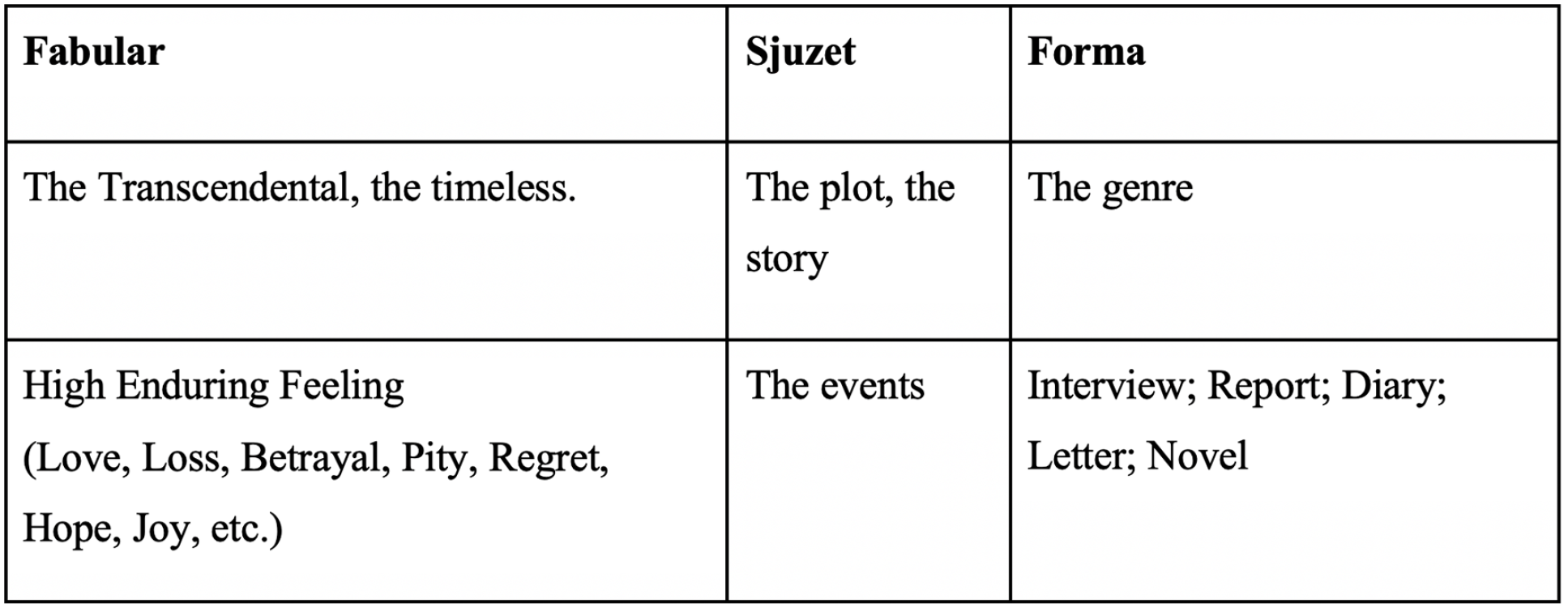
Life as narrative (Bruner, 2004).
Translated to El árbol del amor, and cognisant of the imperative to inspire social imaginaries, we adapted Bruner’s ‘Life as Narrative’ model (2004) to shape our storylistening approach (Figure 2):
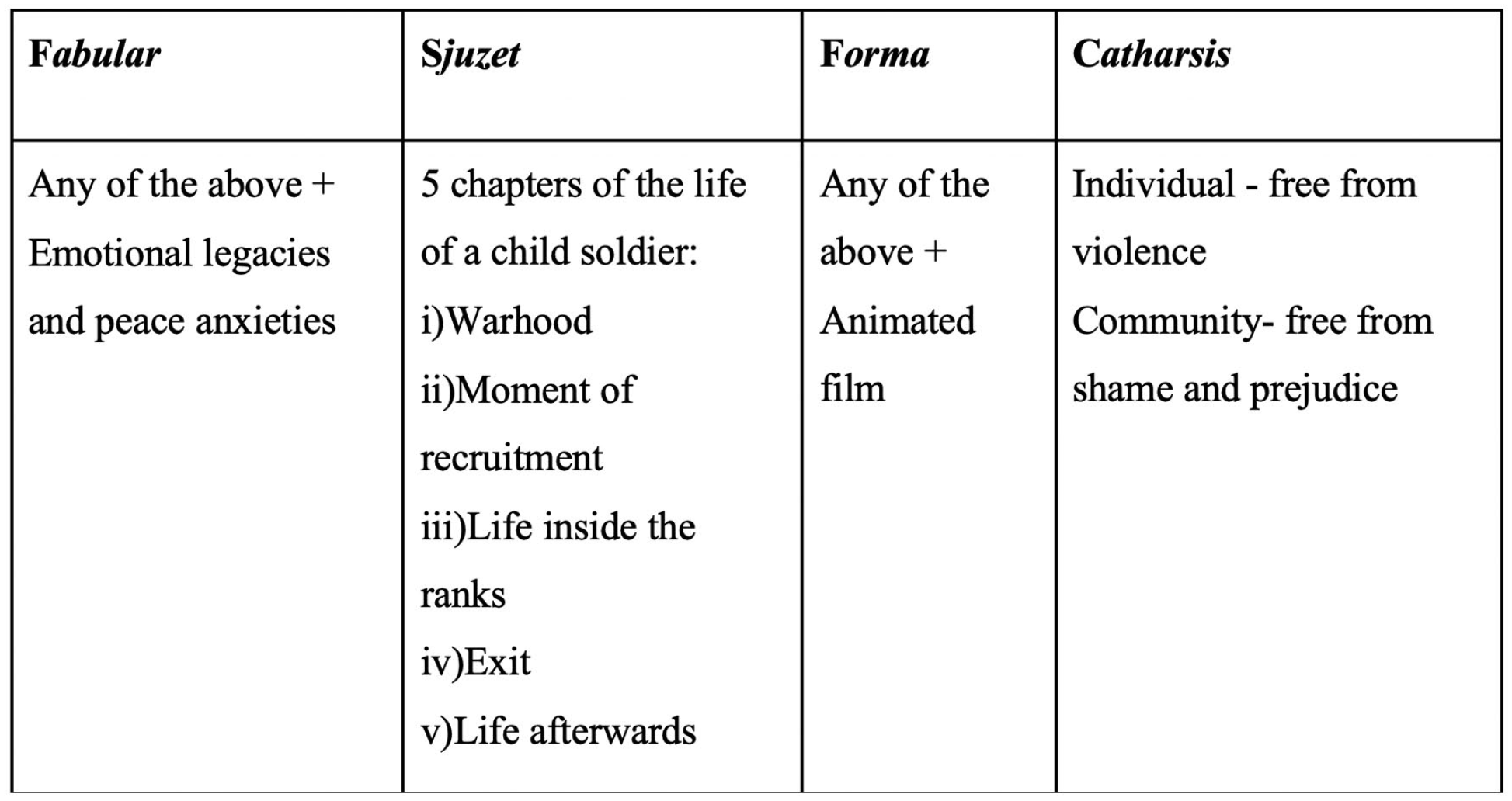
Adapted from Life as narrative (Bruner, 2004).
High enduring feelings, such as love, loss, betrayal, pity, hope, joy and regret might still be present as timeless, transcendental emotions, but within the context of our project, the ‘emotional legacies’ (Nussio, 2012) of ex-combatants and the ‘peace anxieties’ (Charles, 2020) of former child soldiers are also in play. These concerns about identity, jobs and purpose are among the greatest life stresses for many former child soldiers, and indeed ex-combatants in general. Denov and Marchand (2014) highlight what they call ‘constant transitions and adaptations’ as former child soldiers embark upon the reintegration into civilian life.
The events in our project are depicted in the five chapters of the child soldier’s life: (1) their existence in and growing awareness of a violent and conflict-ridden society (their ‘warhood’); (2) the moment of recruitment (involuntary or voluntary); (3) their time as a child soldier (life inside the ranks); (4) the exit from the armed group (calculated or spontaneous); (5) life afterwards (reintegration). In previous research we have identified epiphanic qualities which mark the transitions between each of these chapters (Charles and Fowler-Watt, 2020), but equally important are the spaces in between, which constitute the ‘everyday’ of an individual’s life. This everyday is as eventful as the epiphany.
The narrative style of the project workshops was important in providing a dialogic forum which can encourage young people to organise ‘the episodes of everyday life and this format is likely to embrace episodes that are emotionally charged’ (Harris, 1993: 283). In this sense they gain insights to their emotional lives, which ‘allows the children to make choices about what their emotional lives should be like’ (Harris, 1993: 290–291). Dialogue can also constitute a transformative experience, which supports agency (Shor and Freire, 1987).
The form used to portray their feelings and events might be diary, letter, report, interview, but could be animation or any other creative output. There is also a fourth section in our table: Catharsis. This involves an emotional transformation, for example, the child soldier free from violence and able to imagine a peaceful life in civil society. Likewise, the community narrative attempts to arouse collective catharsis, whereby the whole community is awakened to the experiences of those living in their midst and is able, through mutual understanding and solidarity engendered by storylistening, to move away from the stigmatisation of the former child soldiers. Avoiding the ‘top-down’ concept of development, we are most interested in social transformation, the potential for change. Storylistening enables us to link alternative social imaginaries to the personal and collective process of catharsis that epitomises transformation. The output of the process is less important than the impact, that is, the transformative potential of what we discern to be a grassroots method. Working with these components within the El árbol del amor project, we start to see how the key constituents of narrative inquiry intersect with art and visual representation to produce storylistening.
Storylistening in action
Storylistening operates on three levels: (1) the individual/auto/biographical; (2) the intragenerational (peer-to-peer); and (3) the community (or intergenerational). At the individual/autobiographical level, being listened to fosters and encourages participation, thereby generating catharsis and confidence. At the intragenerational level, defined as peer-to-peer exchanges, storylistening is shaped by shared or non-shared experiences. If the listener and teller share the same or a similar chapter of experience, then, storylistening generates empathy and forms bonds between them. If listener and teller are, however, engaged in an exchange about a non-shared experience, then this conversely generates awareness-raising and a mutual understanding. At community level, which in the case of former child soldiers, might also be conceived as a form of collective intergenerational dialogue, then, storylistening can enlighten and encourage a collective reflection, which not only contributes to a mutual understanding, but in this particular case, it also reduces stigma and fosters reconciliation with former child soldiers, who were perhaps once perceived as the enemy/perpetrator and a threat to social stability (Figure 3).
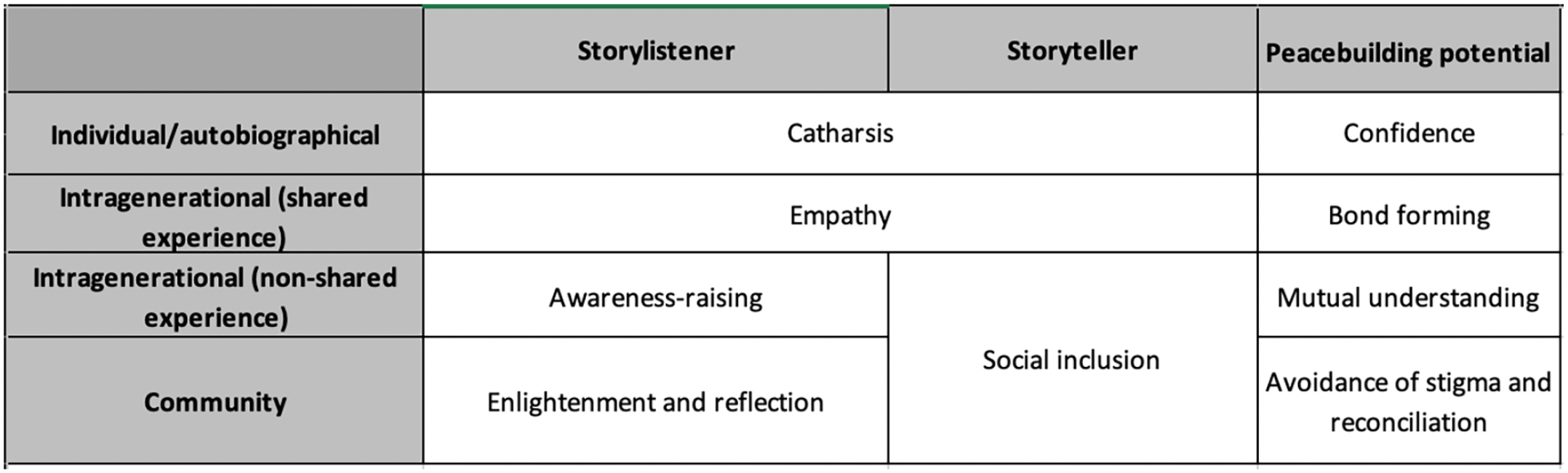
Storylistening.
The Individual/auto/biographical
As A’te states in the animation, ‘life was not fun, and many people didn’t care about us’. With this simple line, the character of A’te articulates the problem facing the research participants, who felt that when previously they had spoken about their experiences, they had not been heard. This is the premise from which the young participants began to engage with our project: From a position of marginalisation shaped by low self-esteem and self-efficacy. As the project progressed, it became evident how the process of sharing their stories had a positive impact on their sense of self and agency, building confidence. As Sek reflects in the final scene of the film: Who would say that the alphabet would have helped me get off my chest all the thoughts that I felt I would never forget? That with words, I would undo them.
In order to tell their stories, the research participants needed to know that they would be listened to, and heard. Through the process of being listened to throughout the project, the storytellers were able to attain catharsis from expressing their lived experiences. The storylisteners were also able to achieve catharsis through understanding that their experiences were shared by others and not isolated. This confidence enabling process released the potential for peacebuilding because it increased self-esteem and self-efficacy, and the young participants felt hopeful about a peaceful future.
The intragenerational level
During the first workshop, the ex-combatants produced a life-size map of their bodies using human cartography or body-mapping methodology (Skop, 2016). They were asked to make links between their bodies and the armed conflict. They were then asked to present their maps to other members of their small group. This was the first time the students revealed their direct experiences of involvement with armed factions. This was not only because the participants had developed more confidence and trust, but it also had something to do with the power of the exercise. It was a very effective way of enabling the participants to draw on particular memories and experiences, without asking them to build a coherent narrative, which was often more of a challenge, especially within the time constraints of the project.
In such circumstances, it is important to acknowledge the story and the contribution. The listener must reflect the courage of the storyteller, who has been brave enough to share their story so we should be brave enough to bear witness by recognising where violence has affected someone’s life. Often this is best done in pairs or very small groups so everyone has a chance to listen to and to talk about the story and through this active process, the storyteller can witness their story being listened to. This awareness of the power of listening was evident in the testimonies of some of the participants: ‘It was great to be able to voice our fears and thoughts’, said one. ‘Nobody has asked us about this before’, said another. And finally, ‘We all know we live with conflict, but we are silent about it. Silence keeps us safe. But what about our mental wellbeing? You have helped us realise we should be talking about this’. The way a group responds after listening to someone’s story can have an enormous effect on the storyteller and the healing process.
There were more than a few tears as students continued to share their personal stories and were able – some for the first time – to really open up about grief, loss, fear and suffering. As researchers immersed in listening, we noticed that as the participants became aware of how intently they were being listened to, they shared more.
Listening to shared experiences
The ‘listener’ can benefit from hearing about someone else’s experiences, which are similar to their own. Listening to others’ stories, allows them to see that others are struggling with similar challenges on a daily basis, perhaps flashbacks, nightmares, the inability to visit a particular place, etc. In relating to others and their stories, the listener may begin to feel less isolated or guilty and start a process of healing and/or catharsis. In the El árbol del amor project, this experience made them feel encouraged to share more and inculcated a growing sense of empathy.
In such supportive groups, the storyteller can benefit from someone listening and bearing witness to their experiences and sharing their burden of hurt and suffering. Storytelling within this listening environment can enable someone to speak their truth for the first time and to recognise the pain with which they have been living. Perpetrators of violence can also gain from storytelling enabling them to voice their actions, how they feel about them and often the pressures they felt they were under at the time. This enables a process of self-reflection, which can induce feelings of shame and guilt, but can also foster and/or strengthen resilience.
In another exercise, participants shared texts with each other that they had written about their experiences as child soldiers. They were asked to check that they were satisfied their contributions were anonymous. They were also asked to verify the details of their stories and given the opportunity to edit and make changes. But their stories had been merged with those of the other participants and they were asked (for the first time) to read aloud texts that had not been written by them. This, surprisingly, provoked another flurry of writing. This illustrated how hearing other people reading our stories can help us see our own experiences from a different perspective. It became clear to us that storylistening can be valuable in comforting those who are mourning the departed or other kinds of loss, but also those who conceal episodes of suffering in general.
The ‘listener’ can hear a story and understand events through someone else’s eyes and ears. The ‘teller’ can benefit from feeling they are not alone; that others have ‘heard’ their experiences. The participants wanted to add more detail. The reading aloud helped them make stronger connections between the individual contributions, which also built empathy. The peacebuilding potential inherent in these intragenerational exchanges was manifested in the bonds formed between storyteller and storylistener; bonds shaped by empathy, appreciation and compassion.
Listening to non-shared experiences
As noted above, one of the most difficult days of the entire project occurred when the former child soldiers came together with children who had not been recruited. It created division in the group. The 10 young animators knew they had been working with ex-combatants, but the level of detail of their pain and suffering was shocking. The five ex-combatants entered the room with hesitation. They sat apart from the other participants. They were apprehensive. The others had been warned that what they were about to hear would not be comfortable, but that the story included elements from everyone’s contributions, including those who were not directly involved with the guerrillas. As facilitators, we had to intervene to bring people physically closer together in the space to listen to the stories, which formed the basis of the script for the film. We created a literary circle and each of us read two sentences. As each person read, they reacted to the text. Some paused. Some gasped. Some even cried.
After we had read the script, we asked for feedback, but were met with complete silence. Despite our efforts to encourage participation with questions and comments of our own, it was clear the strategy was not working. Instead, we decided to finish early to give participants the chance to digest what they had heard and we played games.
The ‘listener’ can gain from hearing stories from other people, which are very different from their own (non-shared experiences). This can help people to see the different perspectives in a conflict, sometimes even encouraging them to realise the impact of their own actions. This growing awareness engenders mutual understanding that forms the basis of a community narrative, essential to peacebuilding.
The community level
I also wish that through these narratives, children or adults from different places will understand what we live through, and that they won’t judge us – A’te.
The young people carefully constructed a narrative based on their own personal experiences in order to be heard. They want their families, their communities and even their country to understand what they have been through, and hope that by understanding such suffering, those with power to wage war will instead seek peace.
For former child soldiers, a feeling or perception of being judged can have devastating consequences. Research has shown how the stigmatisation of ex-combatants can fuel feelings of self-isolation and ultimately recidivism (Denov and Marchand, 2014; Martuscelli and Villa, 2018).
The film aims to question the stigma that often follows former child soldiers through the construction of a community narrative, which invites the community to listen to these experiences. As the film illustrates, the community can be partially responsible for a child’s decision to join an armed group: Many cannot stand problems with their parents at home. When they [have get-togethers] here, some dads get drunk and they hit our mums, And that’s why some of us get fed up and leave (A’te).
On a wider level, the state can also be responsible for failing to provide the security required to protect children and young people from feeling as if they need to join armed groups: I just want to move forward, have a profession or also what other children want, but sometimes the government does not care about us. I wish they supported us by sending us teachers, who understand the situation we are living in so that they encourage us and do not demotivate us (A’te).
Therefore, the animation invites the community to hold up a mirror to itself and to reflect on its actions, its complicity and its responsibilities.
After a screening in the community, residents described how they felt ‘sympathy’, ‘understanding’, and ‘remorse’. The animation transformed perceptions of former child soldiers from ‘evil’ and ‘selfish’ to ‘victims’, ‘helpless’, and ‘lost’. This emergent community narrative is a cornerstone of peacebuilding that is ‘bottom-up’ (MacGinty, 2014), but whilst community narratives are acknowledged as essential to peacebuilding by Ripley (2009), there has been insufficient explanation of what constitutes such narratives. For us, they are defined as narratives, which set out to:
(1) include a wide range of equal voices;
(2) deconstruct polarisation and over-simplified dichotomies of victim and perpetrator;
(3) understand how conflict, violence and suffering has affected the community;
(4) promote understanding through the identification of the structural causes of violence;
(5) work to actively change the status quo.
Importantly, community narratives are not only constructed, but are also shared and received through the process of storylistening, connecting the autobiographical to the community and wider society through the inclusion of marginalised voices and experiences. Storylistening, which is founded upon the sharing of and learning from experience, can therefore:
(1) create spaces and tools in which the marginalised can share their stories, be listened to and heard;
(2) challenge people to question stigmatisation, to avoid inflicting shame and guilt through showing the complexities of child soldiering;
(3) build mutual understanding, empathy and trust;
(4) encourage reflection at an individual and collective level to identify individual and collective responsibilities;
(5) promote reconciliation and peacebuilding.
The lead animator of El árbol del amor, Albao (2019), found the young Nasa participants ‘so open with their stories, with their relationship with their culture, with their land . . . with their dreams, their expectations’. This imperative to share chimes with Durkheimian notions of emotional sharing and the work of Rimé, cited above and which underlines the relationship between the individual and collective within the process of sharing emotional experiences. Through the construction of a community narrative based on their lives, the young participants are sharing their private emotional experiences. Christophe and Rime (1997) have concluded that such emotional sharing creates interpersonal dynamics or ‘emotional fusion’. An emotional experience elicits its sharing, its sharing arouses emotion among social targets, and social targets propagate the sharing of the experience, creating ‘emotional climates’ (Rimé, 2007: 308) within which social bonds are formed. These climates exist apart from an individual’s personal feelings, but often ‘result from objective facts that create shared experiences’ (Rimé, 2007: 318). The social sharing of emotions therefore builds interpersonal empathy; increases social cohesion; reconstructs positive social beliefs; and has long term implications for collective memory (Rimé, 2007: 319).
This series of ‘chain reactions’ (Rimé, 2007: 318) sparked by the process of sharing in the shape of storylistening forms ‘micro-solidarities’ (Richmond, 2013) and underpins ‘everyday diplomacy’ (MacGinty, 2014) through its ‘more humane and bottom-up profile’ (p. 560). In the context of El árbol del amor, this grassroots ‘peace formation’ (Richmond, 2013) constructs and consolidates shared knowledge about child soldiering and children’s experiences of conflict, as well as people’s emotional responses to it (Rimé, 2007: 319) in order to tackle the stigma attached to ex-combatants, in particular. This active peacebuilding through education and enhanced self-awareness plays a key role in conflict transformation (Lederach, 1995). If engaged in a process of conflict transformation, individuals and communities gain a deeper understanding of themselves, the other, and the factors that provoke and sustain conflict.
Conclusion
We do not intend to overstate the potential for storylistening as a peacebuilding methodology, but in the context of El árbol del amor, it was highly effective, to the extent that we have employed it in other participatory peacebuilding projects. It is the transformative potential of storylistening outlined in detail above that is most striking, as the young people developed confidence through being listened to: There was a lot of stuff I never talked about because I thought nobody was interested. When I noticed people would listen, I spoke more. It made me feel safer and better (an anonymous participant, 15-years-old).
Their participation in the project was so life-changing for the participants, that they felt impelled to share their message of peace with the wider world, feelings expressed by A’te in the film: . . .that with this story, those who make war will listen to us.
The voices of the participants were heard beyond the workshops and the film when they screened it, firstly in their own community, where the head teacher made the observations about young people not being listened to, noted above and secondly at the Truth Commission in Bogota in September 2019. Here, El árbol del amor was accepted as the first audio/visual testimony by the Commission. In a moving address, one of the young animators spoke of his pride and even disbelief that as an indigenous young man his voice and his story had been heard and was being included in the country’s official narrative of more than 50 years of conflict.
Creative methods have become known for the affordances they bring to the process of the co-creation of knowledge (Veale, 2005). Storylistening in particular creates an immersive, equitable space in which individuals’ autobiographical narratives are voiced, listened to and heard, which in chorus forge social bonds and inclusion that can inspire change. For the individual, storylistening offers the potential of catharsis, while for the community, it offers the opportunity for collective reflection. In the particular case of child soldiers, storylistening engenders effective reintegration and more broadly fosters reconciliation, which underpins everyday peacebuilding at the community level.
Footnotes
Declaration of conflicting interests
The author(s) declared no potential conflicts of interest with respect to the research, authorship, and/or publication of this article.
Funding
The author(s) disclosed receipt of the following financial support for the research, authorship, and/or publication of this article: The research was supported by Bournemouth University’s block grant from the Global Challenges Research Fund (GCRF).
