



Abstract
Securing sustainable and just transition pathways in cities is recognised as key to addressing global environmental challenges. There is increasing acceptance that transformative change in cities must be shaped by the co-production of knowledge between diverse partners. The creation of spaces of collaboration, referred to in the literature as ‘third spaces’, is integral to such co-production of knowledge. However, evidence to support a direct relationship between third spaces of engagement and securing urban transformation is largely undocumented. This paper deepens and develops the idea of shared spaces for knowledge co-production by drawing on the experiences of City officials and PhD researchers in a City-University knowledge partnership in Cape Town. It uses the data to critique the third space for its limited engagement with how the relationship between individual knowledge brokers and their home institutions effects change. The findings of the paper show that, despite the benefits of boundary crossing between the academy and practice, such crossings also leave individuals peripheralised from their ‘home’ institutions. This disconnect and sense of ‘homelessness’ limits the potential of co-production to affect urban transformation. To address the conceptual lacunae of the third space, I develop the idea of the portal to reflect the dynamic exchange required between individuals and their home institutions for realising relevant change. The form of the portal is not spatially bound, but reflects dynamic processes of entering and exiting sites of knowledge exchange to secure a sense of belonging. By highlighting the need to include processes for anchoring institutional learning, the concept of portals for knowledge exchange offers additional scope for securing urban transformation.
Introduction: Ambiguous spaces for co-producing urban knowledge
Supported by global and local policy architectures, cities across the world are putting in place measures to address sustainability challenges in ways that are just and equitable. The need for processes supporting urban change to be context-specific is complicated by the tension presented by cities that are simultaneously centres of consumption and production (Satterthwaite and Dodman, 2013) and sites of innovation and creativity. Harnessing the potential of cities to steer global sustainability transitions requires non-linear approaches to problem solving, as the complexity of urban challenges falls within the categorisation of ‘wicked problems’ (Rittel, 1972). Against this backdrop, the co-production of knowledge is increasingly accepted as an appropriate model of knowledge production in the face of mounting urban complexity and uncertainty (Klein, 2013; Polk, 2015; Scott et al., 2019).
The co-production of knowledge requires an exchange between partners. Central to this exchange is the creation of sites for producing alternative knowledge pathways. The generative and catalytic potential of these spaces, variously referred to as third- and reflective-spaces (Bhabha, 1994; Scott et al., 2019), has been celebrated for its promotion of transfer, exchange and transformation. The transformative potential of these liminal spaces to shape transitions lies in their promise to bridge between ‘what was’ and the ‘next’ (Akkerman and Bakker, 2011). The value of crossing boundaries between the academy and practice is premised on material changes, measured through sustainability indicators, numbers of outputs including publications and policy briefs and instruments, as well as other benefits that include achieving social relevance in ways that improve research inquiry and practice through the democratisation of science (Oldfield and Patel, 2016).
However, despite the focus on designing processes of engagement to facilitate knowledge co-production, evidence to support a causal relationship between ‘third spaces’ and securing urban transformation is largely undocumented. Furthermore, whilst the creation of virtual spaces of collaboration is fast becoming staple practice in knowledge co-production, there are also cautions that boundary crossing can leave individuals peripheralised from their ‘home’ institutions. The relationship between individual gains and the institutional shifts required to act on alternate insights is not direct or confined to spaces of engagement. While the focus on bringing knowledge partners together in collaborative processes is necessary, it is insufficient to secure transformative shifts. It is therefore necessary to critique the emphasis placed on the third space as the productive point of convergence between knowledge partners given its limited concern with the relationship between individual knowledge brokers and their home institutions as a condition for effecting change.
This paper is concerned with the implications of this loss of a sense of ‘belonging’ (May and Perry, 2011) or state of ‘homelessness’ (Polk, 2019), among boundary crossers for the potential of co-production exchanges in meeting the goals of urban transformation. Given the implications of these potential pitfalls for realising change, the paper deepens and develops the idea of shared spaces for knowledge co-production through introducing the idea of the portal. The paper offers a critical engagement with spaces of engagement by drawing on a City-University knowledge partnership in Cape Town known as the Knowledge Transfer Programme (KTP).
The argument of the paper is built by focussing first on the conceptual underpinnings of spaces of engagement and the assumed role(s) these spaces have for boundary crossing. These assumptions are discussed in the first section. The KTP is then introduced in detail and the methods for collecting data explored. ‘Findings’ presents the boundary crossing experiences of the KTP PhD researchers and City officials over a 3-year period to characterise the features of shared spaces, and to provide evidence of the simultaneously generative and dislocating effects resulting from engaging across institutional divides. The findings allow me, in the discussion section that follows, to critique the heuristic concept of the third space, whilst offering an alternate conceptualisation of spaces of engagement as portals of knowledge exchange based on asymmetric reciprocity.
Spaces of engagement: Assumptions and representations
Responding to evidence that current institutional practices shaping urban transitions are inadequate for effecting sustainable urban change (Polk and Kain, 2016), collaborative research partnering in new knowledge configurations is becoming well-established. As part of this ‘collaborative shift’ (Bennett and Brunner, 2022), urban actors, including universities and local authorities, are increasingly partnering to jointly deliver on sustainability transitions. Collaborative approaches, informed by traditions of participative action research, are shaping urban experiments with diverse knowledge partners including university-based researchers and City officials. Linking scientific knowledge production with policy processes focused on meeting societal goals requires reconceptualising the ‘rules of the game’ by crossing institutional boundaries to co-produce knowledge. These shifts are characterised as a move away from mode 1 discipline-based approaches to mode 2 knowledge which is argued to be more socially relevant, requiring collaboration across disciplines, and with diverse knowledge actors (Gibbons et al., 1994; Hessels and Van Lente, 2008). The conventional science-policy interface is disrupted in the process of linking scientific knowledge production to societal problem solving. However, Williams and Robinson (2020) question the assumptions that Sustainability Transition Experiments (STEs) will necessarily lead, as a result of societal effects, to sustainability transitions. They call for more careful attention to be paid to evaluating these claims, by understanding what is happening within transition processes. After exploring the dynamics of knowledge co-production and boundary crossing below, I look at some of the limitations of the third space concept.
Knowledge co-production between diverse knowledge communities is increasingly advocated in research processes based on the assumption that new knowledge production practices will yield outcomes that serve society (Lang et al., 2012; Patel et al., 2017; Perry et al., 2018; Polk and Kain, 2016). Indeed, some have argued that co-production of knowledge between academic and non-academic communities is a pre-requisite for research aimed at more sustainable development pathways (Pohl et al., 2010). The value added by co-producing knowledge through ‘the integration of the best available knowledge, reconciling values and preferences, as well as creating ownership for problems and solution options’ (Lang et al., 2012: 25) amongst diverse urban actors marks a departure from conventional research (Roux et al., 2017).
Whilst the shift to co-producing urban knowledge between universities and other knowledge brokers is a contemporary frame in applied urban studies, collaborative research is by no means new. Three of these collaborative traditions are of relevance here. First, action research on real world problems involves close exchanges with practitioners or citizens focused on all stages of the research process following a reflective ‘action-research cycle’ (Bennett and Brunner, 2022: 3). New social structures and relationships are created in the research process. Acknowledging asymmetric power relations between research partners based on knowledge hierarchies results in action researchers engaging in questions of positionality, ethics, influence and relational research skills (Bennett and Brunner, 2022). Second, collaborative research traditions are closely aligned with the purpose of social reform, deliberately engaging ‘those who study social problems and issues (researchers) and those who act on or within those social problems (decision-makers, practitioners, citizens)’ (Denis and Lomas, 2003 in Bennett and Brunner, 2022: 76). Reflection based on evidence for the purpose of social change is a central practice in collaborative research. Collaborative research is typically underpinned by normative theories of empowerment and social change, and is therefore well suited to research aimed at co-producing knowledge for sustainable and just futures (Polk, 2016). Third, transdisciplinary co-production similarly has collaboration at its core. There are a breadth of transdisciplinary approaches, ranging from the ethical, metaphysical and mystical perspectives (Nicolescu, 2012) to research aimed at designing solutions to real world problems (Nowotny et al., 2001). The collaborative influence for this paper lies in the latter – collaborations to find solutions to complex societal problems – using interdisciplinary approaches with rather than for society (Swilling, 2014).
In the transdisciplinary tradition, the establishment of shared spaces is regarded as the foundation or prerequisite for bringing diverse knowledge partners together to co-produce alternate responses to complex urban challenges (Hessels and Van Lente, 2008; Klein, 2013; Polk, 2015). Knowledge partners move from their home spaces to occupy ‘neutral’ spaces where they can collaborate and construct new hybrid meanings that would not otherwise be possible. These spaces also function to reconfigure power relations embedded in traditional systems of knowledge production. Breaking with the dominant mode of expert scientists and academics transferring knowledge to policy makers for use in evidence-based policymaking is the basis for socially relevant and applied approaches to contemporary problem-solving (Gibbons et al., 1994; Hessels and Van Lente, 2008; Nowotny et al., 2001). By opening the production of knowledge to shape urban futures, all knowledges are considered indispensable and legitimate (Polk, 2016) in shaping solutions that are both implementable and socially relevant. Shared spaces therefore have a third dimension, which is to navigate the politics of reconfiguring power relations that are entrenched in the different mandates, disciplinary and institutional practices that provide knowledge brokers with their distinctive identities.
The third space, put forward by cultural theorist Bhabha (1994), is a means of thinking critically about hybrid identifications across cultural boundaries. The place and activity of collaboration are foregrounded through this heuristic, where the third space acts as an ambiguous or liminal area that develops when two or more cultures interact. The location of knowledge production has the potential to foster the reconfiguring of different viewpoints (Klein, 2013), which in turn can lead to innovations and transformation. The significance of the ‘place’ of exchange is further emphasised by Nonaka and Konno (1998: 40), who use the Japanese concept of ‘Ba’ to highlight ‘shared space for emerging relationships’. The significance of ba is that it provides a platform for advancing individual and/or collective knowledge. Like the third space, collaboration in ba is a combination of physical (e.g. office space), virtual (e.g. e-mail, Zoom) and mental exchanges (e.g. shared experiences, ideas, ideals) (Nonaka and Konno, 1998).
Knowledge and spatial boundaries are precisely what give different knowledge brokers their distinctiveness and identity. As such, boundaries constitute socio-cultural differences between knowledge partners (Akkerman and Bakker, 2011). In the case of knowledge exchange between academics and policy makers, academics typically frame their understandings of urban processes and dynamics through theory. The approach is generally one of building on the ideas of others, through cerebral rather than experiential engagement. The hegemony of Northern theory adds a further layer to the structural power imbalances that knowledge co-production for cities of the South must address (Watson, 2009). Literature on urban transitions, for example, is largely devoid of engaging with transitions within and from a baseline of informality and deep inequality in access to infrastructure. Against this backdrop, new knowledge insights are required to ensure that scholarship and theory building are not disconnected from contextual realities. The increasing strategic focus on social responsiveness and engaged scholarship described as the ‘third mission’ of universities, provides further impetus to diversify sites and partners in producing new knowledge (Perry and May, 2006; Swilling, 2014). City practitioners on the other hand, operate in a practice-based context, constrained by policy and institutional processes and mandates. The approach is generally one of contributing to practical interventions aimed at changing the material world (Scott et al., 2019). These contributions and practices are, however, politically filtered and motivated, and enacted in a hierarchical space in which practitioners are not mandated to exercise a critical voice (Scott et al., 2019). When knowledge partners come together in the third space, they bring with them these different factors shaping their knowledge worlds and practices.
In the cases of both academics and practitioners, it is individuals who cross boundaries and enter spaces of reflection and liminality. Individuals enter into territory with which they are unfamiliar in the process of boundary crossing, in order to negotiate and combine ingredients to achieve hybrid perspectives (Akkerman and Bakker, 2011). The crossing-over of individuals requires them to navigate these sociocultural differences whilst transcending disciplinary and institutional perspectives and approaches that define the boundary (Nonaka and Konno, 1998). These individuals, variously referred to as knowledge brokers, boundary crossers and boundary workers, have the simultaneous task of ‘building bridges’ between both worlds; at the same time, they are held accountable in each world and must endure criticism (Akkerman and Bakker, 2011). This dual role presents a tension and highlights the ambiguity of boundaries. The shared nature of boundaries in the process of knowledge exchange leads to ambiguity in which the boundary of knowledge can either belong to both epistemic worlds or it could reflect a nobody’s land, belonging to neither one nor the other world. This ambivalence causes what Akkerman and Bakker (2011) refer to as a ‘sandwich effect’ for people and objects crossing sites. In this process, the individuals simultaneously ‘enact the boundary’ whilst moving beyond the boundary. Individuals occupy multiple conflicting roles, navigating between bridging worlds whilst representing the very division (or boundary) between the related worlds.
Boundaries consequently simultaneously hold the roles of maintaining continuity and discontinuity. Boundaries have been described as ‘delicate’ due to the tension between the explicit boundaries used to demarcate expertise in contexts of increasing disciplinary and practice specialisation; and the need to avoid fragmentation and foster continuity between collaborators (Akkerman and Bakker, 2011). The mental work of shared spaces is this tension between continuity and discontinuity in maintaining the socio-cultural identity of knowledge partners. Engagement at the boundary, then, is a process of establishing continuity in a situation of socio-cultural difference. Although it is assumed that the tension at the boundary between continuity and discontinuity and maintaining the socio-cultural identity of knowledge partners can be overcome in a neutral third space, where no domain is dominant, there is increasing evidence that third spaces can be sites of contestation and conflict (Anderson et al., 2013; Polk, 2016).
The liminal and ambiguous nature of the work within collaborative spaces challenges the socio-cultural knowledge identity of individuals, resulting in a state of ‘sort of belonging and sort of don’t’ (Akkerman and Bakker, 2011: 140). This ambiguous role can lead to conflicted narratives on the one hand, and on the other, run the risk of individuals being peripheralised, never fully belonging to or being accepted by either knowledge community. Whilst the assumptions and representations of boundary crossing reflect the ambiguous nature of exchange, the third space is assumed to have the potential to resolve and neutralise these cultural differences.
To address the deficiencies of the third space concept, I introduce the idea of portals. Portals are understood as apertures variously created by knowledge partners, which allow them to navigate out of their home institutions. Through a portal navigation, which often takes the form of an exchange, alternate ways of knowing and doing are revealed. The portal then channels partners back to the home institutions where they find points of leverage to anchor and act on new insights. Partners need to be supported to do the work of finding points of leverage and resonance in their home institutions to give new insights traction. Furthermore, to maintain institutional relevance, partners must engage differently to one another. The politics of exchange between knowledge partners co-producing alternate pathways is conceptualised here as a practice of asymmetric reciprocity. Rethinking exchange guided by purpose and process foregrounds the important deliberate but overlooked work required to support individuals to engage with institutional structures. It follows therefore that realising relevant outcomes, and fostering urban change, cannot be separated from engaging with how relevance is defined and negotiated in different contexts. It is the work beyond the collaborative space that is key to ensuring that the knowledge gains embodied in individuals through co-production exchanges are transferred to affect context-responsive urban transformations.
In order to engage more deeply with the tensions of boundary crossing, and the limits and potential of collaborative spaces in navigating these tensions, the ‘findings’ section of this paper now draws on the experiences of the KTP City officials and PhD researchers.
Methodology: Experimenting with City-University knowledge exchange in Cape Town
The KTP was the flagship project of the Cape Town platform of an international programme, Mistra Urban Futures, 1 which pioneered the use of co-production approaches to generate new urban knowledges. The formation of spaces for knowledge exchange across the university and the local authority were formalised through a Memorandum of Understanding. The project was governed through a Project Steering Group and an Advisory Group, each constituted and led equally by University and City partners. These governance mechanisms supported the embedded PhD researchers in the City of Cape Town (CCT) departments, and city officials who spent time at the University of Cape Town (UCT) on writing sabbaticals. As such, the spaces in which individual brokers engaged with knowledge partners was radically altered.
A distinctive feature of the first phase of the KTP (2012–2016) saw academics from the UCT and City officials from the CCT crossing knowledge and institutional boundaries through embedded research configurations to shape alternate contributions to scholarship and practices of urban change. Boundary crossing and the creation of spaces of exchange were the primary knowledge co-production practices (Hemström et al., 2021). These exchanges were premised on diversifying and deepening knowledge engagements that generate new insights to inform scholarship and to ensure decision-making is evidence-based, transparent and legitimate.
The first phase of the KTP included four PhD researchers working closely with City counterparts embedded in City departments focussing on four policy areas: climate adaptation, energy governance, the green economy and the space economy. These knowledge arrangements crossed institutional boundaries, with researchers spending 7 months per year over 3 years physically situated in local authority departments, providing opportunities for the development of alternate robust and relevant policy responses whilst generating new insights into the inner workings of local government. In a reciprocal knowledge exchange, over two dozen City officials earned 2 months writing sabbaticals away from the City, based at the university. The first two cohorts of City officials in 2013 and 2014 were paired with academics at UCT to co-author academic journal articles on issues of relevance to policy and practice; and in 2015, on the request of City partners, the writing output was an edited book on Climate Change in Cape Town (Scott et al., 2019). These publications resulted in increasing the legibility of policy endeavours, whilst situating local policy experiences and innovations in a much broader context and set of debates.
The KTP deployed the concept of the third space as a heuristic concept to envisage academics and practitioners moving from their ‘home spaces’ into ‘in-between’ or ‘liminal’ space (Scott et al., 2019) (Figure 1). In the KTP, the third space concept informed the creation of a space in which knowledge partners could engage, where no domain is dominant, and where knowledge partners could collaborate in a neutral site. The first and second home spaces of academia and the city of Cape Town were transcended, by physically moving into different spaces, and also through the use of boundary objects. City officials, for example, co-authored and published academic papers with UCT academics, and PhD students produced policy tools with City officials. Whilst engaging in the third space, individuals still belonged to their home space, but occupied space across institutional boundaries too.
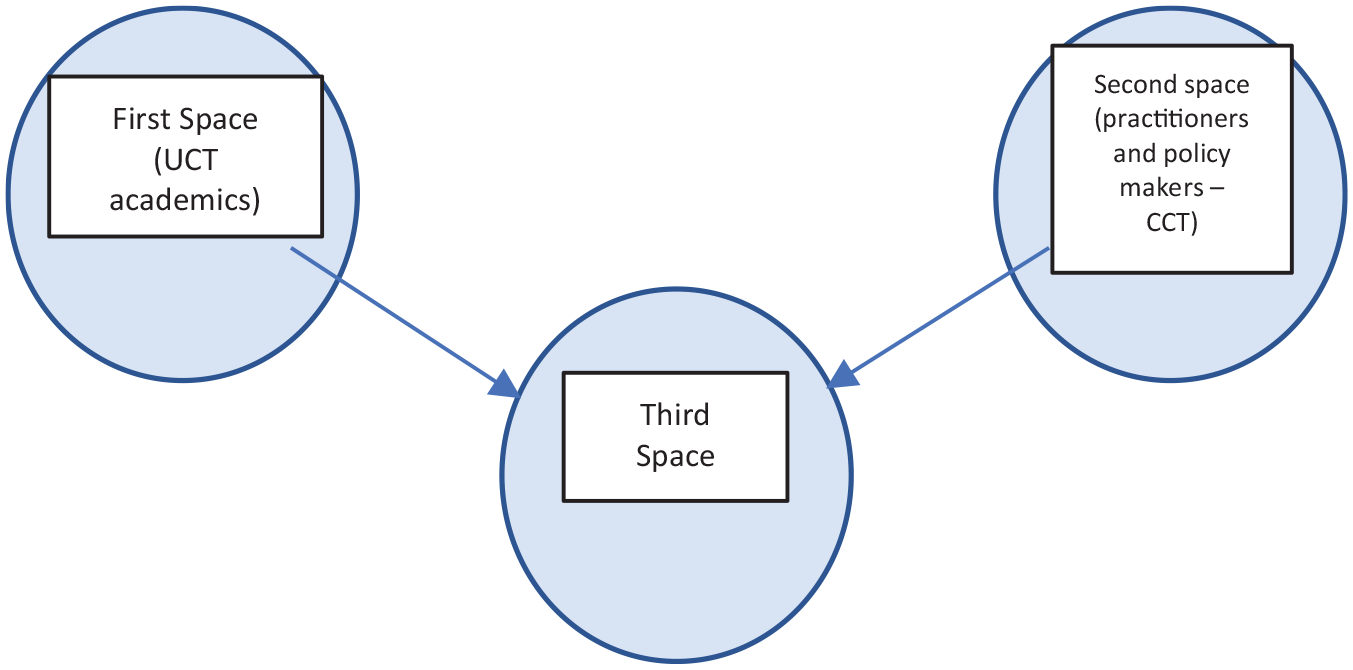
Schematic representation of the ‘home spaces’ of academics (first space) and City officials (second space), and the third space where they produced knowledge together (from Scott et al., 2019).
The design of the KTP was based on the assumption that for urban policy to be more robust, broader knowledge (generated beyond the confines of the local authority) must contribute fruitfully to policy development and decision-making processes within the city; similarly, the relevance and rigour of academic scholarship is dependent on deeper engagement with practitioner expertise. Embedded spaces of collaboration straddled the researcher-practitioner divide, with individuals physically moving into different institutional contexts for elongated periods to jointly explore new sustainable urban transition pathways. These productive points of convergence between the academy and City officials moving out of their home spaces into a third space were described by Scott et al. (2019) in a heuristic model not dissimilar to other globally accepted depictions of virtual collaborative spaces. The KTP approach to knowledge co-production was to create a joint third space as the focal point for generating new insights.
By thinking through the potential and pitfalls of collaborative exchange in the KTP, the relationship between knowledge production between individuals and the ‘reception’ of knowledge at the institutional level becomes visible. Insights from individual boundary crossers are used to further develop the heuristic concept of the third space, previously used to describe the movement of academics and practitioners in Cape Town from the ‘home spaces’ into virtual ‘hybrid space’ or ‘in between space’ (as described by Scott et al., 2019).
The experiences of City officials and PhD researchers who participated in the first phase of the KTP (2012–2015) were documented through a range of mechanisms including unpublished reports from a series of three facilitated reflection workshops (Soal, 2012, 2014, 2015); minutes of project team meetings; summative evaluations presented by the researchers in monthly progress reports; annual progress interviews with the researchers, and written evaluations with City officials at the end of each cycle (City Officials Exchange Evaluation 2013, 2014, 2015). This grey literature is drawn on to provide an experience-based account of boundary crossing and occupying spaces of engagement – what happens in them, and to what effect. As the KTP coordinator, I had direct access to the researchers and officials, as well as to the grey literature that informs the findings presented below. Whilst concerns could be raised regarding bias, of greater significance is the relationship of trust that was built up between myself and researchers and City officials alike, which resulted in open and often heart-felt responses.
In the following section, the accounts of City officials and researchers of their experience of occupying third spaces of engagement are presented in four themes. First, the description of the material and experiential dimensions of how shared spaces of engagement were constructed and governed is presented. Understanding structure provides a basis for engaging with how power is distributed, as well as the potential of the structure to support exchange. The focus then shifts to providing an account of the experience of boundary crossing city officials and researchers, demonstrating the potentials and pitfalls of occupying shared spaces (productive and fraught spaces). Finally, insights on the implications of the ambiguous nature of shared spaces for realising the objective of urban transformation, or realising relevant outcomes through knowledge co-production are detailed.
Findings: Shared, productive and fraught spaces to realise relevance
Shared spaces
Both researchers and officials indicated that their physical presence across institutional boundaries provided opportunities to access knowledge and data in their relevant focus areas. For the researchers, having office space alongside City official counterparts in operational departments meant that researchers were integrated into local authority systems, with access to city infrastructures including meetings, data, fora, etc. Researchers explained, access to ‘the City IT systems with documents, calendars and emails made a huge difference in terms of collecting the relevant data. . .’ (RW_ER2, 2015). Researchers reflected that this positioning provided the opportunity to access ‘in-depth, rich empirical data and knowledge’ (RW_ER4, 2015), that would not have been possible as a ‘normal’ PhD researcher. City officials similarly valued the opportunity to deepen their knowledge through immersion in academic systems, including ‘access to the library, and time to read relevant literature, evaluate and internalise knowledge and information on topics of interest’ (COEFF_C4, 2013). Officials also expressed the value of being ‘exposed to academic peers and seminars to further grow my knowledge’ (COEEF_C5, 2013). Being present in a different space therefore provided opportunities to access knowledge and data in relevant focus areas as well as an immersion in knowledge cultures across institutional divides.
In addition to the physical benefits of being in a different space, the process of boundary crossing also facilitated a mental shift for participants. Feedback from the City Officials Exchange over 3 years consistently showed that ‘dedicated and extended time away from the Council environment was essential to the success of the programme’ (COEEF_C6, 2015). Officials expressed relief over having a ‘block of protected time to work and think without interruption’ (COEEF_C2, 2013). The ability to reflect and ‘to be able to step back from day-to-day operational urban planning and look at overall trends’ was highlighted by another official (COEEF_C6, 2015). The value of being based at an academic institution ‘created a space to focus on the subject at hand, rather than responding to a myriad daily of urgent requests’ (COEEF_C7, 2015). Being freed of the daily rhythm and pressures of being in their ‘home’ spaces allowed for new ways of thinking and being for officials. The researchers highlighted the added fluidity and access they were afforded as they were ‘. . .able to move freely between departments and stakeholders, to work across different scales of intervention and to be free from bureaucratic functions of an official’ (RW_ER4, 2015). Embedded researchers were described as ‘institutional butterflies’ due to their ability to transcend the formal structures, outside the confines of City hierarchies. These alternate modes of engagement facilitated shifts in their own mental models and ways of thinking, as well as those of a larger footprint of officials in CCT structures with whom they were able to engage.
Boundary crossing out of ‘home’ institutions and into third spaces was experienced as more than a spatial shift from one institution to another. It was also a process of ‘moving between reflection, theory, action and practice. . .mimicking a “moving in and out of the field”’ (RW_ER3, 2015). These spaces are therefore defined as having physical, virtual and mental dimensions. Both groups transcending boundaries found being in a new space to be generative and freeing from the confines of their institutions. The stimulation offered by being immersed provided new insights for officials and researchers alike.
Productive spaces
In addition to the physical and conceptual benefits of boundary crossing, a number of tangible outputs were produced. The PhD researchers produced PhDs and academic publications (12 peer-reviewed journal articles), as well as operational editorials (3), policy documents, decision making tools, blogs (9), discussion papers, news items (30) and workshop and seminar presentations (33). One of the researchers (PD_ER1, 2015) indicated at a panel discussion in 2015 that ‘the researcher’s first responsibility. . .is the production of knowledge products – journal papers, conceptual frameworks, discussions papers, operational editorials, amongst others’. In addition, the researchers co-produced policy-related outputs with their City counterparts, including ‘compiling memos for politicians and senior officials, and advising on and co-authoring policy outputs’, contributions which had a significant role to play in CCT projects and processes (PD_ER1, 2015). Between the City officials, over 20 peer reviewed journal articles and an edited volume (Scott et al., 2019) were co-written with academic knowledge partners.
In addition to the quantity of outputs, researchers and officials also highlighted the depth and quality of knowledge produced. The quality of the data gained through ‘iterative and immersive’ embedded processes was highlighted by one of the researchers who contrasted the process with the thin data gleaned from a ‘one hour clip board interview’ (I_ER1, 2014). Reflecting on the process of co-writing with officials, urban scholars at UCT also highlighted the rich and nuanced insights on city processes yielded through this direct engagement with officials over an extended period (COEEF_A1, 2015). The research potential of co-writing as a method for engaging at the science-policy interface was compelling.
Crossing boundaries resulted in non-tangible and unexpected gains for both institutions. The KTP provided an unprecedented opportunity to surface tacit knowledge shaping decision-making (which is often at odds with the evidence at hand). ‘The KTP allowed for insight into the assumptions that inform decision making in Cape Town. . . it is often the hidden assumptions that prove most influential. . . the beauty of the KTP was that it provided the opportunity to elicit and engage these assumptions, both those held by academics and City of Cape Town officials’ (RW_ER1, 2015). Deeper insights into ‘how local government practitioners work’ (City Officials Feedback, DC, 2015) and ‘an increased understanding of the City’s broader responsibilities’ (COEEF_A3, 2015) gave researchers alternate insights into where the levers for change lie.
Officials highlighted the increased capacity yields that resulted from the programme. Skills highlighted included scientific writing skills, contribution to literature and debates and ‘panel beating my thinking and developing new thinking approaches’ (COEEF_C1, 2013). In addition to these skills, ‘the impact. . . has been exceptionally positive with reports of increased confidence and perspective. . . and to hold strategic intent with greater focus and assurance’ (Soal, 2014:10). Officials reported that they found it ‘empowering’ (COEEF_C2, 2013), with some leveraging this newfound confidence and validation to apply for postgraduate studies and/or to present their research at international conferences. This increased mobility has resulted in the programme being described as ‘. . .“unprecedented” in the CCT’s existing staff development processes and seen as a rare and valuable space for senior officials to engage in professional development in a way that is appropriate to their experience and circumstances’ (Soal, 2014: 11).
Further to the opportunities the KTP provided for learning, researchers and officials reported on the value of the programme for building networks. In some cases, existing networks were strengthened, whilst in others, new networks were formed. In addition to building networks across city departments (siloes) the anchor with City projects gave the researchers the credibility and legitimacy to reach beyond the local authority in leveraging and building networks of stakeholders with relevance to specific policy areas (RW_ER2, 2015). City officials on the exchange programme valued the building of networks with academics, as these opened opportunities to new discourses and future joint projects (COEEF_C1, 2013).
The process of knowledge co-production was described as more complex and networked than the assumed bi-directional exchange between the two institutions. Researchers and officials described an interchange of different types of knowledges, and different ways of generating knowledge (RW_ER3 and RW_C3, 2015). Learning new methods and approaches was integral to the process. Furthermore, engaging with extended networks of researchers, academics and officials loosely affiliated with the KTP increased and established communities of practice. Knowledge co-production then was ‘not a process of co-generation of knowledge between one practitioner and myself; rather it was the interchange of different types of knowledge among different people. . . dependent on relationship-building and free exchange of ideas (both practice based and theoretical) between informal networks including City officials, civil society and the private sector’ (RW_ER4, 2015). Similarly, a City official expressed the value of engagement for practice as follows: ‘. . .one of the key outcomes has been mutual learning and collaboration. . . in generating the knowledge, we are both learning from each other, by working together we are each broadening our perspectives, and in that way, becoming better practitioners and better academics’ (RW_C3, 2015). This reflects an increase in grasp and the ability of both academics and practitioners to work in an integrated way both conceptually and experientially.
The value of knowledge exchange between the KTP researchers and officials is shown to be more than the physical outputs. The ability of researchers and officials to produce knowledge in different registers (policy briefs by researchers and academic articles by officials, as just two examples) illustrates the agility and potential of individual boundary crossers to traverse cultural and epistemic divides. The potential of these forms of collaboration have been celebrated, with questions raised of whether ‘the process by which knowledge is produced is in fact the new knowledge frontier’ (Soal, 2014: 15).
Fraught spaces
These levels of access to systemic and tacit knowledge were however by no means a given. Acceptance into alternate institutional spaces had to be navigated by individual boundary crossers. Researchers explained that access had to be earned. The credibility of researchers had to be established through the contributions and alternate insights they brought to bear on city level challenges as expressed in this reflection ‘. . .to get the necessary trust from the institution meant that one had to be directly involved in a project in a hands-on manner. However, this resulted in the expectation to deliver on key project related outputs, which was often not logistically possible and it decreased one’s ability to reflect, and at times to be more objective’ (RW_ER3, 2015). These challenges of positionality and co-option were raised by all the researchers who reflected on the ‘strain of wearing too many hats’, as they struggled to balance the commitments to the local authority, their PhDs and other UCT and consultancy-based work (RW_ER3, 2015).
Along with managing expectations and time, researchers found it challenging to hold their identity as researchers as discreet, and expressed a ‘. . .confusion that comes with holding multiple thoughts at once. . . around method, theory, City deliverables, data, etc’ (RW_ER4, 2015). Researchers reflected on the ambiguity of ‘being inside two institutions and sets of processes. . . yet outside of both’ (Soal, 2012: 4). Their city counterparts too were unclear of what to expect of the researchers, or of what their roles were in supporting researchers who were not employees or staff of the CCT, yet were integrally involved in city processes. The researchers noted ‘the feedback on one’s work [from city counterparts] was often limited as I think some of the officials were unsure if they had “authority” to give criticisms’ (RW_ER3, 2015). The dual role of the researchers, as ‘participant and observer’ (Soal, 2012: 6) meant that the process was not neutral, and the positionality of researchers rendered engagement ‘far more messy and opportunistic than plans and reports suggest’ (RW_ER2, 2015).
Despite being granted 2 months sabbaticals to work away from the local authority, officials, particularly more senior ones, were called back to their institutional home base to attend to emergent crises and demands. Timeframes in this institutional home are unpredictable, and short term action is often required to address public and political demands, leaving officials at the mercy of factors beyond their control. Unlike the researchers who were provided office space at CCT, the City officials were not allocated in-department space at UCT, but had access to libraries, seminars and online resources. Working with the assumption that City officials would require support to write in an academic register, an extensive writing support programme was designed to ‘train’ officials. Upon reflection, the approach of focussing on the City officials was later understood to reinforce power imbalances between City officials and academics. A key learning here was that the training should have engaged both City officials and academic writing partners as part of the process of crossing cultural and epistemic institutional divides.
For both researchers and officials, the blurring of their mandates as well as their inability to insulate themselves from their responsibilities in their home base was overwhelming. Accepting the need to periodically return to their ‘home spaces’ emerged as a critical practice to fulfil their knowledge exchange objectives.
Realising relevance
Despite the positive gains experienced by individuals, as well as the range and quantity of knowledge products that were delivered over the lifespan of the project, there was a tension between the products and realising changed institutional processes that delivered different outcomes on the ground. Whilst the programme had goals to achieve, the different institutional cultures of the knowledge partners imply that understanding the extent to which relevance is achieved, requires direct engagement with the knowledge cultures of the ‘home’ institutions.
With reference to academic knowledge production, Soal (2014: 14) captures this tension as follows: ‘. . .it may be that less new theory has been produced thus far. . . the “fact” of these outputs does not necessarily represent an advancement in scholarship in the fields of urban policy and sustainability. . .’. Embedded PhDs and co-produced scholarship in the form of joint publications are still examined and reviewed using traditional measures in academic systems that remain ordered along disciplinary logics. Similarly, the process of supervising and examining PhDs based on embedded and co-production practices have not shifted, and have been shown to be inadequate to the task. Academic practice has not been influenced in any significant way through the programme, however, the tensions point to new directions requiring reform as embedded PhDs become more common place.
At the local authority level, the KTP has been described as ‘nudging change’. It is widely acknowledged by participants that change in CCT processes is difficult as change is essentially a ‘political process, involving tactical reading, relating and responding’ (Soal, 2014: 19). The time it takes for change to occur was identified as a further factor obscuring the ability to assess the relevance of engagement: ‘the policy impacts of the work in our focus areas [are] difficult to gauge as they sit within wide and complex policy processes that are negotiated, driven or resisted by multiple stakeholders, over long time frames’ (PD_ER4, 2015, 2015).
The KTP demonstrated that ‘for cities to be more sustainable, a transformation of their policy agenda is required, as well as an institutional transformation of the ways in which these policies are pursued’ (Soal, 2014: 19). A key factor then is not just the process of generating knowledge, which in the case of the KTP was a significant change in process, but also how that knowledge is then used to effect change and decision-making in City and University processes beyond the exchange. This progression and need for follow through was articulated as follows in the City Officials Exchange Feedback (COEEF_C8, 2014): ‘a question is how, when these officials write these papers and get them published, that doesn’t mean that the learning is coming back into the institution. . . we need to do a lot more about how they are bringing that knowledge into the City’. Whilst it is acknowledged that local government (and universities) are ‘unwieldy institutions that “learn” over long timeframes as a result of multiple pressures and processes’, leadership has been identified as a factor that could have influence in furthering the reach of contained knowledge exchange programmes such as the KTP. Commenting on missed leadership opportunities at the City, Soal (2014) observes ‘. . .the KTP might have reached even further had there been greater strategic holding of the intent of the programme from inside of the City. . .including the “gearing” of outcomes. . . and the provision of opportunities outside of traditional workshop spaces’ (p. 17). The significance of the purpose of new knowledge insights and how it is deployed in home institutions requires more deliberate attention.
Despite the absence of a clear pathway indicating the contribution of the KTP to supporting fundamental change at both the university and the local authority, the increased number of policy and scholarly co-production partnership projects between these institutions since the KTP, including the second phase of the KTP (2017–2020), is evidence that there is value in the process. The gains of the programme are less about institutional structural change in the short term, but rather about changing the way in which relevance is achieved.
Realising relevance is shown to be a multifaceted set of goals, as opposed to a single goal of fostering urban change through knowledge partnerships. Relevance for academic scholarship is very different to relevance for policy processes and decision-making. Whilst knowledge brokers have benefitted individually, the tensions they experienced as individuals reflect deep-seated cultural differences in the types of outcomes and outputs that are valued in their ‘home’ institutional settings. In essence, the evidence shows that reconciling relevance is a task of reconnecting the production and application of knowledge (May and Perry, 2006, 2018) requiring work beyond third spaces of collaboration and beyond the collaborating individuals.
In summary, whilst the generative potential of shared spaces is derived from the physical, mental and political shifts inherent in crossing institutional boundaries, engaging with the tensions demonstrates the significance of boundaries in containing and shaping identity. When these boundaries are traversed, individuals are left dislocated from their home institutions, limiting their ability to effect change and realise relevant outcomes. In order for new insights to find resonance, deliberate work to drive structural change and learning beyond shared spaces is needed. In the following section I discuss the findings presented above.
Discussion: Disrupting the ‘art of co’ 2 through asymmetric reciprocity
Engaging with the potentials and pitfalls offered by spaces of engagement for knowledge co-production across institutional boundaries forces a re-thinking of the third space concept previously employed to conceptualise and explain knowledge exchange in the KTP (Scott et al., 2019). In this conceptualisation, sites of exchange are assumed to be neutral, with a unidirectional movement of researchers and city officials into a third space where new evidence, insights and approaches are co-produced. There is an assumption that new insights will lead to transformative change in respective home institutions. However, evidence from the Cape Town KTP indicates that despite the positive gains derived from collaboration beyond institutional confines, new knowledge insights and products do not automatically translate into transformative change. Evidence from the Cape Town KTP raises four limitations of the third space and the assumed direct relationship between spaces of engagement and transformative change.
Firstly, the space is not singular and is shown to have physical, mental and political dimensions. The configuration of these spaces is shaped by the salience of the issue as well as the relevant networks to be engaged beyond the shared space. The third space for each boundary crosser, then, is uniquely constructed through dynamic processes aimed at securing contextual relevance. Secondly, whilst shared spaces hold many positive attributes including knowledge products and shifts in individual mindsets, they are also experienced as fraught. The tensions experienced by individual boundary crossers are shown to be tensions in identity and function as they exercise fluidity in operating in alternate knowledge registers. Thirdly, researchers and officials indicated that the gap between the potential and the pitfalls experienced in shared spaces can be bridged through a fluidity of movement between spaces of exchange and engagement and back to home institutions. This deliberate work of moving apart and returning to ‘home base’ is shown to be necessary to give effect to the knowledge gained through co-productive reflexive processes. Fourthly, despite the ability of knowledge partners to engage with and produce outputs across institutional registers, spaces of engagement are not neutral, and cannot and should not neutralise institutional differences. To realise relevant outcomes, knowledge partners must find points of leverage and influence in the home institutions to support and sustain new knowledge insights.
Based on these observations, I propose two conceptual contributions that engage with and deepen our understanding of the form and function of spaces of engagement. First, I propose the concept of a portal to address the limitations of a static, place-based conceptualisation of the third space. Spaces of engagement are reimagined as apertures or openings that provide new platforms for accessing new knowledge worlds. Given the shift in register to engaging with the transformative potential of co- as both coming together and moving apart, third spaces are reimagined as portals that provide a glimpse of alternate ways of knowing and doing, that are then transferred to ‘home institutions’ where further work of transformative change must be realised.
In Pullman’s (2011) fantasy trilogy – His Dark Materials – portals were opened between different universes using the subtle knife. Finding accurate points of insertion into reflexive spaces has been shown to depend on the salience and relevance of the issue at hand to both partnering institutions. Knowing what to partner about is as important as knowing who to partner with (Roux et al., 2017). As in His Dark Materials, getting back through the portal is dependent (amongst other factors) on being tethered to one’s daemon (an external physical manifestation of a person’s inner self that takes the form of an animal). In the case of knowledge exchange through the portal, being tethered mentally to one’s home institution through boundary objects but also physically by returning to home institutions has been shown to hold the potential to bridge between the simultaneous value and tensions presented by shared spaces.
The value of this conceptual shift is that it extends the practice gaze beyond the static and confined reaches of the third space, by re-imagining exchange through dynamic portals. The alternate ways of knowing and doing, glimpsed through the portal, are then transferred to ‘home institutions’ where further work of transformative change, based on these glimpses, must be realised. Deliberate bi-directional movements of individuals extending processes of reflection and learning in supported processes that ‘re-home’ and respond to new insights from individual boundary crossing are a necessary part of reconnecting the production and application of new knowledge. Systemic changes might well be required in this process, which needs to be driven by other individuals and leadership in ‘home institutions’. This second set of reflective engagements is required to ‘translate’ and integrate new knowledge into institutional systems. Perry and May (2006) refer to this process as populating the ‘missing middle’ between contexts of knowledge production and its application. The resulting achievement of ‘dwelling’ reflects shifts in mindsets, perceptions and actions (McFarlane, 2011) and differentiates knowledge from learning institutions (Greyling et al., 2017). This shift from knowledge to learning institutions holds the potential to bridge the ‘missing middle’ and thereby unleash the transformative potential of co-production collaborations. In the absence of attending to processes to establish ‘dwelling’, individuals will remain ‘homeless’, leaving the gains of co-production unhinged from their contexts for application. The concept of the portal then points to the need to focus not just on the fixed spatiality of reflective exchange in the process of knowledge co-production, but also to the necessary bi-directional movement of individuals back to their home institutions where processes to foster learning and further engagement with institutional gatekeepers is imperative to leverage the potential of co-production. The value of highlighting the tethering work of the portal – connecting back to the ‘home’ institution – brings into focus the multiple sites where work is required in order for transformative change to occur.
Second, the pitfalls of engagement are recast by considering the asymmetries in engagement between knowledge partners, and between individuals and institutions. Engagement then is not about erasing difference, but rather deliberately and delicately balancing processes that support continuity and institutional integrity, whilst simultaneously fostering discontinuities with established ways of doing and knowing. It is proposed that a deeper engagement with the process of exchange and its relationship to realising relevant outcomes shifts the focus from the generative value of exchange with its focus on knowledge products as a measure of success, to a focus on the transformative potential of collaboration as reflected in institutional change and learning (McFarlane, 2011; Westberg and Polk, 2016; Wiek et al., 2014) to ‘receive’ and act on new knowledge insights (Perry and May, 2006).
Based on the evidence that engagement in third spaces is necessarily uneven between knowledge partners, and is often contested, I propose a second conceptual contribution. These tensions serve to further undermine the transformative potential of co-production engagements. Bennett and Brunner (2022) for example, conceptualise the contested space as a ‘buffer zone’ that captures the work of establishing and engaging in complex collaborations. The ‘buffer zone’ is understood as a space or border zone between multiple epistemic worlds, in which active labour is employed to foreground the collaborative context. The work in the buffer zone is focused on protecting or empowering collaborative activities. Whilst safeguarding the purpose of collaboration, the focus is on the research process. I argue that whilst the ‘buffer zone’ offers security to individuals engaged in collaborative practices, directly engaging with the politics of knowledge exchange by acknowledging practices of asymmetric reciprocity will further assist in bridging the ‘missing middle’.
It is important to foreground the collaborative context by acknowledging and indeed celebrating the vast differences in how relevance is understood and measured between partners. Differences in history and cultural practices are institutionally ingrained and hard wired. Engaging with difference, as opposed to assuming neutrality is important for shaping the different kinds of work required to shift city authority and university systems. Rather than a process of seeking consensus, the value of collaboration and engagement is shown to lie in processes of mutual respect and acknowledgement of multiple viewpoints and positions that in turn enrich interpretations and responses to urban complexity.
Given these differences and the structural hierarchies that reinforce the unequal nature of university-city knowledge encounters, knowledge co-production can then be conceptualised as a process that is of necessity uneven and unequal over time. Acknowledging and accepting that partnering contexts are inherently unequal (Silbert, 2019), situates the responsibility for shifting institutional practices beyond individual boundary crossers to their home institutions. Practices that allow partners to maintain institutional continuity in the process of exchange are critical to enable partners to find points of leverage and to anchor new insights in their home institutions. Klein (2015), in relation to climate change activism, notes that ‘it’s an alliance. . ., it’s not a merger. . . but when you are faced with a crisis of this magnitude, people have to get out of their comfort zones’.
Engagement at the boundary does not entail a fusion or dissolving of the boundary, nor is it seen as a process of transitioning from multiple positions to a singular position in a process of consensus building. Instead, recognising difference, power asymmetries geographies of influence is shown to be key components of the epistemological shift beyond mutual learning to harnessing co-production to effect transformative change. The value of this conceptual shift in re-thinking the role of reflexive spaces is that it moves us beyond what Silbert (2019) refers to as the space or ‘place and activity’ as captured in Scott et al.’s (2019) static third space heuristic, to a focus on ‘process and purpose’, thus bringing together the ‘how’ and the ‘what’ of knowledge co-production.
Rethinking spaces of engagement as portals that keep knowledge brokers tethered to their home institutions, through processes of asymmetric reciprocity that maintain institutional continuity and relevance, is shown to be an essential component of an alternate model of exchange. The dynamism offered by an asymmetry in what partners bring to processes of engagement and co-production, as well as a fluidity of movement between spaces of exchange and engagement and back to home institutions, signals a shift in register to engaging with the transformative potential of co- as a deliberate process of both coming together and moving apart, with multiple sites of reflection and engagement which lie beyond the co-production process, but are integral to realising the transformative potential of engagement across institutional boundaries.
By engaging with both the potentials and the pitfalls of spaces of engagement, the relationship between individuals and institutions in the shaping change is highlighted. Knowledge exchange occurs between individuals, who undergo mind shift changes. Whilst evidence of individual learning is clear, the ability of both organisations to adapt to these shifts to allow for dwelling to set in is limited. Adjusting organisational practices is dependent on more than individual shifts in mental models. There are numerous factors that are inherent to ‘home institutions’ that can render learning (and hence transformations) incomplete. These disconnects are however not the focus here; instead, the implication of these disconnects is that learning for realising relevant outcomes stretches spatially and mentally further away from reflexive spaces than originally assumed.
Conclusion: Beyond the portal
This paper deepens the practice and conceptualisation of the role(s) of shared spaces for co-producing urban knowledge at a crucial moment in the trajectory of knowledge co-production approaches. The overwhelmingly positive experiences of knowledge brokers engaged in co-producing urban knowledge is resulting in burgeoning funding to support these sorts of engagements, as well as a parallel steep increase in the number of publications extolling the virtues of shared spaces. Whilst these benefits are tangible and real, I argue that the emphasis on generating and nurturing spaces of exchange displaces our attention from understanding and supporting processes of translating individual gains and agency into capacities to foster institutional learning, and ultimately urban change.
By highlighting the significance of the deliberate work that is required beyond the portal, back in ‘home’ institutions, a few considerations come to the fore. First, in order to leverage off the positive gains accrued by individual boundary crossers, we need to engage more deeply with what it means to ‘re-home’ these individuals. In designing knowledge co-production engagements, more attention needs to be paid to ways of connecting the learning gained by individuals coming through the portal with changes at the institutional level. Understanding the potential and limits of institutional change is shown to be a significant activity to give effect to co-production collaborations. Leadership to drive structural change in city authorities and universities needs to result from deliberate ongoing process of reflection and learning (Durose et al., 2021).
Second, the pathways for realising relevance and fostering change are seldom direct or even immediate. Change happens at different paces, and often happens beyond the confines of short-term projects. The agility of collaborative endeavours to recognise and respond to windows of opportunity, and to accept that change operates in varying spatialities and temporalities indicates that pathways to change are not linear and mono-directional. Engaging with the transformative potential of collaboration requires long processes of tracking the desire lines, or routes taken by individuals and institutions beyond collaborative encounters. Individuals don’t unlearn once they return to their ‘home’ institutions. Learning is embodied and transferred between projects. The role of individuals in fostering longer-term structural change beyond project-based shared spaces raises the need for a diachronic approach tracking the influence of boundary crossers over time. The non-linear and oftentimes delayed effect(s) of individuals involved in engagement highlights the need for alternate approaches for assessing the value and impact of boundary crossing for urban change.
Third, knowledge co-production is largely driven by organised (funded) programmes and is not standard practice between universities and city authorities. Funders therefore have a responsibility to ensure that programmes include the building of institutional leadership to ensure continuity and follow through beyond the confines of funding cycles. So, whilst systems change is required amongst partnering institutions, changes are also required in the systems that support the generation of science, knowledge and data for urban change. The value of the portal metaphor is that it reconceptualises the location, the timeframe and the nature of work that is required to foster transformative change. The dynamic spatial and temporal dimensions, as well as the relationship between individuals and institutional transformation are foregrounded through rethinking exchange in a shift from third spaces to portals. These conceptual shifts must inform an evolving research agenda on co-production with implications for both research design, and also for how we assess impact and success.
Whilst understanding the roles of shared spaces in fostering societal change is important, building our scholarly and practice engagement requires deeper grappling with how knowledge co-production, learning and boundary crossing intersect. Rethinking spaces of engagement by invoking the concept of a portal extends the spatial, temporal and epistemological dynamics of knowledge co-production. By highlighting the need to include processes for anchoring institutional learning, the concept of portals for knowledge exchange offers additional scope for securing urban transformation.
Footnotes
Acknowledgements
This paper benefitted from a long history of ideas development at various conferences and workshops over the past 5 years or so. Feedback from the special issue editors, Tim May and Beth Perry, together with the anonymous reviewers have been instrumental in moving the paper along. Saskia Greyling’s contribution as a research assistant during the first phase of the Mistra Programme is duly acknowledged. Brenda Cooper (Burnish Writing), and Emma Daitz have provided invaluable writing and proofreading assistance. All views and errors remain my own.
Declaration of conflicting interests
The author declared no potential conflicts of interest with respect to the research, authorship, and/or publication of this article.
Funding
The author disclosed receipt of the following financial support for the research, authorship, and/or publication of this article: The first phase of the Mistra Urban Futures Programme was supported by The Swedish International Development Cooperation Agency (Sida). The author received no financial support for the research, authorship, and publication of this article.