



Abstract
This paper takes as its starting point the question of whether there is an inherent tension between co-production and critique. Whilst the former requires engagement, proximity, situatedness, an inclusive definition of expertise and an action-orientation, the latter has traditionally been equated with disengagement, distance, academic expertise and theory-building. Tracing both the critique of co-production and the critique of critique, I suggest that co-producing critique could be one basis for rescuing both from their detractors. Drawing on my experiences in the Realising Just Cities programme (2010–2020), I argue that co-producing critique from within the university requires designing boundary spaces, intermediating between knowledge claims and balancing between articulated and attributed values for co-production. This gives rise to co-production as an epistemic praxis, not method, characterised by boundary work, epistemic choreography and triple shifting. I argue that whilst academics should argue for altogether different kinds of institutions, there is also value in recognising how we are tethered to our institutions. More attention should be paid to choreographing universities into, rather than out, of critical-engaged work, in order to mobilise their privilege and position for social justice.
Introduction
Between 2010 and 2020 I led a research programme called Realising Just Cities, stitched together with funding from a number of UK and international organisations. The programme was part of an international centre, Mistra Urban Futures, with headquarters in Sweden which aimed to develop partnerships between urban actors in four city-regions to co-produce knowledge to address critical urban challenges. The programme sought to test and learn about how co-production could contribute to realising more just cities: by working with residents, activists and communities; exploring municipal co-production; and reflecting on necessary changes in the practices, processes and sites of knowledge production (Perry et al., 2019a). In Greater Manchester, Northern England, UK the programme involved 14 locally engaged research projects, responding to, for instance: climate change, economic injustice, social inequalities, spatial planning, community housing and food governance. It was delivered by a team of 13 researchers within the university and over 300 co-researchers brought in through formal partnerships with over 60 organisations.
Throughout this decade, I became increasingly puzzled by the predominance of dualistic thinking around co-production and the role of the university. I encountered different attitudes from within academia to co-production – from warm welcomes to those giving it a wide berth. For some, co-production could address all ills and was positioned as a form of action-based enquiry that necessitated proximity, embeddedness and engagement. Elsewhere, I heard suspicion that co-production fully entailed the loss of all critical faculty through an over-identification with groups involved in the process.
At the same time, advocates of co-production often dismissed and denigrated the university as a site of knowledge production, whilst those claiming to be critical guarded their territories carefully. In our own writing, Tim May and I had written that engagement often took place despite not because of the university (May and Perry, 2011). But increasingly I reflected on how the university and my status as an ‘academic’ were not always impediments in linking knowledge with action for the just city. For me, I did not feel I had made, or had to make, a simple choice between co-production and critique, or the rejection or embrace of academic identity and position.
This paper is located in this dualistic space. I offer a perspective on co-production in research grounded in urban and cultural studies, but with wider methodological relevance. This is an account which takes seriously calls for endogenous and referential reflexivity (May and Perry, 2017) and has been informed through dialogue with others at numerous talks, lectures and workshops over the past decade.
First I ask, what is the relationship between co-production and critique? Reviewing the critique of co-production and the critique of critique, I suggest there is value in social scientific work which aims at the co-production of critique. This requires a more nuanced understanding of the relationships between distance and proximity, disengagement and engagement and the implications for academic positions, dispositions and belonging (May and Perry, 2011). Co-production, I argue, holds potential as one response to both the critique of critique and the demands of critical urban theory for a new urban epistemology (Brenner and Schmid, 2015).
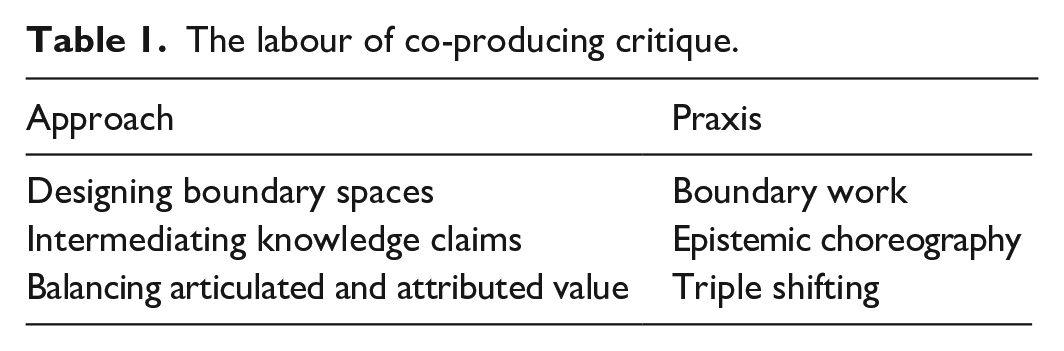
Second, I reflect on the Realising Just Cities programme to identify key principles for holding co-production and critique together in the context of the university, and examine how the institutional realities of the university mediated these efforts. I focus on three approaches: designing spaces to retain both proximity to and distance from the university; intermediating knowledge claims through mobilising the position of the university to legitimise different ways of knowing; and seeking to create alternative value frameworks which recognise both articulated value (by groups involved) and attributed value (by institutions and funders). These approaches required a different kind of academic labour, involving boundary work, epistemic choreography and a form of triple shifting.
This labour is the work of co-production as and of critique. Rather than seeing co-production as a method, it is an epistemic praxis that seeks to find ways through the university and mobilise what the institution affords in pursuit of social justice. As universities continue to be structured around particular forms of knowledge production, it is only through recognising such continuous labour that the messy realities of seeking to bridge co-production and critique become visible from within the neo-liberalising university. The idea of neo-liberalising, rather than neo-liberal, is important here, as it invokes both the dominant form of restructuring processes in higher education whilst holding onto the idea that things remain in process (Maisuria and Cole, 2017).
Finally, I conclude that there is no inherent contradiction between co-production and critique. This constitutes an essential corrective to dualistic thinking that divides academic practitioners into those doing ‘critical’ and those doing ‘engaged’ work. Indeed, contemporary readings of critique and critical urban theory insist on the legacy of work which has never held these ideas in opposition. In practice, approaches to undertaking critical-engaged work from within the university require a series of manoeuvres and shifts which involve being tethered to the university, whilst continuing to criticise and challenge from within. Drawing attention to the informal dimensions of academic labour that are usually hidden from view, co-production emerges not as method but as praxis.
I start by synthesising the critique of co-production and of critique and place them in dialogue with one another, before moving on to consider how the co-production of critique manifested in my own praxis in the context of the university.
Co-production and/of critique
Co-production has appeared as the latest trend in the ‘participatory turn’ (Facer and Enright, 2016) in which knowledge production reaches well beyond the walls of the university to include diverse and distributed expertise within multiple contexts (Banks et al., 2019; Ersoy, 2017; Hart et al., 2013; Hemström et al., 2021). Co-production has spread across disciplines, sectors and sites and is seen by some as having radical potential (Chatterton et al., 2018) to re-fashion the relations between knowledge, institutions and the social world. The co-production of research is generally seen to encompass five key features which characterise contemporary scholarship.
First, knowledge has always been produced in epistemic communities (Code, 1995) which influence the knowledge production process. Co-production recognises that these epistemic communities extend beyond the academy in what Funtowicz and Ravetz call (1993: 739) ‘extended peer communities’. Evidence is constructed and ‘construed. . . as communal’ and ‘communities, not individuals, are the primary loci of knowledge’ (Nelson, 1993: 131). The term co-production sits alongside a challenging of disciplinary boundaries (May and Perry, 2022) as a form of transdisciplinary knowledge production (Durose et al., 2021).
Second, central to co-production is recognition of the inter-relationship between societal context and knowledge production, and a commitment to hold together both knowledge and action. The idea of contextualisation captures how science and society have become intertwined, and sites of knowledge production expanded, resulting in the delegitimation of traditional epistemic authority and expertise (Jasanoff, 2004; Nowotny et al., 2001). With a surplus of knowledge (Stehr, 2004), and blurred and contested boundaries, there is a need to recognise and integrate multiple forms and types of expertise, including moments when expertise is completely devalorised. This involves recognising the incompleteness of knowledge claims, and reframes modes of seeing to allow for particular, situated and contextual knowledge (Peake, 2016).
Third, co-production has tended to emphasise knowledge that is simultaneously practical and imaginative, underscored by concern for its wider social application. Co-production in research draws on the traditions of pragmatism (see for instance Wills and Lake, 2020), acknowledging that grand challenges need to be tackled pragmatically, and robustly (Ferraro et al., 2015). Yet the purpose of co-producing knowledge is equally concerned with embracing surprise and imagination. Appealing to a sociology of ignorance (McGoey, 2014), scholars such as Gross (2010: 1) highlight the need for surprise in research processes, requiring an: ‘interruption of the continuum between accepted knowledge and future expectations’. Thus present urgency is mixed with what Scott (1998: 343) calls the ‘contingency of the future’. With its future-oriented temporality about what could be, co-production is one of the hopeful social sciences (Friere, 1992) which can involve the creation of ‘utopian’ spaces for creativity and remaking the world through imagination (Bell and Pahl, 2018).
Indeed a fourth characteristic of co-production is where it takes place, in different spaces and places of knowledge production beyond the university (Pain et al., 2015). This is not about tidy methods, or extractive practice, but a relational commitment to creating conceptual and physical spaces to ‘activate, expand and apply’ different forms of knowledge and expertise ‘to effect change’ (Bell and Pahl, 2018: 107). The focus is on unsettling the exercise of power and authority in the relationships between academics and communities (Duggan, 2021: 356), often by engaging on the latter’s own terms. Such ‘experiential expertise’ (Collins and Evans, 2002) can only be accessed by centring communities often excluded from knowledge production (Williamson and de Souza, 2010) and enabling them to ‘actively alter the social conditions in which they find themselves’ (Robinson and Tansey, 2006: 152).
Finally, then, co-production alters the positionality of the academic researcher, though not in a homogenous way (May and Perry, 2017). What changes is the monopoly on the word ‘researcher’, as others occupy these roles alongside academics in a ‘buffer zone’ between research and practice (Bennett and Brunner, 2022). Co-production is then implicated in the search to address what Fricker (2007) calls ‘epistemic injustice’ or to find the epistemic good life (Craig, 1990). Such calls invoke the importance of practical wisdom (phronesis) rather than forms of technical, linear understanding (Dunne, 1993). This involves privileging those excluded from knowledge production, in the process of which academics can be, more or less willingly, decentred.
The critique of co-production
Despite its popularity, co-production is as contested as it is popular (Flinders et al., 2016). Many studies deploy the term to invoke any form of collaborative research, without paying attention to the basis on which such claims are made. In the process the long-standing roots of co-production, which bridge between knowledge and action, are often overlooked in favour of emphasising novelty and distinctiveness. Popularity, alongside conceptual sprawl, gives rise to problems of misappropriation. Advocated by funders and universities alike as evidence of their impact, engagement and societal relevance, the terrain has become so full of self-proclaimed co-productive practices that the term ‘co-production’ may become useless in differentiating between them (see Durose et al., 2022). The danger is that this exacerbates the ‘hidden politics’ (Flinders et al., 2016) of co-production and perpetuates acts of participatory justification that bear little resemblance to claims for co-production as a more democratic form of knowledge production. Increasingly there is also concern about the impact of co-production on career trajectories particularly for those trapped in the academic precariat (Burton and Bowman, 2022). Despite the fact that there are rich traditions of engaged work within the social sciences (as is clear from the contributions to this special issue), there remains apprehension about the risks involved for academics in working against the grain of the neo-liberalising university.
Often, concerns arise where the underlying epistemology of co-production conflicts with the traditional norms and standards of social scientific work (Newig et al., 2019). These concerns are based on assumptions about the dangers of more porous boundaries between traditionally guarded zones of knowledge production and the social world of which we are part, fuelled by unease that heightened proximity will lead to over-identification with participants and threaten ‘pollution’ (Flinders et al., 2016). The fear is ‘co-optation’ or the risk of ‘selling out’ (Levin and Greenwood, 2016). Hope and a commitment to transformation are dismissed as naïve, seen to run the risk of producing policy-based evidence (Cairney, 2016) or post-hoc rationalisations for predetermined courses of social action. Critics of co-production raise questions of credibility, legitimacy or bias (Oliver et al., 2019), amid concern that co-production – by virtue of the proximity to and participation of partners in the research – loses the critical edge that is an essential part of the academic enterprise. Here we find echoes of the position taken by critical theorists against pragmatism (Ray, 2004) on the grounds that only the former can reveal and explain structures and processes of domination, which requires a certain distance and disengagement. This position is reinforced when advocates of co-production align a staunch positionality for action and for social change with an attitude against critique, or against theory. The result is an increasing binary opposition between co-production and critique, engagement and distance, understanding and explanation. This is, however, based on a particular understanding of critique that does not reflect contemporary scholarship around critique in general, or critical urban theory in particular.
The critique of critique
Critique usually has what Anker and Felski (2017: 4) call a ‘diagnostic quality’ in which an ‘expert’ scrutinises something to find flaws not apparent to a non-specialist. Who is an expert relates to their training and specialism within disciplines and conventional ‘academic tribes’ (Becher and Trowler, 2001) or epistemic communities (Knorr Cetina, 1999). Critique is often aimed at producing definitive answers, rather than admitting of incomplete or partial claims, indeed, the very basis of critique is often seen to rest on certainty. Critique is seen to entail an inherent negativity aimed, for instance, at exposing existing power relations and revealing structures that dominate and oppress different groups in society. For some scholars, to propose anything as a critical scholar risks establishing new dominations and forms of power – for them, one should therefore stop at critique (Harcourt, 2020). Being critical is seen as a task of unmasking, or ‘debunking’ (Latour, 2004), which presumes a privileged position from which to enact such a corrective task. Explanation is generally favoured over understanding.
Such a view of critique is inherently sceptical about the need for knowledge to relate to action in the world: ‘critique insists that the real-world, pragmatic progress is nothing but a strategy for disguising the persistence of structural inequality, rendering any form of optimism at best overly credulous or misplaced and worst a craven capitulation’ (Anker and Felski, 2017: 15). Such ideas of a distanced scholarly critique suggest that hopes for knowledge to improve social conditions are foolish. Indeed, unlike co-production which starts from a position of engagement, a key idea has been that detachment is needed for critique and is fundamental to the social sciences, ‘by occupying a more or less extra-territorial position vis-à-vis the society being described’ (Boltanski, 2011: 8).
Critique, however, is not singular. In her 2002 essay, Butler (2002) reminds us of Foucault’s distinction between critique as ‘a high Kantian enterprise’ as well as the ‘little polemical activities that are called critique’ (Foucault, 1997: 24). The contingency of critique is at stake here in terms of the relations between immanent and transcendent critique. Critics of critique have taken issue with the diagnostic view, as set out above, and the assumptions made about who, what and how critique is performed and with what implications for action. Instead an alternative notion of critique does not close down (Jueskjaer and Schwennesen, 2012), but opens up possibilities through a diagrammatic mode that draws different lines of connection between subjects and objects. Critics of critique argue that despite their explanatory potential, critical methods cannot capture the complex, dynamic and affective textures of everyday life (Barnwell, 2016). This is why it is important, as Maclure (2015) suggests, to critique ‘from the middle’, in an affirmative mode – to foster as well as debunk. This affirmative mode pushes back at both causal explanations and negativity ‘coming out of the deep, dark below’ (Latour, 2004: 239). Rather than academics making ‘the same gesture when everything else has changed around them’ (Latour, 2004: 235), the task is to foster or create. This in turn requires acknowledging a much wider range of actors’ critical capacities and the creativity with which they engage in interpretation and action (Boltanski, 2011).
Inevitably, the critics of critique have themselves been criticised for engaging in exactly the same critique at which they take aim! (Barnwell, 2016; McDonald, 2018). Furthermore, critique and post-critique are not binary oppositions as ‘critique has always been contaminated with affirmative moments, just as post-critique is shot through with the negation it often ostensible disavows’ (McDonald, 2018: 368). We are left with the irony that ‘the tears in the fabric of our epistemological web require more critical thinking and not less’ (Butler, 2002: 215).
However, each conception of critique has different implications for how we position and understand co-production. According to the first conception of critique, co-production fails to meet the conditions that would sustain any claim to be part of a critical social science. Its very engagement, embeddedness, situatedness, proximity, framing of experts and expertise and commitment to action can be taken as antithetical to the project of critique. Yet this incompatibility can only be maintained if one accepts this particular conception of critique. Instead, within the critique of critique, we can find ways to rescue co-production from its apparently compromised vantage point.
Co-producing critique in the city
Taking the five features of co-production in turn, Boltanski first provides the justification for critique being co-produced in extended peer communities. Ordinary people are not ‘sunk in illusion’ (Boltanski, 2011: 23), but have critical capacities themselves in situations of everyday life. What this means is that ‘a framework should pay attention to the activities and critical competences of actors and acknowledgement of the pluralistic expectations which, in contemporary democratic-capitalist societies, seem to occupy a central position in the critical sense of actors, including the most dominated among them’ (Boltanski, 2011: 48). An alternative framing of critique does not then constrain it to the domain of professionalised, academic expertise: rather than disputing common sense (Anker and Felski, 2017), we are all capable of critique.
Second, critique is a central part of transforming societies and supports change, through the a priori recognition that we are interested humans who filter knowledge through our prior experiences and understandings (May and Perry, 2017). Yet this requires active work at the boundaries between academia and the social world of which it is part, through: ‘the recognition of tension that opens up the possibility of critique and change’ (Calhoun, 1995: 187). Here critique is not a totalising gaze that provides closure, but a form of opening up, an invitation. Maclure (2015) points to the need for critique to be immanent and caught up with the movements and process in which it is entangled. This takes not distance as a precondition for research but instead recognition of the very embeddedness of knowledge production in the social world.
Instead of the negativity of critique, a third characteristic of co-production relates to its hopeful and propositional nature. Here Harcourt (2020) notes that critique is always a proposition of sorts, entailing within it values that shape what we critique and how. He argues that Foucault himself misrepresented his own position, as he both engaged in critical theory and critical praxis in his work with the Prison Information Group. Conceptions of justice, for Harcourt, are already present in critique and always have been – for instance in the work of scholars such as Du Bois who developed a critique outlining the negativity of black oppression and slavery, but did not ‘stop there’, rather proposed what could go in its place. This gave rise to sets of ideas and actions that continue to shape the abolitionist movement today.
The fourth point is that critique can and must take place in other places, spaces and arenas. Whilst critique is not synonymous with theory (Anker and Felski, 2017), recognising the relationship between them can ‘extend the processes of theorising and knowing beyond campus spaces’ (Pain et al., 2015: 121). Challenging the monopoly of academics on critique means valuing common sense and everyday practices beyond the institution, as well as paying attention to how we can ‘repair, take care, assemble, reassemble, stitch together’ (Latour, 2010: 475). The modes of organising – of gathering, convening, assembling – in different kinds of spaces are what brings collective critique forward. The role then of both the critical and engaged academic is to enhance capacities to formulate, mobilise and act.
Finally, this means that although academics are decentred within co-production, their role in the production of critique does not disappear, rather there is a need for an ‘alternative ethos, mood or disposition’ (Anker and Felski, 2017: 10). The academic is not an ‘authoritative interpreter. . .with judicious and knowledgeable detachment’ (Anker and Felski, 2017: 4), but occupies a complex exteriority – both inside and outside society at the same time (Boltanski, 2011). This requires acknowledging a different subjectivity and positionality that means there is no distinctive ‘we’ from within the academy that holds a privileged position from which to reveal oppressions to ‘non-experts’ (Maclure, 2015).
Many critical scholars, even if they have not defined as urbanists, have been concerned with the urban as scale of action. At the same time, within critical urban theory, the relations between thought and action, negativity and proposition, are not posited as oppositional. Lefebvre, as a pioneer of critical urban theory called attention to the emancipatory potential within urban society and the ‘right to the city’ to explore the ‘possible-impossible’ (Lefebvre, 2003: 162). His Critique of Everyday Life (1946) deployed an idea of critique which sought to open up different ways of thinking and living (Gardiner, 2004). In this tradition, critical urban theory has no problem with the propositional mode insofar as it ‘insists that another, more democratic, socially just and sustainable form of urbanisation is possible, even if such possibilities are currently being suppressed through dominant institutional arrangements, practices and ideologies’ (Brenner, 2009: 198). Theory is related to practice and should inform the ‘strategic perspective of progressive, radical or revolutionary social and political actors’ (Brenner, 2009: 201–202). Urban critique is not claiming distanced objectivity but is explicitly normative in its demand for ‘an interrogation of the ends of knowledge’ (Brenner, 2009: 202).
Positioning co-production against critique ignores the fact that there has always been a relationship between critical theory, pragmatism and social justice articulated by critical urban scholars. Critique does propose ‘what is to be done’ but stops there, particularly in the context of inconstancy, change and flux. What is needed, Brenner and Schmid conclude, is a new epistemology of the urban, recognising that ‘the urban is a collective project – it is produced through collective action, negotiation, imagination, experimentation and struggle. The urban society is thus never an achieved condition, but offers an open horizon in relation to which concrete struggles over the urban are waged. It is through such struggles, ultimately that any viable new urban epistemology will be forged’ (Brenner and Schmid, 2015: 178).
What is co-production, if not at least the possibility of putting such a ‘new urban epistemology’ into practice – grappling as it already is with uncertainty, messiness and incompleteness? From this perspective, co-production potentially takes up precisely where critical urban theory leads us; not by refusing or being against critique, but by co-producing critique as the basis for subsequent action. I turn now to reflect on the realities of seeking to do such work from within the context of the university.
Doing critical-engaged work from the university
Informed by critical, engaged urban studies and a hopeful, ameliorative disposition (Dewey, 1957), I approached the opportunity provided by the Realising Just Cities programme with the idea that critique and co-production were not inseparable. The international centre of which this programme was a part – Mistra Urban Futures – was an ambitious endeavour involving the establishment of initial local interaction platforms (LIPs) in Gothenburg, Cape Town, Kisumu and Greater Manchester, which led to subsequent intra-national extensions (to Malmo, Stockholm and Sheffield) and additional nodes (Shimla and Buenos Aires) (Polk, 2015). Each platform shared common features, including recognising ongoing trajectories of critical scholarship and engaged work in each city (Perry et al., 2018).
In Greater Manchester, the design of the platform and approach to the programme was informed by our own critique which, following Brenner et al. (2012), had sought to understand the nature of contemporary patterns of urban restructuring, with a particular focus on the development of knowledge capitalism. In Cities and the Knowledge Economy (May and Perry, 2018), drawing largely on empirical work between 2000 and 2012, we highlighted how the 21st century city had been predicated on particular circuits of knowledge that constitute expertise as residing in elite and professional epistemic communities. We explored the politics and potentials inherent within universities as sites of knowledge production. This led us to an interest in co-production as a backlash to a narrow, economically-driven impact agenda, whilst recognising that it could not be a panacea nor a ‘receptacle into which all aspirations and hopes for a better social science’ are poured (May and Perry, 2018: 153). We concluded that the questions of how to organise for more participative futures, and create spaces ‘to imagine, learn and act for more just and sustainable futures beyond the promise and the politics of the knowledge economy’ (May and Perry, 2018: 179), were essential.
Realising Just Cities was a response to this critique, but sought to go ‘beyond’ (Perry and Atherton, 2017), moving through a negative to a propositional and active mode of learning-by-doing about co-production. Given our prior work on universities and urban development (for instance, May and Perry, 2011, 2017), this meant acknowledging the varying degrees of shelter provided by institutions, as well as the challenges of mediating between the inside-out and outside-in (Harloe and Perry, 2004). These spaces of mediating relations required active intermediation: that is, sets of practices that inform the possibility of producing excellent-relevant knowledge at the boundaries of the academy, which then shape the conduct, context and consequences of social scientific research (May and Perry, 2018: 174).
How then to hold this critique together with co-production in practice in the Realising Just Cities programme? Here I focus on three inter-related approaches which were mediated by the institution in particular ways and produced distinctive kinds of academic labour. These approaches were clearly influenced by collaborators in different projects in the programme, but the analysis below is my own, from my position as UK Director of the programme and drawing on written notes and transcripts of individual and group interviews and meetings during Centre and platform evaluations between 2016 and 2019.
Boundary spaces and boundary work
For critique and subsequent action to be determined by all experts involved meant designing boundary spaces to retain both proximity to and distance from the university. Such spaces needed to be open and porous via structures that could be palpably affected by participants (Garud et al., 2008) and were incomplete by design (Durose and Lowndes, 2021). Alongside boundary spaces, an important principle was the provision of spaces and places to assemble: ‘The critic is not the one who lifts the rugs from under the feet of the naïve believers, but the one who offers the participants arenas in which to gather’ (Latour, 2004: 246). Through so doing, the intention was to put ‘steam’ back into critique through ‘gathering’ for critical-dissensual collaborations (Heimans and Singh, 2018).
This approach manifested in the design of different boundary spaces where academics, policy-makers, community organisers, activists and citizens could meet. The LIP itself was designed as an intermediary programme sitting in, against and beyond academia. Our local platform adopted a flexible, adaptive form in order to develop infrastructure to support activities on the ground rather than designed from the top-down. Co-production was anchored in local teams brought together through long-standing and new relationships with different stakeholders; project teams were then the main locus of decision-making. The platform resisted the pressure to develop a formal consortium arrangement, which had been encouraged at the other international sites. This was in recognition of the need to grow the governance structure according to the needs of the programme and projects to create shared opportunities for learning – rather than create a structure that had to be serviced. The idea was that co-governance would evolve through bringing people actively into the work, rather than individuals having established seats at the table from the start. One of the projects in the programme, Jam and Justice, was explicitly about the creation of such a boundary space, through the constitution of an action research collective (ARC), which brought participants from different walks of life together to jointly initiate, create and deliver mini-projects designed as spaces for social innovation (Perry et al., 2019b). The ARC alone included 19 co-decision-making meetings, 128 research sessions, 24 events organised for wider audiences and 9 socials and fieldtrips (Perry et al., 2019b), recognising the importance of mobilising disruption from everyday routines as a tactic for thinking differently (Perry and Smit, 2022). We counted 98 active co-researchers in the ARC, and more than 300 in the programme as a whole.
An explicit decision was made to mobilise the university as the host institution, to invoke legitimacy, convening power and resources, whilst also challenging its modes of knowledge production from within. The establishment of a LIP and receipt of funding from Sweden required the demonstration of match funding. Whereas in Gothenburg this was provided by local governments who subsequently had joint seats around the table within the formal ‘consortium’, we sought match funding from the university instead. This was in part in recognition that Greater Manchester was suffering under the effects of national austerity policies and cuts to local authority budgets, and in part borne from a desire to avoid co-optation by decision-makers and officials already implicated in particular urban trajectories. The aim was to mobilise the attributed independence of the university, whilst recognising contestation and multi-polarity, to bring other voices and expertise into earshot.
The critical role that universities can play is not a given here. After the first phase of the programme (2010–2015), I made the decision to move institutions, taking a position in a Northern university on the other side of the Pennine Hills and moving the platform. In some ways, this was a sub-optimal decision as it severed geographical proximity between the platform host and specific urban communities involved. Whilst I gained a promotion in the move, this was not the primary motivation. I was triggered by one particular moment when I was called into a university office to justify purchasing a cup of coffee for a community participant in our project. Why was this the tipping point for me? This was an institution that had not provided match funding, requiring me to ‘stitch together’ (Latour, 2004: 4) resources from other UK research funders and develop a method of counting accrued in-kind match generated by individuals. Micro-barriers and institutional aggressions had continuously made the delivery of the programme difficult, despite its high financial value to the institution. At the same time, the programme was mobilised as evidence in support of grand symbolic institutional claims about community engagement and giving back to the local area – how did this empty gesture marry with the querying of buying coffee for a community co-researcher? It was in such an institutional setting over time that Tim and I had concluded that engagement happened despite not because of the institution, and from which we levelled our critique in Cities and the Knowledge Economy.
The institutional move reconfigured the platform. Rather than the university being another force acting against the goals of the programme, the new host was actively supportive, providing cash match funding, space, resources in-kind, and most importantly a genuine interest in both the academic and practical relevance of the work. This meant that the boundary work with the university was considerably reduced, though not eliminated. Boundary work was still required to work around inflexible funding regimes, or contractual requirements, that undermined the kinds of relations with community partners we had sought to establish. Tactics to manoeuvre around institutional blockages were enabled further by the appointment of professional service staff with distinctive skills to massage the institution in such a way as to meet the needs of the programme.
Intermediating knowledge claims
Working across boundaries meant intermediating knowledge claims through mobilising the position of the university to legitimise different ways of knowing. The lack of formality to the platform led to an amorphous form that could be hard to grasp; to this extent, flexibility and responsiveness were at times traded for transparency in decision-making. However, this was important to maintain the fundamental in-betweeness that was needed to move between and within formal governance organisations and the informal tier of grassroots, civic and voluntary organisations. An intermediary position retained both the independence and position of academics in the programme. Through mobilising the attributed independence afforded by being a part of the university, academics across our co-production projects were able to advocate, legitimise and translate knowledge claims that otherwise might be dismissed.
Harnessing the power of exchange to form of coalitions of the willing was a tactical manoeuvre for co-producing critique in different parts of the programme. With decision-makers in the city-regional authority, we designed a process called ‘Developing Co-productive Capacities’ which aimed to open up existing structures to new ideas and expose decision-makers to different possibilities through comparative learning (Perry and Russell, 2020). This involved several international exchanges, including taking a mixed group of academics, activists and decision-makers to an international conference on participatory democracy to co-deliver a workshop and hear examples of bold municipal action from other urban contexts. It also included the mobilisation of a community of activists and practitioners within Greater Manchester through ‘Coalitions for Change’ and the hashtag #CoproduceGM, where events were organised so that groups often excluded from decision-making could mix with officials.
When I started this kind of work I struggled to own my academic identity in such events and gatherings, and often performed acts of self-erasure and apology. Academics bear the weight of previous institutional engagements, both successes and failures – even when they were not directly involved (or even at the institution). The result is that we carry our institutions with us, whether we like it or not. Rather than resist this tethering, I began to accept it, and acknowledge – and work with – the privileged position that comes with being an academic, to legitimise others’ knowledge claims. That meant recognising that distance, as well as proximity, were important – it was precisely because the university and its academics continued to be seen as apart from their localities at some level that we had value to certain groups, by legitimating their claims and opening doors. This was uncomfortable to recognise, given the depths of expertise that community groups and activist associations had developed through years of struggle, and the epistemic closures they had nonetheless faced.
Again, this suggests a different kind of labour. Underpinning such manoeuvres is a recognition that the co-production of critique entails some kind of loose epistemic choreography, that is closer to improvisation than deliberate orchestration. It means working to identify epistemic openings and closings through sometimes ‘sneaky’ practices, for instance, ensuring that co-researchers who would not otherwise be invited into formal spaces of authority gain access. Knowing when and how to mobilise the traditional legitimacy accorded to the status of being an ‘academic’ are important elements of this epistemic choreography, allowing for ‘tactics [to] operate in spaces created by strategic ambiguities’ (May, 1999: 776).
Walking the tightrope between articulated and attributed value
Holding critique and co-production together involves an uneasy accommodation between the articulated value of such work to the groups involved, and the value attributed to co-production by institutions and funders. For the former, our formative and summative evaluations, carried out through collaborative group reflection and independent evaluations, revealed the value of the programme articulated by participants. This included: shaping policy processes and opening imaginations, enabling trans-local learning, exchanges and networks and stimulating infrastructures for action and building capacity (Perry et al., 2019a). Some participants reported that they had learnt ‘new things’ or developed skills, but for many, co-production provided evidence and justification for what they – and we – already knew. The outcome of many projects was a process of collective diagnosis and problem reformulation as the basis for action, given further weight through new coalitions that could continue to mobilise evidence produced for advocacy and activism, even after the programme ended. This collective problem reformulation and the assembling of evidence for urban alternatives was an outcome in its own right, and perhaps the most important one in the timeframe of the initiative. Examples included work around community-led housing, for instance, or participation in spatial planning, where long-standing diagnosis of problems, constituting community critique, was translated into different forms of evidence in the constitution of more collective city-regional intelligence (Perry and Smit, 2022). For many individuals, a sense of self-efficacy and belief was the primary value of the programme, from which they went on to continue their own work, or take new directions, such as through establishing their own charities or organisations.
Following Boltanski (2011), this suggests one aim is to co-produce a critique which challenges reality, provides tools to resist fragmentation, and offers the dominated ‘a picture of the social order and principles of equivalence which they could seize to make comparisons between them and increase their strength by combining into collectives’ (p. 48). Compared with outcomes in Kisumu, for instance, where the emphasis had been on co-producing technical solutions, the distinctiveness of our approach in Greater Manchester was the co-production of critique in the context of ongoing movements and trajectories of change in the city-region. Outputs reflected these aspirations, including academic articles and books, alongside pamphlets, videos, maps, exhibitions, toolkits, networks and new community organisations.
The value attributed to co-production by funders and institutions was, however, rather different, reflecting a narrow understanding of the conditions for and impact of co-production. Despite commissioning a centre on co-production, the funders of Mistra Urban Futures continued to favour traditional measures of success such as academic outputs and quantifiable and measurable impacts. In the UK towards the end of the programme, the influence of the Research Evaluation Framework (REF) began to take hold. Under such processes it became more difficult to land creative and transdisciplinary outputs, such as papers co-authored with non-academics, or have methodologies recognised as ‘robust’, as they challenged dominant disciplinary norms and the expectations of the unit of assessment (in this case ‘built environment’). A remarkable volume of labour, that had previously been welcomed as part of a transformative shift to deeper engagement, could now not be counted. Similarly, whilst impact had been assumed to be a quick win for co-production, meeting narrow and linear criteria in a short-time frame was challenging. The REF favoured concrete, attributable impacts which could be unproblematically claimed to have resulted from individual academics’ work, more than the kinds of diverse, distributed effects and ripples that emerged from Realising Just Cities in building evidence for alternative urban trajectories. Although we were provided with an additional grant by the university for funds to boost, track and evidence impact, this proved counterproductive to the ethos of the programme, introducing an extractive, individualised logic into what was otherwise set up as a collaborative endeavour.
What matters to those involved in co-production, including critical engaged academics, is not, it seems, what counts. Different value frameworks are needed to accurately reflect the relationship between co-production, action and outcomes (Durose et al., 2018). Whilst this work was not ultimately selected as an ‘impact case study’, in seeking to make the case within the university and reconfigure norms and expectations there is nonetheless the possibility of ‘denaturalising strategic assumptions by exposing what is taken-for-granted within their presuppositions’ (May, 1999: 776).
Operating in what we have called a ‘missing middle’ (Perry and May, 2006) between stated expectations of relevance and engagement and the realities of institutional incentive and performance schemes requires working a triple shift. This idea stems from gender and feminist studies which highlight the ways in which working women encounter a triple burden of their paid employment, their domestic labour in the home, and emotion or care work (including for children or within the community) (Duncombe and Marsden, 1995). Drawing on this metaphor, in co-producing critique, the first shift is the labour for academics of meeting institutional and sector expectations, or doing one’s job: in UK research, this is measured in terms of REF performance. There is labour involved in producing what counts in order to guarantee the conditions of one’s employment and safeguard any position from which engagement is even possible. Yet the ‘performative university’ (do Mar Pereira, 2016) leads to toxic and ‘careless’ (Lynch, 2010) cultures and acts as a barrier against achieving socio-political interventions outside the academy. This produces the second shift of undertaking engaged work collaboratively with others, even though this may not be recognised by the institution. This labour takes place in different spaces and at varied times of day, including weekends and evenings (with resulting effects for caring responsibilities in the home); it involves doing all kinds of work that is neither in the formal job specification nor matches the paygrade, but is part of being human. The third shift in this context is the emotional and relational labour, and care work, that comes with working with individuals not as research participants but as human beings. This means developing boundary spaces as ‘care-full’ spaces (Williams, 2017), checking in and up with people on a regular basis, breaching the personal and the professional and admitting vulnerability.
Co-producing critique as an epistemic praxis
If co-production and critique are not incompatible bedfellows in theory, the possibilities for a critical engaged practice are mediated by the university as a site of knowledge production. This produces a particular kind of labour or praxis (Table 1). Where practice signifies specific sets of behaviours or reliable, repeatable actions, I evoke praxis as ‘reflection and action upon the world in order to transform it’ (Freire, 1972: 52). If practice is about doing, then praxis is about ‘knowing, doing and being’ at the same time (White, 2007: 226). Critical praxis, then, is ‘a political and ethical form of being’ (Harcourt, 2020: 19) which sees ‘critical theory and praxis, en situation, relentlessly confronting each other’ (Harcourt, 2020: 539).
The labour of co-producing critique.
Co-production is a form of knowledge politics that recognises injustice as not only procedural or distributive but epistemic. As epistemic praxis, co-production seeks to contest knowledge claims and recognise the legitimacy of different types of expertise. It is about making epistemic moves, to overcome what Harney and Moten (2013), in their pivotal work on undercommoning, have called the ‘negligence’ of critical academics. Often co-production is seen to entail the dismissal of academic expertise, not least by researchers themselves. Academics may distance themselves from their institutions, out of distaste for the power and privilege involved, and position themselves and their practices as somehow exceptional, possible despite not because of the university. Often such individuals are exceptional, exercising commitment to social action and operating against academic self-interest in relation, for instance, to traditional ways of evaluating and rewarding performance. Yet this distancing can inadvertently undermine academic legitimacy and the value that partnerships with universities hold for groups involved. Choreographing the university into rather than out of the landscape of knowledge production can be an important move.
Such a praxis brings challenges. It depends on the power and position of academics and the kinds of effort bargains they are able to strike, which allow for a play between episodic and dispositional power. This effort bargain involves ‘inherent ambiguity [and] leads to the possibility of creating “spaces” in which there is room for variation in performance as well as resistance to undue encroachment upon the exercise of discretion itself’ (May, 1999: 768). Recognising how one is tethered to the institution, as a precondition of both critical and engaged work, requires both obedience and dissent. This is an uncomfortable position – questioning obedience to any authority requires a critical practice, but one that is not only about how not to be governed, following Foucault, but about how, what and when to accept being governed as a precondition for the activity at hand. There is much at risk, as: ‘to gain a critical distance from established authority’ (in this case the university) ‘means for Foucault not only to recognise the ways in which the coercive effects of knowledge are at work in subject-formation itself, but to risk one’s very formation as a subject’ (Butler, 2002: 18). It is this that gives rise to vulnerability, identity confusion and the constant reflexive task of positioning oneself always in-between. This is not about neat narratives of success but trying and failing and reorienting ourselves, as much as the societies we are in, to future possibilities through a trajectory of multiple failures (Castán Broto, 2021: 325).
Co-production as praxis means taking universities seriously as sites of knowledge production, seeking to reconfigure from within whilst recognising and mobilising the privilege they afford. Realising Just Cities suggests it is possible to create spaces of possibility and change within neo-liberalising institutions. At the same time, critique of universities has to be part of this praxis as institutional support continues to be dependent on economic calculations either in the short (via funded grants) or longer (via the REF) term. Once the funding for Realising Just Cities came to an end, so too did the programme. Co-production still has to be paid for, or pay back – or spaces for possibility rapidly close. Structural change is needed rather than individual acts of alternative practice. Until then, however, all we have, is praxis.
Conclusion
I have argued against the claim that co-production is inherently antithetical to critique. Producing a shared critique as the basis for collective action, through a strategy which plays with both engagement and distance, suggests particular ‘moves’ (Simone and Pieterse, 2017: xvii) which academics can make in mobilising and forming collectives and coalitions. Putting this into practice requires designing boundary spaces, intermediating between knowledge claims and balancing between articulated and attributed values for co-production. This gives rise to co-production as an epistemic praxis, characterised by boundary work, epistemic choreography and triple shifting – doing one’s job, unpaid engagement and emotional and care work. As a tool to address epistemic injustice, I have argued that the co-production of critique itself is the basis for action, in a way that takes the experiences and expertise of those systematically excluded on board.
Universities are difficult places from which to bridge co-production and critique, but not impossible. Institutions enable and constrain the ability to do this work and provide varied forms of institutional shelter. As a result we can do ourselves a disservice in rejecting academic identities as this constitutes part of our very value to the communities we seek to serve. The urgency and complexity of contemporary challenges demands an altogether more substantial response than we have seen from universities so far, as institutions that wield great power and are anchor institutions in their respective neighbourhoods (Birch et al., 2013). Far greater attention is needed on how institutions could support academics for whom co-production is an epistemic praxis, which requires transformations in the roles that universities and their academics can play in service of more just societies. Furthermore, when academics involved in co-production position themselves only against their institution, or against theory or critique, they engage in the same binary opposition as those who position themselves only for the idea of critique as impartial, expert knowledge, produced at – and by virtue of – distance from society. Both ‘critical’ and ‘engaged’ researchers can reinforce this separation of critical thought from action in their discourses and writings, despite the rich philosophy of social science that provides justification otherwise. This risks, on the one hand, making overblown claims about the authority of academic expertise to the exclusion of other forms of knowledge central to addressing contemporary challenges and, on the other hand, devaluing the distinctiveness of the university as a site of knowledge production.
As an epistemic praxis, co-production involves working with – rather than seeking to resolve – incompleteness, plurality and contestation. It also means embracing not-knowing and a preparedness to learn, thinking about the future from a position of incomplete knowledge (Scott, 1998: 343). We need to trouble established practices of research and abstraction that may close us off from engagingly productively with a world ‘in process’ (Duggan, 2021: 357). This requires us to recognise the limits to our own and other knowledge claims through enhanced reflexivity (May and Perry, 2017). It means questioning the basis from which we, as academics, should choreograph anything and what epistemic closures and exclusions might be, albeit inadvertently, reinforced in the process (Orr and Bennett, 2009; Redwood, 2008). Working within institutions, such as the universities we currently occupy, makes these dangers real risks. Yet it is, after all, as advocates of critical praxis theory would advocate, better to do something than nothing – to make some move rather than stay immobilised through fear of stepping out.
Footnotes
Acknowledgements
The first draft of this paper was shared in a workshop in 2019 on Contested Knowledge Claims for 21st Century Cities. I thank discussants there for their insightful comments. Thanks also to: colleagues employed in the Realising Just Cities programme without whom it would not have all been possible; all those co-researchers who participated in the programme; Vanesa Castán Broto and AbdouMaliq Simone for comments on early drafts; anonymous referees for helpful reviews; and Tim May, collaborator, co-critic and co-editor of this special issue.
Declaration of conflicting interests
The author declared no potential conflicts of interest with respect to the research, authorship, and/or publication of this article.
Funding
The author disclosed receipt of the following financial support for the research, authorship, and/or publication of this article: This article draws on research funded by the Mistra Foundation for Strategic Environment Research (Mistra Urban Futures) and the ESRC (ES/N005945/2; ES/P011055/1).