



Abstract
One of the more polarizing issues that captivated society in recent years was the controversy surrounding National Football League (NFL) athletes kneeling during the playing of the National Anthem. Initiated by NFL quarterback Colin Kaepernick as a display of protest against police brutality, kneeling during the anthem sparked a firestorm of controversy and a national debate. In this study the controversy and the two men behind it will be analyzed through the lens of Hans-Georg Gadamer’s philosophical hermeneutics. Specifically, this study will highlight how Colin Kaepernick and Army veteran Nate Boyer experienced a fusion of horizons that produced the kneeling protest. Additionally, the current study seeks to illuminate both the utility of philosophical hermeneutics as an interpretive framework and the potentialities of dialog between polar opposites who earnestly seek to understand the other.
In recent years the killing of black persons at the hands of police has continued unabated. As a result, the names of George Floyd, Breonna Taylor, Trayvon Martin, Mike Brown, Sandra Bland, and countless others have become known throughout American society. The protests around these killings have also spread across the country through the efforts of activist groups like Black Lives Matter, civil rights attorneys and advocates like Ben Crump and Lee Merritt, as well as those most impacted by the deaths, the family members of police victims. The most visible of this latter group is The Mothers of the Movement, seven mothers whose children were killed by police and who, due to their coming together and speaking out, were featured prominently during the 2016 Democratic National Convention.
One voice however has all but faded from the headlines and from society’s collective memory, the voice of Colin Kaepernick. It was Kaepernick’s silent protests of police brutality against Blacks during National Football League (NFL) games that sparked a nationwide outcry in 2016. While the relevance and timeliness of his actions are as appropriate and necessary now as they were then, not much has been written on the hermeneutic aspects of his protest. The fact that Kaepernick’s kneeling protest of police brutality against Blacks was, unsurprisingly, twisted by White society into a touchstone for one’s patriotism and support of law enforcement and the military is evidence of competing interpretations of his words and his actions. It is these, the hermeneutic questions of understanding and interpretation, that frame our comprehensive analysis of the Colin Kaepernick NFL protest.
Hermeneutics
Moules et al. (2015: 3) defined hermeneutics as “the tradition, philosophy, and practice of interpretation.” Throughout most of its history, hermeneutics has concerned itself with “problems that arise when dealing with meaningful human actions and the products of such actions, most importantly texts” (Mantzavinos, 2016). As a formal practice, hermeneutics dates to the 17th century when it was used as the main tool for the interpretation of theological texts (Moules et al., 2015). As an interpretive tool, hermeneutics aims for the systematic analysis and understanding of texts or other bodies of work. But a broadening of the scope of hermeneutics occurred when the 20th century philosopher Hans-Georg Gadamer introduced his philosophical hermeneutics (PH). With PH, Gadamer sought to explicate the conditions necessary for understanding to take place. By foregrounding the components necessary to achieve understanding, Gadamer’s PH represents a promising foundation in which to ground qualitative analyses.
In a project that will demonstrate the utility of PH as an interpretive methodological framework, the current study will engage in a hermeneutic analysis of the silent protest by NFL athlete Colin Kaepernick. The act, sitting during the playing of the National Anthem of a football game, was offered in August of 2016 as a protest against injustice in America. To others however, Kaepernick’s act was interpreted as an indictment and rejection of America itself. But we argue that Kaepernick’s act was something else, something greater. In his act of silent protest, Colin Kaepernick was also engaging in a hermeneutic act, the hermeneutic invitation to dialog. Through the use of PH, the current study will analyze the Kaepernick protest, and in so doing, will show the effectiveness of PH as an analytical tool, as well as its flexibility as a framework for brokering understanding and mutual agreement.
Philosophical hermeneutics overview
In a departure from the methodical, text based, tool kit-oriented method of traditional hermeneutic practice, Gadamer’s PH is in fact, not a “method” at all. For Gadamer, hermeneutics was not a method to be used for the mining and extraction of interpretable information from a text. Rather, hermeneutics was “a human’s mode of being-in-the-world” (Gill, 2015: 11). In Gadamer’s PH, this “being-in-the-world” is essentially how we navigate and make sense of the world through an ongoing process of interpretation. In our daily lives and through our interactions with “others” (the people, places, and things we encounter), we co-construct knowledge in an effort to expand understanding and insight. The result of this dialogic, co-constructed, acquisition of knowledge is, hopefully, a better understanding of the “other” as well as of ourselves. When viewed in this light, understanding becomes “more of an event than a procedure” (Grondin, 2009: 407). The components undergirding these “events” of understanding are our fore-knowledge, prejudices, traditions, and history. Together, they are what we unconsciously bring to every encounter with an “other.” That makes them foundational to every event of understanding.
The building blocks of understanding
Far from a “tabula rasa” conception of the mind, Gadamer’s view is that each of us inherently operates from a perspective that is already there. This fully formed set of ideas and assumptions frame how we understand and interpret an “other.” This preexisting template of how we approach the world is what Gadamer described as our prejudices (Gadamer, 1994). Prejudices represent the “prior commitments” (Moules et al., 2015) that we show up with to each and every interaction with an “other.”
Related to prejudice is foreknowledge, a concept Gadamer borrowed from Martin Heidegger. Foreknowledge (also forestructures or foremeanings) is important because, in addition to the prejudices we bring that come from our individual experiences, foreknowledge incorporates all that has gone on in the social world around us. These are seen in the customs and practices of our societies and cultures and are passed down to us through the traditions that permeate our social and cultural worlds. Undergirding foreknowledge, prejudices and traditions is our historically effected consciousness (history). It is the ebb and flow of time that accounts for the fluctuations that occur in the traditions of society, which impact the foreknowledge produced, which in turn effect the prejudices of those within the society.
Taken together, the prejudices, foreknowledge, traditions, and history come together to determine one’s horizon, their vantage point from which they see and experience the world. At any given moment our individual horizon informs the language of our interaction with an “other.” And, for Gadamer, the process of coming to an understanding is essentially the process of putting our horizon in dialog with the horizon of an “other.” But, critical to reaching the event of understanding when in dialog, is adopting a position of openness.
Openness
In what may very well be the most demanding act in PH, openness requires an intentional, deliberate, and willful focus on the position of the other. In commenting on openness Gadamer (1994: 268) wrote, Just as we cannot continually misunderstand the use of a word without its affecting the meaning of the whole, so we cannot stick blindly to our own fore-meaning about the thing if we want to understand the meaning of another. Of course this does not mean that when we listen to someone or read a book we must forget all our fore-meanings concerning the content and all our own ideas. All that is asked is that we remain open to the meaning of the other person or text .
Put this way, attaining openness seems deceptively simple. But, in truth, “remaining open” is only the first step to openness. Gadamer (1994: 292), in building on the idea of remaining open instructs us that our task as an interlocutor with an “other” is to also “try to understand how what he is saying could be right.” As if this was not enough, the task of openness requires even more in that, “if we want to understand, we will try to make his arguments even stronger” (p. 292). Seen in this light, the PH demand of openness sets a standard for openness that far exceeds its normal expenditure in our daily encounters with an “other.”
The hermeneutic circle
The openness demanded by PH is critical to the process of understanding. For, it is this process of dialog between two interlocutors primed for openness that produces a new, shared understanding. The dialogic process whereby the individual and the “other” engage in their dialectic is referred to as the hermeneutic circle. In describing the hermeneutic circle, Moules et al. (2015: 44), sees it as, “The movement of existing understanding, or prejudice, into constructive interchange with another.” In this act, the horizons of the self and the other meet in a dialogical back and forth where each horizon is presented to the other through the means of dialog, conversation, and language.
Dialog, conversation, and language
Language plays a primary role in Gadamer’s PH. For Gadamer, “Conversation is a natural, social form of the open dialectic that lets new understanding appear as each one speaks- and more importantly, listens- to the other” (Moules et al., 2015: 41). The dialog of the conversation, informed by the language of the culture/society is what fuels the hermeneutic circle. In each dialectical interaction we bring distinct horizons into communion with each other through the vehicles of dialog, conversation and language.
Fusion of horizons
The goal of dialog for Gadamer is understanding. When the horizons of interlocutors meet and an understanding is achieved, a fusion of horizons has ocurred. This is arrived at through the movement of the hermeneutic circle of the conversation. But there is nuance to a fusion. Unanimity, or total agreement, is not needed for a fusion to occur. Describing the fusion of horizons Vessey (2009: 540) informs us that
Horizons fuse when an individual realizes how the context of the subject matter can be weighted differently to lead to a different interpretation from the one initially arrived at. Either new information or a new sense of the relative significance of available information leads, at the very least, to an understanding of the contingency of the initial interpretation, quite possibly to a new understanding of the subject matter, and ideally to a new agreement between the two parties about the subject matter.
Previous use of PH as an analytic approach
Gadamer’s choice to not define a clear and distinct method has not deterred researchers from advocating for the adoption of PH as a method for research. By adapting Gadamer’s concepts as methodological guideposts in studies, they argue that a philosophy known for not having a method can actually be used as a fruitful research method.
Austgard (2012) set about the task of developing a research method out of Gadamer’s PH. In Austgard’s work, various components of PH were discussed in detail leading to an explication of their use in research studies. In suggesting how PH “may be used as a framework for a research plan,” Austgard delineated four steps which were, working out the hermeneutic situation, identification of foreunderstanding, hermeneutic dialog with the text, and fusion of horizons (Austgard, 2012). And, as a means of fostering credibility and trustworthiness, Austgard (2012: 833) suggested that “meaningful assumptions should be underpinned by direct quotations from the texts that are being studied.”
Using PH as an actual analytical tool, Muhammad (2018) enlisted PH as an interpretive framework for a hermeneutic analysis of an historic interview between two religious leaders. In his study, Muhammad focused on critical components of PH such as dialog, play, openness, the hermeneutic circle, and the fusion of horizons. Muhammad first detailed the significance of each concept within PH, then subsequently identified manifestations of the concepts in a video recorded interview of two religious leaders with an antagonistic and contentious history. Using exerts from the conversation to highlight Gadamer’s principles at play, Muhammad E A’s (2018: 14) hermeneutic study showed that “analyzing a dialogic encounter in light of the tenets of PH provides a sturdy framework” for using PH as research method.
Kim (2013) in a study of action research among teachers, used PH as the theoretical framework as well. In the study, Kim initiated a call for “an ontological approach to teacher professional development that goes beyond the technical managerial role of professional development” (p. 391). Using semi-structured interviews, field notes, and artifacts, Kim’s study included five participants who were practicing teachers enrolled in graduate level courses as part of their master’s curriculum. Analyzing the data through the use of interpretive phenomenological analysis, Kim employed PH and Gadamer’s usage of the concept of Bildung as an interpretive framework for her findings on teachers’ experiences of action research.
And in one of the more comprehensive dealings with the topic, Moules et al. (2015) offered a practical and informative discussion of hermeneutics “from philosophy to practice.” In their effort to locate the philosophical roots of Gadamer, his specific contributions, and ways of crafting research from a Gadamerian perspective, Moules et al. also lay out a method of conducting hermeneutic research. According to Moules et al., interpretation is central to data analysis in hermeneutic research. In their view, “interpretation occurs throughout the multifaceted engagement with a topic via literature and research interviews, transcribing the interviews to text and reading and re-reading them, developing interpretive conjectures and writing about them” (p. 118). Part of this process of “interpretive analysis” is the foregrounding of key Gadamerian concepts like the ever-important subjectivity of the researcher, forestructures and prejudices, the hermeneutic circle, and the relationship between parts and wholes.
In each of the examples previously discussed, Gadamer’s PH was configured into a research method for analysis. In a similar way, this hermeneutic study of Colin Kaepernick’s NFL protest will also “methodologize” PH.
Purpose statement
In this paper we use the PH of Hans-Georg Gadamer as the interpretive framework for hermeneutically analyzing the protest of Colin Kaepernick. The primary purpose of the current study is to add to the methodological literature by extending the use of PH as a research methodology within qualitative inquiry. Regarding the choice of topic, it came as an outgrowth of the authors’ personal horizons as football fans, as a black male and a black female cognizant of racism and injustice, as fans of Colin Kaepernick the athlete, as supporters of Colin Kaepernick the activist, and as professionals who engage in the work of critical qualitative inquiry (Denzin, 2017). These factors, which constitute our horizons, make up “the meaningfulness and the call of the topic” (Moules et al., 2015: 81).
But as Moules et al also point out, “topics cannot just matter to the researcher alone; they must be something relevant in the world” (p. 81). The nationwide controversy that surrounded the Kaepernick protests has shown the relevance it had in society and justifies its interrogation as a research topic. Toward this goal, this study seeks to use PH to understand what spawned Kaepernick’s protest as well as what his protests spawned. Analysis will also enlist PH to focus on the act of protest itself in an effort to see how we can come to understand Kaepernick’s decision to kneel. To achieve these aims, the research questions guiding this study are:
RQ1: What experiential understandings produced the Kaepernick protest?
RQ2: What experiential understandings were produced by the Kaepernick protest?
RQ3: How can PH help us understand Kaepernick’s act of protest?
Methods
Hermeneutic analysis, as described by Moules et al. (2015), provided the framework this study. In their approach they discussed practical guidelines for conducting hermeneutic research from a Gadamerian perspective. The three primary tasks in Moules et al.’s interpretive (hermeneutic) guidelines are (1) preparing and reading transcripts, (2) writing interpretive conjectures, and (3) developing interpretations. Moules et al. (2015: 125) suggest that numbered, line by line transcripts should be used with wide margins for note taking. In this way, “the transcript becomes a working document, to be read and re-read, written on marked, and remarked so that it becomes a concrete work of dialog between researcher and text.” In the current study, transcripts and other documents were read sequentially, in line by line fashion, but also from a “parts and wholes” perspective, meaning, similarities and differences were looked for within and across documents and more importantly, read for “what makes a difference” (p. 125). The next step, writing interpretive conjectures, took the form of “noting beginning ideas and conjectures of possible meanings” (p. 126.) The writing of conjectures throughout the analytic process served various purposes. In addition to keeping an audit trail to denote rigor in the research, noting conjectures, similar to memoing, documented and tested emerging ideas, helped generate interpretations, and ultimately transformed into the final structured, interpretive report (p. 126). In the final stage, developing interpretations, the task was to offer interpretations of what had been given by the participants (Kaepernick and Boyer) through the analysis of documents. In deriving these interpretations from the data, Moules et al. inform us that “in working out interpretations from the data, there is recognition of similarity-in-difference and difference-in-similarity” (2015: 126). In this is a call to recognize the differences represented in the words and life trajectories of both Kaepernick and Boyer rather than falling into the all too familiar process of “coding” for “themes”; a process frowned upon within hermeneutic analysis (Moules et al., 2015). The analysis, having been guided by similarity-in-difference and difference-in-similarity, is an aspect of the back and forth, parts/whole dimension of hermeneutic philosophy whereby analysis “flexibly allows for the recognition of ordinary occurrences and exceptional views in the data while also seeking out points of affinity and relationship” (p. 127). The ideas gleaned from the hermeneutic analysis of documents are interpreted through the lens of Gadamer’s PH.
Data
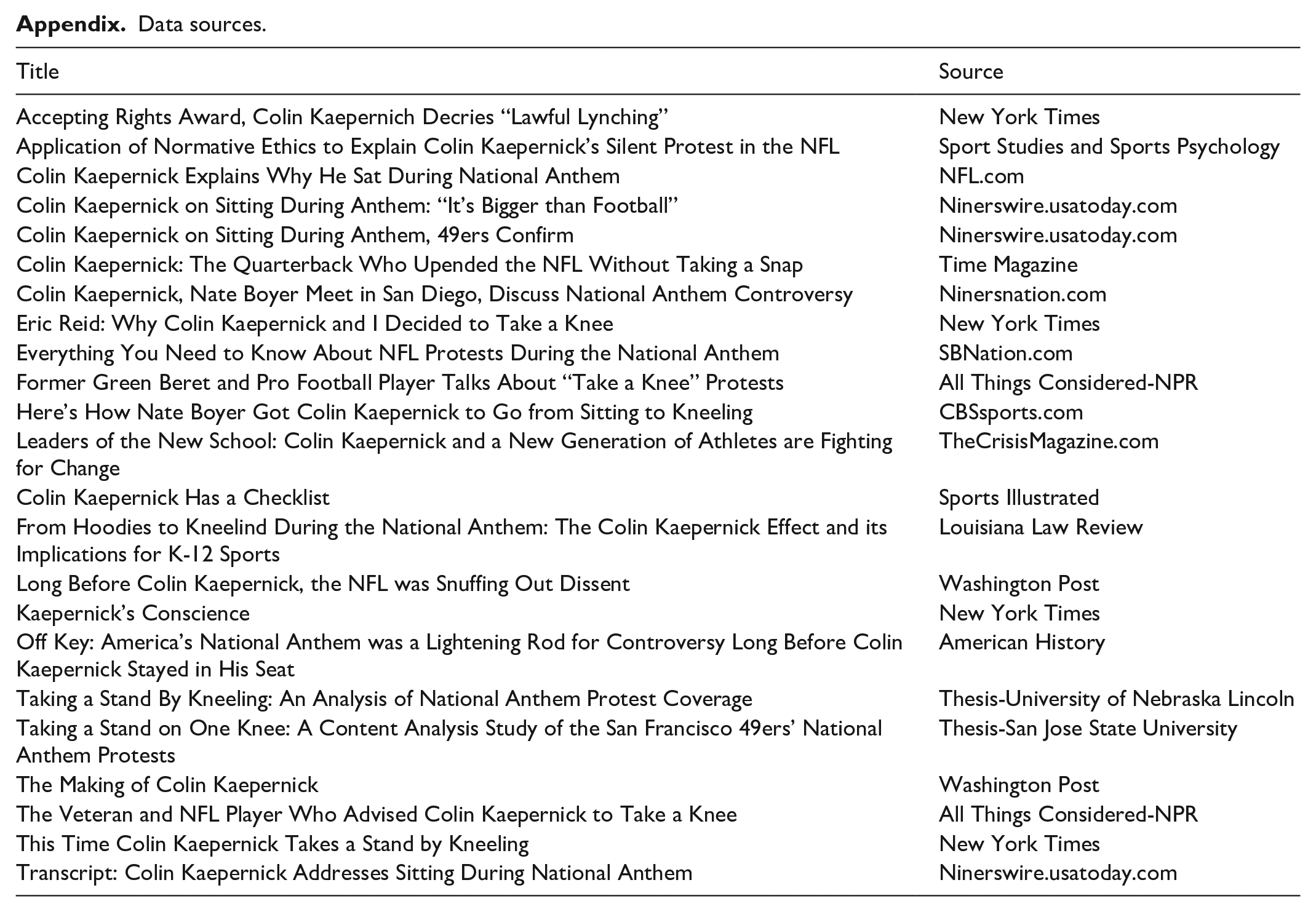
The data under analysis for the current study were documents from online media sources (see Appendix). The data collection for this method was comprised of a document analysis of news reports, articles, interviews and transcripts relating to the events surrounding Colin Kaepernick, Nate Boyer, and Kaepernick’s NFL protest. Data sources included, but were not limited to, online sources such as news outlets, magazines, sports outlets, political sites, and any other online outlets providing fact-based descriptions of the rationale, experiences, history, and conversations of Colin Kaepernick and Nate Boyer. Source data were primarily comprised of comments and information coming directly from Kaepernick and Boyer themselves via quotes captured in print or through audio/video interviews. The corpus was comprised of a total of 23 documents which were managed, stored, and analyzed in Atlas.ti qualitative data analysis software version 8.4.0.
Analysis
Preparing and reading transcripts
From the documents collected for this study, the authors were able to construct a timeline of events detailing Colin Kaepernick’s protest activities. By thoroughly reading and rereading news reports, magazine articles, and interview transcripts, a picture emerged of the context out of which the protest evolved, the horizons of the two men involved (Kaepernick and Boyer), and an altogether different interpretation of the events than the one commonly heard in the narratives surrounding the protest. In what follows, the authors provide a generalized summary of events based on the document review conducted, followed by our PH guided analysis of events derived from the conjectures and interpretations we generated while reviewing the documents.
A summary of the incidents leading to the protest
The act of kneeling during the National Anthem that took place on September 1, 2016, though it garnered the most attention, was not the initial act of protest by Colin Kaepernick, a black NFL quarterback. His protests actually began not with kneeling but with sitting on the bench for the National Anthem during the San Francisco 49ers’ first preseason game on August 14th, 2016 (Tynes et al., 2017). This “sitting” protest, as well as a second one at the following preseason game on August 20th, both went unreported by the media (Tynes et al., 2017). Fate would intervene however during Kaepernick’s third sitting protest on August 26th, 2016 in a game against the Green Bay Packers. While sitting for the National Anthem a third time, a reporter tweeted a picture of the field which happened to show Kaepernick sitting on the bench away from teammates who were standing for the National Anthem. The following day, August 27th, while addressing questions about his sitting for the National Anthem, Kaepernick responded by saying “I am not going to stand up to show pride in a flag for a country that oppresses black people and people of color” (Wyche, 2016). From that moment onward, the Kaepernick controversy was officially underway.
While the events above detail the initial stages of Kaepernick’s protests, none of his actions to this point included kneeling. Enter into the picture, Nate Boyer. As a Green Beret and former NFL football player, Boyer was moved enough by Kaepernick’s sitting protest to pen a letter to him. In his letter to Kaepernick, Boyer, who is white, emphasized his love for America, his anger upon first seeing Kaepernick sitting, and his status as a proud serviceman in the military (Boyer, 2016). Boyer’s letter also recognized the pervasiveness of racism in American society, Kaepernick’s inalienable right to express himself in whatever manner he saw fit, and Boyer’s desire to learn more about the injustices Kaepernick pointed out (Boyer, 2016). Both compelling and heart felt, Boyer’s letter was published online and eventually made its way to Kaepernick. After reading the letter, Kaepernick invited Boyer to a meeting in San Diego, California to discuss the issue in person. On September 1, 2016, after a 90-minute meeting where the two men discussed their views openly with one another, Boyer was invited by Kaepernick to be his guest at the San Francisco 49ers’ preseason game later that day (Fucillo, 2016). At the game hours later, and as a result of their meeting, Colin Kaepernick began his kneeling protest during the National Anthem.
PH interpretations of the Kaepernick protest
As we initially uncovered the background of the Kaepernick protest through the reading of media reports and other documents, the hermeneutic nature of the task was not lost on us. We came to realize, the act of reviewing the literature was itself a hermeneutically informed act. As researchers, our historically effected consciousness came into play with information processing and conjecture making. The first author is a black male, a football fan, and is a member of a black fraternity like Kaepernick. The second author is a black female, has a black husband and son, and a football fan as well. Both authors are acutely aware of the history of black men in America, both have knowledge of systemic racism, and the various ways black Americans have resisted racism and oppression. Additionally, both are graduates of HBCUs, have significant cultural pride, and have substantial doctorate level training in qualitative analysis- which includes PH. As mentioned, the authors’ historically effected consciousness, which gave way to our personal horizons, were responsible for choosing the Kaepernick protest for analysis in the first place. As our thoughts, ideas, and conjectures began to unravel, what became clear was that a two-tiered project of interpretation was underway. As the attempt to gain an understanding of the Kaepernick situation progressed via document review, it became evident that a project of understanding also took place between Kaepernick and Boyer. Resulting from this dual realization, the authors determined that both of these hermeneutic circles, the authors’ with this study, and Kaepernick and Boyer’s, were best addressed through the lens of PH, a framework for elaborating the conditions necessary for understanding to take place.
RQ1: What experiential understandings produced the Kaepernick protest?
Both the sitting and kneeling protests that Kaepernick engaged in were the product of a historical context of racism, discrimination and oppression that has plagued American society since its founding. From his very first statement about his protests he spoke from a position firmly rooted within his historically effected consciousness. Kaepernick’s statement that “I am not going to stand up to show pride in a flag for a country that oppresses black people and people of color” anchors his activism in race-based brutality of the past and the present. In the years prior to Kaepernick’s protest several prominent cases of blacks dying at the hands of police rocked the country. The sensationalized deaths of Eric Garner, Mike Brown, and Tamir Rice in 2014, Freddie Gray in 2015, and Alton Sterling and Philando Castille in 2016, were all at the hands of police and to date, no officers have been convicted and jailed for any of the deaths. These killings were deemed even more questionable due to research documenting the fact that black men are over 21 times more likely to be killed by police than their white counterparts (Gabrielson et al., 2014). These incidents represent the present context of injustice within which Kaepernick was living.
Additionally, these incidents represent the continuation of a history of antagonism between police and the black community. Speaking to this frustration Kaepernick said “There is police brutality. People of color have been targeted by police. So that’s a large part of it. . ..” In another quote Kaepernick reinforced the point that police brutality was behind his protests by saying “There’s a lot of things that need to change. One specifically? Police brutality. There’s people being murdered unjustly and not being held accountable. People are being given paid leave for killing people. That’s not right.” By focusing intensely on the fact that police are seldomly held responsible for the black blood they spill, Kaepernick is highlighting the impunity with which police engage in the terrorizing of black communities. But this is far from a disconnected passion. In addressing a question about if he himself has experienced ill treatment from police Kaepernick responded,
Yes, multiple times. I’ve had times where one of my roommates was moving out of the house in college and because we were the only black people in that neighborhood the cops got called and we had guns drawn on us. Came in the house without knocking, guns drawn on my teammates and roommates. So I have experienced this.
By highlighting the systemic, institutionalized and ongoing targeting and oppression of the black community by police, Kaepernick’s words and actions are akin to athletes in decades past who used their platforms to stand up and speak out against injustice.
There were also political realities that fueled Kaepernick’s understanding as well. One of the issues that he was most vocal about was the negative social climate created that demonized black men in society. By pointing to political leaders as some of the main culprits, Kaepernick has linked his protest with the history and traditions of the criminalization of the black community. He asserts, “You have Hillary who has called black teens or black kids super predators, you have Donald Trump who’s openly racist. . .So, what is this country really standing for?” In spotlighting police brutality, Hillary Clinton’s vocal support of draconian measures that fueled the mass incarceration of black men during the 1990s, and the many racist comments spewed by President Donald Trump, Kaepernick combined his experiential understandings of the past and present with his personal horizon to form a fusion of horizons that ultimately culminated in his act of protest.
RQ2: What experiential understandings were produced by Kaepernick’s protest?
Almost from the outset, the stance Colin Kaepernick took had reverberations throughout the country. One of the first responses to Kaepernick’s protest came from his team, the San Francisco 49ers. In an official public statement in support of Kaepernick, the organization wrote that, “In respecting such American principles as freedom of religion and freedom of expression, we recognize the right of an individual to choose and participate, or not, in our celebration of the national anthem” (Tynes et al., 2017). This statement, while lauding the principles of freedom and individual rights, made no comment at all about the reasons given by Kaepernick for his protest, those being racial injustice and police brutality.
Fan reaction to Kaepernick’s protest was mixed. By 2018, nearly two-thirds of Americans believed that athletes should be required to stand while the anthem is being played (Tigabu, 2018). As with most things in American society however, there are stark differences in perceptions between blacks and whites. Interrogating the numbers further, we find that while 66% of whites believed athletes should stand for the anthem, only 28% of blacks felt the same way (Tigabu, 2018). Mirroring this racial difference, nearly half of American whites (45%) as opposed to only 26% of blacks felt that professional athletes making political statements bothered them (Tigabu, 2018). Indicative of the division between his supporters and detractors is the fact that, at the same time that Colin Kaepernick was polling as the most despised professional football player, his jersey was found to be the most purchased jersey of all NFL players (Heitner, 2016).
The most prevalent meanings people derived from Kaepernick’s protest was their understanding of it as being anti-police, anti-military, and disrespectful of the flag, in short, “unamerican.” By sitting, then kneeling for the national anthem, many throughout the country believed Kaepernick to be disrespecting the flag by protesting. Despite Kaepernick giving the exact reasons for his protest (police brutality and racial injustice), many persisted in the belief that his protest was anti-military. The interpretation of the act as being “anti-military” was in no way due to Kaepernick not explaining his motives or clarifying his position on the military. In fact, in one of the early press conferences after his sitting protest he clarified,
I have great respect for the men and women who have fought for this country. I have family, I have friends that have gone and fought for this country. And they fight for freedom, they fight for the people, they fight for liberty and justice for everyone. . .People are dying in vain because this country isn’t holding their end of the bargain up, as far as giving freedom, justice, liberty to everybody. That’s not something that’s happening.
In broadcasting his unequivocal support for the men and women of the military, Kaepernick is insisting that his issue is with certain racial groups not experiencing the freedoms and liberties that the men and women of the military fight and die for. By pointing out that “people are dying in vain” he is pointing out the tragic irony of those who give their life for freedoms that go unrealized in American society.
Despite his full-throated allegiance with and support of the military, many throughout the country still understood his act to be anti-military and anti-American. Kaepernick, to his credit, took measures to attempt to set the record straight. In one instance he remarked, “I know a lot of people’s initial reactions thought it was bashing the military, which it wasn’t. That wasn’t my intention at all.”
Kaepernick’s own testimony wasn’t enough to dispel feelings and interpretations of his protest as being in some way against the military or America itself. To show just how entrenched the “anti-military” and “anti-police” narrative became, Nate Boyer, himself a former NFL athlete and Green Beret, could not deter those from interpreting the act as anti-American. In an effort to clarify the record himself, Boyer, speaking on the fact that Kaepernick’s first kneeling protest took place on the day of military recognition in the NFL, proclaimed that,
It was military appreciation day in the stadium. 9/11s approaching. And he was sensitive to that. . .He didn’t want to offend veterans. He didn’t want to offend people in the military and even police officers that do it the right way every day.
As the researchers grappled to understand the persistence of this misattribution of Kaepernick’s protest, we were reminded of a meme that has since floated around social media platforms. The meme reads, “Racism is so American that when we protest racism the average American assumes we’re protesting America”. In this simplistic phrasing, the history, traditions, and prejudices that combine to form many Americans’ historically effected consciousness, insist that Kaepernick’s display of anti-racist activism is, in fact, an act of anti-Americanism. No matter what Kaepernick said his reasons and intentions were, for some, protesting racism is protesting America.
Seen in light of the strong proclamations of both Kaepernick and Boyer, the pervasive meanings associated with Kaepernick’s protest, most notably the “anti-military” and “anti-American” understandings of the act, reveal the power of the prejudices, foreknowledge and horizons that people bring to their interpretation of a phenomenon. These pervasive sentiments, are also indicative of a closedness, a refusal to be open to the horizons of an “other” (Kaepernick in this case), and hence, a refusal to even enter into the hermeneutic circle.
There was however a great degree of openness that was directed toward Kaepernick. While he did indeed have his supporters on his team, among other athletes, and in society at large, perhaps the most surprising show of support, given the mischaracterizations of his protest as “anti-military,” came from soldiers themselves. The outpouring of support from veterans was exemplary of the openness needed to form a fusion as depicted by PH. In undergoing this fusion, military members may not have been agreeing with Kaepernick’s protest or his reasons, but they were absolutely in agreement with his right to carry out his silent protest. Their understanding that their military service ensured that right was the catalyst behind the openness that caused their horizons to fuse with Kaepernick’s.
One of most visible ways these military members expressed their support of Kaepernick was via Twitter. Two of the more popular hashtags that began trending during that time were #VeteransForKaepernick and #TakeaKnee (Jacobo, 2017). Posting pictures of themselves kneeling, many veterans voiced support for Kaepernick and his silent protest. Examples include a WW II vet, “My grandpa is a 97-year old WWII vet & Missouri farmer who wanted to join w/ those who #TakeaKnee: ‘Those kids have every right to protest’”; Jean Valjean Ralphio,“I’m a vet and I’ll #TakeaKnee #VeteransForKaepernick”; Jason of the Third Estate, “I took an oath to defend the Constitution, not the flag. . .”; And CharlesJimPetosky, “#VeteransForKaepernick. I’ll take a kneel against injustice and oppression before I stand with those who turn a blind eye to it” (Jacobo, 2017).
As members of the military, those vocal supporters of Kaepernick and his right to protest exhibited a keen understanding of his rights as a citizen as well as the true meaning of their sacrifices as military members. In displaying this degree of openness to Kaepernick’s actions, they weren’t necessarily agreeing with him or his cause. In the fusing of horizons that Kaepernick’s protest produced with them, total agreement was not necessary, only the willingness for those military members to see things from a perspective other than their own.
RQ3: How can PH help us understand Kaepernick’s act of protest?
In the last interpretive finding of the current study, the authors will offer analysis of how PH can help us to understand Kaepernick’s act of protest itself. In doing so, we will continue to draw from PH’s concepts to offer our interpretation of the act that sparked a controversy.
History/horizons/foreknowledge
To interpret the act of protest itself, we must first consider the two participants, Colin Kaepernick and Nate Boyer. In considering the history, horizon and foreknowledge of the two, certain biographical considerations are warranted. Colin Kaepernick’s horizon is one of a bi-racial child adopted by white parents at the age of 5 weeks old (Babb, 2017). Kaepernick’s life was one filled with never really fitting in. While a gifted athlete and student, his awkwardness was as pronounced as his benevolent and selfless spirit (Babb, 2017). In college on a football scholarship, Kaepernick gravitated toward black teammates and students, so much so, that he eventually pledged Kappa Alpha Psi, a traditionally black fraternity. His constant quest for identity forged in him an openness to the plight and experiences of others (Babb, 2017). Always willing to listen and learn, Kaepernick’s sense of identity became tied to random acts of kindness and a straddling of racial lines (Babb, 2017). In the months preceding his protest, Kaepernick became more and more vocal about the injustices perpetrated against blacks by police. Flooding his social media accounts with posts referencing police killings of blacks, Kaepernick became resolved to stand up and be heard by sitting down and being silent.
For Nate Boyer, his horizon is one of a humanitarian/warrior with a will to succeed that is unmatched. Moved by the events of 9/11, Boyer immediately decided to enlist in the Army to spread the freedoms we enjoy here to those who long for them overseas. But his enlistment would have to wait because, at the age of 23, Boyer was in Africa doing relief work in the refugee camps of Darfur (Wilkerson, 2012). Soon after returning from his humanitarian work in Africa, Boyer enlisted in the United States Army and, right after basic training, signed up for the Green Beret special forces group (Wilkerson, 2012). After 6 years on active duty and multiple deployments, Boyer decided to go to college. Using his GI Bill, Boyer enrolled at the University of Texas. It wasn’t long before Boyer decided to try out for the football team. As a 31-year-old walk on who’d never played football, the odds were against him. But, Nate’s history of meeting all challenges head on resulted in him making the team as a safety, ultimately earning a scholarship, transitioning to a starting long snapper, and earning multiple academic and service honors (Wilkerson, 2012). Although Boyer ultimately made it to the NFL via the Seattle Seahawks, he was let go during the preseason and never actually played a regular season NFL game.
Prejudices
In delineating the prejudices that may have been at play with Kaepernick and Boyer, the primary identities they adopted serve as the foundation for the various ways that their prejudices interpret and interact with the world. For Kaepernick, his “pre-judgments” of the world are informed by his experiences of being a bi-racial child who identifies as black. By enveloping himself in the history and traditions of the black community, his judgments on the world and circumstances in the world, come from the vantage point of an oppressed minority in a society steeped in systemic, institutionalized racism. From this horizon, Kaepernick sees his role as helping those less fortunate and being a voice for the voiceless. This way of seeing himself enables him to approach situations with an eye toward justice and the doing of good.
For Boyer, his pre-judgments of the world stem from his deep sense of commitment to democracy and humanity. As a proud veteran, Boyer takes seriously his oath of loyalty to his country. As a humanitarian, Boyer also sees the world through compassionate eyes. His outgoing nature coupled with his willingness to learn enables Boyer to confront challenges with a strong sense of determination. The combination of determination, pride, patriotism, and humanitarianism combine in Boyer to produce a predisposition toward intense dedication and focus toward understanding and helping.
Openness/dialog/conversation
As has been shown, openness is vitally important in PH in order to understand an “other.” In addition to an openness to considering the position of the other, an openness to engage in meaningful dialog and conversation is also necessary. For Gadamer (1994: 385), “conversation is a process of coming to an understanding.” This was exemplified by both Kaepernick and Boyer throughout their interactions around Kaepernick’s protest. On the one hand, Kaepernick, true to his history of exhibiting openness and a willingness to engage others, frequently made reference to his desire to open up dialog. One of the very first conversations he had around his actions was with his teammates. About those talks he said,
It was a conversation. They asked me to talk and just explain why I did what I did. And why I felt the way I felt. I had an open conversation with them. . .I opened it up to all my teammates. Come talk to me if you have any questions. If you want to understand what I’m thinking further, come talk to me.
This openness to dialog was also exhibited by Boyer. Not knowing Kaepernick, Boyer’s first act of reaching out was to pen an open letter to Kaepernick. Published online at Army Times, the letter displayed Boyer’s openness and sincere willingness to dialog with such comments as,
Even though my initial reaction to your protest was one of anger, I’m trying to listen to what you’re saying and why you’re doing it.
This was followed up with,
There are already plenty people fighting fire with fire, and it’s just not helping anyone or anything. So I’m just going to keep listening, with an open mind.
In both statements, Kaepernick and Boyer displayed an uncanny ability to open themselves and their horizons up to dialog. In Gadamerian terms, they both possessed the willingness to put their prejudices “at risk” (Gadamer, 1994: 299) by engaging and entertaining each other’s horizons. In furtherance of this openness and willingness to dialog, Boyer expressed a desire to meet with Kaepernick and Kaepernick invited Boyer to meet with him after reading his letter. It was this 90-minute meeting that took place on September 1st, 2016 that would prove to be consequential. It was this face to face meeting between Kaepernick and Boyer that would offer up the opportunity for them to enter into the hermeneutic circle.
Hermeneutic circle
From what can be gathered about their 90-minute meeting, the conversation between Kaepernick and Boyer was open, honest, and sincere. According to Babb (2017),
They met in a hotel lobby, and Kaepernick listened as Boyer shared stories from the battlefield and recovery rooms. The player had never thought of it from that perspective, didn’t know — before Boyer pointed it out — that the Chargers would be honoring current and former military personnel that evening before kickoff, hadn’t fully considered the passion and fury he was igniting on either side.
This passage shows that Boyer presented information that caused a shift in Kaepernick’s horizon. His vantage point in viewing the situation had changed after receiving information he had not previously known or considered. Boyer also encountered the dialogic nature of the hermeneutic circle as well. Initially, Boyer attempted to get Kaepernick to stand for the anthem instead of sitting on the bench away from his teammates. That suggestion was rejected by Kaepernick. As Boyer recounts,
So, you know, I urged him to stand and then take action because that’s really how this change will happen. And he said, no, I’m committed to sitting until I feel that things are changing and that we’re moving in the right direction
Kaepernick’s rejection of Boyer’s suggestion to stand is in no way a closing or an obstinate way of shutting down the hermeneutic circle. If we recall, the openness necessary throughout the process of understanding does not require the rejection of one’s own horizon or prejudices. Openness begins with simply remaining open to the other person’s account. In this instance, we simply see that Kaepernick is not relinquishing his horizon. The fact that Kaepernick continued to remain “open to the meaning of the other person” is shown when, during the hermeneutic circle of the conversation, Boyer made another suggestion, for Kaepernick to kneel. According to Boyer, Kaepernick was, “Very receptive. He said, ’I think that would be– I think– I think that would be really powerful.” As history shows, Kaepernick’s adoption of Boyer’s suggestion to kneel was indeed powerful.
Fusion of horizons
From the meeting between Colin Kaepernick and Nate Boyer came the joint agreement for Kaepernick to kneel. Coming into the meeting, Kaepernick’s horizon and prejudices had manifested in his act of sitting during the anthem as a form of silent protest. For Boyer, previous to the meeting, his horizon and prejudices had manifested in anger at Kaepernick’s decision to sit during the anthem and were further revealed in Boyer’s attempt during their meeting to get Kaepernick to stand. Despite the starkly contrasting vantage points of each, both Kaepernick and Boyer exhibited an openness to put their horizons and prejudices at risk through dialog via the hermeneutic circle they engaged in during their September 1st meeting. Out of this dialogic encounter came a fusion of horizons, the act of kneeling. In describing the moment Boyer relates that, “We sorta came to a middle ground where he would take a knee alongside his teammates.” The act of kneeling, in this instance, becomes a physical manifestation of their fusion of horizons.
Discussion
By subjecting the kneeling protest of NFL quarterback Colin Kaepernick to a hermeneutic analysis, the authors were able to understand individuals and events in a way different than commonly viewed. In doing so, the current study contributes to an ever-increasing body of research that draws upon the PH of Hans-Georg Gadamer as its methodological foundation. Using Gadamerian concepts such as historically effected consciousness (history, prejudice, foreknowledge), dialog/conversation, the hermeneutic circle, and the fusion of horizons as a framework for analysis, the current study represents what may be the first time PH was used to grasp the deeper meanings and understandings of a major, contemporary event.
In approaching this study, we viewed it in the way that all interpretive analysis is conceived of, as a “movement through the landscape of the topic” (Moules et al., 2015: 118). The free-flowing movement allowed us to address the research questions through interpretations that added clarity and meaning to events. By offering insights into the personal, social, and political antecedents in the life of Colin Kaepernick, descriptions of Kaepernick’s historically effected consciousness were incorporated to broker an understanding of the experiential realities that paved the way for his protest. By highlighting the varying interpretations that were produced by Kaepernick’s actions, the vantage points of his detractors showcase the horizons from which they view the world, and through which they often misunderstood and mischaracterized the meaning of his act of protest. And by foregrounding instances of history, prejudice, dialog, the hermeneutic circle, and the fusion of horizons, this study presented a view of Kaepernick’s act of kneeling as a hermeneutic act itself, a physical manifestation of the merging of two horizons.
In these ways, the current study is itself meaningful. The topic is worthy due to its relevant, timely, and interesting nature. The study represents a significant contribution due to its heuristic and methodological value. This study has meaningful coherence due to the interconnection of the literature, research questions, and findings. And, this study has resonance due to its evocative representation and transferability. In short, this study satisfies several of Tracy’s (2010) “big tent” criteria for quality and excellence in qualitative research.
The nature of the hermeneutic analysis of the current study lends itself to certain limitations. One of the hallmarks of PH and hermeneutics in general is the lack of a definitive method. While this serves as one of the strengths and appeals of hermeneutic analysis, it can also prove to be a limitation. Lacking a clear definitive course of action lends itself to myriad “ways of doing” research. Many times, the lack of a firm methodological approach jeopardizes a study by running the risk of it being poorly done. This limitation of hermeneutic analysis in general is also applicable to the current study. Future studies may also endeavor, as much as possible, to carry out their own interviews with those featured in the study. Relying solely on documents for an analysis limits the availability of information and the number of questions that can be answered.
Conclusion
This study sought to utilize Hans-Georg Gadamer’s PH as an interpretive, methodological framework. For qualitative researchers, this study adds to the ever-increasing body of hermeneutic studies employing PH as a methodological foundation. By laying out the tenets of PH and offering an example of their application to a provocative and relevant real-world event, these findings strengthen the use of PH as a viable methodological option for qualitative studies. For the lay person, these findings are also a valuable tool in furthering real-world instances of dialog, discussion, and other forms of interpersonal communication, particularly those of a contentious or oppositional nature. As shown by this study, Gadamer’s PH represents not so much a step by step blueprint for achieving understanding, but rather, a foregrounding of the conditions and processes necessary for understanding to take place. By highlighting the example of Colin Kaepernick and Nate Boyer, this study shows that, more than being just an abstract philosophical theory, PH can actually bear real fruit in both our research practitioner lives and our personal lives as well.
Footnotes
Appendix
Data sources.
| Title | Source |
|---|---|
| Accepting Rights Award, Colin Kaepernich Decries “Lawful Lynching” | New York Times |
| Application of Normative Ethics to Explain Colin Kaepernick’s Silent Protest in the NFL | Sport Studies and Sports Psychology |
| Colin Kaepernick Explains Why He Sat During National Anthem | NFL.com |
| Colin Kaepernick on Sitting During Anthem: “It’s Bigger than Football” | Ninerswire.usatoday.com |
| Colin Kaepernick on Sitting During Anthem, 49ers Confirm | Ninerswire.usatoday.com |
| Colin Kaepernick: The Quarterback Who Upended the NFL Without Taking a Snap | Time Magazine |
| Colin Kaepernick, Nate Boyer Meet in San Diego, Discuss National Anthem Controversy | Ninersnation.com |
| Eric Reid: Why Colin Kaepernick and I Decided to Take a Knee | New York Times |
| Everything You Need to Know About NFL Protests During the National Anthem | SBNation.com |
| Former Green Beret and Pro Football Player Talks About “Take a Knee” Protests | All Things Considered-NPR |
| Here’s How Nate Boyer Got Colin Kaepernick to Go from Sitting to Kneeling | CBSsports.com |
| Leaders of the New School: Colin Kaepernick and a New Generation of Athletes are Fighting for Change | TheCrisisMagazine.com |
| Colin Kaepernick Has a Checklist | Sports Illustrated |
| From Hoodies to Kneelind During the National Anthem: The Colin Kaepernick Effect and its Implications for K-12 Sports | Louisiana Law Review |
| Long Before Colin Kaepernick, the NFL was Snuffing Out Dissent | Washington Post |
| Kaepernick’s Conscience | New York Times |
| Off Key: America’s National Anthem was a Lightening Rod for Controversy Long Before Colin Kaepernick Stayed in His Seat | American History |
| Taking a Stand By Kneeling: An Analysis of National Anthem Protest Coverage | Thesis-University of Nebraska Lincoln |
| Taking a Stand on One Knee: A Content Analysis Study of the San Francisco 49ers’ National Anthem Protests | Thesis-San Jose State University |
| The Making of Colin Kaepernick | Washington Post |
| The Veteran and NFL Player Who Advised Colin Kaepernick to Take a Knee | All Things Considered-NPR |
| This Time Colin Kaepernick Takes a Stand by Kneeling | New York Times |
| Transcript: Colin Kaepernick Addresses Sitting During National Anthem | Ninerswire.usatoday.com |
Declaration of conflicting interests
The author(s) declared no potential conflicts of interest with respect to the research, authorship, and/or publication of this article.
Funding
The author(s) received no financial support for the research, authorship, and/or publication of this article.
