




Abstract
Narrative inquiry is relational inquiry in which inquirers come alongside the living, telling, re-living, and re-telling of stories . In this article, I present how I adapted narrative inquiry to explore parent perspectives of their gifted adolescent daughters’ experiences of belonging. At the time, I was conducting this study as part of my doctoral dissertation work and as a novice researcher, I struggled with (1) gaining access by a school district to interview adolescent students, (2) believing I could relationally come alongside adolescents as an outsider, and (3) questioning their developmental ability to think reflectively about their stories of belonging. Ultimately, I had to rethink my narrative inquiry approach. Here in this article, I share how I re-conceptualized my methodological approach as (re)fractional narrative inquiry to better understand gifted girls’ experiences from the perspectives of those who have relationally lived alongside them. I also present the context and methods of the study, provide a sample of co-negotiated narratives, discuss justifications of my inquiry, and conclude with reflections and evaluations of my adaptations.
In spaces of educational research, gaining access to adolescent voices as an outside reader can be challenging. My line of research explores the storied lives of gifted adolescent girls and aspects of how their giftedness influence their social and emotional well-being, and for this study, I was interested in learning more about their stories of belonging as part of my dissertation research. When my initial attempts to recruit gifted students for my narrative inquiry study were denied by a school district, I was forced to either change my study completely or reconsider my approach to accessing these stories. I also wrestled with whether I could relationally come alongside adolescents as an adult researcher knowing I would likely face unequal power dynamics of the researcher-researched relationship interviewing minors (see Eder and Fingerson, 2001; Mayall, 1999). Even more so, my methodological supervisor challenged me to think about the one-on-one interview process with adolescents. Her prompt of “How reflective can adolescents really be?” was a helpful and fair critique of my initial aims. To explore the storied lives of gifted girls, I had to re-conceptualize my approach.
This article focuses on how I creatively turned Clandinin’s (2013) narrative inquiry approach to explore the storied lives of gifted adolescent girls within social and institutional narratives related to school. To start, my participants were mothers of gifted adolescent girls, and through a series of interviews, they retold stories of relationally living alongside their daughters and offered interpretations of how their daughters experienced interactions of giftedness and belonging. The mothers’ stories of their daughters’ stories were the phenomena under study. I believe my creative adaptations, which I call (re)fractional narrative inquiry, tease traditional boundaries of how we explore the storied lives of others. Yet, my adaptations created significant tensions as I attempted to locate myself in the landscape of narrative inquiry. In this article, I present my initial framework for my methodological adaptations, my positionality as researcher, a brief overview of adolescent giftedness and belonging, the context and methods of my inquiry, a discussion of my justifications, and conclude with a thorough reflection and evaluation of my methodological adaptations and tensions, including limitations and considerations.
Conceptualization of (re)fractional narrative inquiry
The methodological adaptations I present in this article build from the foundations of narrative inquiry (NI) as defined by Clandinin and colleagues (e.g. Clandinin, 2006; Clandinin et al., 2007; Clandinin, 2013; Clandinin and Connelly, 2000; Connelly and Clandinin, 2006). This includes working within theoretical and conceptual schema of a Deweyan theory of experience (Dewey, 1938); the prioritization of thinking with stories as opposed to about stories; the three-dimensional narrative inquiry space of temporality, sociality, and place; social, personal, and practical justifications; and most importantly, NI as relational inquiry (Clandinin, 2013). According to Clandinin (2013), We intentionally put our lives alongside an other’s life. In that intentionality we are attending in relation to our own life and to others’ lives, to the present time and to other times, and to this place where we meet and to other places. (p. 23)
Narrative inquirers come alongside participants to think narratively about their participants’ experiences, their own experiences, and the experiences that come from living and telling stories in the context of inquiry. This relational living alongside our participants helps us to think along a continuum of experience. Through negotiating and writing narratives with our participants, we become knowers and tellers of stories that are (paradoxically) both (a) bound to a place and time and (b) boundless—our experiences are influenced by our experiences that happened in the past and will inevitably influence experiences that happen in the future (see Dewey, 1938). From this framework, Clandinin (2006) suggests individuals cannot be understood as individuals alone, but only in relation to others and in a social context. In this study, I believed mothers had a much closer relational knowing of their daughters than I ever would as an outside researcher.
In early stages of designing this inquiry, I was inspired by my experiences in the field of giftedness and creativity (see Researcher Positionality). When we think creatively, we aim to think originally, break boundaries, and consider ideas from different perspectives (see Torrance, 1962, 1979). Our ability to think complexly means we “have the capacity to challenge our patterned, linear thinking by pondering alternatives” (Saldaña, 2015: p. 161). In attempt to ponder creative alternatives to both the process and product of NI for this study, my non-conforming intentions required risk-taking and breaking boundaries of how I had conceptualized myself as a narrative inquirer. I was also inspired by Richardson and St. Pierre’s (2018) sentiment: “There is no such thing as ‘getting it right,’ only ‘getting it’ differently contoured and nuanced” (p. 822). Although Richardson and St. Pierre were referring to postmodern writing, this sentiment speaks to my thinking of exploring boundaries of relational inquiry and NI and choosing a term such as (re)fractional to re-present my methodological intentions.
The term (re)fractional represents two overlapping sentiments. First, I use the term refractional to represent the deflection, bend, or oblique turn of stories from one individual to another. I purposefully designed the process of inquiry to not take the most direct route, and although my participants had lived alongside their daughters daily, they were still oblique or turned interpretations of their daughters’ experiences. Second, I use the term fractional to signal that the narrative product is only a portion of the greater story. My inquiry was but a glimpse into the lives of gifted girls’ childhood and adolescent experiences and is not cumulative representation. (Re)fractional thus represents my exploration of stories through others’ interpretations, knowing that others’ knowing, telling, and retelling of stories will be (at best) only a piece of an individual’s storied experience. More so, mothers shared their perspectives of their daughters amid their own cultural and familial stories and thus the re-presentations of their daughters’ experiences are embedded in their own experiences.
The refractional element of my approach to NI was, as a novice researcher at the time, a bold one. I bent the framework of relational inquiry to fit my program of research and mitigate skepticism that I could truly, relationally, come alongside their adolescent experiences as an outside researcher. The mothers of this study had lived relationally alongside their daughters since birth, and I believed they had unique perspectives and interpretations that could speak to the continua of their daughters’ experiences. Indeed, this created an inherent limitation from the start—I was exploring the stories of gifted adolescent girls without inquiring with the girls themselves. Therefore, these narratives should be read and understood only through the interpretive lenses of their mothers’ observations and relational living alongside their daughters. I discuss additional reflections of this limitation later in this article.
Research positionality
At the time of this inquiry, I was a doctoral student in an educational psychology program with a concentration in gifted and creative education. I was actively researching the lived experiences of gifted adolescent girls in the U.S. while also working for a creativity research center at my institution. I frequently led presentations and trainings related to recognizing and fostering characteristics of high creative potential in children and adolescents. Prior to my graduate work, I spent 5 years as a classroom educator teaching mathematics to adolescents (Grades 6–12) and specialized in teaching advanced or compacted mathematics curriculum to high achieving students. I had witnessed first-hand how smart girls navigated the classroom both academically and socially and how some of their behaviors and aspirations were informed (and limited) by traditional gender norms. My specific research interests among gifted adolescent girls continue to evolve with consistent emphasis on supporting creative potential, exploring social and emotional needs, and identifying unique experiences in the social landscape of school.
A brief orientation to gifted adolescent girls and belonging
Over the years, educational and psychological fields have formed several conceptions and theories of giftedness including historical, IQ-based, and non-IQ based conceptualizations (see Misset and McCormick, 2014 for a full discussion). Although a full presentation of these conceptualizations is beyond the scope of this article, understanding the general nature of giftedness and its influence on the social and emotional needs of individuals, particularly children and adolescents, will help guide readers unfamiliar with this area of research. Understandings of giftedness vary across the globe and are ultimately shaped by cultural values, norms, and educational policies. The presentation of giftedness that follows is rooted in how researchers and organizations in the United States (U.S.) have conceptualized gifted, talented, and high-ability students. I present concepts related to both schooling in the U.S. and social and emotional development since my line of inquiry in this study prioritized belonging amongst the social landscape of school.
In education, conceptualizations of giftedness vary from institution to institution (e.g. associations, school districts, schools). At their core, many define gifted students as students who demonstrate high performance or capabilities of high performance across domains of intelligence, academic achievement, motivation, and/or creativity and thus “require modification(s) to their educational experience(s) to learn and realize their potential” (National Association for Gifted Children, 2021). Educational modifications may include differentiated curricula, enrichment opportunities, or grade level acceleration to name a few. Essentially, an institution’s conceptualization of giftedness guides its chosen methods for identifying students for gifted programing.
To support gifted children’s holistic development, stakeholders must also see to their social and emotional needs. A gifted child’s intellectual capacity, by definition, exceeds the norm for their age, but their emotional or physical development may remain the same as their peers’. This concept of asynchrony or developing out-of-sync with the norm is an elemental factor associated with social and emotional conceptualizations of giftedness (see Silverman, 1997, 2012; Wiley, 2016; Wiley and Hébert, 2014). For example, as Guilbault and Kane (2016) suggest, a 5-year-old who can cognitively understand difficult concepts such as death and social justice, may not be unable to emotionally process or handle such life experiences. Moon and Dixon (2006) described this as gifted children experiencing “cognitive adolescence” earlier than their peers. An 8-year-old may have the cognitive capacities of a 14-year-old and so her interests may drastically differ from her other 8-year-old peers. Since children in the U.S. are most often grouped in school based on biological age, gifted children with exceptional intellectual abilities may have trouble relating to their same-aged peers (see Cross, 2016). Coleman’s (1985) stigma of giftedness is one framework that has helped identify the unique social and emotional experiences and how they navigate peer relationships. Gifted children and adolescents may develop social coping strategies to manage this stigma among their peers (see Coleman and Cross, 2014; Coleman et al., 2015; Cross et al., 2014) and ultimately feel “lonely at the top” (Peterson, 2009) wishing they had close relationships with others who shared similar stories of belonging (see Guthrie, 2020).
Related to gifted girls specifically, gifted education and counseling fields have been heavily influenced by Barbara A. Kerr and Robyn McKay’s research. One topic of their 2014 work, Smart Girls in the 21st Century: Understanding Talented Girls and Women, discusses how gifted girls navigate social relationships. For many gifted girls, the adolescent “culture of romance” can leave them feeling torn between prioritizing the search for a romantic relationship and pursuing their academic or intellectual interests. The energy once directed to intense interests in reading, writing, math, science, music, or art is often (mis)directed to the pressure of being pretty and popular (Kerr et al., 2012). Although the field of gifted education continues to explore frameworks of gender and giftedness, much of our current understanding of gender differences lacks focused lines of research to draw any strong conclusions (Callahan and Hébert, 2014). The study I present here aimed to continue my own line of research into the storied lives of gifted girls.
Also, there is longstanding research on characteristics of highly creative individuals that, for the topic of this study, render important considerations. Creative girls tend to be highly original, curious, open, intuitive, independent, empathetic, and perceptive (Kerr and McKay, 2014; Lovecky, 1995; Torrance, 1962), but these behaviors may be seen as unfavorable or disruptive in classroom contexts. For example, creative individuals who express high degrees of originality tend to be unconventional, divergent, and “have an unusual talent for disturbing existing organization” (Torrance, 1963: p. 225). They may be stubborn, impatient, critical of others, and persistently question rules/authorities (Tardif and Sternberg, 1988; Torrance, 1962). They may also be less well-rounded (due to their tendency to specialize in an intense interest early on) and lack social and emotional strengths that foster deep interpersonal relationships (Csikszentmihalyi, 1996). These behaviors are not always welcome in classrooms that, perhaps blindly, value conformity and sameness (see Paek et al., 2020; Torrance, 1963; Westby and Dawson, 1995). The gifted girl who speaks her mind and challenges conventional notions often experiences pushback from her peers, teachers, or parents (Kerr and McKay, 2014), and according to Torrance (1963, 1979), highly creative individuals must become comfortable being “a minority of one” (p. 40).
Lastly, I use the term belonging to represent the social desire for one to create and maintain lasting, positive, interpersonal attachments. Human beings are naturally driven to establish and sustain a sense of belonging (Baumeister and Leary, 1995) and according to Maslow (1943, 1962), basic human needs (e.g. sense of love and/or belonging) must be met to support more complex needs (e.g. self-actualization). For gifted girls, belonging reflects her ability to fit in and establish meaningful relationships with her peers and feel valued in those relationships. When the dominant teenage culture values the “ironclad golden rules” of “don’t go against the group” and “do whatever it takes to be in rather than out” (Assouline and Colangelo, 2006: 66), gifted adolescents who question where they fit into the scheme of school and social cliques may have trouble developing a strong sense of self (Ferguson, 2015).
Narrative inquiry innovations: Methods and procedures
The purpose of this study was to explore parent perceptions of how gifted adolescent girls experience a sense of belonging. I was curious about parent perceptions and interpretations of how their gifted daughters navigated social relationships and how those interactions may have influenced their daughters’ sense of self. Instead of searching for a definite answer via a research question, I leaned into Clandinin’s (2013) notion of adopting a research puzzle. A research puzzle carries with it a sense of a continual searching or wondering (Clandinin, 2013). In general, the puzzling questions about gifted adolescent girls that guide my program of research include: What might I learn by inquiring about the experiences of gifted adolescent girls? How might inquiring about their stories of belonging deepen my understanding of how school and social narratives shape the stories they live by (i.e., their identities)? Where do their stories of belonging intersect and bump against institutional and social stories? Specifically for this study, I added: How might inviting mothers to come alongside me in my inquiry provide deeper insight into the temporality, sociality, and place of gifted adolescent girls’ sense of belonging? How could mothers’ interpretations provide insight I might not be able to capture if I had I interviewed gifted girls themselves? How might my inquiry help adults mentor and provide talent development for gifted adolescent girls inside and outside of the classroom? By engaging in this NI study, I hoped the stories presented would be used as channels through which these questions could be explored.
Participants, recruitment, and consent procedures
I recruited and purposefully sampled a total of three participants through my professional and research networks: one participant (Melissa) attended a training I offered for recognizing creative potential in gifted students and the others (Audrey, Kelly) were mothers of girls who had participated in an earlier study of mine. In this inquiry, I had only met one of the girls (Erica) who was a participated in a focus group as part of a previous research study of mine.
Prior to or at the start of each interview, I reviewed the study’s purpose and procedures and offered participants the opportunity to create their own pseudonyms for themselves and their daughters. At the same time, participants signed electronic or paper consent forms confirming their voluntary participation. See Figure 1 for a summary of participants and their daughters. Each participant valued education, had completed one or more college degrees and each held a career in the field of counseling or psychology and worked with children and teens. In turn, they seemed familiar with the construct of belonging and shared what felt like keen insights into their daughters’ experiences.
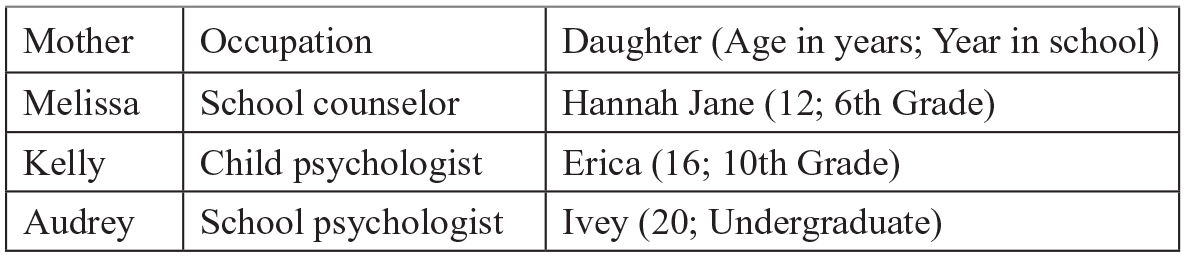
Summary of participants and their daughters.
At the time of inquiry, the ages of the daughters varied, but our conversations remained focused on experiences during pre-adolescence and adolescence. I initially thought speaking with mothers who had daughters at different stages of development (Hannah Jane leaving pre-adolescence and entering adolescence; Erica in adolescence; Ivey leaving adolescence and entering early adulthood) would benefit my line of research; however, to maintain my research for this study, I resisted the urge to compare stories depending on the girls age.
Data collection and analysis procedures: Field texts, interim research texts, and research texts
Honoring Clandinin’s (2013) framework, I use the term field texts to represent the raw data I collected, interim research texts as the narrative drafts my participants commented on and approved, and final research texts to be the final narratives.
For field texts, I conducted a 60–80-minute semi-structured interviews with each participant. When communicating with participants, and as recommended by Clandinin (2013), I referred to our interviews as conversations because I wanted to diminish the power I may have had as a researcher. “Conversations create a space for the stories of both participants and researchers to be composed and heard” (Clandinin, 2013: 45)—which I believed helped set the tone for the next stage of discussing and negotiating each daughters’ narrative. Our initial conversations centered around their conceptualizations of giftedness and their perceptions and interpretations of (1) how their daughters’ giftedness impacted relationships at school and in the home, (2) how their daughters felt about “fitting in” (or not), and (3) how their daughters’ “fitting in” may have impacted their sense of self as a gifted girl. Also, I asked mothers to bring with them a few photographs of their daughters. These photos acted as elicitation devices to help trigger additional stories of their daughters and provided me a greater sense of who their daughters were (e.g. personalities, interests, etc.). In a sense, seeing pictures of their daughters helped remind me, the researcher, of the relational context of my research.
After collecting field texts, I transcribed our conversations verbatim using dictation software and sent transcripts to participants for review. I read and re-read each transcript, used paraphrase features of MAXQDA 2018 (VERBI Software, 2017) to summarize and point to key insights from each mother, and composed a web diagram for each participant that represented key phrases, patterns, or threads I found in the field texts. These web diagrams served as my analytic memos. Without the boundaries of presenting their stories linearly, I needed a method to document my own analytical understandings of how parts of each girls’ story related and even contradicted one another.
I then drafted interim research texts or initial narratives for each gifted girl. These analysis procedures did not create narratives that precisely mirrored each other. I first introduced the setting (place) of our inquiry followed by a summary of how each mother described their daughter’s general personality as well as specific perceptions of gifted characteristics. I then focused on their girls’ lives as lived, as told through the perspectives of their mothers, and placed emphasis on wondering over generalizing (Clandinin, 2013). I ultimately wanted the final narratives to serve as stories that would encourage an audience “to rethink and reimagine the ways in which they practice and the ways in which they relate to others” (Clandinin, 2013: 51). I chose not to write one final narrative or locate finite themes amongst the data. Instead, my goal was to open up possibilities for different and varied stories (Clandinin, 2013) of belonging among gifted girls as reflected through their social, institutional, and familial stories. Lastly, I purposefully situated myself throughout each narrative to remind the reader that the researcher plays a vital role in qualitative inquiry (Wolcott, 2009).
Once I completed a holistic draft of each narrative, I emailed the interim research texts to the participants for review. I offered participants the opportunity to add, subtract, or edit any portion of the narrative, and requested they bring their comments and reflections to our follow-up conversations. This negotiation served as member checking and helped ensure the final research texts portrayed an accurate representation of their daughters (Thomas and Magilvy, 2011) based on their own perceptions. For convenience, I scheduled each follow-up conversation as an online video call.
(Re)fractional narratives of belonging
The (re)fractional narrative presented below highlights one mother’s contoured perspectives of her gifted daughter’s (stories of belonging during adolescence. Following this narrative, I summarize my holistic findings from the remaining mother-daughter dyads (Melissa and her daughter Hannah Jane; Kelly and her daughter Erica). Two told general stories of not belonging amongst the storied landscape of school, which speak to some of the challenging ways gifted students navigate social dynamics. Parents and educators often think that gifted students navigate the landscape of school easily (see Moon, 2009; Peterson, 2009), especially because the emphasis on achievement comes relatively easily to those who have demonstrated advanced intelligence and academic performance—but this is not the case for all gifted students. The third told general stories of almost always finding belonging. Her stories serve as counterexamples the grand narrative that gifted adolescents may have trouble finding a sense of belonging, but I was still left wondering whether her ability to fit in everywhere created, in and of itself, a feeling of not belonging somewhere.
Audrey’s (re)fractional narrative of Ivey: Brilliant and “Misunderstood”
I arrived early at a popular chain-based coffee shop for my conversation with Audrey. Upon walking in, I turned my attention to trying to find the quietest place to sit, as I knew transcribing our conversation alongside the hissing espresso machines and the busy morning rush would be a challenge. Audrey arrived minutes later, and after a brief conversation regarding the level of the noise in the shop, we both decided to proceed with staying where we were as the noise was manageable, and we were both eager to get started.
Audrey had four daughters, all very close in age and all of whom had been identified as gifted by their local public-school district. Upon reviewing the purpose of my study, Audrey offered to talk primarily about her oldest daughter, Ivey, who at the time, was 20 years old and in college. Audrey described Ivey as being a highly gifted child who was one of her “purely gifted” daughters, implying that Ivey’s gifts and talents indeed came naturally to her, and her gifted identification was not necessarily based on high achievement. Ivey loved learning, but she cared very little about grades. Her interests gravitated toward music, theater, and science. In middle and high school, she earned numerous lead roles in school plays, and now that she was in college, she found her place as a Marine Biology major. She had always been highly intelligent, independent, and more mature that her same-aged peers.
However, Ivey’s giftedness also presented challenges to both of her parents and her siblings. For example, Audrey told me, My husband described her early on–and it sounds bad–as a gifted criminal
1
. It’s like she has that mind that can think of things that would never even cross my mind. And she is incredibly good at finding alternative ways to do things.
She was always plotting against her younger sisters, and her behavior at home and at school was oftentimes difficult to deal with. Audrey, a school psychologist, was often contacted by teachers regarding Ivey’s disruptive and inappropriate behavior in class. Ivey had been diagnosed with Attention Deficit/Hyperactivity Disorder when she was in first grade, and it seemed as though some of her behavior issues in the classroom stemmed from this. Audrey now questioned the diagnosis: “Knowing what I know now and looking back and seeing her progress since that age, it was likely anxiety and her not knowing what to do with it.” She continued by sharing how she felt it was primarily Ivey’s giftedness and advanced intelligence that influenced her social anxiety. And the interaction between giftedness and anxious feelings was not only reserved for the classroom. It also translated to the home and her relationships with her sisters.
With her tablet, Audrey pulled up a photo of Ivey and her three sisters. Ivey was the oldest, the tallest, and in this photo, she was standing with her sisters, striking a dramatic pose. Audrey estimated that Ivey was probably in the eighth or nineth grade at the time the photo was taken. She commented, I love this picture. . . You can see her, “I’m front. I’m center.” But if you look at her face, she is looking off. She’s unsure. Like even though she wanted to be that front and center, there is always this, “I’m not that comfortable here.”
She also pulled up another photo of Ivey when she was much younger. Again, it was a photo of Ivey with her three sisters, all lined up in what appeared to be ballet costumes. Audrey drew our attention to Ivey’s facial expression, and claimed, “That was her face all of the time.” I probed further, by asking, “How would you describe that face? When you see that face, what do you think of?” Audrey hesitated for a moment, (Takes a deep inhale) Um, when I see that face, I think “confused.” I think she constantly wrestled with naturally wanting to be one way, but “I keep getting in trouble for it, but I don’t know what to do.” She was–She was unhappy and angry a lot. . . When I look at that picture, I see–Yeah. Frustration. A tinge of sadness. Like she always felt she didn’t belong with her sisters. She knew that I did not talk to them the way I talked to her. And it was because in differences of personality.
Like many gifted children, Ivey had a heightened sense of awareness. Recognizing the ways in which she was different from her sisters—and to also feel like she could not control her differences—was perplexing not only to her mother but also to her.
Audrey continued, sharing more details about how Ivey was always oppositional as a child. Of her four daughters, Ivey was demanding and always requiring attention. Ivey continued to be challenging to her parents as she grew into an adolescent girl. As Audrey and I continued talking, I was encouraged by what I felt to be her candidness and honesty about what it was like to parent Ivey. In high school, their relationship was “incredibly strained.” She reflected, I love my daughter, but I didn’t like her. I didn’t love her personality. I didn’t want to be around her. The other three were just so much easier and she knew that. And that kind of perpetuated it even more. It was just kind of a vicious cycle.
But now that Ivey was in college, their relationship was becoming less strained as Ivey began to turn to Audrey for advice on how to recognize and regulate her emotional reactions and social anxiety. Audrey commented on how it was much easier to be present for her daughter, given that there she was no longer living at home.
As our conversation steered back to Ivey’s earlier experiences of friendship, Audrey told stories of how Ivey had trouble relating to her peers at school. Audrey shared how she believed that most of her interpersonal difficulties stemmed from having drastically higher intelligence than her same-aged peers and “not knowing what to do with it.” I asked Audrey whether she thought Ivey was aware of how her giftedness set her apart from her peers when she was in elementary, middle, and high school. She shared, I think she was, but she didn’t know why. She knew she had to try harder [to fit in] than everybody else. She knew that she got in trouble a lot. She knew that, between me and her teachers. She knew that she was excluded and sometimes, sometimes she would think that she was included, and she wasn’t.
All of this was confusing for Ivey. She questioned her belongingness amongst her peers, and for most of her K-12 experience, she had very few peers to whom she could easily relate. She was often rejected by her classmates, and as she grew older, she became more aware of how she had very few close friends.
To demonstrate, Audrey elaborated with one story of when Ivey was in high school. Ivey and some other girls had made plans to attend the school’s homecoming festivities together, and during the event, the girls left Ivey without telling her. Ivey was purposely deserted, and from that point on, the same girls started bullying her at school. Toward the end of the school year, her class was assigned a project related to Dante’s Inferno in which they had to present their own versions of hell. Ivey got up in front of the class—a class in which these girls were in—and retold the story of when they had left her, boldly claiming, “This is my version of hell.” Audrey referred to this event a few other times throughout our conversation, and I got the sense that to Ivey, peer rejection was “hell.” Audrey added to this, She’s always had a fear of rejection because she has been rejected. . . There is that wall in every situation. She’s very cautious. She enters situations preparing to be rejected. And then she’s kind of pleasantly surprised when she’s not.
Audrey had a comprehensive understanding of Ivey’s sense of belonging. Living alongside Ivey’s experiences as a child, adolescent, and now young adult gave Audrey a unique perspective to how her daughter’s giftedness influenced her belonging with her peers and siblings. Ivey’s high intelligence left her feeling misunderstood and believing that fitting in was simply not “natural” for her.
However, Audrey shared a small period in which Ivey’s stories of not belonging were interrupted. For Ivey’s sixth–eighth grade school years, she was selected to attend a local gifted middle school academy instead of the traditional middle school she was zoned for. Audrey described those 3 years for Ivey as being “life changing.” She continued, She flourished in middle school. As for middle school, it’s usually a hard time for girls, but it was a great environment for her because at the gifted middle school academy, as you may know, there are high level thinkers there. They’re all al little quirky, and she fit right in. And, you know, she had a few issues, but nothing too extreme. [It] was great for her.
Audrey also shared a time that a psychologist, who had seen Ivey, expressed some concern regarding Ivey’s ability to make friends: I remember her coming to me and being like, “Audrey, I’m worried about Ivey’s vocabulary because she speaks so much more intelligently than someone her age should. And that can make her be an outcast.” And at that time, she was at the [gifted middle school academy], and I was like, “Everybody talks like that. So no, she fits right in!”
These stories shared insight into how Ivey gets along well with peers that are at her “same intelligence level” or with those who are “smarter than her.” It was also during her time at the middle school academy when Ivey’s interest and talents in theater grew. Audrey noted that the school’s theater teacher had a daughter that was very similar to Ivey: “She just loved [Ivey] and embraced her. . . she got her.” As Audrey reflected on Ivey’s time at the gifted middle school academy, she realized, “That’s the happiest I remember her being.”
The transition to high school was beyond difficult for Ivey. Audrey described it as “incredibly different” and “horrible.” Even though Ivey was placed in advanced classes, she was unable to relate to her classmates in the same ways she had with her classmates at the gifted middle school academy. They were not on “her level.”
She was bullied quite a bit. She was known for being incredibly annoying. She didn’t have that filter [of] “This might not be appropriate to say” . . .At the gifted middle school academy, they kind of had an environment where the kids were talking and socializing, but when the teacher got up and said, “Let’s get started,” all the kids got quiet and settled down. But [at the traditional high school], they just kept talking, and there was a level of disrespect there. And so, she would turn around and say, “Guys! She said stop talking!” And then, she was targeted. She got on everybody’s nerves.
Even her experiences in the high school theater program were different. At the high school, Audrey described the program as highly competitive and “backstabbing.”
Socially, she didn’t know how to navigate all of that and came home every day crying. Freshman year was just incredibly hard for her. . .Later, she told me she had considered suicide. She was very depressed. She didn’t find anybody she really connected with.
For Ivey, connecting with others who were not on her same intellectual level was very difficult, and I sensed the jump from being surrounded by “quirky” kids who were just like her at the gifted middle school back to being in a more traditional heterogeneous ability environment at the high school was extreme.
It was not until her junior and senior years of high school that Ivey started to find a little bit of relief from the heaviness of not belonging. Audrey had essentially forced Ivey to join the swim team, as a novice, to try to get her around different peers in a new environment. She excelled immediately, as the “black and white world” of swimming was a place Ivey could “function”—because it was her swimming times that determined whether she progressed to the final competitions. This was in stark contrast to the more subjective judgments Ivey experienced in the theater program.
Also, for Ivey’s last year of high school, she was involved in her district’s dual enrollment program. This meant that she, as a gifted and high achieving high school student, could take courses at the local college for college credit. In turn, Ivey was hardly ever on her high school campus her final year of school. “She was totally at the college and loved that environment. It was wonderful for her. So dual enrollment was a godsend. . .” In talking with Audrey, I gathered that Ivey had had a roller coaster of an experience with belonging in her school environments.
As our conversation continued, it was clear to Audrey, and to me as I came to learn more about Ivey’s stories of belonging, that Ivey’s advanced intellect and difficulty with interpersonal relationships had impacted her sense of self. Audrey shared how once Ivey transitioned back to the traditional high school, she started to notice Ivey “dumbing herself down sometimes to fit in a little more.” When I asked her to tell me more about this, she shared how Ivey started noticing how her peers would talk about her when she voiced her opinions or raised her hand to share answers in class. So, she stopped raising her hand and offering answers. “She stopped answering because she was ridiculed for it.” Ivey, who had once always sought to the “center of attention,” no longer felt comfortable doing so. Audrey reflected, I did notice her kind of draw into herself more so as not to make waves. To make it - To kind of disappear. And she wasn’t used to disappearing. She wanted to be the center of attention. So, that was a change in personality for her.
Hearing this, I wondered what it must have felt like for Ivey to begin to make those choices. Her divergent personality traits, particularly as it related to her giftedness, created a sense of opposition with her peers. Her precocious intellect, intense interests, and “quirky” personality were seen as too much. She felt misunderstood all the time. But, in the attempt to appease her classmates, she eventually grew tired of trying to mask some of her more intense personality traits. She became frustrated and angry.
Her mother shared one final story to demonstrate how Ivey had developed an antagonistic personality. During her final year of high school, Ivey participated in a school tradition of decorating paper crowns for homecoming. Instead of the typical glitter and glam, which is how most high school girls decorated their crown, Ivey boldly expressed her “creatively dark” side. Her crown was “rebellious in nature” and was decorated with dark colors. Audrey showed me a picture of the crown, and I saw a collage of images that included fractious statements such as “Boss” and “Bitch.” Audrey reflected, I think she was embracing the role that everyone had set for her. I don’t think that that’s the core of who she is. But to her, she was. It was, in a way, a self-fulfilling prophecy. So, in a way, she was like, “Okay. I’ll be that.”
I wondered if in making such a bold statement, Ivey had chosen a new path in search of belonging—a path that was antithetical to that of the girls she longed to be friends with.
My conversation with Audrey ended with her sharing some final reflections of Ivey’s giftedness and how her giftedness influenced her personality. With respect to Ivey’s behavior, Audrey claimed to have experienced a “shift” in her own assessment of her actions and expressions. She had eventually started to embrace Ivey’s independence and personality, and she concluded with a short story of talking to some of Ivey’s teachers early on regarding her “inappropriate” and “in-your-face” “behaviors in the classroom. She remembered asking them, “If she were a boy, would we be having this conversation?” to which, Audrey claimed, the teachers did not have a response. I started to wonder how the cultural environment of being raised as a girl in the southeastern United States influenced the ways in which others saw Ivey’s unique gifted characteristics. Audrey and I briefly discussed the dominant “boys will be boys” attitude that is commonly adopted, and in referring back to her earlier talks with teachers, she shared, “I know for a fact that this [other] kid acts in the same way, but with boys, it’s being strong. And with girls, it’s being bitchy.” I was then not surprised that Audrey ended our conversation sharing that Ivey “can’t wait to get out of the South.” Ivey was scheduled to study abroad within the next few months, to which Audrey chimed, “I wouldn’t be surprised if she came back and said, ‘Okay. I’m moving there after I graduate.’ I wouldn’t be surprised at all.”
Highlights from other (re)fractional narratives
At the time of my conversation with my participants, each of the three girls were at different developmental stages, which contributed to a rich tapestry of how gifted girls may experience belonging throughout their lives. Their stories of belonging were most evident in their relationships to their peers, but their belonging was also influenced by institutional stories of school, familial stories of relationships to their parents and siblings, and cultural stories of gender norms. Below, I present highlights from the other two (re)fractional narratives: Melissa’s perspectives of her daughter Hannah Jane and Kelly’s perspectives of her daughter Erica.
Melissa’s abbreviated (re)fractional narrative of Hannah Jane: Authentic and “Our Little Grownup.”
Melissa’s daughter, Hannah Jane, was 12 years old and in the sixth grade at the time of our conversation. Hannah Jane had been identified as a gifted student in kindergarten, which is typically considered an early time to identify giftedness in the U.S. and continued to excel in school. Her mother described her as having an advanced intellect, unique interests, and a general disposition of feeling uncomfortable around other kids her own age: She’s more uniquely (chuckles)–I don’t know how to describe this. She’s more like us in a way. It’s hard to explain. Like, I don’t treat her like a grown up. Don’t worry about that! But she’s always been like a little grown-up for as long as I can remember. . . . She is not interested in having anybody come over to the house and really doing anything outside of school with her (few) school friends. It’s more like they are in their own little compartment at school, and this is her home, and it’s like she doesn’t want it to infringe on her time to come and recoup her energies and get ready to go back and face the next day. . .She will be the first to tell you, “Sometimes I just don’t want to be around people my own age. . .Kid’s make me nervous!”
Melissa re-told stories of how Hannah Jane thinks differently than her same-aged peers and how this influences how she makes friends at school. Hannah Jane would often turn to her mother for advice on how to relate to her peers, claiming that she did not understand why some things were so important to other middle school girls (e.g. interest in boys, clothes, and fashion, etc.). Her mother claimed, “It makes her sad sometimes when she’s just not able to connect in ways other girls connect.” Yet, when I asked where she thought her daughter did feel a sense of belonging, Melissa shared how Hannah Jane was consistently excited and felt satisfaction from interacting with a group of students who had severe and profound disabilities that made learning in schools challenging. The students in this special program were non-verbal, and Hannah Jane “loved” going into their classroom and interacting with them: “She notices those kids who nobody else talks to or who generally get left out and she makes a point and tries to engage with them.”
At school, Melissa re-told stories of how Hannah Jane’s achievement also puts her at odds with her classmates. At the time of our conversation, she was part of a gifted and high achieving cohort of approximately 25 other “quirky” students. They traveled in a cohort to most classes, and knowing that she excels at school easily, her peers are often quick to ask her what grade she made on a given test or project even though “everybody knows she made an A.” When this happens, Hannah Jane feels stuck. She does not want to share her high grade for fear of making her classmates feel worse for their lower score, but she also does not want to dumb herself down to make it seem like she did not do well. She often chooses to be honest about her grade, but the struggle to answer with honesty in these types of situations was obvious to her mother. Melissa hoped Hannah Jane would continue to choose being honest over dumbing herself down, but I could sense Melissa’s apprehension for fear of her daughter losing this aspect of her character to fit in more with her peers.
Kelly’s abbreviated (re)fractional narrative of Erica: Confident and “Well-Connected.”
Kelly’s daughter, Erica, was 16 years old and in the 10th grade at the time of our conversation. Kelly claimed that the culture at Erica’s schools, as it relates to gifted programing, was that it was “cool” to be smart. Kelly described Erica as smart, mature, outspoken, headstrong, and a deep thinker. Erica was “the child who questioned everything, needed an answer, needed a reason. She always knew where the line was and how to toe just to the other side of it.”
As it relates to belonging, Kelly re-told stories of Erica growing up with a sense that the world was bigger than the town they lived in because Erica frequented an out-of-state month-long summer camp, visited extended family out of state, and vacationed beyond the borders of the U.S. These experiences helped shaped the networks she was able to create from these experiences which, from her mother’s perspective, bolstered Erica’s confidence and how she saw herself belonging to several different groups. In Kelly’s words: She’s got a lot of overlapping but separate networks that I think forms a net that keeps her from feeling on the fringe. . . And if she feels like she’s on the fringe over here, then she knows that she is not on the fringe over here. If all else fails here in [this town], she’s totally not on the fringe at camp. She’s got that fall back. She’s got those people that she’s texting and in contact with on a weekly basis, sometimes daily. So, she’s really a well-connected kid in terms of safety nets of people. “If these people aren’t working for me, I got these people. If these people aren’t working for me, I got these other people!”
Kelly further elaborated on her perspectives of how she saw this influencing Erica’s sense of belonging as a gifted girl: I think because of her self-confidence and her sense of self, that she can belong anywhere she wants to. She can make herself belong. She will find a way to belong, (short pause) because she’s never not belonged (short pause) in some form or fashion. Even if she was not in the core [of the group], she’s in the group. . .She’s just that kind of person, and I guess if she finds her place–a place where she doesn’t belong, she just leaves and finds a place she does. That’s a bit of the way she is, too. If this doesn’t work, well, “To heck with them. I’ll try something else!” And I think that comes from her self-confidence. She’s got enough confidence in who she is that she’ll find where she belongs wherever she goes. And she won’t become somebody she’s not in order to belong. She has the sense of “Well, if you don’t like me, then poop on you. You don’t have to.”
Kelly wanted to be clear in that she does not feel Erica, in general, compromises who she is to belong. Instead, Erica simply has a way of finding her place, even if it is not among the most popular kids at her current school. She always finds a way to fit in and feel comfortable.
Considerations of narrative inquiry’s three justifications
If we are not careful, NI and the representation of narrative research reports may be misjudged as trite research in which a researcher simply asks people to tell stories and then writes them down. To mitigate this, Clandinin (2013) charged narrative inquirers to be able to answer to personal, practical, and social/theoretical justifications of one’s research: . . .personally, in terms of why this narrative inquiry matters to us as individuals; practically, in terms of what difference this research might make to practice; and socially or theoretically, in terms of what difference this research might make to theoretical understandings or to making situations more socially just. (p. 35)
The following discussion highlights each of these justifications as it relates to my (re)fractional methodological adaptations.
Practical justifications
Personal justifications attend to the relation of the inquiry in context of one’s own life experiences, tensions, and personal inquiry puzzles (Clandinin, 2013). First, my search for understanding the lives and experiences of gifted adolescent girls was inspired by my own experiences of being an identified gifted students in school. Taking classes in gifted education, in fulfillment of earning a teaching certificate endorsement, and learning about characteristics of gifted children significantly influenced my ability to look back on my past stories as a child and adolescent. My studies helped me make sense of how I engaged with my world as a child. Second, my understandings have been influenced by my experiences of teaching and mentoring gifted adolescent girls in my secondary classrooms. I used to work with highly gifted and creative adolescents daily, and I watched how the high achieving girls navigated social dynamics in school. As my inquiry into the lives of gifted adolescent girls continues, I inevitably set my stories alongside those of my participants, or in this case, the participants’ daughters. Lastly, I am a mother to an identified gifted child, and watching my child begin to navigate the social terrain of school as a highly creative individual has me considering all the ways in which my research influences how I parent and support my child. Understanding the (re)fractional stories in this study helps me make sense of my own stories, the stories of my past students, and potential future stories of my own child.
Practical justifications
Practical justifications support NI’s ability to shift or change a practice and may be grounded in the need to understand the experiences of a certain population more deeply (Clandinin, 2013). Practical justifications for this inquiry were rooted in my methodological choices to understand the experiences of gifted adolescent girls. NI’s emphasis on relational inquiry and the challenges I face as a researcher seeking to understand the lived experiences of adolescents were the driving reasons for finding ways to reconceptualize my approach to this inquiry. Teasing the boundaries of NI, in addition to the reflections and evaluations I have outlined later in this article, brought me closer to the complex decisions and strategies of a narrative inquirer. I used this approach to study the storied lives of gifted adolescent girls from others’ perspectives. And although my inquiry did not attempt to validate perspectives from the gifted adolescent girls themselves, the ways in which adult stakeholders (e.g. teachers, counselors, parents) collaborate to support their students and children are influenced by their own perceptions and interpretations of living and teaching alongside gifted girls.
Theoretical justifications
Theoretical justifications speak to the disciplinary and/or methodological knowledge the inquiry contributes (Clandinin, 2013). The mothers’ stories of their daughters brought to life several contemporary perspectives of the complex experiences influenced by social and institutional stories theorized in gifted literature over the years. For example, Ivey, Erica, and Hannah Jane exhibited characteristics common to gifted adolescents, particularly as they relate to social and emotional development. Gifted adolescents are inherently different from other adolescents due to their advanced intellectual and academic abilities, which can complicate their attempts to integrate their intellectual integrity with the dominant teenage culture (Assouline and Colangelo, 2006). In turn, they may have difficulty gaining and maintaining relationships with peers (Callahan et al., 2004; Coleman, 2012). When grouped with like-minded peers, as evidenced primarily by Ivey’s time at the gifted middle school academy, friendships may come more easily (see Assouline and Colangelo, 2006; Rollins and Cross, 2014), and they may have more positive perceptions of school (Eddles-Hirsch et al., 2012). And yet, as in the case of Hannah Jane, there is some evidence that gifted students report homogenous grouping as having fewer social/emotional advantages (e.g. Adams-Byers et al., 2004), and this may have well been the case for Erica who found ways to experience belonging regardless of the group.
Despite their differences—or perhaps because of them—gifted adolescents often long to belong to the dominant teenage culture. Coleman and Cross (2014) interviewed 99 gifted high schoolers regarding aspects of giftedness being a “social handicap” and found 87% of participants believed others saw them as different, with most claiming they felt “estranged and distant” from the other students in their classes (p. 12). Additionally, gifted girls may dumb down or hide their giftedness to be more accepted by their peers. The behaviors of “blending in” or “pretending to be normal” have been described earlier by Coleman (1985) as not admitting a test was easy, asking questions one already knows the answers to, not raising hand or volunteering answers, and purposefully trying to be vague about accomplishments or grades, just to name a few. Gifted girls have been known to take on these behaviors to avoid being seen as unattractive (Reis and Hébert, 2008) or feeling alienated (Fahlman, 2004) as I saw in Ivey and Hannah Jane’s (re)fractional narratives.
Methodologically, the (re)fractional narratives represent elaborations of the ways in which meanings—as incomplete as they may be—guide our understandings of the world. I came to this study with my own understandings of giftedness and belonging and the mothers and daughters of this study had their own. Our collective understandings should only be viewed as limited because, as Dewey (1938) theorized, “every experience lives on in future experiences” (p. 27). We can never fully describe a person’s experience independent of time (Connelly and Clandinin, 2006). My hope is that my conceptualization of both fractional (partial) and refractional (turned, bent, obliqued) stories speaks to the complexity of collecting stories as a narrative inquirer.
Reflection and evaluation
Through the mothers’ re-telling of stories of their daughters, I was able to sample the social, cultural, and institutional narratives within which gifted adolescent girls’ experiences are “constituted, shaped, expressed, and enacted” (Clandinin and Rosiek, 2007: 42); however, my engagement with NI in this way also came with a set of challenges or areas of tension. Coming alongside the telling and re-telling of stories is not in any way presented as an easy and simple task. In thinking narratively about my experience as the inquirer, the following discussion brings to light my position in the three-dimensional narrative inquiry space.
At times, I caught myself falling into patterns of thinking about stories rather than with stories. Clandinin et al. (2011) wrote: Thinking with stories runs counter to the dominant way of thinking which focuses on thinking about stories as objects rather thinking about stories as living. When we begin to engage in narrative inquiry, we need to be attentive to thinking with stories in multiple ways: toward our stories, toward others’ stories, toward all the social, institutional, cultural, familial and linguistic narratives in which we are embedded as toward what begins to emerge in the sharing of our lived and told stories. (p. 34)
There were times throughout this study—and even in the writing of this article—in which I found myself thinking about the girls’ narratives without attending to the other stories also embedded in this (re)fractional narrative inquiry: my stories as the researcher, the participants’ stories as mothers, and other stories (e.g. social, cultural, institutional, etc.) that may not have been captured by my questions or participants’ representations. The mothers who participated in this studied shared their own embedded stories of coming alongside their daughters, but their stories took a peripheral place in our conversations, and I did not probe to understand their own experiences. Since this inquiry initially set out to primarily focus on the experiences of gifted adolescent girls, the mothers’ stories are missing from my research texts. Starting with their own stories of belonging would have attended to the three-dimensional space and relational inquiry process by situating the participants’ stories in the landscapes and worlds of their daughters’ stories (Clandinin, 2006).
Furthermore, another important element of engaging in NI is learning how to think narratively (Clandinin et al., 2011). Although I had drafted my own narrative beginnings as the researcher, I did not teach my participants the cornerstones of narrative inquiry. I only guided them to think like a narrative inquirer through our conversations about their daughters. This study may have resulted in a stronger shared sense of inquiry had I originally designed it to inform or formally instruct participants on how to think narratively.
Clandinin (2006, 2013) warned the co-negotiation of the interim research texts often involves tensions and uncertainties. These tensions may be “created by concerns about the audiences; others are created by concerns about our participants; still others by issues of form” (Clandinin, 2006: 48). The co-negotiation of the narrative of Erica highlighted in this article was a good example of this in that some of my own wonderings as the researcher were inconsistent with Kelly’s wonderings as her mother. Kelly suggested “answers” to some of my wonderings. Believing my wonderings were my own, I had to negotiate keeping them in the narrative while attending to Kelly’s requests in other areas of the interim text. This exchange brought an initial period of doubting my own wonderings, but in my own reflective and reflexive attention of holding both the cornerstones of narrative inquiry alongside my expertise in gifted education, my wonderings were refined in the process. I was careful not to edit out my own voice amid the inquiry but had to be attentive to the relational responsibility I had to my participant.
Additionally, Connelly and Clandinin (2006) encouraged the writing of the research text to be a narrative act in and of itself: “In a different time, in a different social situation, and for different purposes, a different text might be written” (p. 485). My aim of writing a methodological article about my original narrative inquiry study created its own tension. In re-reading my wonderings during the initial inquiry, part of me wanted to add new wonderings and stories to the research text. However, the final research texts were co-composed with participants. Revising my own thoughts and wonderings after time had passed seemed inappropriate, but the temptation to smooth out complexity of my own stories was certainly there.
As an author, I also experienced tensions when attempting to name or label my methodological innovations. In the first iterations of this manuscript, I referred to my methodological adaptations as shared narrative inquiry—I saw my positions of the researcher asking participants to be narrative inquirers to their daughters’ lives. We both shared the role of narrative inquirer. After editorial feedback and careful consideration of their questions, I decided the term shared was misleading. With the myriad of participatory research methodologies in the field, I did not want to suggest that my participants felt they were co-researchers. They played the roles of participants. In this, I felt the pull to label my conceptualization of my methodological adaptations precisely—to create a combination of words that represented the nuanced ways in which I explore stories. After several rounds of brainstorming, reflecting, and self-critiquing, I created and operationalized the term (re)fractional narrative inquiry. At best, this represents a better (but not without critique) representation of my approach.
Lastly, this methodological attempt of using NI in a new way is not without methodological holes. First, these narratives are indeed missing the voices and co-negotiation of the gifted girls themselves. Interviewing the girls was beyond the bounds of the original context of the study, but I am curious as to how the girls would have responded to requests to share their stories of belonging and co-negotiate interim texts—and whether reading my wonderings as the researcher would influence them in one way or another. Second, I did not seek assent or consent from the gifted girls themselves. Their mothers spoke with their daughters about the purpose of the study, and some participants shared their daughters’ excited comments or thoughtful reflections with me via email. However, failure to seek assent/consent from the girls themselves brings up ethical concerns that I did not address.
Similarly, I also predict academic audiences will immediately question whether the girls of this study would agree with their mothers’ relational perspectives of their belonging—begging the question of whether the narratives are “right.” Too often researchers claim to have found answers to inquiry-based research questions. A narrative inquirer would argue that all one can do is come alongside a narrative and admire its complexity. The stories we live by are always evolving, as experiences grow from experiences, which grow into further experiences. With this Deweyan continuum of experience in mind, we must resist the urge to seek closure to these narratives.
The (re)fractional narrative inquiry experience described here is but a stepping-stone along the path of my line of inquiry into the storied lives of gifted adolescent girls. Their stories are complex and ongoing—the stories they live by are continually shaped by their social, institutional, and cultural landscapes. In other words, “There will never be a final story” (Clandinin, 2013: 203).
Footnotes
Declaration of conflicting interests
The author declared no potential conflicts of interest with respect to the research, authorship, and/or publication of this article.
Funding
The author received no financial support for the research, authorship, and/or publication of this article.

Notes
Author biography
Kate H. Guthrie, PhD, is an Assistant Professor and Qualitative Research Methodologist in the College of Education at Piedmont University. Her past experiences as a secondary school math teacher informs her current work and arts-based inquiry approaches in educational research.