



Abstract
Time-use research can provide important insights for different research questions. However, many time-use measures do not capture seasonal differences, qualitative dimensions of time use, and activities that are considered less ‘important’ or ‘desirable’. To address these issues, this article proposes spot phone calls as a new method for measuring time use. The spot phone calls methodology was piloted as part of a research project on time use of adults and children in northern Uganda. In different periods of the year, participants were called on their phones at different times of the day to be asked about their time use. The method was cost and time effective and made it possible to identify and understand seasonal differences in time use. It captured emotional and relational aspects of time use and accounted for activities that were undercounted in other measures, such as ‘doing nothing’ and men’s participation in unpaid care and domestic work. This article calls for the method to be tested with a larger sample.
Keywords
Introduction
Time-use data can be useful for a variety of research questions. For example, it can provide a measure of role performance, values, emotions and well-being (Gross, 1984). Time-use data can also reveal gender differences in activities and highlight women’s unpaid contributions through care and domestic work (Esplen, 2009).
Research on time use has advanced significantly over the last decades. It is now used by many different disciplines, including economics, sociology, psychology, medicine and urban planning (Pentland, 1999). A variety of qualitative and quantitative methods have been developed to measure time use, and many countries conduct national time-use surveys.
Some time-use studies have taken a longitudinal approach (Charmes, 2010; Dotti Sani, 2018), but often time-use data are not collected over a longer period of time. This can mean that important seasonal variations are not accounted for. Seasonality is particularly important in rural settings where work patterns tend to be structured around the agricultural work calendar (Abebe, 2007).
Furthermore, many time-use measures suffer from recall and social desirability bias. For example, when responding to stylised questions about time use, respondents might ‘forget’ or under-report activities that are considered less ‘important’, such as resting. Conversely, they might over-report activities that are considered more ‘important’, such as paid work (Budlender, 2007). Unpaid care and domestic work is especially often under-reported as it is not considered ‘work’ or performed at the same time as other activities (Floro, 1995; Rost, 2018). Men might also under-report care and domestic work because of social norms defining it as ‘women’s work’.
Furthermore, quantitative measures of time have been criticised for ignoring more qualitative aspects, such as relational, emotional and normative dimensions of time use (Seymour et al., 2016). But the methods that account for aspects other than quantity and minimise recall bias (e.g. continuous observations) tend to be expensive and time-consuming for researchers and participants, which means that they often rely on relatively small samples. Most time-use measurements rely on face-to-face interactions between researchers and research participants, which is not only costly, but has also become increasingly difficult in the current COVID-19 pandemic.
To address these issues, this article proposes a new method for measuring time use. As part of a mixed-methods research project on care and domestic work in northern Uganda, I carried out spot phone calls. Over the period of a year, I called participants in different seasons, at different times of the day. I talked to all available household members aged 8 and above and asked them about their time use.
This article presents the spot phone call methodology. After summarising successes and challenges of different time-use measurements, I describe the spot phone call methodology and how it was piloted in northern Uganda. I then elaborate on the advantages and disadvantages of this method. I conclude by calling for more time-use studies using spot phone calls based on a larger sample.
Measuring time use
This section provides an overview of the most commonly used methods for measuring time use.
Stylised questions are often used in household surveys. They ask respondents to estimate the amount of time they spent on particular activities during a ‘typical’ day, week or other period of time (Seymour et al., 2016). Stylised questions do not usually take long, which makes them less costly than some other methods. They are well-suited for capturing activities that take place regularly or where the time spent is set externally (e.g. being at work; Juster et al., 2003).
However, stylised questions have been criticised for high risks of recall bias. Respondents need to aggregate every memory of an activity during the recall period (Seymour et al., 2016). This means that the potential for over or under estimating time is very high, especially if respondents are less educated and their lives are less structured around employment hours, such as in many poor communities in low-income countries. Another disadvantage of stylised questions is that they are usually activity-specific, which means that some activities are simply not accounted for (Seymour et al., 2016).
Survey-based, 24-hour recall time diaries are the most commonly used method for collecting time-use data. Time diaries collect information about all of a respondent’s activities during a specific period of time, usually the previous 24 hours. Some diaries are self-reported – respondents note their activities throughout the day – others are survey-based – respondents recall time spent in the last 24 hours (Seymour et al., 2016). Compared to stylised questions, time-diary questions are not restricted to a limited number of predefined activity categories. The method also minimises recall bias by systematically discussing time use throughout the day (Seymour et al., 2016).
Nevertheless, there is still a risk that respondents under-report activities that are less visible or considered ‘unimportant’. Time diaries do not usually capture differences between seasons or even week days. The previous day might also not be representative for a usual day. Some find the grid-like structure complicated, especially in developing countries where the education level of interviewers and respondents tends to be low (Seymour et al., 2016).
Experience sampling methods (ESMs) ask respondents to record activities throughout the day, usually on a programmed device (e.g. a stopwatch, pager, timer or smartphone; Seymour et al., 2016). For instance, ESM (Hektner et al., 2007) asks respondents to record specific details about the activities they are engaged in at random moments throughout a day using a pager. Even though respondents might misrepresent what they are actually doing (e.g. if they are engaged in illicit or illegal activities), this method can reduce the risk of recall bias and under-reported/over-reported activities (Seymour et al., 2016). Experience sampling can also provide information about the emotional and physical state throughout the day. For example, in their marketing study in the United States, Lai et al. (2010) asked participants to fill out a self-administered survey on their phones at different times of the day, asking questions about duration, location, interactions and current mood.
However, this method might be less suitable to be used in contexts where people are less educated or less familiar with using technology (Seymour et al., 2016). In contexts with limited electricity access, it might also be difficult to charge the devices. If electronic devices are given to participants, this can create ethical challenges, for example, influence participants’ position in the community or increase the risk of social desirability bias. Obtaining the devices and training participants on using them can also be costly (Seymour et al., 2016). The method can place high demands on participants, as they need to remember to take their pagers and fill in the questionnaire. Some participants might also find carrying a pager an intrusion (Nickols and Ayieko, 1996).
Continuous observations involve observing household members over an extended period of time, either from the background or as participator (Nickols and Ayieko, 1996). This approach is useful for understanding non-quantitative aspects of time use, such as heaviness of activities, feelings and relationships. It does not impose any cognitive burden or training on participants (Nickols and Ayieko, 1996) and is suitable for research with poorly educated participants. Since it does not ask participants to estimate time use, it eliminates the issue of recall bias.
But observations are likely to change participants’ usual behaviour and can be considered intrusive. They are also very costly, which usually means that findings are based on a small sample (Nickols and Ayieko, 1996).
Spot observations are a method where participants are visited at different times of the day and their behaviour is observed (Vogler et al., 2009). The observations are recorded systematically and are later coded and quantified (Nickols and Ayieko, 1996). One of the first to use this method were Charles Erasmus and his wife in 1948 when they surveyed time use of the Mayo of Sonor in Mexico (Gross, 1984). Compared to continuous observations, there is minimal disruption of the ongoing activities (Nickols and Ayieko, 1996) and the researcher’s influence on behaviour is minimised. Spot observations take less time than continuous observations, which means that they are more cost effective and can involve a larger sample. Similar to continuous observation, the method works well with less-educated participants and does not require training of participants.
Spot observations work best in contexts of relatively little mobility, where households are close together and researchers have access to households. The method is less suitable for countries where people tend to be inside the house or work place. Spot observations also only provide an estimate of time use (Nickols and Ayieko, 1996) and are not usually carried out throughout the year.
The literature review has shown that each time-use measurement approach has advantages and disadvantages. There seems to be a trade-off between methods that are more cost effective, take up less time of participants and researchers and can more easily generate a larger sample (e.g. stylised questions, time diaries), and methods that are better able to minimise recall bias and to capture qualitative aspects (e.g. experience sampling, continuous observation, spot observation). All the described methods tend to be cross-sectional rather than longitudinal. Using the methods for longitudinal studies tends to be costly, as most of the above described methods require researchers to be in the field.
The spot phone calls methodology
In this article, I propose a new method, called spot phone calls, that addresses some of the challenges of other time-use measurements described earlier. I developed the spot phone call method together with my supervisors as part of a PhD research project on care and domestic work in rural northern Uganda. I wanted to collect longitudinal data with a cheap and easy method that did not involve much travelling. I was also interested in generating in-depth, qualitative evidence from a few selected families.
The spot phone call methodology builds on the experience sampling and spot observation methods described earlier, as it collects time-use data at different times of the day. But rather than prompting respondents to record their time use (experience sampling) or visiting participants to observe their time use (spot observations), spot phone calls involve calling participants on their phones. Similar to the spot observation methodology, spot phone calls record participants’ activities at different times of the day (e.g. early morning, morning, mid-day, afternoon, evening) over a set time period (e.g. a week). To capture seasonality, the spot phone calls are repeated in different seasons of the year. During the calls, different family members (including older children) are asked what they are doing at the specific moment, followed by some open-ended and follow-up questions, for example asking how they are feeling or who decided on their time use.
Spot phone calls in northern Uganda
The spot phone calls were piloted in northern Uganda as part of a PhD project on time use – especially care and domestic work – social norms and social change. The research included different time-use measurements, such as household surveys with adults and children, interviews, Focus Group Discussions (FGDs) and participant observation. Some survey and FGD data were collected together with Oxfam’s WE-Care initiative. 1
The northern Ugandan Acholi region has suffered from a long civil war. Following a political coup that replaced the first Acholi president, the Lord’s Resistance Army (LRA) – led by Joseph Kony – was formed to challenge governmental power through targeting violence against fellow Acholis (Oosterom, 2011). In 2003, 90% of the Acholi population – over 1.5 million people – were displaced (Norwegian Refugee Council (NRC), 2005). In 2006, after peace talks in Juba, the LRA withdrew to neighbouring countries and people from the camps started moving home. Since then, several reconstruction plans have been initiated by the government and international donors (Gelsdorf et al., 2012). Formal education has increased over the last decades (Datzberger, 2018). The region has also been exposed to new cultural influences, for example, through media, information and communications technology (ICT), new technologies, types of entertainment and consumer products (El-Bushra and Sahl, 2005). The research explores care and domestic work of adults and children and related social norms in this context of social change.
Four families participated in the calls, who were identified during the fieldwork. They were selected because they seemed representative of families in the area, had children in the household and owned a mobile phone. They had all participated in semi-structured interviews or participant observation. Involving participants in the research before the calls helped to build relationships, to explain the research to participants, to better understand participants’ living conditions and to formulate follow-up questions.
Two of the selected families were based in a semi-urban village – in Kitgum Town Council sub-county, Kitgum district – and two families lived in rural villages – in Padibe East and Padibe West sub-county, Lamwo district (see Figure 1). 2
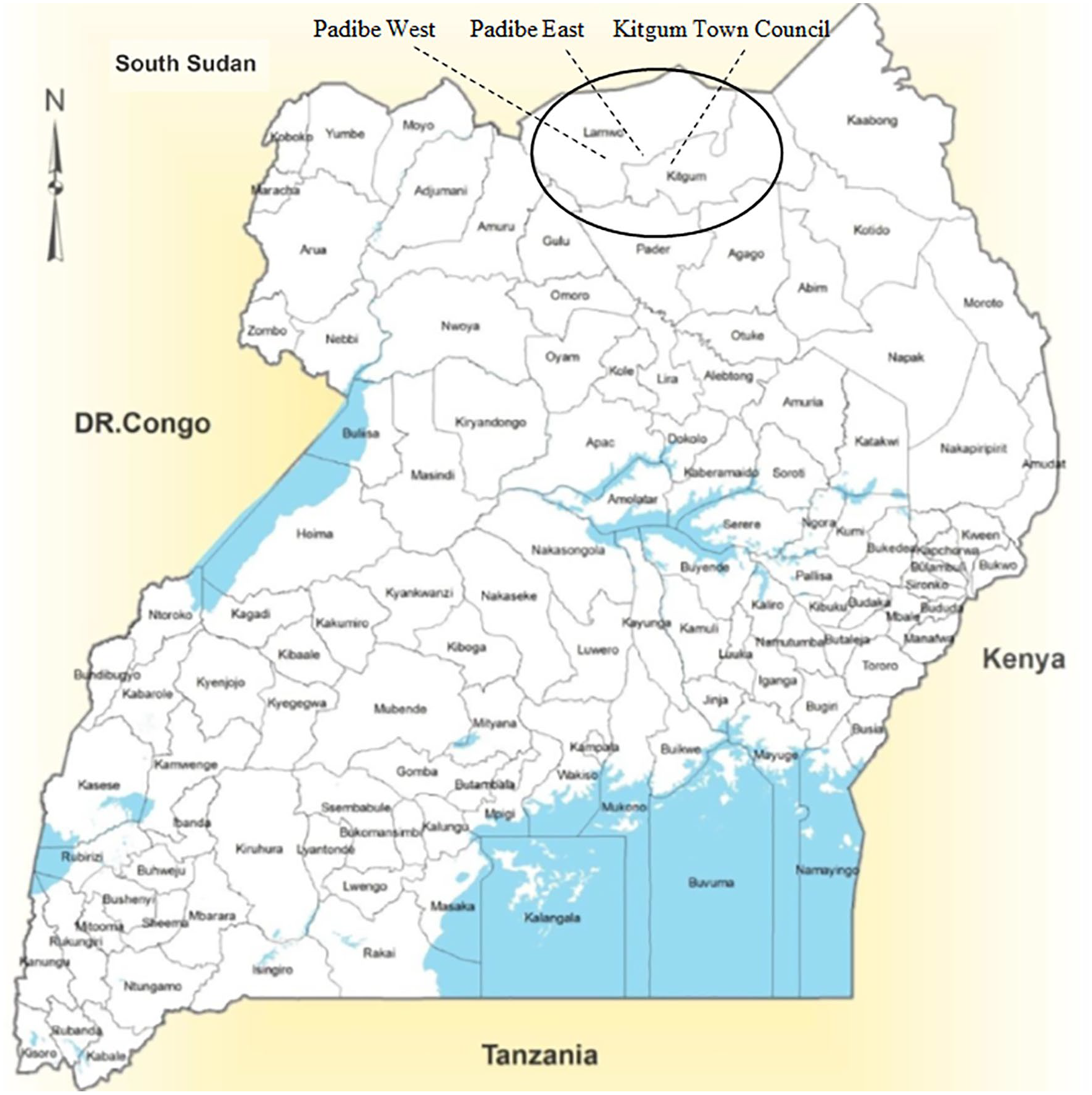
Map of Uganda with research locations.
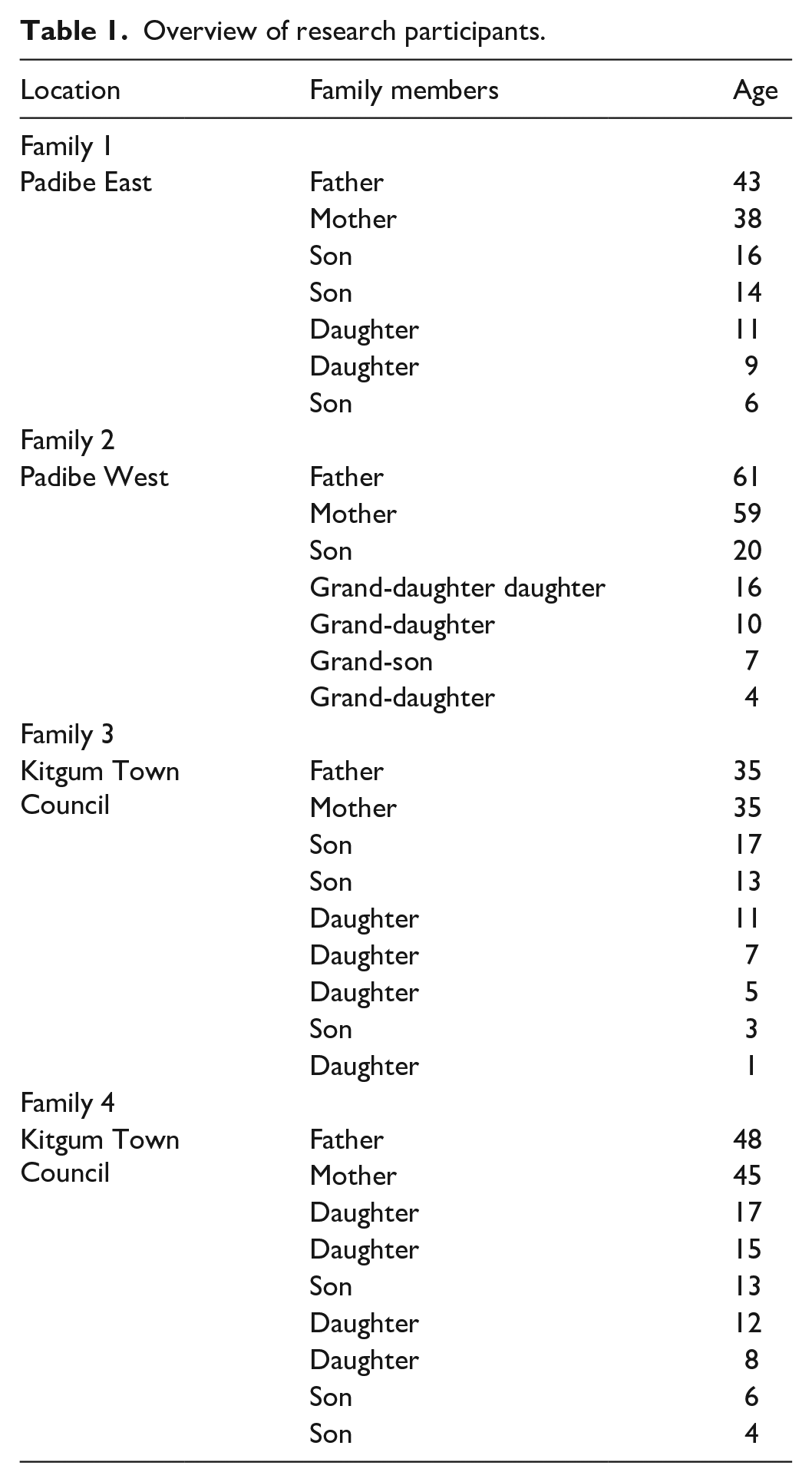
Participants were from low-income backgrounds in grass-thatched houses without access to electricity or water on the compound. They were engaged in agricultural work combined with income-generating activities (e.g. carpentry, selling products at a market, washing clothes for other people). Participants had little education (only a few years of primary school). With the exception of 1 household, the families were composed of a middle-aged father and mother and 5–7 children, aged between 1 and 20. One family was headed by an elderly couple, who looked after their youngest children (15 and 20 years) and orphaned grand-children (4, 7, 10, 14 and 16 years). Table 1 presents an overview of the research participants’ location, gender and age. Note that even though younger children are listed in the table, I only interviewed children aged 8 and above.
Overview of research participants.
The research was approved by the Oxford Central University Research Ethics Committee (CUREC), the Gulu University Research Ethics Committee and the Uganda National Council for Science and Technology. I obtained informed consent from all participants. For children (aged 8 and above), I used a consent script to obtain verbal consent from them and their parents/guardians. Using a similar consent script, I obtained written consent from adults. To compensate participants for their time, they received some household items (salt, maize flour, cooking oil) and UGX 10,000 (about £2) for airtime 3 and charging their phones before each round of spot phone calls.
Data were collected in 2017/2018 over the period of a year in three different seasons. We called participants once a day for 1 week in June (planting season), 1 week in September (weeding season) and 1 week in March (harvesting/selling season). Before each set of calls, my research assistant visited the families and reminded them of the research, especially to charge their phones, which had to be done in nearby town centres as none of the participants had access to electricity at home.
After the visits, we called participants once a day for 1 week at different times each day. If participants did not pick up their phones, we tried calling again later in the day. To avoid biasing results, we did not inform participants when we would call the next day. But we agreed on a preferred time window. For most families, this was between 7 am and 9 pm. To cover different times of the day, similar to spot visits (Nickols and Ayieko, 1996), I divided the day into segments – early morning, morning, midday, afternoon and evening – and randomly assigned a segment to each day of data collection.
My research assistant and I called the respondents together. To facilitate a phone call with three participants on the line, my research assistant used two phones put on speakerphone. I was on one line and the research participants were on the other line. This meant that I was able to communicate directly with the research participants. I asked the questions, my research assistant translated the questions, respondents replied and my research assistant translated their responses.
Such mediated communication might have changed the meaning of responses. But since I did not speak the local language well enough, it was necessary to rely on an interpreter. Before starting the research, I trained my research assistant to be informed about the research topic, ethical considerations and their role as ‘key informant’ (Edwards, 1998). We thoroughly discussed the interview questions and how to translate them accurately.
During each call, we talked to all available household members above 7 years. I first reminded all participants about the research and asked whether they were still happy to participate. If they were, I asked the following questions:
What are you doing at the moment?
How long have you been doing it?
Where are you?
Who are you with?
I also sometimes asked, Who decided that you do this task? How do you feel about doing this task? What else have you done today? What do you think you will do next?
I asked follow-up and probing questions, such as ‘Why?’; ‘Are you doing anything else at the same time?’ or ‘Who cooked your lunch?’ I ended each conversation by asking whether they wanted to add anything or had any questions. During the first call in each season, I also asked whether anything had changed, compared to the previous set of calls.
Calls usually lasted about 5–10 minutes per person. When household members were not available, I asked their relatives what the unavailable household members were doing. In the 3 rounds of data collection, I conducted 42 calls and 91 interviews. I tape-recorded the interviews and typed them afterwards. I analysed and coded them using the qualitative data analysis software NVivo.
Strengths of the spot phone call approach
Generally, the spot phone call method worked well. This section discusses some of the main advantages of the methodology.
Cost and time effective
The spot phone calls were relatively cheap. They did not need a larger team of enumerators being transported to the participating households and did not require me to travel to and stay in the field. This saved money on transport (travel to and within Uganda), accommodation and remuneration. In contrast to experience sampling approaches that use pagers, I relied on existing technologies (i.e. phones), which did not involve costs of obtaining the devices.
Cost for airtime was reduced by buying ‘bundles’ with unlimited calls for my research assistant. To call a Ugandan number from outside of Uganda, I used the online app ‘MTN Webphone’ that charged local call rates (UGX240/£0.05 per minute). I spent about £25 per family for each round of data collection, which added up to £300 in total. Table 2 provides a breakdown of the total costs.
Overview of (approximate) total costs for spot phone calls.
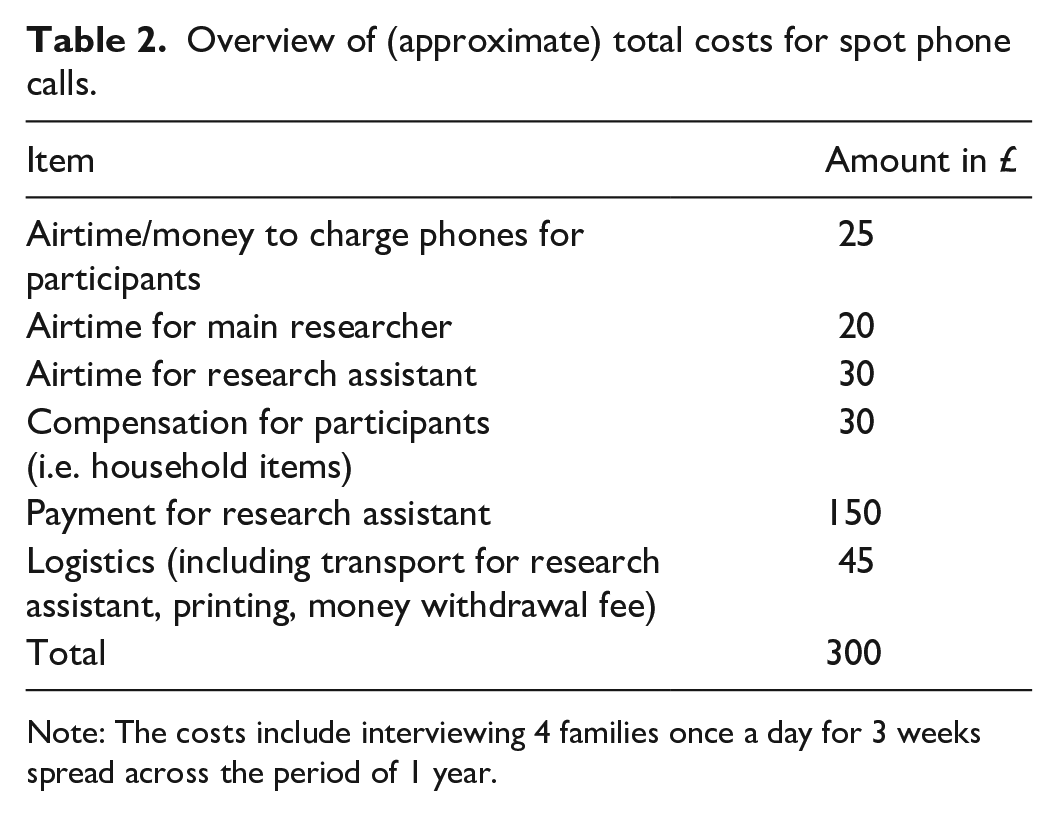
Note: The costs include interviewing 4 families once a day for 3 weeks spread across the period of 1 year.
In contrast to ESMs that ask respondents to self-report activities, spot phone calls did not pose high demands on participants. This meant that not much time was needed for training participants or research assistants. Interviews usually only lasted about 5–10 minutes and could be carried out while doing other activities. For example, I talked to several respondents while they were walking to town, to a meeting or the borehole. Spot phone calls did also not take up much time for researchers – usually only about an hour a day. This meant that they could easily be combined with other activities. I even conducted some calls while being away from home.
Longitudinal
Spot phone calls were also useful for capturing longitudinal dimensions of time use. First, they helped to understand seasonal differences in time-use patterns of adults and children. For example, during spot phone calls in the dry season, children and women told me that they had spent 1–3 hours collecting water because the nearby boreholes were broken, which meant that they had to walk long distances to fetch water. I also called a woman while she was on her way to collect money from community members to repair the local borehole.
In the cultivation period, it was more difficult to reach respondents and they were generally busier than in the other periods of the year. In September, when there was less agricultural work to do, most men were looking for other work, for example, on building sites, and some women and children were engaged in income-generating work, such as selling produce at a market or washing clothes for other people. Children and their parents also reported different activities during term and school holiday times. For example, mothers said that they spent more time looking after babies when their older children were at school.
The spot phone calls also showed how shocks affected time use of different household members. For example, when calling a family in September, I found out that the father had recently had an accident on the bicycle hurting his hand. He was unable to work as a carpenter and spent more time socialising with his friends in the centre, which meant that his wife did ‘everything at home’. His wife confirmed that she was struggling to run the household and to earn an income. Children were taken out of school because there was not enough money for school fees. Their oldest daughter (17 years) explained that in addition to care and domestic work, she was now also selling cassava by the roadside:
I am trying to do some work in order to make money so that we go back to school, but it is very difficult for me [. . .] I do not like it, but the situation and the condition of money are forcing me to do so.
The 15-year-old daughter also said that her work had increased: ‘I have to bathe the kids, sweep the compound, even mopping, and even digging’. The oldest, 13-year-old son, said that he was now the one ‘who calls the other children and talks to them in the evening, in case the father is not around, looking after them, mentoring them’. This example shows how shocks affect time-use patterns of different household members, but that who took over what tasks was related to gender and age.
Spot phone calls also helped to understand how shocks emerged and evolved. An example comes from a male participant who struggled to find work and to provide for his family. In September, he told me, ‘I used to work on a construction site, but at the moment that work is completed, so I am just at home now’. The next day in the afternoon he said, ‘I have been looking for work and didn’t find anything and now I am just going home’. The following day, at 6 am in the morning, he was ‘already in town looking for a job’. He explained, ‘The problem of money forced me, there is no food for children, so I have to look for something to maintain the family’. When I called him again in March, he said, ‘It is equally still hard, there is still no work’. This frustration later led to conflict and desperation. Through the spot phone calls, I was able to ‘experience’ these difficulties with him and to see how the crisis evolved and worsened. The case clearly highlighted desperation and unhappiness related to a lack of work and men’s particular struggles to meet expectations of masculinity.
To conclude, I found the spot phone calls very useful for understanding seasonality and how household shocks evolved and influenced time-use patterns of different household members. None of my other research methods (semi-structured interviews, FGD, surveys, participant observation) were able to capture these dimensions, as they did not take a longitudinal approach.
Qualitative aspects
The spot phone calls were able to capture a variety of aspects of time use other than quantity, which has been identified as crucial for understanding time use (Seymour et al., 2016). In contrast to most survey methods (e.g. stylised questions, time diaries), the spot phone calls allowed me to ask follow-up and probing questions. This was very useful for understanding relational and emotional aspects of and reasons for time use. For example, a woman told me that her son was not available for the interview as he had gone to drink alcohol with his friends. When I asked, ‘why?’, she explained, ‘The father used to drink so much, so he is following the footsteps of the father’ and when I asked how she felt about it she became emotional: ‘Children no longer listen to the parents, they don’t sit with the father at the fireplace. Every time, they keep loitering around the centre and trading places’. These emotional, relational and intergenerational aspects and context-specific reasons for time use would not have been recorded if I had only asked for her son’s activity.
The continuous approach also helped to establish relationships with participants who opened up more as the calls moved on. For example, towards the end of the research, some participants started telling me about new developments or concerns even without me asking. Participants seemed to enjoy the calls and some even continued contacting me afterwards and seemed disappointed that we did not continue the calls.
Recall bias and social desirability bias
Like experience sampling or observations (Seymour et al., 2016), another advantage of the spot phone calls is that they can eliminate recall bias. Respondents were asked what they were doing at the particular moment of the interview, which meant that they did not have to recall activities. Sometimes, I also asked respondents what they had done immediately before the interview. But I usually asked probing questions to help them remember activities.
Asking about current activities might also reduce the risk of social desirability bias – giving incorrect answers because respondents believe that this will be viewed favourable by researchers. For example, while not many people mentioned ‘resting’ as a daily activity in semi-structured interviews, spot phone calls caught participants while sitting under a tree or chatting to friends. For example, a man said, ‘There is nothing I am doing. I am just sitting’.
Spot phone also seemed better at accounting for men’s care and domestic work that might have been under-reported in other methods because of social norms and ideologies defining such work as a ‘non-masculine’. The household survey data that were collected in conjunction with my research shows that, compared to 95% of women (351, N = 369), only 51% of men (190, N = 369) had engaged in care or domestic work the day before the interview (see Karimli et al., 2016). In semi-structured interviews, very few male adult participants mentioned care or domestic work as their daily activity.
But during spot phone calls, the majority of men reported doing care or domestic work most days. For example, a man said, ‘I am just seated’. But when I asked, ‘Are you just sitting or doing anything else at the same time?’ he replied, ‘I am shelling simsim [sesame]’. Similarly, another man first did not list care or domestic work as part of his activities that day, but when I asked where his 1-year-old daughter was, he said that he was currently taking care of her. He added, ‘I bathed the child. I also went to the market, bought something and prepared food’. Similarly, the following extract from a spot phone call interview with another man shows that even though he did not mention care and domestic work as part of his activities, further probing revealed that he had engaged in childcare, cooking and water collection:
I am just from eating and I am just under the tree resting.
From the garden, I finished up with the latrine and now I am resting.
I woke up from the bed, went to the garden.
Paul
4
who is six years
I chat and talk with him.
I cooked myself.
I went also to the borehole to collect water.
I have cooked enough food for everyone in the family.
The interview extract shows that the spot phone call method was useful for capturing activities that might have been under-reported in other methods, such as men’s participation in unpaid care and domestic work.
Weaknesses of the spot phone call approach
Even though the spot phone calls generally worked well, I encountered some challenges. Sometimes, I did not get through to respondents or to my research assistant because of network issues or because their phones were switched off. Potentially, participants chose not to pick up their phone when they were busy or occupied with something they did not want to talk about. In all but one household, men owned the phones. This meant that if men were away from home, I was unable to talk to their wives and children.
Since not everyone in the region owned a phone, selecting only respondents who owned a phone might have biased the data. I had initially planned to select respondents randomly and provide phones for those who did not have one. But my research assistant and the ethics committee advised me against this approach because this would have raised ethical concerns and could have reinforced power imbalances. When selecting participants, I made sure that they were representative of the area and were not financially better-off than average.
Even though the interviews did not usually take long, the longitudinal approach meant that spot phone calls required some time commitment throughout the year. Methods that collect data throughout the day (e.g. observations, experience sampling) have also been argued to be intrusive (Seymour et al., 2016) or to invade participants’ privacy (Vogler et al., 2009). To make sure respondents did not find the calls intrusive, I continuously asked for consent and emphasised that they did not have to pick up the phone if they did not want to.
The sample size was very small and the spot phone call data were unable to establish averages and associations of time-use patterns and other factors. In contrast to other similar methods, such as spot observations (Nickols and Ayieko, 1996), I only collected data once a day, which only provided a limited insight into time use. The calls were also unable to capture body language and to observe non-verbal reactions to the questions. I was unable to understand what was going on in the background, for instance, who else was present or listening and how this might have affected the interviewee. I was unable to observe what people were doing but had to rely on their reports, which is likely to generate less-accurate data than observations.
The method worked well with poor rural communities. It is suitable for people with low-literacy levels as it does not rely on respondents’ ability to recall activities (like stylised questions, time diaries) or on respondents’ ability to use new technological devices (like experience time sampling). It also suits agricultural and informal work arrangements where taking a phone call during work hours is not an issue. But the method might work less well in contexts, where participants work in an office or where people are concerned about nuisance calls and telephone scams.
Conclusion
The literature review of commonly used time-use measurements has shown that more cost and time effective methods based on larger samples (e.g. stylised questions, time diaries) run the risk of ignoring less-visible activities and qualitative dimensions, while most methods that are better able to minimise recall bias and to capture qualitative aspects of time (e.g. experience sampling, continuous observation, spot observation) tend to be cost and time intensive. Longitudinal research is often be particularly costly.
This article has proposed spot phone calls as a cost and time effective, longitudinal method that can capture qualitative aspects of time use and reduce recall and social desirability bias. Spot phone calls involve calling participants once a day over a specific time period (e.g. a week) in different seasons.
Testing the methodology in rural Uganda highlighted the following advantages: spot phone calls were relatively cheap and did not take up much time of participants and researchers. The method shed light on how seasonality and household shocks influenced time-use patterns, and it captured qualitative dimensions of time use, such as emotions, conflicts and relational aspects. Asking respondents what they did at a specific moment, followed by probing questions, helped to reduce recall and social desirability bias. In particular, I found spot phone useful for highlighting ‘doing nothing’ and men’s participation in care and domestic work. Spot phone calls worked well in a poor rural communities with low-literacy levels.
However, spot phone calls might work less well in settings where participants are employed or worried about phone scams. I encountered some technological challenges with reaching respondents and some might argue that the calls were intrusive or imposing. The sample size was very small and the spot phone call data were unable to establish averages and explore associations of time-use patterns and other factors.
It would be interesting to test and extend the spot phone call methodology in other settings. I suggest that spot phone calls could be used in two key ways. First, as part of a larger research project, spot phone calls (even if based on a small sample) can help to triangulate findings from other sources and add a longitudinal perspective. In situations where limited budgets do not allow for longitudinal survey data collection, spot phone calls could be an easy and cost effective addition to quantitative time-use surveys that could add qualitative and longitudinal dimensions. Researchers could explore how spot phone calls could be combined with household surveys. For example, some of the survey participants could be selected to participate in spot phone calls.
Second, just like spot observations (Nickols and Ayieko, 1996), spot phone calls could potentially be used to collect both qualitative and quantitative data. For example, activities could be coded and time spent on different activities could be recorded more systematically. To collect more precise time-use data, one could think about extending the methodology to record time use several times a day. One could, for example, have a longer call once a day and some shorter calls to ask only about current activities at other times of the same day. Another option might be to replace the shorter calls with some kind of text message survey (if literacy levels allow). The calls could be accompanied by a background survey to look at the influence of different household and personal factors on time-use patterns throughout the day, week and year.
However, quantifying the approach should not adversely affect the qualitative dimension of the data, as well as the efficiency of the method in terms of costs and duration. It would be interesting to explore how to best quantify data on time use collected through spot phone calls, while still keeping the qualitative components and open-ended/probing questions.
More generally, mobile phones provide new opportunities for reaching respondents, including those from poor and remote areas. Mobile phones allow for data collection at a distance, which is particularly important in the current COVID-10 pandemic. More research exploring how to use mobile phones for collecting qualitative and quantitative data on time use and other topics could make an important contribution.
Footnotes
Acknowledgements
The author would like to thank the research participants and her research assistants. She is also grateful to her PhD supervisors, Prof Douglas Gollin and Dr Gina Crivello who helped her to develop the spot phone call methodology.
Declaration of conflicting interests
The author declared no potential conflicts of interest with respect to the research, authorship, and/or publication of this article.
Funding
The author disclosed receipt of the following financial support for the research, authorship, and/or publication of this article: This work was supported by the Economic and Social Research Council [grant number ES/J500112/1] and the German Academic Scholarship Foundation (Studienstiftung).
