




Abstract
While the methodology of formative intervention research has long been established, the aspect of new instrumentality of Change Laboratory is fragmentally documented. Therefore, in this study, we modified two major Change Laboratory mediating tools used in bilingual student-teaching seminars, namely the disturbance diary and four-field model. These two empirically investigated Change Laboratory tools have mediated transformative agency within the collective movement toward identity formation as the Change Laboratory participants (bilingual preservice teachers) conveyed their dilemma of to-be or not-to-be a bilingual teacher. We provide evidence on the relationship between the bilingual preservice teachers’ identity formation and their participation in the Change Laboratory intervention. The analysis made salient the role of two new Change Laboratory mediating tools, the adapted disturbance diary and individually generated four-field models, for the bilingual preservice teachers’ collective transformation in bilingual teaching. It also crystallized the importance of deepening the bilingual preservice teachers’ analysis of multiple languages and pedagogy as understood in the new bilingual teaching model in the Change Laboratory intervention.
Keywords
Introduction
While the methodology of formative intervention research has long been established (Engeström et al., 1996), the aspect of new instrumentality of Change Laboratory (CL) is fragmentally documented (Engeström, 2000; Engeström et al., 2014). Therefore, in this study, we modified two major CL mediating tools used in bilingual student-teaching seminars, namely the disturbance diary (DD) and four-field model (FFM). These two empirically investigated CL tools have mediated transformative agency within the collective movement toward identity formation as the CL participants (bilingual preservice teachers) conveyed their dilemma of to-be or not-to-be a bilingual teacher. In what follows, we first introduce the concept of bilingual teacher identity and why we situate the CL methodology in the bilingual student-teaching seminars. We then explain the main theoretical concepts underpinning the CL methodology and our innovations to the CL methods in the methodology section followed by the findings.
Bilingual teacher identity on-the-move
We understand that identity formation is a complex process with an inherent tension between the collective and the individual. Thus, bilingual identity development has some particularly complex manifestations in teaching since it is collectively shaped by language and culture, but also individually told through one’s narratives. Beijaard et al. (2004: 123) argue that teacher identity formations are the “process of practical [pedagogical] knowledge building characterized by an on-going integration of everything individually and collectively relevant to teaching”. However, Sfard and Prusak (2005: 17) proposed teacher identity formation as the vision of one’s own “experience of engagement in practice,” as expressed in narratives rather than the experience itself. The most significant part of narration of the stories, according to Sfard and Prusak (2005: 17), is likely to “imply one’s membership in, or exclusion from, various communities”. In the process of identifying ourselves, there are some narratives floating around that individuals may appropriate (or reject) as members of various groups. In this regard, bilingual teacher identity formation is “collectively shaped even if individually told” (ibid. p. 17). Such a collective and floating narrative distinguishes bilingual teacher identity research from mainstream teacher identity research, as argued by Martínez-Álvarez et al. (2017) in their study of multimodal explorations of bilingual preservice teachers’ identities through examining the culture concept maps, such as graphic organizers and audio/video recordings created by the bilingual preservice teachers in the cross-cultural communication course.
Following Martínez-Álvarez et al.’ s (2017) work, we also broached Bakhtin’s (1981) orchestration of self with the process of narrating by Sfard and Prusak (2005) and described the identity-making process of the bilingual preservice teachers as constant and collective in the new instrumentality of CL. We highlighted the constant as we echoed Britzman’s (1992) proposal that identity is “occurring . . . within the irreconcilable contradictions of situational and historical constraints” (p. 42). Such attention to contradictions reminded us of Roth’s (2007) discursively constructed definition, drawing on cultural-historical activity theory, as the making and remaking of self in response to threats and affirmations (Roth et al., 2004). In this study, we focus on the incessant shifting—from affirmations to threats or from threats to affirmations—of the act of constructing meanings about ourselves and others as the CL participants renegotiated floating narratives and historical contradictions. We describe such incessant shifting using Jackson and Mazzei’s (2012: 7) metaphor for identities, as they have always emphasized that human activity is on-the-move. In other words, identities are constantly on-the-move, in the same way that human activity is constantly on-the-move.
Why adopt CL methodology in bilingual student-teaching seminars?
Gutiérrez and Rogoff (2003) found that, over time, classroom teachers pay less attention to the complex relationships between culture, context, and diversity in language learning/teaching; rather, classroom teachers tend to conflate these linguistic and cultural-historical complexities with learning styles because these simple learning style labels (i.e. visual, kinesthetic, etc.) are easier for teachers serving multicultural student populations. Thus, Gutiérrez and Rogoff (2003) urge researchers to “account for both cultural regularities and variations, with a cultural-historical emphasis on understanding individuals as participants in cultural communities” (p. 23). Therefore, renegotiations and reinterpretations of cultures and languages are critical to developing a bilingual teacher identity, because many foundational bilingual education theories are centered on this sociocultural relationship (Zentella, 2005). We thought that the CL methodology with its range of mediating tools overlapping with the bilingual teaching seminar would provide a context to address with the preservice teachers the complexities of teaching and learning in bilingual classrooms, while paying attention to historical contradictions and theory (Anderson and Stillman, 2013; Britzman, 2003).
Hence, this study may be of interest to the following three audiences: (1) teacher educators and researchers interested in teacher education, (2) researchers interested in identity development, and (3) members of the activity theory community who are interested in the CL approach. For teacher educators and researchers, centralizing identity dynamics is significant to both bilingual teacher educators and bilingual preservice teacher education as this study illustrates the process and struggles of becoming bilingual teachers (Beijaard et al., 2004). For identity formation researchers, this study substantiates the theoretical shift required in building bilingual teacher identity. It compels the construction of identity as human activity in narrative form and embedded in materiality (Coole and Frost, 2010; Hekman, 2010). For CL researchers, the CL process led us to adapt two major mediating tools of CL interventions (i.e. DD, adapted before the CL; the FFM, adapted during the CL) for two underlying motivations: One, the DD, in the format of daily logs which include both aha moments and disturbances, encourages the CL participants to tell their own bilingual teacher identity stories in narration; two, the individually generated four-field model (IGFFM) helped us operationalize bilingual teacher identity formation in this study as movements (Pallesen, 2017; Sfard and Prusak, 2005; Vacchelli and Peyrefitte, 2018).
Thus, our research questions were the following:
How do the new CL instruments afford bilingual teacher identity formation?
How are the participants tensions and disturbances manifested in their telling of to-be or not-to-be a bilingual teacher?
Theoretical framework
CL methodology is established on the fundamental premises of cultural-historical activity theory (CHAT) and expansive learning theory. It undergoes seven phases of expansive learning actions and is usually characterized as formative intervention work in which research interventionists are doing the investigation together with the CL participants to address their need for change.
Cultural-historical activity theory (CHAT)
CHAT allows CL participants (and researcher-interventionists) to understand contradictions as historically accumulated systemic tensions within and between the nodes of the activity systems as well as the long-term, object-oriented purpose of the activity (Engeström, 2016). The research interventionists often provide the CL participants with six activity system elements—rules, community, division of labor, instruments/artifacts, subject, object—as analytical tools to understand the two and more on-going activity engagement and to perform their analysis tasks.
Theory of expansive learning
Expansive learning theory “puts the primacy on communities as learners, on transformation and creation of culture, on horizontal movement and hybridization and on the formation of theoretical concepts” (Engeström, 2016: 36). The theory of expansive learning not only structures the CL intervention sequence but also has the potential to critically transform bilingual preservice teacher education; rather than the traditional, linear trajectory of learning, we saw the becoming of a bilingual teacher as a horizon of possible actions that cannot be completed.
CL methodology cycles through the following seven expansive learning actions: (1) questioning, (2) analyzing, (3) modeling the new solution, (4) examining/testing the new model, (5) implementing the new model, (6) reflecting on the process, and (7) consolidating/generalizing the new practice, as described by Virkkunen and Newnham (2013). The CL research-interventionist usually invites the CL participants to document their observations in the DD, identify mirror material to question, analyze the major historically developed contradictions of a particular organization/activity, and begin development of a new model. Such a new model is visually represented as a two-dimensional zone of proximal development, a FFM, collaboratively developed by the CL participants for their activity (Sannino et al., 2016), which is bilingual teaching (see Figure 1).
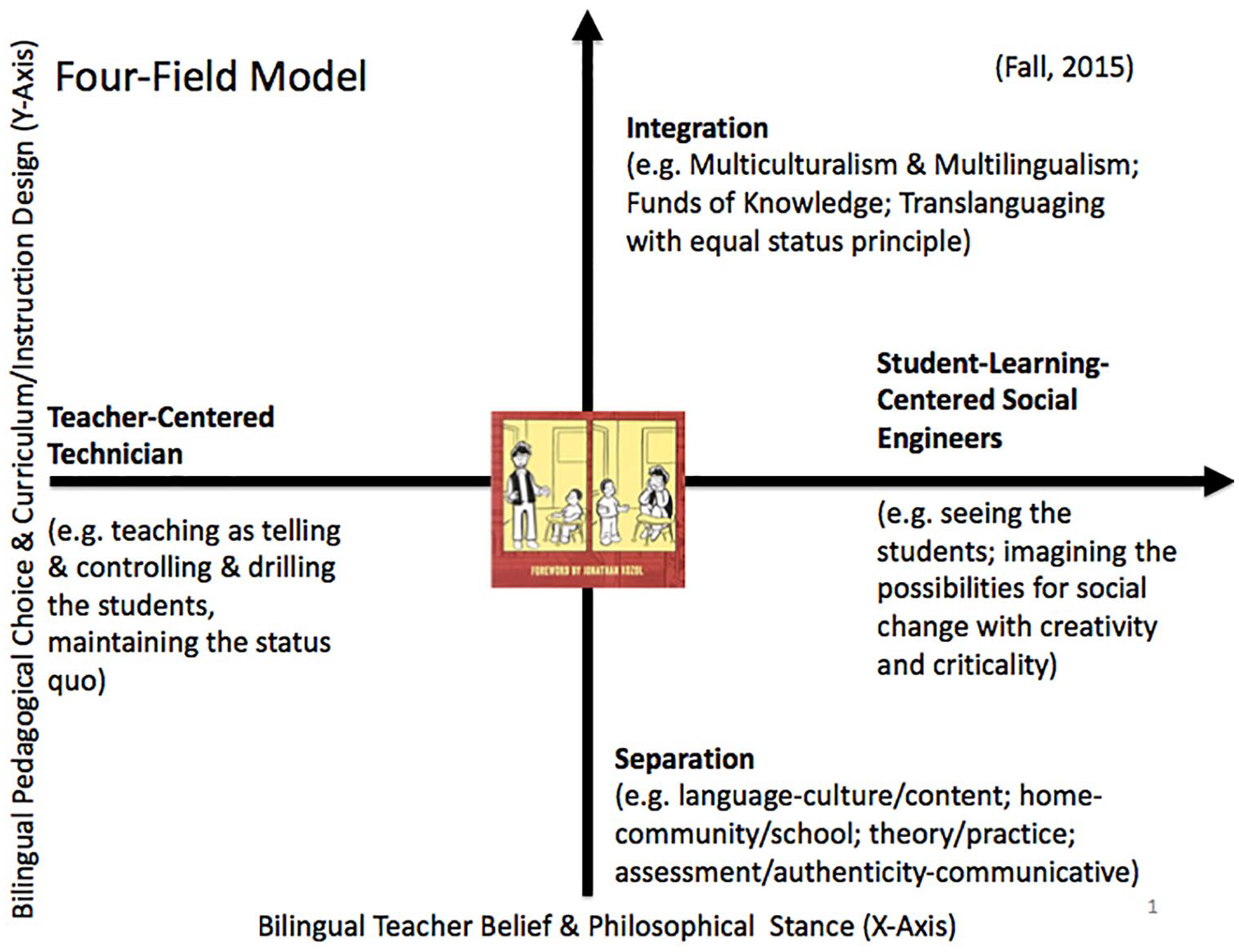
Four-field model (FFM).
Double-stimulation and four-field model (FFM)
Two major CHAT-informed principles based on the Vygotskian (Sannino, 2015) and Marxian (Bligh and Flood, 2015) traditions guide the CL methodology during the expansive learning cycles, which are (1) double-stimulation and (2) ascending-from-abstract-to-concrete (as related to conceptual development). In a typical CL intervention, double-stimulation is “essentially a process of reframing or reconceptualizing the problem situation” (Sannino, 2015: 2). Thus, double-stimulation can also represent a principle of promoting transformative agency in the CL intervention. The FFM is where the CL participants meet to ascend from abstract to concrete, specifically, in the development of concepts, as they identify object-oriented movement—from old ways of doing the activity to new possible ways of reimagining the old activity—within the collective zone of proximal development. The double-stimulation method requires two stimuli: the modified DD in the format of daily logs which include both aha moments and disturbance as the first stimulus and the (individually generated) FFM (a representation of the FFM with grids for each participant so that they could individually mark their positionality) as the second stimulus to support the learning of our CL participants.
Disturbance diary and language as new CL instrumentality
A key characteristic of a CL intervention is the use of representational devices or artifacts to help participants’ process of identifying contradictions. Language, thus, serves as a CL tool to name, critique, and imagine the self (Greene, 2004), vis-à-vis the present and/or a near future in the disturbance diary (in the format of daily logs where both aha moments and disturbances are documented) and in the back of the individually generated FFM where the CL participants share why they marked where they were in the grid. While evaluating and accommodating to the context, individuals situate themselves not only in the complexity and multiplicity of social identities as learners/teachers (Coffey and Street, 2008; Lantolf and Pavlenko, 2001), but also in their act of authoring—how they give meaning to their lives, position themselves in relation to others, and claim their own agency by evaluating their social worlds (Vitanova, 2005).
Language is viewed as an instrument that culturally shapes and is shaped by the stories of those whom the individual interacts with in personal and social circumstances. When multiple languages are present, language choice, attitudes, and ideologies are part of the identity formation process. In constructing themselves in their aha moments and disturbances, bilingual teachers confront popular fallacies about language (Phillipson, 1992) and interrogate themselves as defenders/advocates of the children’s ways of speaking for learning.
Methodology
The authors adopted an insider/outsider qualitative method tradition (Wasser and Bresler, 1996) in which three bilingual teacher educators are researcher-interventionists (hereafter, mediators), and the bilingual preservice teachers are our CL participants. Organizing the bilingual student-teaching seminar as a CL intervention would require us to adapt some principles of the CL method to create a hybrid space where bilingual teachers’ own learning and their teaching would overlap (Rantavuor et al., 2016). The main adaptation we did was reorganizing the bilingual student-teaching seminar as a course lab in which we would document how we could transform bilingual preservice teacher education from within (Souto-Manning, 2019), particularly in terms of the bilingual teacher identity formation and the dynamics of identity formation in a CL intervention.
Research context
The CL intervention is specifically developed within a hybrid 12-week student-teaching Seminar, which met once each week for 100 minutes in an east-coast US university-level bilingual teacher preparation program. We introduced tools and theories that would invite the bilingual preservice teachers to name the disturbances they encountered in their student-teaching, explore rich and diverse possible explanations, and create novel, imaginative collective responses that could help transform their bilingual teaching practices (Sannino et al., 2016). In understanding the CL intervention as a course lab, our hybrid bilingual student-teaching seminar (hereafter, the Seminar) is a culminating teaching experience in a bilingual classroom and, at the university level, a course on reflecting and analyzing the preservice teachers’ thinking about their bilingual teaching practices. The bilingual preservice teachers are placed in a classroom where both the minoritized and dominant languages are used as mediums of instruction. We examined three interconnected activity systems for units of analysis with a partially shared object (seeing the learning of bilingual children) and potentially shared outcome (becoming culturally responsive bilingual teachers). We saw the CL participants as the subject of the activity system of the hybrid CL/Seminar.
We offered CL participants two major new mediating artifacts (i.e. adapted DD and individually generated FFM) that were repurposed as double-stimulation to continue to conceptually ascend from-abstract-to-concrete understanding of bilingual teaching. By modifying the CL methodology, the explicit design of the Seminar allowed us to identify the important methodological instruments used as investigative tools for identity formation in a CL intervention. The confluence of the CHAT theoretical traditions of developmental work research and identity formation dynamics also allowed us to better understand the bilingual preservice teachers’ statements about their professional development related to language, identity, and pedagogy.
Participants
There were 18 participants in the seminar. For detailed analysis in the subsequent narratives (Saldaña, 2013), we used a purposeful sample (Merriam and Tisdell, 2016) and selected three Seminar participants, Annie, Leonore, and Carl (all names are pseudonyms) as our case studies (Yin, 2018). This sample selection enabled us to closely follow three participants to manifest how bilingual teacher identity is collectively shaped and individually told, and to offer enough details to contribute to the understudied area of the enacted transformative agency of the CL participants’ collective movement in the formative intervention work.
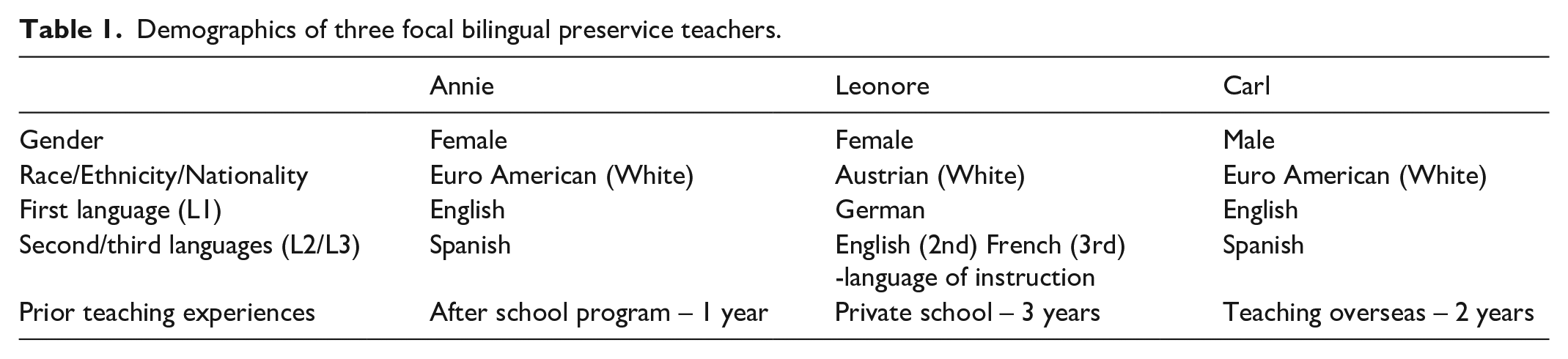
In addition, the three focal case studies shared one characteristic: while they were bilinguals, they did not grow up speaking the minoritized language, an increasing tendency within bilingual teacher education that seems to pose particular challenges that we want to address. While they were all enrolled in a master’s teacher preparation program in Bilingual/Bicultural Education, they differed in their professional experiences (see Table 1). They represented different student-teacher profiles but were all committed to language equity as a social justice issue.
Demographics of three focal bilingual preservice teachers.
Instruments
We used numerous CL tools over the semester but are focusing here on the two most used, which generated the main data for the study. The adapted DD was used for 12 weeks and the individually generated FFMs for 5 weeks. They became critical in helping us gauge the bilingual preservice teachers’ way of communicating the materialization of the student-teaching classroom activities (Hekman, 2010) they carried out over the duration of the Seminar.
Disturbance diary (DD)
Based on the concept of tensions as potential sources of development, we used an adaptation of the DD proposed by Virkkunen and Newnham (2013). The difference between our version of the DD and the version proposed earlier by Virkkunen and Newnham is that we added a column of “My aha moments (What surprises you? What are the most important sources of joy and inspiration?)” next to their original disturbance column. The bilingual preservice teachers were invited to share, in writing, their visions of their experiences and new understandings occurring during their student-teaching placements. The new version of DD is titled as BBE Student-Teaching/Practicum Daily Logs (see Figure 2).
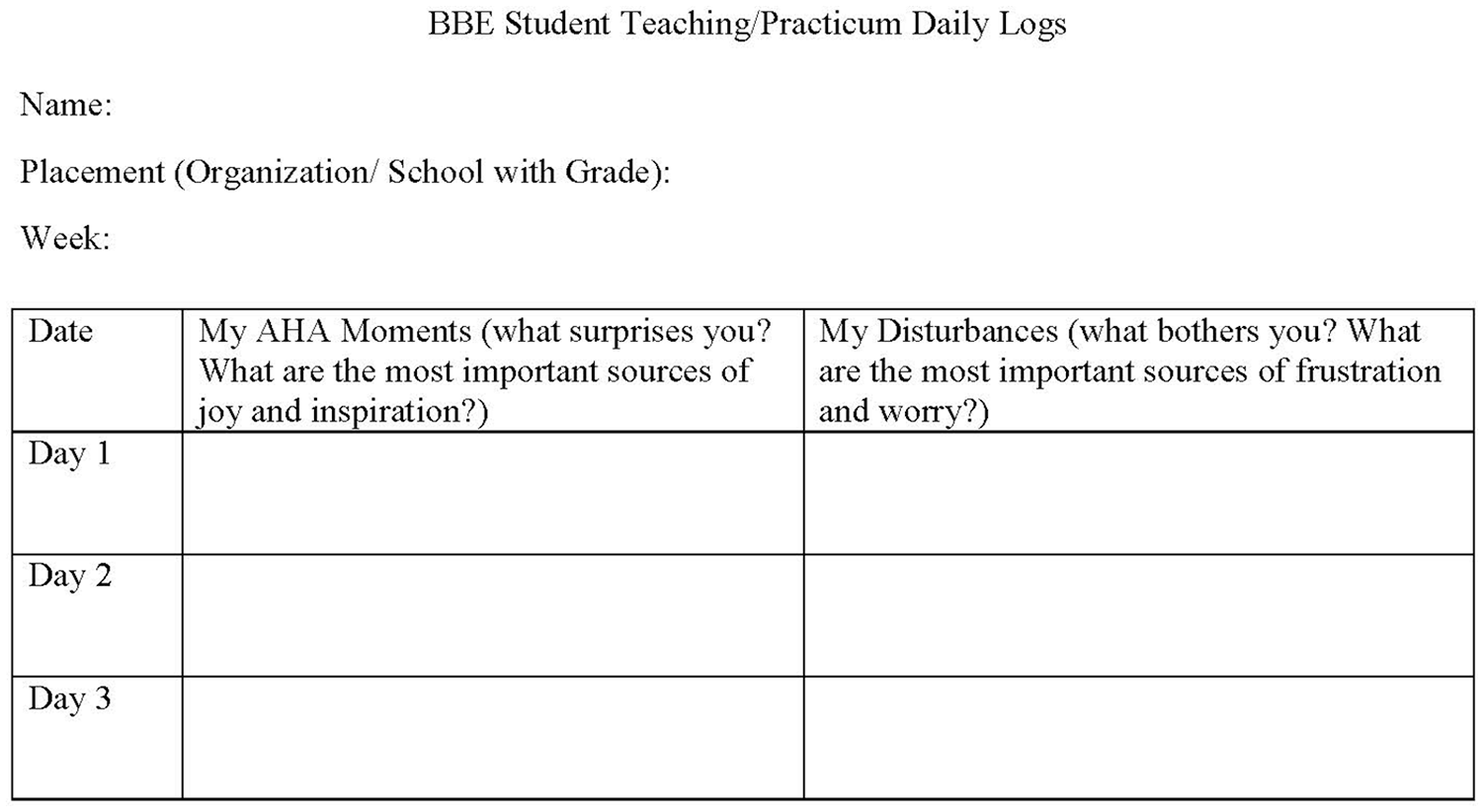
Disturbance diary with aha moments (daily logs).
They were asked to write 3 positive (aha moments) and 3 disrupting (disturbances) reflections weekly throughout the 12-week period.
Four-field model (FFM)
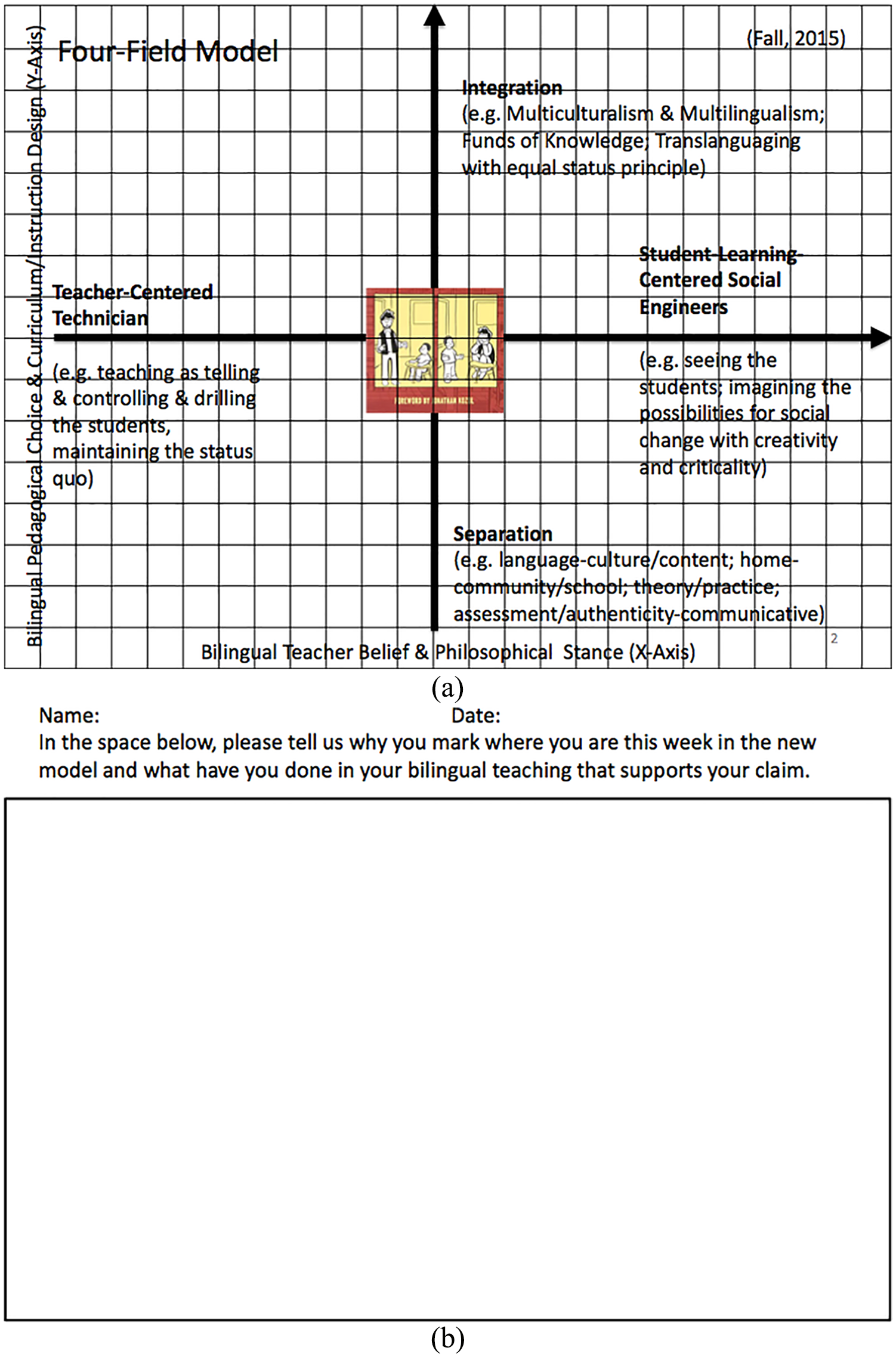
The FFM is a CL method tool (Virkkunen and Newnham, 2013) that we used with our CL participants (the preservice teachers) within the Seminar. FFM is a two-dimensional new model that served as a space for collaborative analysis and development as well as a depiction of the bilingual preservice teachers’ inner contradictions of bilingual teaching and learning. Photo 1 shows the FFM collaboratively created by the class, which was modified by the researcher-mediators (Wideen et al., 1998) as a gridded-poster on the bulletin board.
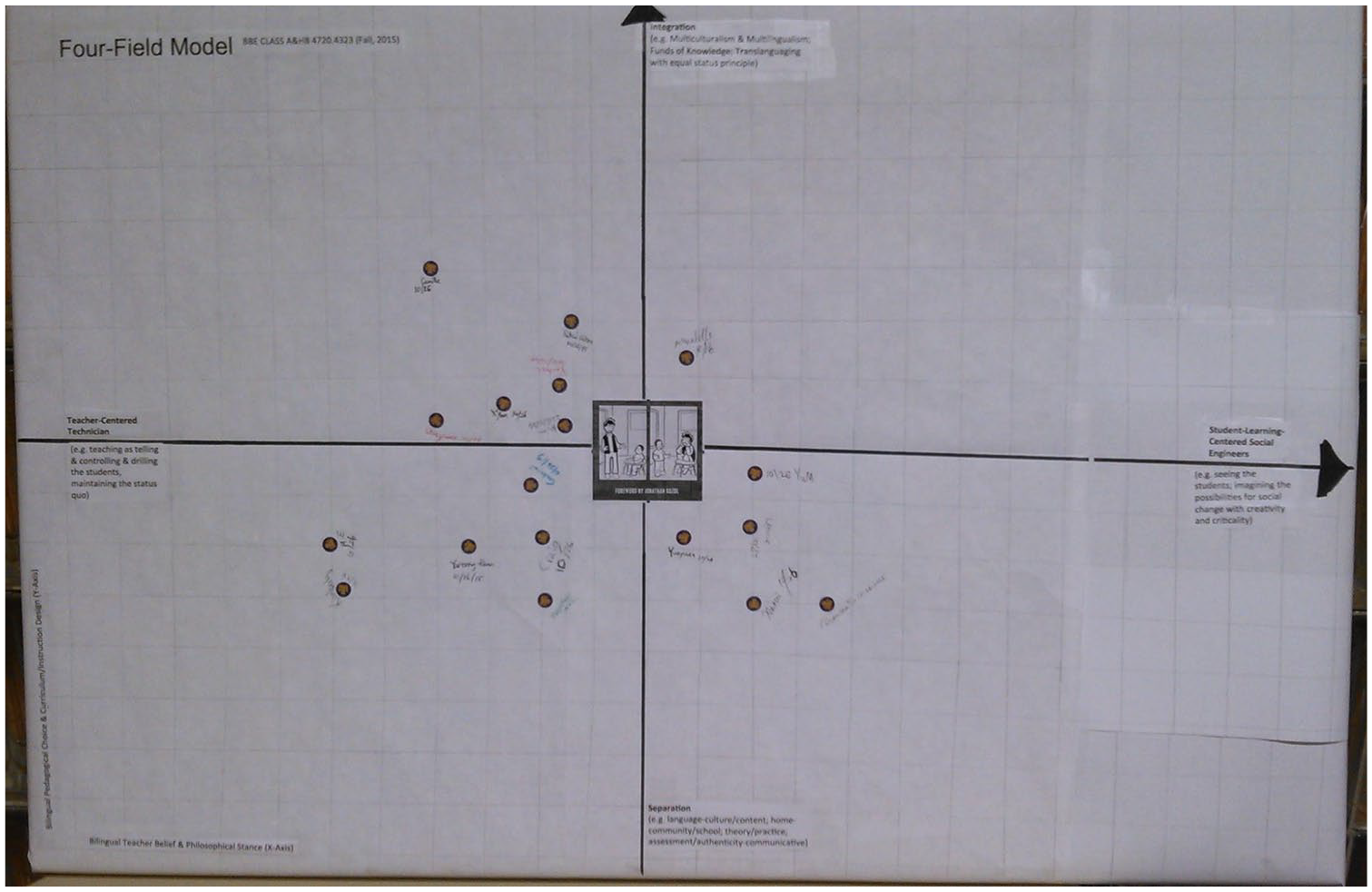
Four-field model (FFM) as a gridded-poster on the board.
The X-axis and Y-axis are prompted by the research-mediators, as our bilingual teaching philosophy shapes our bilingual pedagogical choices and curriculum design. The CL participants named the kind of bilingual teacher they wanted to become (i.e. from teacher-centered technician to student-learning-centered social engineers) and the kind of bilingual lessons they wanted to implement (i.e. from separation to integration). The FFM, thus, theoretically represented the collective Zone of Proximal Development (ZPD), otherwise known as “the distance or the area between individually experienced present and the collectively generated foreseeable future” (Engeström, 2000: 157).
Individually generated four-field model
The IGFFM was our extension and adaptation of the FFM. After the first 2 weeks of plotting the bilingual preservice teachers’ development onto the collective FFM represented in a board (Photo 1), the research-mediator (first author) realized that the visual outcome was messy and unclear. Thus, we reproduced the FFM as a two-sided handout (Figure 3(a) and 3(b)).
(a) Four-field model (FFM)—front side. (b) Four-field model (FFM)—back side.
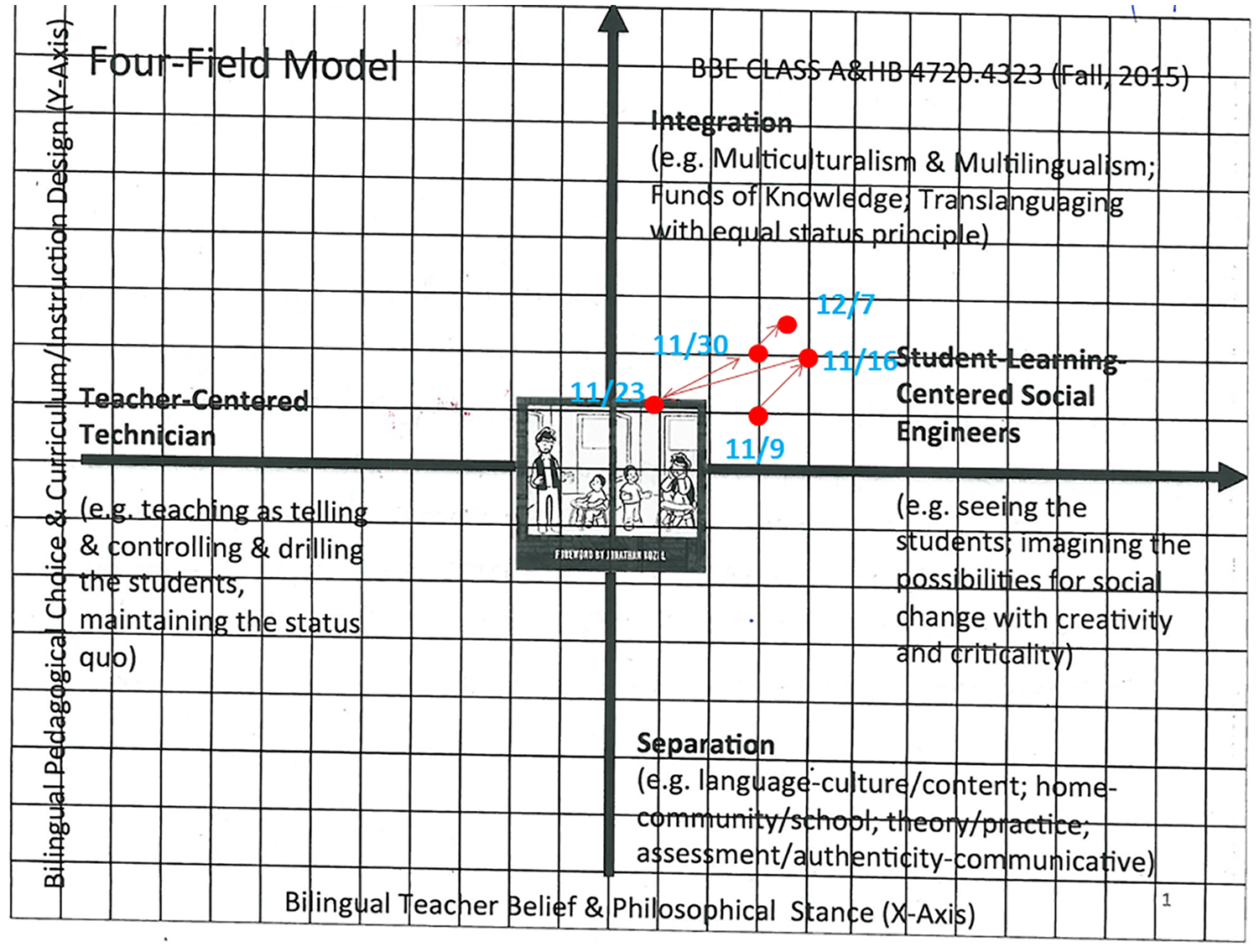
We provided each class member a copy of the FFM to individually trace their weekly participation in historically bounded traditions of bilingual teaching and/or their movement away from such traditions guided by the new, collective vision of bilingual teaching (see, Figures 4, 7, and 10 in the “Findings” section). We collected the IGFFM in the last 5 weeks of the Seminar. We did not give the bilingual preservice teachers access to the previous week’s tracing to prevent them from striving to achieve a linear development to show progress. Furthermore, we asked them to write about their positioning once they placed themselves in their individual FFM. We found the generated data useful in selecting the cases for the micro-analysis of the relationship between identity formation and the Seminar.
Annie’s individually generated four-field model trajectory.
Data analysis
In order to address the stipulation that bilingual teacher identity is both collectively shaped and individually told, we immediately sought to apply the CHAT triangle analysis to identify the manifestations of contradictions (Engeström and Sannino, 2010) documented in the data in their relationship to the different elements of the activity system. We paid attention to primary and secondary contradictions. The analysis of the bilingual preservice teachers’ words suggested tensions primarily in the domain of pedagogical tools (how they encountered, struggled with, and mastered the tools for bilingual teaching), how they saw or who they considered to be the subjects (actors or agents) of the activity, and how they encountered and interpreted social norms concerning the division of labor they thought could be improved in their classrooms. The analysis also found references to how the bilingual preservice teachers engaged in their real/imagined communities. From this analysis, bilingual teacher identity development emerged as a salient theme in the adapted DDs and IGFFMs.
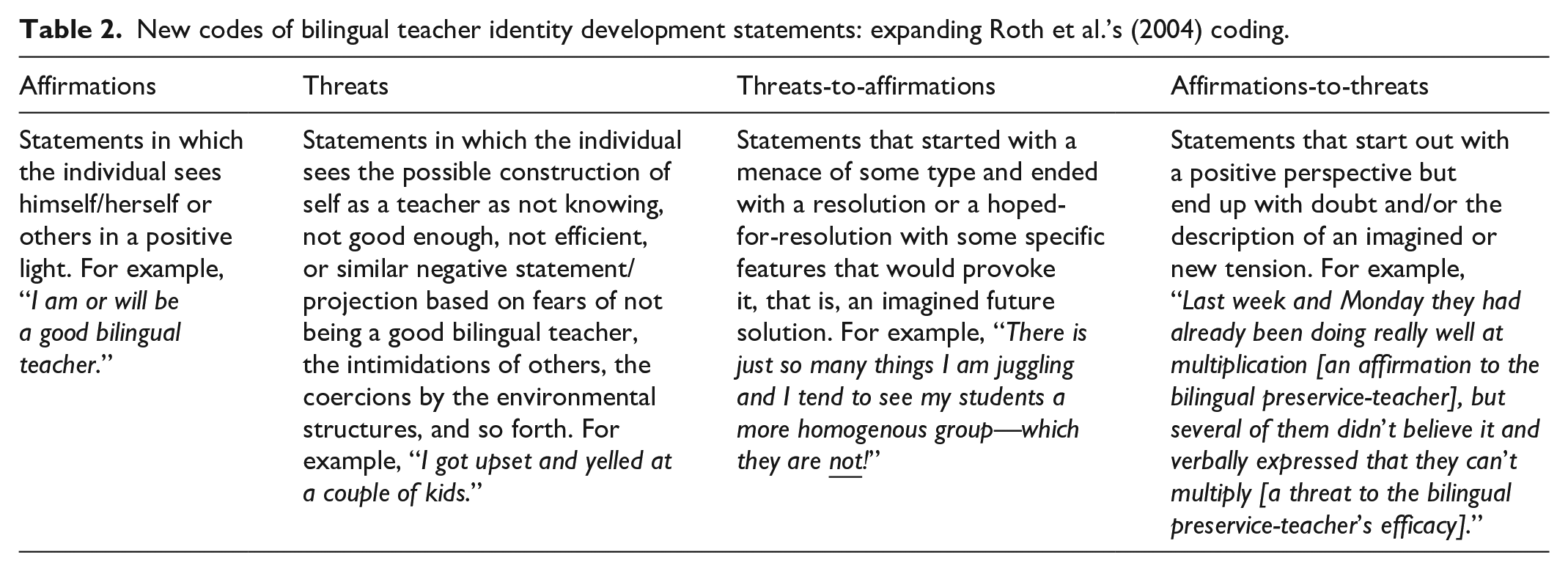
Then, we carried out a second layer of analysis focusing on the process of (re)making of self in the bilingual preservice teachers’ disturbances and aha moments. Our micro-analysis led us to realize that affirmations and threats were documented in both the disturbances and the joys. We understood the manifestations of contradictions as related to the bilingual teacher identity formation as on-the-move (Jackson and Mazzei, 2012). We thus extended the codes “disturbances” and “ahas” to reflect the fluid nature of both categories and included the movement from threats-to-affirmations and from affirmations-to-threats within sentences encountered in the adapted DDs (see Table 2).
New codes of bilingual teacher identity development statements: expanding Roth et al.’s (2004) coding.
Furthermore, we examined bilingual teacher identity building in relation to changes in the weekly Seminar and the particular expansive learning cycle phase addressed weekly. We charted the identity production dynamics as expressed in the adapted DD onto the IGFFMs of the three case study participants to document the evolving bilingual teacher identity formation.
The FFM served as a meta-level instrument that helped our CL participants focus on the functional relationships of the activity under study to capture their social imagination (Greene, 2004) and guided them in (re)mediating the deficit constructs they encountered in their practice to move them toward the possible and the agentic. The X-axis represented the bilingual teacher’s belief and philosophical stance; the bilingual preservice teachers decided to move themselves from being teacher-centered technicians to becoming more inclined student-learning-centered social engineers (Drake, 1953). The Y-axis represented the bilingual pedagogical choices in their curriculum and instructional design; in this case, the bilingual preservice teachers decided to move themselves from an appositional separation mind-set to a more integration enactment.
Visually, we layered the coding of each sentence of their adapted DD into an Excel spreadsheet that provided us a chart (see Figures in the “Findings” section) of the narration of the bilingual teacher identity formation and their dynamic movement over 12 weeks. The CL intervention tools were pivotal in stimulating a significant shift in the narratives.
Finally, we used Sfard and Prusak’s (2005: 17) theoretically driven narrative analytic method to identify the “endorsable” stories of the telling identities, demonstrating how these bilingual preservice teachers constructed their protracted development across time and the continua of their IGFFMs. Due to the L1 background of our three cases, we were particularly interested in how their conceptualizations of the role of language in bilingual teaching changed over time and/or showed up in significant educational and social ways in the shaping of their bilingual teacher identity formation during the CL intervention.
Findings
Bilingual teacher identity formation in a CL intervention
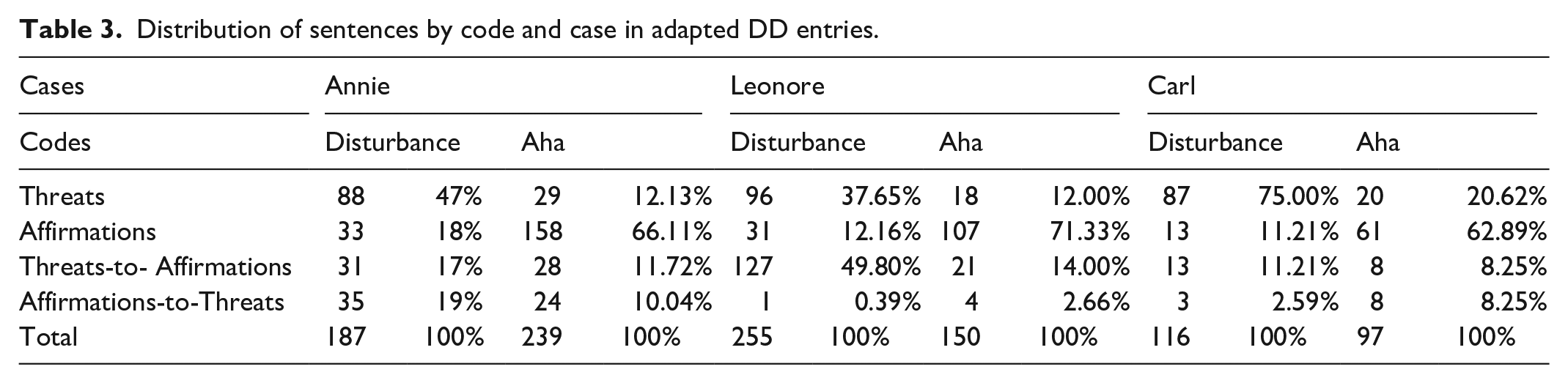
To answer our first research question: How do the new CL instruments afford bilingual teachers identity formation? We start with a discussion of Annie’s, Leonore’s, and Carl’s adapted DD entries and what we learned from our coding. We summarize the four codes that demonstrate how bilingual teacher identity is evolving as participants enact their transformative agency in their adapted DD entries across three cases in Table 3.
Distribution of sentences by code and case in adapted DD entries.
Annie
Annie self-identified as a White Euro American whose L2 is Spanish. She was completing her student-teaching experience in a first-grade Spanish/English bilingual classroom. She described herself as an “outsider” of the language and culture of her prospective students. Concomitantly, she was committed to social justice and acknowledged the importance of the role of language equity.
As shown in Table 3, Annie generated a total of 426 sentences (187 in her disturbance column and 239 in her aha column) in the 12-week entries of the adapted DD. In the disturbance entries, there were 88 sentences coded as threats. In these threats, Annie recognized that her weaknesses stemmed from being both an elementary teacher and a second language learner. She proposed that as a non-native speaker, she lacked an intuitive sense of how to utilize language variation to produce authentic teachable moments. She recognized that teaching the bilingual student population would be difficult, not because she was incompetent, but because of the lack of institutional linguistic support at her bilingual school.
Movement was documented for Annie in the disturbance category—there were 31 sentences indicating threats-to-affirmations (17% of the total sentences in the disturbance entries), as stated in the following entry:
Although this assessment can be quite laborious [threats to becoming a bilingual teacher], I can see how it can also be useful [affirmation to becoming a bilingual teacher] in that you are working one on one with a child and can really see how they are processing all the new information. (DD7: 19 October 2015)
Likewise, there were 35 sentences indicating affirmations-to-threats (19% of the total sentences in the disturbance entries), as in the following example, “The main disturbance today is connected to my AHA—the moment when [my student] said, ‘You won’t let me do anything!’ It was so difficult to hear that. I really felt I was out of options” (DD10: 9 November 2015).
In the aha entries, the affirmations (158 sentences; 66.11% of the total aha moments) outnumbered the other three codes, indicating a healthy sense of self and efficacy in the bilingual classroom. For instance, referring to her interactions with a student around reading, Annie shared, “It is a pleasure to work with a student who likes to share her thoughts about her process—sometimes it can be so challenging to access this inner thinking and understand the process of students” (DD12: 23 November 2015).
Annie shared her observations and used her adapted DDs epistemically as a tool to describe and make sense of her observations about herself in the CL intervention, the cooperating teacher, the children, and the students’ parents.
Leonore
Leonore self-identified as an Austrian-born immigrant whose L1/L2/L3 are German, English, and French, respectively. She was completing her student-teaching experience in a 5th grade French/English bilingual classroom. She described herself as growing up bilingual and knowing the phenomenon firsthand. As shown in Table 3, Leonore generated a total of 405 sentences (150 in her disturbance column and 255 in her aha column). She differed from Annie in that 127 of her sentences, almost 50% of her entries, were in the disturbance category and constructed as movements, as threats-to-affirmations.
For instance, Leonore identified the main frustrations she was engaged in as management and multiculturalism. By management, she explained her threats as being that she was “ I didn’t have a good French-speaking day today. Sometimes I feel I can’t express myself well, and on days like that, French (my third language) suffers the most . . . It sometimes feels as if my brain is tired of keeping those three languages active at all times. I do think that multilingualism is quite demanding for our executive functions. (DD7: 20 October 2015; italics added)
The strong emotions Leonore expressed in the first sentence (I didn’t have a good French-speaking day today) signaled the main internal tension of a bilingual teacher with her key tool—her command of the language of instruction. She conceptualized her proficiency as fluid versus fixed: some days she was more proficient than others. She established a connection between the ability to express herself with her proficiency in the language of instruction, her third language.
By sharing her major disturbances of linguistic insecurity, Leonore acknowledged the social nature of the phenomenon of bilingualism. She implied that her experience was not an isolated phenomenon; rather, it was an instantiation of the social phenomenon of bi/multilingualism. In this way, she connected with the learners in her own classroom; her discoveries and new vision were taken into consideration when thinking about her own and her student’s learning—after all, teaching in multiple languages is difficult and more complex.
In addition, 107 sentences (71.33%) of Leonore’s aha moments were constructed as affirmations. For example, she stated, “I love witnessing [bilingual] students’ learning and thinking.” She described herself as aspiring to be a multilingual, culturally relevant social engineer engaging in inquiry and being a creative social justice educator who advocated for bilingual children.
In the language-as-a-scaffold story, Leonore reflected on her first small group instruction with two new French-speaking students who understood and spoke little or no English. She wrote,
By asking the right questions (e.g., “What in the text makes you think that . . . is evil? Show me.”), and modeling deeper thinking I can (kind of) guide them in the right direction to interpret books rather than retelling them. It’s amazing how scaffolding really works. (DD2: 16 September 2015; italics added)
Scaffolding, a key concept from the field of second language learning (Nunan, 1991), was new and significant for Leonore’s understanding about her bilingual teacher identity as the social engineer of learning for her students. Scaffolding emerged from both her university environment and her placement through reflecting on the materialization of her teaching strategies and observing her students. Scaffolding helped Leonore see the possibilities of learning mediated by key questioning and modeling of the focal language, even when the children did not know the language.
Upon applying the scaffolding theory, it became clear to Leonore that she had to turn to her students’ behaviors as well in order to ensure the lesson’s applicability to real life situations. She shared,
I took a risk in my science lesson today . . . The students’ extremely high level of engagement showed me that the lesson mattered to them. I then used their ideas to design the subsequent lesson, so it was really them who wrote the lesson. (DD6: 14 October 2015)
In this example, Leonore’s gaze was constantly fixed on the learners and their needs while also considering that her own identity was shaped as a risk-taking bilingual teacher.
Carl
Carl self-identified as a White Euro American, a second language learner who came into the bilingual teacher preparation program through a non-traditional route as a Peace Corps Fellow (PCF). PCFs volunteer to work outside the United States for a period of time and, upon their return to the United States, sign a contract to be a head teacher in a high-need school while at the same time earning a master’s degree and teacher certification. He was completing his teaching experience in a 3rd grade Spanish/English bilingual classroom.
Carl described his commitment to helping the children from families less fortunate than his. Such commitment was withered in the depiction of his “newness” to the profession as “a turbulent time” in his life. He centered the main tension he faced on his dual role—as lead teacher, with no educational foundational knowledge, as well as his role as a graduate student—which he believed pulled him away from giving full attention to his students. He felt overloaded by the lack of time for himself and his needs, planning until the wee hours in the morning to get up early the next day to receive the children. With respect to graduate school, he described his efforts as minimum; it was constructed as an obstacle rather than an opportunity.
In speaking about the classroom, Carl focused on planning, pedagogical strategies, and literacy assessments. When discussing his planning, Carl wrote, “It’s really not fair to [his students] how unprepared [he was] and how tired [he was]” (DD4: 29 September 2015). When writing about assessment, he described how far behind he was on his school curricula.
While the teacher education program emphasized language objectives in addition to content objectives in all lessons, Carl did not show evidence of paying attention to language in epistemological ways. Even in his last entry, Carl revealed little to no planning for the language of instruction. He provided evidence of his feelings that transferring between languages was acceptable without giving a sense of when it was acceptable and not. He shared, “I had to give a city math test today. It took 2 full hours and still 2 students didn’t have time to finish. I gave it in English-only to the non-ELLs and in English and in Spanish to the ELLs” (DD8: 28 October 2015).
Carl generated a total of 213 sentences (116 in his disturbance column and 97 in his aha column) in his adapted DD throughout the semester. The statements of his teaching were either positive or negative; very few involved reflections. Less than 15% of the total sentences indicated movements.
In narrating his disturbance (see Table 3), Carl tended to highlight the threats (87 sentences or 75% of his disturbances), as they materialized in the everyday events in the classroom. Rather than reflect on what was possible, he admonished himself for his lack of success with the children, because he had too much to do and too little time to do it. He stated,
Tomorrow is the last day of October and I still have 5 students that I haven’t finished my reading assessments with. It’s the only thing I’ve done in reading during school . . . I have to read with every kid in English and in Spanish until I find an independent level and an instructional level. (DD8: 29 October 2015)
He explained that writing about disturbances was disconcerting. In the aha moments, 62.89% of the sentences are affirmations. He wrote,
We continued our study of landforms in geography today. We did a smart notebook quiz where the students worked in partners with whiteboards and they totally loved it! They were so excited that they were learning in English the landforms they’d only been exposed to yesterday for the very first time in Spanish. (DD6: 14 October 2015)
Carl’s story was evidence that knowing a language is insufficient; the individual aspiring to be a bilingual teacher needs to know the effective ways to plan and teach in two languages. It also documents the need for both practice and theory, as Carl described himself as dedicated to thinking about his teaching but did not mention theories of learning principles that could guide him in his planning. It was only toward the end of the semester when he started linking planning with being a better teacher and began incorporating the idea that disturbances were sources of change. Carl noted in his week 11 entry, “I had been dreading starting guided reading. Today, however, it was actually quite nice. I was pleasantly surprised with how engaged the students were with the lesson and the text” (17 November 2015).
In sum, from the three cases presented here, we have learned that focusing on the process of movement of threats and affirmations helped the CL participants to refocus their relationship between themselves and their bilingual students in the classrooms. The adapted DDs continued to serve as stimulation throughout the study to provoke CL participants to find pivotal moments and expansive solutions.
Relationship between identity formation and a CL intervention
To answer the second question (How are the participants tensions and disturbances manifested in their telling of to-be or not-to-be a bilingual teacher?), we plotted the bilingual teacher identity production activity described earlier onto a timeline of the 12-week Seminar organized around the learning cycle model (Virkkunen and Newnham, 2013) to understand the dynamics of their relationships. Doing so allowed us to address our research questions and bring the individual action to collective activity in the FFM. This analysis indicates that the Seminar’s FFM had an impact in the preservice teachers’ identity formation.
The FFM (see Figure 2 presented in the “Methodology” section) was constructed during weeks 4 and 5 of the Seminar and served to generate concepts for understanding bilingual teaching—what is and what could be. The Y-axis focused on the pedagogical choice and curriculum/instructional design. It moved away from the traditional dualisms (from which manifestations of contradictions emerged) to a dialectic perspective where funds of knowledge (Moll and González, 2004), translanguaging (García and Kleifgen, 2018), among other multicultural/multilingual theories are considered. The CL participants constructed the X-axis continuum (teachers’ beliefs and philosophical stance) to move from a traditional, teacher-centered perspective to a student/learning centered perspective of social engineers. As the bilingual preservice teachers enacted their professional identity in these four-fields, they moved around from being technicians (for certain subject areas) to becoming advocates for the bilingual children.
In what follows, we focus again on the three cases of Annie, Leonore, and Carl. In this section, we use information from their IGFFMs that they used to mark their self-assessments within the collective FFM. On the backs of their IGFFM, the CL participants explained the reasons for their changing positionality within the FFM.
Annie
Upon construction of the FFM, Annie placed herself as already within the upper right-hand quadrant: a student-centered, integrationist teacher (see Figure 4).
In the adapted DD analysis of the threats and affirmation codes as well as her reflective notes in relation to her IGFFM, Annie appeared to be struggling to stay confident in her progressive ways of seeing bilingual teaching although she acknowledged threats. This struggle showed up in both the disturbance and aha categories of her adapted DDs, but more so in the disturbance category, where there was evidence of change early on as going from threats to affirmations and, after week 3, from the threats to threats-to-affirmations. While threats plagued her practice, there was a shift in how she narrated them. After week 2, in the aha category, she started embracing threats as a source of growth and possibilities. After week 5, there was an evident increase in sentences indicating a threats-to-affirmations movement (see Figures 5 and 6 below). The orange arrows going upward out of the blue squares show the movements from threats-to-affirmations, and the blue arrow going downward out of the orange rhombus show the movements from affirmations-to-threats.
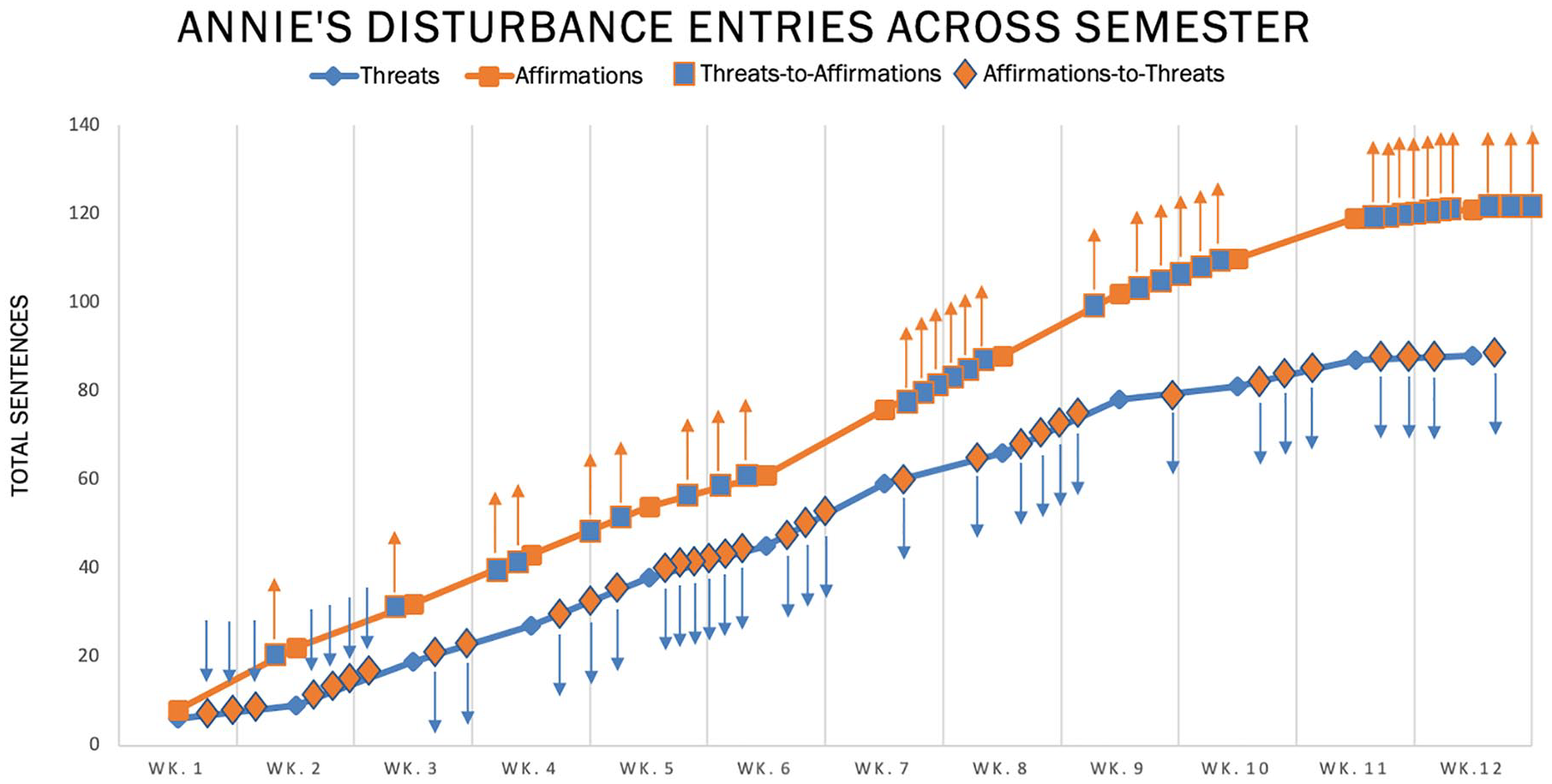
Annie’s disturbances across semester.
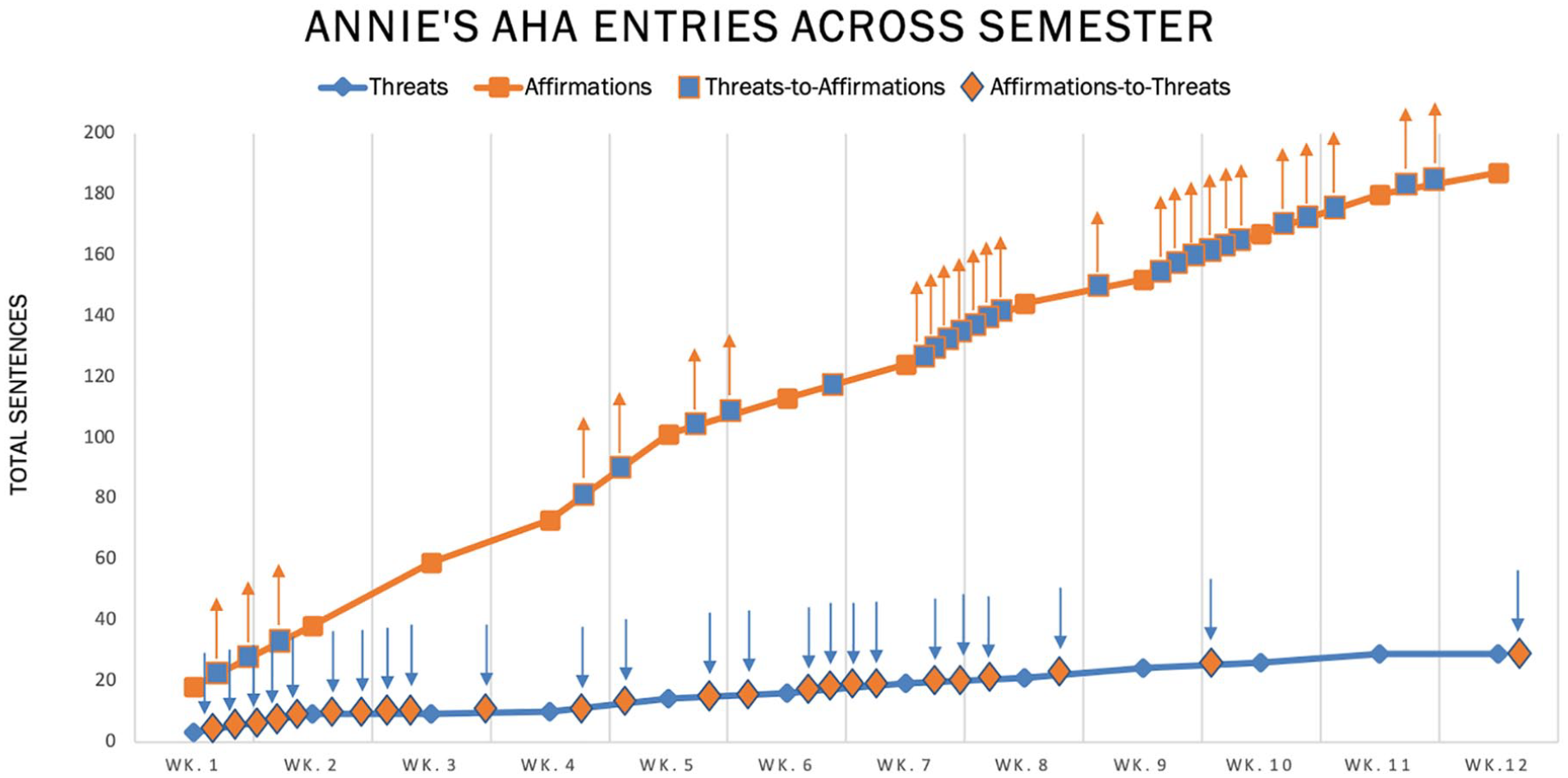
Annie’s ahas across semester.
In the consolidation period of the FFM (weeks 8 through 9), Annie’s entries in the disturbance category (Figure 5) were threats-to-affirmations, whereas in the aha category (Figure 6), the affirmation dominates, and there is an increase of threats-to-affirmations starting in week 6. When Annie had to demonstrate how she incorporated some aspects of the FFM into her bilingual teaching practices during week 11, in the disturbance category, her entries were primarily written as threats-to-affirmations. She seemed to affirm the elements of the FFM and herself as a good bilingual teacher.
Leonore
She described her development as generally protracted across time and the continua of the FFM (see Figure 7). She painted her movement throughout the semester as going back and forth, inching toward a student/learning centered integrationist perspective while separating languages so as to maximize the use of languages-other-than-English.
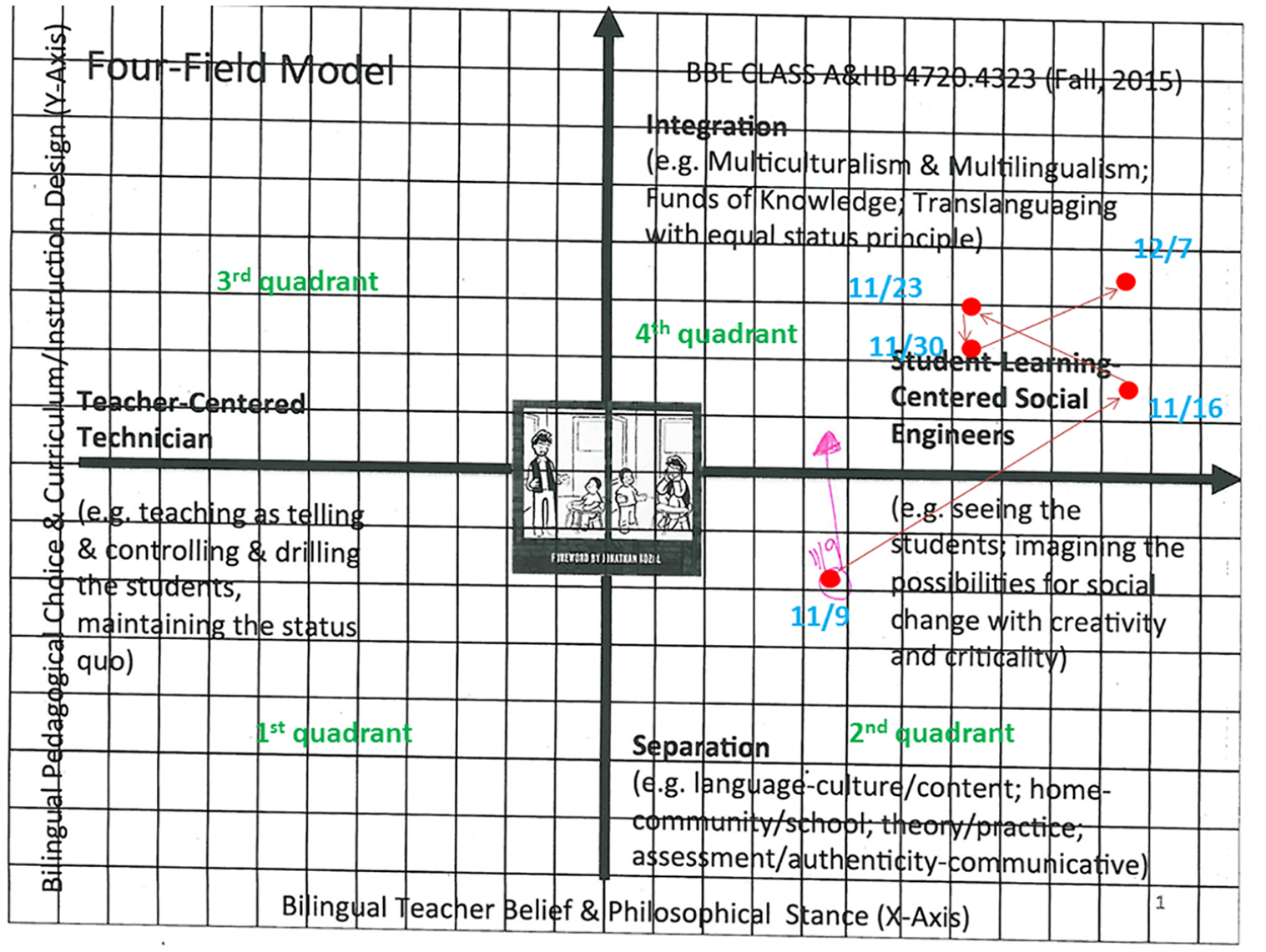
Leonore’s individually generated four-field model trajectory.
When the identity-making and remaking is plotted over time, even though the particulars are different, the overall pattern is similar to Annie’s. In the disturbances (Figure 8), the affirmations were clustered around the 4th–5th weeks, when the FFM was introduced. Threats in the aha entries (Figure 9) seemed to dominate during the consolidation period (weeks 6–7).
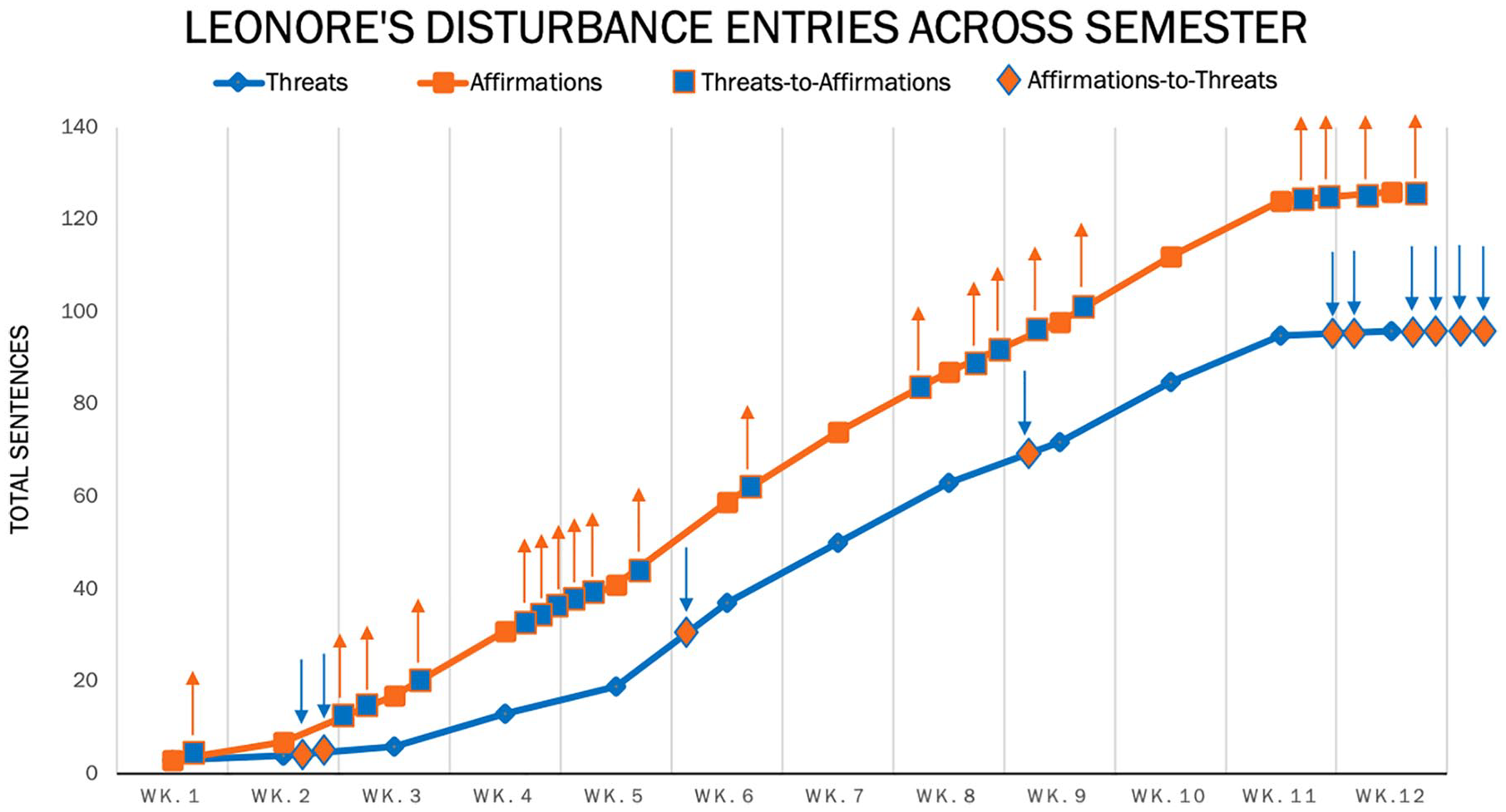
Leonore’s disturbance across semester.
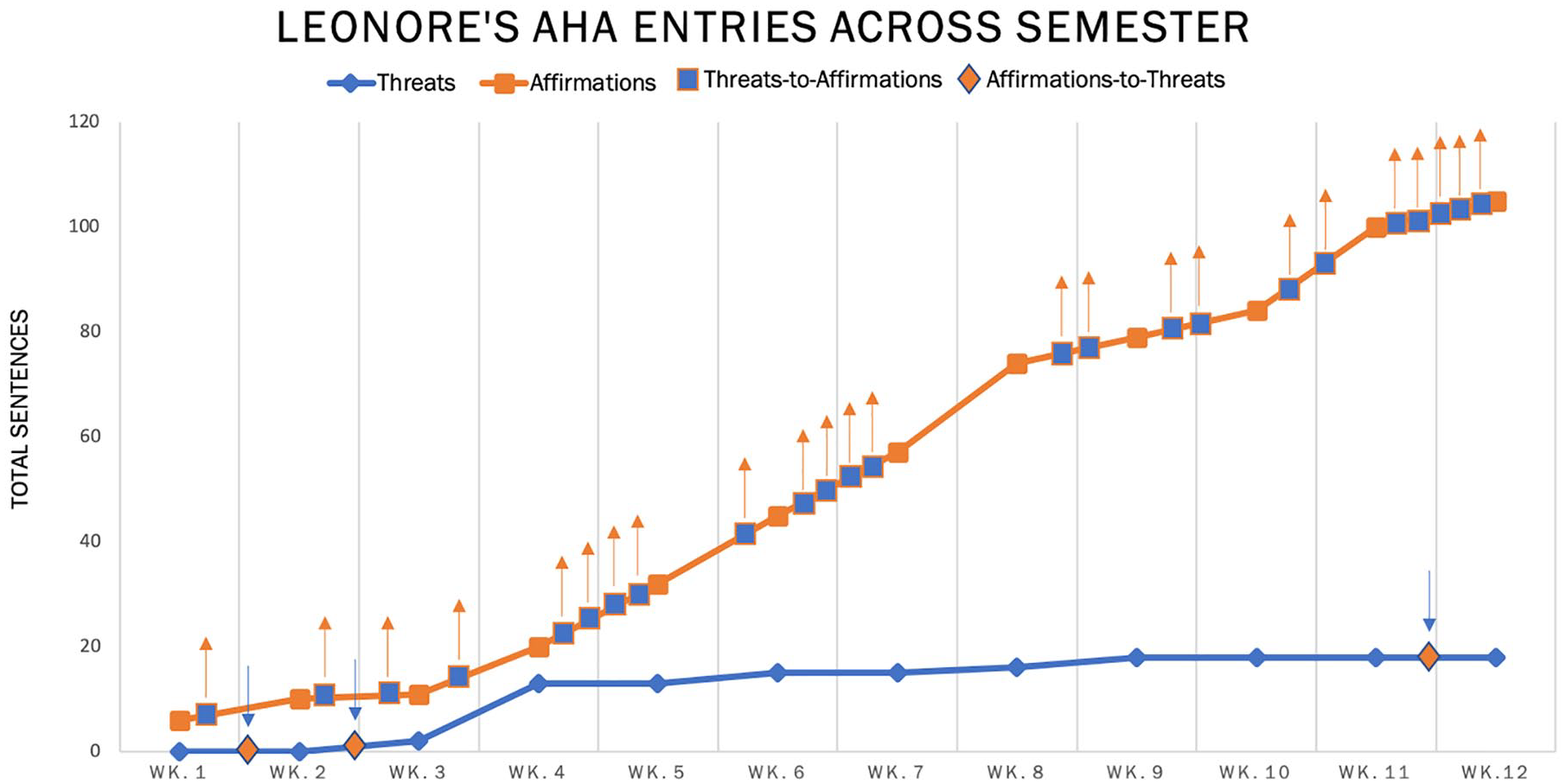
Leonore’s aha across semester.
During weeks 10–11 when the bilingual preservice teachers had to demonstrate how they incorporated elements of the FFM in their teaching, the entries were primarily threats-to-affirmations in the aha entries (Figure 9). Leonore seemed to be struggling with what bilingual teaching meant, embracing disturbances as sources for conceptualizing her teaching.
Leonore’s case was illuminating, as she showed a movement from the more traditional bilingual teaching and, unlike Annie, did not place herself as already in the quadrant representing the new vision of bilingual education at the beginning of the semester (see Figure 7). Leonore referenced and weighed in her academic learning and the collective, floating narratives about the relationship between cognition and language (Adesope et al., 2010; Bialystok, 2011). She anchored the phenomenon of bi/multilingualism within the cognitive-brain functioning, which points to her understanding of the materialization and embodiment of language.
Carl
Carl saw himself as moving linearly from a teacher-centered/dualistic philosophy to a student-learning-centered integrationist stance throughout the semester, as presented in his IGFFM trajectory (Figure 10).
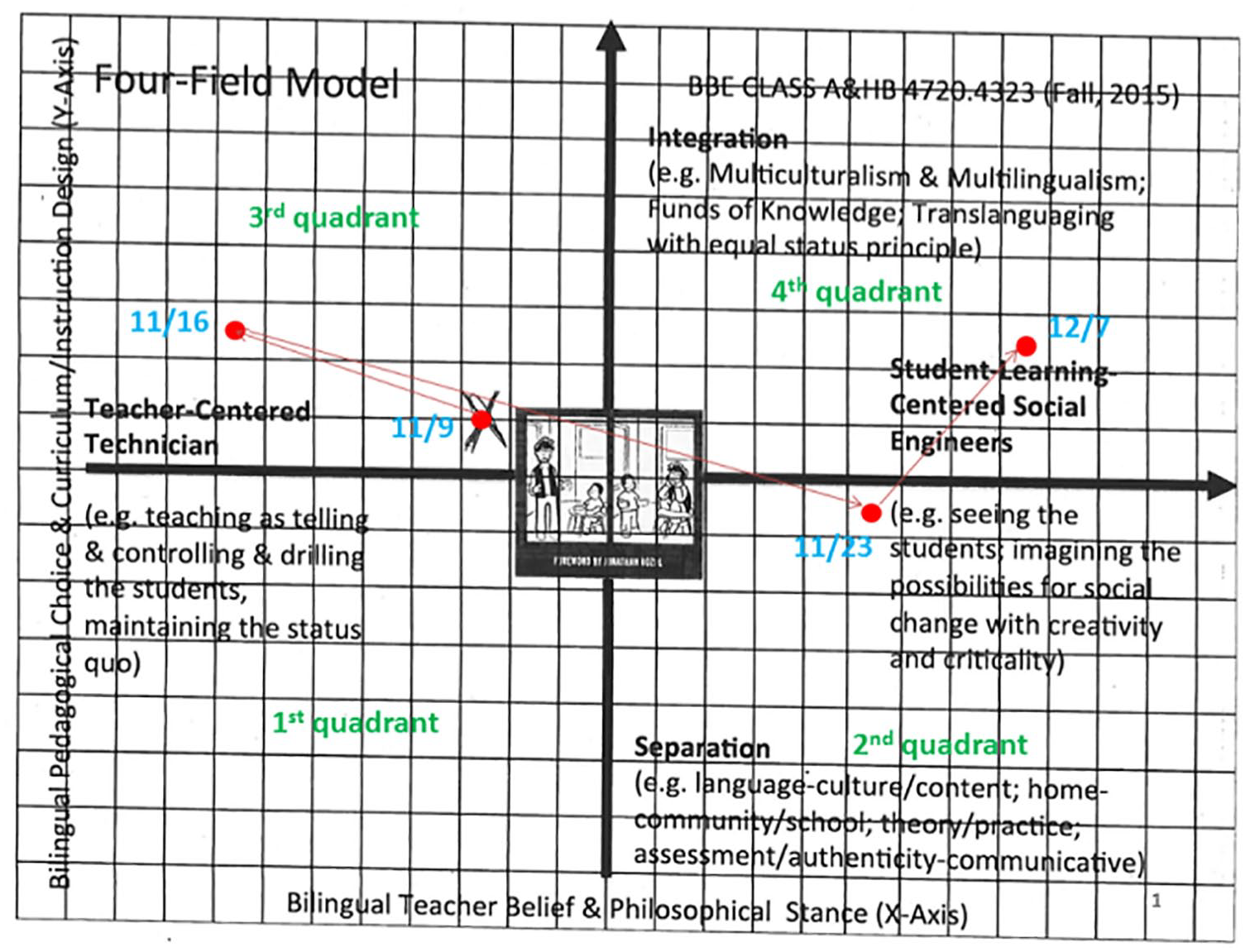
Carl’s individually generated four-field model trajectory.
However, the material description of practices as shown in Figures 11 and 12 do not demonstrate a significant movement in this direction. In other words, there was no major identity shifting for Carl to move from threats to affirmations or vice versa. He contends that learning general literacy strategies trump the role of languages, as Carl reflected,
We were speaking in Spanish, but referring to a chart in English . . . some kids had written in English and some in Spanish, but the important thing was not the language we were in, but the revising and editing stages of the writing process. (IGFFM: 7 December 2015)
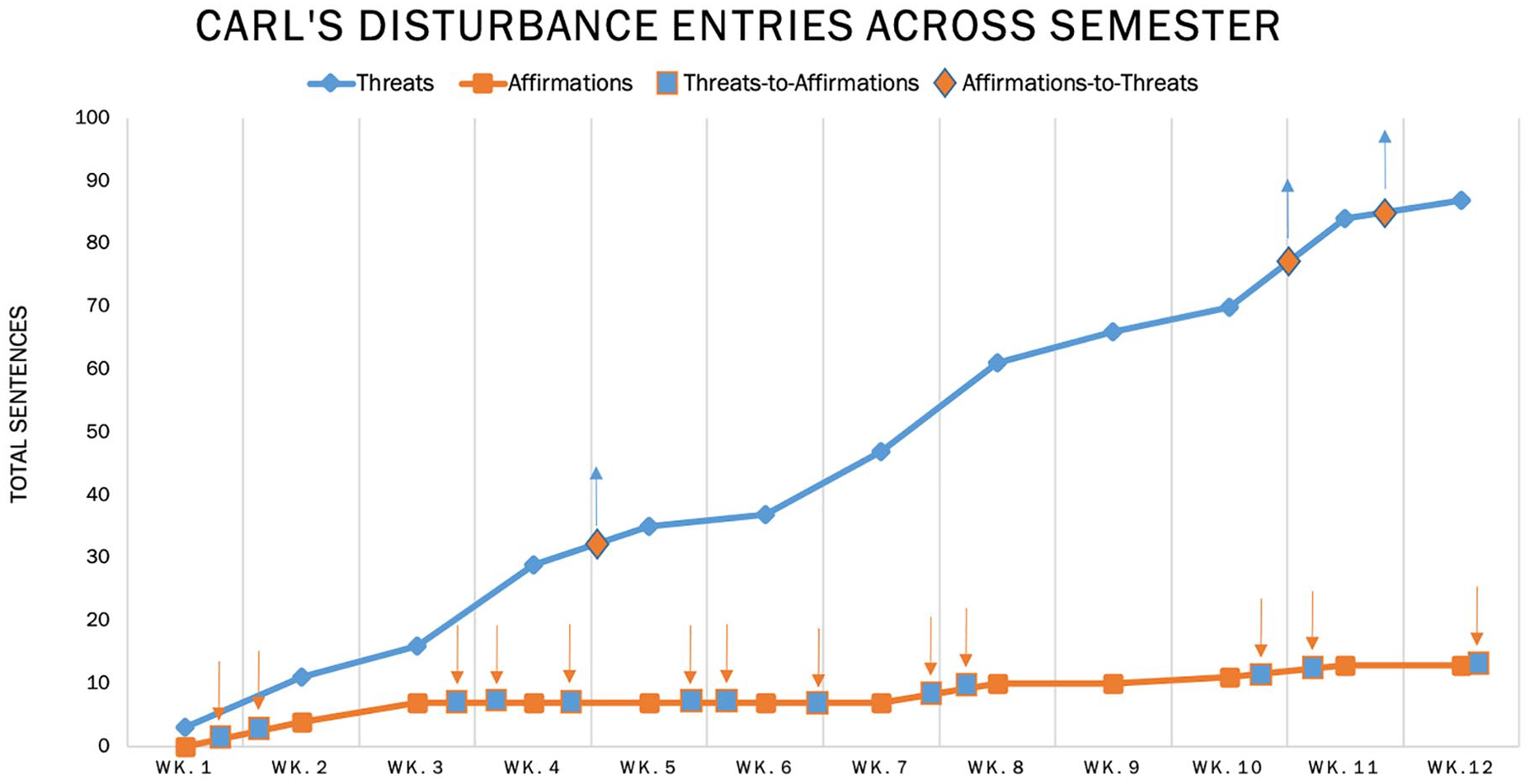
Carl’s disturbance across semester.
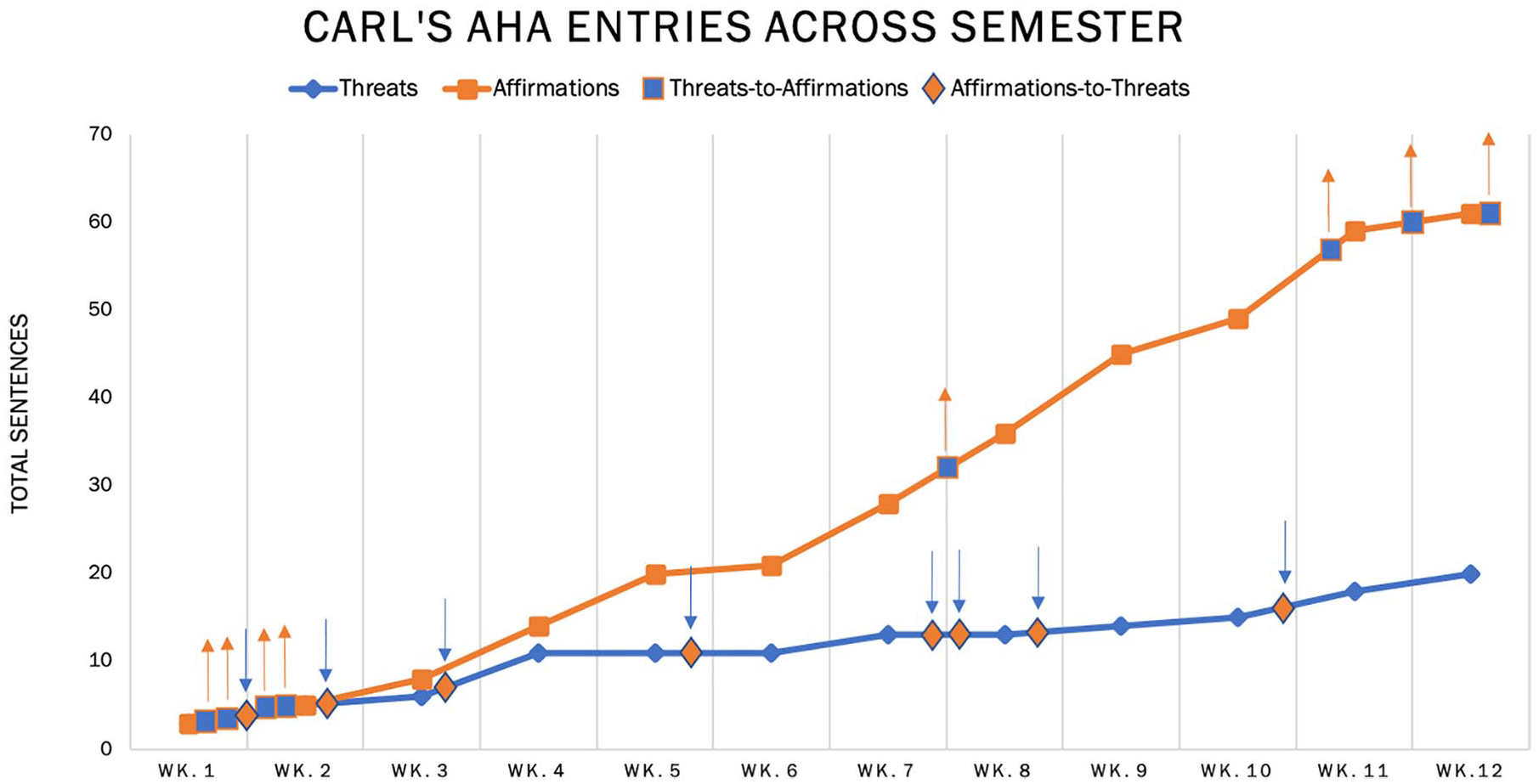
Carl’s aha across semester.
Across three cases, when we explored the occurrences of affirmations, threats, or movement over time, we found three clusters of intense identity formation activity around weeks 4–6, 7–9, and 11–12 in the disturbance entries, and around weeks 4–5, 8–9, and 11 in the aha entries. In weeks 7–8, the bilingual preservice teachers were asked in the Seminar to further refine the FFM by creating an “ideal bilingual classroom.” During weeks 11–12, another cluster of identity building activity correlated with the bilingual preservice teachers’ individual presentations of their philosophical statements and classroom video of their own teaching.
In each of the overlaps of intense identity formation and the CL intervention tools, Carl implicated himself and demonstrated his making and remaking of self as a bilingual teacher in a much less nuanced way compared to Annie and Leonore in this qualitative case study. Corresponding to his teacher-centeredness, he stated, “I have entered class unprepared and it’s easier to be teacher-centered when you’re unprepared” (IGFFM: 5 November 2015). He understood it generated less than optimum teaching. He gave an example of doing a read aloud of a book he had not “pre-read” prior to going into the classroom, as it resulted in spontaneous decision-making. It led to the pedagogical strategy of note-taking which was not using the time optimally, nor were the “kids engaged in the story” (IGFFM: 16 November 2015). In sum, the analysis of the IGFFMs and the plotting of disturbances and ahas in the adapted DD entries across the 12 weeks provided us with information regarding the bilingual preservice teachers’ individual sense of identity formation while considering the FFM collectively generated, as we discuss next.
Discussion
As we reflected on our use of the two major CL instruments, the key differences from the use of the same instruments as documented by Virkkunen and Newnham (2013) are as follows:
Our extension and adaptation of the Disturbance Diary is that in addition to disturbances, we also asked the bilingual preservice teachers to add entries focusing on sources of joy, a response to our awareness that bilingual preservice teachers are in vulnerable places that make them focus on what overwhelms or challenges them as novices. We believed that they needed the “aha moments” to focus on the surprises and the unexpected to articulate affirmations. Thus, we instructed the bilingual preservice teachers to respond to the guiding questions: What surprises you? What were the most important sources of joy and inspiration? The bilingual preservice teachers articulated their disturbances by responding to the questions: What bothers you? And, what are the most important sources of frustration and worry?
Our extension and adaptation of the four-field model further illustrates the collectively shaped and individually told understanding about the relationship between bilingual teacher identity formation and the CL intervention, as they are pertinent to the conceptualization of the role of language in bilingual teaching/learning.
Across the three cases, the evidence showed tendencies toward clustering around similar in-class activity that reflected movement or transformation in bilingual preservice teachers’ identity formation, associated with and leading up to the collectively constructed FFM. The consecutive use of the CL intervention instrument (the IGFFM) seemed to be the cause of pivotal shifts at the individual and collective level. The concepts generated along with the FFM regarding what bilingual teachers could do seemed to convey who they were as bilingual teachers. By way of reconstructing their bilingual teacher identity as learning-centered social engineers of their curricula, the CL participants illustrated their growth mindset as integrationists from a philosophical perspective.
In other words, the FFM served as a meta-instrument for generating changes in the bilingual preservice teachers’ identity formation and bilingual teaching practices. It created a concrete collective zone of proximal development while allowing each individual bilingual preservice teacher to continue to develop their own bilingual teacher identity. The envisioned future bilingual learning/teaching enabled the bilingual preservice teachers to construct a view of themselves as (a) learners in relation to the ethnolinguistic community of the learners, (b) social engineers of a curriculum based on the advocacy of bilingualism in instruction, and (c) inquirers with the school children with whom they worked. It also proposed a philosophical stance where (a) languages could co-exist and sometimes blur, (b) literacies of the home and school were broadened and even hybridized, and (c) theory and practice intertwined and fed on each other in dialectical ways to support culturally responsive teaching/learning.
The use of the FFM on bilingual teaching was motivating; it generated a new conceptualization of the role of language in learning that provided openings for transformational mediation of the CL participants’ teaching. The FFM generated possibilities of designing new systematic structures and developing agentive teachers who knew the kind of teaching their bilingual students could benefit from.
Understanding the location and time of the aha moments and disturbances in the adapted DDs was critical to capturing the importance of identity formation in the CL intervention. The dynamics of the bilingual teacher identity formation, which occurred over time, were narratively manifested in the adapted DD entries. In Leonore’s case, her language proficiency and insecurities became central to her bilingual identity formation which shaped her pedagogical decisions in designing her bilingual lesson.
The FFM acted as a conceptual tool that created the possibility of understanding bilingual teaching/learning and potentially transforming it. The bilingual preservice teachers’ distinction of knowing more than one language became the tool for understanding the learning of their students and other bilinguals. This dynamic permitted the appropriation, critique, and integration of theories about learning bilingually. For them to become a bilingual teacher, the CL participants collectively imagined all social forces working with and against the learning in two languages.
Conclusion
Evidence of the relationship between the identity formation of the bilingual preservice teachers and their participation in the Seminar was presented in the stories of their bilingual teacher identity development. Of particular importance was how they understood tensions as sources of change; how they used floating, collective narratives to help themselves name, describe, and resolve the problems they encountered; and how they understood the role of multiple languages in shaping their own bilingual teacher identity.
This study has implications for our three target audiences. First, teacher educators and researchers are able to see strong connections between the identity formation of preservice teachers and their student teaching as interacting with other activity systems, such as supervisors and cooperating teachers. Moreover, we see the importance of bilingual preservice teachers’ deepened analysis of multiple languages and pedagogy, resulting in the shift of their conceptualization of bilingual teacher identity development. Second, it gives the researchers interested in identity development a different approach to understand bilingual teacher identity formation as collectively shaped and individually told. Third, by using the CL intervention as investigative tools, it permitted members of the activity theory community who are interested in the CL approach to situate ourselves as researcher-mediators (as opposed to researcher-interventionists). Furthermore, taking on the role of researcher-mediators allowed us to highlight specifically the methodological innovations related to the CL interventions and new instrumentality.
Analyzing the overlap between the Seminar and its tools with the identity formation dynamic gave us an understanding of the FFM as a meta-instrument to generate collective transformation in bilingual teaching. Through narrative analysis of the DDs, we were able to understand the nature of the bilingual teacher identity formation in relation to the role of language in pedagogy when the CL participants moved from threats to affirmations and from affirmations to threats. Conceptualizations of the role of language were nuanced when the relationship between the bilingual preservice teachers and the language of instruction became one and when they considered language proficiency and insecurities as central to their bilingual teacher identity, as in the case of Leonore.
Thus, the bilingual preservice teachers’ distinction of knowing more than one language became the tool for understanding the nature of learning—the bilingual preservice teachers’ own learning, that of their students, and that of other bilinguals. This dynamic permitted both the appropriation and critique of different theories about learning bilingually, and the consideration of social forces working with and against the learning in two languages that bilingual preservice teachers collectively imagined as necessary for becoming bilingual teachers. Through this course lab, we learned about the potential of integrating methods from a CL intervention to support the transformation of teacher education from within. We also learned that we needed to be flexible to adapt those methods, such as recognizing the need to create the IGFFMs and to be responsive to the context and process, in this case, the bilingual preservice teachers’ needs. In the same way, the preservice teachers’ identities were on-the-move, and so were ours as researcher-mediators.
Footnotes
Acknowledgements
The authors thank Professors Yrjö Engeström, Anu Kajamaa, Annalisa Sannino, Jaakko Virkkunen, for their ongoing feedback starting from the March 2015 Change Laboratory Method Course held in the CRADLE research center at the University of Helsinki. We dedicate this manuscript to the memories of María E. Torres-Guzmán (1951-2018) for her contribution, kindness and inspiration. The authors would like to thank the anonymous reviewers whose comments have greatly helped them improve this article. They also would like to thank Johnnie Yaj, for his data visualization and Excel spreadsheet expertise in preparing the tables and figures in this article. All errors remain their own.
Declaration of conflicting interests
The author(s) declared no potential conflicts of interest with respect to the research, authorship, and/or publication of this article.
Funding
The author(s) received no financial support for the research, authorship, and/or publication of this article.
