




Abstract
There is an absence of literature on the dynamics of men interviewing men generally and particularly, on sensitive subjects. Childless men are, compared to women, absent from geographical, gerontological, psychological, reproductive and sociological research. These disciplines have mainly focussed on motherhood, women and family formation. Over the past 15 years, research literature on both involuntary childlessness and ageing has highlighted the paucity of material on men’s experience. Consequently, the fertility intentions, history and experience of men have been overlooked. Infertility research has shown that failure to fulfil the status of parenthood may lead to a complex form of bereavement and is a significant challenge to identity. In this piece, I draw on my experience of conducting an auto/biographical doctoral study on the life experiences of 14 involuntarily childless older men. I briefly explore the literature surrounding research interviews with men participants. I highlight the gender dynamics encountered in both interview and wider academic settings. I identify how danger, harm and risk are present in academic environments such as conferences. I use my experience to illustrate how physical, emotional and ethical dangers affect one’s sense of self. I argue that ethical standards should be applied to all research locations.
Keywords
Introducing the issue
There is considerable interest in reproduction and ageing today, with the vast majority of studies focusing on either one or the other. This piece is drawn from my experiences of conducting a doctoral study on the lived experiences of older involuntary childless men. This population are almost invisible in humanities, social science and sociology scholarship. In this article, I examine the dynamics of agency and social structures that I experienced as a heterosexual older man in a field that is in the main, populated by women. Central to this analysis is my own auto/biographical experience as an older ‘mediated’ childless man conducting research with involuntary childless men. This article is not focused on men’s experience of childlessness, Assisted Reproductive Technology, fatherhood or any age-related health condition(s). Publications reporting the findings from my PhD study on involuntary childless men and the inequalities surrounding ageing and childlessness can be here following these references: Robin Hadley (2018a, 2018b, 2018c, 2019a, 2019b). I draw on Robert Zussman’s (2000) concept of ‘autobiographical occasions’ to show how the relationship between agency and structure operationalise traditional gender normatives. I will examine the issues I encountered during and after my auto/biographical doctoral study on the life experiences of involuntarily childless older man.
The article begins by outlining the background to autobiography and then moves on to focus on Zussman’s (2000) concept of ‘autobiographical occasions’ and the reasons for its use. The absence of men’s experience from literature on reproduction and ageing is then explored followed by an examination of the methodological basis of my doctoral study on which this article is based. I also highlight the risks involved in presenting work that challenges gender expectations. The article calls for transparency in the ethical procedures of academic organisations and for a change in how men are viewed.
Autobiography
In the late 1950s, Charles Wright Mills (1959) argued that ‘The social scientist is not some autonomous being standing outside society, the question is where he (sic) stands within it’ (p. 204). Furthermore, Wright Mills (1959) encouraged social scientist to learn to use your life experience in your intellectual work: continually to examine it and interpret it. In this sense craftsmanship [sic] is the centre of yourself and you are personally involved in every intellectual product upon which you [. . .] work. (p. 216)
Gayle Letherby (2014) argues that ‘all research is an auto/biographical practice, an intellectual activity that involves a consideration of power, emotion and P/politics’ (p. 45). Liz Stanley (1993) highlighted how the presence of the researcher and their role in constructing knowledge of an individual revealed the influence of structural contexts: The notion of auto/biography is linked to that of the ‘auto/biographical I’. The auto/biographical I is an inquiring analytic sociological [. . .] agent who is concerned in constructing, rather than ‘discovering’, social reality and sociological knowledge. The use of ‘I’ explicitly recognises that such knowledge is contextual, situational, and specific, and that it will differ systematically according to the social location (as a gendered, raced, classed, sexualitied person) of the particular knowledge producer. (p. 49)
Many works demonstrate the clear links between auto/biography and feminist scholarship (e.g. see Letherby, 2014; Stanley, 1992, 1993). The auto/biographical approach emphasises that researchers are not detached, neutral observers and that self, involvement, and power and privilege are acknowledged in the research process (Carroll, 2013; Letherby, 2014; Stanley, 1992, 1993). Furthermore, Michael Brennan and Gayle Letherby (2017) contend that auto/biography has provided significant understanding ‘of areas of life that are difficult to access or research’ (p. 155). Zussman (2006) asserts that the Self is not an entity but ‘are stories we and others tell about ourselves’ (p. 27). Nonetheless, these stories are more to do with regulation of the self and less about agency or expression of self-concept (Zussman, 2006: 28). He argues for a concept of ‘autobiographical occasions’ that ‘are those special occasions on which we are called on to reflect in systematic and extended ways on who we are and what we are’ (Zussman, 2000: 5). Likewise, he contends that ‘auto/biographic occasions’ are a means of highlighting the relationship between structure, control, agency and freedom (Zussman, 2000: 7). In this piece, I apply this latter concept of ‘auto/biographical occasions’ to explore the relationship where agency, structure and control intersect in research.
The auto/biographical approach situates the biographies of ‘the researcher and the participants as data and as an inextricable part of the research process’ (Carroll, 2013: 457). However, critics of auto/biography assert that it is self-indulgent and both academically and intellectually weak. In rebutting that accusation, Brennan and Letherby (2017) counter that auto/biography enables us to read the contextual into the personal and it is an epistemological approach that acknowledges the significance of the personhood of all involved. A self-conscious auto/biographical approach is academically rigorous in that it highlights the social location of the writer and makes clear the author’s role in the process of constructing rather than discovering the story/the knowledge. (p. 156)
Consequently, Brennan and Letherby (2017) argue that auto/biography recognises and acknowledges the significance of the personal contexts of both the researcher and the other. They extend their argument to make a case for an ‘autobiographical continuum’ (Brennan and Letherby, 2017: 54) ranging from auto/biography to auto/biography. The former refers to academics that write about themselves and recognise the importance of others in their story. The latter write about others but acknowledge the significance of their personhood in the process. Nevertheless, there is no set format for structuring or style of writing an auto/biographical piece. However, Brennan and Letherby (2017) contend that ‘auto/biographical reflection’ should be incorporated throughout any social science piece (p. 156). I will ‘situate’ myself in the next section and then explore ‘auto/biographical pinch points’: occasions that demonstrate tensions between structure and agency.
Situating myself
I am a 60-year-old mediated childless White-British man from a working-class background who was raised with the expectation of being a father. My parents often said, ‘You’ll have children of your own one day’, at times of disagreement. From my 20s onwards, my peers were becoming parents and I became jealous of those who became fathers. For example, I told one friend, who had recently become a father, ‘You have the life I should have had’. On two occasions I have been told, ‘I want to have your baby – you’ll make a great Dad’. On the first occasion, I was in my mid-20s and my then partner and I agreed that becoming parents was the ‘next step’ in the relationship. Self-doubts weighed heavily: was I strong enough? Would I be able to give enough materially and emotionally? Would I – could I – be a good father? After ‘trying’ for a baby, that relationship ended when I was 29. The second occasion was in my mid-30s. My self-doubts had subsided and I felt more confident in my ability to be a father: ‘Yes, I can do this’. However, that relationship ended soon after our conversation. In my late 30s, I met my partner and, after the relationship became serious, we discussed my wish to become a father. My partner is a few years older, a perinatal health professional, and did not now want to become a mother. I was in the position of either staying in a relationship or trying to locate a partner who wanted children with me. It was my choice and I placed our relationship first. However, I was/am conscious of not quite ‘fitting’ in with peers and the familial, relational and social dividend of parenthood/grandparenthood. Moreover, this sense of ‘outsiderness’ extends into academic arenas.
Background
The social sciences have mainly focussed on childbearing, age, family (formation, practices), fertility (history, intentions, predictors and rates), marital status, motherhood, relationship dynamics, social networks and women (Dykstra, 2009). Feminist researchers have highlighted the absence of men’s experiential accounts in the fields of reproduction and ageing (Arber et al., 2003; Leontowitsch, 2013; Throsby and Gill, 2004). Karen Throsby and Rosalind Gill (2004) highlighted the lack of information on men’s experience of in vitro fertilisation (IVF), fatherhood in general and how ‘not being a father has received so little attention’ (p. 333). Maria Lohan (2015) argues that men are absent from the literature ‘on family planning, fertility, reproductive health and midwifery’ (p. 215). Since the 1990s ageing research has focused on women because of women’s structural disadvantage and men’s earlier age of mortality. Recently, gerontology scholars have acknowledged two important facts concerning older men. First, the paucity of material exploring men’s lived experience of ageing. Second, the impact of age-related economic and relational change on older men’s identity (Leontowitsch, 2013; Thompson, 2008).
Discussions regarding reproduction have historically centred on women with little consideration for men’s experiences (Earle and Letherby, 2003). Marcia Inhorn et al. (2009) and Lorraine Culley et al. (2013) argue that the dominance of the link between women and reproduction resulted in a limited script for men to draw on. Furthermore, Inhorn et al. (2009) argued that men have been marginalised as the ‘second sex’ because of the assumption men are uninterested in reproductive intentions and outcomes (p. 1). Tracy Morison (2013) argues that heteronormative gendered roles means male involvement in procreative decision-making is limited to ‘taken-for-granted’ narratives of ‘non-choice’ and ‘non-topic’ (p. 1140). This normative dynamic reinforces pronatalist stereotypical roles of men as provider/protector and women role as childbearer/nurturer. This normative is reinforced structurally. For example, in the United Kingdom as in much of the world, it is not possible to estimate the level of male childlessness because male fertility history is not recorded at the registration of a birth (Kreyenfeld and Konietzka, 2017).
The lack of available data on men’s reproductive experiences is partly down to the historical attitude that fertility and family formation are relevant only to women (Greene and Biddlecom, 2000), combined with the view that men’s data may be unreliable, difficult to access (Berrington, 2004) and, in most of the world, not collected. Only collecting female fertility intention and/or history data reinforces the pronatalist normative between womanhood and reproduction and the masculine ideal of unchallenged virility. Rosemarie Tong (2009) argued that all feminist perspectives hold a view on reproduction: from those who view reproductive technology as a means of liberation and control, to those who see ‘biological mother-hood is the ultimate source of women’s power’ (pp. 2–4). This reflects the wide-ranging debate in the feminisms regarding assistive reproductive technologies, family, motherhood and non-motherhood. Feminist studies of Assisted Reproductive Technology and infertility highlighted the absence of men’s voices and experience (Barnes, 2014; Culley et al., 2013; Throsby and Gill, 2004). By contrast, masculinities scholars have avoided any discussion on reproduction – having concentrated on younger men in crime, education, employment, the body and fatherhood (Arber et al., 2003; Inhorn et al., 2009). Despite the increase of material on fatherhood in recent years, childlessness and infertility seldom feature in masculinities’ research.
Gerontological research in the last 20 years has focussed on the lives of older women mainly because of the disadvantageous status of women in terms of economics, health and care (Arber et al., 2003). The greater population of older women, and the faster reduction in female mortality, led Sara Arber and Jay Ginn (1991) to postulate the ‘feminisation’ of later life (p. 9). Moreover, Deborah van den Hoonaard (2010: 27) argued that widowhood has become an exclusively feminised space due to men’s lower age of mortality, widowers’ high rate of remarriage and the predominance of widows following both World Wars. The focus on older women has highlighted the paucity of contemporary research literature on men’s experience of ageing and later life (Leontowitsch, 2013). David Morgan (1981) highlighted the ‘taken-for-grantedness’ of embedded gendered social relationships in sociological scholarship (p. 96). He argued that men’s gendered experience was hidden in plain view and recommended, ‘Thus taking gender into account is “taking men into account” and not treating them – by ignoring the question of gender – as the normal subjects of research’ (Morgan, 1981: 95). I argue that in much ageing and reproduction scholarship, men are still defined in such a manner. Moreover, I propose there is a need to look how that view is maintained with and beyond scholarship.
Background to the project
My interest in male involuntary childlessness started as the subject for my Master of Arts in Counselling dissertation (Hadley, 2008). A number of counselling clients had brought the subject to counselling and this had raised my awareness of the issue. The criterion for the subject of the dissertation was personal experience. As I had been particularly broody in my mid-30s, I decided to explore men’s experience of wanting to be a father. I define ‘broody’ as the behaviours, feelings, thoughts and urges that constitute the emotional, physical and social aspirations to be a parent. I conducted a Grounded Theory qualitative study using semi-structured interviews. The sample was formed of 10 men. All the participants identified as White-British, heterosexual, and their ages ranged from 30 to 60+ years. The findings identified that men viewed fatherhood as a re-connection, repayment, repeat or replacement, of childhood experience. All the men reported having experienced depression with eight of the men reporting that childlessness contributed to their depression. The men also related childlessness to feelings of bereavement and isolation, and alcohol and substance abuse.
The paucity of material on men’s experience of involuntary childlessness spurred me on to further investigations. I self-funded a Master of Science in Research Methods (Hadley, 2009). My aim was to determine if there was any truth in the common belief that men were not ‘broody’ and women were. The sequential quantitative-qualitative mixed methods research design used an online questionnaire to measure the influences, motivations and reasons to parent. Over 200 completed replies (n = 232) were analysed using descriptive, univariate, bivariate and thematic techniques. Findings showed that 59% of men and 63% of women said they wanted children. The main influences on men’s wishes to have children were ‘cultural and family expectations’ with an underlying factor of ‘biological urge’ and ‘personal desire’. In addition, the men-who-wanted-to-be-fathers had higher levels of anger, depression, sadness, jealousy and isolation than equivalent women did.
Introducing the research
This article comes out of my auto/biographical qualitative doctoral study that examined the lived experience of older involuntarily childless men. For the study, I drew on Pat Chambers (2005) pluralistic framework of biographical, life course, gerontological and feminist approaches. The biographical approach provided a method of understanding the individual and social context of the participants’ experience using the Biographic-Narrative Interpretive Method (BNIM). The BNIM technique fits with the life course perspective through contextualising experiences in relation to past, present and future (Wengraf, 2011). The life course perspective examines the context of biographical experience of socio-cultural values utilising key principles of human agency, historical time and place, social contexts of transitions, timing, and linked or independent lives (Holstein and Minkler, 2007: 18). Drawing on the feminist approach acknowledged how social actors perceived the organisation of their social world and hence their subjective experience. Feminist scholars recognise that men and women’s experience of ageing is shaped in relation to each other as well as intersecting with the power issues of other social categories such as sexual orientation and class (Calasanti and Slevin, 2001: 3). To collect and understand the interactions between involuntarily childless men’s experience and their cultural, economic, political and societal contexts, a qualitative approach using semi-structured biographical narrative interviews was selected. John Oliffe (2009) argued that qualitative research has the potential to disrupt the ‘dominant discourses that espouse men as stoic and alexithymic by collecting and making available first-hand accounts’ (p. 68).
The aims of the study were to explore the lived experiences of men aged 50–70 years and who did not have children, but who, currently or in the past, wanted to be a father. This age range was chosen to account for the demographic increase in the United Kingdom between World War II and the early 1960s (Goldstein, 2009: 9). Excluded from the study were men who considered themselves as biological fathers, who were any form of social fatherhood, for example, stepfather, or were involved in infertility treatment. The ‘snowball’ method of recruitment sampling was initially used for generating respondents as it was highly recommended for accessing hard-to-reach groups. However, feedback from both participants and third-party recruiters highlighted that they had great difficulty in raising the subject of someone’s fertility history in conversation. There was a poor response to the initial recruitment drive. After 6 weeks, only one man had responded and he subsequently withdrew for undisclosed reasons. The recruitment scheme was revised and the recruitment strategy adapted to include newspapers, business cards, dedicated website linked to Twitter, directly engaging personal and organisational networks and arranging an interview on local radio. The most successful methods were ‘Personal networks’ and advertisements in ‘The Oldie’ magazine. Figure 1 shows the different recruitment methods and their success rates. The sample was not stratified by other criteria such as ethnicity or social class because such classifications may have impeded recruitment.
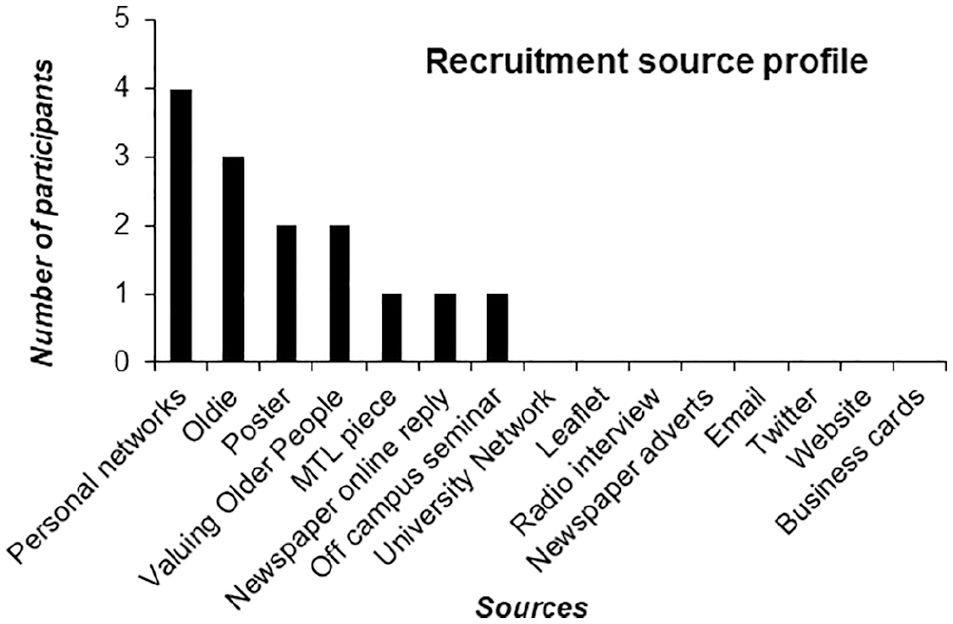
Profile of recruitment sources.
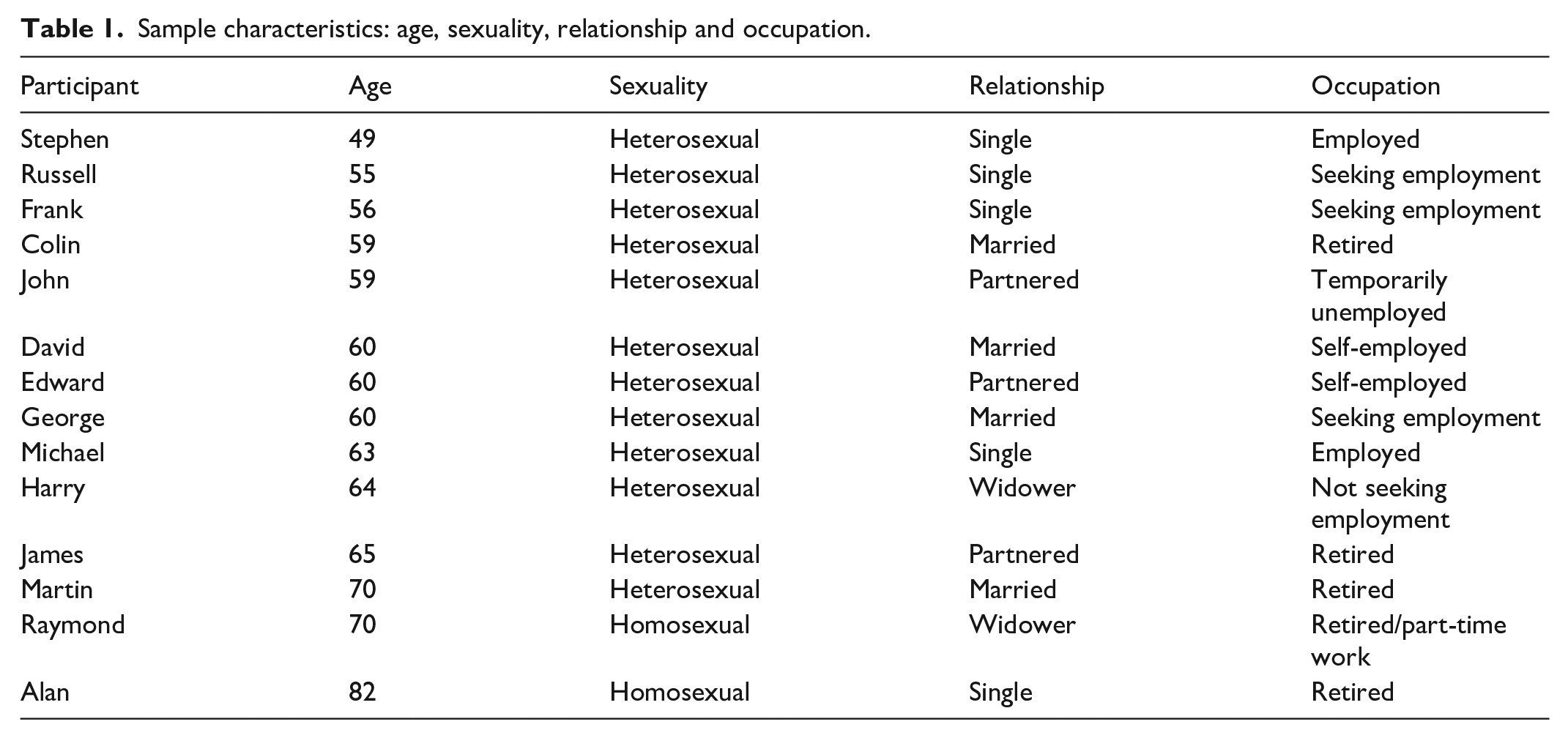
The issues with recruitment issues led to a loosening of the age criteria. From the 28 respondents, the final sample comprised of 14 men aged between 49 and 82 years old. One participant self-identified as Anglo-Celtic Australian and the rest as White-British. Two men self-identified as homosexual and the remainder as heterosexual. Seven participants had partners and seven were single. Two of the men were widowers. The majority of the participants lived in the United Kingdom. One lived in Thailand. Six of the participants described themselves retired, three were seeking employment, two were in fulltime work and one in part-time employment. One man described himself as not seeking employment and one man was temporarily unavailable for work due to illness. The sample characteristics are given in Table 1. Participant-approved pseudonyms were generated and these are used in this piece. The participants’ age is given in brackets. Keele University Ethical Review Panel approved the study.
Sample characteristics: age, sexuality, relationship and occupation.
In all my studies, I have drawn on feminist research and research methodologies for a range of reasons. The foremost motive was the absence of any research concerning men’s lived experience of childlessness or ageing in masculinities scholarship. Jeff Hearn (2000: 352) emphasised that men cannot be feminists but that they can be profeminist. Profeminist researchers recognise patriarchy, research by men using feminist theoretical insights and methodology, and acknowledge their male privilege and experience (Pease, 2000: 6). 1 Theorists now suggest that masculinity is not fixed but fluid and adaptive over the life course; for example, Coles (2008) poststructuralist concept of ‘mosaic’ and Inhorn’s (2012) ‘emergent’ masculinities. These both encapsulate the novel and transformative adaption of traditional ‘ways-of-being’ as social processes that respond to local realities in the context of global forces. Consequently, masculinities scholars have followed ‘feminist auto/biographers (and others)’ in acknowledging ‘that identity is multi-dimensional’ (Letherby, 2014: 56). Central to feminist scholarship is the need for a reflexive approach with the need for researchers ‘to be explicit about the significance of their personal, (Stanley, 1993) as well as intellectual autobiography’ (Letherby, 2014: 52). Eric Mykhalovskiy (1996) argued that the work on masculinity in the social sciences excoriated the ‘texture and variety of men’s experience’ (p. 137). Mykhalovskiy contended that the ‘auto/biographical’ approach adds character, depth, engagement and resonance to this piece rather than cold objectivity. By acknowledging the subjectivity of my personhood (intellectual and personal), I believe this work is richer because it is ‘value-explicit’ (Letherby, 2014: 51).
Interviewing men
Interviewing is potentially, one of the most powerful methods for generating data as it gives access to the content, patterns, dynamics and experience of the participants world. For men, the interview has been viewed as an environment where masculinity is both displayed and under threat (Johnston, 2016; Schwalbe and Wolkomir, 2001). For example, male participants may present themselves as being powerful and autonomous (Schwalbe and Wolkomir, 2001). Patricia Adler and Peter Adler (2002: 526) advise that access to specific groups is increased if the researcher is an ‘insider’ and if the researcher and the researched share similar characteristics of ‘age, gender, social class, ethnicity, and general appearance’ (Adler and Adler, 2002: 528). John Oliffe and Larry Mróz (2005) recommend that a non-competitive environment ‘is essential in establishing an atmosphere conducive to men talking freely without distraction’ (p. 258). Alex Broom et al. (2009: 61) identified how reciprocal enactment of masculinities helped build interview rapport. Allowing male participants to take control of the interview was a recommended strategy for male researchers interviewing men (Adler and Adler, 2002; Oliffe and Mróz, 2005; Schwalbe and Wolkomir, 2001). However, Kevin Walby (2010: 641) challenged Michael Schwalbe and Michelle Wolkomir’s (2001) view of men as autonomous, rational and controlling actors during research interviews. He argued against the claim that all men performed a common identity in research situations. Similarly, Oliffe and Mróz (2005) – as male researchers interviewing male participants – found ‘most men enjoy having someone attentively listen to their point of view’ (p. 258). Participants in a male factor infertility research study reported that they ‘had never before shared this experience so fully with another man’ (Webb and Daniluk, 1999: 22).
There has been much discussion on interviewing, with the majority of this debate centring on women interviewing women (Roberts, 2014). Studies that analyse female interviewer and male interviewee highlighted the physical and emotional risks involved. Women interviewing men have reported sexist comments, interviews shorter and ‘less conversational’ than interviews with women, men manipulated or controlled the interview, ‘wooing’ of the interviewer, repeating their sexual masculinity and ‘power plays’ of manoeuvring the female researcher into a ‘heterosexual female’ role. Men also portrayed themselves as ‘decent’, ‘good’ and ‘masculine’ (Grenz, 2010; Pini, 2005). In contrast, Caroline Gatrell (2006) found very little difference between the attitudes of the women and men she interviewed. Tina Miller (2005) observed that her interviews with fathers lasted longer compared to her experience of interviewing first-time mothers. Some of her male participants had difficulty in articulating their personal and emotional adjustment. Miller found the majority of her participants had had little opportunity to talk in an ‘emotionally attuned’ manner outside of the interview. Some women researchers found male participants were equally or more comfortable talking to women than to men (Gatrell, 2006; Lohan, 2000). Steven Ortiz’s study is one of the few that reports on the dynamics of male researchers interviewing women. Ortiz became an accepted ‘male insider’ by adopting a ‘muted masculinity’. He consciously adapted his appearance, behaviour, and speech to reconstruct himself ‘as being ‘less’ masculine’ (Ortiz, 2005: 271)
There has been little acknowledgement in research literature of the potential sexual attraction and involvement between researchers and participants (Roberts, 2014). Nonetheless, Lohan (2000) noted that when she interviewed men of a similar age, ‘it was I as interviewer, who was doing the “chatting-up”’ (p. 177). Both Simon Roberts (2014) and Walby (2010) found many participants sexualised the interview in their interviews with gay men and male-for-male sex workers, respectively. Walby (2010: 641) argued that the acknowledgement of the researchers’ sexuality positions them as a ‘sexuality insider’ with consequential increased rapport through shared identity (Kanuha, 2000; Roberts, 2014). However, Roberts (2014) highlighted the disadvantages of being an ‘insider’ including the blindness to the significance events or situations through the assumption of ‘commonality of experience’ (p. 454). Furthermore, Walby (2010) proposed that researchers’ assumption that gay men were always pursuing hegemonic masculinity is not necessarily true all of the time and in all cases.
Other researchers have reported little difference between the participants’ responses to the gender of the interviewer (Padfield and Procter, 1996). Nevertheless, the difference was significant with female participants disclosing highly sensitive material to the female interviewer (Maureen Padfield) that they did not to the male interviewer (Ian Proctor). Christine Williams and Joel Heighe (1993) found male nurses referred to sexual orientation and sexuality with the male interviewer but not with the female interviewer. Moreover, some participants gave considered replies in order not to cause offence to Williams of Williams and Heighe (1993: 290). Similarly, Gatrell (2006) found her female participants ameliorated contentious views. Likewise, female researchers found their legitimacy as professional researchers questioned by female participants (Broom et al., 2009). Alex Broom et al. (2009) concluded that both male and female researchers used gender commonalties to establish rapport. Consequently, a ‘gender script’ (Broom et al., 2009: 61) of idealised positions between researcher and participant was enacted. Nevertheless, male researchers then found it difficult to broach questions of a sensitive nature to male participants. Martin Robb (2004) found that both he and his male participants had difficulty in discussing direct questions concerning masculinity. Broom et al. (2009) argue that in addition to gender, other factors such as age, class, location and the timing and duration of the interview can have a significant impact on the interview.
My experience demonstrated the many influences that affected on the relationship between myself and potential and actual participants. For fear of biasing the sample, I had not referred to my childless status in any recruitment material. However, on first contact, all the participants asked if I was ‘childless’. I felt it was important to the men to know my status and I willingly disclosed my status as an insider. For example, I noted on the respondent sheet, ‘Russell seemed concerned to find out if I was involuntarily childless and I think his agreement to participate hinged on that’. I was aware of the power of being a PhD researcher from a University and tried to minimise the power differentials within the interview (Oliffe and Mróz, 2005: 258). I was careful not to use jargon, I deferred to the participants’ wishes on how, when and where we met and I dressed in a ‘smart-casual’ manner. Following each interview, I used my field notes and research diary to reflect on the interview dynamics. What went well, what went badly, what I missed and which incidents were dominating my thoughts. I use examples from my research diary and field notes to highlight the dynamics within three interviews. Each interview was a site where ‘autobiographical occasions’ were shared and an ‘auto/biographical occasion’ was created.
I am a heterosexual man and I did not ‘advertise’ my sexuality; neither the fact that I am married; nor did I hide it (Bruni, 2006). In my interviews with the self-defined gay participants Alan (82) and Raymond (70), we did not discuss my sexuality – I assumed they would realise I was not gay. Both men lived in ground floor social housing flats. Both indicated in their narratives that they had double beds. I did not interpret this as symbolic of any sexual positioning (Roberts, 2014; Walby, 2010) but as reflecting a sense of loss in their change from partnered to solo living through, respectively, relationship breakup and bereavement. While I am an insider regarding the wish for fatherhood, I was an outsider to other aspects of their lives. Nonetheless, the total recorded interview times were 7 hours and 37 minutes for Alan and 2 hours and 25 minutes for Raymond. The interview time totals were neither the shortest nor the longest and I believe reflect the men’s character. Alan had always been very socially outgoing and had been a long-standing activist for gay rights. He was a volunteer at a local support centre for young Lesbian, Gay, Bisexual and Transgender (LGBT) people and had been deeply involved in organising the first local ‘pride’ event. He had given many interviews to local and national media on LGBT matters. Raymond was not as outgoing: when his partner was alive, they had actively avoided any local ‘gay scene’ nor been activists. Both Alan and Raymond were happy to be interviewed and both said they enjoyed the encounter.
My class and my status as a ‘naïve beginner’ in PhD research affected both my interviews with George (60). George was tall, slim, tanned, articulate and middle class. He was a former mathematics teacher and had just completed a post-doctoral research contract. During the latter part of the first interview, I asked an ‘off the cuff’ question. At the time, I thought George had responded in a sharp manner, and immediately my fear was that the second interview would not take place. Although, I listened to the recording many times I have not found anywhere George was not pleasant and genuine. Following our second interview, I noted my perceptions of the interview dynamics in my research diary: I came away feeling that I had disappointed him, that at times he was frustrated by my questions and said on one or two questions what was their point? I wonder how much that he is already a PhD and was interested in the methodology and background to the study linked to my general anxieties about being not good enough and not being academic enough. Perhaps I should have asked about his PhD and field of study more. I am in awe of his use and ease with language and sense he feels my unease. I feel I have disappointed him.
On reflection, George’s confidence and well-spoken manner keyed into myself-awareness of my working-class roots: my Mancunian accent, my insecurity surrounding methodology and my right to be carrying out a PhD. My experience relates to the auto/biographical approach and demonstrates how researchers are not detached, neutral observers and that self-involvement, privilege and power are acknowledged in the research process (Hugill, 2012).
As a self-defined involuntarily childless man, I was aware of the affect my own auto/biographical background had on the research. There are both advantages and disadvantages to the insider position. My insider status may be considered to add to the validity of the study through a shared understanding of our experience of involuntary childlessness. Equally, through familiarity, I may have missed some aspects of the data which an ‘outsider’ may have acknowledged (Kanuha, 2000). The ‘insider-outsider’ relationship involves complex shifts and subtle nuances throughout the research process. The researcher-researched liaison involves an ongoing negotiated relationship where outsiders sometimes occupy social positions as insiders, and vice versa (Järvinen, 2001: 280). Taking an ‘autobiographical occasion’ view adds the important context of reflecting on the structural influences in interactions.
Gender issues in wider research settings
A number of academics (the vast majority feminist scholars) have reported the exclusion of the male experience in the disciplines surrounding reproduction (Culley et al., 2013; Inhorn et al., 2009; Lohan, 2015). However, not only are men absent as research subjects they are also absent from relevant research groups and institutions. Very few studies report on the ‘back office’ dynamics as a man working in a gendered area that is heavily populated with women. Steve Robertson (2006) noted that men researching gender are often viewed with suspicion in terms of their sexuality. Moreover, health-care staff has been recorded ‘othering’ patients who do not conform to masculine gender norms of invincibility and bravery (Hugill, 2012). I have reflected heavily on an instance where agency and structure reflected widespread embedded gender norms. In 2014, I attended a seminar on an Economic and Social Research Council (ESRC)-funded study of donor conception families. The co-investigator’s struggles in interviewing the male partner of a couple drew a sympathetic laugh, collective eye-rolling and an unspoken ‘typical man’ emanated from the audience (Hadley, 2014). Reflecting on that incident, I have wondered if the man did deserve some empathy from both the researchers and the audience. Would the response have been the same if the woman participant had behaved in a similar fashion?
I have often been the ‘only man’ in academic environments. However, this is no new experience for me. In my counsellor training, I was one of two men in a class of 22. I have attended many lectures, seminars, workshops, personal development groups and training events where I have been the only male. At many of research events, there are academics who have researched areas where women have been treated extremely poorly by men and institutions. On such occasions, I try not to behave in the manner often reported of male academics: domination of any conversation, exclamation of the importance of their own research and behaviours that attempt to govern the environment. I like to think I would not behave in that manner in any environment. To a degree, I am paralleling Ortiz’s (2005: 270) ‘muted masculinity’. Nevertheless, I have had a range of reactions to my research findings – from being asked if I can be hugged to covert and overt hostility.
In general conversations at sociological conferences, responses to my research subject have included exaggerated eye-rolling, imitation of crying with gestures of wiping away pretend tears and saying ‘Boo hoo’ and ‘Why should I care? Oh, that’s right I don’t’. The most serious example of open hostility occurred when I presented at a conference focusing on all aspects of reproduction. I was the only man at the conference of some 30 or more delegates. Over coffee at registration, I introduced myself to another delegate, Dr X, standing nearby. My proffered hand was ignored. My inquiry on whether the delegate was presenting received a curt, ‘Yes, and I’m chairing too’ followed by Dr X turning her back and addressing someone else. During questions at the end of my presentation on research findings, Dr X made comments to the effect that my participant’s narratives were untrustworthy because ‘I bet they have had children’. By chance, I then attended Dr X’s talk. As is my usual practice when I am the sole male attendee, I placed myself in the front row of the seating furthest away from the speaker. By doing so I hope that all the other attendees can see me and I am not near the powerful figures in the room. During her talk, Dr X referred to the ‘paedophile in the corner’, looked at me and made a hand gesture in my direction. I have never met Dr X before and I was unaware of any of her academic work. The incident left me shaken and confused. I continue to be affected by the incident and will not attend any events at the University where Dr X is in post and, ironically, sits on the ethics committee.
This incident relates to one of the findings from my research: all the participants feared that they would be viewed as a paedosexual. Harry, a recent widower had lived at the same address for over 30 years. During his partner’s lifetime, children were welcomed freely into the home. Following her death, he feels he has to guard against being viewed a threat: Now, there’s loads and loads of really young children along this street. Some like to come in and play with the dogs. And you have to say, ‘No! Look go and get your Dad’. It’s things that bother you-I’d hate someone to look saying, ‘Watch that old man, always got kids round him’. I don’t want anyone looking at me thinking that.
The negative portrayal of older people is well established with lone older men particularly viewed as ‘dirty old men’ and sexual predators (Gutmann, 2009; Walz, 2002). Many media campaigns have reinforced the stereotype of the ‘dirty old man’ and the view that men are sexual predators (Gutmann, 2009: 29). Examining this incident through the lens of ‘autobiographic occasions’ highlights how gendered views become embedded in social and academic structures.
My experience illustrates that danger, harm and risk does not end with data collection. There are other risks ‘associated with leaving the field, analysing sensitive data, and fulfilling commitments to research participants in the delivery of research findings’ (Sampson et al., 2008: 930). In addition to physical, emotional and ethical dangers, Geraldine Lee-Treweek and Stephanie Linkogle (2000) argued that researchers can face ‘professional danger’ when they challenge or deviate from existing academic, theoretical, methodological, occupational and/or institutional precepts (p. 20). Letherby (2014) highlighted how she was warned that the auto/biographical approach was ‘sloppy sociology’ and that colleagues might use personal material negatively. Moreover, she postulated that fear (and experience) of emotional, intellectual and professional violence leads researchers and writers to compose ‘the personal’ outside of reports and articles, if at all (Letherby, 2014). The majority of professional societies have clear and transparent ethical standards for members who are conducting research. Common to many are guidelines on ‘respect’, including to ‘do no harm’. These attributes should also be applied to settings outside of research scholarship.
Conclusion
This article has highlighted the intricacies of gender in the research process that I, a heterosexual older man, experienced during interviews and in academic locations. I have described the different findings of the influence of gender and other factors such as class in the interview. Furthermore, I have demonstrated how gender is not only a consideration for reflexivity during research but also in other arenas. As Roberts (2014) stated ‘Studies using insider status need to acknowledge their differences to those they are researching’ (p. 459). Furthermore, Robertson (2006) argued that a strength of auto/biography was the reflexive process that ‘allows for, and indeed demands, the consideration of such issues that may not otherwise be thought about within a research project’ (p. 316). This article has highlighted how gender is one of many dynamics in operation in the research interview and extends into other research and structural settings.
Analogous arguments have been raised within feminisms regarding men’s experiences that have led the way in examining the multi-layered meaning and socio-cultural intersections concerning reproduction for men (Earle and Letherby, 2003; Letherby, 2003). Nonetheless, Culley et al. (2013), Inhorn (2012; Inhorn et al., 2009) and William Marsiglio et al. (2013) have argued that feminist scholarship has retained the theoretical and experiential spotlight on women’s reproductive issues. This reflects the wide-ranging debate in the feminisms regarding assistive reproductive technologies, family, motherhood and non-motherhood (Tong, 2009). Research in the masculinities has concentrated on younger men in education, crime, employment, the body and fatherhood (Arber et al., 2003; Inhorn et al., 2009). Although there has been an increase in material on fatherhood in recent years, infertility and male childlessness are notable by their absence. On the surface, the two approaches parallel the dominant social heteronormative with feminisms encapsulating the gamut of reproductive narrative, while the masculinities have only recently looked at fatherhood. However, that view does not do justice to the ongoing debates in the feminisms concerning the relationships, reproduction, intersectionality and power. It does highlight the absence of any debate concerning non-reproduction in masculinities. Nevertheless, it appears that the belief that men are not interested in taking part in research concerned with reproduction is still embedded within the research community and that their absence ‘condemned to be meaningful’ (Lloyd, 1996: 451). The meaning of male reproduction to men remains largely unexplored. Morgan (1981) highlighted how social science research had hidden men’s experiences: ‘men were there all the time but we did not see them because we imagined that we were looking at mankind’ (p. 93). Subsequently, feminists called for men to be viewed as gendered social objects not gendered objects by ‘naming men as men’ (Hearn, 1998: 783). Nonetheless, as there is ‘no . . . one experience of being a man’ (Kaufman, 1994: 152), I believe auto/biography has an important role in increasing the understanding of the men’s lived experience. Consequently, it is time for men to stop being seen as objects – gendered or social – but as people with associated complex chaotic messiness of human beings. By examining ‘pinch points’ where ‘occasions for auto/biographic reflexivity’ occur, a similar messiness in how gendered narratives are maintained and operationalised is highlighted.
Footnotes
Declaration of conflicting interests
The author(s) declared no potential conflicts of interest with respect to the research, authorship and/or publication of this article.
Funding
The author(s) received no financial support for the research, authorship and/or publication of this article.
