



Abstract
Interdisciplinary psycho-spiritual research into workplace stress and self-care is scant noting the fact that negative self-talk and harsh self-judgement stymie the search for inner meaning and self-care. To address this, this article uses an intuitive and reflection-oriented methodology to research self-care choices for the stressed and suffering worker. In particular, it breaks new ground because no workplace-based applied psycho-spiritual research uses bricolage, let alone the heuristic inquiry process which gives expression to it. Bricolage is a tapestry of ideas, themes and possibilities cobbled together to produce creative outcomes. It adapts and co-opts whatever information from whichever discipline that is necessary. This approach appears well suited to the subjective, intuitive nature of workplace stress and suffering and especially where interdisciplinary approaches to self-care are warranted. The heuristic inquiry process which is used for the first time for workplace self-care works intentionally with interior resources that may be unknown or fragmented and dialogues sensitively with inner ‘rules’ or patterns that may have become problematic. Incubation and reflective illumination produce tacit knowledge to augment healing intuition. This process is illustrated by an example. It is about a less intense focus that actively encourages tender, ‘standing apart’ from symptoms so as to allow perspectives to arise and the intuiting of transformative possibilities. From this, self-compassion, humility and meaningful detachment are re-affirmed as ways to pay self-kindly attention and address self-criticism and self-blame. The contribution of the study is threefold. First, it extends bricolage to workplace self-care by considering inner resistance and negative self-talk, both barriers to self-care. Second, it affirms the heuristic inquiry process as an intuitive method for self-care research. Third, and paradoxically, it shows that self-engagement, in a compassionate yet less intense way, can lead to self-care transformation. Finally, limitations to the study and possibilities for future research are discussed.
Keywords
Introduction
Although there are many research methods, often they are not readily nor successfully used in the subjective, messy and complex nature of lived experience at work, especially in the search for inner healing, self-care and sense-making in times of stress and suffering (Anderson and Braud, 2011). This reflective article extends research methods for workplace self-care as newer ways of knowing and transforming human experience. It is also motivated by the fact that there are alternative, more personal inquiry, even psycho-spiritual approaches, that take the researcher beyond quantitative approaches towards the intuitive, idiosyncratic and personal. This is, which after all, where the subject, the sufferer, so often dwells.
The negative impact of suffering, traumatic and other work-related stress on the wellbeing of people at work is clearly documented (Danna and Griffin, 1999). So too, psychological and medical treatments are well researched. The absence of well-documented, multi-disciplinary approaches to self-care presents a research opportunity. In particular, I am interested in ways that draw on applied, even non-religious, spirituality and positive psychology to strengthen how one researches, let alone responds to stress and suffering at work from an interior or more meaning-oriented way.
Self-care
Currently, responsible self-care carried out by informed individuals is not being effectively harnessed. Whilst self-care should be the first option, it is often not considered at all, by either individuals or clinicians. The reasons for this are complex and rooted in the ways in which health and illness have been thought about and organised (emphasis added). (Duggan et al., 2018: v)
The quote, albeit written in the context of community health, nevertheless highlights the gap and opportunity for focussed research on self-care choices. Moreover, Duggan et al. (2018) indicate that the ‘the state of self-care and self-management policy, programs and support in Australia is fragile at best’. Pointedly too, they also say there is a paucity of support for ‘individuals to understand and make better-informed choices about their personal health’ (p. 1). This is an urgent call to action.
Definitions in relation to self-care are difficult to establish, however, some important definitions are provided in Appendix 1. Moreover, interestingly enough, Duggan et al. (2018) found that there is ‘very little Australian literature which uses the term “self-care” or has a specific focus on self-care as a means primary prevention of chronic disease’ (p. 9). Notably too despite the meta-analysis undertaken, they did not examine the workplace context nor consider holistic self-care choices, although they made one reference to cultural beliefs, and especially ones that included spirituality nor meaning. Yet, arguably one could consider the workplace an environment where severe and stress can be associated with chronic health-related issues and conditions (Giorgi et al., 2018; World Health Organization (WHO), 2012).
Workplaces
Specifically, at work, poor self-care can lead to negative affect and self-blame and be a ‘potential contributor to the high rates of stress, depression, and burnout’ (Mills and Chapman, 2016: 87). In fact, in a workplace context self-care can be about a whole raft of steps and personal choices although almost none to date is about inner-meaning (Clode and Boldero, 2006). Yet, self-care ought to be researched holistically because it ‘involves various strategies that help promote or maintain ones’ physical, mental, emotional, and spiritual health; as well as ensuring that personal or family needs are not neglected’ (Mills and Chapman, 2016: 88).
Moreover, recent research such as Mills and Chapman (2016), albeit in a preliminary way, points to the power of self-care and self-compassion, in particular, as personally transformative choices. They do however, which impels this research, note the dearth of qualitative methods, related to workplace psycho-spiritual issues, to give these self-care choices effect.
It is suspected that older or outdated forms of thinking and reflecting may contribute to workplace stress conditions (Kenny, 2012). Despite this, next to no workplace-oriented research examines self-kindly ways to address negative self-judgement, problematic rumination and lack of self-acceptance. Let alone does workplace research or praxis to date utilise Moustakas’ (1994) heuristic inquiry process.
Psychological research into workplaces, let alone psycho-spiritual, can often be about performance, detachment or job satisfaction. They do not necessarily engage across the body, mind and spirit domains let alone with workplace distress (King and Nicol, 1999; Petchsawanga and Duchon, 2012). This is despite the fact that people who present with stress or mental health issues may name spiritual themes, inner meaning and sense-making as key needs (Rupert et al., 2015; Sprung et al., 2012).
Such stress-related presentations can be complex, idiosyncratic, poorly addressed and even pain-filled (Tzounis et al., 2016). In fact, if we conceptualise what is occurring at the (inner) meaning, spiritual or sense-making level then much research does not incorporate as many disciplines as needed (Devenish-Meares, 2015b). Furthermore, so often, self-care disciplines are considered in isolation to others despite the fact that people may need interdisciplinary disciplinary choices even ones that seem eclectic, or even somewhat spiritual in nature (Kenny, 2012; Schneiders, 2005).
Monocular research approaches can fail to consider the opportunity that a synthesis of multiple disciplines could offer (Kincheloe, 2001). There is also the risk that inner, intuitive approaches can be regarded as less scientific and therefore less useful (Anderson et al., 1996). However, to study the human condition, Anderson (2000, 2004) argues strongly for the use of intuitive research approaches interpreting from different and disparate. Also, in the pursuit of interdisciplinary studies between psychology and spirituality, there may even be distrust or dismissiveness between the disciplines (Carter and Narramore, 1979). Yet, underscoring the potential and to encourage interdisciplinary even subjective research, Carter and Narramore (1979) stated that we must venture out if we are to build a meaningful integration . . . to shed light on innumerable problems and new theoretical concepts to better understand the nature of human beings and human functioning . . . if these are pursued isolated fashion then we make little progress. (p. 121)
As stated in the quote, research into the human condition may need to go further; in this case intuiting an extension in the ways to research self-care. In fact, recalling both Moustakas (1990) and Anderson and Braud (2011) and given the subjective, suffering-related subject matter, it can be useful to include the researcher’s personal experiences and deeper interest(s) in a human subject. In this, intuitive revelations can occur because deep and abiding interest is held in the human subject, in this case self-care, that can literally move and transform the researcher’s conceptualisations and they themselves (Creswell, 2018). Moreover, complicating factors such as subjectivity and the potential benefits of a researcher bring their intuitive and curious selves to the topic, calls to mind the bricolage concept.
Bricolage is well established in humanities and has begun to be used in contemporary spirituality related to human experience although not yet for the workplace (Parker, 2015). It draws on the ‘skill of using whatever is at hand and recombining them to create something new’ (Mambrol, 2017: n.p). Then, of note, Levi-Strauss (1966) used bricolage to study and challenge prevailing and dominant discourses and ways of understanding phenomena. This then can guide intuitive studies in the forms of heuristic searching for answers to human predicaments that note, challenge, integrate and grow inner conceptualisations (Anderson, 2004).
Although not used this way before at work, such a guiding approach could expand psycho-spiritual research about self-care to address the harsh self-judgements and lack of self-love arising from stress. This is because heuristically focussed process, as defined by Moustakas (1990), explores human phenomena and even uncovers hidden knowledge or new insights. It starts with a personal question or challenge and moves through inner exploration, explication, illumination to transformation and possibly new frameworks of inner meaning. Nor does sufficient workplace-related research recognise, at least from a self-care perspective, the subjective, even eclectic or unsystematic ways that people suffer and may or may not reflect on their circumstances, particularly in times of stress, when meaning, hope and healing are absent (Cassell and Symon, 2011).
Consequently, an approach that matches the presenting human condition to meaningful, inner reflection, discovery of knowledge and synthesis with all its subjectivity, is useful (Kenny, 2012). This is particularly relevant to issues related to self-care choices in response to self-blame and negative self-judgements in times of stress and anxiety.
Clearly, it seemed that a synthesis of current psycho-spiritual care options would be useful. Yet beyond this, from a workplace perspective, Kenny (2012) says that ‘heuristic methods of inquiry offer the potential for the emergence of insight that could create meaningful order from the complexity that accompanies questions that arise’ (p. 11). Specifically, for a self-care researcher grappling with considerable subjectivity and engaging personal questions, this approach accommodates spiritual themes, including self-love, however idiosyncratic and personal they may appear to the secular world, which have much to offer treatment and healing particularly when considered in terms of positive psychology (Ashmos and Duchon, 2000; Charry, 2011; Devenish-Meares, 2016b, 2018).
Despite the fact that practical, inner meaning issues and spirituality can be overlooked, some research points to the efficacy of inner-meaning and sense-making as key themes for the workplace although it is not well understood nor comprehensively researched in the main (Krishnakumar and Neck, 2002; Weick, 1995). Again, performance and leadership feature most often as the independent variables in spirituality studies associated with work.
Questions about the usefulness of interdisciplinary research approaches to workplace stress, suffering and trauma, not to mention wellbeing and human flourishing, does exercise the mind of some psychologists, managers and theologians (Charry, 2011; Chopko et al., 2016; Devenish-Meares, 2015a). Then again, there is a dearth of ways to study psycho-spiritual self-care choices at work. Considerable psychological research tends to overlook or ignore spirituality, and similarly, spirituality can appear ascendant at least in the minds of some and even lead to forms of spirituality that seem incompatible with modern psychological research (May et al., 2004; Schneiders, 2005).
Crucially too, Isaksen (2000) noted that a sense of inner meaning at work enabled people to better withstand workplace stress. Morin (2008) also found that a sense of meaning can be a protective factor against workplace stress, although they did not delve into applied spirituality. Moreover, Pratt and Ashforth (2003) found that the inner or intrinsic characteristics at or associated with work can lead to meaning. Then, spiritual writers and researchers posit the inner or transformative benefits of applied psycho-spiritual approaches and particularly those which pay attention to one’s suffering in self-loving ways (Charry, 2010; Rohr, 2007).
The problem
A key challenge is that negative self-dialogue, harsh self-judgements, avoidance of self-care and not seeking different even eclectic ways to cope, all work together to stymie detaching self-caringly and meaningfully (Devenish-Meares, 2018). Then, there is the issue that what takes place interiorly is subjective and not easily studied. Moreover, despite, or because of these personal and research-based inhibitors, interior or more intuitive approaches to self-care can be often overlooked. This is notwithstanding that compassion, self-care and holistic ways to support people have received some attention and can be efficacious (Anderson, 2004; Devenish-Meares, 2015b).
Overall, the stressed at work, let alone their carers and even those researching such human issues, are often faced with unease about the causation, symptoms, consequences and responses. Heightened self-blame, a lack of self-kindness and negative self-judgements can reduce openness or even avoidance of self-care (Devenish-Meares, 2015b; Neff, 2003). Then there are psycho-spiritual questions related to self-care transformation although research methods do not often explore such issues (Devenish-Meares, 2018). So too, people are told to detach from work and yet they may ruminate, often painfully on their predicament (Sonnentag and Fritz, 2015).
The problem is that research into inner or personal resources, knowledge and self-caring responses to stress can be ignored or even faulty. A failure to enact necessary self-care choices could lead to exacerbation of the situation including more suffering. Then, as Sela-Smith (2018) says ‘if knowledge at the tacit level is flawed, the experience of and response to the external world will reflect that flaw; to correct flaws, we must find entrance to the tacit dimension’.
Arguably then there is a need for what is termed by Moustakas (1990), the heuristic inquiry process. This is about sensitively, intuitively and gently reflecting, dialoguing with the self, revealing new information and re-framing what is possible, noting that all the while we are dealing with the lived and therefore subjective inner experience of people (Moustakas,1990). All of this points to the need to pay attention to and research sense-making and the highly subjective or inner realm of the human condition and how to make meaningful sense of workplace stress (Moustakas, 1990).
Aim and rationale
This article represents an opportunity, methodologically speaking, to explore and augment ‘how’ to conduct integrated research into psycho-spiritual self-care choices particularly those around self-kindness and tender self-awareness. Of relevance to this, Anderson (2000) says that compassionate inquiries into the human condition ‘invites the researcher to structure the research method, procedures, setting, and context to maximize (rather than minimize) the very gateway through which the researcher understands or is inspired by the experience studied’ (p. 34).
Noting the dearth and complexity surrounding psycho-spiritual, workplace self-care, not the least is the issue of how to define the term, the study proposes a way to qualitatively explore the themes. It does this using three psycho-spiritual choices as examples; self-compassion, humility and detachment affect self-care to see how they could be related and how they individually or collectively tangibly add to self-care choices.
Specifically, the aim is to extend compassion-based, self-care research approaches using an intuitive and reflective approach. This is focused on the synthesis of helpful new self-care concepts (Anderson, 2004). This is as Anderson (2000) says about empathic identification and seeing and ‘intuiting things through our own wounds; which invites change and transformation’ (Anderson, 2004: 312). Guided by bricolage, I aim to extend the use of the heuristic inquiry process to augment how researchers engage with and extend self-care choices in the workplace.
What began at the beginning of my doctoral journey as a search for and integration of psycho-spiritual self-care choices, almost belatedly led to discovery of certain intuitive and reflection-oriented methodologies to augment such praxis. This is not surprising as such methodological work, in my chaplaincy experience, should always serve the subject being studied. Overall then this article is about; (a) expanding a method to assist care practitioners and pastoral carers better support the stressed and suffering by expanding ways to consider and use self-care choices.
The rationale of this article is that there is a dearth of research methodologies that actively support self-care choices with all their intuitive, illuminative and sense-making potential. Moreover, it is not clear that anyone has, guided by bricolage, used Moustakas (1990) heuristic inquiry approach to tenderly reflect on what is taking place interiorly and augment how one intuits new possibilities to bring about self-care transformation and build related frameworks.
Method
Bringing the compassionate heart to scientific inquiry – to the way we ask our questions, conduct our investigations, analyze our data, construct our theories, and speak to our audience – brings a renewed intentionality. Our values and intentions frame the manner of our thinking and actions. Our compassion allows us to ask the most meaningful questions and guides our hypotheses and speculations toward rich and expansive theories regarding the nature of the human experience. (Anderson et al., 1996: 16)
Although it may be challenging to so-called scientific ap-proaches and as referred to in the quote above, I deliberately chose a compassion-informed research process (Weick, 1995). Again, this seeks to mirror the meaning-related, interior, messy and subjective nature of lived experience especially for the stressed and suffering. Over time, I became consciously aware of bricolage as a guiding approach. This informed the research journey by enabling continual, reflection-driven analysis and heuristic inquiry.
From this, first, bricolage, as the overarching guide, is discussed in terms of its overall usefulness in guiding subject human research. It is about using whatever theme or information that is at hand or can be used in a way that matches what the searching individual may need. Then the heuristic inquiry process as the method to enact the bricolage is discussed. Finally, a brief example will highlight heuristic inquiry’s use in terms of a self-care choice framework. The immediate value for the researcher is an intuitive and practical inner research process that allows and synthesises self-care themes with as much from each source or discipline as is necessary, in a form of bricolage.
Specifically, Moustakas’ heuristic inquiry approach is used for the first time as a method to examine workplace self-care choices. It takes as its premise that research related to the stressed and suffering worker could reflect personally transformative insights beyond disciplinary boundaries. This recalls the creative potential of bricolage, in any combination or integration of even disparate themes, ideas and connotations and discovery of new frames of reference and transformation possibilities. Such motifs or choices can arise from paying a different kind of reflective attention, intuiting possibilities and shine new, reflective light on what the person is experiencing (Anderson, 2000; Moustakas, 1990). Underscoring this, Anderson (2004) suggests, albeit in non-business or workplace contexts, that compassionate and sensitive ways to reflect on lived experience can bring about healing and transformation (Anderson, 2004).
This is a personal process where the researcher is open not only to their inner experience, but they seek new information and insights into the subject, explicating new self-care choices, related to the stressed, because they are as a bricoleur, a ‘perceiver of patterns’ (Pinchbeck, 2006). This is an engaging, reflective and synthesising process as wide and as inclusive as necessary (Kincheloe, 2004). It is precisely the tender movement through experiences particularly responses and reactions that could lead to improved self-caring choices or at least speak into the inner debate or dialogue taking place in the conflicted and self-judging person (Ollman, 1993).
The research process is also exhausting but not without potential benefits including improved sense-making options and even self-care related transformation in the interior life of the stressed. My abiding interest in how workers care for themselves or not and how to support them sustained me in the search for options, perspectives and even eclectic patterns. As Anderson et al. (1996) suggest such a process is ‘essentially introspective, heuristic, and enormously demanding in terms of documentation and repeated cycles of reviewing the data again and again’ (p.16). Then in terms of this, human experience is the data I seek to engage in.
A bricolage approach is not without its challenges nor is it a free for all anything goes approach. It is about sensitive, open and a gradual self-directed unfolding of what multiple sources can offer (Kuhl, 2014). Such openness and the complex nature of the human condition can also mean that there needs to be a methodological adaptation to incorporate new ideas and themes.
It was always going to be challenging to change methods but the nature of the subject at hand (almost) demand it! Kothari (2004) calls this an ‘inbuilt flexibility in research design, (needed) because the research problem, broadly defined initially, is transformed into one with more precise meaning in exploratory studies (p. 36)’.
I, as researcher, continually reflected on how I was conducting highly subjective research. In this, and to pay attention to the risks and emerging opportunities, I realised that I needed an intuitive and reflective process beyond my critical reading, hermeneutics and simple synthesis, from my earlier works. In this, Moustakas’ (1994) heuristic inquiry approach has allowed the emergence of perspectives and opportunities for improved workplace responses and self-care choices. This is about openness to inner cues, new knowledge, illumination and creative synthesis which may not have been used together before.
Of note, Moustakas’ idiographic and heuristic inquiry approach is not dissimilar to Anderson’s (2000) method. Both lend themselves well to intuitive, personal and psycho-spiritual forms of inquiry. This is well summarised by Rowe and Netzer (2012) who say that intuitive inquiry, which can reveal creative and embodied ways of knowing and understanding, also includes five successive, often iterative cycles: (a) Cycle 1, clarifying the research topic via imaginal dialogue; (b) Cycle 2, identifying preliminary lenses via engagement with the literature; (c) Cycle 3, collecting original data and preparing descriptive findings; (d) Cycle 4, transforming and refining interpretive lenses; and (e) Cycle 5, integration of findings and literature review, and discussion of theoretical implications, in which students reflect on transformational shift in awareness. (p. 5)
Again, such a rich opportunity is the epitome of bricolage which is about a varied, adaptive and wide-ranging search for relevant materials in and with which to conduct meaningful research (Levi-Strauss, 1966). In addition, another key aspect of informing choice of method is that I as a researcher and chaplain can suffer, remain personally moved by this theme and become chronically stressed. This drives the pursuit to assist myself and others towards new tender, self-care possibilities (Anderson, 2000).
The literature
Bricolage in more detail: drawing on seemingly disparate approaches
Bricolage, as an approach to qualitative inquiry, has gained popularity in academic circles. However, while conceptual and concrete precedents exist, the approach has remained relatively misunderstood, and unpopular, in broader research communities. This may be because the complexity of the approach has stymied discussions and commentary. Rogers (2012: 1)
Bricolage has been called a tapestry of ideas, themes and possibilities cobbled together to produce a necessary research outcome (Markham, 2005). My experience as chaplain and researcher suggested bricolage because it speaks into what is the intuitive, subjective and highly personal nature of self-care responses. Moreover, the discourse proposed here is complex and highly idiosyncratic and deals with ambiguity in a search for understanding and transformation.
Noting this, Rogers (2012) says that bricoleurs ‘do not embrace symbiotic hermeneutics as a way to develop certainty about a phenomenon, nor do they do so to create a more accurate representation’ (p. 11). This is similar to Kincheloe (2004) who says ‘there is no final, trans-historical, non-ideological meaning that bricoleurs strive to achieve’ (p. 5). In fact, for personal meaning-making and healing of suffering, approximations may be all that there is possible. This reflects the complexity of human experience and ‘how a multiplicity of complex ontological and epistemological factors shape phenomena’ (p. 6).
What reinforces the approach is that as Rogers (2012) says bricolage assists researchers because it ‘respects the complexity of meaning-making processes and the contradictions of the lived world’ (p. 4). Furthermore, mirroring the complex myriad of choices or lack of choices available to the stressed worker, Denzin and Lincoln (1999) say that ‘the combination of multiple methodological practices, and empirical materials, perspectives, and observers in a single study is best understood, as a strategy that adds rigor, breadth, complexity, richness, and depth to any inquiry’ (p. 6). Furthermore, and of relevance to inner and personal reactions to workplace stress, Kress (2011) argues that such approaches ‘remedy the limitations of monolithic views of the world and their corresponding discursive structures which necessarily restrain one’s ability to make sense of the world (p. 103)’. Arguably, the complex setting of workplace suffering and anxiety requires every available response.
Despite bricolage’s potential and has been noted there are no workplace-related spiritually focused studies that use bricolage, notwithstanding the fact that it can move research beyond established boundaries. It is also relevant that Levi-Strauss’s (1966) work on bricolage explicitly spoke not only of human patterns and their complexity but also, and this is key to treatment of the human condition, of what is necessary and available to effect something different or new so as to be helpful. Again, such research begins with a personal question or challenge that is aimed at discovery through self-inquiry and dialogue. The life experience of the researcher and the research participants is not a text to be interpreted but a full story that is vividly portrayed and further elucidated; . . . from these individual depictions and portraits from research participants, a composite depiction is developed. The researcher then develops a creative synthesis from this material. (King, 2018: n.p.)
Of relevance too, a bricolage approach was used by Parker (2015) to research the spirituality of ageing. He demonstrated that bricolage is useful when examining complex environments because it enables new perspectives to challenge or augment existing motifs. More specifically, Parker’s (2015) multi-disciplinary research integrated perspectives from psychology, aged care and spirituality. He did this by integrating critical narrative and interpretative approaches (Denzin and Lincoln, 2000). Parker termed this a ‘re-contextualisation of spirituality in terms of contemporary approaches to discussing it’ (p. 66).
Moustakas (1990) heuristic process enacts the bricolage
Moustakas’ (1990) heuristic inquiry process, which is also referred to as heuristic self-search psychology research, activates a form of bricolage because it searches widely and can challenge existing thinking by immersion in a phenomenon, reflecting, opening up new knowledge and developing new inner frames of reference. In essence, heuristics, similar to bricolage, offers a creative approach to complex, interdisciplinary problems of which one could say that holistically caring for a suffering worker is most definitely one such challenge.
Herein, the research goal, using the intuitive, personal and transformative nature of the heuristic inquiry process is to develop and synthesise new self-care insights. The research process is focused on supporting care practitioners and the stress themselves to deal with stress-related issues such as self-blame, painful rumination and negative self-judgements.
Of relevance to psycho-spiritual studies, Denzin and Lincoln (2000) say that to examine the human condition, one has to explore personal cues and the essence of a person with their complex or even thwarted motivations, inner rules and aspirations. This is what heuristic inquiry process does. It does this via compassionate incubation of a personal subject (Anderson, 2000). This is about a non-intense ‘living with the subject’ and what Moustakas (1990) termed ‘retreating from intense focus’ (p. 33). This intuitive approach can lead to discovery of tacit knowledge, personal illumination and possibly a meaning-oriented explication to address questions.
In this, Sela-Smith (2018) states that ‘the personal question or problem connected to self-understanding is rooted in tacit knowledge and creates a sense of un-ease that the researcher seeks to resolve’ (p. n.p.). This appears remarkably similar to what the sufferer or stressed may be encountering.
Intuition is relevant to psycho-spiritual research because it is ‘an internal capacity to make inferences and arrive at a knowledge of underlying structures or dynamics . . . intuition makes possible the perceiving of things as wholes’ (p. 23). Arguably, it is in the noticing of patterns and bringing a different form of reflection to bear that may allow new perspectives to emerge.
Older forms of inner rules or meaning-making may need a different, arguably gentler form of self-examination or incubation so as to allow discoveries. Rogers (1951) describes this problem and its opportunity succinctly: ‘the structure and organization of self appears to become more rigid under threats and (can) relax its boundaries when completely free from threat’ (p. 124). Such relaxation or even surrendering engenders a new way to focus (Moustakas, 1990). It also seems remarkably like the gentle, self-loving separation from problematic symptoms that Rohr (2007) speaks of.
Again, while the focus here is heuristic inquiry, mention must be made of Rosemarie Anderson’s (1998, 2004) research method which is about a movement through what is known and unknown. This is about making explicit the researcher’s knowledge, biases and preconceived ideas. Time does not permit a comprehensive examination; however, similar to Moustakas’ approach, Anderson’s (1998, 2004) intuitive inquiry approach incorporates compassionate and intrapersonal reflection in all stages of research. Like the heuristic inquiry process, Anderson (2000, 2004) actively uses the researcher’s interests, skills and knowledge and works constructively with intuition and indwelling, just to name two key aspects, as part of an iterative and transformative process to uncover findings.
Relaxing or surrendering, if intuitively based should focus, as far as possible, on compassion towards self and others as much as it seeks new conceptualisation and possibilities to address an issue or problem (Anderson, 2004). Furthermore, Kenny (2012) summarising Moustakas’ approach, and keeping the bricoleur concept in mind, encourages exploration of eclectic sources so as to bring about a ‘richer and fuller understanding of the experience’ (p. 9). Remarkably, the search for illumination and explication is also a form of inner sense-making (Weick, 1995). Such approaches also seem similar to Gadamer (1975) who encourages the search for deeper, richer understandings, particularly in the context of human subjectivity.
As depicted in Table 1, the heuristic inquiry process focusses on a deeply personal issue or problem (Kenny, 2012). The aim is to engage with the subject matter, in this case workplace suffering and stress, to seek new healing perspectives through self-inquiry and inner dialogue.
Moustakas’ heuristic inquiry process.
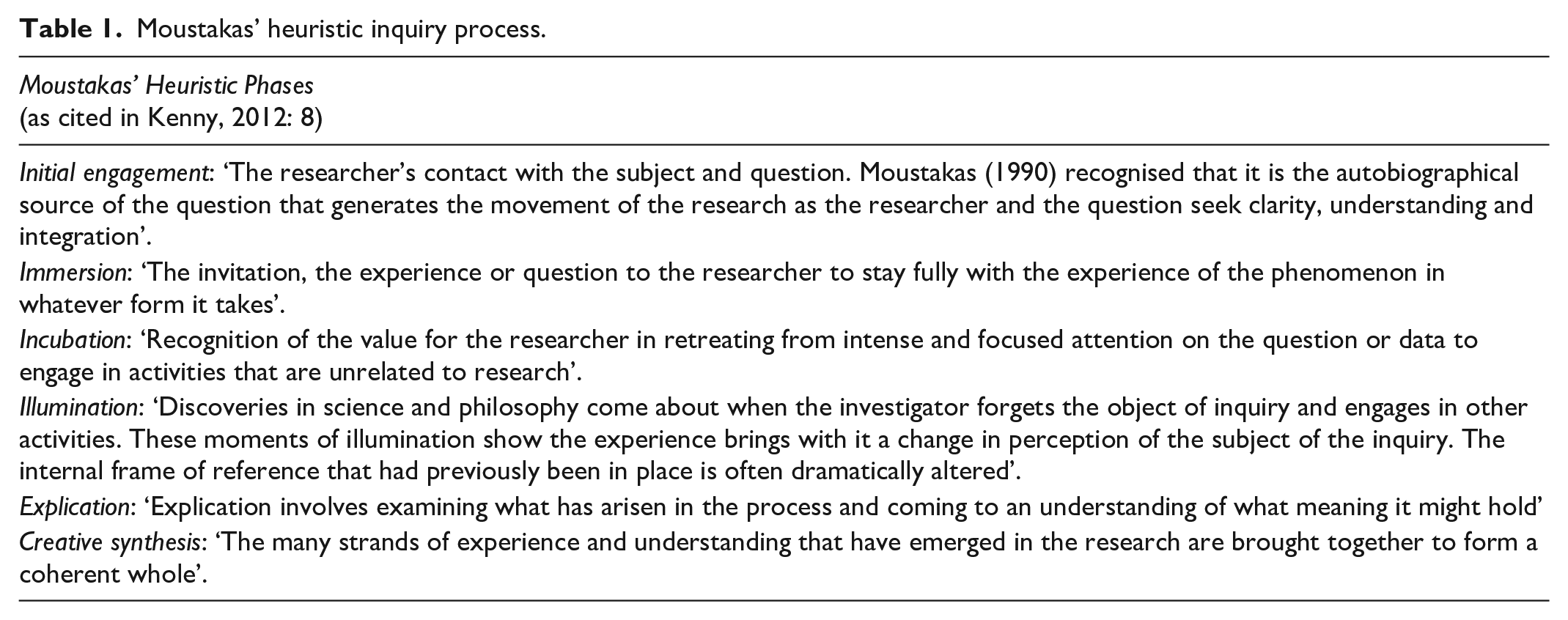
The process is about the researcher’s engagement with and in the phenomenon to uncover or illuminate intuitive and helpful self-care choices. Again, this is about the researcher and subject matter both in their differing ways searching for self-care perspectives. Next, immersion is about a self-awareness that is paradoxically about focused attention but not so much as to become enmeshed. It is also about the researcher’s tender, ‘retreat’ from the intensity of the problem and symptomology, with support, so one becomes open to new ideas and perspectives (Kenny, 2013: 9). This is arguably, as important for the subject, as for the researcher, who quite possibly has so ruminated on the issue(s) that they are lost, stuck or finding little solace. Explication and synthesis arises because one focusses tenderly and due to a reflective space and focus is able to discover new perspectives or meaning.
The heuristic process as described by Kenny is summarised below. In summary, it is epitomised by conscious engagement, albeit of a non-intense and reflective nature, with immersion in and incubation of issues or activities that may initially seem un-related to the research.
I now examine each aspect in turn. Later, they will be illustrated in a workplace self-care example drawn from as many sources for self-care that arose for me in the literature review.
Initial engagement
To study the human condition, initial engagement begins with a ‘question that is deeply felt, a question that has an emotional effect on the researcher and that cannot be ignored’ (Kenny, 2013: 7). One notes too that personal issues can affect both the researcher’s and the subject’s inner processes. For me, this was particularly true as I have grappled for over 10 years with those who cannot enact self-care.
Of relevance to workplace suffering and stress, this is because the deeply felt becomes ‘the first point of contact between the internal world of the researcher and the external and social world in which the research takes place’ (Kenny, 2013: 7). For the context under examination, the practitioner and sufferer can become engaged in the reflective search for illumination, discovery and re-framing.
Immersion
Immersion is an intuitive process where the question under examination is considered even amplified deep within the researcher (Moustakas, 1990). Or put another way, it is an indwelling of the question (Anderson, 2004). For the workplace researcher, this relates to or is because they are regularly close to stress and suffering even when they may not be consciously exploring how to engage, magnify or challenge pre-existing understandings. Because the inner reflective process is not forced, there is the possibility that ‘long hidden tacit knowledge, suppressed, repressed, rejected, and feared by the individual, by social systems, and by humankind may finally emerge’. Then, ‘once known, individuals can be transformed by this self-knowledge’ (Sela-Smith, 2018: n.p.)
Pointedly, a key feature of heuristics is ‘tacit knowledge’ which can be hidden and arise from being immersed in a subject or issue. It is deep-seated and as Moustakas (1990) says is focused on ‘the deep structure that contains the unique perceptions, feelings, intuitions, beliefs, and judgments housed in the internal frame of reference of a person that governs behavior and determines how we interpret experience’ (p. 32).
Neither is it about being overwhelmed nor caught into older rules or outdated thinking (Rogers, 1951). Immersion is about clearing an inward space to notice what is occurring and intuit new understandings (Kenny, 2012: 7). Carl Rogers notes that the inner rules may have become problematic and may require addressing. He says these are ‘experience which, if assimilated, would involve a change in the organization of self, tends to be resisted through denial or distortion of symbolism’ (Rogers, 1951).
Incubation
Pointedly, Moustakas says ‘incubation is the process in which the researcher retreats from the intense, concentrated focus of the question and allows the inner tacit dimension to reach its full possibilities’ (p. 26). Paradoxically, incubation is about a non-intense focus on or even removal from thinking too much on the subject, for a time, so as to allow new perspectives to arise. While these authors do not reference spirituality, one wonders if this is like some forms of spiritual detachment from Rohr (2007) which can address rumination (Nolen-Hoeksema et al., 2008).
Anderson (2004) calls incubation rather helpfully and practically down-time to allow new information to settle and shift in the awareness of the researcher (p. 10). Certainly, as Moustakas (1990) puts it one is not focused on the phenomena so as to allow creative even non-linear reflection to arise.
Illumination
Illumination is about a reflective receptivity to new ideas and transformation that comes about because of a different focus or even less focus (Moustakas, 1990). It is about what arises, recalling incubation, from taking a step back to pause and, at times, not pursue new information. This is a form of open-minded exploration bearing in mind the theme of creativity. Again, it is about standing aside from intensive scrutiny to allow for new light to be shone on an old subject. This recalls bricolage which is about allowing perspectives to rise from as wide a range of even unlikely or disconnected sources or disciplines (Rogers, 2012).
Explication
Moustakas’ (1990) explication step is about examining what has come to mind, hopefully, given the retreat from intensity, in a temperate and creative way that may even surprise the researcher. This process cannot be forced and as Levi-Strauss (1966) suggests useful material, source, knowledge or information may be revealed even if not to directly solve the problem.
Creative synthesis
Creative synthesis, although an important integrative step, may or may not occur in any structured or linear way. The generation of ideas, whether these are of an intra-subject or intra-subjective nature, can lead to change and the challenge of earlier conceptualisations. One may even see the emergence of a new approach or conceptual framework. However, the end result may not be explicitly defined even as one searches for meaning. However, inner transformation if one intuits new and helpful perspectives may be the result (Anderson, 2004).
This step represents a progressive and immersive engagement with the deeply personal topic at hand. Noting the limitations of word space herein, one cannot help but wonder about its possible, later use for the care practitioner and sufferer too. Overall then, the heuristic inquiry process provides a way to explicate new understanding. For me, this recalls the potential of meaning-related and inner kindly choices and psycho-spiritual self-care, in particular. Then, noting the decisions or non-decisions above, my applied research is about inner-sense making and choices, is reflective in orientation and adopts an applied inter-disciplinary approach to suffering at work. In this context and in terms of the spirituality of imperfection, Richard Rohr uses both psychological and spiritual language to speak about navigating disaffection and pain towards self-care transformation.
It is crucial to note that each step is not linear nor are they always producing clarity when one expects. Each step or phase must remain necessarily incomplete or as Sela-Smith (2018) says they could, for a time, remain ‘uncharted territory because the ground is not formed until the inquirer literally creates both the territory and the path by surrendering to the unknown and then walking the territory to discover what is there’ (p. n.p.)
Finally, Sela-Smith indicates the heuristic inquiry process works if the researcher ‘has surrendered to the heuristic self-search, and the process has unfolded naturally through the first five phases, then, the final phase spontaneously occurs to form a creative synthesis (n.p)’. In the next section, I discuss how the heuristic inquiry process can develop a more efficacious research approach to self-care. The hope is that a new inner story can emerge that leads to a creative synthesis even from seemingly different disciplines or sources.
Discussion: extending heuristics into self-care research
The aim of this article is to explore how a bricolage-informed and heuristically driven inquiry research could be extended and how one researches workplace self-care theory and praxis. In stress and suffering, there is often no rhyme or reason as suffering is discursive, hard to understand, complex and challenging, often all at once.
So often too, things even choices must be learned or indeed unlearnt on the journey towards inner meaning and reframing (Moustakas, 1990). This also recalls the idea that often we are dealing in fragmented and perhaps poorly understood knowledge and information (Markham, 2005).
Oftentimes, the researcher let alone the sufferer and care practitioner have only part of the whole story in which to make sense out of. In addition, there may be pre-existing inner patterns at work. Of note, again as Markham (2005) says, albeit in the context of reading, bricolage even in fragments can reveal pre-existing and commonly accepted sense-making patterns that have become overly familiar, set or even unhelpful: Fragments also tend to reveal and, therefore, make available the interstices of reading, so that the reader is not locked into a single line of argument, the form of which is transparent in its smooth familiarity. Multiplicity is made more possible (p. 4).
In researching, personal self-care choices we may be dealing with incompleteness or fragmentation which prevent inner adaptability and openness to as much transformative knowledge, themes and actions as needed to ensure self-care and meaning in life (Anderson, 2004). Yet, it seems that Moustakas’ (1990) heuristic inquiry approach creates paradoxically the focus and lowering of intensity and more space to allow new conceptualisations to arise. These could build on fragmentary awareness, knowledge or indeed solutions that allow the person to make healing-oriented sense of their circumstances.
Pastoral carers at work, by way of example, are continually called upon to engage with narratives on multiple levels and assist the teller to make sense of their stories. Yet again, so often the sufferer is enmeshed and using negative self-talk that prevents a transformative or even self-discovery process but rather is stuck in particular ways of thinking and feeling. They are unable to follow Moustakas’ (1990) idea of ‘retreating from intense focus’ (p. 33) so as to engage in a healing movement towards new frameworks of self-care–related choices. It may also be that they lack access to the tacit knowledge awareness that can challenge the problematic ideas, perceptions and actions that give rise to suffering.
Pointedly, human subject researchers are not unlike the innovative story teller who in their sense-making could ‘draw their techniques from multiple perspectives, voices, and sources’ (Rogers, 2012: 7). This recalls the role of bricoleur who enacts a deep, eclectic search. To this end, for over 5 years, I have been researching and publishing in the areas of psycho-spiritual care and choice(s) for and by anxious, stressed and suffering even burnt out workers as a result of events, circumstances and symptomology.
In terms of recalling Moustakas’ (1994) heuristics, I continually reflected that people are hard on themselves, can get stuck into forms of thinking, do not let go of painful thinking or judge themselves harshly. This is the antithesis of Bassett’s compassionate self-talk motif and moves on to say ‘that’s not all of me; I am more than the painful affect’.
Recall too here, to give shape to sense-making, healing and self-care transformation of negative affect and suffering, the type of self-talk could be about self-acceptance and non-judgmental self-care and one that is open to being continually tested by continual reflection and refinement. This openness could stretch practical responses in a world of increasing complexity. It also recalls Maxwell (2013) who in terms of qualitative research says ‘that any design component may need to be reconsidered or modified during the study in response to new developments’ (p. 40).
What sustained the search for knowledge and integration was the key idea that in a heuristic inquiry creativity ‘is to be found within the researcher and elucidated by an intuitive and tacit process of knowing’ (West, 2001: 129). This is a deliberate but not forced movement even beyond just well-known explanations to a more ‘integrative’ and inner approach where new information, ideas or insights understandings may emerge.
Again, what came to consciousness for me as researcher was how much the person chronically stressed or suffering had often not only lost hope they also abandoned hope and their inner dialogue was blameful and self-judging. What arose over time was the discovery of self-compassion psychology as what Moustakas (1990) calls a ‘moment of illumination’ (p. 8). What had been hidden, forgotten or never recalled was that harsh self-judgements and self-condemnation actively worked against gentle, tender self-reflections and prevented healing meaning-oriented themes or choices to arise.
Example: searching then retreating: a lowering of intensity around presenting issue
I now examine each heuristic inquiry step in terms of self-care considerations. I also note that it is a necessarily brief and preliminary illustration to encourage further use and exploration. Neither in the messy and cyclical nature of human stress and suffering is research necessarily linear and organised (Moustakas, 1990).
Noting this, while, post-writing, it is clear that this article’s example is specifically focussed on reflection and explication of self-compassion, humility and meaningful even inner detachment, these were not necessarily the first themes. They arose time and time again in the search, reflection and incubation phases of a long doctoral study; a thesis open to not only thematic innovation but also methodological augmentation. Of importance to this, Anderson (2000) says that compassionate inquiries into the human condition ‘invites the researcher to structure the research method, procedures, setting, and context to maximize (rather than minimize) the very gateway through which the researcher understands or is inspired by the experience studied’ (p. 34).
Initial engagement
For me, given the subject matter, my abiding, day-to-day in-volvement in workplace stress work, the research opportunity was to extend self-care responses to suffering, using critical reading and integration and eventually heuristics. The question was as follows: how could self-care innovation be researched sensitively and compassionately for the stressed and suffering noting so often the lack of kindly self-awareness? In this, I knew that a subjective feeling-based approach was necessary given the subject matter. Moreover, this would be what Anderson (2004) called an intuitive and compassionate process given the individualised nature of self-blame alongside an inability to enact ways to treat oneself well. Note too, we are so often dealing with incomplete or fragmentary self-awareness.
This is not only for reasons outlined for I too experience some of the symptoms that I was researching. As such, the questions were intentional, highly subjective and interior in nature (Sela-Smith, 2018). It also meant that for reasons of pain, avoidance and incomplete information sometimes ‘knowledge at the tacit level is flawed, the experience of and response to the external world will reflect that flaw’ (Sela-Smith, 2018: n.p.).
What followed was a long thematic search, punctuated by times of separation from the intensity of the study. This means I would engage in intense pastoral care of the stressed, then pause, retreat, and research only to return to this work. The search was epitomised by eclectic reading, in the psycho-spiritual realm, around how people judge themselves harshly lack self-acceptance and ruminate often painfully. It led first to self-love then self-compassion, not dissimilar constructs as I have examined elsewhere, and eventually to themes such as humility and meaningful detachment (Devenish-Meares, 2016a; Sonnentag and Fritz, 2015).
In fact, even this methodological approach emerged mid-way through my doctoral studies, noting that the process of exploration itself was an outcome. This gave voice to new tacit awareness and knowledge about self-care. The process was also animated by the possibility that those affected while sent away from work, and yet may think painfully but with little or no support in terms of self-kindly choices. Clearly, such detachment itself may not be enough (Moreno-Jimenez et al., 2009). For me, this incubation led to a search for what or how one could assist a person.
Immersion and Incubation
In the literature review, I noted Moustakas (1990) explication as a non-intense way of allowing ideas to arise particularly when one is not self-loving or sent on stress leave and still cannot find space to reflect or not even to reflect. This speaks to the often eclectic and non-linear nature of self-care conceptualisations where ideas or options are generated or not generated if there is avoidance (Devenish-Meares, 2015b).
Immersion is about staying with the stress and suffering, continuing a form of self-dialogue and self-disclosure and honouring any hunches and meanings that may arise, however, unexpected or unique. In this, immersion is staying with the questions. This is where researcher, treatment practitioner and sufferer are each encouraged to notice, mull over patterns, seek new information and integrate what they learn. Each may not be aware of the whole story. Again, they may be dealing in fragments or problematic older inner rules (Markham, 2005) which gives rise to despair, disengagement or negative self-talk such as ‘I am a failure at work and no one loves me’. The conscious absence led to a search to re-discover self-kindly responses from spirituality and positive psychology.
In the incubation phase, I discovered after seeing the gap in the detachment literature that I could find out more via a meaningful detachment; yet how often is painful, stress related rumination a feature in the suffering or stressed worker? This choice gives impetus to what Kenny (2012) calls the ‘retreating from intense and focused attention on the question or data to engage in activities that are unrelated to research’ (p. 8). This leads me to ask: do I or how do I retreat from the intensity of the issue? If I do not then maybe I could seek as Levi-Strauss (1966) says revelations that while they do not directly ‘solve’ the problem give rise to a more relaxed, even less intense reflective state where inner explication can occur.
The immersion and incubation process with its less intense focus is not dissimilar to Rohr’s (2007) work about one standing slightly further apart at least metaphorically from suffering in a non-judgmental, self-kindly way. In the workplace, there is often an intensity of symptoms which is neither researched psycho-spiritually let alone compassionately responded to. This is similar to Carl Roger’s (1961) positive and empathic regard. It also recalls Roger’s perennial, therapeutic idea that in the removal of self-perceived threats, here read, standing away gently that boundaries can become relaxed and interior change can occur. I ask, can I not see myself as the problem to be fixed but as a person who could benefit from gentle self-dialogue?
Detachment still takes place but with a choice to actively lower intensity using self-kindly choices. Again, observing oneself calmly and lovingly is remarkably like the incubation phase of heuristics, that is, retreating from an intense focus (Moustakas, 1990). In terms of lower intensity, Rohr (2011) calls the inner observer an internal ‘stable witness’. This is where one simply notes emotions and the situation but does not get overly enmeshed in unproductive rumination to counter self-judgement and self-blame.
What led to illumination was a cycle of engaging repeatedly then trying as much as possible to leave it, only return to it and then allow it to speak to me on a deeper level. What kept arising in me, impelled by new ‘cases’ of those who judge and cannot enact self-care, were self-kindly choices that enable care and reframing to occur.
Illumination
What can arise from incubation and immersion, that is, being in the experience fully yet less intense, is illumination or what I term a ‘reflective receptivity’ to new ideas and self-caring transformation. Here, receptivity is so often expressed in feeling terms and is supported by Moustakas’ (1990) process. It raises spiritual or meaning connotation to do with self-love and is as Rohr (2007: n.p.) says about ‘standing slightly further away’ when imperfection and failure are experienced and ‘observing the self’ in its demands, ego-centred needs and performance anxieties with self-loving eyes, arguably because of one’s innate lovability (Devenish-Meares, 2016a, 2016b).
Although only highlighted briefly, self-compassion, humility and meaningful detachment appear to be a counter balance to painful rumination and harsh self-judgements. They arise when one notices what is taking place by way of self-loving illumination; I am still loveable despite what I feel or has occurred. Such noticing or awareness is about adopting a more reflective or contemplative stance beyond self-blame towards explication as Moustakas (1990) says of new(er) meanings. Heuristically, it challenges older forms of thinking and operating, for example, that ‘I am my pain’ or ‘I can’t stop ruminating’ or ‘I didn’t know there was another place to stand (metaphorically)’ (Rohr, 2007).
Also in terms of illumination, what arose even though it had been part of the initial search was humility. Humility of the kind being examined here is about self-truth and having a realistic self-appreciation and not one that is punitive nor self-blaming. In all this, Funk’s (2005:) positive definition of humility is useful as it is about ‘standing in the truth of being’ (p. xxv). Humility also relates to self-awareness. Moreover, for Funk, humility is not ‘lack of confidence’, although she does note its problematic modern reception. Funk also suggests that those who mistake humility for weakness will find it difficult to accept that it is related to inner-strength.
I discovered that humility can allow a re-framing of experience in terms of compassionate self-acceptance (Neff, 2003). So too Neff et al. (2005) proposed self-compassion as a panacea for self-pity. Then, Fr Richard Rohr posits humility as a key way to know, value and care for one’s true, if not incomplete self. It struck me too that this is a key concept of inner journeying where one ‘makes one’s own wounds a source of healing’ by becoming aware, self-loving and developing more compassion for oneself (Nouwen, 1972: 90).
Finally, it is noteworthy that humility mirrors Moustakas’ heuristic inquiry process because it is about what I term ‘compassionate explication’, seeking the truth or reality as incomplete as it is for researcher and for a worker. It points to reality about issues not as we want them to be rather how they really are so we can begin to tenderly reflect on them (Rohr, 2007).
Explication
Moustakas’ (1990) cites Polanyi (1983) who states ‘underlying all other concepts in heuristic research, at the base of all heuristic discovery, is the power of revelation in tacit knowing’ (p. 20). For me, at this stage what came to consciousness was, from my readings in Neff’s (2003), the ideas of self-compassion psychology and from Richard Rohr (2007, 2010), ideas of lower intensity ‘standing apart’ and the humility motifs. Uncannily, Rohr’s idea of a self-loving, standing aside from intensive self-critique and blame, is remarkably similar to Moustakas’s ‘retreat from intensity’ idea.
Earlier, even though I did not know it then, there was an absence of the subject of self-love, self-care and accepting themselves as they are. Moustakas’ approach enabled these now self-evident ideas around self-love to change not only my perceptions of workplace self-care but also add to how I could practice pastoral care and enable the person to better care for themselves. It also impelled me to read and distil psycho-spiritual and positive psychology material from more sources.
This affirmed a moment or rather moments of illumination that stressed workers need a way to notice and then enact meaningful detachment not only for respite’s sake but also to allow for new lights to be shone on old subjects. It also became apparent after repeated cycles of incubation that such a self-directed process was not unlike Anderson’s (2004) ideas around intuitive inquiry, that is, maintaining a compassionate stance.
A creative synthesis
Over time, the heuristic inquiry process enabled the discovery and creative synthesis of three themes or choices: meaningful detachment, self-compassion and humility. These are shown in Figure 1. They can be enacted in whatever combination that is necessary for self-care, on a case by case basis.
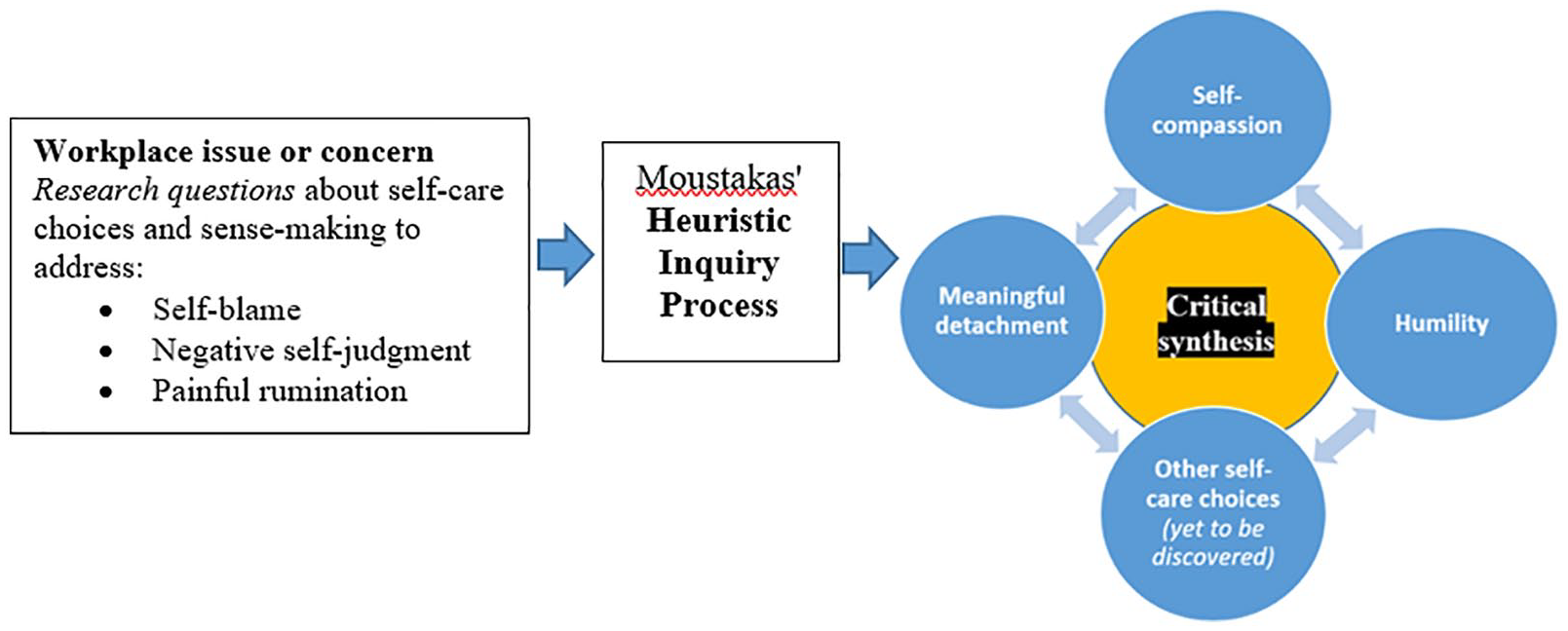
Creative synthesis extending the heuristic process beyond just the researcher to direct self-care.
The self-care choices are not only research concepts. They are intuitive and meaning-related ways to transform one’s stress. The synthesis is clearly intended to go beyond previous work to guide the self-care researcher towards how a suffering or stressed worker integrates self-care choices into their life (Devenish-Meares, 2018). Certainly, the researcher will use their own inner or intuitive processes but this time also be far more focused on the subject themselves.
Integration is about intuiting what is necessary; be a new narrative description of what has/is happening. Time, separation, self-care knowledge and deeper reflection can arguably create the conditions for a re-framing of experience in terms of a compassionate self-acceptance (Neff, 2003). Here, it was about the researcher focusing on inner, subjective self-care choices that arose to address negative self-judgements, self-blame and rumination. It also denotes as yet undiscovered theme(s), not this is always an iterative and personal self-care process.
It also led to the discovery of Richard Rohr who talks about the enmeshed person who being so immersed that they just ‘go back and forth in their own heads’ critically self-blaming and remonstrating with ‘should I/shouldn’t I; why did I; why I didn’t’. Rohr argues for a self-kindly ‘standing apart’ from painful and problematic experiences in self-kindly way not unlike Neff’s (2003) self-compassionate, positive psychology.
What I found is that stepping away from the intensity of the subject matter allowed the choices to arise and form a story of care although there are other choices that are not yet examined. The complementary way the themes work together is shown as unidirectional to highlight a key aim of heuristic inquiry; that of ‘a story that contains some new whole that has been identified and experienced as a result of this union of the deep-unconscious and the waking consciousness, between the internal and the external’ (Sela-Smith, 2018). In this case, it is the enactment of a holistic series of self-care choices that are inwardly focused but connected to how the person navigates the external world (at work). This new frame of reference, recalling bricolage is eclectic and uses as much as it needs to be.
There is much promise in such a research approach not only to encourage ways to study but also to synthesise and offer new ideas for praxis. As such, this is also a theory building exercise (Anderson, 2004). I note too that it is crucial, even while undertaking a personal, even idiosyncratic research journey to try to keep the inner perspectives of the stressed and those who suffer in a constant frame.
Summary
Heuristic inquiry’s focus on self-understanding can enable transformative, self-caring choices to bear on experience however eclectic, subjective and intuitive these may be (Anderson, 2004). The heuristic inquiry process transforms self-knowledge and appears highly useful to my key research interest: psycho-spiritual self-choices (or lack thereof) related to stress or suffering workers. This process enables researchers to notice and allow hidden or new transformative knowledge and ways of being (choices) to bring about healing and hope. Again, I must note too that I, as researcher, am constantly challenged, stretched and moved beyond my theoretical and praxis boundaries but this is only possible if I stay with the process of self-dialogue, incubation and openness to new concepts or combinations of what has not been integrated before!!
Contributions to self-care praxis and research
This research is primarily about psycho-spiritual, self-care choices in the context of self-blame and lack of self-acceptance occasioned by stress or workplace suffering and anxiety. Conceptually, at least, the research breaks new ground because, no workplace-based applied spirituality research has used the term bricolage let alone the heuristic inquiry process in workplace-based psycho-spiritual studies or related self-care (Parker, 2015). While much confirmatory work will be necessary, this article affirms the potential of the heuristic inquiry-based methodological approach, in that it develops and strengthens approaches to self-care research.
Overall, as summarised in Figure 2, the contributions of the study are threefold, albeit noting it is an emergent approach that needs far more examination. First, it extends bricolage to workplace self-care research to actively work with resistance and negative self-talk which are both potential barriers to inner healing and self-care driven transformation. Second, it affirms heuristic self-search psychology research as an intuitive method for workplace self-care research. Third, paradoxically, by surrendering to the process and active engagement in a compassionately oriented yet less intense reflection on the subject can lead to meaningful detachment, self-compassion and possibly self-caring transformation.
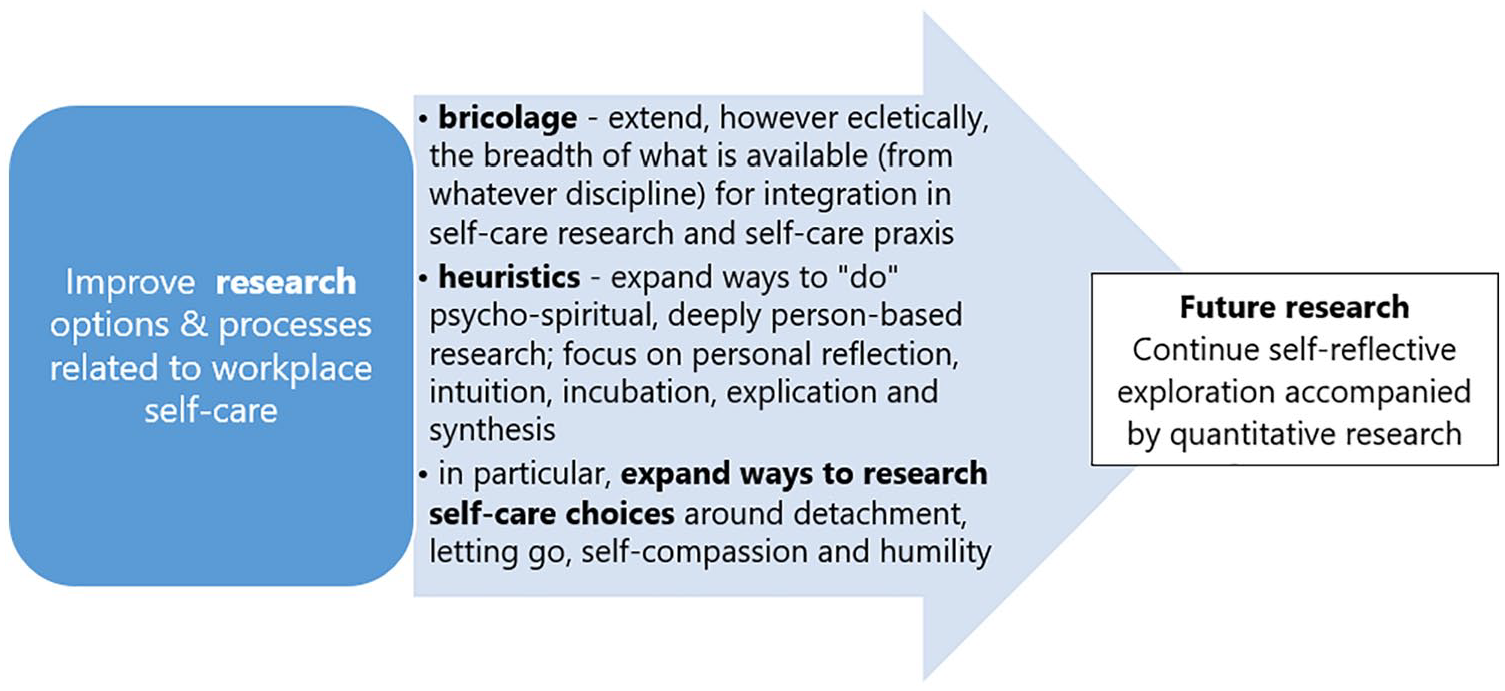
Research outcomes.
Another key outcome of this article is the novel way that both bricolage, as enacted by heuristic process, informs and enables the researcher to make sense of the lived experience of chronic workplace stress. This is done, for the first time, recalling Rogers (2012) by going on an inner journey of explication and illumination of the personal self-care choices by synthesising multiple sources to do with humility, detachment and self-compassion (Moustakas, 1994). This is about recognising dominant inner discourses and opening oneself up to deeper reflection on workplace meaning, intrinsic self-management issues, meaningful self-dialogue and self-care during times of stress (Kincheloe, 2004).
Specifically, encouraging further research into self-care and psycho-spiritual responses to workplace stress, the heuristic process of immersion, incubation and reflective synthesis challenges old ways of thinking and through compassionate, non-enmeshed self-dialogue, reflection and illumination. So too with the inclusion of humility, something that may surprise, one is actively encouraged to see that life is incomplete and that (perceived) failure and related phenomena could be met with self-kindly stances. This could even include religious or spiritual action and choices if these are helpful, particularly if they address self-judgements and self-blame.
So overall, this article extends qualitative methodological approaches that conceptually examines how the subjective researcher’s inner person can make inner sense of stress and suffering by learning to ‘stand slight further away’, that is, detach meaningfully and learn to live with what has happened and be self-kind (Neff, 2003; Rohr, 2007). This, by corollary, could have implications too for the sufferer and stressed themselves although this will need to be examined in later research.
The research is significant because a draft self-care framework to guide research emerges from the worked example: one aimed at a thoughtful, self-awareness and self-kindness. This is about self-care, reframing experience and letting go even as one makes meaningful sense. It specifically encourages standing slightly apart metaphorically in a self-kindly way and separating from painful affect, recalling self-compassion (Neff, 2003). Such an approach, once confirmed, may also assist care practitioners and chaplains to better and more intrinsically support those seeking understanding and healing.
Limitations of this study
While an intuitive approach and Moustakas’ heuristics inquiry method, in particular, seems well suited to self-care research, there are limitations. The research is subjective and qualitative being an intuitive and self-reflective process. Moreover, this study is very conceptual in nature and does not comprehensively explore self-care. Neither does it explore what self-care is related to, supported by or is inhibited by.
Furthermore, Weick (2001) warns that in such intrinsic approaches that there is the possibility of ‘seeing in a way that is not seeing’ (p. xi). This means the approach may not explore the excluded voices (McKee et al., 2008). Clearly, more case study and qualitative work is necessary.
Moreover, for me, I was constantly excited by the ‘ah-ha’ revelations of discovering combinations of self-care choices and potentially transformative inner-reflections. These are certainly open to scrutiny and testing and yet may resonant for the reader with their own hunches and ponderings if they confirm, stretch or are close to their own experiences (Braud, 2010). Anderson (2000) puts this more clearly saying that ‘the principle of sympathetic resonance introduces resonance as a validation procedure for the researcher’s particular intuitive insights and syntheses’.
Then, while the emergent self-care framework may be useful, it could be augmented by quantitative examination of self-care variables and indicators that measure the nature and extent of stress. To address limitations at least in part, I constantly revisited the themes, referring emerging findings to academic and praxis supervisors, openness and transparency throughout the heuristic process. I also had to grapple with themes and disciplines that confronted or contradicted my experiences and personal assumptions such as the perceived dichotomy between spirituality and positive psychology (Anderson, 2015).
Validity
Limitations also raise questions about bias and validity. Below I comment on two aspects that are worth noting.
Resonance validity
This is about the study’s resonance with its target audiences (Anderson, 2004). My preliminary research example has resonated with Defence leaders, chaplains and psychologists who were stretched and stimulated by Rohr’s spiritual connotations of humility. Of specific note, it encouraged chaplains to consider how positive psychology could be useful alongside spiritual care (Devenish-Meares, 2016a). Moreover, to date, 11 audiences or academics have taken up and used my initial and highly subjective findings.
Efficacy validity
Anderson (2004) says that efficacy validity is ‘the capacity of a study as a whole to give more value to one’s own life . . . the study is important if it can be replicated’ (p. 333). My unexpected discovery of the inter-relatedness of humility, detachment and self-compassion albeit over a 5-year interior and reflective search and process has changed my personal and work life especially my chaplaincy. It has resonated in my pastoral care work, self-care and resilience teachings and mentorship.
Future exploration
Highlighting new ways to research psycho-spiritual choices should give impetus to further research into what Anderson (2004) calls ‘the interpretive dynamic of being human’. It also animates the need for researchers to carefully but earnestly incorporate their own interests noting they cannot ‘honestly escape (their own) attitudes and projections’ (p. 4). The fact, although there is what Anderson (2000) terms sympathetic resonance in that academics, authors and practitioners have cited my approach, much more work is necessary. I suggest it could be as follows:
Empirical (quantitative) studies of causation, effect and correlation, particularly using Anderson et al. (1996). Specifically, in terms of psycho-spirituality and positive psychology, it would be useful to study self-care as follows: ‘How does self-care unfold as a process? What are the concomitants of self-care? What sets the stage for the occurrence of self-care? What facilitates self-care? What inhibits self-care?’ (p. 3).
Extend Moustakas’ heuristic approach beyond the researcher: the personal, intuitive and creative nature of the process could after significantly more consideration, be extended to include the treatment or pastoral care practitioner and even the sufferer on the basis that each can, if they remain with and sensitively explore lived experience, support or activate personal transformation (Anderson, 2004). Moustakas, while speaking of the researcher, uncannily mirrors what the sufferer may also be experiencing: one attempts to move back and forth between their complex, subjective inner-world while trying to remain connected to the external world.
Intuitive (qualitative) research: Using Anderson’s intuitive inquiry approach in conjunction with case studies, diary analysis and observations.
Conclusion
This reflective article briefly introduces and hopefully stimulates the conceptual use of bricolage as expressed in a heuristics inquiry process for inter-disciplinary, workplace research and praxis. Oftentimes, sufferer, helper and researcher only have fragments of a story or are operating in the context of pre-existing inner ideas or even rules that may be harsh, extend stress or may not even be known.
It was shown that the complex and highly subjective nature of human experience can benefit from a heuristic inquiry approach that incorporates as many disciplines as make intrinsic and personal sense. This extends the boundaries and means of conducting an interdisciplinary study and extend self-care choices of the individual. It also integrates all the illumination, nuances, creativity and new information that is possible.
Finally, despite the opportunities offered by re-examining self-care choices around stress suffering, in terms of explication and a different form of focus and exploration, clearly we are dealing with highly subjective material. While the synthesis encourages further exploration around self-care choices that give rise to meaningful inner shifts, research that incorporates carefully selected measures will be needed to extend the integration of positive psychology and applied spirituality into useable self-care frameworks.
Footnotes
Appendix 1
Declaration of conflicting interests
The author(s) declared no potential conflicts of interest with respect to the research, authorship, and/or publication of this article.
Funding
The author(s) received no financial support for the research, authorship, and/or publication of this article.
