




Abstract
This reflective process paper outlines the challenges encountered in trying to access mothers of preschool-aged children in a child-focused setting. Two recruitment approaches were implemented yielding eight respondents. Three key themes for recruitment challenges emerged at societal, service, and personal levels—no time, no money, and a lack of priority given to the well-being of mothers in a child-focused setting. This article also outlines the methodological rationale for the chosen approach and explores alternatives based on previous research into hard-to-reach and hidden populations. The data support questions as to the agency of mothers, and the validity of the voices we do hear from most—the vocal Internet minority. Through this study, questions arise as to the lack of importance placed on the well-being of mothers by early childhood services and mothers themselves, and how this may affect research, education, and service delivery.
In early 2016, I began to recruit mothers of preschool-aged children for a mixed-method doctoral study of the impact of a relational self-construal on well-being. I intended to recruit 100 mothers. My Academic Supervisor gently suggested 30 might be ample, reminding me that “recruitment is always harder than we think it will be.” But I worked with mothers; I listened to their stories for a living; I was convinced that they would jump at the chance to participate in a study about their resilience and their happiness. After 15 months and countless emails, phone calls, and mail outs, I had recruited eight. I had failed, or at least it felt that way. But it turns out my recruitment challenges have become the story within the story of my research project. In trying to give voice to the often-ignored experience of mothers, I discovered that mothers are not given the opportunity—they are, essentially, muzzled.
This reflective process paper outlines the challenges encountered in trying to access mothers of preschool-aged children in a child-focused setting. It examines the decision-making process and raises questions as to the agency of mothers and the validity of the voices we do hear from most—the vocal Internet minority. It questions the lack of importance placed on the well-being of mothers as compared to their children, and how this may affect research, education, and service delivery.
The institution of motherhood puts mothers at a disadvantage and forces them to compromise in many areas of their lives. For this reason, Rich (1976) distinguishes motherhood; the patriarchal and oppressive institution from mothering; the potentially empowering agency of mothers (O’Reilly, 2006; Rich, 1976). In this tradition, my new research sought to explore the personal and private experience of mothering within the social construct of motherhood for women whose children are attending a preschool program. Motherhood and mothering are inherently gendered, and consequently, my study is heavily informed by feminist philosophy. Cosgrove and McHugh (2000) argue that giving voice to women’s experiences is one of the most significant contributions made by feminist researchers.
When I began this project, it was to create a space for the voices of the “average, everyday” mother to be heard. I chose a mixed-methods, case study design underpinned by hermeneutic phenomenology to capture mothers’ experiences. I wanted to hear from mothers of relative privilege who had largely been excluded from the research narrative of motherhood and mothering in social work, as they did not access services or engage with the systems in which social workers operate. The study sought to catch mothers “upstream” before they needed or were forced, to engage with child protection, welfare, or mental health services. After working in private practice with mothers who are more than willing to share their stories, and having had countless school-gate conversations with other mothers, I had presumed that it would be easy to access mothers for research purposes. This experience has reminded me that when engaging in research born of our professional and personal experiences, we need to be careful of the assumptions we make.
Why do we need to hear from the mothers of preschool-aged children?
The act of mothering is complex and challenging and can be damaging to mental and physical health (Arendell, 2000; Rullo and Musatti, 2005; Sarafino, 2006). The social standards of motherhood are ever changing, ill defined, and contradictory. It is impossible for mothers to live up to these standards and this inability to define their roles has a significant negative impact on their physical and psychological health. Single mothers, working mothers, lesbian mothers, and other mothering situations outside the cultural norm are even more likely to suffer physical and mental harm (Sarafino, 2006).
Women’s experience of mothering is as diverse as individual mothers themselves; however, in Western society, the current dominant ideology is “Intensive Mothering.” Sharon Hays (1996) defines Intensive Mothering as child-centered and involving an excessive amount of the mother’s time, energy, and finances to best provide for the child’s emotional, physical, and intellectual development. It is also heavily reliant on expert advice. While not all women practice Intensive Mothering, it is the recognized ideology of motherhood and provides the standards by which mothers are measured.
Brown (2008) found that mothering and motherhood was the second most common shame trigger for women, whether they were a mother or not, and that it was surpassed only by physical appearance. Brown defines shame as . . . the intensely painful feeling or experience of believing we are flawed and therefore unworthy of acceptance and belonging. Women often experience shame when they are entangled in a web of layered, conflicting and competing social-community expectations. Shame leaves women feeling trapped, powerless and isolated. (p. 29)
Not only are the expectations of mothers impossible to meet, they are also often conflicting. The expectations on mothers are imposed, enforced, and reinforced by individuals, groups, ourselves, and the social/traditional media (Tucker, 2004).
Mothering a preschool-aged child is physically, emotionally, socially, and mentally draining, yet much of the psychosocial research on mothers’ experiences focuses on the first 12 months postpartum. Interestingly, Woolhouse et al. (2014) found that depressive symptoms were more prevalent for mothers 4 years postpartum than at any other time preceding this. Overall, one in three women reported depressive symptoms in the first 4 years after birth, but only one in seven are diagnosed with postpartum depression in the first 12 months (PANDA, 2015). Conceivably, the decrease in surveillance of depression in mothers beyond the first 12-month postpartum is due to the reduction in risk to the child.
In one of the few studies focused solely on mothers’ well-being, Luthar and Ciciolla (2015) found that personal support was just as important for well-being as mothers’ role satisfaction. Four resilience factors were of particular importance; receiving unconditional love, comfort when distressed, authentic relationships, and satisfactory friendships. These social and relational aspects were explored in my current research.
Social work is well placed to explore the experiences of mothers. Psychology’s inclination to pathologize mothering, along with nursing’s child-centered approach, does not adequately tell women’s stories of becoming a mother (Parratt and Fahy, 2011). The loss experienced when becoming a mother is often ignored by women and health professionals, as the current emphasis on postpartum depression in new mothers focuses solely on the intrapsychic factors and not on the social and cultural contexts of new mothers’ experience (Barclay and Lloyd, 1996).
Most of the commentary on mothering and motherhood is informal: blogs, media representations, and in social settings. The rise of popular websites/blogs such as “Scary Mommy,” “Queens of Constance,” and “Mamamia” has led to the formation of online communities based on a, seemingly, shared sense of what it means to be a mother. There has been a recent rise in a genre of blogs that celebrate the imperfections of mothers to counteract the pressures of Intensive Mothering. But make no mistake, these blogs still present a prescribed mother identity for their tribe to aspire to. These blogs are personal experience and opinion that can become dogma among followers.
The reliance on social and mainstream media means that there is very little research-based discussion of the experience of mothering and motherhood among mothers. My research aimed to tap into those mothers who were not necessarily active on blogs or in online communities in a systematic and “scientifically robust way,” to engage with and learn from them, and also to provide other mothers with evidence-based information.
Recruitment approaches
When sharing my recruitment challenges with fellow research students and other mothers, I was consistently met with the same question, “Why don’t you put it on Facebook?” While this seems like a logical and simple method of accessing thousands of mothers in the community, it was not appropriate for this research and I was concerned that it could contain unidentified biases which would prohibit me from extrapolating to wider populations (Barratt et al., 2015). In this study, I was keen to hear the quiet voices of mothers in the community who are not necessarily active in online communities. It could be argued that those who are active on parenting and motherhood websites are natural help seekers and possess a degree of confidence and resilience, demonstrated in locating and engaging in a community of reassurance and support. It could also be argued that these mothers are heavily invested in, and mostly embracing of, their role as mother, and are mothers particularly vulnerable to the effects of Intensive Mothering (which is not the focus of the voices I am seeking to locate, hear, and represent in the current research). In addition, I sought to hear from a diverse population, to uncover disparities in experience.
As I was looking specifically at mothers with a child in preschool, it seemed logical to liaise with preschools to recruit respondents. Moreover, with 95.8% of 4-year-olds accessing state-funded preschool in Victoria (SCRGSP, 2009), this strategy for recruitment would have a greater chance of being representative than targeted recruitment in online forums.
Approach 1
Preschools in Australia can be private, government, or community operated. In Victoria, the vast majority (74.2%) are community operated (SCRGSP, 2009). Preschools are managed by cluster managers who are responsible for several centers. Cluster managers can be run by Local Councils, volunteer committees, or private enterprises.
Three preschool cluster managers were selected based on their location, to achieve maximum variation, and the number of centers managed (156 in total). By approaching larger managers, I hoped to be able to reach more mothers with less bureaucracy. The cluster managers were contacted by telephone to seek permission to place recruitment posters in their center’s reception areas and make letters available to all mothers of preschool-aged children. Two managers agreed to participate, stating that emailing the information was easiest. One cluster manager declined to participate at a cluster level, advising that due to the busy nature of the centers, they preferred to let individual centers make this decision.
In February 2015, the two cluster managers were sent the information for the study with a request to disseminate to their centers. One cluster manager complied with this request, yielding one respondent. The other cluster manager withdrew from the study due to lack of time at cluster manager level.
Approach 2
After speaking with my one engaged cluster manager, it was agreed I should contact the centers directly to follow up on my request for their assistance. To recruit more respondents, I amended my recruitment strategy to include all preschools within 11 Local Government Areas (LGAs) across Melbourne (Figure 1).
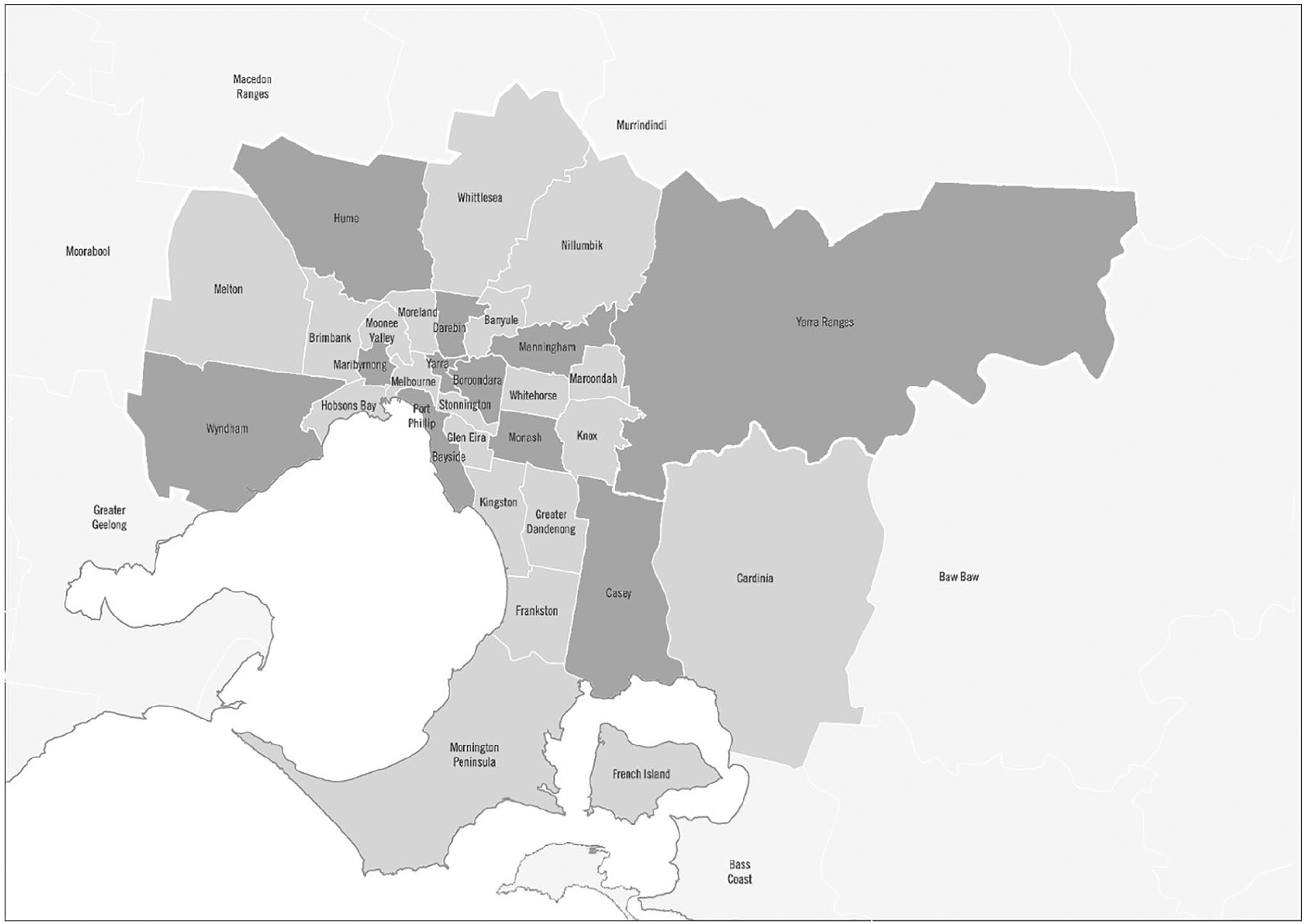
Local Government Areas approached for recruitment purposes.
Using information from LGA websites, I was able to identify and contact 404 centers yielding an additional seven respondents, five of which were from one LGA (in the outer east of Melbourne). The best response was from centers that requested I send printed materials. Several centers advised that they did not have the funds for additional printing.
One LGA, in the southeast of Melbourne, asked that the research be conducted through them as the cluster manager and then subsequently did not respond to further communication. This area has the largest growth in children aged 0–4 years in all of Victoria and the fifth largest in Australia (ABS, 2006) as well as the highest concentration of young mothers in Victoria (ABS, 2011).
Respondents
The interviews conducted with respondents were rich in data, and I am tremendously grateful to have been welcomed into these women’s lives. While their stories were diverse, there were some similarities in the characteristics of the respondents. Two respondents were directly linked to the center, with one a preschool teacher and the other a committee member. Three respondents had doctoral degrees, and one respondent was a midwife. The remaining two respondents had no professional interest in research or the research area.
No time, no money, no primacy
There is a myriad of possible reasons for the lack of respondents to my recruitment strategy, but three key themes seem evident at societal, service, and personal levels—no time, no money, and no primacy.
At the societal level, our patriarchal culture both deifies and devalues care work, mothering in particular. Mothers’ well-being is only a consideration where the welfare of her children is at stake. Children do not fare much better. While we may espouse them as our future, Australia’s spending on early childhood education is some of the lowest in the industrialized world (OECD, 2008). Our lack of investment in children’s services extends to staff. In Victoria, long day care and preschool teachers earn over $10,000 less than primary school teachers at the beginning of their careers and over $25,000 at the end (Dowling and O’Malley, 2009). Preschool in Australia is not free, 4-year-olds receive 15 hours of subsidized preschool education per week but places are limited, and fees for most families amount to over $1000 per year. These 15 hours of subsidized education are currently under threat of being reduced to 10 hours per week.
The reluctance of cluster managers and preschools to participate in the study at the service level reflects the time, money, and priority constraints evident at the societal level in addition to an apparent wish to protect both their centers and their client families. Questions and concerns about the nature of the research were addressed satisfactorily with several centers, except for one LGA Cluster manager as identified in a previous section. This may have been a factor for those centers which did not respond to the initial invitation to participate.
By their very nature, preschools are child-focused. It was perhaps for this reason that a study of mothers, albeit mothers of preschool children, did not represent a significant project for staff to spend their very limited time and resources. Despite their child-focused natures, some centers expressed a desire to participate in the study but had no funds for printing the recruitment materials with one volunteer committee member admitting that she used her own supplies for all admissions administration. This is a direct result of the lack of funding for early childhood education in Australia.
On a personal level, mothers are incredibly time poor. Not only are they responsible for two-thirds of the household chores in addition to any work or study, they are also responsible for much of the mental and emotional work of parenting (ABS, 2009). This leaves very little time to reflect on their experiences of mothering, let alone schedule 90 child-free minutes to meet with a researcher. Perceived judgment by professionals and other mothers was a theme for some mothers in this study, and this may have contributed to other mothers not participating at all. This may be particularly true of young, lesbian, minority, or single mothers who are particularly sensitive to mother judgment and precisely the voices we most need to hear.
Methodological considerations: a hidden population or just hard to reach?
When I began this research, it never occurred to me to research techniques for sampling hard-to-reach or hidden populations. There are 1.2 million Australian families where the youngest child is below 5 years old (ABS, 2015) and US Census Bureau (2012) estimates that 81% of all women go on to become mothers before the age of 44—this represents a significant proportion of the population. Mothering is often carried out in full public view: in schools, supermarkets, doctors’ offices, and community events. Mothers are not difficult to identify so why was accessing them so difficult? Could it be that for the purposes of research, mothers are a hidden population or were they just simply hard to reach?
By reframing my population as hard to reach, I see that additional sampling approaches could be used, including snowballing to give me greater access to mothers (Alston and Bowles, 2012). Snowballing is inherently feminist; the use of personal and social networks gives researchers access to otherwise ostracized and underresearched populations (Woodley and Lockard, 2016).
A hidden population is one who engages in deviant, illicit, or stigmatized behaviors (Neuman, 2007). While the act of mothering is none of these, I was asking women to speak about their private and intrapsychic experiences of mothering, which are hidden from view. Given the dominant ideology of Intensive Mothering (Hays, 1996), these experiences might well be considered deviant, illicit, or stigmatized by mothers themselves.
By viewing mothers as a hidden population, insider status could have proved crucial to gaining access to other mothers. My research was born of my experience, both as a mother myself and as someone who works specifically with mothers in private practice. I consider my experiences and my role as a mother to be integral to my research, and yet I did not design my study as insider research. In her study of older lesbians, Eliason (2015) found that a more casual and personal approach by an older lesbian as researcher improved recruitment. She was able to gain the trust of the community and reassure respondents of their safety in disclosing their experiences. The approach used in my study was impersonal letters and posters from a university researcher with no mention of my status as a mother.
My reasons for eschewing snowballing and insider research in the recruitment phase were twofold: as discussed, I was confident recruitment would not be an issue, and I was aware that this would create, what I perceived to be, a selection bias, decreasing diversity and validity. Mainly, I did not want to gather data from mothers just like me: White and middle class. Upon reflection, I saw that, as Sydor (2013) wisely recognizes, social research into the needs of marginalized groups needs to consider a range of sampling techniques, including snowballing as biased data are preferable to no data. This led to further consideration of the notion of bias. While I was using a hermeneutical approach to my data analysis, where I would make my opinions, preconceptions, and “biases” in the interpretation explicit rather than bracketed, I was taking a positivist approach by attempting to bracket these in the recruitment of participants. I was privileging the notion of scientific rigor and objectivity. I was aiming for good enough objectivity. However, the acknowledgment and inclusion of the subjective is, in fact, inevitable throughout all parts of the research process (Brennan and Letherby, 2017). In retrospect, had I incorporated the subjective in my recruitment process, my research would be “value explicit” rather than “value free” and arguably more objective (Letherby, 2003). This kind of autobiographical approach to research, including the recruitment of participants, would have been appropriate for a study which examines issues of the self, close relationships, and family life (Brennan and Letherby, 2017).
Conclusion
As researchers, educators, and clinicians, we need to hear the voices of all mothers regardless of their interaction with the systems in which we work. In understanding the subclinical concerns of mothers of preschool-aged children, we are better able to offer appropriate services before they are compelled to engage with child protection, welfare, or mental health services. If we pathologize or normalize the distress and difficulties encountered in mothering young children, we do both mothers and our services an injustice. By checking our assumptions as researchers and embracing non-traditional sampling techniques and methodologies, we are better able to access this potentially hidden population and address their unmet needs. Acknowledging our subjectivity in all aspects of research can be a strength rather than a limitation of research that aims to uncover the experiences of women where they are socially, politically, and physically located.
Footnotes
Declaration of conflicting interests
The author(s) declared no potential conflicts of interest with respect to the research, authorship, and/or publication of this article.
Funding
The author(s) received no financial support for the research, authorship, and/or publication of this article.
