




Abstract
Focus groups are a well-used research method in the social sciences. Typically, they are conducted in person to generate research insights through group discussion and interaction. As digital technologies advance, there have been efforts to consider how to conduct focus groups in an online format, often using computer-based tools such as email, chat and videoconferencing. In this article, we test the potential of smartphone-based mobile messaging as a new method to elicit group-level insights. Based on empirical analysis and comparison of in-person and WhatsApp group chat focus groups conducted in Singapore, we find that WhatsApp group chat does have the potential to generate well-elaborated responses and group interaction, particularly among younger, digitally fluent participants. However, the quantity and richness of the conversation still do not match that of the in-person focus groups, and further innovation may be needed to improve mobile messaging as a qualitative research method.
Introduction
Over the past several decades, focus groups have become a mainstay of social science research. They are often organized as facilitated discussions to elicit qualitative insights from a group of individuals in a short period of time. However, focus groups are conducted not only to gain insights from the individual participants. Rather, the group interactions, discussion and consensus building that occur among the participants are considered an important data point in their own right. Traditionally, focus groups are held in person, convening a facilitator and multiple participants in a common physical location to elaborate on the researchers’ topic of interest.
Recent technological advancements have introduced a wide array of new communication channels. Face-to-face meetings are increasingly replaced with alternatives such as video chat, email and text messaging. Many so-called ‘digital natives’ – younger people who grew up in the Internet era – are not only comfortable with, but even prefer, communicating digitally (Skierkowski and Wood, 2012). Thus, it appears worthwhile to consider whether the traditional focus group format can be adapted to reflect these new alternatives and preferences.
Existing research on digital focus groups are primarily based on online mediums such as email, discussion boards, video conferencing and computer-based chat groups (Abrams et al., 2015; Moore et al., 2015; Stewart and Williams, 2005). While mobile messaging shares many traits with its online counterparts, it also has several unique characteristics. Importantly, it is generally conducted on smartphones rather than computers, resulting in high levels of accessibility and different communication flows and patterns. In this article, we consider the potential of a mobile messaging focus group as a qualitative research method, using the popular smartphone application WhatsApp.
To explore this topic, we analyse four focus groups conducted for a research project on waste management and household item reuse in Singapore. Two focus groups were held face-to-face, and two focus groups were conducted via group chat in WhatsApp. We discuss our considerations in developing and facilitating the mobile messaging focus groups and reflect on their performance in three key areas – quantity and quality of response (individual), quantity and quality of interactions (group dynamics) and logistical considerations.
Literature review
Focus groups in the social sciences
First used in the social sciences in the early 1940s (Oates, 2000), focus groups are an information-gathering technique based on a semi-guided discussion or debate among a group of people. Conducted successfully, focus groups can elicit individual-level feedback, ascertain group consensus (Cyr, 2016) and raise new issues that the researcher had not thought of (Morgan, 1997).
However, they do have limitations which need to be carefully considered. Group dynamics can be influenced by a dominant individual, social anxiety or a sense of hierarchy among the participants. A fear of conflict or discomfort in stating personally revealing, unpopular or minority opinions can inhibit openness to speaking and result in reproducing normative discourses (Farnsworth and Boon, 2010; Smithson, 2000). Even a skilled facilitator may have difficulty moderating these factors and maintaining a productive environment for discussion. Indeed, the attributes of the facilitator themselves may influence group behaviour and dynamics, for instance, if they are of a different cultural background or socioeconomic class than the participants (Smithson, 2000). Thus, focus groups must be seen as a dialogue constructed through multiple social interactions that influence how the participants speak and act (Gibbs, 1997).
Furthermore, there are logistical limitations. Focus groups are held at fixed times, requiring travel to and from a specific location. Those with little free time, without easy access to transport, or who have disabilities or social anxiety may be deterred from participating (Farnsworth and Boon, 2010). The researchers also need to allocate time and budget to recruit participants, coordinate and organize the focus group.
Different methods to mediate some of these challenges have been explored, including facilitator training and controlling for group dynamics in the data analysis phase (Smithson, 2000). Others have also considered the use of different formats, such as online focus groups, to address some of the limitations of face-to-face focus groups.
Online focus groups
Many of the earliest documented uses of online focus groups for research took place in the late 1990s and were based on asynchronous group discussion via email and web-based message boards (Stewart and Williams, 2005). As technology evolved, researchers experimented with more immediate forms of conducting online focus groups, including virtual discussion rooms (Brüggen and Willems, 2009) and online videoconferencing platforms (Tuttas, 2015).
Because the methods used to implement online focus groups vary widely by type and format and often consist of small sample sizes, it is difficult to make broad comparisons and generalizations. However, there are some patterns that are noticeable across studies. For instance, online focus groups have been found to generate lower word counts (i.e. words typed/spoken per participant) than face-to-face focus groups (Brüggen and Willems, 2009; Schneider et al., 2002). The responses are also shorter and more immediate (Schneider et al., 2002; Woodyatt et al., 2016) and include less explanation and detail (Abrams et al., 2015). While Brüggen and Willems (2009) found online platforms elicited more substantive arguments per participant, the responses were considered to be more superficial and less profound. Data richness was also ranked poorly by the researchers in Abrams et al.’s (2015) study.
In terms of group interactions, Schneider et al. (2002) found discussion to be more uniformly distributed across participants in an online chat, possibly because of the inability for participants to detect social context cues such as body language and perceived status differences that would inhibit their participation. The online environment can also make participants more comfortable to share sensitive information and disagree with one another (Woodyatt et al., 2016). However, participants have been found to respond to each other’s comments less frequently (Abrams et al., 2015), or not respond to all of the facilitator’s questions (Brüggen and Willems, 2009). Furthermore, there can be long periods of relative silence and inactivity (Moore et al., 2015), which could be related to lower levels of participant attunement and engagement (Reid and Reid, 2005). The lack of non-verbal cues in online environments is commonly referred to as a challenge (Reid and Reid, 2005), and Woodyatt et al. (2016) found it more difficult for the facilitator to probe and follow up on participant responses. This could be due in part to the barriers for the researchers to gain impressions about the participants (Brüggen and Willems, 2009) and bridge the physical and emotional distance (Adams-Hutcheson and Longhurst, 2017).
Logistically, online focus groups do present a number of advantages. They allow for different modes of communication (e.g. incorporating photos and links) and it is easier to recruit a diversity of participants from various backgrounds and physical locations (Lijadi and van Schalkwyk, 2015). However, they can exclude those without know-how or access to technology. Moore et al. (2015) also refer to the difficulty of verifying participant identity and characteristics such as age and gender in virtual environments.
With regard to research ethics, Rodham and Gavin (2006) argue that conducting online research does not pose fundamentally different ethical issues than offline research, as both require requisite attention to gaining informed consent and maintaining the anonymity and confidentiality of participants. In both online and in-person focus groups, none of the data provided is truly confidential, as it has been shared with the other participants. However, there are some specificities of online environments, including the provision of personally identifiable information such as user names and phone numbers; unresolved questions about whether virtual spaces such as chat rooms constitute public or private spaces; and subsequently, if people should have the expectation that what they say will be contained within the confines of those spaces (Markham and Buchanan, 2015). Furthermore, the ease with which digital data can be saved, manipulated, forwarded and otherwise disseminated compounds the potential for ‘leakage’ (Sparks et al., 2016). Such considerations are not meant to dissuade the conduct of digital research, but rather call for the need to take particular care with regard to doing no harm, understanding people’s expectations and taking appropriate protective measures for the vulnerability and sensitivity of the produced data (Markham and Buchanan, 2015).
In the following section, we consider the value of conducting focus groups via mobile messaging and how it might alternately mediate or exacerbate some of these dynamics.
Mobile messaging as a communication platform
Previously, online platforms and modes of communication were primarily computer-based. In recent years, however, mobile phones have become ubiquitous and the cost of data plans has decreased significantly, driving an exponential increase in the adoption of text and mobile messaging. WhatsApp and Facebook, two of the most popular messaging applications, had 1.5 and 1.3 billion active monthly users in 2018, respectively (Constine, 2018). These smartphone applications support text-based messaging, video calling and the sharing of hyperlinks, images, voice memos and a wide array of emojis, GIFs and stickers that aim to replicate the non-verbal cues in face-to-face conversations. Part of the attraction of such applications is that they are free, easy to download and sending messages is immediate and convenient.
In Singapore, 91% of the adult population use a smartphone, compared to 71% who use a laptop or desktop computer; mobile phones were used for 78% of web traffic in 2018 – a 75% increase over the prior year (We are Social and Hootsuite, 2018). Of the messaging platforms, WhatsApp is the most actively used, with 73% of the population using it on a daily basis (We are Social and Hootsuite, 2018). Furthermore, the pervasiveness of WhatsApp group chats for everyday communication among families, friends, interest groups and work colleagues indicates that many people are already familiar with using mobile messaging for group communication. This may help to mediate concerns about the digital divide, as well as technical difficulties that have been encountered in online focus groups that require participants to download, install and learn a new software.
As a form of communication, mobile messaging shares traits with both written and spoken forms of communication. Although it is text based, the sentence structure frequently takes on key characteristics of spoken conversation, including being more spontaneous, flexible, informal and dynamic (Jesenská, 2015). As opposed to email, which favours fully developed sentence and argument structure, the back-and-forth of mobile messaging more closely mimics everyday spoken interactions.
At the same time, mobile messaging shares important traits with written communication. As a text-based medium, it allows one to structure and edit their remarks, and the text, once sent, is static and enduring (Jesenská, 2015). Mobile messaging can also be either synchronous (all parties are responding in real time) or asynchronous (i.e. messages are responded to with a time lag).
There are also characteristics of mobile messaging that are unique to both spoken and traditional written forms of communication. For instance, multiple conversations (or ‘threads’) can happen simultaneously in mobile messaging, and there are different rules for taking turns to ‘speak’ (Jesenská, 2015). Furthermore, mobile messaging is primarily conducted via a smartphone keypad, rather than a computer keyboard, which can result in poorer typing performances, including lower speed and accuracy (Kim et al., 2012). As such, people may be less willing to write long responses, as opposed to a series of shorter comments supplemented with emojis and shorthand. Textese is a term coined to represent the more casual register of writing, for instance, by substituting ‘u’ for ‘you’ or an emoticon rather than using words to express oneself (De Jonge and Kemp, 2012). A side effect of this type of textese has been a frequent use of wordplay and puns as an expression of creativity that is beyond what is typically found in the spoken language (Tagg, 2011). Despite this, some research points to mobile messaging as being ‘associated with less warmth and affection, fewer expressed affiliation cues, and lower feelings of bonding’ (Nesi et al., 2017).
The unique and distinct nature of mobile messaging thus shows interesting potential to both mediate and intensify some of the critiques of in-person and online focus group discussions. We explore this further through our case study.
Methodology
This article is based on research that was conducted on attitudes and practices towards waste disposal and management in Singapore. The research aim was to inform broader recommendations to engage residents in responsible waste management practices, particularly recycling and the reuse of household items. In addition to typical waste management practices, the research specifically explores attitudes towards karang guni, or informal waste recyclers who go door-to-door, buying people’s unwanted goods (e.g., cardboard, newspapers, electronics) to resell on secondary markets. Finally, the research was designed to generate new tools that might facilitate waste management; hence, user attitudes on different types of product features and an exploration of user-generated solutions were also of interest. The research protocol was approved by the Singapore University of Technology and Design’s Institutional Review Board (IRB).
Focus groups
Two focus groups were held in person (Focus Group IP1 and IP2), each consisting of between three to seven individuals. Two additional focus groups were conducted through group chat in the WhatsApp messaging application (Focus Group WA1 and WA2), each consisting of four to five individuals. All participants were between the ages of 21 and 65; two of the focus groups (one in-person and one WhatsApp) consisted of participants of all ages, while the other two groups consisted only of participants under the age of 35. The participants were recruited from two neighbourhoods in Singapore, and each focus group included only residents from the same neighbourhood.
Both focus group formats were piloted with colleagues; the facilitators subsequently adjusted the format before engaging the research participants. The facilitators of the focus groups are also the authors of this article.
Recruitment
Participants were recruited for the in-person focus groups through door-to-door flyers and from respondents to a door-to-door survey on recycling. Those who were unable to attend an in-person focus group were given the option to participate in the WhatsApp focus groups. Furthermore, WA2 participants were recruited in person at the metro station and market, which allowed the facilitator to make a personal connection and verify the participants’ general characteristics. Participants were screened to only include regular users of WhatsApp and were advised to remove or change their WhatsApp profile picture and bio to help protect their privacy. Participants were informed of the objectives of the study and received a shopping voucher for their participation (Table 1).
Focus group composition.

Focus group process
Both in-person focus groups were held in a neighbourhood venue easily accessible by public transport. At least one main facilitator and one note-taker were present. The focus groups lasted 2–2.5 hours on a weekday night. Participants completed a mix of discussion, individual exercises and group activities regarding recycling and on their perceptions regarding karang guni (informal waste recyclers) in Singapore. This included a card sort activity, word association exercise, and a worksheet to generate ideas to improve waste management practices in Singapore (refer to Figure 1).
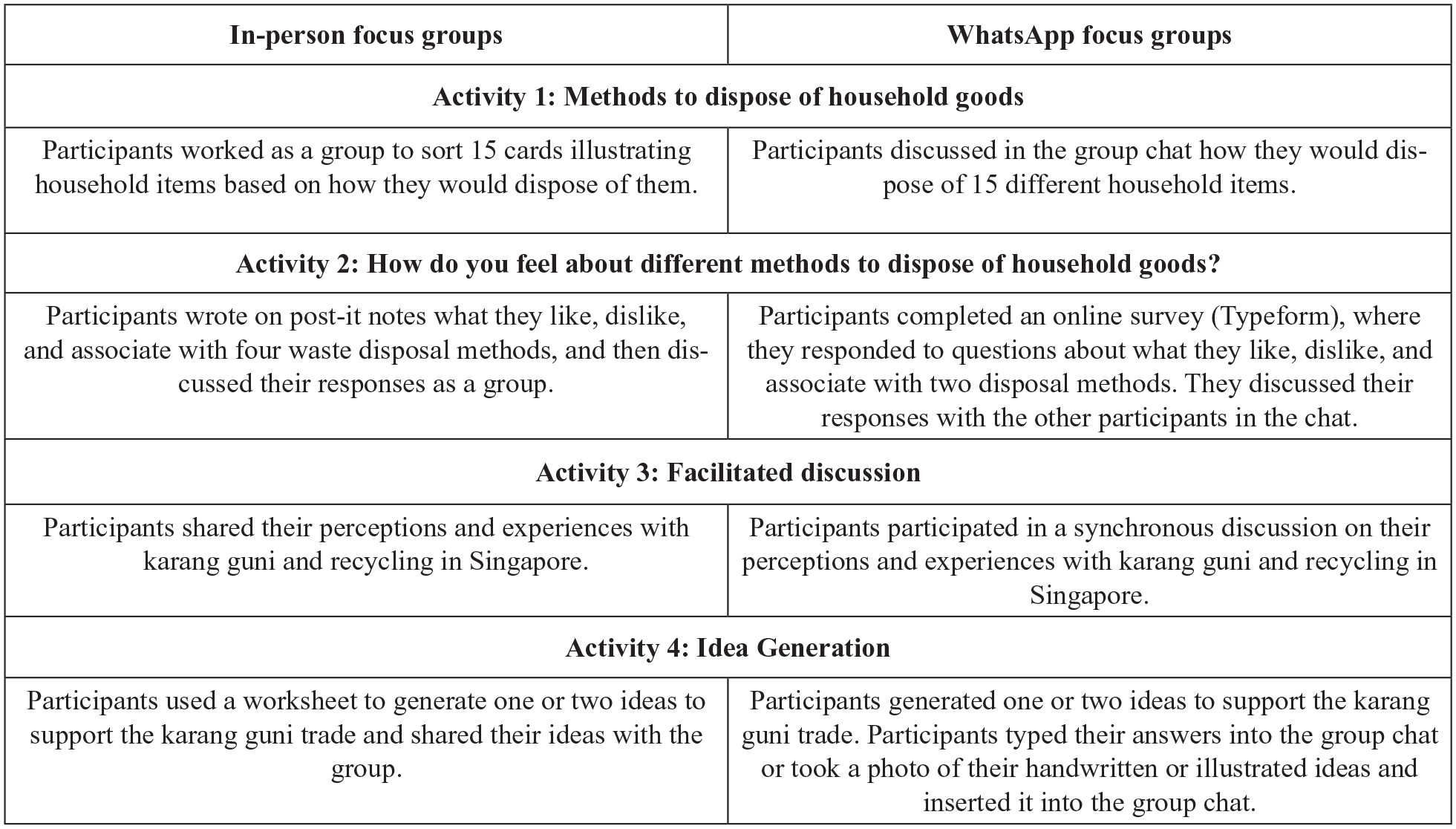
Focus group activities.
The WhatsApp focus groups included one main facilitator and one to two observers. The main facilitator created a WhatsApp group chat and added the participants to the chat at the beginning of the focus group. Participants were guided through the same activities as the in-person focus group, with some activities adapted for a mobile platform. Instead of concentrating all activities in one session, the focus group was conducted over 5 days, with one activity/topic for discussion introduced each day. This design was meant to accommodate the nature of smartphone messaging, which is often used as an intermittent chatting device.
On Day 1, participants completed an online consent form and introduced themselves to each other on the chat, including a short icebreaker question. On each subsequent day, the facilitator introduced the prompt or activity for the participants to complete during the day. The facilitator received automatic notifications of each new response on their mobile phone and would at times remark on the responses, ask for further elaboration and prompt for additional responses to keep participants engaged. Three of the subsequent activities were asynchronous, meaning that participants could choose to respond and add on to other people’s responses at any time of the day, and one activity was synchronous, requiring all participants to be online at the same time. Afterwards, participants completed an online survey about their experience and were mailed a voucher to thank them for participating in the research.
Analysis and insights
Audio files from IP1 and IP2 were sent for transcription, and chat transcripts from WA1 and WA2 were downloaded directly from the researchers’ WhatsApp phone application. The transcripts were coded using NVivo 10 software, using coding groups that correspond to three categories of inquiry: quantity and quality of response, group dynamics and logistics. For the non-quantifiable measures, the facilitators incorporated their own personal reflections and experience. These three categories are described in further detail below.
Quantity and quality of response (individual)
The quantity of responses is represented by the average number of responses of the participants and the length (word count) of those responses. A single response is defined as an individual speaking turn, or an individual digital message.
To determine quality, each response was coded for whether it included who, what, when, where, why and how statements. Responses labelled with just one tag, particularly ‘what’ statements, are used as a proxy of a lower quality of response and vice versa.
For example, when asked how they dispose of unused household goods, one participant stated, ‘People also sell their items through Instagram as well. They use Instastory to sell, they set their prices and people just PM (private message) them to purchase from them’. In the coding process, this statement was tagged as having two types of elaboration: where (Instastory) and how (private messaging).
Quantity and quality of interactions (group dynamics)
To consider the group dynamics of the focus groups, we evaluated the distribution of responses across participants, how often the participants responded to one another, the use of verbal and non-verbal cues (e.g., emojis) and the role of the facilitator in the different settings.
For instance, one participant from the WhatsApp focus group said, ‘On (Participant X)’s point, I don’t find the thrift shops in Singapore to be very appealing. I once visited the store near Potong Pasir and vowed never to go again for fear of catching bed bugs . . .’ This response was tagged as building on other’s responses, as they added onto a statement from another participant rather than directly replying to the facilitator’s prompt.
Logistical considerations
Logistics refer to the process by which participants are recruited to the focus group, scheduling, finding a location and other functional matters.
Findings
Quantity and quality of responses (individual)
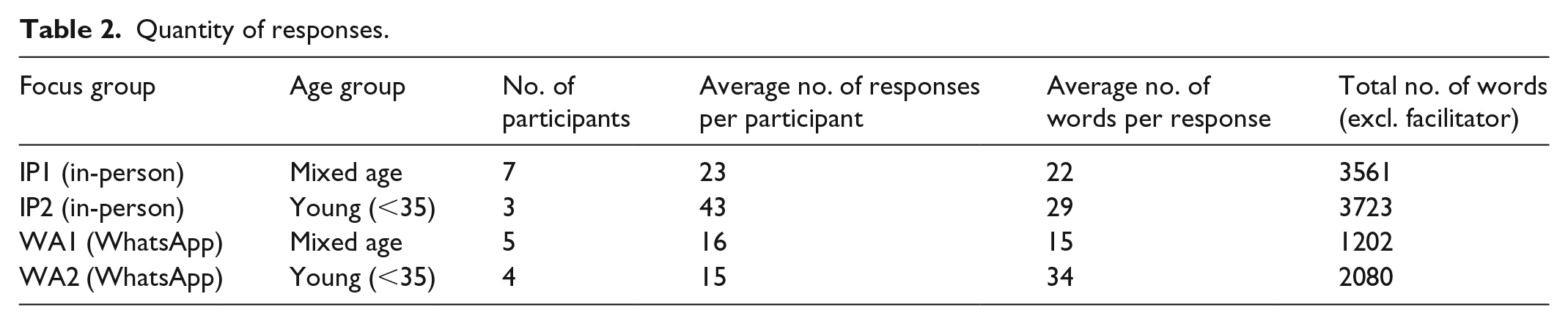
The WhatsApp focus groups had, on average, fewer responses per participant than the in-person focus groups. They also had the fewest total number of words spoken/typed in the focus groups. However, the length of the responses varied across the groups. While WA1 had the lowest number of words per response, WA2 had the highest number of words per response of all of the focus groups, indicating fewer, but more elaborated responses. It also reflects that not all participants in the WhatsApp chat responded to all of the questions from the facilitator, compared to the in-person focus groups where participants generally took turns to allow one another to speak on each topic (Table 2).
Quantity of responses.
This was also apparent in looking at response quality. In WA2, 21% of the responses included four or more types of elaboration (i.e. who, what, when, where, why and how). In the other focus groups, there were almost no similarly elaborated responses. WA1, in particular, had the least elaborated responses, with 55% of responses including no elaboration at all. For instance, upon being asked what challenges they faced with selling secondhand goods online, one participant in WA1 stated, ‘Maybe some buyers will suddenly bail on you, which is a waste of time. Other than that, it seems ok’ and did not provide further detail. Other participants in the group chat did not agree or disagree with this statement (Table 3).
Elaboration of responses.
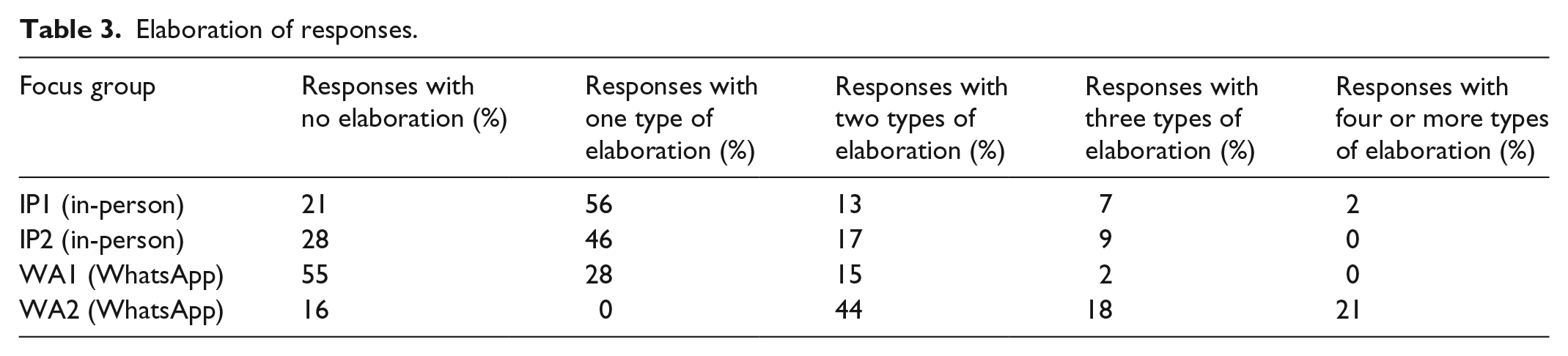
Thus, the WhatsApp focus groups represent the two most extreme cases in terms of quantity and quality of response, with the fewest average number of responses per participant, both the fewest and the highest average number of words per response, and the least and most elaborated responses. While WA2 shows the upper potential of the WhatsApp focus groups to generate thoughtful and insightful responses, the lower number of total words relative to the in-person focus groups indicates that the conversation was not as full or well developed as the in-person focus groups.
Quantity and quality of interactions (group dynamics)
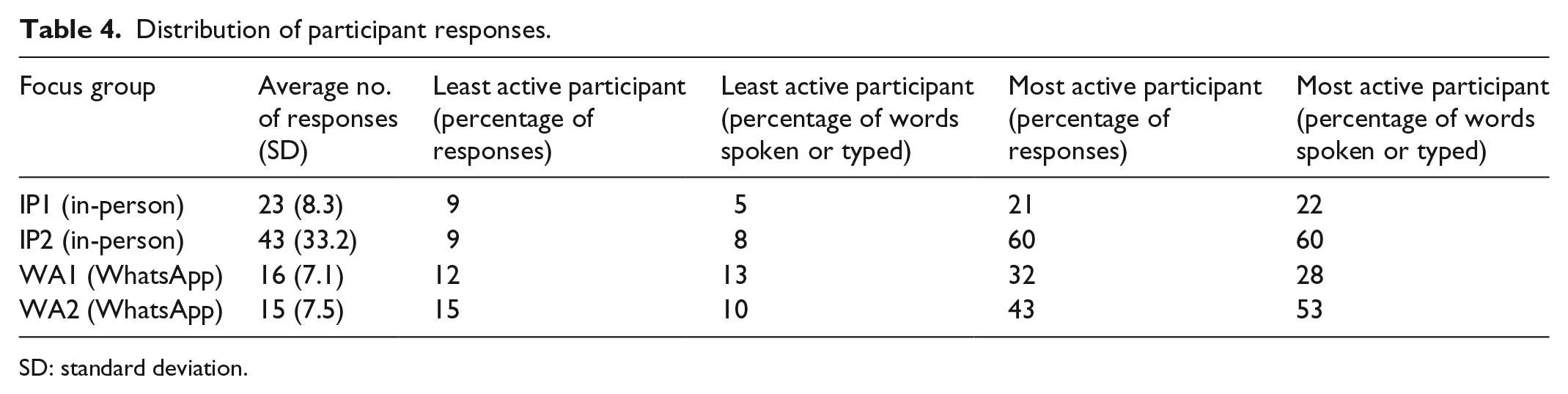
We evaluated the distribution of responses as a proxy for whether people felt comfortable to participate, with mixed results. While IP1 and WA1 both had a fairly even distribution of responses, IP2 and WA2 each had one dominant individual whose responses made up more than 40% of all of the responses in the focus group session (Table 4).
Distribution of participant responses.
SD: standard deviation.
However, the facilitator found that the presence of the dominant individual in the WhatsApp focus group WA2 was less noticeable or disruptive than the presence of the dominant individual in in-person focus group IP2. One reason could be that the asynchronous nature and ability to have overlapping threads in WhatsApp meant the dominant individual in WA2 did not overwhelm the conversation or prevent others from speaking; indeed, their relatively frequent responses provided additional stimuli for other participants to respond to. At the same time, the researchers also felt that the activity from a dominant individual masked non-participation from the others.
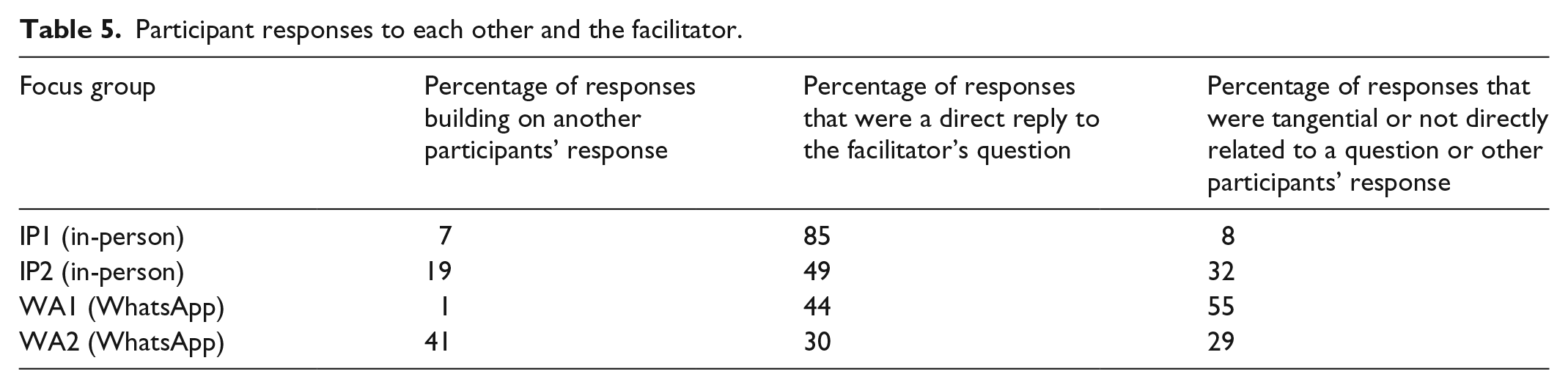
This dynamic was further explored by analysing how participants responded to one another. Building on others’ responses is considered to be one of the advantages of a focus group because it stimulates participants to generate new and unanticipated insights. In WA2, 41% of participants’ responses referred to, responded to or built on someone else’s response, by far the highest amount of interactivity among all of the focus groups. In IP1, on the other hand, participants only built on someone else’s response 7% of the time and responded directly to a question or statement from the facilitator 85% of the time. This could be interpreted as the facilitator being seen as a less dominant and/or influencing figure in the WhatsApp group chat, whereas the physical presence of an ‘authority figure’ in the in-person focus groups might have generated a more hierarchical question-answer sequence (Table 5).
Participant responses to each other and the facilitator.
Indeed, the role of the facilitator altered between the in-person and WhatsApp focus groups. While the amount that the facilitator spoke or typed relative to the participants was similar for each focus group, the types of interactions were different. In the in-person focus group, the facilitator felt more control to adapt the activities and questions based on the group dynamic and interest. They could prompt the participants to speak, fill in gaps in the discussion, quickly ask follow-ups, ensure that all of the topics were covered and respond to the personality of each individual.
The in-person participants also seemed more comfortable asking clarifying questions. For instance, when the facilitator asked how they would dispose of old furniture they did not want, one participant in IP1 asked, ‘It’s spoiled, right?’ to check whether they understood the question. In the WhatsApp setting, similar clarifying questions were uncommon. Participants may have decided it was easier and more considerate to answer without seeking clarification rather than ‘spamming’ the group participants and waiting for a response from the facilitator.
The mostly asynchronous nature of the WhatsApp focus groups could also explain why the facilitator played a different role than in the in-person focus groups. In the in-person focus groups, when there were gaps in the conversation and the participants did not speak, the facilitator would engage in casual conversation and stimulate new discussion topics. With the WhatsApp focus groups, the facilitator had less of an immediate need to engage the participants to respond, as it was less obvious when there was a ‘lull’ in the conversation due to each person responding on their own time. Furthermore, the facilitator was not always available on WhatsApp, making it difficult to immediately probe or respond when someone made a remark, resulting in lags in the same conversation thread. Although the facilitator would specifically prompt (quieter) individuals in the group chat, it was not always effective in eliciting a response. Thus, the facilitator felt that the conversation could have been further developed had the participants been in an in-person setting; instead, the facilitator felt that the mobile messaging setting did not maximize the insights and thoughts of the participants.
To help compensate for the lack of physical cues, the facilitator and participants in WA2 frequently used emojis, superlatives, italics and punctuation marks, which guided the facilitator and participants to interpret their tone of voice and general feeling (Figure 2). However, it was still insufficient for the facilitator to assess the group dynamics, making the questions posed seem less organic and dynamic than the in-person focus groups.
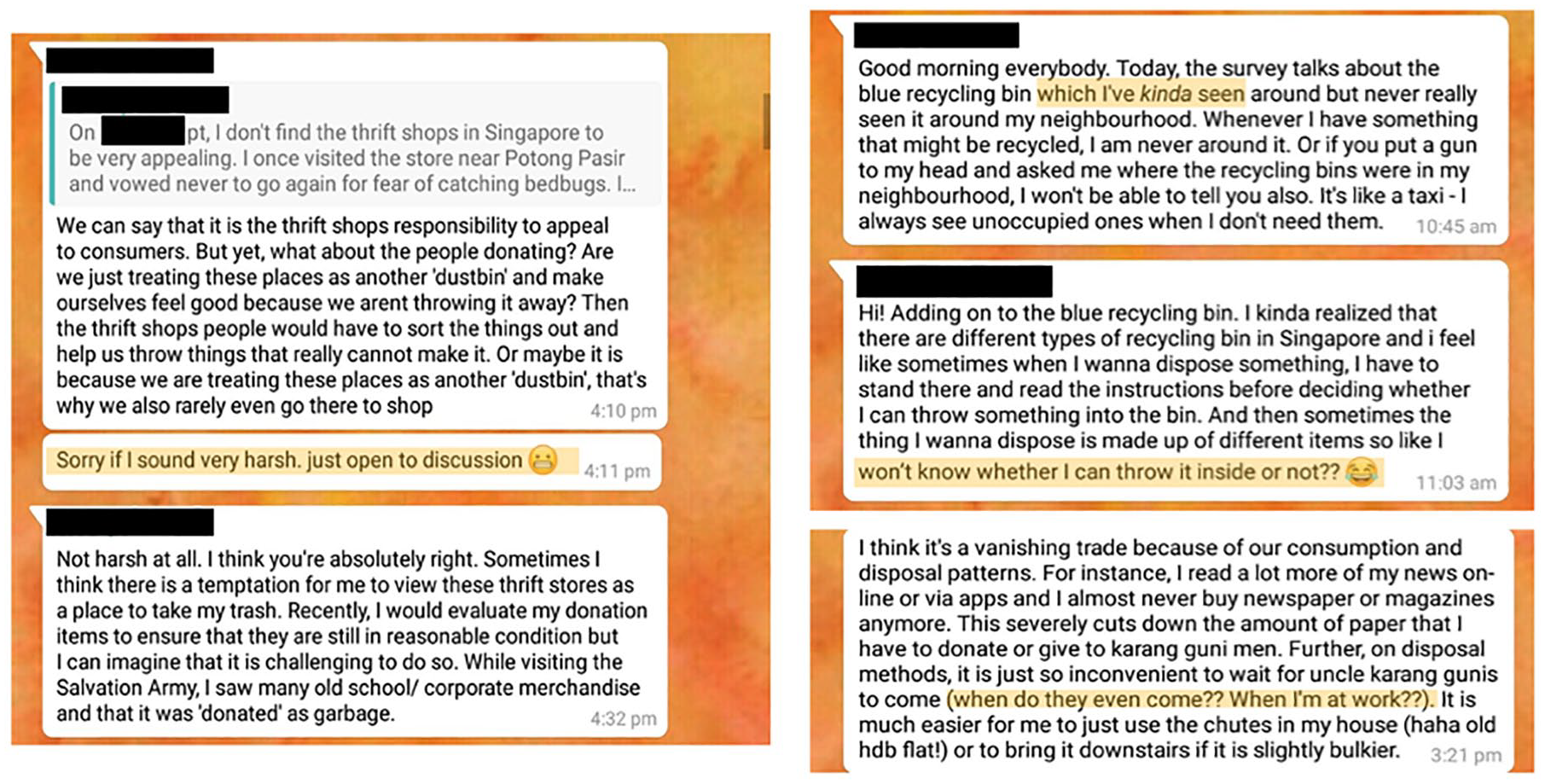
Use of emojis in group chat.
Logistical considerations
Organizing in-person and WhatsApp focus groups differed in several key ways. Predictably, in-person focus groups were more time-consuming and costly. Several hours were spent to identify a facility and coordinate schedules. A number of participants were ‘no shows’ despite confirming their attendance, disrupting the balance of the focus groups. The research team also paid room rental fees and purchased and transported supplies and refreshments. Following the focus groups, the researchers sent the audio recording to be transcribed and checked and cleaned the transcripts for errors.
In contrast, minimal time was spent organizing the WhatsApp focus group, and no costs were incurred except the shopping vouchers, which were mailed to the participants as a token of appreciation. Recruiting and scheduling participants was easier and more efficient, as participants did not need to adhere to a fixed time, or consider travel time and cost, thus potentially increasing their willingness to participate. Because recruitment for WA2 was conducted in person, the facilitator could verify the general characteristics of the participants. Furthermore, the chat log was exported verbatim as a text document after the focus group ended. The facilitator did find the WhatsApp focus groups to require more mental effort, as they needed to regularly engage with the participants over the course of the 5-day period rather than a single 2- to 3-hour session.
Participant feedback
The participants of the WhatsApp focus groups completed a short pre- and post-survey (100% response rate). In the pre-survey, the respondents were asked why they were interested in participating in the digital focus group. In response to a multiple choice question, the participants responded in equal parts that they were interested because it ‘saves time’, ‘no need to travel’, ‘interesting concept’ and were ‘curious about what it is’. No one stated they were interested ‘because it’s anonymous’, and only one participant said they were interested because ‘I enjoy interacting with people online’. In the post-survey, the feedback was positive, and 100% of the participants said they would participate in another similar focus group. In an open-ended response, they listed the positives to include ‘gives different perspectives’, ‘convenient and good to engage in such discussions while on the go’, ‘easy access and less time consuming’, ‘at your own pace’ and ‘convenient, can respond at own convenience, easy to speak up’. When asked for how the focus group could be improved, only two participants responded to the open-ended question, and both referred to lack of participation by other members of the group: ‘I enjoyed hearing everyone else’s opinions. But I think there’s little engagement among the participants so that could have made things even more interesting’, and ‘Perhaps greater participation from other members of the group’.
Limitations and future research directions
The primary purpose of the focus groups discussed in this article was to gain a better understanding of waste management practices and attitudes in Singapore, with the comparison between different focus group methods being secondary. Hence, the design and execution of the focus groups does not allow them to be systematically compared with one another. Furthermore, the small number of focus groups means we are only able to highlight the potential of WhatsApp focus groups, rather than to make broader generalizations.
More rigorous study could help to shed additional light on the opportunities and limitations posed by WhatsApp focus groups. The relative success of one of the WhatsApp focus groups (WA2) and the relative failure of the second WhatsApp focus group (WA1) show a wide breadth of potential, and a larger study could further explore which factors influence the quality of the discourse and interactions in a group chat setting. In particular, it would be useful to identify additional strategies to increase the level of engagement and number of responses, for instance, through integrating additional WhatsApp functionality such as voice memos, photos and stickers.
Another area of further study is how such forms of engagement can contribute to existing literature on the ethics of digital research. Both online and face-to-face focus groups generate information that is shared among the participants. However, with mobile messaging, the participants have access to the others’ mobile phone numbers and what is essentially a written transcript of the focus group in their WhatsApp. While difficult, it is possible that with some effort and the use of a paid service, a mobile phone number could be traced back to a person’s identity.
To increase the confidentiality of the shared information, such as for more sensitive topics, one should carefully research the most appropriate platform. As an example, the latest update to Telegram, a social messaging application popular with younger populations in Singapore, allows one to communicate without revealing personal phone numbers and anonymizes forwarded messages. The group administrator can also delete messages sent to and from all of the group participants, essentially removing the chat transcript from their phones. Rather than advocating for any particular platform, it is critical for researchers to fully consider and stay up to date on the privacy features of different mobile messaging applications, which are constantly changing as the rules of online privacy are being debated and defined in real time.
Conclusion
The experience shows that there is potential to conduct focus groups using group chat in a mobile messaging platform. Mobile messaging has been characterized as a unique semi-hybrid between spoken and written communication – bridging the spontaneity and informality of everyday conversation and the more edited, permanent nature of written text. The prevalence of smartphones in Singapore can help to address concerns about the digital divide that are frequently raised in online focus groups. In addition, the use of an existing, well-used messaging app was effective to minimize technical problems and decreased the participants’ time commitment and deviation from daily rituals, making recruitment and participation relatively easy.
WA2 illustrates that this combination can work in a focus group setting, eliciting longer and more elaborated responses than their in-person counterparts. Furthermore, the virtual environment did not discourage the participants from engaging with and responding to one another. In fact, it may have minimized the dominant effect of the facilitator, reducing the question-and-answer nature of many of the other focus groups. The participants frequently built upon each other’s responses, which generated new and useful insights for the research project, and the more spontaneous nature of mobile messaging allowed for a fairly natural and organic conversation. The presence of a participant who was relatively dominant also did not appear to disrupt the flow of the discussion and indeed was helpful in stimulating more responses from others. However, while the discussion was productive, there were relatively fewer responses per participant in the WhatsApp focus groups, and the facilitators felt that the full potential of the discussion was not explored or captured. As such, future research using this method should carefully consider and potentially test in advance additional strategies that can help to increase the overall levels of engagement among the focus group participants.
On the other hand, the results from WA1 demonstrated that WhatsApp focus groups can also be unproductive, eliciting short, minimal responses. We speculate that this is in part due to the participants having different levels of digital fluency, whereas all of the participants in WA2 were younger and highly familiar with both the technical mechanics of using group chat on WhatsApp, as well as having meaningful conversations via mobile messaging. Thus, while older participants may have access to the technology, they may have a more functional, rather than expressive, approach towards communicating through mobile messaging that is less conducive for generating rich, qualitative insights. Selective recruiting is likely to be an important aspect of digital focus groups, and it appears to be particularly well suited to a younger, digitally fluent population.
Furthermore, there are scenarios where a mobile messaging focus group may be more or less appropriate. For instance, in the WhatsApp groups, the facilitator felt less control to adapt the questions and discussion for the participants, and the participants were less likely to ask clarifying questions. Hence, an in-person focus group (or other medium) may be better suited for more complex or ambiguous research questions where it is important to have more dynamic or flexible facilitation.
Given the evolution of how people communicate, it is important to ensure that our research tools are able to adapt and remain relevant and accessible to different segments of the population. The use of WhatsApp to conduct focus groups is one example, and while it has its limitations, it shows promise as a method to enable qualitative research and engage with younger, digitally fluent research participants.
Footnotes
Declaration of conflicting interests
The author(s) declared no potential conflicts of interest with respect to the research, authorship and/or publication of this article.
Funding
The author(s) disclosed receipt of the following financial support for the research, authorship, and/ or publication of this article: The material reported in this document is supported by the SUTD-MIT International Design Centre (IDC), under grant IDG31700101 “Empowering Traditional Trades and Forging Sustainable Households with Smart Recycling Platform” (Principal Investigator: Lyle Fearnley). Any findings, conclusions, recommendations, or opinions expressed in this document are those of the author(s) and do not necessary reflect the views of the IDC.
