




Abstract
For researchers, conducting face-to-face interviews is always a challenge as it often turns into a one-way directed information retrieval. Therefore, interviewees not always are very motivated, enthusiastic and cooperative in responding to the questions. In the end, this has implications for the quality of the interview data. To improve the interview setting and the resulting data, in several projects the Net-Map tool was used to conduct participatory social network analysis. The tool is a combination of in-depth interviews and participatory network mapping. During the interviews, the interviewee draws the network of relevant actors, notes down their motivations and evaluates and displays the actors’ influence and benefits by building towers using any kind of stacks. In this research note, we present the strengths and weaknesses of the method against the experiences with applying the Net-Map tool on four different continents and give ideas for improvements and further research.
Keywords
Background
Net-Map is a participatory, innovative tool for social network analysis (SNA), which combines elements of qualitative and quantitative research. During an in-depth interview, the interviewees (individuals and groups) create and draw maps of the networks they participate in. While drawing the network, they engage in a process that helps them to understand and clarify their own view of the given situation, discuss the situation and finally develop a strategic approach to improve their own networking activities. The advantages and disadvantages of Net-Map compared to classical SNA are more implicitly discussed in the literature (Campbell et al., 2014: 431; Hauck et al., 2015; Schiffer and Hauck, 2010). In classical SNA, the analysis focuses primarily on data raised in a quantitative manner, which makes it difficult to understand the underlying reasons for complex and dynamic structures, and there are typically time gaps between data collection and results (Reed et al., 2009). In contrast, the Net-Map approach additionally supports qualitative information based on individual actors’ viewpoints and perceptions, which helps to combine purely structure-oriented quantitative network analysis with more qualitative aspects such as narratives and participatory approaches (Hauck and Schiffer, 2012). In addition, in quantitative SNA, each actor reports his or her own ties to other actors, whereas in the Net-Map tool, the actors also report their perceptions of ties between third parties. Therefore, at least one representative of every actor group must be interviewed when using the Net-Map tool in individual interviews to prevent bias when aggregating single networks for further analysis of the overall network. In principle, it is also possible to use Net-Map in group interviews with all relevant actors and construct the overall network together. This, however, bears some additional challenges as the actors have to coincide about the network they draw. This is time-consuming, more difficult to control biases and challenging, in particular in conflictive networks.
Based on experiences with applying this research tool in four different countries and continents, we document the strengths and weaknesses of the proposed method against the international background and propose ideas for improvements and further research.
Case selection and method
The tool was used to analyse the governance models in four different research projects. A governance model is a special arrangement of institutional structures and actor constellations of which three ideal types are distinguished: hierarchies, markets and community management based on cooperation (Vatn, 2010: 1246). Although they focused on different topics, all of the types we present in this article analyse collaborative governance approaches in environmental management. Collaborative governance approaches seek tailored solutions for complex problems and are characterized by the incorporation of all concerned actors and their specific needs, by using all kind of resources (e.g. local knowledge), by using social capital and by being flexible and adaptive (Mert and Pattberg, 2015).
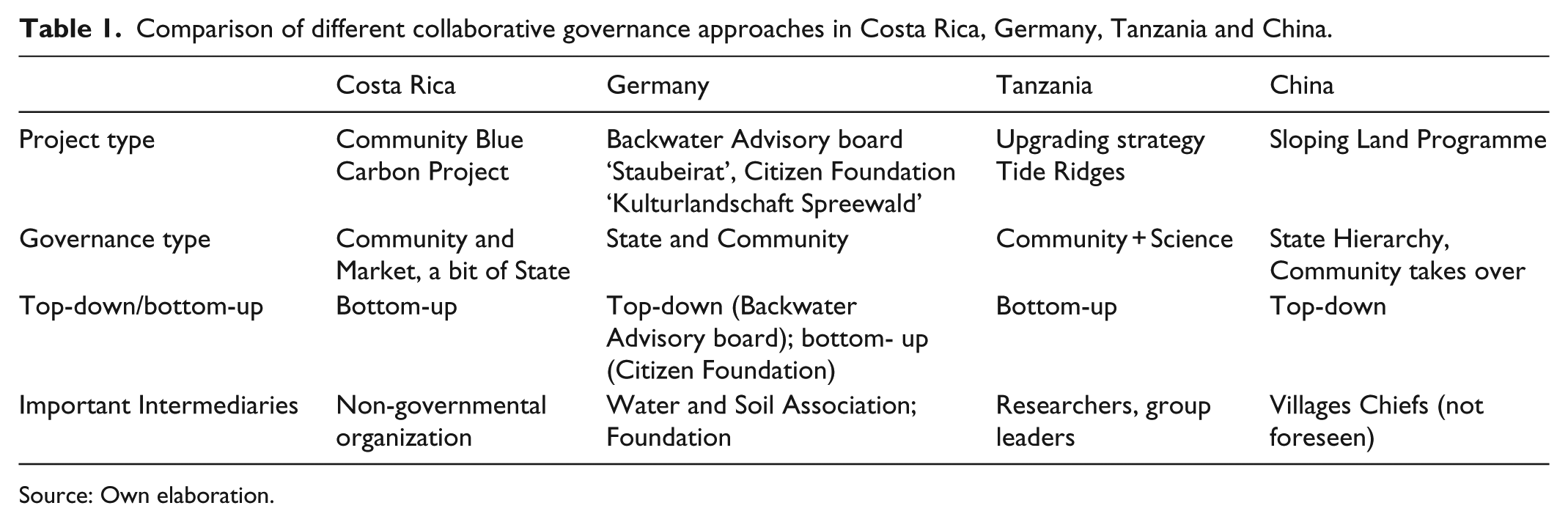
In Costa Rica, a community-based payment scheme for ecosystem services was investigated in which fishermen are paid for restoring mangroves and are also active in educational work. In Germany, collaborative governance approaches were analysed in which actors from public, private and civil society worked together for water management and biodiversity protection. In Tanzania, the functionality of farmer groups implementing so-called upgrading strategies, such as tide ridges within a village that aim to improve food security, were assessed. In China, a state-financed payment for ecosystem services scheme was studied in which peasants are paid for reforesting part of their land (see Table 1).
Comparison of different collaborative governance approaches in Costa Rica, Germany, Tanzania and China.
Source: Own elaboration.
Most interviews were conducted with actors at the local level. For each study, the following comparable information was gathered: determining the important actors in the governance approach, their connections with each other, their motivations to participate and their influence on and benefits from the schemes.
The Net-Map tool which is an empirical research tool developed by Eva Schiffer and the International Food and Policy Institute (IFRPI) was used for data collection. Net-Map is used to (1) visualize implicit knowledge and understand the interplay of complex formal and informal networks, power relations, and actors’ goals; (2) uncover sources of conflicts as well as potentials for cooperation; (3) facilitate knowledge exchange and learning processes; and (4) develop visions and strategies to achieve common goals. (Schiffer and Hauck, 2010)
To specify the context for which the network is mapped, an overarching Net-Map question is first formulated: ‘Who has influenced/can influence XY where and when?’
The interviews include four steps:
Recording the participating or influencing actors. During this step, interviewees identify the actors within the network, write the names on actor cards and distribute them on a large sheet of paper. To gather additional information, they are asked what makes each actor important.
During the second step, different links between the actors are identified. The interviewer asks for one specific link between actor A and all other actors, followed by the same link between actor B and all the other actors, and so forth, and then draws arrows connecting the actors. When one link is finished, the next link is mapped with a different colour. In the reviewed studies, we asked for different relationships between the actors such as personal contacts, trust, flow of money or materials, written contracts and exchange of knowledge; the arrows are all displayed in different colours.
During the third step, the motivation of each actor is established, a legend is drawn and symbols are placed beside each actor’s card. In some cases, the interviewee was presented a list of five pre-defined motivations based on the case study experience which were identified through qualitative interviews beforehand; these include economic, ecological, social, image-related and knowledge-related motivations. Additional information is gathered by asking for the reasons behind specific motivations.
Finally, the interviewee is asked to indicate how strongly each actor is influencing the result in the overarching Net-Map question. He or she arranges towers (which are built of some stackable material such as small bricks and chocolate) for each actor according to the estimated importance. The greater the influence of the actor, the higher the tower. Towers of different actors can be of the same height, and the heights of towers may or may not be restricted. The interviewer notes the height of the towers onto the map and gathers additional information by asking for reasons for the actors’ influence.
This visualization process is accompanied by narratives which the interview partners provide to explain the drawings.
In our studies, the Net-Map tool was used to analyse five main aspects: (1) Who are the important actors in a network? (2) What are the relationships between those actors (such as flows of knowledge, information, money and other resources, contracts, reporting, trust or conflicts)? (3) What are individual actors’ motivations or goals (e.g. ecological, economic, social, image, knowledge, love, joy)? (4) What is each actor’s, influence or importance?
To adapt the tool (Schiffer and Hauck, 2010) to our research needs for the case of Costa Rica, Germany and Tanzania, the forth step was repeated, asking not only for actors’ influence and importance but also for actors’ personal benefits, income food availability, learning and trust.
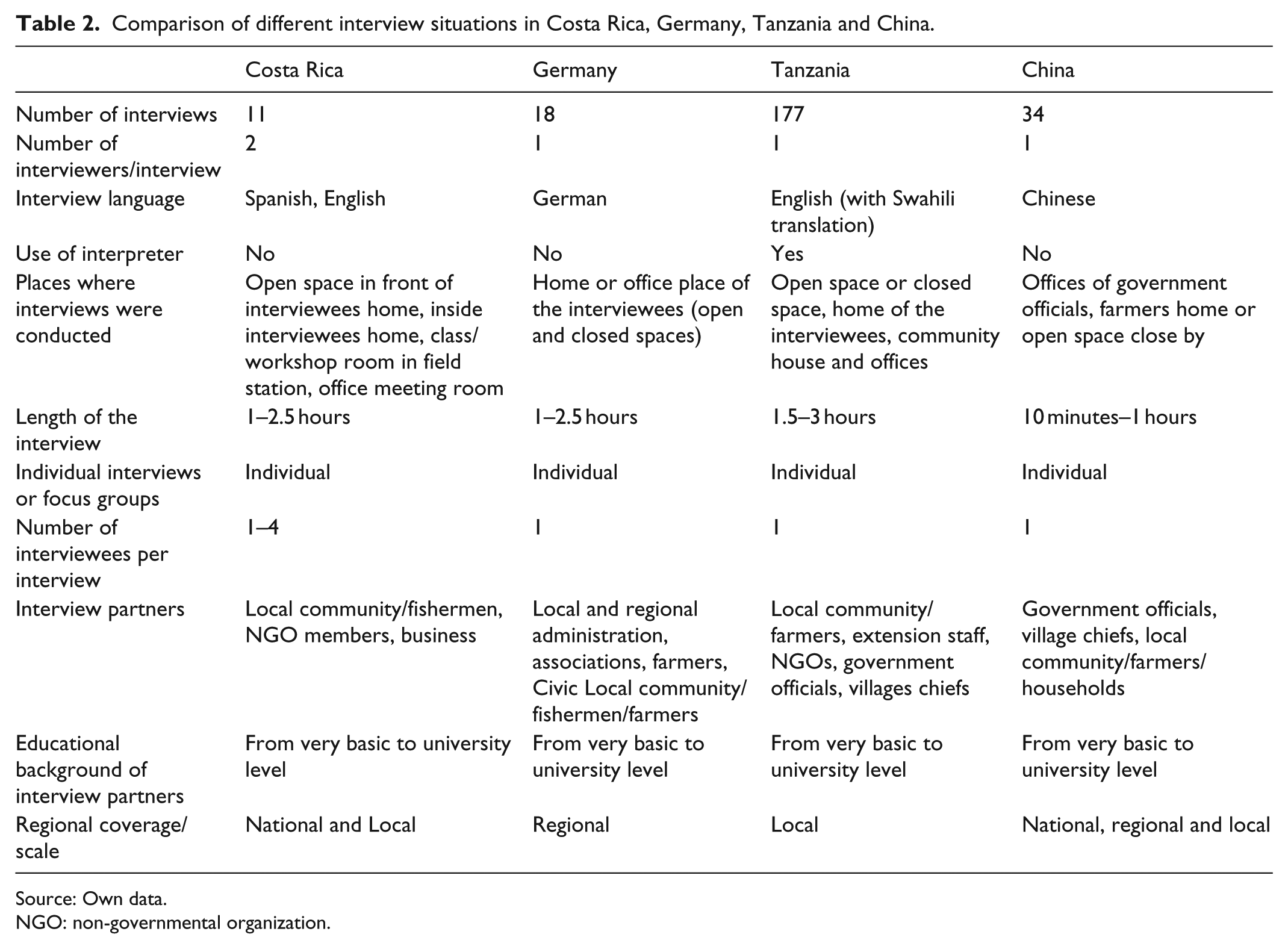
In each case study, individual interviews were conducted by the lead researchers of the respective project. Local staff only served as translators in the case of Tanzania, but they were trained in the interview method and the terminology was defined in their presence. An overview of the different interview conditions is presented in Table 2.
Comparison of different interview situations in Costa Rica, Germany, Tanzania and China.
Source: Own data.
NGO: non-governmental organization.
Research results
After data collection in each study was finalized, we conducted a short survey with open questions among six researchers that had been involved with the studies. They were asked for their opinions regarding the strengths and weaknesses of the Net-Map tool in relation to (1) interactions with interviewees, (2) collection of scientific data, (3) structural aspects of the tool (e.g. guidelines, interview steps and duration) and (4) what they would change to improve the method.
Challenges regarding the interaction between the interviewee and interviewer can be attributed to either methodological challenges or differences in the respective research design or country context of the studies.
Methodological challenges
In Costa Rica, it was sometimes difficult to keep the interviewees focused and not make them deter from the topic, whereas in Germany, the experience was mixed. Some interviewees perceived interviews as time-consuming and annoying, but others felt that interviews were more interactive and interesting than conventional interview techniques.
Challenges to data collection were, in Germany, related to actors who performed different roles in the network. This made it difficult to unmistakably assign roles to one particular actor as their roles were associated with several actors, and thus it was more difficult to assess their relationships. In addition, the individual interpretation of terms used during the interviews deviated, which made it difficult to secure common understanding. In Tanzania, the main challenge was to process the acquired data because of a large number of interviews. Although this took more time and the data-acquisition schedule was very dense, the data richness allowed not only for an elaborated case study comparison design of different networks across different villages and regions but also for a broader statistical analysis beyond network measures (e.g. a chi-square test for motivations and influence towers). In China, only a small number of actors was part of the governance approach and interviewed, so the data quality was highly dependent on the interviewer’s ability to obtain the most information possible and to subsequently interpret the Net-Maps. In Costa Rica, data collection was not a challenge, because people are more relaxed and easily communicate their perceptions.
Challenges associated with specific case study conditions
In Tanzania, there were challenges related to the illiterateness of interviewees, which was solved using icons for actors. In the beginning, the participants felt as though they were at a school and first had to become comfortable with the situation to provide their answers. It was sometimes difficult for them to make statements regarding other persons. As such, it was necessary to take care to not make them feel ashamed when they did not know an answer, and to give them sufficient time to think and therefore maintain their confidence. The length of the interview was usually long, up to 3 hours, which caused weariness and challenged their ability to concentrate on the topic. Similarly, in China, it was difficult for the interviewees to make statements regarding the involvement, links or influence of other actors. Interviewees could comment on their own level (e.g. other farmers in the village), but not on government employees on the regional or state level. This finding revealed the opacity of the network. Local actors had a limited perspective on the network up to hierarchical structures. Although they were experts and an active part of the network, they only knew about the local structures.
Regarding structural aspects, the main challenge was the length of the interview. In Germany, Tanzania and Costa Rica, the interviews were often considered to be too long, which made it difficult for people to stay focused on the topic at hand, such as staying focused and concentrated or thinking about other urgent tasks they must do. In China, the interviews were considered to be too short. People especially at the local level had less knowledge and could not comment on higher levels, so the interpretation of maps and the resulting situation was difficult for the interviewer because network narratives did not offer much additional information.
Advantages of the Net-Map method that were mentioned in all four case studies were that the method is easy to understand, very intuitive and contains an element of fun. In addition, the step-by-step procedure is simple and subsequently adds complexity to the network while explanatory information is collected during the qualitative part of the interview. Because the stakeholders construct their network on their own during the interview, they address the actors very consciously. This creative act results in being very helpful for reflecting their relationships. The prompt visibility of the collected information makes interpretation possible immediately, as well as makes discussion of the results easier. Most importantly, both the interviewer and interviewee learn during the process, and knowledge exchange occurs in both direction. This makes the tool suitable for interviewing not only single persons but also groups of people. As the data become structured, comparison between interviews becomes easy. In addition, the combination of collecting qualitative and quantitative data is an added value of the method, as it presents a complete picture and allows mixed-method analysis.
Discussion and conclusion
Although our findings do not allow for a systematic case study comparison due to the slightly different research design of each study, we found that Net-Map is a very flexible tool that is suitable for three out of the four different socio-cultural contexts. Only in China the tool showed limited suitability because of its hierarchical context. This coincides with the findings of Reed (2008) that ‘methods should be selected and tailored to the decision-making context, considering the objectives, type of participants and appropriate level of engagement’ (p. 2424).
The tool addresses several problems that may occur during conventional interviews, such as reaching transparency and common understanding through visualizing the situation, overcoming shyness or the will to talk and creating a comfortable atmosphere that keeps the participants involved, which in the end improves not only social learning but also the quality of the interview data (Campbell et al., 2014; Schiffer and Waale, 2008).
Although the use of the tool is time-consuming, it has the great advantage of enhancing learning effects. These learning effects occur immediately when the interviewee is reflecting on his or her perception of the network. Immediate data analysis and discussion is possible, in contrast to classical SNA and other participatory methods for governance analysis such as experiments or multi-criteria analysis. Similar to participatory modelling, the resulting map is a product which can serve as a boundary object, which acts as a device ‘for the development of a shared language to address different objectives and integrate different forms of knowledge’ (Hauck et al., 2015: 408). The maps can be discussed in a focus group with all interviewees to reach a common understanding of the overall network perception, which would be a second step of social learning.
On one hand, the maps help to make tacit or implicit knowledge, or the ‘know how’ (Roberts, 2000: 431), visible. The interviewees report their perception of the network, and only the overlay of all interview data depicts the entire network picture. As actor groups can be split into interviews or focus groups, the method gives the less powerful a chance to explain their perception of the network but makes the situation difficult if different actors discuss their perception at the same time. On the other hand, when there are diverse actors with different educational and knowledge levels, the immediate mapping of the lack of knowledge or shyness to utter perceptions becomes obvious during the interview. In this case, the learning effect occurs in the end when the resulting map is discussed with the interviewees.
The visualization of the results for participants was used as a motivation to take action because it enhances the understanding of the network and roles of individuals/groups that must be improved in order to achieve a better performance. For example, after the interviews, the participants realized the weaknesses of their network and tried to do ‘something about it’ for improving the situation; for example, if the group leader is not fulfilling his or her role in the group, members would have a meeting to try to fix it.
However, for conducting Net-Map interviews, researchers must consider the specific settings in the case study they want to investigate, especially regarding power relations and the distribution of knowledge. The method seems to function well in open societies where uttering critiques, thinking out loud, speculating about and for others, and abstract thinking is common. Literacy helps, but the method can also be applied to involve illiterate people because of the visualization motivations and actors’ names can be represented by icons. In general, the method seems to be intuitive enough to work for everyone, independent of the educational or social background of the interviewee. Knowledge differences of the distinct actor groups are perceived to be mainly due to lack of information, not to educational standards. Altogether, it seems important to use the method in a flexible way and to adjust it to the given situation so that interviewees can familiarize themselves with the method and continue at their own pace. However, in contexts with strong hierarchies, the method seems less suitable because hierarchies are the more accepted social structure compared to networks. Local actors are not familiar with answering open questions and do not have enough information due to poor participation in the design of the governance models. Only people with hierarchical power are capable of sharing such information. In addition, in this context, it was difficult to make people comment on other involved actors, as well as on the links and influence within social spheres other than their own. Actors are not really interested in clearly addressing power structures and dependent actors do not feel free to evaluate other actors in their network.
Moreover, in all case studies, the level of education differed and influenced the application of the tool. Despite conducting pilot interviews to test the wording of the questions, it was sometimes difficult to use the same terms for every actor group, such as in the German case study. This may be a limitation of the method, as it is hardly possible to use the same language if the actor heterogeneity is very high. In contrast, the strengths of the tool are the visualization possibilities, which allowed including, for example, illiterate participants in Tanzania.
The different education levels are linked to the wider profile of the different actors, which had influence on the behaviour of the interviews in all case studies. Whereas grassroots stakeholders generally had more time but were less keen on discussions, academic or business stakeholders had time constrains but were more open to discussions.
Finally, the interview questions must always be framed in the local political context. In some cases, such as in China or Germany, the questions broached more sensitive topics than in Costa Rica or Tanzania, which influenced interviewees’ behaviours. The experience also showed that if the interviews are short on time and information, a lot of local knowledge is required from the interviewer to be able to interpret the maps. Therefore, we recommend good preparation and prior training of the interviewer, as well as proper pre-testing of the research questions and wording in the original context. Using an interpreter for local languages such as in Tanzania did not make a difference in the utility of the method because the interpreters were trained in the interview method beforehand. We did not find the method to be very suitable for highly hierarchical settings. For this reason, we encourage more research regarding power relationships and knowledge hierarchies in different social and institutional settings when applying the Net-Map tool (Figure 1).
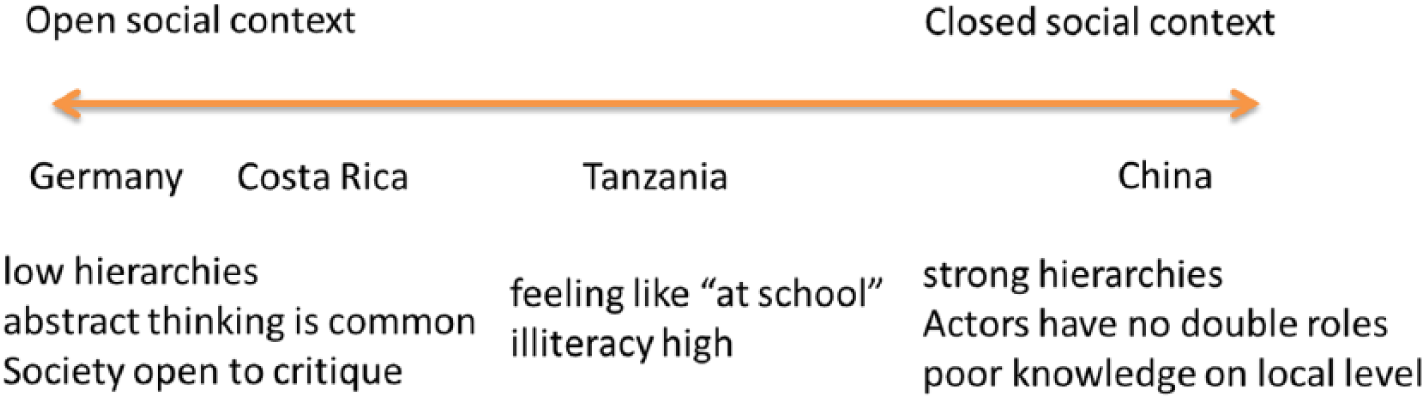
Continuum of social context based on power and knowledge.
Footnotes
Acknowledgements
The authors would like to thank all involved local stakeholders in the case studies for participating in the Net-Map interviews and workshops. They also thank the anonymous reviewers for their careful reading of the manuscript and their insightful comments and suggestions. I.H. has been part of Leibniz Centre for Agricultural Landscape Research (ZALF) at the time of data gathering.
Declaration of conflicting interests
The author(s) declared no potential conflicts of interest with respect to the research, authorship, and/or publication of this article.
Funding
The author(s) received the following financial support for the research, authorship, and/or publication of this article: This paper is based on research conducted in various projects. The CiVi.net project ( ), funded under contract number 282750 within the 7th Framework Programme of the European Commission. The cp³ project is funded through the 2013-2014 BiodivERsA/FACCE-JPI joint call for research proposals with three national funders: BMBF Germany, FWF Austria and NWO Netherlands (proposal number: BiodivERsA-FACCE2014-43). The project Trans-SEC is funded by the German Federal Ministry of Education and Research (BMBF) under the contract number 031A249A and the German Federal Ministry for Economic Cooperation and Development (BMZ) has co-financed it. The fourth author got a scholarship from the China Scholarship Council. His trip was supported by the Technical Support Programme (No. 2013BAC03B04) and National Key Project for Basic Research (973) (No. 2014CB954302) of the Ministry of Science and Technology of the People’s Republic of China. The sixth author’s field stay has been funded by the German Academic Exchange Service (DAAD) through a PROMOS scholarship (Programm zur Steigerung der Mobilität von deutschen Studierenden).