




Abstract
Within the social sciences, there is a wealth of literature that examines the challenges and ethical dilemmas encountered by researchers in conceptualising, conducting and understanding their research. In this article, we share our reflections on experiences we encountered carrying out a qualitative evaluation of a prison gardening intervention with male substance misusing prisoners. Our aim is to suggest that there is much we can gain when researchers engage in a process of reflexivity, which includes consideration to the intersection of identity of the researcher, the researched and the forces of various kinds, operating upon and within such situations. As such, here we share our fieldwork experiences and shed light on how, for us, the evaluation was a subjective, power-laden, emotional, embodied experience. We highlight how a human geographer and a sociologist working as part of a multidisciplinary evaluation team encountered issues associated with choices in terms of how we conduct our work, the emotional labour expended and how we had to assume both chosen and imposed identities. We have been challenged to consider and reflect upon aspects of gender, class, age and professional status throughout our research experience, with the ‘researched’ and between the ‘researchers’. Finally, we suggest that embarking on qualitative research in a prison setting is an outcome of complex negotiations, but in theorising our subjectivities is a means of illuminating issues that often remain invisible within prison research.
Introduction
Phillips and Earle (2010) argue that while methodological debates regarding the positionality of researcher engaged in prison research has not been totally absent, such a focus still remains largely neglected by those conducting research in such setting. In their work, they draw attention to the methodological and epistemological contours of prison research, its complexities and how this offers an opportunity for an empathic understanding of the lives of prisoners in their study. The aim of this article is to share our connection to the knowledge produced, which is shaped not merely by the approach employed but how our individual biographies intersect with that of the participants in our study (Stanley and Wise, 1993). We share how Lizzi’s, a White, married, middle-class female (Junior Researcher), and Geraldine’s (Principle Investigator), a Black, unmarried, mother of working-class African Caribbean descent (Senior Researcher), identities became part and parcel of the research process. As in the work of Phillips and Earle (2010), the suggestion here is not that identities are fixed but aim to offer an insight that demonstrates the methodological significance of our identities to the study carried out. Letherby (2003, 2013) notes, there is much that can be understood when researchers engage in a process of reflexivity. As such, Letherby (2003, 2013) asserts that reflexivity occupies a central role in ‘the doing’ and in ‘understanding’ what is done when researchers engage in social research. This is because there are a myriad of ways in which researchers are present and connected to the research they undertake. This article illuminates the various ways in which the researchers’ identities, whether externally or internally inscribed, intersect with the evaluation context, participants and subject under investigation. Our article contributes to the growing body of research which recognises the importance of positionality in prison research.
Positionality
Over the past 12 months, we (Lizzi and Geraldine) have been part of a multidisciplinary team from Coventry University evaluating a horticultural intervention (the Master Gardener Programme (MGP)) at HM Prison Rye Hill (see Brown et al., 2015). Over this period, we spent, in total, an estimated 152 hours in the field engaging both formally and informally with participants (and staff) on the MGP allowing us to spend time working alongside participants, engage in conversations with participants and staff and gaining an insight about other parts of the prison estate (such as visiting the recovery wing, industries and staff canteen). Consequently, there is a core ethnographic dimension to our evaluation in which we used a variety of research tools to capture participants’ experiences of the MGP and over the evaluation period we collected a wide range of data (detailed in the ‘Methodological approach’ section) month by month. As noted by Jewkes (2012), ‘a small minority of ethnographers acknowledge the emotional content of prison studies’ (p. 63). Here, we argue that the knowledge we produce is enhanced by having time to gain an understanding of the context in which the evaluation was undertaken, getting to know the participants and staff delivering the programme was an insightful experience. Our approach enabled us to situate ourselves in this process, which has methodological and epistemological implications such as how emotions, memory and subjectivities became entangled within fieldwork encounters (Holland, 2007).
Working in a prison setting
The prison in which the research took place is a private training prison which opened in 2001 and is run by G4S, a leading global integrated security company (www.g4s.com). At the start of the evaluation, the prison was designated as a category ‘B’ training prison holding 664 sentenced male adults. The sentence requirement at HMP Rye Hill (2014) is for prisoners who receive more than 4 years with 18 months left to serve. However, at the midpoint of the evaluation, the prison was designated as one of eight prisons in England and Wales to undertake a re-roll 1 of its population, and since Spring 2014, the prison has housed men incarcerated for a sex related offence. Today, the prison remains a training prison with a capacity of 635 and acts ‘as a national resource for sentenced male adults who have been convicted of a current or previous sex offence(s)’ (www.hmpryehill.co.uk) and who have been sentenced to over 4 years and have at least 12 months left to serve on their sentence.
The evaluation took place between August 2013 and December 2014. At the start of our evaluation, the prison was in the process of introducing a new approach to supporting prisoners with a substance misuse issue. A key part of this included the development of a recovery wing alongside a wider suite of substance misuse programmes. In Phase 1 of our evaluation, we spent 6 months with a group of ‘mainstream’ prisoners, and due to the re-roll of the prison to a vulnerable persons (VP) population, Phase 2, the final 6 months of the evaluation was undertaken with sex offenders. All participants included in our evaluation experienced substance misuse and were recruited on the garden from the dedicated recovery wing; the garden was part of a wider suite of programmes provided and being developed by the substance misuse team.
As in the work of Phillips and Earle (2010), our field notes, and the conversations we have had about our study, reveal an aspect of the research that often remains hidden in relation to how we felt about the MGP, participants, staff in the prison setting and generally about our role in conducting this study. Indeed, our notes and conversation often had an emotional or subjective dimension. This enables us, like Phillips and Earle, to focus attention on how factors such as gender, ‘race’ and class unravelled during the process and our fieldwork experiences. However, our reflection here also includes how perceptions associated with age and experience also impacted fieldwork experiences:
Lizzi: I am a Senior Research Assistant with a research background in human geography and 6 years’ experience of working in the academy. I have worked on many agri-food-related projects, including in the area of food growing and the social and community aspect of this. Prior to this evaluation, I had no experience of working in prisons; my fieldwork experiences have involved working with people around food growing spaces in the United Kingdom and internationally. My part-time PhD fieldwork focused particularly on food growing spaces on housing estates and disadvantaged areas in London where I critically sought to understand the broader experiences and motivations of citizens from a critical realist perspective. I am a White, British female from a professional family. As someone who became disengaged with school and particularly in subjects that did not interest me, my need to work in a job that was meaningful and captivating coupled with work experience at a research institute gave me a concern for real world, practical research which contributes towards ‘making a difference’. The working-class area of the country where I went to school comprised a host of socio-economic issues which may have prompted my interest in undertaking a human geography degree and MSc. in urban regeneration research and policy. My Christian faith (not one I grew up with) is central to my identity and as such is of key importance to my reflections around my research experience.
Geraldine: I am an experienced researcher (albeit quite junior in the academic hierarchy), and I have been involved in social research (initially as a Research Assistant and now as a Research Fellow) for over 15 years. My academic background is in sociology and social policy, and the research I have conducted has largely focused on exploring issues that have been identified as disproportionately negatively impacting groups identified within UK policy as ‘excluded’, ‘marginalised’, ‘disadvantaged’ and more recently categorised as ‘vulnerable’. Hence, this work has included research with teenage parents, Black and minority ethnic communities, women, older people and offenders. I am an unmarried mother from African Caribbean descent and the first of my siblings to attend Higher Education. I was born and grew up in inner city Birmingham, which is one of the United Kingdom’s largest metropolitan cities. As a Black female researcher, I often find myself navigating between two worlds – as a Black woman working and researching in what remains a White-dominated institution and as a woman who lives in and is part of a wider Black community. This is challenging as I am continually reminded of how my background, gender and racial identity mediate the research process in diverse ways (Brown, 2015). As a Black feminist, there is a political goal that underpins much of the research I have undertaken in that my aim is to ‘allow space for groups who are often absent from debates to be included’, providing an opportunity to give voice to those who have been silenced (Hill Collins, 1990: xiv). This reflects how for me the personal is a political act (Mills, 1959). I hope to undertake research that is not merely an attempt to generate new intellectual insights as while this is important, fundamental to the research I undertake is for my work to make a difference in the lives of those I engage in the process (see Letherby and Bywaters, 2007).
Cohen and Taylor (1981) describe prison as places of intensely managed emotions where institutional interests in formal order coincide and conflict with the raw exigencies of ontological survival in an alien and austere environment. Consequently, the stress and anxiety imposed by closed and crowded living conditions, and limited privacy have to be endured daily by prisoners. It is therefore to be expected that anxiety defences are mutually at play for both researchers entering this world from the relative comforts of life outside and prisoners themselves:
Lizzi: My previous personal and research experiences undertaken had not prepared me for research in prisons. In all honesty, I was quite apprehensive about going in to this space and there was an element of fear in terms of not being able to relate to the participants and a fear of being ‘rejected’. However, as Geraldine was confident about the process, I felt comfortable placing my trust in her. Although I felt the need to ‘find a place’ in this new research environment as discussed by Warren (1988, cited in Jewkes, 2012), working as part of a team made this process somewhat easier. Warren suggests that finding ‘a place’ can be
tricky for the female ethnographer within a strange culture … because not only does she have to conform to assumptions about women being unchallenging and compliant but she must also be seen to be operating successfully in a male-dominated public sphere. (Jewkes, 2012: 68)
Our gender was not a barrier to working with the participants, but for me age, or how I felt others perceived this, was.
I knew Geraldine would be great at working with the guys, which comforted me but also made me question my ability. However, being more reserved, introverted and somewhat shy in an unfamiliar environment, I was nervous about not knowing what would happen. Going into any unfamiliar setting, in an intense manner (for the whole day in a confined space) with a group of males (who I had never met before) would have given me some degree of apprehension, of which the ‘offender’ status added to. The (un)predictability of the participants was something I was initially cautious of, which may have been to do with perceptions around their substance misuse issues. The fact that we would be entering their space as outsiders – in the whole sense of the meaning – outside to the regime, outside of their cultural norms – meant that I did not know how I should act, which perhaps reflected my level of research experience generally (and did make me self-reflect, recognising the importance of the experience for researchers). As such, I can concur that as a ‘novice prison researcher’, I experienced anxiety about entering the field although not with observing and talking to the participants on a one-to-one basis, as Jewkes (2012) asserts. This is due to the space of the garden and the methodological approach we took in our evaluation, which moved beyond the formal researcher–participant interview. I did, at the start of the visits, observe Geraldine’s behaviour and mirrored it to a certain extent – informally and somewhat unconsciously knowing what was ‘acceptable’ and the kind of things to ask, talk about, and so on. I was surprised and comforted at how polite, welcoming, warm, friendly and sensitive in tune with their emotions the participants were, which made our prison visits enjoyable. Geraldine and I became a familiar part of the garden space, which allowed for a closeness to the participants (and the garden) over a period of time.
I felt as though for me, prisons were a forgotten place and prisoners were a forgotten people. I was never made to think about prisons or prisoners and therefore I had a very limited knowledge or connection to the prison system. I am reminded of a friend – before the prison evaluation, Tom* who as well as experiencing quite severe mental health problems, was also tagged. Although this gave me a little insight and preparation for the prison, it enabled me to consider Tom’s circumstances and complex needs. This project along with other events has taken me on a complex and unforgettable journey shaping my inseparable personal (Christian) and professional values:
Geraldine: I was excited about the opportunity of working on this project. I have had some previous experience of researching in a prison environment and also had some personal experiences in terms of friends and family members who had come to the attention of the UK Criminal Justice System. At the point of starting this project, one of my oldest friends was coming to the end of a 5-year prison sentence and I had visited him on a number of occasions so I had some understanding of the prison regime. This is not to suggest that I was not initially nervous about doing this work, but my nervousness was not associated with the thought of working with prisoners. If I am honest, I was a little more anxious about the relationship I would have with those employed to work in the prison. Indeed, I understand what Phillips (2010) means when she writes about the marginalising experiences often reported in accounts of empirical research carried out by Black and minority and female researchers. Phillips accepts that this undoubtedly holds epistemological value but simultaneously is evidence of how ‘race’, gender and class remain central to how individuals experience the social word. Furthermore, fully aware that having some understanding and knowledge about prison through knowing friends and family members who had been incarcerated did not automatically designate me as an insider. Like Lizzi, I too recognised my outsider identity. However, being an outsider for me as a Black woman working in the Academy is not unusual. There are numerous occasions that working in the academy, for me, equates to feelings like being a body out of place (Mirza, 2006) as I am often required to enter places and spaces in which my racial identity positions me as an outsider. For me, my anxiety similar to that noted by Phillips (Phillips and Earle, 2010) related to the uneasiness I perceived I would encounter from those working within the institution in which I would be undertaking this work.
I was aware that Jane was apprehensive at the start of the project as she had spoken to me about her feelings prior to starting. I had tried to reassure her that we were a team and we would conduct the data collection together. As a Principal Investigator (PI), I explained that I was responsible for ensuring her safety and that meant she would not be expected to work alone with prisoners, we would ensure that we had opportunity to share how we were feeling about the work and she could talk to me about any concerns she may have; I would support her in any way I could. The first fieldwork date was set by the commissioners while I was on annual leave. I had tried to get the date changed or suggested that another senior member of the team attend the meeting, but was told in no uncertain terms that as I was PI on the project it was preferred that I attend the initial meeting with the evaluation participants. Despite explaining that I would be in Singapore and returning to the United Kingdom the morning of the visit, the date remained the same alongside the expectation that I attend. After a 13-hour flight, I jumped on a train from London Heathrow to Coventry and was picked up by a member of the team and driven to the prison to conduct the research team’s introduction to participants and participants’ introduction to the evaluation. On reflection, it is possible to see the very insistence that I attend and my acquiescence to this request as an example of an internal fear and how our own racial positioning (and awareness thereof) informs how we make sense of and react in certain situations (Rollock, 2012).
Methodological approach
The decision to primarily adopt a number of qualitative methods for our evaluation of the MGP is in acknowledgement of the limitations associated with research designed to uncover fixed patterns. A mixed-method approach drawing on a range of qualitative tools is a recognition that human behaviour is complex and fluid, and there are factors that are often overlooked in research that primarily focuses on uncovering fixed patterns alone. As we detail below, while the aim of the MGP was to work with substance misusing offenders, these prisoners were diverse in terms of age, ethnicity, drugs used, educational background, length of offence and offences perpetrated. As such, it was decided that an appropriate way of understanding the relationship between the MGP and its impact was to design an evaluation that was flexible and focus on the process, capture small scale situations, stresses, diversity and variability in terms of the range of perspectives held by participants engaging in the programme and key stakeholders involved. However, while the primary approach to the evaluation rested on using a range of qualitative methods, the evaluation was also informed by a survey administered to staff working at the prison but who had no direct input to the gardening intervention. Data were also collected from participants’ families in survey form and in addition, the research team carried out an analysis of data that were routinely collected by the prison. Demographic data were also collected from participants via a short survey. Tables 1 and 2 demonstrate the type and amount of data collected during Phases 1 and 2 of the evaluation from programme participants and programme-related personal (see Table 3 in Appendix 1 for a description of the tools used). Phase 1 data were collected from September 2013 to March 2014 and Phase 2 from August 2014 to December 2014.
Master gardener (MG) programme participants.

MG programme related personal.
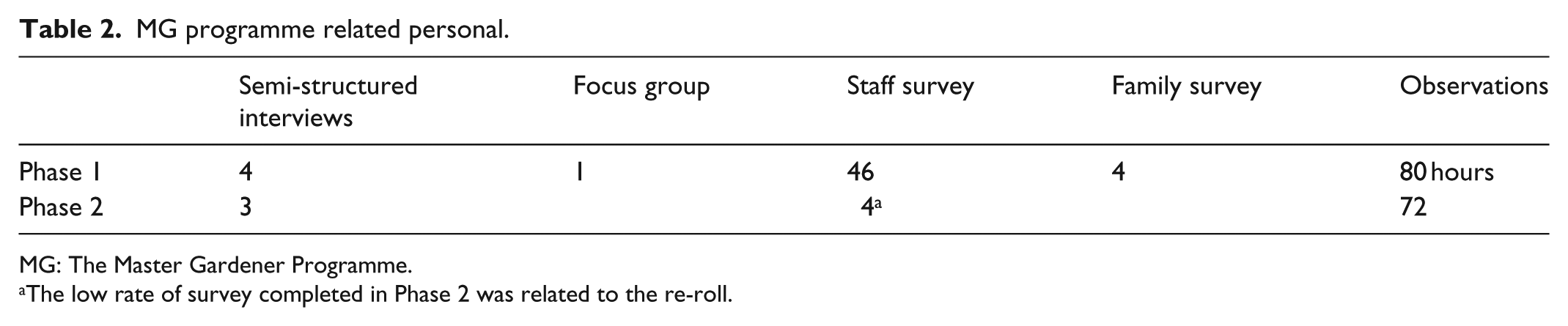
MG: The Master Gardener Programme.
The low rate of survey completed in Phase 2 was related to the re-roll.
Therefore, in total, the research team has
Spent around 152 hours conducting participant observations;
Facilitated three focus groups;
Conducted seven staff interviews;
Collected 50 completed staff feedback forms;
Gathered 58 completed reflective diaries, 46 completed circles of change, 25 demographic surveys;
Analysed three portfolios;
Collected four family surveys.
Reflexivity: understanding the relationship between self and ‘others’
Phillips and Earle (2010) argue that the attraction of reflexivity lies not in confessional or testimonial exhortation but in its capacity to acknowledge researchers as active participants whose identities, like those of research subjects, may be variously shaped by powerful hierarchies of race/ethnicity, gender and class. Furthermore, consideration of such dynamics enables us to see how our own positions and interests are, sometimes discretely, imposed throughout the research process, influencing the questions we ask, the ones we do not, who we interview and who we do not, how we interview, how we listen and how we do not and ultimately how we understand (Hertz, 1997). For this reason, they foresee reflexivity as providing a guide to sociological practice somewhat immunized against ‘the single, central, dominant … quasi-divine, point of view that is all too easily adopted by observers’ (Bourdieu, 1999: 3):
Lizzi: I was aware that on first impressions, I felt a different age and background from the group. This with the mainstream prisoners was a point of conversation, with them asking my age, where I was from, how I grew up and where I did my food shopping. One of the guys was curious about my upbringing and asked whether I grew up on an estate; the same participant also asked whether I shopped at Waitrose alluding to me being posh (neither of which was true!). I welcomed this discussion as it allowed me to have some further social interaction and facilitated a bond with the group. Additionally, I was aware of how I feel others have perceived me in the past, which I brought with me to the prison project. I was conscious of my age, demeanour, personality traits and professional position. Being more of an introvert who prefers to ‘blend in’ to group settings contributed towards the anxiety I initially experienced. One point to note is that upon reflection, it is likely I would have felt anxious in any group setting at first. I initially tried the approach of blending in which was not too easy given the setting. I actively tried to engage in group discussions by taking notes and showing active listening skills – an acceptable tactic in the academe. However, this opened the perception of me as someone in authority quietly observing, watching and assessing. Although I was observing and watching, this was my role during the visits – a subordinate role to Geraldine’s which involved the more challenging task of facilitating the group, ensuring data were collected as well as their engagement with the evaluation. This made me further reflect on myself, and my behaviour and actually made me laugh as the perceptions of the participants was quite opposite to my reality. It forced me to question my positionality.
This sense of power the participants instilled in me was not something I had experienced before and made me feel uncomfortable. This experience was more apparent when supporting Geraldine with a focus group as part of another project (due to the absence of one of the research teams on the project). I was the only White person in the room and the only female apart from Geraldine; my role was to note-take and to ensure we obtained completed consent forms. I took my place around the table, tried my strategy of blending in through keeping quiet and making notes (as I had limited overview of the project and experiences of participants). This however triggered the participants to question my position, asking whether I was Geraldine’s boss. Again, this perception of me, being so far from my reality where I have felt junior, young and inexperienced, not only made me feel extremely awkward but also led me to consider my positionality and how others perceive me (which may be the opposite to how I perceive myself) and the ‘power’ I have.
I was also consciously aware of my appearance, with some participants stating I look younger than I am, sometimes making me feel less capable of my job role, or that my capability was being questioned. Upon reflection, I attended the first visit dressed in a quite masculine way – wearing trousers, limited make up and my hair tied back in a low bun (which is uncommon for me). Over time, my comfortableness with being a female was apparent in being more relaxed by dressing and looking how I would normally would, and even wearing my hair down on one occasion. Like Adams (2000), my presentation of self is something that raised doubts about ‘authenticity and integrity, as she feared presenting an “unreal” or “false” self’ (Adams, 2000, cited in Jewkes, 2012: 67). Being married was one aspect of my identity which was not a point of discussion (although it was mentioned by Geraldine) despite my visible wedding ring; perhaps, this subject was perceived as ‘too personal’? Geraldine openly talked about where she was from and being a mother, allowing this to be an area of discussion. This made me consider what information was appropriate to share. Finally, I soon realised that while it is important to consider and reflect on the above, for me, regarding the participants as ‘people’ and listening to their experiences was central. Overall, trying to blend in actually created barriers (internal and external) and can be perceived as pretentious, as such ‘finding a place’ even before entering the research environment is important:
Geraldine: The majority of those recruited to the intervention identified themselves as White European, hence, of the 25 participants engaged in the intervention, only three respondents identified as non-White. What became clear during the study is how perception held by some of the participants in regard to my racial identity in this setting helped to facilitate positive relationships with prisoners. Participants were often keen to share information about their families, life prior to entering prison and life in prison. In addition, in Phase 1, participants spoke candidly about their substance misuse both inside and outside prison. Rarely did they refuse to answer questions asked, there were occasions in which participants would share things they had written additional too what we asked them to do. I felt that my racial identity provided me with a proxy insider status; during one visit, I was told that I was ‘real’ that I was ‘O.K.’ and that they trusted me.
In this setting, notions associated with my racial identity were perceived by participants as signalling that I would have an understanding of their experiences and that I shared a connection. Hence, engagement was problem free. Alongside this, the fact that I spoke with a recognisable local dialect, turned up in jeans, lived in the same city of some of the participants on the programme or grew up in an inner city area that shared familiar characteristics to that in which some participants had lived prior to their sentence likely added to my acceptance. It appeared that I challenged their perception or the ideas they had about being an academic. This sense of familiarity was something I also experienced and I remember feeling a sense of acceptance and warmth towards participants. I was aware of how my personal experiences of supporting friends and family who had come to the attention of the criminal justice system lent itself to seeing beyond the offender label to the person underneath. Bourne (1983) notes that respondents and researchers can experience a kaleidoscope of emotions during the course of a research project and lists emotions such as laughter, tears, love hate, happiness, longing, fear grief and loss are all feelings that we may encounter and observe in others when we undertake research. Furthermore, not only is a range of emotions experienced during the course of a project but we may also experience in a single interview (Bourne, 1983: 89). I experienced and observed a range of emotions in the field. I was conscious of how an aspect of our evaluation allowed for the humanisation of prisoners. I was conscious that I wanted them to know that I did not share the judgemental attitude that is often associated with those awarded with the offender label. This is not to suggest that this did not pose some challenges during Phase 2 of the project that led to multiple conversations with colleagues.
Phillips and Earle (2010) argue that this sense of empathy can be viewed as represented a sense of working-class alignment in which there is an emotional recognition of shared class heritage. This is in conjunction with perceptions held that being Black, I was working from an informed position through having experience of criminal justice system and drugs. To participants, my primary identity, irrespective of that I was the PI on the project, was not related to my position within the academy but the subordinate position that perceived I held in wider society. For them, it was Lizzi they initially identified as the ‘boss’ or indeed any other member of the team that accompanied me on a visit. Rollock (2012) argues that an explanation rests in how it has been argued that racialised Others occupy a liminal space of alterity; a position at the edges of society from which their identities and experiences are constructed irrespective of class. However, it is also possible to understand the engagement of participants as reflecting how they viewed the work we were carrying out and how they welcomed the opportunity to contribute to providing an evidence base that would support sustaining the MGP at the prison and its expansion to other prison setting. As such, it is possible to see that engagement was also facilitated by participants and the researchers having a shared goal in wanting a smooth execution of the evaluation to elicit evidence that demonstrated the wider range of health, social and educational benefits they identified from being involved, which superseded certain notions of difference.
Final reflections
In writing this article, we attempt to make visible how as researchers we are rarely neutral, objective bystanders in the work we undertake. In so doing, we want to add our voices that of researchers working in secure settings as a way of showing as noted by Amanda Coffey (1999) that
Fieldwork is personal, emotional and identity work. The construction and production of self and identity occurs both during and after the fieldwork. In writing, remembering and representing our fieldwork experiences we are involved in process of self-presentation and identity construction. In considering and exploring the intimate relations between the field, significant other and the private self we are able to understand the processes of fieldwork as practical, intellectual and emotional accomplishments. (p. 1)
Lizzi: The experience of working with a senior Black researcher has given me insight into considerations of ‘race’, class and age in the research environment, both in terms of professional and participant interactions. While Geraldine has been forced to reflect on ‘race’, class and gender throughout her professional life, I, on the other contrary, have never really been forced to question my whiteness (and power that goes with it) until this research experience, demonstrating one of the advantages of being part of a multidisciplinary team. While this experience has been uncomfortable at times, with participants trying to ‘work me out’, it has enabled and challenged me to have a greater understanding of my own positionality and how aspects of my (self-constructed) identity (and others), and how others perceive me, implicitly shape and are fundamental to the research process.
Geraldine: Situating ourselves in the research process highlights some of the methodological and epistemological challenges encountered when engaged in research. It is possible to suggest that in relation to Lizzi, I was in a privileged position and my identity as a Black African Caribbean woman not only helped to facilitate access to my participants but also provided an insight that enabled me to explicate stories that can be hidden when researching in a prison setting. Yet, as noted by Phillips and Earle (2010), this is not to suggest that this is always the case. As someone with over 15 years’ research experience, I am also aware of the emotional labour one may encounter when engaged in social research (Hochschild, [1983] 2003). Yet, the emotional work experienced during this journey cannot be under stated conversations about suicide, death, abuse and self-harm. The emotional work experienced was in part my reaction to the stories recounted and I acknowledge that none can ever be truly an insider (Naples, 1996) and can never share or understand all participants’ views and experiences. Nonetheless, it was a reminder of why it is important to challenge the dehumanising stereotypes often associated with prisoners.
Our evaluation would be very different if we had decided to remain invisible or taken a position with the expectation that we remained the ‘objective’. Embarking on qualitative research with ethnographic dimensions in a prison setting is an outcome of complex (re)negotiations but in theorising our subjectivities (Letherby, 2013) is a means of illuminating issues that often remain invisible within prison research.
Footnotes
Appendix 1
Research tools.
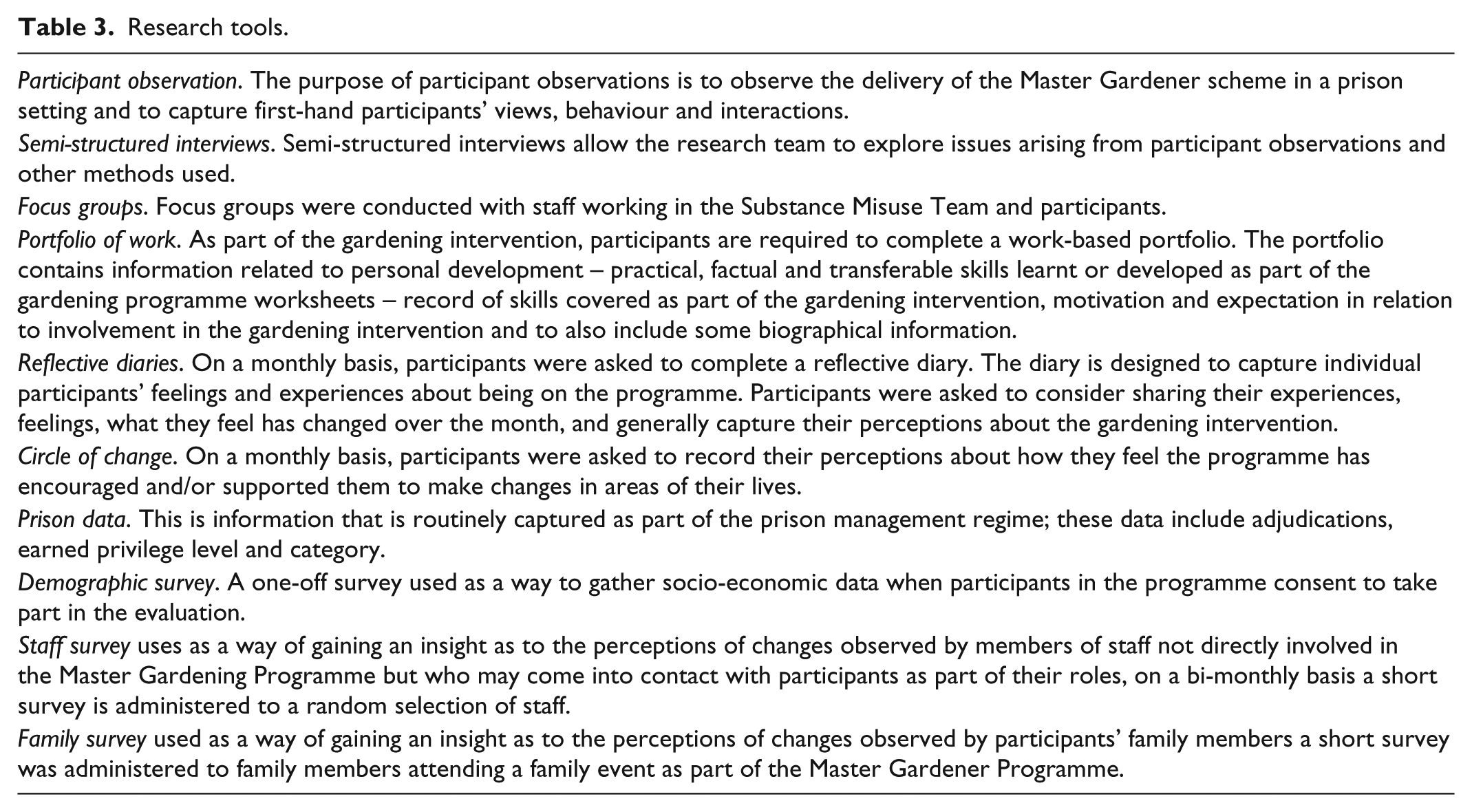
| Participant observation. The purpose of participant observations is to observe the delivery of the Master Gardener scheme in a prison setting and to capture first-hand participants’ views, behaviour and interactions. |
| Semi-structured interviews. Semi-structured interviews allow the research team to explore issues arising from participant observations and other methods used. |
| Focus groups. Focus groups were conducted with staff working in the Substance Misuse Team and participants. |
| Portfolio of work. As part of the gardening intervention, participants are required to complete a work-based portfolio. The portfolio contains information related to personal development – practical, factual and transferable skills learnt or developed as part of the gardening programme worksheets – record of skills covered as part of the gardening intervention, motivation and expectation in relation to involvement in the gardening intervention and to also include some biographical information. |
| Reflective diaries. On a monthly basis, participants were asked to complete a reflective diary. The diary is designed to capture individual participants’ feelings and experiences about being on the programme. Participants were asked to consider sharing their experiences, feelings, what they feel has changed over the month, and generally capture their perceptions about the gardening intervention. |
| Circle of change. On a monthly basis, participants were asked to record their perceptions about how they feel the programme has encouraged and/or supported them to make changes in areas of their lives. |
| Prison data. This is information that is routinely captured as part of the prison management regime; these data include adjudications, earned privilege level and category. |
| Demographic survey. A one-off survey used as a way to gather socio-economic data when participants in the programme consent to take part in the evaluation. |
| Staff survey uses as a way of gaining an insight as to the perceptions of changes observed by members of staff not directly involved in the Master Gardening Programme but who may come into contact with participants as part of their roles, on a bi-monthly basis a short survey is administered to a random selection of staff. |
| Family survey used as a way of gaining an insight as to the perceptions of changes observed by participants’ family members a short survey was administered to family members attending a family event as part of the Master Gardener Programme. |
*
indicates use of a pseudonym
Declaration of conflicting interests
The author(s) declared no potential conflicts of interest with respect to the research, authorship and/or publication of this article.
Funding
The author(s) received no financial support for the research, authorship and/or publication of this article.