




Abstract
Immersive ethnographic research can be profoundly destabilising for researchers’ sense of identity, and the attempt to inhabit and reconcile dual identities as researcher and participant can take a severe emotional toll. Prior to the reflexive turn in qualitative sociology, this identity work remained largely unacknowledged. Feminist critiques of positivist social science, along with personal accounts portraying the messy, chaotic aspects of research, have helped to create a new climate in which researchers can openly examine their identity conflicts and even recognise them as an integral part of their research. However, advice on navigating these situations remains somewhat limited. This article is a reflexive account of issues encountered while researching the practice of psychedelic support – the provision of emergency care to people undergoing drug-related crises – within the transformational festival scene in the United Kingdom, the United States and Portugal. Transformational festival settings are engineered to disrupt everyday experiences of identity and selfhood and induce emotional vulnerability. Thus, they throw issues of researcher identity and its management into sharp relief. Physically and emotionally intense fieldwork settings can bring about non-ordinary mental states in the researcher which can put habitual working practices and capacities out of reach. This effect contributed to a painful disjunction between my researcher and participant identities, which centred on the struggle to create linear, written narratives of largely embodied and non-verbal experiences. However, I found that the effect was somewhat mitigated by developing fluid, non-linear, multisensory working practices and documentation methods which were more appropriate to the research setting and the mental states it induced. I conclude that ethnographers in intense or extreme field settings can benefit greatly from methods and tools which work even when we are out of our everyday minds.
Keywords
Introduction
The rich rewards – and accompanying risks – of deep immersion in fieldwork settings for ethnographers of crime, deviance and control are well documented. For instance, especially among hidden and/or stigmatised populations, the only way to discover underlying emotional dynamics which are difficult to articulate in interviews or to observe from outside may be to experience them oneself (Newmahr, 2008). Furthermore, some participant behaviours may only be observable when the researcher appears genuinely immersed (O’Grady, 2013). In addition, when researching communities of practice, engagement in the ‘embodied learning’ of ‘apprenticeship’ offers invaluable insights (Rossing and Scott, 2016: 1). Thus, Ferrell (2004) proposes ‘los[ing] ourselves’ within the practice of ethnographic methods so deeply engaged with the setting that they become ‘no methods at all’ (p. 298). At the same time, however, Ferrell foregrounds the risks of such research, drawing parallels between cultural criminological fieldwork and edgework – Lyng’s (1990) model of deliberate risk-taking activities like skydiving. Immersed, embodied ethnography can indeed feel like an emotional and physical gamble, involving risks both immediate (e.g. Raymen (in press) sustained various injuries while researching parkour) and long-term (as when Dick Hobbs’ (1989) observation in pubs brought him close to alcoholism). Criminologists often have the added risk of legal jeopardy (see Elliott and Fleetwood, this special section). One type of risk is common but, it seems, poorly understood: immersed ethnography can be highly destabilising to the researcher’s experience of identity and can even change it permanently. For sports ethnographers Rossing and Scott (2016), emulating their beginner participants’ poor technique and reluctance to exercise ‘spoiled’ their highly valued self-identities as skilled sports practitioners. Newmahr (2008) describes with some ambivalence how the voice in her fieldnotes changed as she became more immersed in the BDSM (Bondage and Discipline, Dominance and Submission, Sadism and Masochism) community she was studying. Bhardwa (2013) struggled to reconcile researcher and dance scene member identities in the field. Crises involving identity and self-doubt seem common in immersive fieldwork, stretching back to Malinowski’s (1922) infamous angst in the Western Pacific, which Young (2014) summarises as despair at having failed to reconcile his multiple identities into a coherent whole.
But what is to be done about this? ‘Confessional tales’ (Van Maanen, 2011) vividly recount the difficulties and eventual triumphs of individual researchers, but can be short on advice. Ethnography primers acknowledge the emotional and psychological strain of fieldwork, for example, by warning that ‘marginal native’ status ‘creates considerable strain on the researcher as it engenders insecurity … The researcher will be physically and emotionally affected’ (Walsh, in Seale, 2012: 254), but may not offer many suggestions for coping with this. We are told we must ‘manage’ our identity conflicts (a word redolent of neoliberal attitudes to the self; Rose et al., 1996), but not what this involves or how we should do it (Coffey, 1999). A more sustained examination of the phenomenon might give rise to specific insights and strategies.
My fieldwork took place within the transformational festival scene. A core scene value is the desirability of transforming oneself through intense, cathartic experiences. These experiences are often associated with use of psychedelic substances, but the settings themselves are engineered to disrupt identity and induce emotional vulnerability. My work as a ‘sitter’ (caregiver) with people undergoing drug-related crises at these events (often involving their own identities and/or self-concepts) highlighted issues of researcher identity and its management for me. I experienced a painful disconnection between my researcher and participant identities, especially in more physically challenging settings, where the state of internal equilibrium that seemed to be required for smooth management of the conflict proved to be inaccessible. However, much of the difficulty turned out to stem from my choices of field documentation methods and their impact on how I performed and experienced my identities in the field. In brief, conflicts arose from my attempts to produce coherent, analytical, sequential written narratives of my observations while immersed in a milieu which valued embodied, intuitive and non-verbal experience and predisposed its participants to non-linear modes of thinking. When I adapted my methods to better fit the setting, by employing more multisensory, multimodal means of data collection and developing a speedy visual mapping approach to fieldnote taking, balancing the dual identities became less burdensome. With further development, these methods may prove useful for other fieldworkers in the sometimes overwhelming environments associated with the study of crime, deviance and control.
The project
My doctoral research is a mixed-methods ethnographic study of psychedelic support/harm reduction (PS/HR) projects. These are peer support organisations operating at music festivals and similar events, providing ‘sanctuaries’ or ‘care spaces’ – comfortable, lower stimulus environments in which festivalgoers who are undergoing difficult drug experiences but do not require medical attention (‘visitors’) can take refuge. Each visitor is assigned a sitter (volunteer care worker). Most sitters identify as festival scene members; their performance of this identity is crucial in establishing trust with visitors, who perceive them as peers. Sitters work a mix of day and night shifts throughout the event, providing basic comforts, companionship, supervision and reassurance for as long as each visitor needs it. This serves to lighten the load of such long, complex cases on medical services (who prioritise provision of acute care to as many patients as possible) and thence on local hospitals.
But this is not the care spaces’ only aim. An operating principle they share is that the so-called ‘bad trip’ can be transmuted into a beneficial experience through the provision of a comfortable and supportive setting. As one care space manual states, ‘difficult is not the same as bad’ (Zendo Project, 2013: 2). Even so, the difficulty can be formidable. Visitors often arrive distressed, aggressive or paranoid, and many are initially unable to speak or understand speech. Sitters must draw on internal reserves of stability, resourcefulness and empathy. Furthermore, in more punitive drug policy environments, they may find themselves in conflict with event organisers, police, security crews and other support staff who do not share (or are wary of openly sharing) their ideals about the benefits of psychedelics. Thus, care spaces act as a turbulent intersection point where conflicting forces within drug subcultures and the drug war may be observed in microcosm. During fieldwork, I volunteered as a sitter with three PS/HR projects (Harmony, Avalon and the Haven 1 ) in three countries (Portugal, the United Kingdom and the United States). I set out to become an ‘apprentice’ in the community of PS/HR practice, working and playing with sitters on and off duty.
The transformational festival setting
My fieldwork took place at transformational festivals, where the practice of psychedelic support originated. I attended seven events – Burning Man in the United States, Boom in Portugal, and five festivals in the United Kingdom. Transformational festivals share distinctive practices and values, including, but not limited to, an emphasis on participation/co-creativity, environmentalist politics, mass rituals and a focus on electronic music, especially psychedelic trance or ‘psytrance’ (Krasnow, 2012). Like mainstream music festivals, they involve camping in a remote natural location. However, they tend to eschew corporate sponsorship, have less emphasis on big-name performers and last longer, often up to a week. The transformational scene overlaps considerably with global psychedelic culture (psyculture), and its distinctive patterns of drug use reflect this influence.
Transformational festivals are also united by a common purpose. They are designed and organised to provide not just entertainment but also opportunities for personally transformative experiences – said to range from temporary suspensions of everyday forms of identity, allowing usually hidden aspects to be expressed, to lasting transformations and ultimately large-scale social change. Psychedelics are central to this discourse of transformation but not required; many of my participants said that simply being in the festival space felt ‘mind-altering’. Scholars of the festival have explored the non-ordinary quality of festive space and time. Hetherington (1997) has described the festival as a heterotopia, a ‘neutral space’ in which varied forms of expression can flourish, while Turner (1987) framed it as a liminal space, a place where normal social roles and rules are suspended. Liminality arises partly from a sense of enclosure and separateness from the everyday world. Gilmore (2010) shows how event organisers put Turnerian theory into practice through site layout and decoration, in particular the design of thresholds, gates and ritual spaces. For scene blogger Wallace (2014), the layout of Boom in 2014 recreated the atmosphere and typical progression of a psychedelic experience. During a festival, participants are said to perceive time as separate from ‘clock’ or ‘calendar’ time (Mesnil, 1987; Turner, 1987). Gus, one of my sitter participants, said that for him festival time ran on ‘a true body clock’; on returning home, it could take him up to a week to readjust.
Many of my participants emphasised the multisensory intensity of the festival as an important aspect of its otherness. The spaces are laid out to overwhelm the senses – bombarding the festivalgoer with loud music and relentless ambient noise, dazzling light shows and spectacular installation art – along with the pleasant and unpleasant sensory input of outdoor living. Combine this with the impact of mass rituals such as the burning of the eponymous Man, the tendency towards more exertion and less food and sleep than usual, and the powerful emotions and embodied experiences all these provoke, and reports that this environment can disrupt emotional equilibrium and destabilise normal structures of identity begin to make sense. In Jeet-Kei Leung’s (2013) web documentary series about transformational festivals, The Bloom, a festival organiser observed, ‘… after four days in a row, five days, there’s this kind of wearing down of the self and there’s this kind of vulnerability that you arrive at, and this willingness to drop into a space of trust’. The vulnerability is seen as desirable – for example, it may enable the release of suppressed emotions. However, especially in the absence of trustworthy companions, it can be difficult to deal with.
Ego death: transformational events and identity
To understand the attraction of ‘wearing down the self’, we must consider the psyculture concept of the ego. This seems to have evolved from, but is not reducible to, the Freudian concept of ego. Psyculture publications, lectures and general discourse portray the ego as a part of consciousness thought to be the seat of logic, rationality, analytical thought, verbal reasoning and ‘mental chatter’, and – perhaps most importantly – one’s sense of discrete, individual selfhood. In this final respect, it bears some resemblance to current sociological understandings of the self, which consists of all that ‘a person assumes to be his or her own’ accompanied by a sense of continuity over time (Tsekeris, 2015: 1). However, it has more in common with portrayals of the self in critiques of neoliberal governance such as that by Rose et al. (1996). The ego in psyculture discourse, like the neoliberal self, perceives itself as an isolated individual who must compete to survive. This causes it to desire, and be preoccupied with, power and status: Sanna, one of my sitter interviewees, attributed aggression in security guards and defensiveness in some visitors to overactive ego, while her managers’ flexibility and approachability reflected their ‘soft egos’. In addition, this sense of isolation is thought to cause a host of other psychological problems. In the wider belief system of psyculture, separateness is considered the root of most evils – political, ecological, interpersonal and intrapersonal – while awareness of interconnectedness is the antidote. Thus, it is considered desirable to rein in the ego and bring it into balance with other aspects of consciousness. But the ego may not relinquish control easily and may even attempt to thwart transformative experiences in order to remain in charge. As a survey respondent puts it, ‘… bad feelings, loops and confusion are [the ego’s] weapons against one’s true self’.
Various features of the transformational festival environment are intended to loosen the grip of the ego, often assisted by use of psychedelics. For some, ego boundaries may be gently softened through feelings of connection and communitas, for example, in shared enjoyment of rhythm and movement on dance floors (Duffy et al., 2011). Others may undergo the more dramatic ‘ego death’, a kind of collapse of the self-concept. This can occur spontaneously or be precipitated by an upwelling of painful or disruptive feelings related to the self, identity and one’s place in the world (Echenhofer, 2012). Prominent aspects of identity (such as those expressed in the workplace or in problematic relationship) may begin to appear false, toxic or pointless (sometimes described as ‘ego games’), while the sense of unitary selfhood may become temporarily inaccessible. For some, ego death manifests as the feeling of oneness with everything known as the mystical experience (Pahnke, 1969). Others find it disorienting and frightening. Either way, it compromises the ability to comprehend and interact with reality. This generally resolves within a few hours, but at the time may feel irrevocable.
New work by Carhart-Harris et al. (2016) on the neurological effects of lysergic acid diethylamide (LSD) has proposed a biological mechanism for the process of ego death. The default mode network (DMN) is a group of interconnected areas in the brain associated with the self-concept (Schilbach et al., 2008) – a term whose usage in neuroscience seems to encompass the sociological concepts of the self and of identity – and autobiographical memory (Buckner et al., 2008). The areas of the DMN tend to operate as a group and exchange a large volume of signalling traffic, a phenomenon known as ‘functional connectivity’. Subjects in the Carhart-Harris study underwent magnetic resonance imaging (MRI) scanning while on LSD. The brains of those who reported feelings of ‘ego dissolution’ showed less signalling than usual inside the DMN, accompanied by stronger connections between the whole DMN and the rest of the brain. The researchers suggest that this temporary redistribution of connections may help to jolt brain networks which have become ‘entrenched in pathology’ out of unhelpful patterns – for example, alcoholism (Krebs and Johansen, 2012). It must be noted that there are substantial gaps in our understanding of the relationship between patterns of brain activity under MRI scanning and subjective cognitive processes. Nonetheless, studies like these suggest avenues for further exploration.
Ego death experiences can be followed by a sense of release, breakthrough or renewal, possibly related to the formation of new schema of self and/or identity (Echenhofer, 2012). Within the scene, they are valued as spiritual rites of passage. In one common practice at psytrance events, originated by legendary DJ Goa Gil in the 1990s (St John, 2012), DJs play progressively darker and more frightening music (darkpsy) throughout the night hours in an attempt to induce the ‘surrender’ of ego death in dancers rendered vulnerable by psychedelics – sometimes followed by more uplifting music to soundtrack the ‘rebirth’ phase as the sun rises. However, this trajectory of collapse and renewal can also be found on different timescales, beyond the dance floor and the individual psychedelic experience. The festival organiser quoted in The Bloom (above), for example, implies that it can pervade and shape an entire week-long event – with an emotional collapse around the fourth or fifth day, ideally followed by a breakthrough. As it turned out, my role as researcher did not exempt me from participating in this process alongside everyone else.
The initial methodology
My approach was threefold: participant observation, interviewing sitters using adapted biographical and narrative techniques and an online qualitative survey of festivalgoers who had undergone a drug-related crisis at an event (i.e. the target ‘audience’ of PS/HR spaces). 2 Entering the field, my aims were to document the PS/HR training and my own work shifts as richly as possible, involve myself in the life of the volunteer PS/HR groups, carry out interviews with sitters, observe how PS/HR services worked with other festival support services and immerse myself in the events as a whole. It was crucial to incorporate the perspectives of visitors and potential visitors, but due to ethical concerns I decided not to attempt to interview them in the field. Instead, I designed the survey to emulate as closely as possible the experience of a qualitative interview while providing enhanced anonymity. This was one of several ways in which the sensitive nature of the observation constrained my data collection options. I was aware of the recent flowering of ‘multimodal methods’, encompassing various videographic, photographic and embodied approaches. However, none of the innovative techniques I knew of seemed to be usable at the core of my observation: caregiving encounters with vulnerable visitors. They all seemed to entail intractable complications around ethics and informed consent or practices which visitors would find intrusive or redolent of surveillance. Thus, on entering the field, my approach to data collection – apart from the recording of sitter interviews – relied almost entirely on periodically withdrawing from immersion in the festival soon after each shift to produce a written narrative of events (as continuous prose in the form of a journal entry or shorthand notes for later expansion).
Identities in the field
Starting out, I had decisions to make about level of immersion, identity performance and the notion of ‘insider status’. I was new to formal PS/HR work and hoped that my beginner status would work to my advantage, enabling me to inhabit the role of the ‘stranger’ and to receive mentoring and training. Ten years of festival-going made me feel at home in the wider festival setting, but I knew I could at best be a ‘partial insider’ (Moore and Measham, 2006), with other identities and allegiances that set me apart. I thought of my academic identity as distinct from my identity as a ‘festival person’, but in order to maximise others’ trust and my own immersion, I decided to avoid enacting academic detachment and present myself primarily as a scene member with the researcher identity acting as a sort of back-seat passenger – although I strove to make my researcher status and my topic common knowledge. I planned to take an integrated ethnographic approach similar to Newmahr’s (2008), in which analytic practices of thinking and documenting would coexist with interpretive, subjective and embodied experience. In the past, exercising my sociological imagination spontaneously in festival spaces had not disrupted the flow of my experience. This led me to expect that the coexistence would be peaceful and comfortable. In practice, however, the need to withdraw regularly to produce orderly written fieldnotes in a timely fashion gave rise to the sensation that I was maintaining and switching between two non-overlapping, largely incompatible identities. This became more and more of a struggle, especially at the more physically demanding events, for reasons to be discussed in the two following sections.
When words are inadequate: doing psychedelic support
Transformational culture discourses associate intellectualised, academic modes of knowing and understanding the world with the runaway ego – which tends towards a sense of separateness, rationality at the expense of intuition and distancing oneself from experience in order to analyse it (‘living in the head’, as one of my visitors put it). In contrast, ways of relating to others which emphasise embodiment, emotion, intuition and immediate experience are highly valued. Communication channels besides the verbal may be freighted with meaning, while verbal communication may be minimal – as in Harmony’s sitter training sessions, where a sequence of group bonding activities focused on movement, breathing, bodily sensations, eye contact and sound rather than speech. This is especially the case in psychedelic support work. For various reasons, verbal communication may be fragmentary, confusing, only a minor part of the interaction or entirely absent. Interactions may consist largely of body language and be mediated by an unspoken, intuitive reading of the visitor’s needs.
On arrival at the care space, visitors often have difficulty speaking, comprehending language or both. Psychedelic experiences can have a non-linear quality which makes the construction of sentences challenging even at the best of times and an embodied quality which can shift the focus to other means of expression. As one sitter said, ‘… you get a lot of healing done… a lot of that is not that verbal, you know, people are dancing, moving, trying to integrate stuff’ (Bob, interview, 2014). People undergoing a psychedelic crisis may want to talk but feel unable to. Some find this inability embarrassing, as in an experience described by UK sitter Gus: I became increasingly agitated about the idea that somebody would try and talk to me and I wouldn’t be able to respond at all… eventually this paranoia about communication got so extreme that I couldn’t make eye contact with anyone. (Interview, 2014)
Sitters need to be sensitive to the possibility that attempts to elicit conversation, even if this is a series of questions about the visitor’s needs, may exacerbate self-consciousness. In situations like these, it can help to keep speech to a minimum and attempt to intuit what is needed.
The altered state may be so extreme that the visitor cannot process verbal input, let alone respond to it. ‘Looping’ is a common crisis presentation in which the visitor is experiencing a short sequence of thoughts or impressions repeatedly. For some, this is accompanied by a repeated movement or phrase, while others appear motionless and unresponsive, like one survey respondent who describes being ‘… frozen in my chair, horror stricken with the realization that the entirety of the universe was a very short loop and that I … always would be trapped in that moment of realization’. Looping visitors often have difficulty understanding speech. Even if they do, whatever was said tends to be forgotten when the loop restarts.
Thus, sitters often need to use the body to communicate and to convey a sense of safety and reassurance. Sitter Sanna told me she often used techniques involving ‘distance and space’ to appear unchallenging to visitors and showed me one example:
I do use this consciously but it’s also intuitive […] lowering myself and talking to somebody lower than they are. [We are sitting cross-legged and face to face. She demonstrates – leaning back and lying on her side, propped on her elbow, so that she’s looking up at me]. (Interview, 2014)
Another technique, particularly popular at Harmony, was the use of synchronised movement to connect with non-verbal visitors. This could involve mirroring the visitor’s movements or encouraging the visitor to copy theirs, which were usually slow, flowing and combined with steady eye contact. I saw sitter Laurent managing to engage a deeply unresponsive visitor through shared movement, which I later did my best to describe: ‘like wrist stretches combined with sat-down tai chi’.
Some sitters use movement not just to communicate but also to help visitors resolve their crisis. They draw on a model of psychology in which past traumas can be explored, dislodged and expressed through the body. Haven trainer Rebecca suggested that if a visitor was making a repeated small motion, encouraging them to focus on and amplify it could help their process along, while Avalon worker Shirley had found dancing or spinning around with visitors could help them break out of thought loops. Some care spaces have dedicated areas for movement and dance work.
Verbal communication does have an important place in PS/HR work. Some visitors encouraged me to keep talking to them because my voice acted as a ‘tether to reality’ or a distraction from thought loops. Some appreciated conversation about everyday life and shared experiences, while others wanted to talk through their emotional problems. However, speech is not where the centre of gravity lies in the encounter with a visitor in psychedelic crisis, and entirely verbal accounts risk missing much of the point.
This became increasingly apparent as I wrote up fieldnotes after shifts. Despite my efforts to create multisensory accounts that incorporated all the channels of communication, the affordances of the medium seemed to push me towards a narrative which emphasised conversations and those observations which were easiest to verbalise. The frustration this caused contributed to my sense of a widening chasm between my identities as psychedelic sitter and as researcher.
The academic as intruder: documenting in public
When I did manage to reassume the persona of the task-oriented, productive scholar-at-work, I had a further set of problems to contend with. Like O’Grady (2013), I encountered resistance and disapproval from some participants when visibly performing the role of an academic. The problem was not the fact that I was doing research (when I mentioned that I was studying psychedelic support, people generally responded with excitement, appreciation and offers of help) but where, how and when it was done. St John (2012) writes that festivals allow participants to experience a temporary suspension or ‘unburdening’ of everyday, neoliberal modes of subjectivity. I found that festivalgoers prized this suspension highly and reacted strongly against anything that could be seen as contaminating the fluid, anarchic festival space with rigidity and discipline – anything that smacked of bureaucracy, ‘clock time’, productivity or the office. For instance, sitters were very reluctant to fill in visitor arrival and departure forms. I quickly discovered that it also extended to typing industriously in public. Working on fieldnotes in a chai tent early in the first summer of fieldwork, I was constantly interrupted by concerned strangers asking me if I was OK. They seemed to read my absorption in writing as a sign of detachment or alienation, an indication that something was wrong.
Aware of this, I developed a standard practice of withdrawing from the care spaces and their immediate surroundings in order to write – which contributed to the growing feeling of separateness between my two identities and rendered the changeover all the more cumbersome. When I did take the risk of engaging in visible documentation practices, the disruption of rapport with participants was palpable. On Thursday night at Boom, I was in the Harmony staff tipi, hunched over the harsh blue-white light of my iPad, catching up on fieldnotes while waiting for a prospective interviewee. Off-duty Harmony workers were hurrying off to the Dance Temple; now and then people would look in and invite me along, responding with a benign sort of impatience when I protested that I had to work. Finally, Laurent looked in and demanded with a rather affronted air, ‘Deirdre, is this how you choose to party?’
Early in the summer, I had discovered another method of documenting my experiences which did not involve appearing detached or unsociable: recording voice memos on my phone while walking around the site, apparently talking about the event on the phone to a friend. However, this method had some drawbacks. First, voice recording imposed an even more linear order on my thoughts than writing a field diary. Writing allowed me to glance back over what I had covered without breaking the flow, and to make brief notes, then expand them one by one. Recording did not afford this. Instead, I found myself recounting sequences of events as they had occurred in a rather pedestrian way, avoiding diversions and spontaneously arising insights lest I lose my overall train of thought. Relatedly, voice recording was in effect a write-only medium: information could be recorded easily but reviewed only with difficulty or not at all. Since playing back voice memos was time-consuming and, amid the relentless noise of the festival, often inaudible, mentioning something in a voice memo was like placing it in a sealed box I could only open during transcription. I quickly began to lose track of what was inside and felt the need to keep supplementing the memos with written narrative.
Although I did eventually improve this process substantially, during the most intensive fieldwork period – at Boom and Burning Man, which occupied most of August 2014 – I was still struggling with my methods, especially writing, and finding the balance of my two identities increasingly precarious. I was also somewhat bewildered as to why it was proving so difficult. Both these events had similar emotional trajectories and presented physical challenges which brought all these issues to a head – although enough of the details were different that I failed to spot the pattern until data analysis, when I began to arrive at an explanation.
Wearing down and bouncing back
Festivals are not straightforwardly spaces of hedonism. An element of physical discomfort is almost always involved, and seasoned festivalgoers develop skill sets to cope with this. This varies from country to country: British festivalgoers, for example, become adept at maintaining balance and morale amid rain and mud. However, Boom and Burning Man are taxing even for their regulars, and a mythology of ordeal and sacrifice has grown up around their physically difficult aspects such as the often days-long queues to get in (St John, 2012). Northern Europeans may find their coping strategies entirely inadequate. Inevitably, this impacted my research process.
Heat, climate, noise and sleep deprivation all had powerful effects. Both Boom and Burning Man have high daytime temperatures, and Burning Man has the added complication of being extremely arid, with dehydration an ever-present danger which can catch out even veteran researchers like Gilmore (2010). My researcher and festivalgoer identities came into conflict regarding how to behave in the heat. ‘Festival time’ has its distinctive quality partly because days are shaped more by natural forces – such as the sun and the body’s response to it – than by the clock. The heat of the day is usually devoted to rest in the shade, and my festival instincts told me this was wisest. At Boom, however, my academic persona was still thinking in terms of clock time and efficiency and insisted on seizing the opportunity to get things done – writing, planning, photography, undertaking observations and attempts at interviewing. These efforts were usually futile, especially when they involved pre-arranged appointments: everyone else had lost touch with the clock even more than I had. They also induced an insidious kind of heat exhaustion whose first manifestations were confusion and plummeting mood, making it difficult to identify the problem or act quickly to solve it. At Burning Man, I was more aware of this and did less work in the heat of the day; however, this distanced me further from the academic mindset, making it harder to return. Noise is another important factor. Burning Man’s Black Rock City is a non-stop sonic tapestry of PA systems, explosions and speaker-laden art cars, while at Boom the psytrance at the Dance Temple runs 24 hours a day and is loudly audible everywhere. Noise and climate together increase the disruption of sleep, and the effects of sleep deprivation build up as the days pass. At week-long events, where crew such as myself may be on site for several weeks, the cumulative effects can be substantial.
Sitters and their managers face an additional set of challenges. Their sleep patterns are further disrupted by the mix of night and day shifts and sometimes by unexpected extra work if the care space is short-staffed. Maintaining a connection with a visitor requires many hours of focused, sustained attention, active listening without judgement or apparent boredom, and emotion work. Breaks – even momentary ones – are often not an option, because many visitors perceive the sitter as their connection to reality and become frightened if he or she leaves. The work can be physical, as in the embodied techniques described earlier, and stressful, as when attempting to de-escalate situations with aggressive or physically agitated visitors. In the most serious cases, this may involve restraining them until they are calmer – which many sitters, ill at ease about exerting control or authority, find upsetting. One must work to manage one’s own emotional state and energy levels – a skill referred to in Harmony training as ‘keeping your centre’ – in order to stay stable, grounded, competent and alert in the face of visitors’ distress and the highly charged situations in which one finds oneself.
All in all, by the Thursday night of each event I was thoroughly discouraged. I had been expecting hard work, but the difficulties I was experiencing were more fundamental, more disorienting and more troubling than simple exhaustion. I had two central problems, which seemed separate but mutually exacerbating. The first was an identity crisis. Both my researcher identity and my resourceful festivalgoer identity seemed to be crumbling. On Thursday night at Boom, I wrote ‘[I feel] out of the flow, out of joint, neither working nor playing very well. I don’t feel I’m being effective as a researcher or managing to let go and have fun’. Unaware of the extent of the literature on disruptions of identity in ethnographers or of how common such attacks of despair were in the field, I had an overwhelming sense of failure which was exacerbated by embarrassment at my loss of equilibrium. Despite collecting ample data, I was convinced that my sense of myself as competent in the field had been mere self-deception. I struggled to suppress these feelings, afraid that if fully expressed they would render me incapable of work for the remainder of the event.
The other problem contributed to my sense of incompetence. Around the middle of each week-long event, it became difficult to create coherent narratives of my observation. At times, documenting my experience seemed supremely unimportant; for much of Wednesday and Thursday at Burning Man, the immersed, emotionally open festivalgoer identity was firmly in charge. At others, I felt keenly the importance and urgency of documenting, but could not access the ability to narrate my experiences. On shift at Boom, I was managing to hold it together, as though drawing on some specialised reserve of energy, but off duty I felt cognitively and socially impaired, repeatedly failing to recognise the faces of acquaintances. At both events, around the Thursday my written fieldnotes abruptly descended into disjointed venting (these outbursts were tagged ‘not even remotely academic’), while the content of my voice memos became increasingly hard to remember.
An excursion into neuroscience later led me to suspect there was an underlying explanation for both problems. As discussed earlier, researchers have associated the self-concept with a set of highly interconnected brain areas known as the DMN (Schilbach et al., 2008). LSD can cause decreased interconnectivity within the DMN, which may be part of the biological basis for experiences of ego dissolution under the drug’s influence (Carhart-Harris et al., 2016). It turns out, however, that numerous environmental stressors also reduce the interconnectivity of the DMN. These include sleep deprivation (De Havas et al., 2012) and hyperthermia, which is linked to deficits in ‘self-referential cognitive activity’ and ‘gathering and evaluating the information about the world’ (Sun et al., 2013: 7).
I speculate that this effect may underlie the scene belief that festival environments mimic some of the effects of psychedelics (although there is no indication that these stressor-related disengagements within the DMN are accompanied by stronger connections elsewhere, as in the LSD experiment) and that it may also contribute to the destabilisation of identity often undergone by ethnographers in physically demanding conditions. The DMN seems to deal with retrieval of autobiographical memory (Buckner et al., 2008), understanding social cues and creating internal representations of the world, the past and the future which give a sense of continuity to one’s experiences – all important functions of the ‘self’ as it is conceived of in neuroscience (Schilbach et al., 2008). There are evident connections to self and identity as understood by the social sciences – for example, continuity of experiences over time contributes to the sense of a persistent, unitary self, while understandings of the world and of social cues help us define our identities relative to others. My suspicion is that concepts of self and identity, and the ability to recall and create sequential narratives of one’s experiences in the field (including insights into the behaviour of others), may rely on the same neurological mechanism. Impairment of one may go hand in hand with impairment of the other. Many sociologists and anthropologists have grappled with the question of whether they ought to indulge in their participants’ psychoactives of choice during observation, arriving at a variety of conclusions, but the research discussed above seems to imply that avoiding drugs in intense or extreme research settings is no guarantee that one will not arrive at a state of non-ordinary consciousness despite oneself: a state that may play havoc with equilibrium, the sense of self-efficacy and linear, verbal methods of data collection.
On the pivotal nights of Boom and Burning Man in 2014, Day 5 of each event, the mass ‘wearing down of the self’ discussed by Leung’s organiser interviewee was happening all around me. Focused on the self-contained, time-bound trajectories of my visitors’ psychedelic crises and the sense that the academic identity was alienating me from the ‘flow’, I had not realised that this might also be happening to me. All week at Boom I had been passing on to my visitors some advice I had received from a veteran psychedelic support worker: that difficulties could be greatly eased by surrendering to the experience and not attempting to control its flow, whether by clinging to pleasant parts or resisting unpleasant ones. Meanwhile, my academic ego was resisting furiously, convinced it was facing a kind of annihilation from which nothing could be salvaged. But at each event – both times, on a punishingly hot Friday afternoon in the aftermath of a 2 a.m.–8 a.m. ‘graveyard’ care space shift followed by insufficient sleep – a moment arrived when, no longer able to resist, I surrendered to the tide of angst, with the sensation of plummeting into a pit of unknown depth.
However, I was still apparently following the usual trajectory of an ego death and rebirth experience, in which collapse and catharsis resolve difficult emotions and clear the way for a fresh outlook. Both internally and externally, the turnaround was dramatic, as though I had hit rock bottom and bounced. Clarity and confidence returned, and opportunities for meetings and interviews suddenly fell into place. I now seemed to be working from a kind of amalgam of the academic and festival-going identities, which felt more smoothly integrated. Research conundrums disentangled themselves. At Burning Man, I began the process of experimentation and thought that culminated in the more fluid research methods I used the following summer. But perhaps most importantly – as with Newmahr’s (2008) explorations of submission in BDSM – letting go of control had granted me invaluable, visceral experience of a deep emotional process that was central to the scene I was studying.
Moving into the non-linear: my methodological optimisations
Reflecting on my research process during the winter of 2014, I realised that ethnographers of deviance, crime, nightlife cultures and the wilder reaches of human experience need to be prepared for the possibility that such alterations of consciousness will occur. We might benefit greatly from research tools which can be used effectively without the need to discipline ourselves to an everyday work mindset amid the chaos. By the end of my fieldwork the following summer, I had developed a data collection process which seemed to fulfil this purpose.
The first key realisation was the power of multisensory memory cues. I began to record voice memos at the second fieldwork event. Back home, I was reluctant to transcribe them; they seemed a necessary evil, their content dull, overly linear and mildly embarrassing to listen to. When I did, however, I discovered they were not merely records of words but ways of returning to the festival atmosphere, whose sounds filled the silences and triggered floods of additional memories. Increasingly, I began capturing sound for its own sake. For example, recordings of the ambient sounds of a walk from end to end of each festival site proved highly fruitful both individually and in comparison with each other. But most importantly, for the purposes of this article, I found that even recordings I had made on days when I felt most mentally impaired (and grimly convinced I would remember nothing) transported me back with astonishing vividness, cueing memories not only of the scene of the recording but also of related moments within shifts and interactions I could not ethically record. Encouraged by this, I also took more and more photographs and videos as fieldwork progressed. However, the ‘write-only’ nature and linear quality of voice memos remained problematic.
Visual fieldnote maps as prompts for voice recording
By the end of fieldwork, I had found a solution that combined important advantages of written accounts with those of voice recording, without the disadvantages of either. Every so often I would spend a few minutes in my tent, rapidly writing a few key words relating to incidents, conversations, impressions and insights into bubbles on a double page spread in a sketchbook. I would begin by scattering them as widely as possible across the page, in no particular relative arrangement. As the pages filled, relationships emerged, and the bubbles became nodes in a complex network. Memories would spark others connected to the same person, location or topic, or where I intuitively felt there was a connection I could not yet articulate. Key incidents developed radial haloes of related memories or recalled a different incident in the same location. Only some of the relationships between nodes were directional; some connections representing linear progressions were added at the time, others later. The maps were rhizomatic rather than hierarchical; nodes could have any number of connections, and I did not perceive them as representing discrete categories. With no obligation to recall things in order, I felt able to capture far more of them. I would also review each page from time to time to add things remembered later and emerging connections. The non-linear quality of this process and its reliance on intuitive leaps were highly compatible with the festival headspace, felt less effortful and required less of an identity shift. The process was also much quicker than writing continuous prose, and thus far less isolating and disengaging.
Some non-sequential connections were straightforward. For example, a snippet of conversation with an Avalon worker about the police’s new drug-checking process led me to recall several other conversations about the same issue. Others were more intuitive. In Figure 1, the image of flashing blue lights in darkness connects one aspect of an evening at Secret Garden Party 2015 (thousands of tiny LED lights with paper ‘wings’ like sycamore seeds, dropped from paragliders above the crowd at the Great Stage) with another (a glimpse of emergency vehicles amid the crush of people in a muddy passage as the crowd attempted to disperse later). For me, this connection was a powerful expression of the inextricable melange of euphoria, communitas and risk one finds at large festivals.
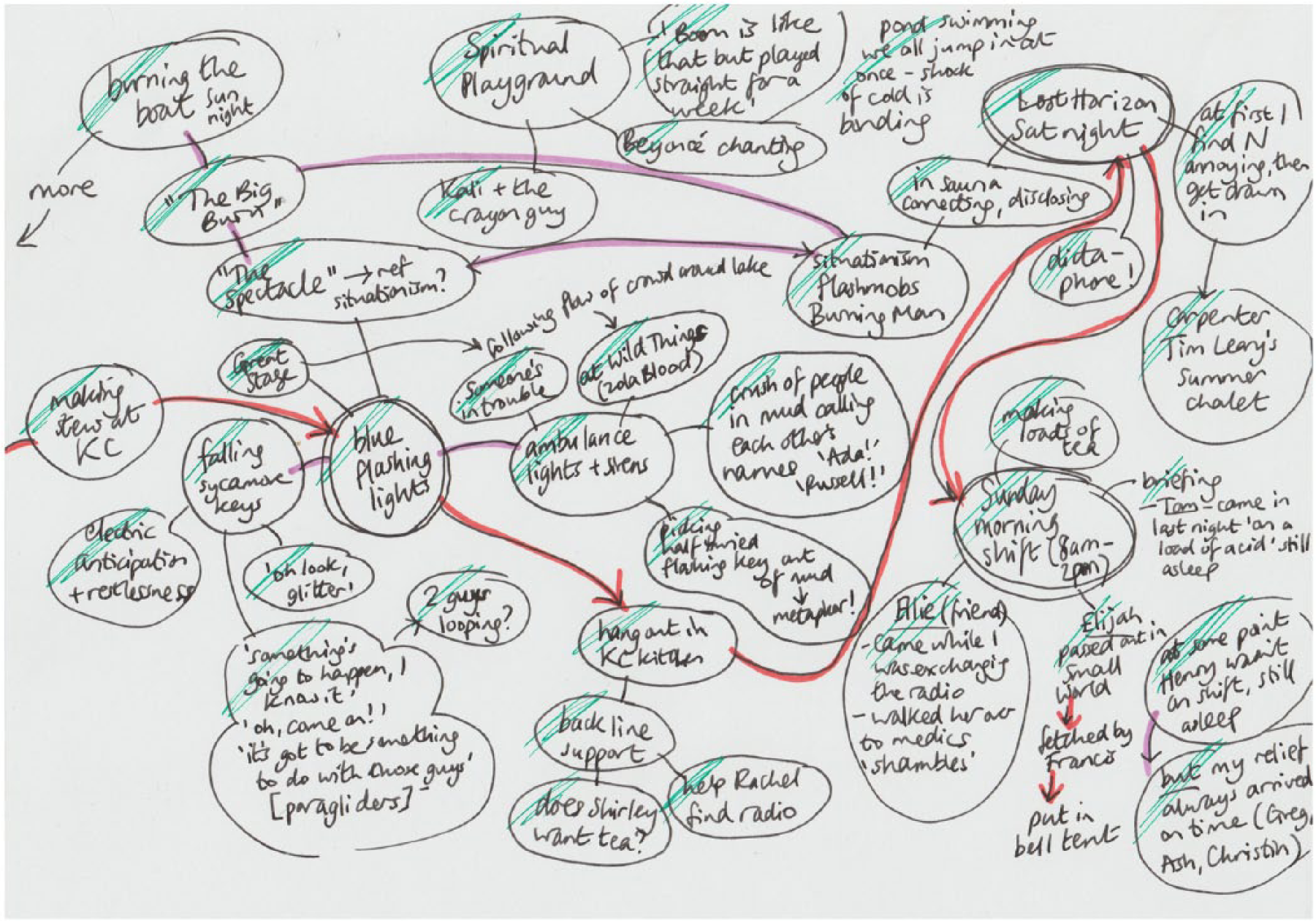
A page of mind-map-based fieldnotes. Redrawn to incorporate sitter and visitor pseudonyms and clarify slightly (while preserving most of the roughness). The line marked in orange (added later) represents the order of key events in time, while those highlighted in purple are examples of a topic related to one incident which sparked a related memory elsewhere.
In the second stage of note-taking, I used the maps as cues for a more detailed account captured in voice memos. Some of the voice memo creation happened towards the end of the event, while still immersed, and the rest in the days immediately following it, when I was in a transitional state – increasingly engaged with the everyday world but still able to access the festive headspace, nonlinearity and ‘body time’. The flexibility afforded by the maps helped me move smoothly through all the material I wanted to cover while the memories were fresh (any delay would have greatly reduced my recall from the brief cues in the maps). The path I took from node to node was decided freely in the moment. This allowed me to engage deeply with particular issues – for example, I covered all care space interactions with police in one session. It also gave rise to further intuitive connections. Marking each node as it was done (shown in green in Figure 1) set me free from keeping track of what I had already discussed, enabling me to concentrate on recounting each incident as vividly and richly as possible. In the third and final stage, that of transcription, I had fully returned to consensus reality and was able to tidy the memos up, reordering and editing them slightly, while adding further memories cued by listening to the sound files – although I kept copies of the less sequential earlier versions.
As fieldwork progressed, my interviewing practices also shifted from struggle for order to acceptance of flow. Interviews fell through or happened at unexpected times; when they did, participants were keen to discuss my question topics, but doing this according to my interview schedule proved impossible. I began to realise that allowing flow in interviews helped reveal the connections participants made between topics. As time went by, I became increasingly open to serendipity and relinquished more control, until on the final day of Burning Man I secured an interview with a very busy – and thus elusive – sitter and prominent activist by impulsively boarding an art car bound for parts unknown. As we bounced and jolted across the desert landscape, my participant moved fluidly and eloquently through all my question topics with hardly any explicit prompting. That interview became one of the keystones of the dataset.
Conclusion
This article contends that exposure to physically demanding and high-stimulus environments such as that of the transformational festival may interfere with researchers’ everyday habits of thought, including our self-concepts, our identities and the ability to narrate our experiences. Although in some ways the transformational festival and the psychedelic care space within it are unique environments, they also share features and dynamics with many settings in which ethnographers of crime, deviance, nightlife and drug cultures carry out field research. These features include chaotic daily rhythms, sleep disruption and deprivation, physically demanding environments, and the stresses of deep engagement with vulnerable, volatile or aggressive participants. Balancing conflicting identities and taking coherent fieldnotes may prove unexpectedly difficult in such settings. Yet the experiences of vulnerability and powerful emotions these settings elicit are not necessarily impediments to research, needing to be managed and minimised; rather, they can in themselves be ‘epistemologically productive’ (Coffey, 1999) by conveying otherwise unavailable insights (Newmahr, 2008; O’Grady, 2013). It may therefore be advantageous to choose methods which maximise immersion and engagement, to minimise the complexity of ‘identity work’ (Coffey, 1999), and emphasise the accumulation of a large and varied collection of memory cues to enable detailed recall later, rather than the creation of a coherent narrative requiring disciplined working practices in situ. After a struggle with more traditional research practices and the emotional impact of their failure, I found that a combination of multisensory data collection practices, including voice and sound recording, and a rapid visual mind mapping technique were effective in this regard. This article is an invitation to further discussion regarding the creative development of a set of resilient, flexible research tools which we may confidently bring with us on expeditions into the wilder reaches of human experience.
Footnotes
Declaration of conflicting interests
The author(s) declared no potential conflicts of interest with respect to the research, authorship and/or publication of this article.
Funding
The author received assistance with fieldwork travel costs from the Allcorn Box Scholarship Fund, awarded by the School of Social Science at the University of Kent. No other financial support was received for the research, authorship and/or publication of this article.