



Abstract
Music is an indispensable cultural product, reflecting changes in social, psychological, and cultural contexts. This study analyzes the historical evolution of topics and conveyed affect in popular music lyrics in Germany from 1954 to 2022, using LDA-based topic modeling and transformer-based sentiment analysis. These results show that Love & Relationships is the most referenced topic, with Dreams & Longings prominent until the mid-1960s and Society & Status rising from 2017. The sentiment analysis reveals a significant decline in positive sentiment since the mid-1960s, accompanied by increases in negative, ambiguous, and neutral sentiments. These trends may reflect broader societal changes, including shifts in cultural values, rising individualism, and increasing mental health issues. The study highlights the evolving nature of popular music and its reflection of social dynamics.
Keywords
Introduction
Music is seen as an indispensable cultural product (Schellenberg and von Scheve, 2012). Every day, people absorb music from various sources, be it the radio, streaming providers, television, or public performances (Ruth, 2019). On average, 15 to 25 percent of waking life is spent listening to music (Greenberg et al., 2021). In industrialized countries the role of music ranges from a leisure activity to an identity-forming work, and from a commodity to a means of exerting political influence (Schellenberg and von Scheve, 2012). Music can help to overcome personal problems and strengthen social bonds (Christenson et al., 2019). Popular music in particular is seen as a mirror of society that reflects changes in social, psychological, and cultural contexts (DeWall et al., 2011; Schellenberg and von Scheve, 2012).
Popular music can be described as music that enjoys great popularity and is commercially successful (O’Toole and Horvát, 2023; Ruth, 2019; Schellenberg and von Scheve, 2012), and it encompasses a variety of genres, including Rock, Pop, Hip-Hop, Metal, and Electronic (Serrà et al., 2012). Inherent to popular music is its continuous evolution in close interplay with cultural changes in modern societies (Mauch et al., 2015). As a result, the connection between musical and social change has been analyzed, discussed, and classified in numerous works. The present study extends existing research by analyzing the evolution of the topics and the affect conveyed by song lyrics over time.
Related Work
An important aspect of change in popular music is the tonal evolution. Tonal changes can be related to cultural and social developments or events (Mauch et al., 2015). Furthermore, it is assumed that tonal changes interact with changes in song lyrics and thus reflect the evolution of the affect that is conveyed in those lyrics (Schellenberg and von Scheve, 2012).
Mauch et al. (2015) have analyzed the US Billboard Hot 100 from 1960 to 2010, using Music Information Retrieval (MIR) methods and repurposed text mining tools to visualize harmonic and tonal changes in popular music. The authors found that although the sound of popular music has evolved continuously, there were particularly rapid changes around 1964, 1983, and 1991. The first revolution around 1964 is associated with the increasing popularity of Rock, Soul, and related genres. The second revolution around 1983 is attributed to the spread of New Wave, Disco, and Hard Rock. Finally, the biggest revolution in popular music came around 1991 with the spread of Rap and related genres.
Schellenberg and von Scheve (2012) analyzed the evolution of musical characteristics (fast temp and major mode as a cue to happiness, slow tempo, and minor mode as a cue to sadness) of popular music from 1965 to 2009, whereby the US Billboard Hot 100 were also used for this purpose. According to the authors, popular music has become sadder-sounding and more emotionally ambiguous over time. They suggested that increased individualism may be a social factor for the described evolution, and that individual consumer behavior has become an integral part of identity formation and thus music consumption. As a result of a globalized economy, consumers could now choose from a wider range of music than they could 50 years ago (Schellenberg and von Scheve, 2012).
In the present study, the evolution of the most referenced topics in popular music lyrics is a central focus as it can provide insights into societal interests at various times (Christenson et al., 2019). It is assumed that the affect conveyed in song lyrics develops differently across various topics, offering a detailed understanding of this evolution.
Christenson et al. (2019) analyzed the evolution of the most referenced topics in popular music lyrics, examining Billboard magazine's year-end top 40 US songs from 1960 to 2010. They found that popular music lyrics have consistently been dominated by romantic and sexual relationships, with lyrics becoming more sexually explicit over time. Additionally, lifestyle topics such as partying, dancing, and drug use have gained prominence, particularly in the last two decades. The increasing presence of sexual topics in popular music may reflect a cultural and social change in the evaluation of sex. While sex remains predominantly associated with love, sexual relationships outside of romantic love relationships are increasingly accepted by the majority. According to the authors, the increase in lifestyle topics may reflect the growing popularity of Rap and Hip-Hop, genres often dominated by these themes. Christenson et al. (2019) noted that music is just one factor influencing the lifestyle of young people, and that a direct correlation between content of popular music and people's behavior cannot be established.
Ruth (2019) examined the relevance of prosocial behavior in popular music between 1954 and 2014 and conducted a general topic analysis of the German music charts using five-year intervals. As reported by the author, love is the most referenced topic in popular music lyrics, followed by song lyrics that could not be assigned to a specific topic. Music and partying is the third most referenced topic in popular music lyrics, followed by social and political songs. Nonsense lyrics come next, followed by lyrics referencing places and travelling, and topics associated with violence and drugs. However, Ruth (2019) observed no significant increases or decreases in any of these topics over the investigated period.
When analyzing the historical evolution of the affect conveyed in popular music lyrics, it is important to consider not only the evolution of the most popular topic but also other semantic features, such as language use, which might be a decisive indicator of the affect conveyed by the lyrics.
In this context, DeWall et al. (2011) studied the evolution in terms of word use in the 10 most popular songs in the US each year from 1980 to 2007. They examined whether word use has evolved in line with the increase of individualistic personality traits such as extraversion, self-esteem, and narcissism in the US. The authors observed that the use of self-referential words has increased over time, with more first-person singular pronouns and fewer first-person plural pronouns. This change aligns with the increase in narcissistic personality traits in US society (DeWall et al., 2011). Additionally, the use of words associated with social interactions and positive emotions has decreased, which, according to the authors, reflects increasing loneliness and mental illness in US society. The use of words associated with anger and antisocial behavior has also increased over time, further confirming the rise in narcissistic personality traits and the rejection of social bonds (DeWall et al., 2011).
Similarly, Brand et al. (2019) analyzed the emotional content of song lyrics using the annual US Billboard Hot 100 from 1965 to 2015 and a set of English language lyrics obtained from the website musixmatch.com from 1965 to 2010. They found that the frequency of negative words increased over time, while the frequency of positive words decreased over time. They concluded that the increase in negative lyrics may be partly due to a general preference for negative emotions in art and partly due to undirected, unbiased cultural transmission. They suggest that it is likely that the emergence of certain genres or historical events may have influenced music production and thereby the preference for negative emotions (Brand et al., 2019).
Parada-Cabaleiro et al. (2024) investigated the dynamics of English lyrics of Western popular music from 1970 to 2020 and found that popular music lyrics have become simpler and easier to comprehend over time in terms of vocabulary richness, readability, complexity, and the number of repeated lines. In addition, they observed that the emotion conveyed in lyrics has become more negative and that lyrics have become more personal over the last five decades.
Furthermore, some relevant work exists that looks at the evolution of song lyrics and musical features under certain conditions and contextual factors. These contextual factors are crucial to the discussion of broader societal changes, which may be related to the evolution of affect in popular music lyrics.
For instance, Qiu et al. (2021) analyzed the top 10 songs in the US and Germany from 1980 to 2017 and found that the unemployment rate predicted anger in lyrics, concluding that popular song lyrics may reflect public sentiment about the socioeconomic environment. The authors attribute at least two reasons for this relationship. First, the socioeconomic environment may influence the public's mood, whereby the public prefers songs that match their mood. Second, the socioeconomic environment may influence the mood of composers who convey their mood in their songs (Qiu et al., 2021).
Similarly, Pettijohn and Sacco (2009) investigated the relationship between popular music lyrics content and changes in US social and economic conditions by analyzing the top one song of each year between 1955 and 2003 according to the US Billboard magazine. Their results suggest that, during more threatening social and economic times, lyrics tended to be more meaningful, more comforting, and more romantic. Furthermore, the authors observed that when social and economic times were more threatening, songs with more words per sentence, more future references, and more coverage of social processes were popular. One reason for this finding is attributed to the fact that when times are threatening, people identify strongly with a cultural worldview that boosts self-esteem and makes them feel that they are part of something more important. Moreover, identifying with popular song lyrics that represent people's worldviews might help to alleviate the threats to the self. Finally, when times are threatening, people may focus on the intimacy that comes from close relationships (Pettijohn and Sacco, 2009).
In line with this, Putter et al. (2022) analyzed how the first six months of the COVID-19 pandemic were related to lyrics concerning interpersonal relationships and negatively valanced content. The authors examined the top five weekly songs in the US and UK from 1999 to 2020 and found that the first six months of the COVID-19 pandemic (March–August 2020) were associated with popularity of lyrics reflecting a greater degree of social isolation and lower satisfaction. Their second study investigated US monthly data from 1999 to 2020 to analyze the relationship between socioeconomic hardship and references to interpersonal relationships and prevalence of positively and negatively valanced words (Putter et al., 2022). Here, they found that references to interpersonal relationships were not related to economic misery. The prevalence of negatively valanced words, by contrast, increased with greater economic misery and the use of positively valanced words decreased (Putter et al., 2022).
Furthermore, North et al. (2018) analyzed the content of the UK's weekly top five singles charts from 1960 to 2011 and considered their macroeconomic correlates. They investigated whether changes in optimism in lyrics predicted future changes in economic optimism but found no evidence for this hypothesis. However, they observed that economic turbulence was linked to an increase in the popularity of lyrics focused on themes of certainty and succor.
Finally, Anglada-Tort et al. (2021) investigated how music lyrics have changed over time as a function of the musician's gender. They analyzed weekly top-five UK chart songs from 1960 to 2015 and observed an increased presence of female musicians over time, especially in 1968, 1976, and 1984. The three inflection points were associated with the women's rights movement in 1968, the rise of punk in 1976, and the peak in popularity of Margaret Thatcher's prime-ministership in 1984. Furthermore, the authors found that the total number of words and the use of self-references in popular music lyrics changed significantly as a function of the musician's gender, especially around those years, potentially caused by the same reasons mentioned above. In addition, they observed a general significant trend towards increasing repetition in lyrics over time. By contrast, the total number of words was observed to increase significantly over time, which may be attributed to the rise of rap music in the UK and US (Anglada-Tort et al., 2021).
Research Aims
Few studies have examined the historical evolution of the affect conveyed in popular music lyrics, particularly with regard to rhetorical devices and contextual factors, by using machine learning techniques. This study aims to fill that gap. In addition to a comprehensive analysis, a topic-specific investigation of the affect conveyed in popular music lyrics was conducted for the most referenced topics in popular music. Although a topic analysis of popular music lyrics is already covered in existing studies, this study repeated the analysis for two main reasons. First, most existing research is based on US hit lists. This study extends the research to German music charts, which differ from US music charts, for instance, in terms of the prevalence of German chansons ('Schlager”) in the 1950s (Hüser, 2006), the emergence of the German New Wave (“Neue Deutsche Welle”) in the early 1980s (Hornberger, 2020), and the emergence of German rap in the 2020s. Second, there is a 10-year gap in the existing research, which this study aims to fill. Accordingly, we first aimed at investigating what were the most referenced topics in popular music lyrics in Germany from 1954 to 2022 (RQ1).
As the year 1954 marks the beginning of the recording of the German music charts (Giloth and Sobbe, 2018), we further asked how the affect conveyed in popular music lyrics in Germany has evolved from 1954 to 2022 (RQ2).
Current research indicates a trend away from predominantly positive-sounding music toward sadder and more ambiguous tones. Additionally, language use in lyrics was observed to become more self-centered, antisocial, and aggressive. It is thus assumed that this evolution is also reflected in the emotions of the song lyrics. More concretely, it is hypothesized that the affect conveyed in popular music lyrics have become more negative and more ambiguous over this period (H1).
Existing research suggests that the sound of popular music is constantly evolving but is also characterized by periods of rapid change. Based on this, it is hypothesized that, although the affect conveyed in popular music lyrics has evolved continuously over time, it is also characterized by periods of rapid change (H2).
Finally, to obtain more differentiated results regarding the interaction of topics and conveyed affect, the exploratory research question was formulated as to how the affect conveyed in popular music lyrics in Germany has evolved from 1954 to 2022, separated by topic (RQ3).
Methods
The present work aimed to complement existing research, for instance by Christenson et al. (2019), Ruth (2019), and Schellenberg and von Scheve (2012), by basing all analyses on automated procedures, namely natural language processing (NLP) techniques (Chowdhary, 2020). Topic modeling (Churchill and Singh, 2022) was used to answer the first research question, and a sentiment analysis (Wankhade et al., 2022) was conducted to answer RQ2 and RQ3 and to test the hypotheses.
Data
Over the years, the official German music charts have not been continuously compiled by a single company but by different companies at different times (Giloth and Sobbe, 2018). From 1954, the first hit lists were published by the music magazine Automatenmarkt, based on sales of songs in jukeboxes (Ruth, 2019). From 1959 to 1977, the trade journal Musikmarkt was responsible for compiling the music charts based on record sales (ibid.). Since September 1977, the company GfK Entertainment (formerly Media Control GfK International) has been responsible for compiling the charts (Giloth and Sobbe, 2018). In the course of our research, it was not possible to find any official organization that provides collected chart lists for the period 1954 to 2022. The company GfK Entertainment maintains a history of charts since 1977. No archives could be found for Automatenmarkt and Musikmarkt.
According to our research, the privately run website Chartsurfer.de is the only freely available online archive of collected German music charts from 1954 to 2022, providing annual charts for each year. The annual charts included all the songs that reached the top 10 chart positions in that year (Chartsurfer.de, 2024). Thus, to ensure a standardized and comparable evaluation system for the entire period, only data from this website was used in this study.
Web scraping was used to extract the song name, the artist name, and the year of the chart position. This resulted in a total of 3503 songs from 1954 to 2022. The number of songs per year varies over the years due to the different number of songs within the first 10 chart positions. The year 1958 is the year with the fewest songs (41) and 1962 the year with the most songs (58). On average, there were 51 songs in the top 10 each year, varying by 2.43 songs per year.
The online music encyclopedia Genius was used as the preferred source for the required lyrics due to its extensive collection of lyrics (ML Genius Holdings, LLC., 2024). A Python client provided by Miller (2020) allows song lyrics to be downloaded from the website filtered by song and artist name. Thus, 3141 lyrics of 3503 songs could be obtained automatically; 362 lyrics were not found. This may be because the lyrics searched for are not available on Genius but also because the artist and song name in the data obtained from Chartsurfer.de differ too much in spelling and wording from the data on Genius to be matched correctly.
In the event of a mismatch or missing lyrics, the correct lyrics were found, if necessary with the help of other websites such as Songtexte.com, Lyrics Translations, FlashLyrics, and JioSaavn. A total of 56 songs were classified as instrumentals. No lyrics could be found for 16 songs. For the purposes of the present study, the lyrics were not transcribed manually. Thus, the period from 1954 to 2022 is represented by a total of 3431 songs with associated lyrics. Each year is represented by an average of 50 lyrics, varying by 2.43 songs per year.
Most song lyrics obtained from Genius were labelled with meta-information that served to structure the content of the lyrics. Different text passages were introduced with inserts in square brackets that provided context to the paragraphs. The lyrics downloaded by the Python client of Miller (2020) also contained additional information, such as the number of contributors, the number of available translations, and information on embedding the lyrics, which were placed before and after the actual lyrics. Using a Python script, all meta-information was automatically removed so that only the lyrics themselves remained. In the case of manually obtained lyrics, care was taken in advance not to copy any information that went beyond the actual lyrics.
It has been shown that the quality of the results increases if all song lyrics are available in the same language. Therefore, all non-English lyrics were automatically translated into English using the DeepL API (DeepL SE., 2024). English was chosen as the target language first because 66% of the songs were already in English, thus reducing the likelihood of translation errors, and second because the majority of NLP services are optimized for English. Overall 30% of the songs were in German, 0.9% in Italian, and 0.8% in both Spanish and French. The remaining 1.4% were represented by a variety of languages, which were represented by a small number of songs. The Python library langdetect was used to recognize the language of a song lyric (Danilk, 2021).
Procedure
Topic Modeling
In the context of the dataset created in this study, Latent Dirichlet Allocation (LDA) (Blei et al., 2003) proved to be a suitable technique for topic modeling due to a high interpretability of the results. The Python library Gensim was used to implement the topic model (Řehůřek and Sojka, 2010). Gensim contains a ready-made LDA integration, extensive documentation (Řehůřek, 2022), a large number of open-source projects (GitHub, Inc., 2024), and an active community (Medium, 2024). This made it easy to get started and to overcome any challenges that arose in a timely manner.
As described in Churchill & Singh (2022), the quality of a topic model is significantly influenced by the data preprocessing. The Python library spaCy was used to preprocess the song lyrics; this offers a series of pretrained pipelines that automate the preprocessing of text data (Explosion., 2024). The pipeline en_core_web_sm trained for English was used in the present study. In the course of this, all words were first lemmatized. Words that did not offer any value in terms of content were removed to reduce noise in the dataset as far as possible. For this purpose, spaCy provides a list of stop words that contain frequently used words but have little semantic meaning (Explosion., 2024). Expressions frequently used in song lyrics such as ohh, doo, or dee were also filtered out due to their lack of semantic content. All punctuation marks and numbers as well as words consisting of only one letter were removed, and all letters were converted to lower case.
For the underlying dataset, it has also been shown that the topic model provides more coherent and unambiguous results once all words that are not nouns, verbs, or adjectives are filtered out. Therefore, the song lyrics were tokenized and de-accentuated with the help of Gensim. Gensim was also used to create a dictionary that assigns an ID to each word. This dictionary was used to build and train the LDA model.
The evaluation process of various model parameters showed that a topic model with six topics and an automatic assignment of
Sentiment Analysis
In the context of the underlying dataset and in view of the research concept of including rhetorical devices and context, computing machine learning models proved to be the most suitable method for carrying out the sentiment analysis. In detail, the transformer model bert-base-uncased-poems-sentiment, which is trained on a dataset of poems, proved to be a suitable model for the dataset of song lyrics due to its accurate sentiment classification on the one hand and its four sentiment classes on the other hand (Wong, 2023). That is, in addition to the sentiment classes positive and negative, the model offers the sentiment classes no_impact and mixed. The sentiment class mixed, which includes texts containing both negative and positive sentiments, offers added value in the context of sentiment analysis of song lyrics, as it was anticipated that song lyrics increasingly exhibit an ambiguous sentiment. The accuracy of the sentiment classification was evaluated manually using various songs.
The associated Python library transformers was used to implement the pretrained transformer model (Wolf et al., 2020). In the first step, the data was preprocessed. In detail, all punctuation marks and numbers were removed from the texts. Subsequently, words consisting of less than three characters were filtered out, and the sentiments for all song lyrics were calculated. The sentiment class no_impact was renamed to neutral, and the sentiment class mixed was renamed to ambiguous to create a naming consistent with existing research (Behbehani and Steffens, 2021). The code created for this study can be found in the Supplementary Material.
Results
Topic Modeling
As already described, the underlying topic model was trained with six topics. Each of the six topics is described by a group of words that reflect the central terms and concepts of the topic. Each word was assigned to each topic with a probability that describes the relevance of the word to the topic. The 10 words with the highest probability of each topic are listed in Column 2 of Table 1 including the probability value in brackets. Column 3 contains the five songs that were assigned to the respective topic with the highest probability. The probability is shown in brackets. If there are more than five songs with the same probability, the songs with the most recent chart positions are shown. For each of the five songs, a manual content analysis was carried out to extract the central lyrical concept of the song using the translated lyrics after the preprocessing pipeline. The topics were then named based on the results of the manual content analysis and the associated words. If a topic could not be named by the 10 words and 5 songs, further songs and manual content analyses were consulted. The topic names are shown in Column 4. The numbering of the topics shown in Column 1 corresponds to the numbering that was automatically generated by the topic model and does not correspond to the order of the percentage distribution of the topics. The results of the manual content analysis can be found in Table 3 in the Appendix.
Overview of identified topics (all values in %).

Topic Distribution
Figure 1 depicts the cross-year topic distribution of popular music lyrics from 1954 to 2022. The distributions of one topic were added up across all songs and measured as a percentage of the sum of all distributions. A song is therefore not exclusively assigned to one topic but can appear in several topics with different weightings.

Cross-year topic distribution of popular music lyrics from 1954 to 2022.
As can be seen in Figure 1, Love & Relationships is the most frequently referenced topic in popular music from 1954 to 2022 with a total share of 39%, followed by Society & Status with 18.5%. Dreams & Longings takes third place with 16.6%, and Music, Dancing & Partying is the fourth most frequently referenced topic with a share of 10%. The final topics are Desire & Self-realization with 9.8% and Miscellaneous with 6.2%. Figure 2 illustrates the development of the topics in popular music lyrics over time. It should be noted here that the topic Miscellaneous suggests a certain consistency when simply looking at the words, but this is lost when the actual song lyrics are included. The theme is therefore understood as a categorization for lyrics that cover different subject areas.

Topic distribution of popular music lyrics from 1954 to 2022 by year.
Love & Relationships
References to the topic Love & Relationships show an upward trend from 1954 to 2022 (b = 0.213; p
Society & Status
The topic Society & Status shows an upward trend from 1954 to 2022, which rises sharply at the end of the 2010s (b = 0.158; p
Dreams & Longings
References to the topic Dreams & Longings show a downward trend from 1954 to 2022 (b = −0.285; p
Music, Dancing & Partying
References to the topic Music, Dancing & Partying show a slight upward trend from 1954 to 2022, which is characterized by a series of high and low points (b = 0.066; p
Desire & Self-Realization
References to the topic Desire & Self-realization do not show a significant linear trend from 1954 to 2022 (b = −0.021; p = .303; R2 = .016). The year 1958 marks the high point with 25%. The year 1967 marks the low point with 3.6%. From 2010 onwards, references of the topic remain stable with an average of 11.4%.
Miscellaneous
The topic Miscellaneous shows a downward trend over the period under consideration (b = −0.130; p
Cross-Topic Sentiment Distribution of Popular Music Lyrics
Figure 3 illustrates the sentiment distribution of popular music lyrics from 1954 to 2022 over time. To obtain the percentage distribution of a sentiment class over the sum of all songs, the distribution of the respective sentiment class is totaled over all songs and measured as a percentage of the sum of all sentiment distributions. The following sections describe the evolution of the sentiment distributions over time in detail.
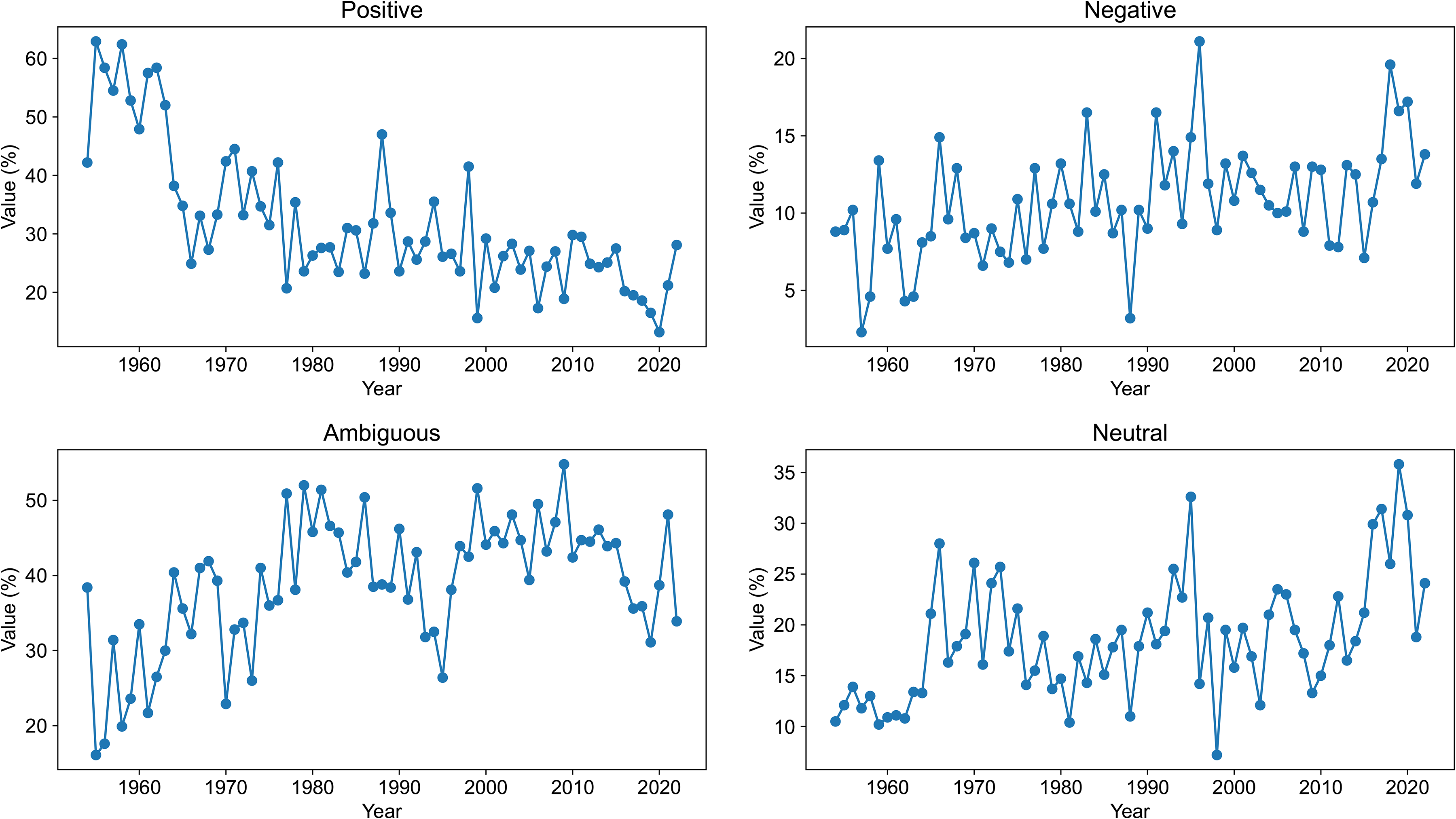
Sentiment distribution of popular music lyrics from 1954 to 2022 by year.
Positive
The proportion of positive sentiment in popular music lyrics shows a downward trend from 1954 to 2022 (b = −0.444; p
Negative
The proportion of negative sentiment increases continuously over the years (b = 0.084; p
Ambiguous
An upward trend in the proportion of ambiguous sentiment can be observed from 1954 to 2022 (b = 0.218; p
Neutral
Finally, Figure 3 indicates that the proportion of neutral sentiment increases continuously from 1954 to 2022 (b = 0.143; p
Topic-Specific Sentiment Distribution of Popular Music Lyrics
Table 2 shows the statistical measures of the linear progression of the sentiment distribution for each topic. The sentiment evolution of each topic deviates from the cross-topic sentiment distribution to varying degrees. The following section describes the results of the topic-specific sentiment distribution of Dreams & Longings, Music, Dancing & Partying, and Desire & Self-Realization in detail. The results of these topics are considered as the most important findings, as they deviate the most from the cross-topic sentiment distribution (excluding Miscellaneous, which is not considered to be an important independent topic, as it is a collection of lyrics dealing with various topics). Illustrations showing the sentiment distribution of the topics Love & Relationships, Society & Status, and Miscellaneous by year can be found in Figure 7, Figure 8, and Figure 9 in the Appendix, respectively.
Overview of identified topics and sentiment.
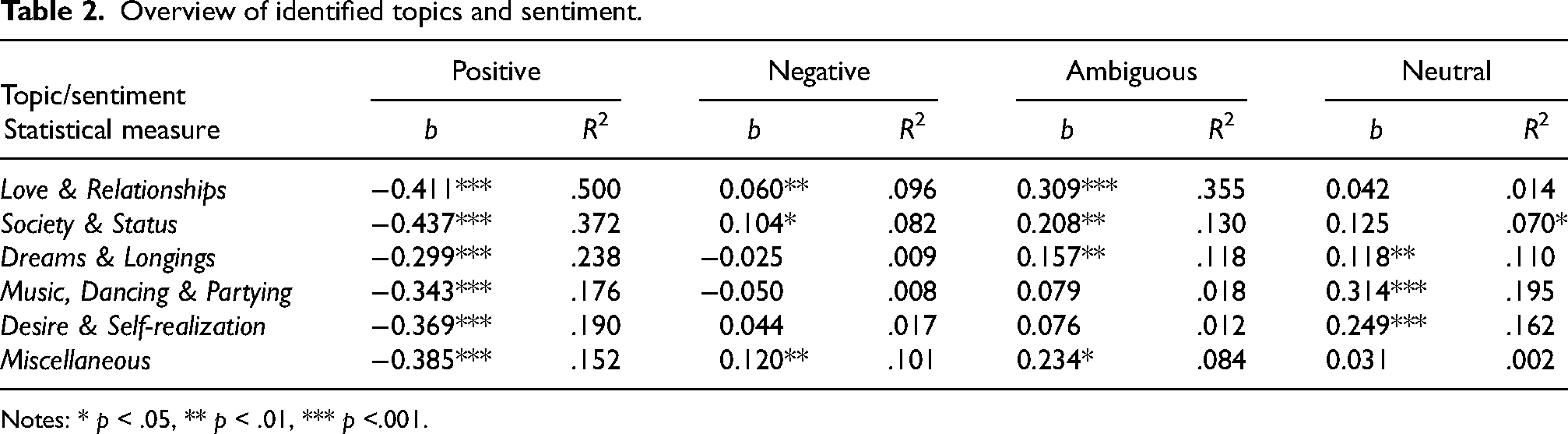
Notes: * p < .05, ** p < .01, *** p <.001.
Dreams & Longings
Figure 4 displays the sentiment distribution of the topic Dreams & Longings in the lyrics of popular music from 1954 to 2022 by year.
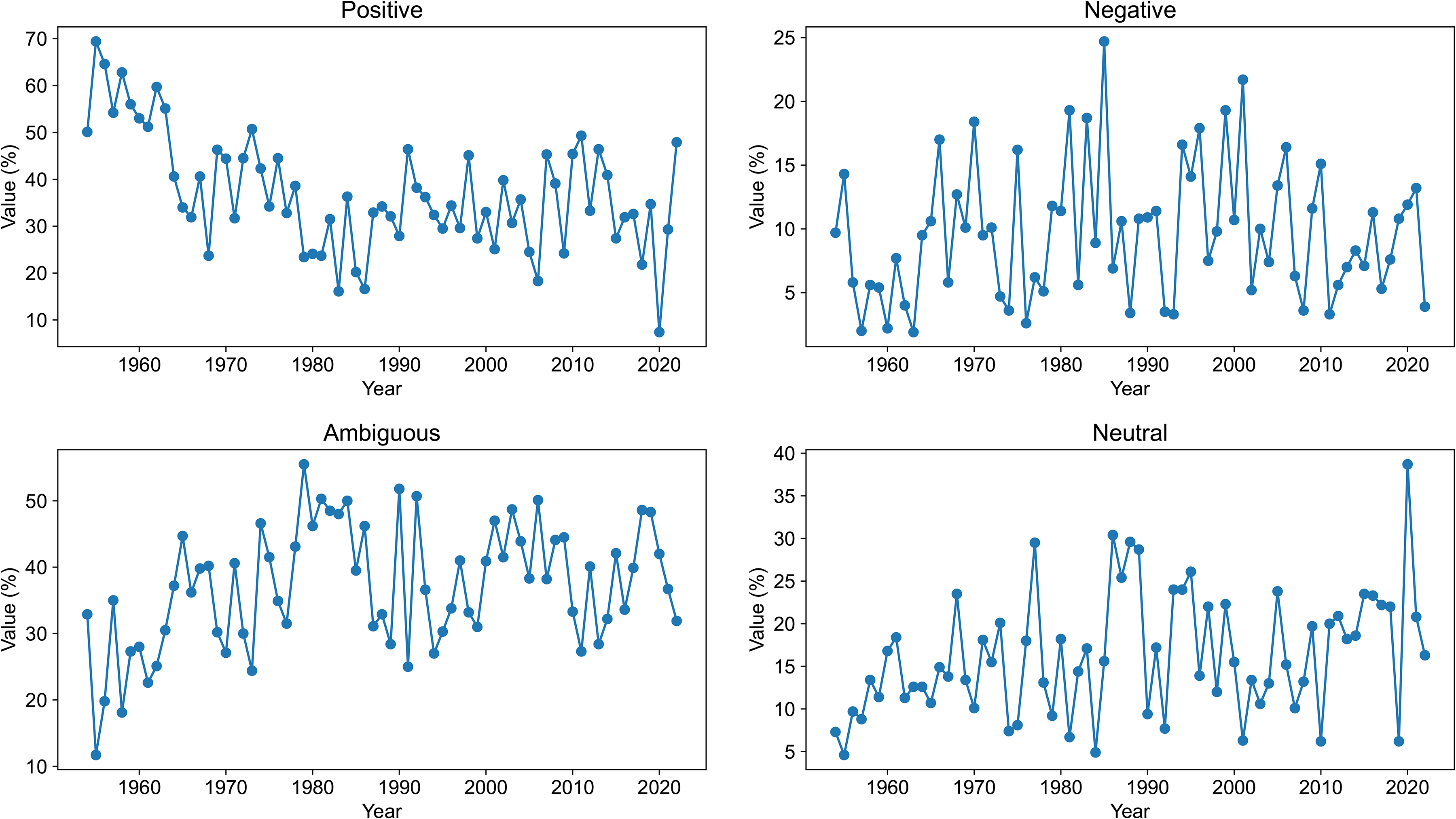
Sentiment distribution of the topic Dreams & Longings in popular music lyrics from 1954 to 2022 by year.
In the 1960s, there is a sharp decline in the proportion of positive sentiment. Until the beginning of the 1960s, it remains at an average of 57.6%. In the mid-1960s, the proportion falls to an average of 34%. From the end of the 1970s to the mid-1980s, the proportion of positive sentiment remains at a level of 24.0% on average. Since the 1990s, the share levels off at an average of 33.9% with constant fluctuations. At 7.4%, 2020 marks the outlier low point.
Until the mid-1960s, the proportion of negative sentiment is at a level of 5.5% on average. In the following years until the early 2000s, the proportion of negative sentiment remains at an average of 11.1%. The year 1985 marks the peak at 24.7%. Since the beginning of the 2000s, the proportion of negative sentiment remains at a level of 7.4% on average.
At 11.7%, 1955 represents the low point of ambiguous sentiment of the investigated period, whereas 1979 constitutes the high point with 55.5%. The observed upward trend has been levelling off since the early 2000s.
Regarding the share of neutral sentiment, the year 2022 stands out as an outlier with a share of 38.7%. The year 1955, with a share of 4.6%, represents the low point of the period under review.
Music, Dancing & Partying
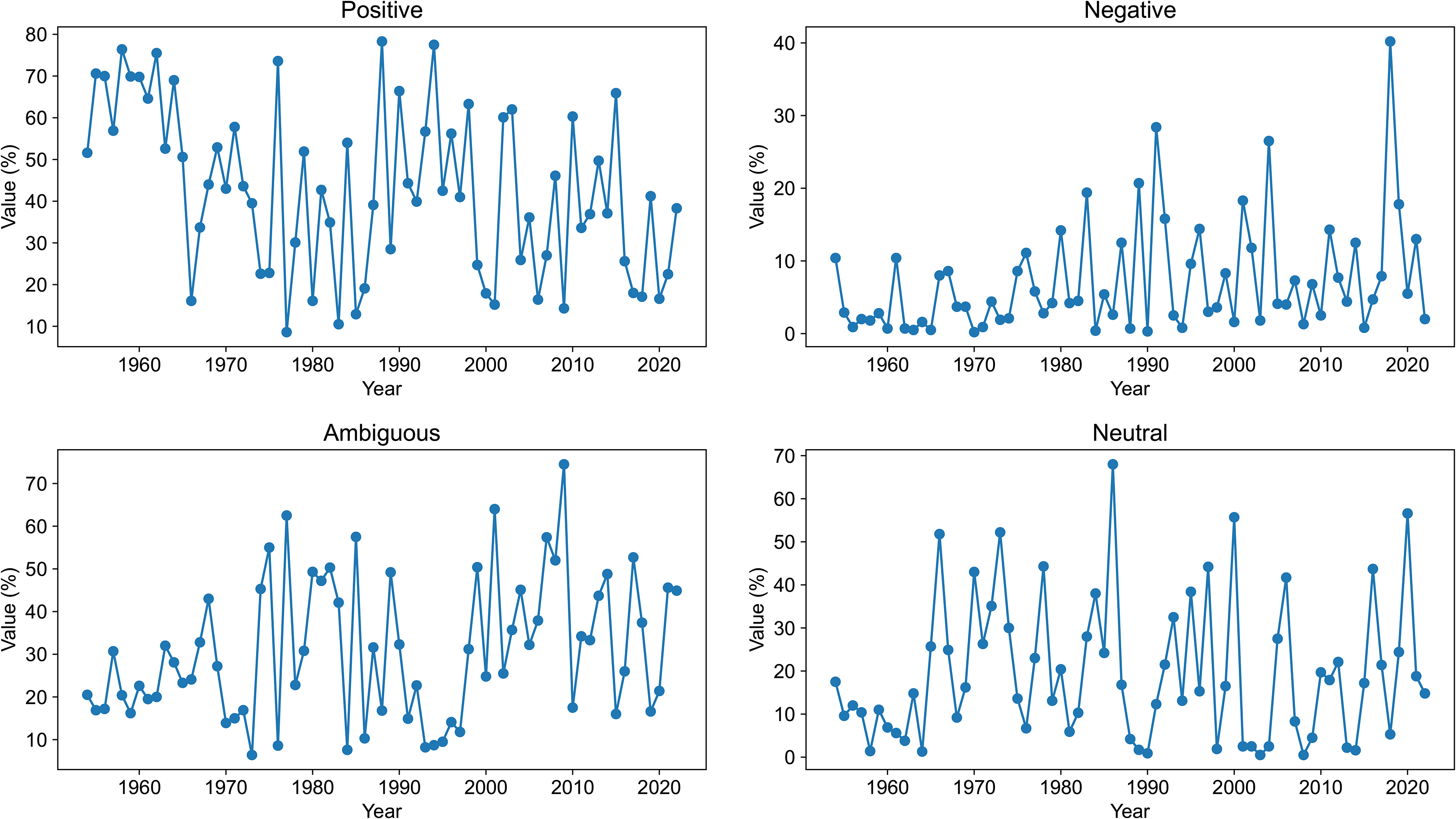
Figure 5 shows the sentiment distribution of the topic Music, Dancing & Partying in the lyrics of popular music from 1954 to 2022 by year.

Sentiment distribution of the topic Music, Dancing & Partying in popular music lyrics from 1954 to 2022 by year.
While the proportion of positive sentiment averages 45.9% until the mid-1960s, it falls continuously in the following years until it reaches an average of 23.8% in the early 2020s. The year 1958 marks the high point in the period under review with a positive sentiment share of 92.2%, followed by the low point in 1960 with 7.2%.
With shares of 56.8% and 67.5%, the years 1959 and 1960 represent two outlier peaks in negative sentiment, while the average of the surrounding years is 6.7%. With a share of 29.1%, 2017 marks another upward outlier.
The years 1958, 1993, and 2005 mark three outlier lows in the proportion of ambiguous sentiment with 7.2%, 10.4%, and 9.3%, respectively. At 71.4%, 1964 represents the high point of the period under review.
Outlier peaks in neutral sentiment can be found in the years 1965, 1993, and 2005 with 49.9%, 57.2%, and 58.5%. With a share of 0.2%, 1958 marks the low point of neutral sentiment in the period under review.
Desire & Self-Realization
Figure 6 depicts the sentiment distribution of the topic Desire & Self-realization in the lyrics of popular music from 1954 to 2022 by year.

Sentiment distribution of the topic Desire & Self-realization in popular music lyrics from 1954 to 2022 by year.
Until 1964, the proportion of positive sentiment averages 57.8%; it then drops sharply, followed by a continuous decline to 10.4% in 2006. The proportion rises to 53.8% by 2022. The years 1966, 1977, and 1992 mark three outlier lows of 16.4%, 9%, and 4.4%, respectively.
Of note in the proportion of negative sentiment are the years 1955, 1962, and 1988, where negative sentiment is comparatively low at 1.2%, 1%, and 1.3% respectively. The years 1959, 1966, and 1987 mark outlier highs of 32.6%, 30%, and 27% in the period under review.
While the proportion of ambiguous sentiment at the end of the 1950s averages 25.3%, it rises to an average of 41.6% by the beginning of the 1990s, with constant fluctuations. At 9.9%, 1995 marks the low point of the period under review. The year 2006 marks the high point at 71%. The proportion of ambiguous sentiment falls to 14.3% by 2022.
By the end of the 1950s, the proportion of neutral sentiment averages 7.3%. The average rises to 28.8% by the early 2020s. The years 1995 and 2019 mark outlier highs of 73% and 52.6%. The years 1960 and 2003 mark outlier lows of 1% and 0.8%.
Discussion
The aim of the present study was to analyze the historical evolution of the affect conveyed in popular music lyrics in Germany from 1954 to 2022. In addition to a comprehensive analysis, a topic-specific investigation was carried out for the most referenced topics in popular music. Three research questions were defined in this context.
What are the Most Referenced Topics in Popular Music Lyrics in Germany from 1954 to 2022?
The results of our study suggest that Love & Relationships is the most referenced topic in popular music from 1954 to 2022 in Germany with a total share of 39%. This confirms existing research, although the percentage share of the topic is lower in the present study. Ruth (2019) reported that 56.8% of the song lyrics analyzed deal with love, while Christenson et al. (2019) found that love is referenced in 67.3% of the song lyrics analyzed. The lower proportion in this study may be due to differences in the database compared to existing research. Christenson et al. (2019) analyzed the top 40 positions of US end-of-year charts for every second year from 1960 to 2010. Ruth (2019) analyzed German end-of-year charts for two years per decade from 1954 to 2014. This study, however, considers all songs that made it into the top 10 positions in the German music charts between 1954 and 2022.
In addition, the lower proportion may be due to the use of the LDA-based topic model. For a song lyric to be categorized under the topic Love & Relationships, the topic must be clearly stated in the song lyric using the respective keywords. A manual interpretation of the song lyrics, as carried out in the work of Ruth (2019) and Christenson et al. (2019), offers greater flexibility in deciding which song lyrics are assigned to a topic. In both studies, no significant fluctuations in the proportion of song lyrics referring to love were described over time. This finding could not be confirmed by the present study.
The results further indicate that, until 1962, the proportion of topics associated with Love & Relationships remained comparatively low. From 1963, there was a steep increase, followed by a decline from 2017 onwards. The low proportion of the topic in the 1950s is associated with the dominance of the topic Dreams & Longings at the time. The decline since 2017 might be related to the increasing popularity of the topic Society & Status. As also described in Ruth (2019), the general popularity of the topic Love & Relationships may be attributed to the fact that love is one of the most important topics in everyday life and that this is reflected in song lyrics. Especially for young people, who are the main target group of popular music, love is increasingly at the center of life (Ruth, 2019).
According to Pettijohn and Sacco (2009), lyrics tend to be more romantic and have greater references to interpersonal relationships in times of social and economic thread. Moreover, North et al. (2018) found that, during times of economic turbulence, lyrics tend to focus on themes of certainty and succor. However, these observations could not be made when looking at the evolution of the topic Love & Relationships in our study. Although the proportion of Love & Relationships increases with the first post-war recession in Germany around 1966 (Heilemann, 2019), it falls again at the time of the first oil crisis in the early 1970s (Matthies, 1983). The share then rises during the time of the second oil crisis in 1979 (Matthies, 1983) and falls again in the mid-1990s right after the reunification of Germany (Heilemann, 2019) and global recession in the early 1990s (Starke, 2015).
Furthermore, we found that Society & Status is the second most referenced topic in popular music with a share of 18.5% in total. In Ruth (2019), a related topic called Society & politics is listed with a share of 9.4%. Christenson et al. (2019) list similar topics as Wealth/Status, which is referenced in 9.3% of the lyrics, and Social/Political Issues, which is referenced in 7.2% of the lyrics. While in Ruth (2019) no significant fluctuations of the topic Society & politics were observed over time, Christenson et al. (2019) describe a strong increase of the topic Wealth/Status from the beginning of the 2000s. They attributed the increase to the growing popularity of Rap, Hip-Hop, and related genres, especially Gangsta Rap, which are dominated by references to lifestyle topics such as wealth and status. An increase in the topic of Society & Status is also evident in the results of this study. However, unlike the results presented by Christenson et al. (2019), this increase only occurred from the mid-2010s onwards. This may be due to differences between German and US music charts, as well as the fact that this study only examines the top 10 chart positions, while Christenson et al. (2019) considers the first 40 positions of the charts. Although the dataset for this study contains a few songs from the 2000s that can be assigned to the Rap and Hip-Hop genres described above, the charts and in particular the topic Society & Status are not dominated by songs from these genres. However, this changed in the mid-2010s. The increase in the Society & Status topic recorded from the mid-2010s may be attributed to the increasing popularity of the genre German Rap, which emphasizes money, luxury goods, and an eccentric lifestyle.
A study by Albert et al. (2019) suggests that, although two-thirds of all young people in Germany consider a high standard of living important, this has not increased in importance compared to 2002; instead, the materialistic orientation of young people has decreased. Christenson et al. (2019) observe a similar phenomenon in relation to drugs. That is, references to drug use have increased in US song lyrics, which was not reflected in actual drug use. The authors describe that music is only one factor influencing young people's lives and that increasing references to drug use in song lyrics can be offset by other factors. A similar explanation could be applied concerning the prevalence of the topic Society & Status in our study.
With a share of 16.6%, Dreams & Longings is the third most referenced topic in popular music according to the results of this study. While no directly related topic is listed in Christenson et al. (2019), it might be connected to Places & journeys in Ruth (2019), which had a share of 4.1%, averaged from 1954 to 2014. Ruth (2019) described no significant fluctuations of this topic over time. By contrast, this study suggests a steady downward trend in Dreams & Longings. Until the mid-1960s, references to this topic averaged 30.2%, before an abrupt decline to 20.2% was recorded in 1964. The initial popularity of the topic may be attributed to German chansons (”Schlager”), which emphasizes wanderlust, longing, wishful promises, and an idealized idea of home (Forell, 2023; Hogger, 2018). Hogger (2018) suggests that these song lyrics, with exaggerated stereotypes of other cultures, reflect a desire for an ideal world and served as an escape from post-war everyday life. The sudden decline of the topic Dreams & Longings in the mid-1960s corresponds with the rise of Rock, Soul, and related genres, which set a different lyrical focus. One might argue that this topic cluster partly reflects the comforting lyrics and future references described by Pettijohn and Sacco (2009). However, we could not confirm their finding regarding an increase of its proportion during social and economic threatening times. In contrast, the proportion of Dreams & Longings decreases despite all crises.
The results of the present study further indicate that Music, Dancing & Partying is the fourth most referenced topic in popular music from 1954 to 2022 with a share of 10%. In the study by Ruth (2019), the topic Music & party is in a similar range with a share of 12.1%. Christenson et al. (2019) list the topics Music/Musicians, Dance/Dancing and Good Times/Partying, which together represent an equivalent to Music, Dancing & Partying in this study, but with a combined share of 40.6%. This major difference might be due to US charts analyzed in (Christenson et al., 2019), which differ from the German charts used by us and (Ruth, 2019). It may also be due to the different delineation of topics. While Ruth (2019) observed no significant fluctuations over time, Christenson et al. (2019) described a strong increase of Dance/Dancing and Good Times/Partying since the early 2000s, which is partially corroborated by the present study. Interiano et al. (2018) describe a similar upward trend in danceable audio features in songs over a period of several decades. The authors suggest that this trend may be due to the spread of dance-based pop songs. This may be one reason for the slight increase in the topic Music, Dancing & Partying, assuming that songs referring to this topic are more danceable. In addition, this trend might be associated with the emergence of music streaming and recommendation platforms, which have strongly influenced the global music culture and potentially encouraged more fragmented and functional music listening and the composition of both simpler and shorter songs (Hesmondhalgh, 2022).
Furthermore, with a share of 9.8%, the topic of Desire & Self-realization is the fifth most referenced topic in popular music according to the results of this study. No similar topic is listed in Ruth (2019). The topic Personal Identity listed in Christenson et al. (2019) can be understood as part of the topic Desire & Self-realization. Here, Christenson et al. (2019) describe a slight increase in the topic Personal Identity from 1964 to 2010. On average, 9.5% of the song lyrics are assigned to the topic, which roughly corresponds to the results of the present study. However, we could not observe a significant trend in the proportion of the topic over time. We assume that outliers and fluctuations in our data might be attributed more to the coincidental popularity of several songs rather than to a broader social trend.
Finally with a share of 5.3%, Miscellaneous is the sixth most referenced topic in popular music between 1954 and 2022 according to the results of this study. No related topic is listed in Christenson et al. (2019). In Ruth (2019), the topic Miscellaneous is found with a share of 13.5%. The difference may again be due to a differentiated delineation of the topics. Ruth (2019) described no significant trend over the analyzed period. This study shows a downward trend from 1954 to 2022, which, however, cannot be attributed to any specific social development.
How has the Affect that is Conveyed in Popular Music Lyrics in Germany Evolved from 1954 to 2022?
In the course of this research question, we assumed that the affect conveyed in popular music lyrics has become more negative and more ambiguous (H1). This study confirms the assumption that the proportion of negative sentiment rose from an average of 8% by the end of the 1950s to an average of 14.3% at the beginning of the 2020s. In addition to the increase in the proportion of negative sentiment, there is a continuous rise in ambiguous sentiment. In the 1950s, ambiguous sentiment averaged 24.5%. By 2021, it had risen to 48.1%, and in 2022 it was 33.9%. Over the period under investigation, both negative and ambiguous sentiment increased in the lyrics of popular music. The increasingly negative use of words observed by DeWall et al. (2011) and the rise of sad- and ambiguous-sounding music described in Schellenberg and von Scheve (2012) are reflected in the affect conveyed in the song lyrics analyzed in this study. Our study also confirms findings by Parada-Cabaleiro et al. (2024) and Brand et al. (2019) that lyrics have become more negative over time.
The reasons for the changing affect conveyed in song lyrics may also reflect both the increasing loneliness in society and the increase in mental illness over time (DeWall et al., 2011). Also, increased individualistic traits such as narcissism and social rejection, which are associated with increased anger and anti-social behavior, may contribute to the rise in negative sentiment in song lyrics (ibid.). According to Schellenberg and von Scheve (2012), individual consumer behavior, including music consumption, has become a significant part of identity formation, reinforced by a globalized market economy. Consumers have been given the opportunity to choose from an ever-increasing range of products over the years, and they take advantage of this opportunity (Schellenberg and von Scheve, 2012). The authors suggest that ambiguity is a key concept in modern societies, whether related to the disappearance of binary gender roles or constantly changing interdependencies between people. Kwon et al. (2021) also described an increase of negative themes in popular music lyrics from 1998 to 2018, especially in Hip-Hop and R&B. The steep increase in negative sentiment in the late 2010s may be attributed to the increase of the topic Society & Status, which may be attributed the rise of German Rap/Hip-Hop. The strong fluctuations we observed in the evolution of negative sentiment in 1988 and 1996 are likely due to the coincidental popularity of several songs with particularly negative affect, rather than a broader social phenomenon.
As negative and ambiguous sentiment rises, positive sentiment starts to decline. While the proportion of positive sentiment remained at a high level until the mid-1960s, averaging 54.9%, this fell abruptly to 38.2% in 1964 and has been falling continuously since then. In 2020, the proportion of positive sentiment reached its lowest point at 13.2%. The peak phase of positive sentiment in the lyrics of popular songs in Germany in the 1950s may be traced back to the popularity of German chansons ('Schlager”) at the time, as can the popularity of the topic Dreams & Longings. As already described, the lyrics of German chansons can serve as an escape from everyday life in a country destroyed by war (Hogger, 2018). Lyrics about other countries may also reflect the tourism boom of the 1950s and 1960s and the Germans’ longing for accessible and popular holiday destinations (Forell, 2023; Hogger, 2018; Lehnert, 2022). In addition, Hogger (2018) suggests that the lyrics of German chansons can provide an insight into everyday life in the 1950s and 1960s. In this context, it can be observed in the present dataset that simple leisure activities are portrayed positively, with the relationship with the opposite sex usually taking center stage.
The sudden decline in the proportion of positive sentiment in popular music lyrics in the mid-1960s may be primarily associated with the increasing popularity of Rock and Soul and related genres. The 1960s were characterized by strong cultural changes (Eyerman and Jamison, 1995; Siegfried, 2005). Young people distanced themselves from the traditional values and norms of their parents’ generation and favored a more liberal lifestyle (Eyerman and Jamison, 1995; Siegfried, 2005). Rock music and related genres are particularly popular with the younger generation (Eyerman and Jamison, 1995; Siegfried, 2005). The continuous decline in positive sentiment after the sharp drop in the mid-1960s may be attributed to the same phenomena responsible for the increase in negative sentiment. The peaks of positive sentiment found in 1988 and 1998 cannot be attributed to specific social developments but rather to the random, selective popularity of several songs that convey a rather positive affect.
The results of the present study indicate that the proportion of neutral sentiment increases slightly from 1954 to 2022. Three distinctive peak phases can be observed: the first from the mid-1960s to the mid-1970, the second in the mid-1990s, and the third at the end of the 2010s. The first increase in the mid-1960s may be attributed to the already described increased popularity of Rock, Soul, and related genres. The second and third peaks, in the mid-1990s and the late 2010s, may be connected to the rise of Hip-Hop and Rap. Here, future work might look in detail into the relationship between genre and sentiment to draw stronger conclusions.
Furthermore, in the course of the second hypothesis, it was assumed that, although the affect conveyed in popular music lyrics has evolved continuously over time, it is also characterized by periods of rapid change (H2). The results of this study show a continuous decrease in positive and a continuous increase in negative and ambiguous sentiment. This evolution is characterized by a sudden decline in positive sentiment in the 1960s, confirming the hypothesis and existing research. This evolution may be associated with the first tonal revolution around 1964, as reported in Mauch et al. (2015). Plausible reasons for this abrupt change, namely the increased popularity of Rock and Soul and related genres in connection with the dissociation of young people from the values and norms of their parents’ generation, have already been described in detail above.
As reported by Qiu et al. (2021) and Putter et al. (2022), socioeconomic difficulties may lead to more negatively valanced lyrics and less positively valanced lyrics. Based on this premise, the first recession in Germany after the second world war around 1966 (Heilemann, 2019) may have influenced the rapid decline in positive sentiment. It should, however, be noted that a clear decline in the topic was already evident in 1965, while the recession did not occur until a short time later. Also, the proportion of positive sentiment did not pick up again after the crisis. By contrast, findings by Pettijohn and Sacco (2009) suggest that, during times of social and economic threat, lyrics tend to be more meaningful, comforting, and romantic. In line with that, it may be derived that during times of crises, lyrics tend to be more emotionally positive in general. The results of this study, however, do also not confirm this assumption and do not show an increase in positive sentiment during the aforementioned time. It might thus be argued that the respective negative and positive effects of times of crisis on the emotionality of song lyrics balance each other out, resulting in the observed zero effect in our study.
Also, the tonal revolutions observed by Mauch et al. (2015) in 1983 and 1991 are not reflected in the evolution of the affect conveyed in song lyrics as reported in this study. This discrepancy might be due to the dataset analyzed in this study differing from the one used by Mauch et al. (2015). Alternatively, it is possible that these tonal revolutions are not generally reflected in song lyrics. The preceding topic analysis in this study also shows no noticeable changes at the beginning of the 1980s and 1990s. Since Mauch et al. (2015) attributed the abrupt change around 1991 primarily to Rap and related genres, which differ lyrically from other genres (Tegge and Coxhead, 2020), it is assumed that the differences from existing literature regarding the tonal revolution around 1991 are primarily due to the German charts used in this study where Rap and Hip-hop experienced its major breakthrough several years later (Boulaghmal and Polfuß, 2023).
How Has the Affect Conveyed in Popular Music Lyrics in Germany Evolved from 1954 to 2022, Separated by Topic?
The evolution of the sentiment distribution of the topic Love & Relationships confirms the cross-topic trend. Given that Love & Relationships is the most referenced topic in popular music, with a cross-year share of 39%, this is not surprising. The evolution of positive, negative, ambivalent, and neutral sentiment may be attributed to the phenomena already described, the outliers to the temporary popularity of individual songs.
The evolution of positive sentiment on the topic of Society & Status shows an above-average decline in the mid-1960s. Until 1963, the proportion of positive sentiment remained at a level of 49.6% on average, before falling to 10.1% in 1966. At the same time, the proportion of negative, ambivalent, and neutral sentiment increased. This sudden drop in positive sentiment may be attributed to the cultural and social revolution observed in the 1960s, which is clearly reflected in this topic. While positive song lyrics about being a father, faraway countries, or food enjoyed great popularity, in the following years it was increasingly ambiguous, negative, and neutral songs that focused one's own life and its problems. This could also be a further indication of increasing individualism in society.
In contrast to the cross-topic average, the topic Dreams & Longings shows a less pronounced decline in positive sentiment and no upward trend in negative sentiment. This may be primarily due to the delineation of the topic itself. Dreams & Longings is a rather positively connoted topic, and this is reflected in the song lyrics. At 39.6% across all years, the proportion of positive sentiment is above the proportion of ambiguous sentiment of 35.5% and the cross-thematic average of positive sentiment at 31.6%.
Concerning the topic Music, Dancing & Partying, neither the proportion of ambiguous nor negative sentiment increases, which may also be attributed to the delimitation of the topic. Many of the song lyrics assigned to this topic are about a good, exuberant time characterized by music and dancing, where negative emotions are less present. The above-average proportion of neutral sentiment of 26.2% across all years can be attributed to lyrics that describe the music, dancing & partying, but convey little to no affect. The years 1959 and 1960 are conspicuous outliers with negative sentiment proportions of 56.8% and 67.5%, while the average for the surrounding period is 6.7%. These outliers can be attributed to the temporary popularity of songs that convey predominantly negative affect, rather than to social factors.
The sentiment evolution of the topic Desire & Self-realization shows a similar trend. The proportion of positive sentiment initially decreases continuously, which may also be attributed to the phenomena already described. In the last 10 years, however, there has been an upward trend in positive sentiment, which can be attributed to the increased popularity of Christmas songs assigned to this topic. The evolution of the proportion of negative and ambiguous sentiment shows no linear trend between 1954 and 2022, while the proportion of neutral sentiment is increasing. The increase in neutral sentiment shows two striking upward outliers, in 1995 with 73% and in 2019 with 52.6%. It can be observed that German Rap songs are increasingly assigned to this topic, and they tend to have a more neutral affect.
Over the period under review, the evolution of sentiment distributions on the topic of Miscellaneous fluctuates considerably. There is a downward trend in the proportion of positive sentiment, while the proportion of negative and ambiguous sentiment increases. The evolution of the proportion of neutral sentiment does not show a linear trend. As song lyrics with a wide variety of content are assigned to the topic Miscellaneous, the evolution of the sentiment distribution of this topic is considered to be random rather than influenced by social developments.
Limitations and Future Studies
A limitation of this study is that all non-English lyrics were automatically translated into English. Therefore, translation errors cannot be ruled out and were taken into account in the course of this big-data oriented study as opposed to the studies by Ruth (2019) and Qiu et al. (2021) who also investigated German charts. Ruth (2019) analyzed all German and English lyrics in their original language and used translations provided by lyrics websites for all other languages. Qiu et al. (2021) used separate dictionaries to analyze the word usage of songs in different languages. In further studies, topic modelling could be carried out separately for each language to obtain more precise results. Looking at the sentiment analysis, new models could be trained specifically in context of multilingual song lyrics.
Furthermore, using an LDA-based topic model means that hidden meanings and rhetorical devices are not considered in the topic analysis. Consequently, some songs may be assigned to topics where they would not be placed according to a manual interpretation, which might be more precise in particular in controversial cases.
This study did not analyze statistical correlations between the historical evolution of the topics, the affect conveyed in the lyrics, or the genres of the underlying songs. Future studies could address this gap to create a more detailed picture of the evolution of popular music. Additionally, examining genres could provide further insights into the connection between song lyrics and social evolution, helping to categorize possible trends more precisely.
The topic analysis shows that references to Society & Status have been increasing since 2017. Follow-up work could investigate how this trend develops over a longer period. As this study indicates that the increase in the Society & Status topic is linked to the rising popularity of German Rap, future research could combine this with an analysis of genre evolution. This might allow for a more precise analysis and classification of trends.
Conclusion
The results of the topic modelling show that Love & Relationships is the most referenced topic in popular music, with Dreams & Longings taking center stage until the mid-1960s and Society & Status from 2017 onwards. The enduring popularity of lyrics referencing the topic Dreams & Longings until the mid-1960s may be understood as an escape from the everyday life of a country destroyed by war. Conversely, an increasingly materialistic and eccentric lifestyle depicted in many song lyrics about Society & Status does not necessarily reflect broader societal trends.
The cross-thematic sentiment analysis reveals that the proportion of positive sentiment decreases over the period under review, while negative, ambivalent, and neutral sentiments increase. The sudden decline in positive sentiment in the mid-1960s may be attributed to a change in young people's values and norms. The subsequent continuous decline in positive affect, alongside the rise in negative, ambivalent, and neutral affect, may reflect the increase in loneliness, mental illness, and individualism observed in society. Taken together, this study contributes to the understanding to the evolution of popular music in the post-war era and the mirroring role of music for society.
Supplemental Material
sj-py-1-mns-10.1177_20592043251331155 - Supplemental material for The Evolution of Song Lyrics: An NLP-Based Analysis of Popular Music in Germany from 1954 to 2022
Supplemental material, sj-py-1-mns-10.1177_20592043251331155 for The Evolution of Song Lyrics: An NLP-Based Analysis of Popular Music in Germany from 1954 to 2022 by Til Hunke, Florian Huber and Jochen Steffens in Music & Science
Supplemental Material
sj-py-2-mns-10.1177_20592043251331155 - Supplemental material for The Evolution of Song Lyrics: An NLP-Based Analysis of Popular Music in Germany from 1954 to 2022
Supplemental material, sj-py-2-mns-10.1177_20592043251331155 for The Evolution of Song Lyrics: An NLP-Based Analysis of Popular Music in Germany from 1954 to 2022 by Til Hunke, Florian Huber and Jochen Steffens in Music & Science
Footnotes
Action Editors
Mark Gotham, King's College London, Department of Digital Humanities.
Peer Review
Manuel Anglada-Tort, Goldsmiths University of London, Department of Psychology.
Amanda Krause, James Cook University.
Consent to Participate
Not applicable
Consent for Publication
Not applicable
Declaration of Conflicting Interests
The authors declared no potential conflicts of interest with respect to the research, authorship, and/or publication of this article.
Ethical Considerations
This research did not require ethics committee or IRB approval. This research did not involve the use of personal data, fieldwork, or experiments involving human or animal participants, or work with children, vulnerable individuals, or clinical populations.
Funding
The authors received no financial support for the research, authorship, and/or publication of this article.

Supplemental Material
Supplemental material for this article is available online.
Data Availability Statement
The dataset including the original song texts used in this article is not publicly available due to legal concerns. However, the final dataset including the sentiment and topic analysis is made available upon reasonable request.
Appendix
Sentiment distribution of the topic Love & Relationships in popular music lyrics from 1954 to 2022 by year. Sentiment distribution of the topic Society & Status in popular music lyrics from 1954 to 2022 by year. Sentiment distribution of the topic Miscellaneous in popular music lyrics from 1954 to 2022 by year. Results of the manual content analysis.


Song - Artist
Lyrical content
Associated topics
Danza Kuduro - Lucenzo feat. Don Omar
dancing, moving
1 (100%)
Don’t Stop the Music – Rihanna
music, dancing, moving, partying, attraction
1 (100%)
SexyBack - Justin Timberlake feat. Timbaland
attraction, moving
1 (100%)
My Humps - The Black Eyed Peas
pleasure, partying, consumption
1 (100%)
Pon de Replay - Rihanna
music, dancing, clubbing, partying
1 (100%)
Saturday Night - Whigfield
partying, dancing, nightlife, attraction
1 (100%)
U Got 2 Let The Music - Cappella
music, dancing, partying
1 (100%)
Mamy Blue - Pop Tops
childhood, home, comfort
2 (100%)
Jerusalema (Remix) - Master KG feat. Burna Boy &
Nomcebo Zikode (99)
challanging times
2 (99%)
Smooth Criminal - Alien Ant Farm
crime, burglary
2 (99%)
Bla Bla Bla - Gigi d’Agostino
nonsense
2 (99%)
Eine Insel Mit Zwei Bergen - Dolls United
island, nature, infrastructure, fantasy
2 (99%)
Hardcore Vibes - Dune
rave culture, music, party, scene
2 (99%)
We Made It - T-Low & Miksu / Macloud
wealth, luxury, pride, conflicts, lifestyle
3 (100%)
Wieder Lila - Samra & Capital Bra
wealth, status, power, criminality, lifestyle
3 (100%)
Wir Ticken - Capital Bra x Samra
society, power, money, criminality
3 (100%)
Barking - Ramz
lifestyle, status
3 (100%)
Rockstar - Post Malone feat. 21 Savage
drugs, wealth, lifestyle, status
3 (100%)
Nevermind - Dennis Lloyd
breakup, emotions, friendship
4 (100%)
Don’t Let Me Down - The Chainsmokers Feat. Daya
friendship, hope
4 (100%)
Sorry - Justin Bieber
regret, relationship, apology
4 (100%)
Love Me Like You Do - Ellie Goulding
love, touch, spirituality
4 (100%)
How Deep Is Your Love - Calvin Harris Feat. Disciples
love, connection, devotion
4 (100%)
Imagine Dragons - Thunder
past, desire, self-realization
5 (100%)
Silver Machine - Hawkwind
freedom, journey
5 (100%)
All I Want for Christmas Is You - Mariah Carey
desire, relationship
5 (99%)
Driving Home for Christmas - Chris Rea
journey, memories, spirituality
5 (99%)
The Hanging Tree - James Newton Howard Feat.
Jennifer Lawrence
death, murder, flight
5 (99%)
Firestarter - The Prodigy
chaos, destruction, determination
5 (99%)
I Wanna Be a Hippy - Technohead
desire, flight, freedom
5 (99%)
High Hopes - Panic! At The Disco
hope, visions, desire, contrasts
6 (100%)
All Good Things (Come To An End) - Nelly Furtado
life, hope, transience, new beginning
6 (100%)
Ho Mir Ma ’Ne Flasche Bier - Stefan Raab feat. DJ
Bundeskanzler
beer
6 (100%)
The River of Dreams - Billy Joel
journey, nature, dreams
6 (100%)
Orinoco Flow (Sail Away) - Enya
journey, nature, freedom, longing
6 (100%)
References
Supplementary Material
Please find the following supplemental material available below.
For Open Access articles published under a Creative Commons License, all supplemental material carries the same license as the article it is associated with.
For non-Open Access articles published, all supplemental material carries a non-exclusive license, and permission requests for re-use of supplemental material or any part of supplemental material shall be sent directly to the copyright owner as specified in the copyright notice associated with the article.
