



Abstract
The International Conferences of Students of Systematic Musicology (SysMus) are a series of interdisciplinary student-run conferences with the aim of promoting intellectual exchange between early-career researchers in various fields of systematic musicology. In 2022, the 15th conference was hosted by the Institute for Psychoacoustics and Electronic Music (IPEM) in Ghent, Belgium, and was held in a hybrid format, allowing researchers to be present and participate in the events in person and online. SysMus22 comprised 43 posters, 23 presentations, 6 workshops, a panel discussion, musical demonstrations, and 3 musical performances. Topics were as diverse as music cognition, psychology, health and well-being, music theory and performance, technology, and philosophy, among others. Adding to the richness and diversity of topics were keynote lectures given by Psyche Loui (MIND Laboratory, Northeastern University), Mendel Kaelen (Wavepaths), and Rebecca Schaefer (Music, Brain, Health & Technology Laboratory, Leiden University). The whole conference was marked by a friendly, warm, and stimulating atmosphere, encouraging the exchange of ideas between all participants and particularly among researchers at the beginning of their academic careers in systematic musicology. This report provides an overview of SysMus22, the topics it covered, and the format it employed, with a critical discussion of the benefits and challenges posed by the hybrid format.
Keywords
About SysMus
The SysMus conference series (International Conference of Students of Systematic Musicology) was founded by Richard Parncutt and Manuela Marin in 2008. Conferences are held annually as a platform organized by students, for students. It is especially targeted at master's and PhD students at the beginning of their academic careers, to enable them to meet and discuss their research with peers. SysMus covers a wide range of topics that may fall under the umbrella term of systematic musicology: from music cognition, psychology, and therapy, to music theory, technology, and philosophy. The 15th conference (SysMus22) was held at Ghent University in Belgium on September 7–9, 2022.
SysMus22
SysMus22 was hosted by students from the Institute for Psychoacoustics and Electronic Music (IPEM). It was organized by a committee of volunteer students and researchers from IPEM, chaired by recent PhD graduate Kelsey E. Onderdijk and PhD students Aleksandra Michałko and Bavo Van Kerrebroeck, supervised by Edith Van Dyck.
This 3-day conference was held in a hybrid format for the second year in a row, not only because of the uncertainty concerning the coronavirus disease (COVID-19) pandemic, but also as an increased effort to reduce the carbon footprint of the conference. In total, 83 participants were present at SysMus22; most people attended on-site in Ghent (N = 48; online, N = 35) and most presentations were posters (N = 41; oral, N = 23; Figure 1(a) and (b)). The other events included six workshops, three keynote lectures, three musical moments, a demonstration tour, and a panel talk (Figure 1(c)). Out of 83 attendees, 34 participated in a post-conference survey; of that group, most of the attendees were women (N = 19; men N = 15) (Figure 1(d)); this may be indicative of an increase in female leaders in the near future, given that women continue to be underrepresented in academia (Toutkoushian & Conley, 2005), including in fields of study related to music (Overland, 2016).
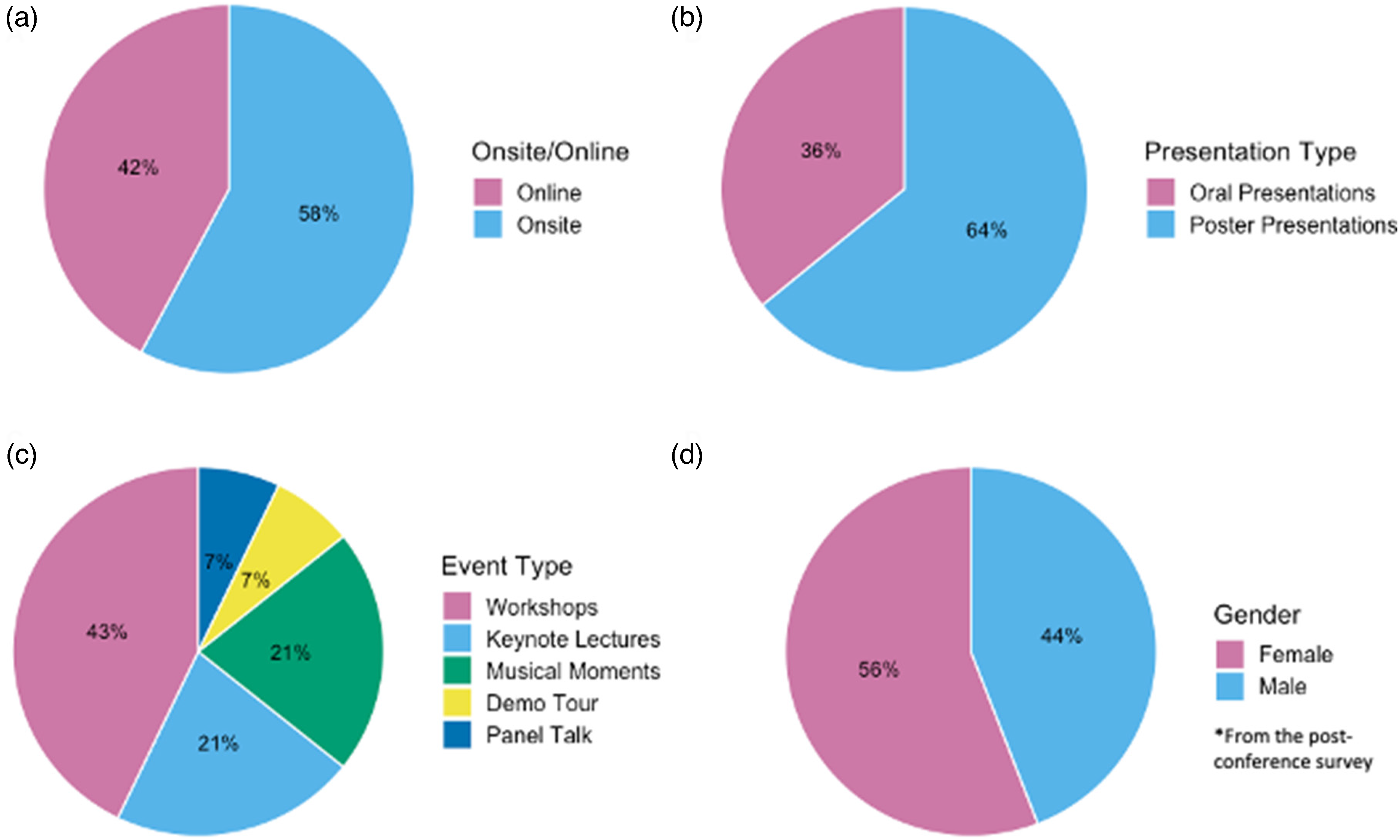
SysMus22 descriptives (as percentages). (a) Online versus on-site participation. (b) Presentation types: oral and poster presentations. (c) Event types: workshops, keynote lectures, musical moments, demonstration tour, and panel talk. (d) Gender of participants (from post-conference survey).
Participants came from many different countries, with the UK (28.9%), Germany (10.8%), and the Netherlands (8.4%) being the most represented, presumably owing to their close proximity to Belgium. Participants also came from Turkey, South Korea, and Colombia, to name a few other countries (Figure 2). The majority of participants (76%) were PhD candidates, but undergraduate and graduate students, as well as post-docs, were also present. This combination resulted in a friendly, diverse, and supportive environment of peers without the worry of having to meet the expectations of those in higher authority.
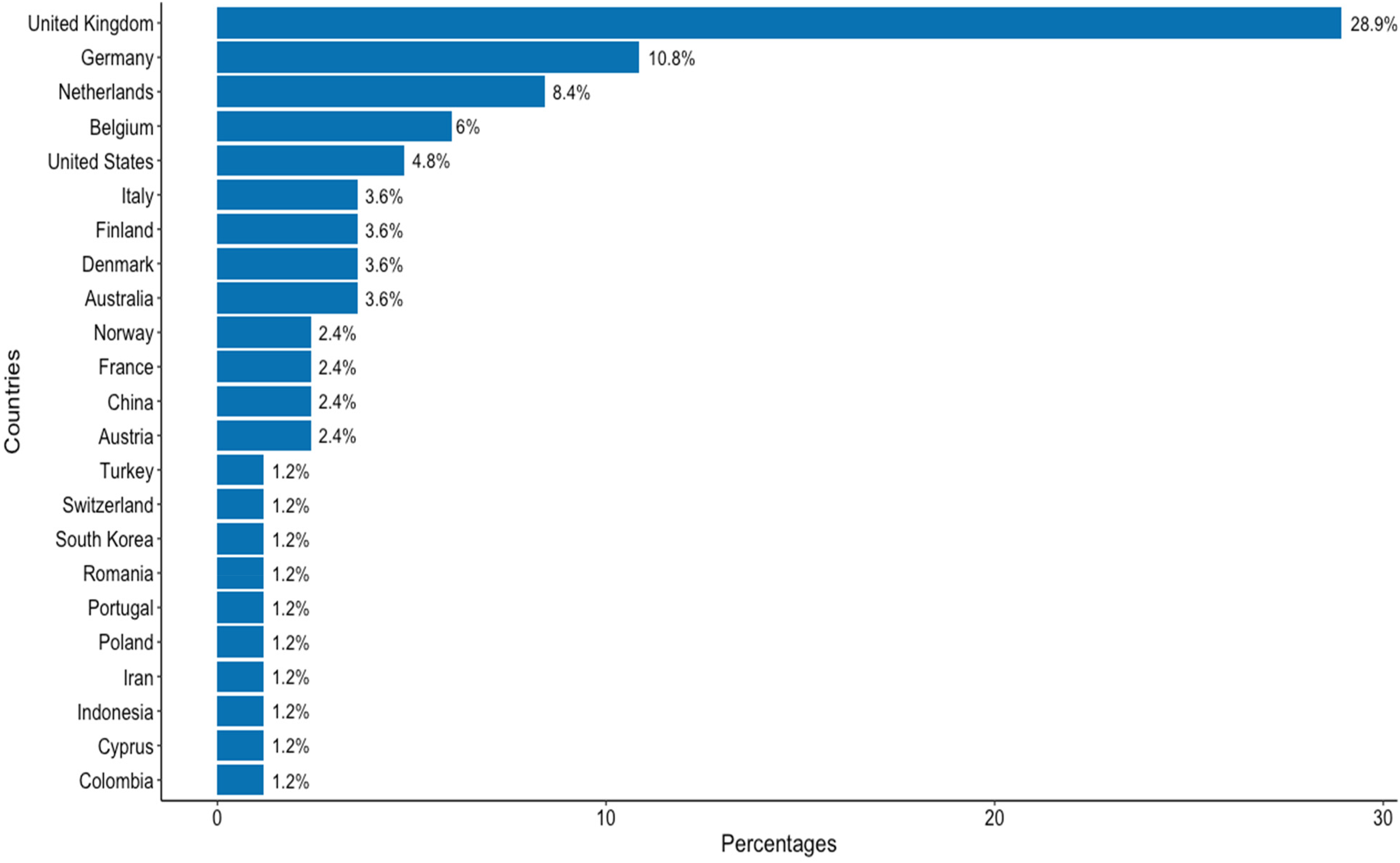
Country distribution of attending participants.
SysMus conferences, including SysMus19 (on-site, Kirk & Bresler, 2020), SysMus20 (online, Peck, 2020), SysMus21 (hybrid, Kiss, Guiot, Hashim, D’Aleman Arango, & Miguel, 2022), and SysMus22 (hybrid), increased in popularity as the number of presenters increased over the years (Figure 3), excluding SysMus20, when the COVID-19 pandemic hit. SysMus19 had the greatest number of oral presentations (oral = 34; poster = 13) of the 4 years, whereas SysMus22 had the greatest number of poster presentations, as well as the greatest total number of presentations (oral = 23; poster = 41). Although the number of presenters decreased at the start of the pandemic, SysMus conferences opened new doors to the hybrid world, where more people were able to attend either on-site or online and present their research internationally.

Four most recent SysMus conferences and numbers of attendees: SysMus19, SysMus20, SysMus21, and SysMus22.
The organizers catered to this high number of online attendees by trying to make the conference dynamic, interactive, and rewarding for virtual participants (see Section “Hybrid Format”). Another reason for employing a hybrid format was a focus on the conference's environmental impact. The carbon footprint of conferences uniting researchers across the globe is colossal (Klöwer, Hopkins, Allen, & Higham, 2020; Neugebauer, Bolz, Mankaa, & Traverso, 2020), and there is an increasing demand to make conferences more sustainable. The commitment of SysMus22's organizers was obvious in their communication; participants were expressly discouraged from flying to the conference unless absolutely necessary, a list of accommodation with a transparent estimated carbon footprint was published, and vegan options were available at every meal, with some meals being completely vegan. The organizers’ commitment to sustainability inspired and encouraged the early-career researchers to be more environmentally conscious in their own work and daily lives.
Keynote Presentations
The first keynote speech was presented through Zoom by Psyche Loui, Associate Professor of Creativity and Creative Practice at Northeastern University, and director of the Music, Imaging, and Neural Dynamics Laboratory (MIND Laboratory). Two main questions drive Loui's research: (a) Where does musicality come from? and (b) How can musicality be used toward the greater good? Loui's laboratory uses a combination of behavioral, neurophysiological, and neuroimaging methods. Here, she discussed older and more recent work on statistical learning, preference, and creativity, using a novel musical system that was unfamiliar to the participants; the Bohlen–Pierce scale (Loui, 2022; Loui, Wessel, & Hudson Kam, 2010).
The second virtual keynote speaker was Mendel Kaelen—a neuroscientist, musician, and entrepreneur, who focuses on the combination of music, neuroscience, and psychedelics. Kaelen is also the founder and chief executive officer of Wavepaths, a company inspired by his research on psychedelic therapy and the use of music as medicine. He considers psychedelic therapy a directive approach through research data, patient experiences, and musical examples. For instance, he reviewed how psychedelics notably modify music-evoked mental imagery (Kaelen et al., 2016), music-evoked emotions (Kaelen et al., 2017), and the perceived personal meaningfulness of music (Preller et al., 2017). Kaelen also discussed how person-centered music is crucial to apply psychedelic therapy effectively, safely, and ethically.
The final keynote speech was presented in person by Rebecca Schaefer, Associate Professor of Health, Medical and Neuropsychology at Leiden University, and director of the Music, Brain, Health & Technology Laboratory. Schaefer's group conducts research on psychological and neural processes involved in music, and how this knowledge can be applied to health and well-being. Starting with a primer on the relationships between action, perception, and cognition (Schaefer, 2014), and their relevance in music perception and production, Schaefer's talk was centered around movement sonification. More specifically, she discussed different ways that movement can be translated to sound, not only to maximize pleasure, but also to promote the rehabilitation of movement in clinical settings.
Panel
In addition to the keynote presentations, SysMus22 hosted a panel talk entitled “Immersive XR in Art and Science: A Future Outlook”, with speakers Marc Leman (IPEM, Ghent University), Konstantina Orlandatou (Hochschule für Musik und Theater Hamburg), and Ine Vanoeveren (MAXlab, Royal Academy of Fine Arts, Antwerp). The talk was moderated by Pieter-Jan Maes (IPEM, Ghent University). In this talk, the speakers discussed, together with comments and questions from on-site and online participants, how extended reality (XR) can be utilized as a new space for research, arts, and heritage interaction. To contextualize this discussion, Marc Leman presented an introduction to XR, with an emphasis on how one’s virtual embodiment is dependent on the relationship between action and perception, giving a sense of presence. Then, several examples of the implementation of XR in modern society were given, such as the interaction with old synthesizers in a virtual reality space, or a concert transmitted in an augmented reality space.
The panel discussion highlighted the transformative potential of XR in music performance, education, and interaction. Although the recent health context may have brought discussions about virtual interactions into the mainstream, hybrid digital performances and interactions in virtual spaces offer benefits beyond simply compensating for physical restrictions. While a traditional view may entail that real-life social interactions are essential to music education, performance, and composition, XR holds the potential to enable social interaction in a digital space that is just as authentic as face-to-face interactions. Digital replicas of exhibitions, concerts, and art installations can be experienced remotely, crossing geographical borders much like this conference. Furthermore, XR can grant spectators in a musical performance a more immersive and central experience than is enjoyed by traditional audiences.
Workshops and Demonstrations
To start the conference, all physical attendees were guided on a tour through the Krook building and observed demonstrations of the technologies and equipment of the IPEM research group. The demonstrations showcased wearable sensors for physiological monitoring, a motion-capture system for real-time skeleton streaming into XR (Qualysis), real-time audio tracking (Zacktrack), immersive audio experiences (TiMax), a spatial-audio composition (BeingHungry), a spatial-audio composition system using virtual reality (VR), and a VR system that allows one to relive the sound world of IPEM in the 1960s. Additionally, Claudia Stirnat brought an interactive spatial music (sound) installation, which uses binaural synthesis, to IPEM. For the virtual attendees, several related videos were showcased on the Mozilla Hubs platform. The demonstration of these various technologies formed an inspiration for attendees to consider in their future research.
Attendees were also able to sign up for one out of three workshops held on each of the first 2 days of the conference. Three workshops were held on the first day. First, during “Introduction to spatial audio and room acoustics” (Bart Moens), participants explored and created a spatial-audio piece on an 80-speaker setup, and learned about higher-order ambisonics and room-acoustics simulation. The workshop “Analog and digital sound synthesis” (Bavo Van Kerrebroeck) taught attendees about digital sound synthesis using Max MSP and analog sound synthesis using the EMS Synthi 100. The third option on the first conference day was “Research in the wild” (Maruša Levstek), which demonstrated methods for conducting research outside of the laboratory, such as surveys, interviews, focus groups, observations, and video ethnographic approaches.
The last three workshops were available on the second day. The first workshop “Introduction to motion capture for performance” (Adriana La Selva & Ioulia Marouda) allowed participants to create a dancing score, using the Qualisys tracking system, which also taught them about skeleton creation, data clean-up, and exporting for game engines. Second, “Interactive settings for interacting brains: Dual-EEG approaches in music research” (Mattia Rosso) demonstrated the setup of a dual-electroencephalography (dual-EEG) recording for a joint rhythmic task, followed by a discussion on hyperscanning (i.e., simultaneous recording of brain activity from several participants), and a question and answer session with a representative of the manufacturer of the showcased EEG system, ANT Neuro. Finally, “SpotiPy: Getting started with APIs for music research” (Rory Kirk) demonstrated how to use Spotify's API (i.e., application program interface) in Python, and discussed the applicability of the information that can be obtained from Spotify in music research. This total of six workshops is the widest selection offered at a SysMus conference thus far, and enabled attendees each to select two workshops to their liking. All workshops provided beneficial introductions to practical skills for early-career researchers in systematic musicology.
Presentations and Posters
This year, 16 of the oral presentations were presented on-site, whereas 7 were remote and broadcast in the conference room. Reflecting the diversity of SysMus’ subject areas, the presentations were divided into six sessions, covering the following topics: neuroimaging (e.g., on age-related changes in neural processing of vocal music); computational approaches (e.g., on using large-scale multilingual datasets to analyze song lyrics); socio-emotional functions of music (e.g., on goal-directed mechanisms influencing music-induced emotional episodes); psychology (e.g., on the use of memory-based games to unravel our capacity for music); systematic musicology (e.g., on the characteristics of music that are used for sleep); and music, health, and well-being (e.g., on musical imagery as a relaxation technique).
The poster presentations were held entirely online on the Mozilla Hubs platform (Figure 4). On each day, the posters could be found in two different rooms inside the platform, with approximately 10 posters in each room, encompassing a total of 41 poster presentations. The posters, like the presentations, reflected a wide array of topics within systematic musicology. Additionally, this year, three posters received a “Best Poster Award”, sponsored by the Society for Education, Music and Psychology Research (Sempre). The winning posters were “Depict or Discern? Fingerprinting Musical Taste” by Kristina Matrosova, “Effective Practice and Performance Preparation Interventions for Tertiary Music Students: A Systematic Review” by Akiho Suzuki, and “Learning Apps Can Help Ear Training by Targeting Music Perception Problems” by David Munive Benites.
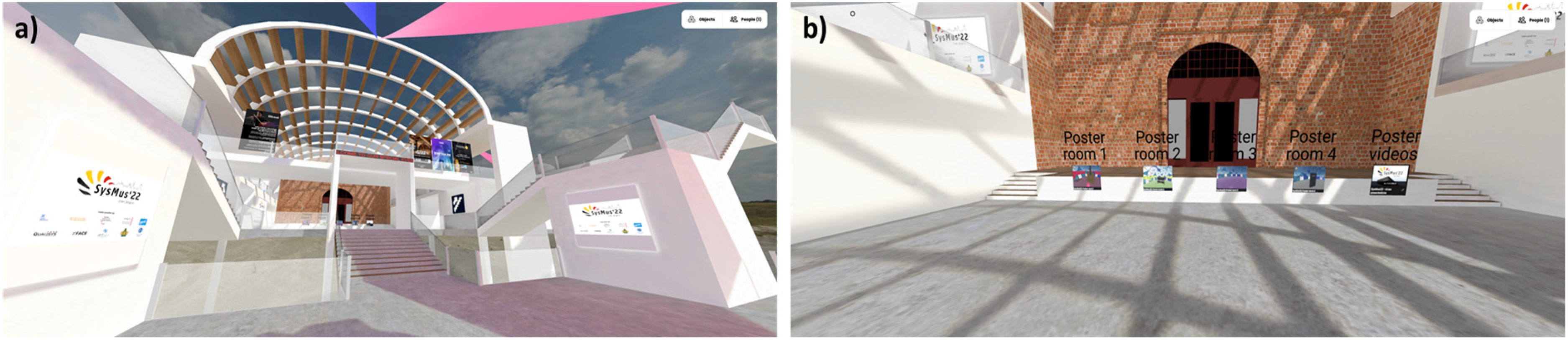
SysMus22 Mozilla Hubs platform. (a) Foyer. (b) Four rooms for posters and one room for poster videos (Permission to use the screenshots from the platform has been granted by the SysMus22 committee).
Overall, the conference showcased excellent research that may inspire new collaborations and research directions in systematic musicology. Innovative approaches, such as neuroimaging and computational techniques, demonstrated the field's adaptability to new technology. However, since most research focused on the psychological aspects of music, future conferences could benefit from a wider range of perspectives, including those from music theory and philosophy.
Social Activities
The 2022 installment of the SysMus conference included various social and musical activities for all its participants, both on-site and online. The first-day activities began with a guided demonstration tour for the on-site participants, in groups. Grouping participants together allowed for more comfortable and closer interaction, particularly for those meeting each other for the first time. A musical intermezzo was also showcased for all participants, performed by Bavo van Kerrebroeck and Mattia Rosso (IPEM members). The second-day activities included dinner at the restaurant Madonna with a live performance by Holy 7, a Balkan orchestra, for on-site participants, and a movie night for the online participants, on Zoom. The last day included a Belgian frituur lunch at the venue, and the conference ended with a jam session and open stage. The organizers provided instruments and arranged pieces in advance for a smooth musical activity. Next year, the addition of a karaoke night may spark even more musical activity, in particular for those who deemed themselves not musically gifted enough to participate in a jam session.
Hybrid Format
The hybrid format of the conference enabled participants to attend in person or online. The organization of this format was generally favored by the participants, as it ensured that any student researcher, irrespective of geographical location or financial situation, could participate. As a result, the conference reduced its carbon footprint, as initially intended by the organizers, while maintaining a global atmosphere where peers from all over the world could share their ideas. It also provided easy access to most of the conference activities. Two of the six workshops, “Research in the wild” and “SpotiPy: getting started with APIs for music research”, were available to both online and in-person participants. As previously mentioned, a movie night was organized for the online attendees; this was streamed on Zoom on the second day of the conference. The organizers did their utmost best to involve the online attendees as much as possible, being aware that remote attendance can feel somewhat isolating.
Zoom and the Mozilla Hubs platforms were used throughout the conference. Zoom was utilized to live-stream all talks and the musical intermezzo to the online participants. The online participants asked questions and communicated by using the Zoom chat function or raising their virtual hands. Presenters’ videos and slides were shared on the ‘shared screen’, and the cameras showed the speakers and the general audience. The ability for remote presenters and attendees to see the on-site audience was a nice addition and improved the sense of connection between those online and on-site. By contrast, the online demonstrations and poster presentations took place on the Mozilla Hubs platform – a three-dimensional virtual space, where the attendees were able to move and talk with each other either by using their computer keyboard, mouse, and speakers or VR headsets. The virtual venue (Figure 4) contained a foyer, two demonstration rooms, and four poster rooms; access to this venue was open at all times, even some time after the conference ended. The online participants also had a separate Zoom group, where one of the organizers provided online instructions for the attendees. Formal and informal personal communication was encouraged on online platforms.
There were some drawbacks to the hybrid setup. For instance, there could have been extra spaces on Mozilla Hubs or another online platform for social mingling between all participants. One possibility could be the display of tables in a virtual foyer, where the on-site and online participants could have allocated time to socialize with each other, as experienced during the previous SysMus hybrid conference (Kiss et al., 2022). Moreover, there were some limitations of Mozilla Hubs, where it was not obvious for the participants that they could turn on their camera, since participants seemed to prefer seeing people’s faces instead of only their avatars. In addition, comprehension was sometimes impaired, owing to ambient noise, when the poster presenters were speaking. However, these minor technical setbacks did not prevent researchers from having fruitful discussions and exchanges, regardless of their locations.
Closing Remarks
SysMus22 was a remarkable conference with high-quality research presented through talks, posters, workshops, keynotes, and a panel talk. The well-organized conference created an engaging and comfortable atmosphere between participants for sharing research and networking. Owing to COVID-19 and the limitations it creates, no travel grants were offered for this conference. However, the hybrid nature of the conference made it possible for participants from 23 different countries to attend, aligning with the importance of diversity and inclusivity, and gave a viable option for researchers who would not have been able to attend for various reasons (e.g., disability, or geographical or economic difficulties). The next hybrid conference, the 16th International Conference of Students of Systematic Musicology (SysMus23), will be held at the University of Sheffield, UK, and will be organized by PhD students at the university’s Department of Music and Music Mind Machine Research Centre.
Footnotes
Action Editor
Ian Cross, University of Cambridge, Faculty of Music.
Contributorship
All authors were involved in developing the concept and design, writing, editing, and reviewing the report. CA contributed to data visualizations. All authors approved the final version of the manuscript.
Declaration of Conflicting Interests
The author(s) declared no potential conflicts of interest with respect to the research, authorship, and/or publication of this article.
Ethical Approval
This research did not require ethics committee or institutional review board approval. This research did not involve the use of personal data, fieldwork, or experiments involving human or animal participants, or work with children, vulnerable individuals, or clinical populations.
Funding
The author(s) received no financial support for the research, authorship, and/or publication of this article
