




Abstract
The different labelling systems defined by the functional theories of harmony have been developed from about 1870 to 1950, without the help of computers. The complexity of harmonic labels spans from pure triads over added characteristic dissonances, over alterations of the fifth, up to non-chord notes like suspensions. Computer-based evaluation of functional label expressions shows that thereby their cardinality increases up to several thousands. For this, we present the basic theory, a concrete program implemented in Prolog, and some empirical results. The software is capable of analysing historic published analyses by inductively collecting all appearing labels, as well as theories as such, where the set of labels is given deductively, by regular expressions. A major application is the mining for possible modulation chords, i.e. different functional labels which result in (enharmonically) the same pitch classes. That this strategy had actually been applied by composers manually is explained by significant examples from the Romantic period.
Keywords
Aspects of Functional Harmonic Theory
Historic Origin
The origins of functional harmonic analysis were established by Jean-Phillipe Rameau ([1722]1965). The basic idea is that particular patterns of interval structures and of chord sequences have a characteristic effect on the listener, which is independent of most other aspects of a musical work. Influential publications by Weber (1817), Fétis ([1844]2008), Hauptmann (1873) and many others followed. The functional analysis in the narrow sense was defined by Hugo Riemann. He developed in a series of publications (Riemann 1877, 1880, 1895, 1918) an evolving theory which brings together different aspects: the underlying acoustic phenomena, chords’ structures and relations, and tonality, culminating in the inner representation by the receiving mind. The different stages of his theory were accompanied by an evolving symbol system, in which combinations of letters, numbers and graphical signs express the relations between chords and tonal functions. The symbols can be used to label concrete examples of written music for notating their assumed inner logic or a possible way of reception, see for instance Figure 3. They can also be used stand-alone to speak more precisely about abstract harmonic patterns, independent from a concrete musical realization and even independent from a particular musical key, as in Table 1.
Categories of Ambiguities, with Examples.

Successively, many different functional theories have been developed, each with its own symbol system. They are all based on one of Riemann's original proposals, but vary in different ways (Marschner (1894), Oettingen (1913), Erpf ([1927]1969), Karg-Elert (1931), Keller (1957)). For a survey, see Imig (1970). The only ones which survived in pedagogical practice (Imig 1970, p. 223) are the systems based on the variants by Grabner (1923) and Maler (1931), hereinafter called GM-style.
Different Semantics of Functional Terms and Their Relations
As discussed in detail in Lepper et al. (2022a), different semantics can be assigned to a sequence of labels from a functional labelling system. In most use cases, the author of a labelling sequence intends to apply several different semantics simultaneously, for expressing a combined interpretation. Let two extreme positions be called S-m and S-p. Semantics S-m try to model the mental reception of the labelled music fragment or the abstract chord sequence.
To the classically attuned ear, the identification of the tonic immediately evokes a hierarchization of the constituent tones and chords, intuition about their context free proximity, a syntax that governs component ordering, and [..] semantics, [..] which symbolize a rich network of overlapping metaphors: […] energy, gravity, attraction, magnetism, discharge, orientation, centre, departure and arrival, return, passing, neighboring, leading, deception, completion/incompletion, suspension, finality, stability/instability, and so forth (Cohn 2012, p. 178).
All these aspects can comprise the semantics S-m, when the author of an analysis selects a particular functional label for a particular event, sounding or notated.
Let (in any pitch organizing system) a pitch class stand for the equivalence class of pitches up to the octave. Then the semantics S-p are just a collection of pitch classes which make up the chord (or at least a part of it) to which the label is attached—an automatic translation coming with no further claims for meaning.
Basic Principles of Functional Chord Labels
Functional chord symbols consist of two parts: a sequence of letters gives some pitch class as the root of the chord, relative to the currently valid tonic centre. The characters
The characters can be followed by a sequence of numbers and modifiers which give the components of the chord. Each such component, including the root, is a pitch class corresponding to one or more pitches contained in the concrete sounding musical event. Each number specifies one component by the numeric name of the interval from a pitch representing the root class upward to a pitch representing the component. The modifiers qualify this interval as major, minor, diminished, augmented, etc.
For a compact notation, the pitch class of the root, the third and the fifth are assumed to sound implicitly; the quality of the third (major or minor) is indicated by upper or lower case of the last character. These implicit sounds can be suppressed by the dedicated modifier ‘
Modulations
All textbooks analysed by us agree that central interest lies on the analysis of modulations. (Distler (1940), Lemacher and Schroeder (1958), de la Motte (1976), Andreas and Friedrichs (1986), Kretschmer (1987), Krämer (1997) and others) These are the harmonic processes (or chord sequences) which cause a change of the feeling of the current tonic centre by the listener. In most labelling systems they are notated by stacking two lines of symbols: the first describing the reception/interpretation relative to the ruling diatonic centre when entering this passage; the second relative to the new diatonic centre reached at its end, see Figure 3.
The role of a modulation can vary: for example, it can be intended to be noticed explicitly as such, or contrarily as a mere subconscious effect, see de la Motte (1976) for a discussion. Independently of this formal and dramatical role, only with respect to the sounding pitch classes, textbooks agree that there are three types of modulations called diatonic, chromatic and enharmonic (Geller (2002), Hussong (2005), Acker (2009)). We have not yet found a single consistent definition of chromatic modulation, but the others are always precisely defined:
The simpler diatonic modulation takes a simple triad which fulfils a particular function in one particular first diatonic context and re-interprets the same triad with the same root pitch class as a different function in the target context. This operation can only be applied to a simple triad of form
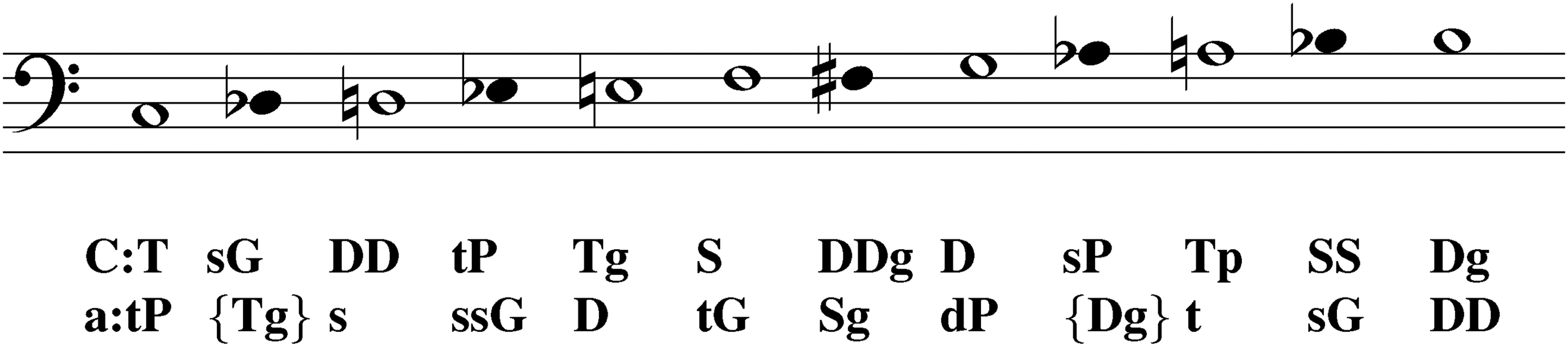
Examples of how to reach every step of the chromatic scale by functional expressions. Terms in braces {…} describe the enharmonically exchanged pitch class.
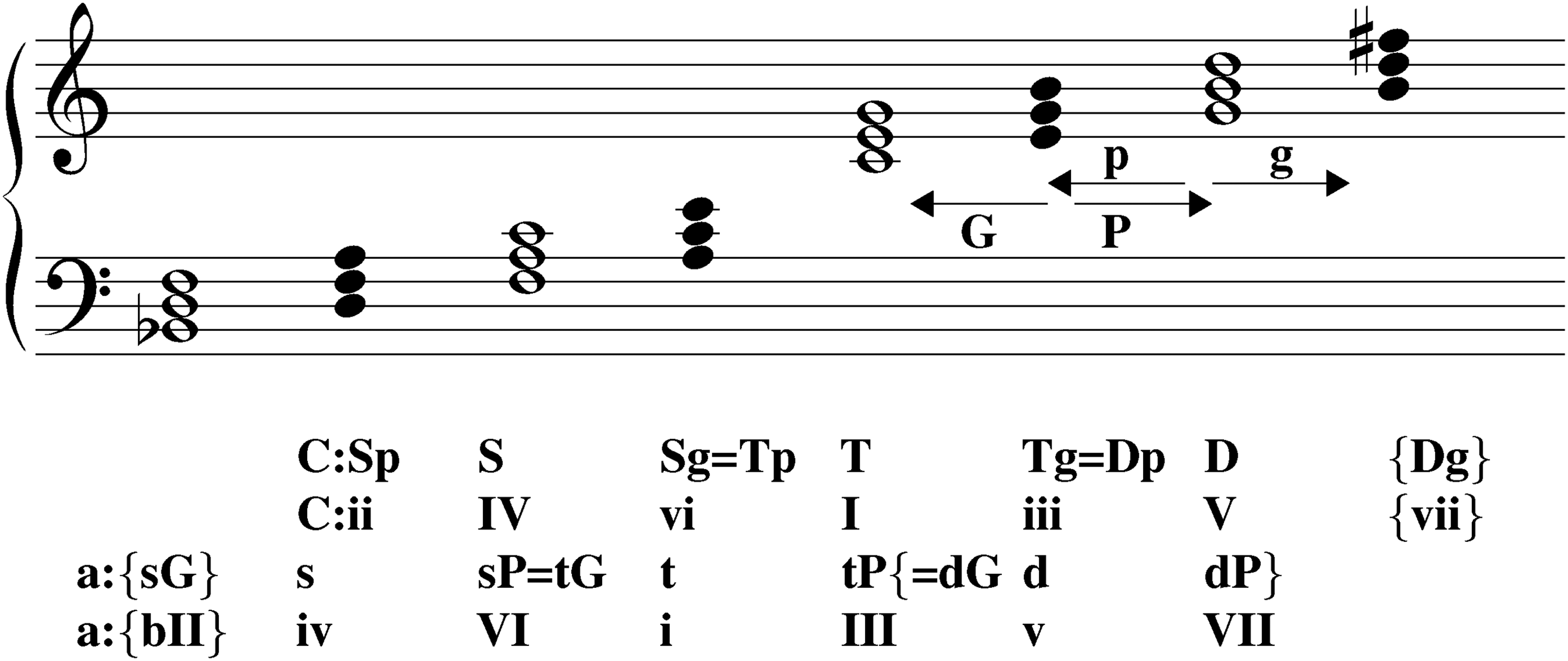
All functions of major and minor key arranged by the circle of fifths. Terms in braces {…} do not belong to both diatonic keys (even not to the ‘extended tonality’ which mixes major and minor mode = ‘Mischung’ by Schenker) because they need (a) additional accidentals or (b) the minor chord on the fifth scale step.

Examples of ‘utmost far’ diatonic modulations.
Enharmonic Modulations, Functional PC Set Homonyms and Keyboard Patterns
Enharmonic modulation is quite different: it does not re-interpret the roles of the same triad and root pitch with respect to two different diatonic contexts but rather the role of the chord's components with respect to two (nearly always) different root pitches. As long as no non-chord notes are involved, this requires at least one of the chords to have a complex
The upcoming predominance of equally tempered twelve-tone tuning and the keyboard for theory, demonstration, teaching and composing in the eighteenth century allowed these new harmonic patterns, in which one particular set of pitch classes (or one particular keyboard grip) is interpreted as different functions relative to different root pitches and thus to different diatonic contexts. This can happen successively to modulate from one such context to another, or simultaneously to add an additional aura to a seemingly unambiguous function.
In contrast to notated pitches, the keys of the standard keyboard represent enharmonic pitches. Their classes up to the octave are enharmonic pitch classes, called EPCs by Hentschel et al. (2021a). Sets of these classes are the subject of pitch class set theory (Forte 1973) and are called pc sets.
As a consequence, in the mind of musicians at least two classification grids for chords are applied concurrently: the functional interpretations, representing all the energies and tendencies listed above, versus the mere mathematical logic of the resulting ‘neutral’ pc sets. 3 These can be reified as concrete keyboard patterns, collapsing representatives of all pitch classes into one octave. Many composers (including Beethoven and Wagner) used the keyboard as a kind of ‘harmonic abacus’ for ‘manual’ exploration of modulations and harmonic proceedings. In this process, the mental image of functional relations and the functionally neutral patterns of keyboard grips, corresponding to pc sets, permanently co-exist and possibly conflict or co-operate. 4
Therefore it is a valuable preparatory step for the harmonic analysis of late Classical and all Romantic music to find and classify all those different terms from a functional harmonic symbol system (functional label together with a diatonic reference pitch) which produce identical pc sets. In this article these terms are called (functional pc set) homonyms. The related theory and software for their automated detection and classification set the theme of the
Functional pc set homonyms can become important in at least two aspects: they can (a) be employed by the author explicitly, as the tertium comparationis to change the functional context, as the common chord in a modulation. But they can also (b) influence the reception of a piece of music by inducing the reminiscence of the other diatonic sphere, possibly without transgressing the threshold to consciousness. 5 We call these the pivot role and the auratic role, respectively.
Our agenda for the exploration of functional homonyms is (1) to manually analyse some simple and small functional labelling systems, and in the process (2) to derive classification grids and strategies. Then (3) these are implemented by a computer program, which is (4) finally applied to a realistic labelling system, which is beyond manual analysis due to its prohibitive size. As a by-product, we get a classification grid for the types of homonyms, see Table 1, which will be explained later, when the first examples have been constructed.
Modelling Functional Symbol Systems in the FunCode Project
The
‘Semantics S-p’ in a precise sense means mapping rules from sequences of symbols to sequences of sets of pitch classes. (Not necessarily enharmonic pc sets!) This re-formulation is not only for the execution by computer systems. A more important goal is to assign mathematically sound semantics to all possible syntactical combinations. Therefore, a subset of the programming language Prolog has been chosen for the implementation, because it comes with precise and explicit mathematical semantics. Carefully chosen Prolog clauses can be directly read as the axioms of a mathematical specification. This is not so easy with other programming languages, which may be better suited for fast and efficient programming. Lepper et al. (2022b) publish the source text in the style of ‘literate programming’, which combines program listings and explanatory text. These semantic definitions are intended as a translation target for other symbol systems from historical music theory, to make them comparable and discussable by humans on a precise basis, and possibly even mutually convertible by automated processing.
Mining for Homonyms in the FunCode-pcSets Sub-Project
According to the derivation of pitches and chords in classical functional theory from psychological and physical hypotheses, the pitch classes in the
Intention and Operation of the Prolog Implementation
The symbol systems of functional theories were developed from about 1870 to 1950, without any help from automated processing by computers. The manual analysis executed by their authors could only cover the chords of the first, most basic construction steps and cannot be considered complete. The work reported here applies programmed execution (by Prolog software) to different functional symbol systems.
The basic definitions of the interval numbers, modifiers and the set of the allowed combinations of root symbols and intervals (for chord notes and non-chord notes) are given to the algorithm as parameters. It calculates all possible chord forms, sorts them according to the normal form of the resulting pc set and delivers statistical data, based on several measures of chord complexity.
There are two use cases: (A) The set of expressions can be defined in a normative way, by prescribing the set of all possible terms by a regular expression. This can be appropriate when processing a particular theory. The examples in the article follow this first strategy.
The other use case (B) follows the inductive approach by collecting all the expressions found in a particular analysis or group of analyses and adding them step-by-step to the Prolog database. In this case, a normalization of the chord component list is required, to eliminate duplicates.
7
The applicable evaluations are the same in both cases:
For a particular pc set and labelling system, all possible interpretations as function terms can be retrieved. For a particular labelling system, all generated pc sets and all pairs of homonyms can be listed, in detail or summarized. All these inquiries can be filtered by value ranges for different complexity measures, to separate practically relevant combinations from extreme artefacts. All the results can immediately be visualized for the user, or retrieved as Prolog data for further processing. Importing Prolog evaluation results into a language which does not know backtracking (such as Python, R or Matlab, all widely used in music theory) can only be done by encapsulated search. This can be done, for instance, by starting SWI Prolog via its command line interface and employing its libraries for JSON or CSV export.
The software is publicly available under the CC-BY-NC-SA licence on a public source hosting platform, under the project name
Structure of the Following Text
The following section presents a sequence of labelling systems with increasing complexity (
The next section presents the labelling system i4, which introduces the use of non-chord notes. It contains 1,903,364 pairs of homonyms and thus requires automated analysis, which is demonstrated in practice. As a pre-requisite, the programming needs a new classification scheme for suspensions and retardations, a further by-product (Table 7).
The last sections discuss the psychological effects of functional homonyms in general and present a summary of the results.
Stepwise Increasing Complexity of Functional Chords; Manual Analysis Still Possible
Simplest Labelling System i1: Characteristic Dissonances Only
There is a wide variety of functional theories and corresponding labelling systems. All of them describe (possibly in slightly different sequential order) four ways of deriving more complex chords, starting from the plain major and minor triad:
α Addition of further pitches in the distance of a third—the characteristic dissonances. β Cancelling of chord components, especially of the root. γ Chromatic alteration. δ Replacing chord notes by non-chord notes.
Operation α adds chord components beyond the root, third and fifth, which are nevertheless considered genuine chord tones. These are the characteristic dissonances. They link particular chord forms to particular fundamental functions and go back to Rameau ([1722]1965).
Each chord in a dominant role must be a chord with a major third, because only in major mode can it serve as the leading tone into the root note of the tonic.
8
Such a dominant can additionally contain a minor seventh, in
The subdominant can appear in major or minor mode and can additionally carry a sixth, called ‘sixte ajoutée’. The question of which kinds of sixths are allowed with a subdominant of a particular mode is controversial among theorists. All textbooks analysed by us (Distler (1940), Lemacher and Schroeder (1958), de la Motte (1976), Andreas and Friedrichs (1986), Kretschmer (1987), Krämer (1997) and others) agree on allowing the major sixth
For all these characteristic dissonances, voice leading rules are defined which prescribe their ‘normal application’—e.g. ‘the seventh of the dominant goes down to the third of the tonic’ or ‘the sixte ajoutée goes up to the third of the tonic.’ This article abstracts from these rules and all application contexts as far as possible.

All chord forms from i1, a first most simple example labelling system.
Regular expressions for the example instances.

The current text is about chord forms only—the functional context of the chords is ignored. Therefore, the letters
With the simple collection

All homonym pairs in labelling system i1.
Categories of Homonyms
The basis for any enharmonic modulation is thus a pair of homonyms, as defined above. (The German term, sometimes also used in English literature, is ‘Mehrdeutigkeit’, which can be translated as ‘ambiguity’.)
Every pair of homonyms falls into one of the different categories defined in Table 1. The top line of this table shows symbolically that the two pc sets into which the functional expressions evaluate are always the same. A global property is whether one or two of the functional expressions involved are of type
In cases A-1 to A-4, the functional expressions are different. In cases A-1 and A-2, the pitch classes, to which the expression is applied as its root, are the same. In case A-2, the root symbols (ignoring upper or lower case) are different. Therefore, the pair can be used for a modulation between two tonics at the distance of two fifths: the same keyboard pattern (pc set) serves as dominant for one tonic and as subdominant for the other. The homonyms (
Case A-1, in which the root symbols (up to case) are identical, cannot happen with genuine chord pitches only, because the characteristic dissonances are defined unambiguously—hece their name. Case A-1 will later be filled with more complex chord sets, by non-chord notes enharmonically identical with other pitches, like
Much more frequent will be the ambiguities from cases A-3 and A-4, where the root pitch classes are different. In case A-3 (identical root symbol), their interval immediately gives the interval between the tonics involved in a modulation; in case A-4 (root symbols
The category A-5 is fundamentally different and will be explained in the next section.
Example Labelling System i2: Applying Derivation
; Cancellation of Chord Components
In functional theory, the cancellation of a chord component means that a pitch class can be removed from the concrete sounding event without affecting the psychological effect of the complex chord constructed so far. This operation (
It is understood that characteristic dissonances cannot be cancelled, because then they would not have to be introduced in the beginning. And the third of the dominant cannot be cancelled, as it is the leading note required for the dominant to work as such.
The most important cancellation is

All additional chords for i2 by applying cancellation
(DD-6) = we did not give any cancellations to the subdominants. (DD-7) = the dominants got all possible cancellations, namely the free combinations of that of the root, which is indispensable because it is the most important, and that of the fifth.
Due to the more complex chord structure with ‘holes in the middle’ we get a further ambiguity with the same root symbol

Two more pairs of homonyms from the expression language i2, thanks to cancellations. (The small note heads in the lower system are added only for explanation and not contained in the homonyms.)
A unique case is e + g + b
But even more important are the first instances of A-5, where the functional expression does not change at all. This implies that the roots to which it is applied are different. And because the resulting pc set is nevertheless the same, it follows that the chord structure is symmetric by rotation.
The first examples are the chord
Please note that the category of ambiguity A-5 opened with these two chords is fundamentally different from the categories with different functional expressions—a distinction not always made clear by textbooks.
Example Labelling System i3: Applying Derivation
; Alteration
The term ‘alteration’ in English literature is used in significantly different ways, and even more so (‘Alterierung’) in German. In the widest sense it just refers to a chromatic change of an arbitrary chord component. In the narrowest sense, which is used in this article, it is restricted to a chromatic change which strengthens a step-wise tendency which is already inherent in the chord.
Therefore
It is a matter of taste as to whether the
A similar issue applies to whether the root of a subdominant can be raised (DD-8) or lowered (DD-9). Lowering can only happen when the following tonic is minor—otherwise the lowered root would enharmonically only be an anticipation of the tonic's third. 16
The root of
A major design decision (DD-10) is whether the
But the main candidate for alteration is the fifth of the dominant. In the standard resolution, it can go in both directions; therefore it is a candidate for
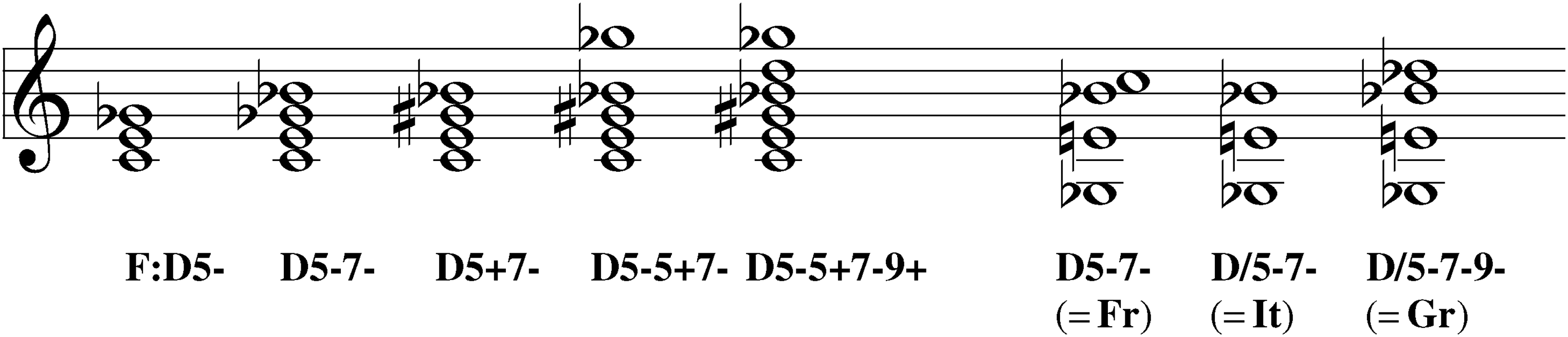
Examples for alteration of the dominant's fifth and their historic namings.
This alteration of the fifth opens a plethora of new ambiguities. A manual analysis of these chords is still possible, but only because both the segments limited by the seventh and the third will be filled by a free combination of alternatives which produce exactly the same intervallic structures. Table 3 shows the resulting variants. (The term
Dominant chords from example set i3 using γ, the alteration of fifth, shown as keyboard patterns = chromatic keyboard distances. In the number stacks from the headline, the (major) third is the lowest pressed key—in all others it is the (minor) seventh.

Due to the construction principle, all combinations of the diagonal are rotationally symmetric by six keys/halftones, i.e. by the interval
The two half patterns <24> and <42> are mutual rotations, therefore also the doubled patterns in their fields on the diagonal, see the frames in the Table. This is a special case because these expressions cover both categories A-3 and A-5 from Table 1: The pc set c + d + f
All fields mirrored at the diagonal yield the same key pattern when applied to two roots at the distance
A special case is that the rotationally symmetric half pattern can become adjacent to the distance 2 from the other half-pattern, making each of the four combinations rotations of each other. So they are the first entry in category A-3 where four functional terms are involved.
Therefore we get eight pairs of homonyms and one quadruple. From
Automated Analysis
Applying Automated Analysis to the Simple Models i1 to i3
Table 4 documents the fundamental functions to operate the software. Programming and testing has been done for SWI-Prolog (threaded, 64 bits, version 8.3.29, https://www.swi-prolog.org), but the code is not too specific and should run also on other implementations.
Fundamental commands to operate the Prolog implementation.

A labelling system is defined by one or more calls to
Each pc set class is represented by that pc set which gives the smallest number when its bit set representation is read as an unsigned binary integer. This pc set is called the normal form of the pc set class; the corresponding number is called its (class) number. 20
When loading the accompanying Prolog source
Interactive input
Output of pc sets and corresponding functional expressions when executing

Every headline shows a pc set class in its normal form. The first visualization is the list of pitch classes as one-digit numbers in base 12, with
If the pc set class is in itself rotationally symmetric, then the corresponding rotation angle ( = shift interval) is shown at the end of the line.
The functional expressions appear below the pc set. They are followed by five one-digit numbers, again without separator and in base 12. The first integer d is the distance of the resulting pc set to the normal form of the pc set class as printed in the headline: when the functional expression is applied with the pitch class ‘
A comparison of Tables 6 and 1 shows the identity of programmed and manual analyses, thus far.
The auxiliary command
The command
The printed interval is that between two tonics to which the expressions are related in functional theory. It lies between 0 and 6, because for larger values the two expressions will be swapped. It is a primely theoretic value; in a concrete musical setting this distance may differ: (a) each of both chords which happens to have the chord form
Output of homonym pairs when executing
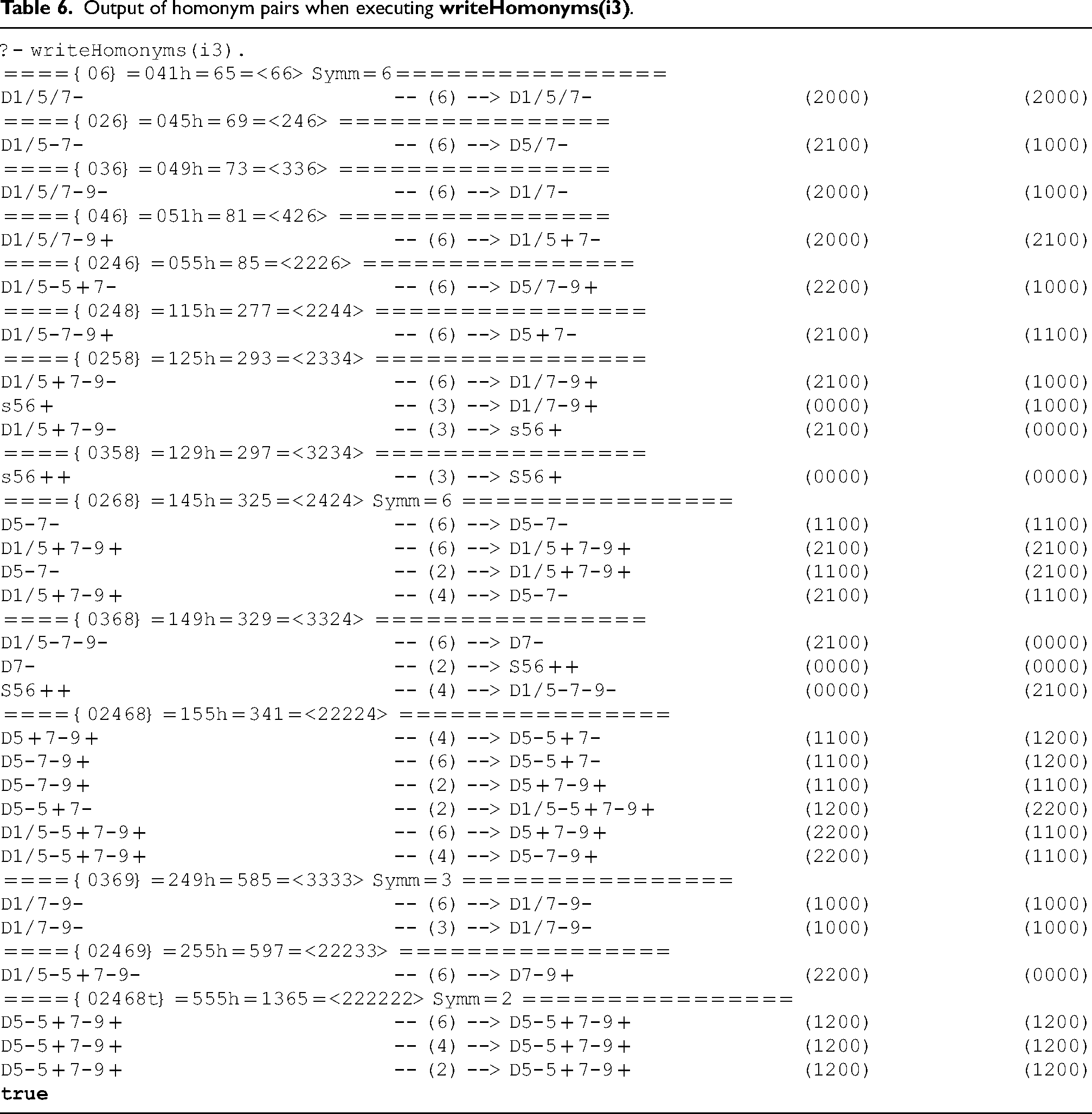
The auxiliary function write
The interactive command
Example Labelling System i4: Replacing Chord Notes by Non-Chord Notes
The last operation
In a psychological interpretation of functional labelling, the non-chord notes are perceived as a second, sub-ordinated level of tension: first the listener expects the chord to be ‘cleared’ (by resolving the suspension, by the passing note reaching its target, etc.), and then the chord can proceed as a whole, as required by its functional role. Correspondingly, in reduction analysis (Schenker 1935; Lerdahl and Jackendoff 1983) and all theories based on perception hierarchies (on which McFee et al. (2017) give a recent survey), the non-chord notes are the first to be eliminated. Nevertheless the additional ‘aura’ added to the sound by briefly touching other chords and functions should not be neglected. Furthermore, historic development shows an increasing emancipation of these notes from their original contexts, for instance in jazz harmony, where
Adding non-chord notes increases the numbers of homonyms beyond the feasibility of manual analysis. This is where computers become indispensable. Table 7 shows symbolically a sensible disposition of non-chord notes. The modifier
Non-chord notes for the different chord types, expressed by interval specifications.

The table says that every chord form can get the retardation
The next chord note, the third, can be replaced in a similar fashion—the possibilities for minor and major are different because of the different distances: An augmented fourth
The fifth is even more complicated.
Characteristic dissonances are chord-owned pitches, so they can be the subject of suspensions or retardations. This leads to
Putting these pieces together we get the regular expression for set
Non-chord notes always have an auratic effect, which can be more or less significant. A most impressive example is the passing note g in the bass of Figure 13(b), anticipating the minor mode of the next measures, dialectically in an upward movement, and referring back to ‘Brünnhild's awakening’ more than 10 minutes ago. But non-chord notes can also be used in a pivot role: the examples in Figure 9 are just artificial, but the second one only makes explicit the auratic relations from Figure 11(a). All the more important is a systematic exploration of the resulting homonyms, which cannot be sensibly done without automated processing.

Non-chord notes used in modulation pivots, marked by the boxes. The eureka operator ‘
Filtering and Analysing Chord Forms and Homonyms
Figure 10 shows a sensible context of an expression chosen from c1 The number of own chord pitches which are affected (by a non-chord note, by alteration or by cancellation). c2 The number of additional non-chord pitch classes which sound in the chord. c3 The number of own chord pitches which sound together with a related non-chord pitch. c4 The number of pitches resulting from more than one chord component. c5 The number of chord notes which are affected by two non-chord notes (mostly one from above and one from below). c6 The number of chord notes from c5, which are themselves sounding ( = the intersection of the contributors to c3 and c5).

A homonym pair from the labelling system i4. The first expression has been chosen at random from the complexity class (2,2,1,0), to demonstrate that the use in the pivot role is still sensible. (This full-fledged
Whether cancellation counts for c1 is controlled by the Boolean style parameter
Measure c4 can be increased by combinations of suspension and retardation as in
Measure c5 = 1 is the characterization of the ‘doppelte Leittoneinstellung’ (‘double framing by leading notes’, Maler (1931)) and the resulting ‘Scheinfunktionen’ (‘pseudo functions’), see next section for examples.
Surprisingly a limitation of c6 can exclude even only moderately modern situations, see Figure 12(b).
Some logical implications may be useful. Under ¬(


But the real borderline depends heavily on genre, epoch and style: replacing more than half of all notes is often found in Romantic music, see the chord marked (x) in Figure 11. (‘Lausch, Geliebter’ from Tristan II.)

Examples for extreme pitch combinations in Tristan und Isolde: (a) a widely accepted interpretation of the beginning; (b) synchronicity of altered and non-altered root as retardation of a
For interactive exploration, the implementation provides versions of the abovementioned display functions which prepend a call to a filter function.
Therefore
The request
Numbers of homonyms filtered by minimal and maximal complexities.

Possible Musical Effects of Homonyms and Ambiguities
As mentioned above, there are two main possible effects of all ambiguities: they may be used explicitly by the composer as a pivot chord in a modulation, or they can add a second aura to a sound, a volatile impression of a ‘parallel universe’ in which the same chord would have a different future.
Whether this impression reaches the level of consciousness is dependent on the full context. A simple experiment is offered by the c is unambiguous. But if a halt is made, after at most one second the perception will change to e + g, to e-minor—the acoustical equivalent to a ‘rabbit–duck illusion’. A similar test can be made with the
This effect can even raise to an important role in the overall architecture of a larger work: the chord b at Figure 11(i) is in its context doubtlessly a dominant with cancelled root and two retardations
In general,
Somehow in the middle of explicit modulation and implicit aura are the abovementioned ‘double framings by leading tones’ (‘doppelte Leittoneinstellungen’). A typical example are the two opening chords in the finale of Mahler's First Symphony f + a

Moderately modern examples for more than one suspension to the same note.

Two very different examples of an auratic e minor.
The beginning of the finale of Mahler's Sixth Symphony is even a ‘double double take’: a
That a labelling system like
Only
So this chord is not covered by
Our implementation can put you on that trail by executing
Related Work, Future Work, and Conclusion
The different systems of functional harmonic music analysis go back to ideas of Rameau ([1722]1965) and have been developed mainly by Riemann (1877, 1880, 1895, 1918). From this starting point, different families of theories evolved. Each comes with a syntax and semantics for chord labelling. The labelling systems of the GM-style family (going back to Grabner (1923) and Maler (1931), the prevailing style in continental Europe's textbooks) were defined from 1930 to 1970 without the help of computers. The aim of the
In functional theory, a quest of fundamental interest (in theory, but even more in practice) is for homonyms, i.e. pairs of functional symbols which produce isomorphic pc sets / keyboard patterns. These pairs can be used (a) explicitly as pivots for modulation or (b) to explain auratic undertones in seemingly one-dimensional chord sequences. We showed that it is possible to find these homonyms by manual analysis for very simple labelling systems (in this article and in the software
The software presented in this article (part of the
These results are loosely but naturally related to two other areas of recent research: first, projects of manual annotation of existing encoded music corpora (Temperley and de Clercq 2013; Neuwirth et al. 2018; Hentschel et al. 2021b) are necessarily concerned with harmonic annotation encoding in general. Several systems have been proposed (Harte et al. 2005; Hentschel et al. 2020; Nápoles López and Fujinaga 2020), which are based not on functional but on scale degree theory. These systems address only the syntax and not the semantics, which are considered to be understood or to be taken from informal textbooks. Hentschel et al. (2021a) define a format for using different semantics and encodings in parallel, which can perhaps be enhanced to support the ‘relative sections’ required for functional labelling. Remarkably, Temperley and de Clercq (2013, p. 194) follow the functional approach in one central point, namely that they ‘simply treat a “key” in rock as a single pitch-class’.
Second, there are projects for automated extraction of harmonic information from musical data in various formats, among others by Raphael and Stoddard (2004), Rohrmeyer (2007), Illescas et al. (2007), Harte (2010), De Haas et al. (2013), Jacoby et al. (2015) and White and Quinn (2018). Some of the publications have the word ‘functional’ in their title and indeed are definitions of chord forms, of the relations between root pitches, of search patterns and strategies, etc., all inspired by the fundamental functions
Necessarily, all the abovementioned works of automated processing include a definition of the semantics of the applied labelling system, namely implicitly by the code which extracts the labels from the input data. But only one of them gives an explicit definition of non-functional chord names, namely Harte (2010, p. 103). All other publications assume the meaning of the Roman numeral symbols to be understood, of refer to informal textbooks; Jacoby et al. (2015, p. 9) speak of the ‘familiar Roman numerals’. To give exact semantics to scale degree systems may turn out to be a similarly demanding task as for functional systems: Their syntax is simpler, but the context additionally contains the major/minor mode.
The sheer numbers shed light on the different characters of the two families of labelling systems: the dozens of alternatives for a particular pc set, even when choosing narrow complexity limits (the first chord in Figure 10 is part of 28 homonym pairs, even with a low maximal complexity of
Nevertheless, both activities could be connected: the sequence of pc sets extracted from an encoded piece of music could be fed into our software and turned into a sequence of sets of functional symbols, from which sensible combinations could be selected manually or automatically.
In considering future work, the homonyms collected so far can possibly be taken as a basis for empirical psychological studies. For instance, we found in spontaneous tests with piano that listeners more familiar with Classical/Romantic music and thus familiar with tonal organizations around the symmetric
Furthermore, the design decisions listed in the text above only as an informal collection could be made more systematic by specifying them as Prolog code, for synthesis, analysis and comparison of labelling systems.
In addition, all symbol combinations could be collected from the influential textbooks by Distler (1940), Grabner (1923), Maler (1931), de la Motte (1976) and others, automatically evaluated for their expressiveness and thus compared.
Further research is required for automated soundness analysis of regular expressions and whether stronger formalisms are desirable for ergonomic reasons.
A classification scheme for functional ambiguities (A-1 to A-5, see Table 1) and a new systematic approach to non-chord notes (see Table 7) came out as by-products of the mathematical analysis. These are examples of the fact that mathematical re-modelling is also fertile ground beyond digital processing, for discourse by humans. And we discovered the one and only ‘tonic’ chord in the Tristan prélude, the chord b in measure 56, see Figure 11(i).
Footnotes
Acknowledgements
The Tristan examples have be copied from the Complete Piano Score by F. H. Schneider, published 1914 by Breitkopf & Härtel, Leipzig. The Siegfried example has been copied from the piano reduction by K. Klindworth, published by Schott, Mainz.
Many thanks to the reviewers and editors, who helped to improve this article considerably.
Action Editor
Frank Hentschel, Universität zu Köln, Musikwissenschaftliches Institut
Peer Review
Fabian Moss, École Polytechnique Fédérale de Lausanne, Digital Humanities Institute.
Néstor Nápoles López, McGill University, Music Research’.
Declaration of Conflicting Interests
The author(s) declared no potential conflicts of interest with respect to the research, authorship, and/or publication of this article.
Ethical Approval
This research did not require ethics committee or IRB approval. This research did not involve the use of personal data, fieldwork, or experiments involving human or animal participants, or work with children, vulnerable individuals, or clinical populations.
Funding
The author(s) disclosed receipt of the following financial support for the research, authorship, and/or publication of this article: We acknowledge support by Deutsche Forschungsgemeinschaft (DFG) and Open Access Publishing Fund of Osnabrück University (BO 5110/2-1, 491052604).
