



Abstract
In the past, natural ceramic biomaterials like bones and seashells were used to make music. Today, ceramics are largely absent from the musical scene. Yet, recent development of bio-inspired ceramics could be used to create musical instruments that emulate sound from ancient times, that do not make use of endangered animal species or that enable exploration of new types of music. In this paper, the question of whether bio-inspired ceramics would be suitable for usage in musical instrument is posed. The study focusses on nacre-like alumina ceramics of various compositions and their suitability to be used, fabricated, and to produce sound are discussed based on materials’ properties. It is found that flat pieces could be produced with high throughput for making idiophones or parts of musical instruments to increase the sound radiance, for example, and that complex shapes could be produced by a craftsperson to reproduce other musical instruments’ designs or create new ones using 3D printing technologies. The potential application of such ceramics for music could also open ideas in architecture where tiles are used, for example. Future work to enable these applications should be on more thorough characterisation of dynamic properties according to standards, scaled-up and reliable fabrication processes, and evaluation of the sound produced.
Introduction
Throughout history, the development of musical instruments has advanced from being made from natural materials like bones of birds and other animals to complex assemblies of wood pieces, metallic pipes, strings, etc. Today, the production of music and sound using digital means is creating new styles of music, while digital methods also enable the exploration of musical instruments with new shapes and materials using rapid prototyping and 3D printing (Damodaran et al., 2021; Kolomiets et al., 2021; Zoran, 2011). The development of musical instruments using new materials has been driven for various reasons, such as lowering the costs of classical instruments, for example with the fabrication of musical instruments using carbon fibre and glass fibre reinforced composites (Duerinck et al., 2020) or re-creating ancient sounds like Stradivarius-sounding violins obtained using controlled fungal degradation (Schwarze, 2008). Among all materials, ceramics are surprisingly absent from the contemporary and modern music scene, except in folklore and traditional music, for example with the use of clay ocarinas. One can postulate several reasons for the scarcity of musical instruments made from ceramics in contemporary and modern music, among which their brittleness, cost, difficulty to shape, and their association with ancestral, “old-fashioned” or folkloric music. Yet, producing musical instruments out of ceramics could be interesting to re-create or understand music from older times and societies (Koumartzis et al., 2015; Zampronha, 2021), to avoid the use of animal-derived materials, or to explore new types of music (Cervenka and Kendall, 2009; Emerson and Egermann, 2020; Zoran and Buechley, 2013) (Figure 1). Figure 1A shows ancestral musical instruments made of bones and seashells which could, if reproduced, inform us on the musical landscapes in which our ancestors lived. Figure 1B shows a bone rattle and clay flutes with shapes and inscriptions. Reproducing them using synthetic materials could help understand better the cultural role of music in past societies. Figure 1C shows musical instruments made of endangered animal species like tortoises and elephant tusks. Making similar rare instruments using synthetic materials that mimic their aspect and properties could help protect these species. Finally, Figure 1D illustrates how artists explore sounds and music by developing new instruments out of clay. It could therefore be interesting to explore if ceramics other than clay could be used to make musical instruments as well.

Ceramic-based musical instruments. (A) In paleo/archaeology. Left: bone flute from Hohle Fels Cave in Germany dating from the Aurignacian period 40,000–28,000 B.C. (Reproduced with permissions from ref Conard et al., 2009. Copyrights, Nature Publishing Group). Right: Conch shell with mouthpiece from New Zealand, 36 cm length, 14.5 cm diameter (Credit: Walter Lawry Buller). (B) In anthropology. Left: pre-Columbian notched bone rasp. (Credit: National Museum of Anthropology, Mexico City.) Top right: Pre-Columbian clay whistle, A.D. 800–1500, 4 cm width and 5 cm height. (Credit: The Crosby Brown Collection of Musical Instruments, 1889.) Bottom right: Clay xun, 206 B.C. – A.D. 220, China. 10 cm length and 4.8 cm diameter. (Credit: gift of Joseph G. Gerena, 2005.) (C) In restoration/preservation. Right: Guitar made with a tortoise shell (Credit: carters.com.au). Left: Flute made from ivory by Monzani & co (Credit: originalflutes.com). (D) For creation and exploration. Right: Picture of the Burnt Earth ensemble playing. Left: Innovative musical instruments made of clay (Credit: paulchenoweth.com, rootedinclay.com, kenjensenpottery.com).
Ceramic materials include traditional ceramics such as those made from clay, and advanced ceramics. Traditional ceramics are still used in folklore to make musical instruments like ocarinas or jal tarang. Advanced ceramics, in turn, have not been explored for musical instruments although they can be employed in sound-related applications as sound absorbers or sound sensors (Cuiyun et al., 2012; Panda P and Sahoo, 2015). In the past decades, a new class of advanced ceramics has emerged, called bio-inspired ceramics. These bio-inspired ceramics are receiving special attention because they are less brittle than other ceramics (Bouville, 2020). Also, bio-inspired ceramics are perceived more positively as innovative and promising by the general public and stakeholders thanks to the bio-inspiration and bio-mimicry aspects (Kohsaka et al., 2017; Whitesides G, 2015). Indeed, despite being made of artificial and synthetic materials, bio-inspired ceramics copy the microstructural designs of natural ceramics like bones and seashells which confers them unusual properties.
Since musical instruments made from these natural ceramics (bones and seashells) exist, could bio-inspired ceramics be used to make musical instruments as well for the purposes cited above (Figure 1)? To date, there is no mention in the literature of musical instruments made of bio-inspired ceramics. Also, bio-inspired ceramics are still under development for applications in health and medicine as implants (Dee et al., 2020), in aerospace as turbine blades (Chan J and Le Ferrand, 2022), in defence as protective shields (Duplan and Forquin, 2021), among others. Discussing their use for musical applications could add to this list of potential application. Despite the lack of data on sound-related properties, mechanical data have been reported on a variety of bio-inspired ceramics which could be used to anticipate vibrations-related properties.
To determine if a musical instrument could be made of a bio-inspired ceramic, the specific case of an instrument made of the gold standard of bio-inspired ceramics is considered. This gold standard is called nacre-like ceramic (NL ceramic) and is inspired by the nacreous layer of seashells (Figure 2). The iridescent layers that are visible in seashells are a ceramic composite made of 95% brittle CaCO3 (aragonite) mineral microplatelets assembled in a brick-and-mortar structure with 5% of organic protein and polysaccharide-based mortar (Figure 2A). This microstructure and composition make nacre special as it results in a combination of high strength and high toughness (Wegst et al., 2015). In short, nacre is a non-brittle ceramic. Reproducing the microstructural arrangement of nacre in synthetic ceramics to solve the problem of their brittleness has therefore been the main drive of the research in this field. A number of advanced ceramics featuring nacre-like brick-and-mortar microstructure have been fabricated, for example using bricks made of aluminium oxide (Bouville et al., 2014; Grossman et al., 2017; Henry et al., 2022; Le Ferrand et al., 2015; Pelissari et al., 2018; Wat et al., 2019a, b; Wilkerson et al., 2016, 2018), glass (Magrini et al., 2019, 2020), or calcium phosphate (Gao et al., 2017) (Figure 2B). These bricks have similar dimensions to those in the natural nacre. Although all these materials are referred to as ceramics, they contain about 5% of mortar which may be a ceramic, a polymer, or a metal.

Bio-inspired nacre-like ceramics. (A) Image of a seashell with the nacre layer showing iridescent colours, and micrograph of the cross-section of nacre showing the brick-and-mortar microstructure (Credit: Xin Ying Chan). (B) Electron micrographs of cross-sections of a NL ceramic sample with Fast-Fourier images showing that microplatelets are aligned horizontally as in natural nacre, and picture of the real sample. The scale bars in the micrographs are 5 μm. Reproduced with permissions from (Le Ferrand et al., 2015). Copyright 2015, Nature Publishing Group.
In this paper, a thought experiment is therefore carried out to address the question: could bio-inspired NL ceramics be used to create musical instruments? If such a musical instrument could be made, would it be pleasant to play with? Can it be produced commercially, or would it be crafted by a specialist? Which type of musical instrument would it be? These questions structure the organisation of this paper and the criteria considered are summarized in the mindmap in Figure 3. After introducing the methodology employed, some answers to these questions will be discussed using comparisons and estimations of materials’ properties. First, the practical usage potential of NL ceramics will be tackled, which includes their structural integrity, weight, and user-friendliness. Second, the fabrication methods and shaping ability of NL ceramics will be reviewed and discussed. Third, the sound-related properties will be addressed. Finally, discussing these three aspects will lead to the formulation of potential scenarios for the use of NL ceramics in the musical field. Since bio-inspired ceramics are still under research and development, anticipating their potential uses and applications could drive the research into new directions as well as address unforeseen questions. Carrying out such exercise could also increase the awareness of the materials’ development outside the ceramic engineering field, bringing together a variety of people with complementary expertise to push the material development towards real applications.

Mindmap illustrating the organisation of the paper.
Methodology
Material Data Collection
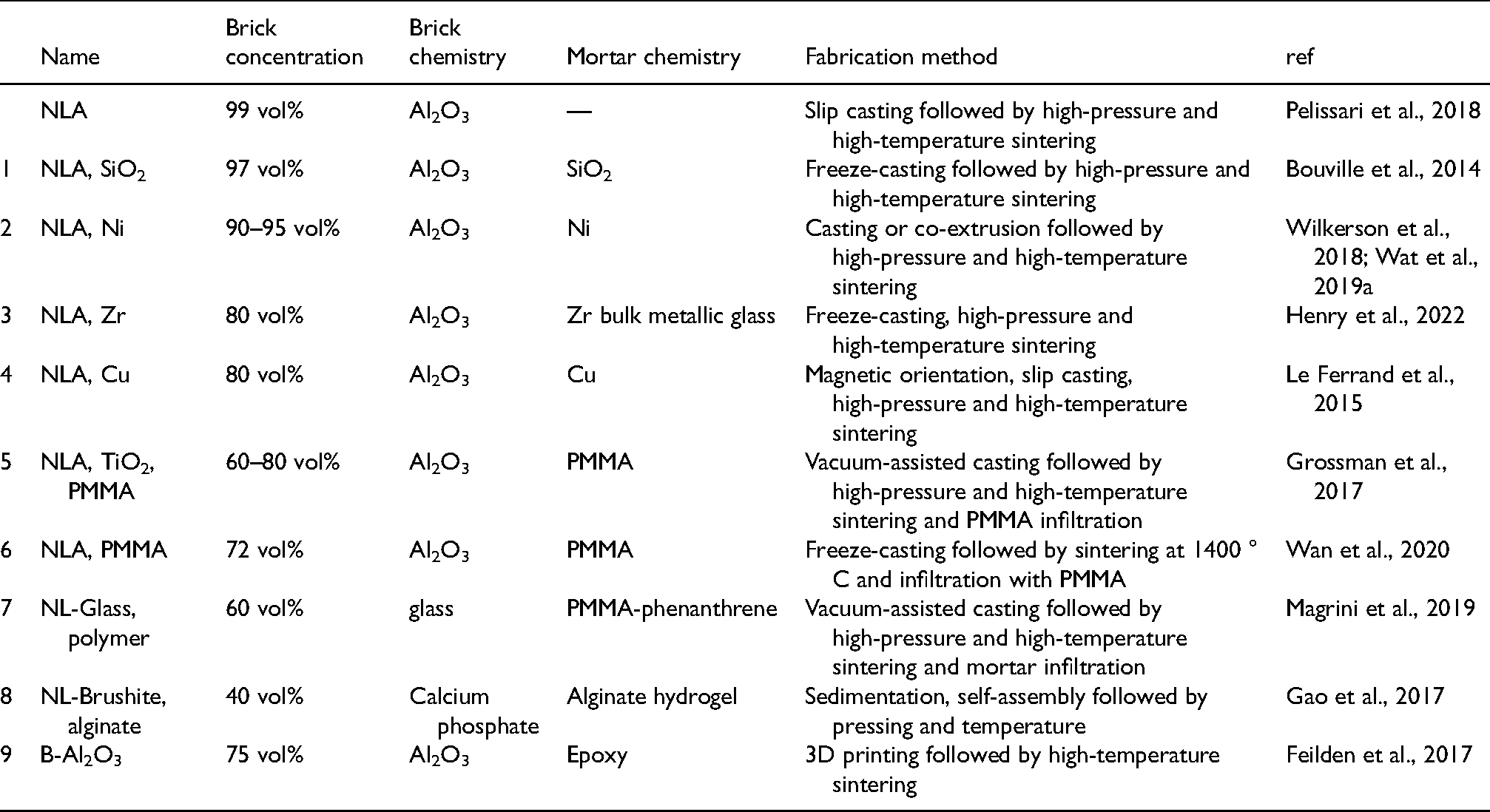
Material properties of NL ceramics were collected from peer-reviewed publications. Their compositions and fabrication methods are summarized in Table 1. The material data collected were Young's modulus E, density
NL ceramics discussed in this study. PMMA stands for polymethyl methacrylate.
Estimation of the Weight
To explore the possibility of replacing current materials with NL ceramics in musical instruments, the weights of the new instruments were estimated. To do so, the average weight of selected three musical instruments was first gathered: soprano recorder made in plastic (about 120 g), brass trumpet (about 1 kg), and a 22″ cymbal (about 2.7 kg). Knowing the densities of the materials they are made of – that is, 1.1 g.cm − 3 for the plastic, 8.5 g.cm − 3 for brass, and 8.8 g.cm − 3 for a copper alloy (bronze), respectively – the volume of material in the musical instrument was calculated. This volume was then used to obtain the weight of musical instruments made from NL ceramics using the simple relation:
Design Capabilities
Processing Methods
The processing methods of the selected NL ceramics are summarized in Table 2. Typically, all processing methods of NL ceramics employ ceramic powders which are manipulated either directly in dry state, or when suspended in a liquid before a high-temperature sintering treatment transforms the loose powder into a ceramic body. The processing methods are grouped into three paths according to their capabilities. Also, they are described as a sequence of 4 methods: (1) method to obtain the brick-and-mortar microstructure; (2) method employed to form a shape; (3) method to turn the soft material into a strong, consolidated body; (4) an optional post processing which consists of material infiltration. The detailed specifications for each method can be found at their respective references.
Processing methods for obtaining NL ceramics.

Processing Performance Parameters
To compare the different processing methods, two performance parameters were defined: K1 to quantify the throughput and K2 to quantify the facility and customisability, or design freedom. Those two parameters were established so that the higher the K1 value, the higher the throughput, and the higher the K2 value, the easier to apply and more customisable the method is, and their formula are:

The price p was estimated by considering the cost of the materials and equipment, only. The time t was estimated based on the time required for the processing steps. Finally, the DDF was computed as 1 when only one product can be obtained with no flexibility in shape or orientation of the NL structure. Another DDF was added for a flexibility in shape, flexibility in orientation, and for producing complex 3D shapes including overhangs. Therefore, the DDF varies between 1 and 4. The details of how these parameters were calculated are given in SI Table S2.
Finally, a third performance parameter was established to reflect the performance of a high-throughput fabrication method optimized for a single product:
Sound-Related Properties
Categories of Instruments
Musical instruments were classified following Sachs–Hornbostel: aerophones, membranophones, chordophones, and idiophones (Lee, 2019). Aerophones, membranophones, and chordophones produce sounds by the resonance in a cavity of the vibration of the air induced by blowing, a vibrating membrane, and a vibrating string, respectively. The material in which the musical instrument is made of is therefore used as a resonance cavity or a wave guide. Idiophones produce sounds by the vibration of the material body itself.
Physical Parameters
The physical parameters used to estimate the sound properties of materials are the radiation coefficient R, the impedance z, and the loss coefficient 

The material comparison based on these properties was conducted to find out for which type of musical instrument NL ceramics would be best suited. In the case of aerophones, membranophones, and chordophones, the properties of the material they are made of are of lesser influence than their design. Yet, a high radiation coefficient, low loss, and high impedance would result in a reflected vibration of the air onto the material with little loss, which means a high intensity. Indeed, in the case of a sound wave traveling in air (medium 1) and reflecting on the surface of a material (medium 2), the sound intensity reflected is:
In the case of idiophones, however, it is the body of the musical instrument itself that vibrates to produce a sound. Hence, it is the velocity of propagation of sound c in the material that is the most important:
Pitch
To estimate the pitch of a xylophone, NL ceramics lamellae of thickness 0.5 cm were considered, and the lamellae length was calculated for the notes: C3, 130.8 Hz, C4, 261.63 Hz, C5, 532.35 Hz, C6, 1046.5 Hz, and C7, 2093 Hz, using:
Results and Discussion
Practical Usage Potential
To assess if a musical instrument could be made from NL ceramics, the question of whether someone would be able to use it is discussed first (Figure 4). More precisely, the structural integrity of the material will inform whether such an object can be handled by a player and resist the variability of the environment. Furthermore, discussing the weight of the object will also enlighten us on the ability to replace current existing materials. Finally, a human-centric approach will suggest whether the material would be appropriate for such usage.

Mechanical and physical properties of NL ceramics. (A) Materials map showing the toughness Kj as a function of the strength
Structural Integrity
The uniqueness of NL ceramics lies in their mechanical properties, with a combination of strength and toughness (Figure 4A). All reported NL ceramics have a toughness similar to that of woods, which is around 1 order higher than for other ceramic materials. However, their strength is closer to that of metals, in particular steels and bronze, which are often used in musical instruments. This suggests that NL ceramics could be used to make an object without having to fear that it would break during usage. With musical instruments being carried and transported in cars, trains and planes, bags and suitcases, a certain mechanical stability and resistance to shocks is required. NL ceramics seem to be able to fulfil such capabilities.
In addition to the mechanics, musical instruments are often used daily throughout the year. Therefore, they should be able to sustain variations in temperature and humidity. Among the listed NL ceramics, the brushite-alginate ceramic contains alginate, a hydrogel. Therefore, this composition is sensitive to moisture and is not suitable. The other mortars used which are made of ceramics and metals can expected to be stable in case of small variations in the environmental conditions and therefore could be appropriate. Although metals tend to expand with heat, the natural variations in temperature of the environment can be considered to be small enough to avoid local deformations, although this needs to be verified experimentally.
Weight
In addition to the mechanical properties, an important property is the materials’ density. The density of NL ceramics is of 2 to 5 g.cm-3, which is higher than woods and plastics, but lower than most metals (Figure 4B). In the case of replacing the material of an existing musical instrument with NL ceramics, the weight should therefore be considered. To this aim, three instruments were chosen: soprano recorder, originally in wood or plastic, trumpet, originally in brass, and a 22″ cymbal, originally in bronze; and the weight of the same instruments made with NL ceramics were calculated (Figure 4C).
For the soprano recorder, all NL ceramic compositions would lead to a heavier recorder, which might not be practical when it is played by children, for example. Also, although the maximum weight calculated is half a kg, supporting the weight of the instrument might reduce the agility of the fingers and hinder the player's ability. To overcome this, a porous version of NL ceramics could be envisaged. However, including porosity would also reduce the strength and toughness of the material. Finally, decreasing the wall thickness could be an alternative, but would lead to a wall thickness of about 1 mm, which might be riskier in case of shocks.
For the trumpet, the opposite is observed, and a ceramic trumpet would be more than twice lighter. This could be an advantage. Also, it could give the opportunity to increase the thickness of the material in the trumpet's wall to make it even stronger.
Finally, the weight of the cymbal would also be greatly reduced. Although the cymbal does not necessarily need to be carried by the player, lower weight could facilitate its transport and allow a larger variation of thicknesses to be customarily used, to create a larger variety of sounds, as will be discussed in the last part of this paper.
Overall, musical instruments made of metals could be replaced with a NL ceramic without leading to a weight problem. However, this is not the case for wood-based instruments. Exploring new instruments designed out of NL ceramics would be more suitable than copying musical instruments that were originally made of wood. Finally, although being bio-inspired, NL ceramics have higher densities than natural materials such as ivory or tortoise shell, which are around 1 g.cm − 3 and are porous. Therefore, these materials may not be directly replaced without adjusting the design of the instrument.
User-Friendliness
For a material to be used, it needs to be user-friendly. Here, the hardness of NL ceramics might be detrimental. Indeed, ceramics have a hardness of about 16 GPa. In the case of a musical instrument with a mouthpiece, such as a soprano recorder, there may be concerns as the ceramic from the instrument may be able to break or harm the teeth of the player in case of an incidental shock, for example. Therefore, instruments that are played with a mouthpiece placed in the mouth may not be suitable. Also, for musical instruments in close contact with the mouth, biocompatibility may be a concern for NL ceramics with mortars made of a non-biocompatible polymer and Ni. Therefore, such compositions of NL ceramics should be avoided. Even without contact with the mouth, NL ceramics with Ni mortar could induce allergies and therefore should not be used.
Finally, the high thermal conductivity of the ceramics should be noted, above 19 W/mK. This is largely inferior to that of metals, which can reach 200 W/mK, but higher than woods, about 0.1 W/mK. This means that the material might feel cold at first and would take some time to heat up to the body temperature.
Conclusions on the Practical Usage Potential
To summarize the practical usage potential of using NL ceramics, it was established that certain compositions had to be eliminated due to toxicity or sensitivity to moisture. Therefore, NL ceramics 2, 7 and 8 (Table 1) may not be used for musical instruments. The considerations of the mechanical properties suggested that they had enough stability to be used. Finally, although NL ceramics could replace metals in established musical instruments, it may be more appropriate to use them to explore new designs or to make parts of musical instruments. This now poses the question of the design capability and fabrication of such ceramics.
Design Capability
The sound created by musical instruments results from the vibration of the material itself for idiophones, or from the vibration of the air in a cavity such as a pipe or a vessel, for membranophones, aerophones, and chordophones. The design of the musical instrument is therefore critical to determine the type of instrument and the sound it will produce. To evaluate the feasibility of designing new instruments using NL ceramics, the fabrication processes and the design degree of freedom attained are discussed in the following.
Fabrication Process
NL ceramics are highly packed brick-and-mortar structures. The fabrication of such ceramics requires to (1) create the microstructure, (2) obtain the shape, (3) consolidate the material to obtain the mechanical properties, and optionally, (4) some post processing. The various processing methods used to create NL ceramics are summarized in Table 2 and are divided into three paths depending on the final ceramic shape obtained (Figure 5).
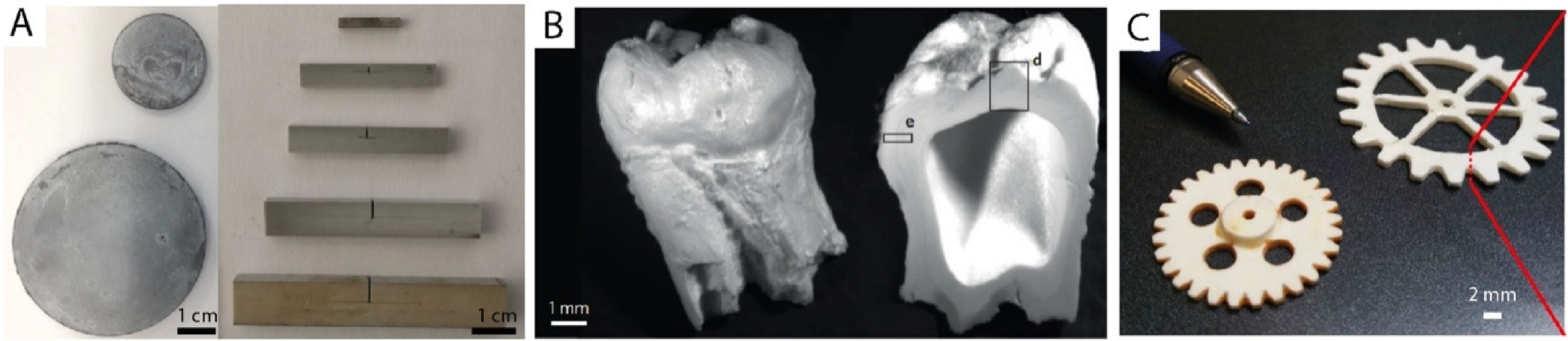
NL ceramics objects. (A) Pictures of NLA discs produced after simultaneous sintering and pressing. Left: top view. Right: cross-sections. Left: Reproduced with permissions from (Le Ferrand et al., 2015). Copyright 2015, Nature Publishing Group. Right: Reproduced with permissions from (Saad et al., 2020). Copyright 2020, Acta Materialia Inc. (B) Images of a complex shape sample produced by casting in a porous mould followed by pressure-less sintering at high temperature. Reproduced with permissions from (Le Ferrand et al., 2015). Copyright 2015, Nature Publishing Group. (C) Images of complex shape samples produced using extrusion-based 3D printing and pressure-less sintering. Reproduced with permissions from (Feilden et al., 2017). Copyright 2017, Feilden et al.
The first fabrication path creates flat nacre-like panels through a consolidation step involving high-temperature sintering and unidirectional pressing. Typical samples are discs of 2 mm to 1 cm thickness and with diameters that depend on the die used during pressing (Figure 5A). The second fabrication path involves casting into a porous mould and yields pieces which are typically hollow with a wall thickness of less than 1 cm (Figure 5B). The third fabrication path uses computer-aided design (CAD) to create a digital shape before printing it with a 3D printer. To date, extrusion-based 3D printing and digital light processing (DLP) have been employed to make NL ceramics with finely controlled shapes (Figure 5C).
To envision if these processes could be used to fabricate musical instruments, the processing time, number of steps, cost, and performance parameters K1 were computed (Figure 6A). The estimation of the processing time shows a large variation, from a couple of hours for the direct pressing method, to more than 100 h for the magnetic casting. This large difference in time is due to the fact that magnetic casting requires an additional step where ceramic particles are functionalized to make them magnetically responsive (see SI Figure S1). Also, 3D shapes produced by magnetic casting are consolidated via pressure-less sintering at a high temperature of 1600 °C which takes about 10 h. In methods that use high temperature and high pressure simultaneously, it is possible to consolidate samples in only a couple of hours. In these methods, the temperature is first raised to 1450 °C at 25 °C/min with a pressure of 20 MPa, then maintained at 1450 °C for 15 min with a pressure of 40 MPa. The other processing methods like sedimentation and freeze-drying take a long time due to the time to let the particles sediment and the time for drying the samples. 3D printing methods and vacuum processes take an intermediate time, with the conventional sintering being the longest step. Therefore, although there is a correlation between the processing time and the number of steps in the process, it also depends strongly on the consolidation method chosen, that is, if the sintering is carried out with or without pressure.

Design capabilities. (A) Processing time t, number of step n, price p and performance parameter K1 for the processes employed to produce NL ceramics. (B) Degree of design freedom DDF and performance parameters K1* and K2 for the same processes.
Considering the number of steps only, direct pressing is the simplest method as the material powder is directly consolidated. The overall cost of this process is, however, not advantageous. For all the processing methods, the cost is largely determined by the equipment used for the consolidation. Indeed, the price for a typical pressure-less high-temperature furnace is 23,000.00 USD, whereas a high-temperature and high-pressure furnace is above 100,000.00 USD.
Based on these data, the throughput performance parameter K1 was obtained. A process with a high K1 is able to produce parts in a short time and at low cost. Therefore, direct pressing is performing better in terms of throughput as compared to the other methods. Yet, direct pressing produces plates and may not provide sufficient DDF for musical instrument applications.
Design Degree of Freedom
To better assess the various fabrication methods, their DDF was calculated taking into account the shape of the objects but also the orientation of the nacre-like microstructure (Figure 6B). Indeed, tuning the microstructure orientation in the NL ceramics allows the creation of anisotropy, which is a feature also reported in woods and that plays a role in the sound properties of soundboards (Sproßmann et al., 2017).
Since the first fabrication path can only produce horizontally aligned NL ceramics in the form of discs or plates, it has the lowest DDF of 1. The second approach uses casting of a liquid slurry containing the ceramic particles. During the casting, the orientation of the particles can be tuned, for example using magnetic fields, which allows the tuning of the orientation of the nacre-like microstructure. As this control has been reported to also vary the local properties (Le Ferrand and Bouville, 2019), it adds more DDF. Also, using a mould with a complex shape is possible (Figure 5B). The third fabrication path using 3D printing also offers microstructural control, 3D shapes, bulk or thin samples, etc. and provides the highest DDF.
Calculating
To date, extrusion-based 3D printing (robocasting) and digital light processing (DLP) 3D printing have been employed to make NL ceramics using commercial printers, 3dInks, and CeraFab7500 from Lithoz, respectively (Feilden et al., 2017; Hofer et al., 2021). In DLP, spreading the ink onto the print bed induces the microstructural alignment, whereas it is the shear forces at the nozzle in the extrusion-based printing that does so. Both printing methods require the preparation of an ink (Table 3). The extrusion-based printing method uses a complex mixing protocol to prepare the slurry, such as the use of a high-power horn sonicator and a planetary mixer. Such pieces of equipment are typically used to prepare about 50 ml slurry, which is a small amount. It would therefore be tedious to use this approach to print large objects of several centimetres width. The DLP printing method, in turn, uses a commercially available slurry provided by the company Lithoz that is modified by the addition of other particulates which are mixed using a magnetic stirrer for 24 h. In the context of a craftsperson, the DLP printing method would therefore likely be the more practical. However, DLP is less able to produce controlled NL orientations.
Slurry composition and preparation for the two 3D printing methods. Specialized equipment used is italicd.

Conclusions on the Design Capability
It can therefore be concluded that for industrialized production, direct pressing at high temperature is the most favourable method. With this process leading to blocks of horizontal NL material, it could be used to produce pieces such as the lamellae of xylophones, guitar rosettes, or percussion items, for example. In turn, for a craftsperson, 3D printing would be the method of choice to produce parts with various designs since it offers a large degree of design freedom. DLP would be more favourable than robocasting due to the simpler ink preparation. If NL ceramic-based musical instruments could be fabricated, the sound it could generate is discussed in the next section.
Sound-Related Properties
Having established that simple flat shapes can be produced using a direct pressing method, and that complex designs can be realized using 3D printing, the question arises of what sound the fabricated objects would make. Since there is an infinity of potential designs, this section aims at assessing what type of sound could be obtained, with the intention of finding for which type of instrument, or which part of a musical instrument, NL ceramics could be interesting. First, the vibration intensity will be discussed followed by the pitch in the case of a xylophone.
Vibration Intensity
To compare the effects of composition of the NL ceramics on their mechanical and sound properties, property maps were drawn (Figure 7). NL ceramics with various chemistries for the bricks and mortar are compared between each other and with respect to the standard NLA, which is the most studied NL ceramic so far. To draw the property maps, data for same compositions were averaged and their standard deviation taken, when available.

Materials property maps for NL ceramics. (A) Stiffness E as a function of the density
First, the modulus-density property map shows a decrease in modulus with the decrease in density (Figure 7A). This is expected as the decrease in density is correlated with a decrease in concentration in ceramic bricks, for example around 60% for “NLA, PMMA”, and the addition of an organic mortar, such as PMMA (poly methyl methacrylate). For NL ceramics with metallic mortar, the one with Cu mortar shows slightly lower modulus, whereas the one with Ni mortar has higher values. Finally, the NLA with SiO2 mortar appears to have the highest modulus. Thanks to the range of densities and stiffness available in NL ceramics by tuning their composition, the sound properties could be varied.
The radiation coefficient R was found to vary from 1 to about 3 m4.s−1.kg−1 for the different compositions, whereas the loss varies from about 10−4 to 10−2 (Figure 7B). With all NL materials’ properties falling within the region of natural ceramics which are glasses, clay, seashells and bones, it is interesting to see that with the addition of polymer, the radiation coefficient and the loss get closer to that of woods, whereas the ceramics with metallic mortar have similar properties to metals.
Finally, by plotting the radiation coefficient R as a function of the impedance z, it appears that most NL ceramics are close to metals, but the addition of polymer decreases the impedance (Figure 7C). Overall, the chemistry of the bricks, as long as they remain from a ceramic material, have lesser effect on the properties than the composition of the mortar and the concentration of ceramic bricks in the material.
Pitch
The pitch of a musical instrument depends on the frequency spectrum of the sound it produces. These properties depend essentially on the design of the instrument. However, for idiophones, it also depends on the material’s properties. For simple geometries it is possible to determine the pitch using simple equations, such as in the case of a xylophone with small lamellae (Figure 8). The investigation aims to determine the range of musical notes a xylophone made from NL ceramics could produce for reasonable lamellae dimensions from 2 to 14 cm.

Lamellae length of a xylophone for a lamella thickness of 0.5 cm as a function of NL ceramic compositions for the musical notes C3 to C7 as well as for wood and metal used in xylophones from Wegst (2008).
As expected, the smaller the xylophone's lamellae, the higher the pitch. For the lamellae lengths considered, four octaves can be covered from middle to high pitch. Although there are differences between the different compositions of the NL ceramics, the general trend and pitch covered are the same. This suggests that the differences in mechanical properties between the NL ceramics may have little consequence on the type of music produced, except for the NL ceramics 6 and 8 which can attain another lower octave for lamellae length of less than 12 cm. These two compositions, NLA, PMMA and NL-brushite, alginate have the lowest amount of mineral, of about 60 vol%, and therefore have the lowest densities. The range of notes attainable is comparable to the notes that would be obtained with wood, yet smaller than for metals. In this example, the thickness of each lamella was fixed at 0.5 cm and could thus be further varied to attain a larger range of notes.
Conclusions on Sound-Related Properties
Overall, the properties maps indicate that NL ceramics have a radiation coefficient similar to that of steels and glasses, which may suggest a sound of high intensity. Tuning the mortar composition tunes the internal damping of the vibration. Thus, a ceramic or glassy mortar would likely produce a clear, bright sound similar to the one obtained when tapping on a porcelain cup or crystal glass, whereas a metallic and organic mortar would likely produce a more dull and dampened sound, closer to that of woods and metal-based musical instruments. Finally, although the pitch of the notes produced depends on the design of the instrument, reasonable sizes would likely yield high musical notes from C4 and higher. Also, the pitch may be little related to the exact composition of the material, when mineral content exceeds 60 vol%.
Conclusions and Outlook
For the application of NL ceramics to make musical instruments, the usage, design capabilities and sound properties were considered and discussed for various existing NL ceramics compositions. The chemical composition was found to have consequences on the usage and sound, as well as on the design capabilities through their fabrication processes. From the findings, two potential real applications can be proposed (Figure 9).

Mindmap summarizing the results obtained and two potential scenarios of application of NL ceramics for musical applications.
For the practical usage of the NL ceramics in the context of a musical instrument, it was found that some NL ceramics compositions would likely cause an issue due to allergies or swelling. The NL ceramics 1,3,4,5,6 and NLA were suggested to be usable. Regarding the weight, it was proposed that it may be less advantageous than other materials such as wood or plastic, but better than metals. Hence, copying existing designs in NL ceramics would likely not be a meaningful application. The NL ceramics were found to have low user-friendliness, should not be placed in the mouth, and therefore may be more interesting in combinations with other materials.
Regarding the design capabilities, two cases were established. For high-throughput production, for example in an automated industry, the direct pressing method is the most suitable and could process flat shapes, whereas for low-throughput unique pieces, for example by a craftsperson or for prototyping, 3D printing would be ideal as it would lead to high DDF. Two 3D printing methods were identified and the DLP method was found to be the most straightforward.
Finally, the sound properties that were discussed based on the mechanical properties of the NL ceramics suggested the production of a loud sound, with a high radiation coefficient and a high pitch. The composition of the NL ceramic had some influence on the damping and impedance, consequently impacting the pitch emitted for use as an idiophone. Low mineral content was found to be a critical parameter to affect the sound. The NL ceramics produced by 3D printing typically have a ceramic content above 90 vol% with no mortar, which may produce a clear, glass-like sound.
Based on these conclusions, two potential scenarios of usage of NL ceramics for musical instruments can be proposed. In scenario 1, a high-throughput industrial plant fabricates plate shapes out of NL ceramics with one chosen composition. The flat shapes could be later cut using an automated water jet or laser jet, infiltrated if porous, and bonded to other materials. The musical instruments or parts of instruments that are flat and that could be interesting to fabricate could be xylophone lamellae, soundboards, guitar rosaces, among others. In case of xylophone lamellae, the choice of the material to impact the xylophone lamellae to produce the sound will also be critical, with softer mallets a preferred choice. In scenario 2, a craftsperson would use a 3D printer to produce customized designs with NLA composition. Typical musical instruments or parts of instruments that could be fabricated could be bells of trumpets or feet of flutes to increase their radiation, chimes, or to explore new designs. NL ceramics could also be used by a craftsperson to copy ancient instruments such as those studied by palaeontologists, archaeologists, or anthropologists, or to create rare artefacts.
This study proposes a new potential application for NL ceramics, which, although niche, might be interesting. Studying more in depth the sound properties could also lead to other applications in architecture where ceramic tiles are often used. Finally, more development is still needed for actually producing large-scale objects in NL ceramics and testing further their resilience in diverse environments. Future work should carry comprehensive mechanical testing under various conditions of temperature and humidity, in particular regarding quasi-stating and dynamic testing. For example, compression, bending, crack tests, fatigue tests, and impact tests should be conducted experimentally. Also, for the sound-related properties, vibration transport through the media should be more closely studied at various frequencies and amplitudes. Since the topic is on larger objects, quantifying the level of defects, their aspect, and reproducibility should also be done. The data should be collected and compared using ATSM or ISO standards. Finally, the sound and musical notes produced by prototypes should be evaluated by a professional. These evaluations would be relevant for designing musical instruments but also other objects for everyday applications.
Supplemental Material
sj-docx-1-mns-10.1177_20592043221146184 - Supplemental material for Could Bio-Inspired Nacre-Like Ceramics be Suitable to Fabricate Musical Instruments?
Supplemental material, sj-docx-1-mns-10.1177_20592043221146184 for Could Bio-Inspired Nacre-Like Ceramics be Suitable to Fabricate Musical Instruments? by Hortense Le Ferrand in Music & Science
Footnotes
Action Editor
Trevor Agus, Queen's University Belfast, SARC, School of Arts, English and Languages.
Peer Review
Claire Barlow, University of Cambridge, Department of Engineering.
Ajith Damodaran, Easwari Engineering College, Department of Mechanical Engineering.
One anonymous reviewer.
Associated Content
Supporting information is available in the supplemental file.
Declaration of Conflicting Interests
The author declared no potential conflicts of interest with respect to the research, authorship, and/or publication of this article.
Ethical Approval
This research did not require ethics committee or IRB approval. This research did not involve the use of personal data, fieldwork, or experiments involving human or animal participants, or work with children, vulnerable individuals, or clinical populations.
Funding
The author disclosed receipt of the following financial support for the research, authorship, and/or publication of this article: This work was supported by the Nanyang Technological University (grant number Start-Up Grant).

Supplemental Material
Supplemental material for this article is available online.
References
Supplementary Material
Please find the following supplemental material available below.
For Open Access articles published under a Creative Commons License, all supplemental material carries the same license as the article it is associated with.
For non-Open Access articles published, all supplemental material carries a non-exclusive license, and permission requests for re-use of supplemental material or any part of supplemental material shall be sent directly to the copyright owner as specified in the copyright notice associated with the article.
