




Abstract
While an increasing amount of literature highlights the psychological well-being benefits of musical participation, research focusing on electronic dance music (EDM) event contexts remains scarce. This exploratory mixed methods research draws influence from interdisciplinary research on EDM culture and psychological well-being research on music festivals that suggest EDM event attendance may have a positive influence on well-being. Two studies were implemented. Semistructured interviews with regular attendees of EDM events were undertaken and analyzed thematically (Study 1, n = 7). Four main themes were identified, namely the importance of social, musical, and emotional experiences, and shared values at EDM event. These themes were then used as a basis for developing a questionnaire which explored relationships between scores on facets of EDM event attendance and measures of subjective, social, and psychological well-being (Study 2, n = 103). Results showed that all four EDM event facets were positively associated with psychological and social well-being measures. Principal component analysis was utilized to elucidate nuanced aspects of the four themes and their links to well-being scores. A four-factor model (SMEV) that encapsulates the key psychological beneficial aspects of EDM event attendance has been suggested, and the implications of this model and findings are discussed within the context of future research avenues.
Keywords
Introduction
Much like ‘rock’ or ‘classical’ music, electronic dance music (EDM) is a varied overarching genre of music with over 300 distinct sub-genres (McLeod, 2001). From the sparse rhythms of half-time dubstep (D’Errico, 2015) to the repetitive, hypnotizing phrases of trance (Shapiro, 2000), EDM encompasses an array of varying electronically produced musical styles. A distinguishing feature of EDM is the presence of repetitive beats that drive a consistent pulse in the music, usually characterized by 4/4 rhythm (Neil, 2002), sitting typically between 120 to 180 beats per minute (Butler, 2006). EDM producers select and organize such sounds and structural features based on the perceived effect it will have on a live audience (Ferreira, 2008). As such, EDM is firmly situated within an event culture, as St John (2017) explains, ‘dance music cultures possess distinct festival roots, in the club, the rave, the party’ (p. 1). EDM events, or ‘raves’, may be summarized as ‘masses of young people dancing all night to a syncopated electronic rhythm mixed by DJs’ (St John, 2006, p. 2). The American cities of Detroit, Chicago, and New York are regarded as the birthplaces of early EDM genres such as techno and house (Reynolds, 2013), with electronic music outfit Kraftwerk being considered pioneers of the genre, credited with hugely influential tracks such as ‘Trans Europe Express’, released in 1982. Reynolds suggests that, in New York, this track ‘almost single-handedly sired the electro movement’ (p. 4). Indeed, the history of raves, according to Fritz (1999), may be traced to the rise of house music during this era with the first underground EDM events on the Balearic island of Ibiza occurring in the late 1980s and becoming a global phenomenon by 1992. Today, a once underground music scene is a mainstream musical phenomenon. Annual high-budget spectacles dedicated to the genre, such as Electronic Daisy Carnival and Tomorrowland, attract attendees in the thousands (Dineen, 2015; Little et al., 2018), with hundreds of individuals also frequenting EDM club nights across the UK, Europe, and the USA (IMS, 2019). As such, the EDM event context may be considered comparable to archetypal, culturally significant, musical spaces such as the concert hall. As Small (1998) posits regarding such contexts, ‘it is only by understanding what people do as they take part in a music act that we can hope to understand its nature and the function it fulfils in human life’ (p. 8). This article aims to explore the motivations for attending, and experiences of EDM events as a basis for understanding their influence on individuals’ well-being. In recent years, there has been an increased focus on the ways in which participation in accessible musical activities may improve well-being (Krause et al., 2018; MacDonald, 2013). However, despite the popularity of EDM events, relationships between participation in electronic dance music events (EDM events) and well-being have yet to be systematically explored. As such, this exploratory paper attempts principally to address the question: what facets of EDM event attendance may influence well-being? This is achieved through describing the results of two studies which capture individuals’ subjective experiences of EDM event participation (Study 1) and explore associations between EDM event attendance and various measures of well-being (Study 2).
The EDM Event Experience
Though psychological studies exploring the well-being benefits of EDM event attendance are scarce, previous research within sociology, cultural, and religious studies have alluded to well-being benefits associated with participation. Fritz (1999) suggests that the rise of EDM event culture was related to a ‘growing tendency to move away from ritualistic group bonding practices’ (p. 32) during the latter decades of the 20th century, and that raves may be considered a new form of religious ritual. St John (2006) also argues that EDM events may be a modern form of spirituality, sharing qualities with religious participation in their ability to promote identity formation, belonging, and inter-cultural understanding. The importance of these aspects of EDM events has also been supported by qualitative studies. Interview research with ravers conducted by Lynch and Badger (2006) revealed common themes of community acceptance, self-expression, tolerance, and the promotion of self-development associated with EDM events that formed the basis of a set of values that ravers associate with participation. This value system is often referred to as PLUR (peace, love, unity, and respect), a cornerstone of EDM event culture (Hutson, 1999; St John, 2004; Weber, 1999). In harmony with the ideals of this value system, Lynch and Badger (2006) found that principal individual gains from EDM event attendance were increased autonomy, tolerance, and expression as well as developing greater intimacy with friends. Moreover, research that views EDM event participation through the lens of neo-tribal theory has suggested similar positive outcomes. Neo-tribes, as characterized by Maffesoli (1996), are re-actualizations of historical notions of community. They afford spaces to engage in shared practices and develop common bonds, eliciting a sense of solidarity and belonging. While there is some critical debate regarding the consumerist nature of cultural events undermining the authenticity of such experiences (Cabanas, 2016; Gauthier, 2013), research consistently highlights themes related to attributes of neo-tribal discourse. For example, in qualitative research with EDM event attendees by Riley et al. (2010) participants recounted a sense of belonging that was underpinned by tolerance, viewing EDM events as a collective celebration of being together. This is supported by themes of belonging and acceptance revealed in other EDM event studies (e.g. Kavanaugh & Anderson, 2008; Little et al., 2018; Lynch & Badger, 2006) which have also been argued to underpin EDM events as a spiritual experience (Takahashi & Olaveson, 2003). However, it should be noted that illegal drugs such as MDMA may influence these aspects of EDM culture. MDMA is typically taken at EDM events to increase mood and heighten the sensory experiences inherent within these contexts (Parrot, 2004). As suggested by Reynolds (1999), the ability of MDMA to remove inhibitions and promote tolerance contributed to the development of the welcoming, community ethos of rave culture. Despite this, the negative psychological and physiological effects of this substance cannot be overlooked (Parrot, 2002), with risks such as heat exhaustion a particular concern in the rave context (Parrott, 2004). As such, it is important to acknowledge the role drugs may play in shaping the EDM event experience. Overall, existing research provides useful insights into aspects of EDM events that may be conducive to well-being, though no previous studies have explored statistical relationships between key aspects of EDM event experiences and well-being.
EDM Events and Well-Being
The concept of well-being is multifaceted and has been measured in different ways (Ben-Aryeh et al., 2014). Three distinct, widely researched conceptualizations of well-being include social well-being (Keyes, 1998), subjective well-being (Diener, 1984), and psychological well-being (Ryff, 1989). Social well-being pertains to self-evaluations of the society in which one lives and their place within it, whereas subjective well-being concerns individual’s cognitive and affective evaluations of their lives. Psychological well-being, as defined by Ryff, synthesizes subjective well-being concepts with theories of positive and negative affect balance (Bradburn, 1969). Decreased well-being is linked to poor mental and physical health outcomes such as depression, coronary heart disease, and lower life expectancy (Koivumaa-Honkanen et al., 2004; Steptoe et al., 2015) and research shows higher levels of well-being predict increased productivity and creativity, improved health and social behavior (De Neve et al., 2013). As such, it is considered a public health interest to assess activities within which participation may improve well-being (Department of Health, 2014). Reviews of research on musical participation and well-being highlight numerous associations between aspects of participation and psychological outcomes that promote well-being, focusing predominately on participation in traditional music groups such as choirs and orchestras (Croom, 2015 Daykin et al., 2018; MacDonald, 2013). Research focusing on musical participation at a broad level, using telephone interviewing with a sample of 1000 individuals revealed that engagement with music through attending ‘musical concerts, theatre or events’ is positively associated with subjective well-being scores (Weinberg & Joseph, 2017). This suggests EDM-related musical event attendance may be associated with improved well-being, however, it is unclear what percentage of the sample participated in EDM events. Seminal research on festival experiences conducted by Packer and Ballantyne (2011) provides some initial quantitative support for a positive relationship between EDM event attendance and well-being. Packer and Ballantyne found four main themes of attendance (the music experience, festival experience, social experience, and the separation experience) through content analysis of interviews with attendees. Aspects of these correlated positively with a composite well-being outcome measure derived from the psychological functions of music scale (Laiho, 2004), Keyes (1998) 5-item dimensions of social well-being scale (SWBS), Ryff and Keyes (1995) psychological well-being scale (PWBS), and Keyes et al. (2002) subjective well-being measure. This supports the notion that festival attendance, a context in which an EDM event may take place, promotes well-being. However, conclusions regarding the extent to which individual facets of attendance correlate with attributes of well-being cannot be drawn due to the use of a composite score in analysis. The extent to which findings may be generalizable to EDM events broadly is also unclear as there is no data provided regarding the extent of the festival’s genre offerings. Nonetheless, a recent study regarding EDM festival attendance provides support to these findings. Thematic analysis of interview data conducted by Little et al. (2018) amongst attendees of Electronic Daisy Carnival revealed themes of communitas, escape, and self-reported changes (such as increased positive attitude). The PLUR values emerged as a central aspect of communitas and were found to be adopted by attendees outside of the festival experience, suggesting EDM event experiences may promote long-lasting changes in individual well-being. It was also suggested that EDM festivals can provide opportunities for escapism that foster a sense of belonging within an environment where one can express oneself freely. These findings pave the way for further investigation into the extent to which these themes may correlate with individual well-being concepts and how they may be experienced across other EDM event contexts.
The Current Study
The current study builds on previous research by exploring facets of EDM event experiences and how these may be associated with well-being in a mixed-methods design. Two studies are reported with the aim of answering the following research questions: (1) What motivates individuals to attend EDM events? (2) What experiences are afforded by attendance? (3) What aspects of attendance are valued by participants? (4) What correlational links are there between these aspects of attendance and well-being measures? Qualitative methods have been shown to be valuable for examining components of EDM event experiences (Little et al., 2018; Packer & Ballantyne, 2011). Subsequently, the first study uses semi-structured interviewing to explore subjective experiences of EDM events among a sample of adults. The second study used these initial findings to develop a survey tool to enable the systematic investigation of links between facets of EDM event experiences and measures of social, subjective, and psychological well-being. Based on previous literature it was predicted that feelings of belonging, self-expression, and shared values may be important facets of EDM event experiences, and subsequently that there would be positive associations between these facets and well-being measures.
Study 1
Method
Participants
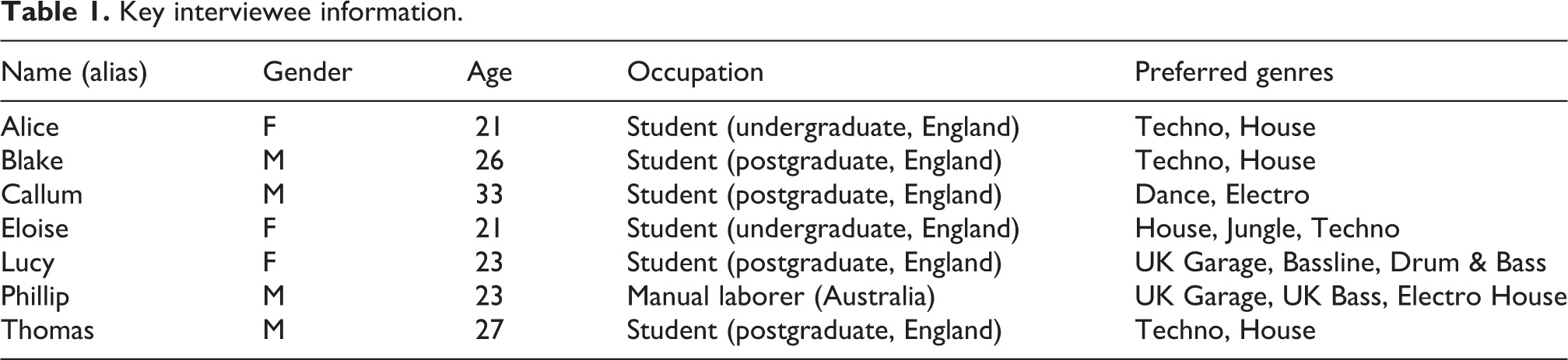
Semi-structured interviews were conducted in a university in northern England with 7 fluent English-speaking participants (4 male, 3 female, aged 21–33 years). Volunteer sampling (N = 4) and purposive sampling (N = 3) was used to recruit participants that regularly attended EDM events. Participant information is displayed in Table 1. All participants are given pseudonyms.
Key interviewee information.
Materials
An interview schedule with prompts was used to facilitate discussions. This included questions exploring intense musical experiences initially developed by Schäfer et al. (2014) and adapted to pertain to EDM festivals by Little et al. (2018). These were modified for the current study to pertain to EDM event contexts broadly. These were also paired with novel questions exploring individual’s motivation for attendance, the type of events attended and whether individuals identified with an EDM event culture (see Appendix).
Procedure
Participants began by reading an information sheet and completing a consent form prior to interview. This informed participants they would be taking part in a discussion about their subjective experiences of EDM event attendance. The term ‘well-being’ was avoided by the researcher during the interview to reduce the possibility of primed responses affecting the data. The interview process was conducted following the guidelines of Fylan (2005), ensuring a comfortable, informal discussion was facilitated. Interview prompts were used when relevant in addition to spontaneous questions that arose based on the content of discussion. Participants were encouraged to speak openly and honestly about their experiences. All interviews were conducted in a private room on the university campus, except for one which was carried out over Skype (participant Phillip – who was currently residing in Australia), and recorded on the researcher’s mobile phone. A debrief detailing the full nature of the study was provided following interview completion.
Analysis
All interviews were transcribed verbatim and analyzed using the six-phase thematic analysis framework outlined by Braun and Clarke (2006). The current study is exploratory in design and, as per the guidelines of Braun and Clarke, an inductive, bottom-up approach was employed to avoid the potential of researcher pre-conceptions.
Results and Discussion
Participants spoke about a broad range of experiences during EDM events, encompassing motivations for attending, feelings of joy, unity and tolerance from others, strong musical experiences, and identity expression. While there was reference to some negative experiences pertaining to drug-taking behavior and sharing the rave space with individuals that may not subscribe to the positive ethos expected by fellow attendees, the accounts focused primarily on positive experiences. Thematic analysis did not reveal drug-taking, or any other negative experiences, to be main themes of discussion. The four main themes identified through thematic analysis were as follows: (1) social experience, (2) musical experience, (3) emotional experience and (4) shared values. The following analysis illustrates the subjective experience of EDM event attendees through these four overarching themes and delineates specific subthemes within them (indicated in italics). Possible links between these themes and well-being are suggested in the context of existing research.
Social Experience
The social experience was the most prevalent overarching theme, containing the greatest number of individual codes in thematic analysis, suggesting this is a core aspect of EDM event attendance. A recurring subtheme within this was developing friendship bonds, as Alice encapsulated, stating ‘I think it’s a whole level of friendship that doesn’t get re-created elsewhere.’ For Alice, the EDM event context may provide unconventional opportunities in which individuals are able to be themselves and get to know each other on a more personal level. As such, shared EDM event experiences may allow for deeper levels of friendship to develop between attendance companions. The consolidation of interpersonal relationships was also found by Packer and Ballantyne (2011), who found such relationships deepened in the context of festival attendance. Recollections from interviewees in the current study suggest this may extend to wider EDM event contexts. Participants spoke of how they would reflect on shared EDM event experiences with their friends after the event, with Thomas stating: ‘I think of some of my closest friends and the experiences we had…we always reflect on those experiences and get goose bumps thinking about them…we still text each other about them randomly in the middle of the day.’ This suggests EDM events may provide a basis for friends to reconnect and share emotional reflections on their mutual experience post-attendance. As such, EDM events may facilitate the development of relationships both in an active sense through interpersonal experiences during an event and residually through shared memories of an event that engenders positive discourse between attendees. In addition to consolidating existing friendship bonds, participants also spoke of how EDM events were a place in which new bonds were formed and meeting new people was a significant subtheme. As Blake explained, ‘those kind of events, especially when you’re outside having a smoke…or you’re just sat in a toilet, you’ll just talk to people…it’s alright to talk to people.’ For Blake, EDM events are opportunities in which sociability is facilitated with ease, suggesting that social connectedness is a prominent aspect of attendance. EDM events offer opportunities to meet and socialize with new people in an open, welcoming environment with individuals who typically share mutual interest in the music being played. This was corroborated by Lucy who sated ‘people just wanna get to know you at a rave…they wanna get to know the music and they wanna get to know the other people listening to it.’ This echoes the findings of Garcia (2011), who, through interview research, similarly suggests that the EDM event environment facilitates intimacy between others who have not previously met. The way in which participants described the ease of sociability in EDM event contexts was also related to a broader theme of sense of community which referred to the way in which participants perceived EDM events as a paragon of community values, as Callum expressed: ‘I do see it as, to a certain extent, as an idealized community, in terms of how welcoming, usually, it is.’ In addition, feelings of belonging were found to be related to shared musical experiences with others, as recounted by Phillip: ‘It’s nothing like you would ever hear anywhere else in the world…it does make you feel like you’re part of quite a unique group of people that have experienced this sort of music before anyone else.’ For Phillip, experiencing the development of rising EDM subgenres as an active participator in their live contexts engenders a sense of belonging within an exclusive community that are afforded this shared opportunity. Notions of belonging such as this are supported by Little et al.’s (2018) interview study in which community and sense of belonging were central motifs of EDM festival participation. Overall, feelings of community underpin EDM events as a positive social experience and are as such somewhat comparable to numerous other musical activities in which the social aspect has been found to be central to attendance (Dingle et al., 2013; Kokotsaki & Hallam, 2007; Packer & Ballantyne, 2011).
Musical Experience
Participants expressed a range of varying genre preferences within EDM. For instance, Alice, Blake, Emily, and Thomas recalled their love of techno and house and how these genres underpinned the basis of meaningful musical experiences for them. Contrastingly, Phillip and Lucy expressed a preference for the bass-heavy styles of UK bassline, grime, and drum and bass. However, regardless of individual sub-genre preferences within EDM, all participants identified the musical experience as a profound aspect of attendance that contributed to their emotional state and to the social experience engendered during EDM events, as expressed by Thomas:
You’re just lazed deep in the music…and of course you’re not the only one so you can hear people who are…giving it loads in terms of the dancing and really going for it, and that’s exciting, you feel part of a community.
Physical responses to EDM that are shared between Thomas and other attendees appear to underpin feelings of unity and belonging with others. This supports research that suggests dancing in synchrony increases feelings of social closeness (Tarr et al., 2014, 2016) and furthers the notion that shared musical experiences between attendees contribute to feelings of community. Participants also recounted the effect of the sound systems at EDM events and how they could physically feel the music while on the dancefloor. This was encapsulated within the subtheme psychophysiological responses. Alice, for instance, stated ‘how can things sound this loud, and be this intense…why can I feel it in my body, this is so cool.’ Lucy, similarly, expressed ‘you can actually feel it in your body and I think it makes it as much of a physical experience than it is just a social one.’ These excerpts may be viewed in the context of musical embodiment, that is, the expression of one’s perception of music through body movements that reflect and imitate its structural attributes (Leman, 2007). It has been found that EDM facilitates this embodiment more than other music genres (Burger & Toiviainen, 2020). Such recollections support the notion that EDM is embodied by dancers, which underpins group synchronization on the dancefloor (Solberg & Jensenius, 2017). This notion was further supported by Alice, whom by the musical features of techno specifically were referred to in promoting dance, with her describing how the genre ‘feels so much more instinctual than other genres…it’s just pounding, you have to dance.’ The appreciation of music at EDM events was further encapsulated within the subtheme expansion of musical taste. As articulated by Eloise, repeated attendance at EDM events led her to become captivated by the culture surrounding the music and established an appreciation of a style of music that she was not previously interested in:
At first maybe I didn’t like the music so much, I was going more for the night out, and now I’ve got more into the actual culture of it and I’m going for the music specifically, and go without drugs.
Notably, Eloise refers to the fact that over time, drugs became unimportant as the music became a central motivator for participation (a view shared also by Callum and Lucy). Some individuals may be initially motivated to attend EDM events by the opportunity to take drugs in an environment where it is socially accepted. However, according to participants, an enthusiasm for the music develops over time which motivates re-attendance irrespective of drug use. Thomas revealed EDM events offered an immersive, often unpredictable musical experience that was a welcome contrast from mainstream nightlife: ‘a commercial music night…you know what the vibe is everyone getting mashed and wants to sing along to Carly Rae Jepsen, whereas this is a different world, and you can immerse yourself in it.’ The increase in motivation to attend for the musical experiences is supported by research by Takahashi and Olaveson (2003). Their interview-based study similarly found that music was a more principal motivation for veteran EDM event attendees who considered other factors such as drinking and drug taking as less important. Furthermore, as comprised within the subtheme DJ and performance, the choice repertoire of the DJ and the performative aspect of the music were recounted as key elements of the musical experience. This was expressed by Phillip when reflecting on a Martin Garrix set at an EDM festival, stating ‘he actually played quite a good variety of music…a good mix of his own…as well as remixes…which made it a lot more enjoyable.’ In Phillips view, a DJ who is adept at mixing various styles of EDM during a set, including their own tracks, is important for an enjoyable musical experience. Indeed, participants were motivated to go to specific EDM events on the basis that certain DJs were playing, with this becoming more prominent a motivation following more frequent attendance to EDM events. As Eloise expressed regarding a particularly memorable event:
It was a DJ that I wanted to go and see…so I care more about who’s playing, whereas before I would just be like, there’s an event on, right, let’s go, and I didn’t care what it was.
The motivation to attend EDM events, therefore, is not solely based on the music, but also the perception of a DJ’s ability and track selection. Repeat attendance to EDM events builds attendees’ knowledge of DJs and may become a principal motivation for future attendance.
Emotional Experience
Participants spoke of strong emotional responses during and as a by-product of EDM event participation. Categorized in the subtheme increased positive affect, participants Alice, Lucy, Phillip, and Thomas repeatedly referred to intensely happy emotional experiences during EDM events. Particularly euphoric moments were experienced during significant moments during the events, such as the beginning of a headline DJs set:
I very clearly remember a peak of the night…turning around and she just appeared…it was a big moment and everyone was buzzing…it’s a euphoria. It’s what I would describe as a peak. It’s a rush of emotion, goosebumps. (Thomas)
For Thomas, EDM events may facilitate emotional experiences characterized by intense euphoria synonymous with the concept of ‘peak experiences’ outlined by Maslow (1962). These are characterized as immersive instances of happiness and fulfilment that leave a lasting imprint on the individual (Privette, 1983). Participants frequently alluded to the notion that the musical aesthetics of EDM events may engender these experiences. This is supported by research by Solberg (2014) which details the way in which structural attributes of EDM, such as the use of risers and drum build-up during the break routine, may contribute to experiences of this nature. Maslow (1964) asserted that peak experiences may have therapeutic effects and, indeed, participants spoke of residual positive emotional states post-attendance. For instance, Callum expressed; ‘I think I become more self-reflective and calmer in a sense afterwards.’ Participants valued the otherworldly nature of EDM events, becoming absorbed within the music and other sensory experiences, fostering a feeling of being in the moment. This was encapsulated through the subtheme escapism, expressed by Alice as ‘this total feeling of freedom and no responsibilities. You don’t exist anywhere outside of that room.’ Participants’ reflections on EDM events as opportunities to escape their conventional state of mind and live within the moment echoes the subjective experiences of attendees outlined in Hutson (2000) research, suggesting EDM events may provide opportunities for spiritual development. This view is shared by Takahashi and Olaveson (2003) who argue that the experience is inherently meaningful and constitutes a form of spiritual practice. Indeed, participants in the current study spoke of transcendental and meditative qualities of EDM elicited through EDM events. As Redfield and Thouin-Savard (2017) suggest, EDM events may be considered a religious ritual that positively impacts well-being through providing meaningful experiences that may be integrated into an attendee’s everyday life. The final subtheme within this category, reduced inhibitions, was found to be interrelated with escapism in that it facilitated mesmeric engagement with music. Alice suggested, ‘it’s the place where you can feel most free of inhibitions I suppose, you can just dance for 4 or 5 hours, nothing really matters.’ These excerpts suggest the feeling of complete freedom to be oneself during EDM events afford opportunities to feel a level of immersion within the music which may contribute to engendering spiritual, meditative, and peak emotional experiences.
Shared Values
Participants recalled numerous aspects of the social decorum of EDM events that appeared to contribute to positive musical, social, and emotional experiences. A prominent subtheme was identity expression, with EDM events being perceived as an environment in which one could express themselves freely without judgement; ‘people…just get to run away for a few days and be their true selves you really don’t see it anywhere else’ (Lucy). This view was also shared by other participants such as Alice who remarked that during EDM events people are ‘not an everyday version of themselves.’ As such, EDM event contexts may provide a welcome sense of relief from the societal restrictions on self-expression inherent within day-to-day life. This reflects previous interview research wherein participants emphasized self-expression and self-realization as key aspects of EDM event attendance (Lynch & Badger, 2006). This notion was also captured within the theme of societal escape in Little et al. (2018). Notably, it emerged that EDM events also provided opportunities for women to express and enjoy themselves in a way mainstream nightlife did not as they felt less like they needed to keep their ‘guard up.’ Lucy stated, ‘as a woman you feel on a lot of nights you definitely have to keep your guard up…I really don’t feel I have that anywhere near as much with raves.’ In harmony with this view, Eloise also expressed how she believed individuals attended EDM events ‘for the music or…the community’ as opposed to going out ‘just to pull’ or ‘to get really drunk’ as she perceived these to be more common motivations for mainstream club nights. For Lucy and Eloise, attendees of EDM events are perceived to respect sexual boundaries in a way that participators of commercial nightlife events may not and as such facilitates greater opportunities for self-expression. This facilitation of self-expression was related to the second subtheme, acceptance and respect, which were values participants felt were shared amongst most attendees of EDM events. Although participants did not mention the term explicitly, frequent reference was made to values indicative to the principles of peace, love, unity, and respect (PLUR). This is a value system that is considered a to be a cornerstone of EDM event culture (Hutson, 1999). For instance, when asked what he felt was the most important aspect of the experience, Callum expressed ‘feelings of humanity, and shared values, acceptance, possibility the acceptance of people who don’t have shared values.’ Here Callum refers to the notion that EDM event attendees are like-minded in their acceptance and tolerance towards others, in lieu of differences of opinions and behaviors that may be held amongst socially disparate participators. As such, attitudes of acceptance and respect of others underpins social harmony during EDM events. This was corroborated by Phillip, who stated, ‘everyone’s generally very friendly towards other people at these events. It’s almost like everyone’s there to look out for each other.’ For participants, feelings of peace, love, respect and unity from fellow attendees facilitate a welcoming atmosphere and may be considered fundamental to eliciting the strong sense of community that is expressed regarding EDM events. This supports the presence of PLUR as a key aspect of EDM event communitas outlined by Little et al. Moreover, the final subtheme, openness, encapsulated the open-mindedness of attendees during EDM events that may underpin PLUR. This was reflected on by Thomas:
I think, you’ve got a hell of a lot of people here who are open minded…who are open to new experiences, open to new genres, willing to go with experimental stuff, and generally create a really nice, welcoming, friendly atmosphere.
Along with other participants such as Alice and Callum, Thomas perceives EDM event attendees as more accepting of behavior and musical experiences that are typically outside of the mainstream. Subsequently, it may be argued that the shared openness towards engagement in behaviors and experiences that may typically be considered socially unacceptable in the mainstream facilitates a non-judgmental community whereby self-expression can flourish. Overall, the above findings emphasize fundamental facets of the EDM event experience which are comparable to themes revealed in existing qualitative research on musical festivals (Packer & Ballantyne, 2011), raves (Takahashi & Olaveson, 2003), and EDM festivals (Little et al., 2018), and strengthen the argument that these are worth considering in relation to well-being.
Possible Relationships With Well-Being
In the context of previous well-being research, Study 1 findings indicate multiple avenues where there may be relationships between EDM event attendance and well-being. Regarding the social experience, well-being may be promoted through the satisfaction of physiological needs such as relatedness and belonging (Deci & Ryan, 2000), as has been found amongst festival attendees (Packer & Ballantyne, 2011), and through the recall of positive episodic memories (Philippe et al., 2012). The concept of community, expressed by interviewees as a central facet of EDM events, is also an indispensable element of social integration, an indicator of social well-being outlined by Keyes (1998). The EDM musical experience may also facilitate the promotion of well-being through contributing to feelings of community and social cohesion by engendering group embodiment on the dancefloor, as well as through eliciting shared peak emotional experiences (Solberg & Jensenius, 2016, 2017). As illustrated within excerpts expressing the therapeutic and meditative nature of EDM events within the emotional experience theme, EDM events may also possess characteristics of religious rituals that positively impact well-being through providing meaningful experiences that may be integrated into attendees’ everyday lives. Research suggests that such spiritual experiences are positively associated with well-being (Ellison & Fan, 2008; Kennedy et al., 1994). Study 2 aimed to test these relationships using the themes of attendance outlined in Study 1 as a basis for a survey design.
Study 2
Method
Participants
Participants (N = 103) were recruited through various purposive and volunteer sampling methods conducted online. The age range of participants was 18–47 (M = 23.7, SD = 5.97), 72% were male (N = 74) and 28% female (N = 29). Targeted e-mails were sent out to participants who took part in Study 1 and to a database of addresses provided voluntarily to the first author through an EDM netlabel. The survey was also advertised on multiple EDM fan groups and pages on social media. Participants had the option to be enrolled into a competition to win a £20 iTunes voucher upon survey completion with the requirement to share the survey to be eligible to win, creating a snowball sampling effect. Participants were required to be 18 or over to take part.
Materials
The questionnaire was split into five sections. The first section obtained information on age, frequency of attendance at EDM events, duration of participation in EDM events, and preferred event genre. This was followed by four distinct sections pertaining to participants’ lived experience of EDM events that represented the four main themes that were identified in Study 1, namely the social experience, musical experience, emotional experience, and shared values. Each of these four sections contained nine Likert-scale items (1 ‘strongly disagree’ – 7 ‘strongly agree’) with three items pertaining to each of the subthemes. Positively and negatively worded items were included (see Figure 1 for an overview). In addition, two 7- point Likert-scale items asking whether drug-taking positively or negatively affected the EDM event experience were included, as this has been highlighted in previous research and by some Study 1 interviewees as a factor that may influence experiences. The final sections included various Likert-scale measures of well-being. These were the satisfaction with life scale (SWLS) (5 items) (Diener et al., 1985), the psychological well-being scale short-form (PWBS) (Ryff & Keyes, 1995) (18 items), and a shortened version of Keyes’ (1998) social-well-being scale (SWBS) (5 items).

Questionnaire items and their respective sub-theme and overarching theme categories (‘N’ = negatively worded.).
Design
A correlational design was used in which links between facets of EDM event attendance and scores on the three well-being scales were explored. Further analyses explored whether there were any links between other factors (age, frequency of attendance, duration of attendance) and EDM event experiences as measured by the survey items developed.
Procedure
The surveys were completed in participant’s own time. Participants were required to agree to take part in a research project before responding and were informed of confidentiality and anonymity of data and their right to withdraw. Items in all sections required a response and participants could not continue to the next section without answering. The only exception to this was the voluntary e-mail input to enter the iTunes voucher competition upon completion. A debriefing note was provided upon completion of the survey, informing participants of the exact nature of the study and how their responses would be used. The research received ethical clearance through the institution.
Analysis
Statistical analysis of the quantitative survey data was completed using IBM SPSS Statistics and reported using descriptive and inferential statistics. Reliability analysis was conducted amongst questionnaire items using Cronbach’s Alpha. Principal component analysis (PCA) was carried out using the factor analysis function amongst all 36 items measuring EDM event experiences (see Figure 1), with principal component extraction set to be based on eigenvalues greater than 1. Correlational analysis was conducted amongst the EDM dimension (predictor) variables (SOC_TOTAL, MUS_TOTAL, EMO_TOTAL and VAR_TOTAL), well-being (dependent) variables (PWBS_SCORE, SWBS_SCORE and SWLS_SCORE) and other variables (age, duration, frequency of attendance, and predictor variables calculated through PCA). Where assumptions of normality were not met, non-parametric tests (e.g. Kruskall–Wallis, Spearman’s Rank) were used. All tests were two-tailed, and the significance level was p < 0.05. Multiple regression analyses were subsequently performed to determine how much variance in well-being scores EDM dimension variables explained, with the four EDM dimensions being used as predictor variables.
Results
Reliability Analysis and Principal Component Analysis
Firstly, negatively worded items (three per measure) were systematically recoded so that participants’ scores were reversed for the relevant items on each of the four EDM event measures and on the PWBS. This ensured that higher scores accurately represented higher levels of psychological well-being and agreement with the EDM event engagement variables respectively. A total score per participant for each of the three well-being scales was then calculated. A total score representing each EDM event dimension was also calculated by taking a sum of the responses to the items within each of the four overarching theme categories. Reliability analysis was then conducted amongst the nine items within each of the four EDM event dimensions respectively. Firstly, this revealed the social dimension variable, labelled ‘SOC_TOTAL’ (M = 53.79, SD = 7.00), had a Cronbach’s alpha of α =.850. Principal component analysis (PCA) was subsequently carried out to identify whether the social dimension measured aspects captured in the subthemes (i.e. developing friendships, meeting new people, community, see Figure 1). As shown in Table 2, PCA revealed two components with an eigenvalue of 1 or greater. Therefore, an average score from the items that were revealed to comprise these separate components (that is, the components within which items showed the highest factor loading on respectively) was then calculated to create two new component variables. Firstly, items SOC_2A/B/N and SOC_3A/B/N, which represented sub-themes ‘meeting new people’ and ‘sense of community’, loaded highly on component 1 and therefore the first new component variable was labelled ‘SOC_COMMUNITAS’ (M = 5.98, SD = .87). Items SOC_1A/B/N, which represented the ‘developing friendship bonds’ subtheme, loaded highly on component 2 and subsequently a new variable labelled ‘SOC_BONDING’ (M = 5.97, SD = .91) was calculated. The Cronbach’s alpha values of these variables were α = .866 and α = .633 respectively.
Social theme item factor loadings derived from PCA with varimax rotation (N = 103).

Reliability analyses were then applied to the musical dimension variable MUS_TOTAL (M = 52.60, SD = 6.81) which revealed a Cronbach’s alpha value of α = .727. As shown in Table 3, PCA revealed two components with an eigenvalue of 1 or greater. Therefore, an average score from the items that were revealed to comprise these separate components was then calculated to create two new component variables. Firstly, items MUS_1 N, MUS_2A/N and MUS_3A/B/N loaded highly on component 1. As this component is predominantly comprised of MUS_3 items pertaining to DJ and performance and MUS_2 items related to psycho-physiological responses, a new variable labelled ‘MUS_PERFORMANCE’ (M = 5.84, SD = .85) was calculated. Items MUS_1A/B and MUS_2B loaded highly on component 2 and as this component is principally comprised of MUS_1 items related to expansion of musical taste a new variable labelled ‘MUS_ DISCOVERY’ (M = 5.84, SD =1.02) was calculated. The Cronbach’s alpha values of these variables were α = .630 and α = .688, respectively.
Musical theme item factor loadings derived from PCA with varimax rotation (N = 103).

Reliability analysis conducted on the emotional dimension variable EMO_TOTAL (M= 54.31, SD= 6.08) revealed a Cronbach’s alpha value of α = .772. As shown in Table 4, PCA revealed three components with an eigenvalue of 1 or above. Therefore, an average score from the items that were revealed to comprise these separate components was then calculated to create three new component variables These components did not match the three sub-theme categories as expected. Firstly, items EMO_1B and EMO_2A/B loaded highly on component 1. As EMO_2 items represented reduced inhibitions and EMO_1B experiencing euphoric emotional state, a new variable labelled ‘EMO_HAPPY_FREEDOM’ (M = 6.09, SD = .768) was calculated. Items EMO_1A/N, EMO_2 N and EMO_3 N loaded highly on component 2. As this component includes EMO_1 items related to general positive outlook on EDM events in addition to EMO_3 N and EMO_2 N, reversed scored items within the escapism and reduced inhibitions sub-themes respectively, a new variable labelled ‘EMO_POSITIVE_RECALL’ (M = 6.17, SD = .82) was calculated. Items within the escapism subtheme, EMO_3A/B loaded highly on component 3 and subsequently a new variable labelled ‘EMO_ESCAPISM’ was calculated (M = 5.68, SD = 1.16). The Cronbach’s alpha of these variables was α = .768, α = .698 and α = .614 respectively.
Emotional theme item factor loadings derived from PCA with varimax rotation (N = 103).

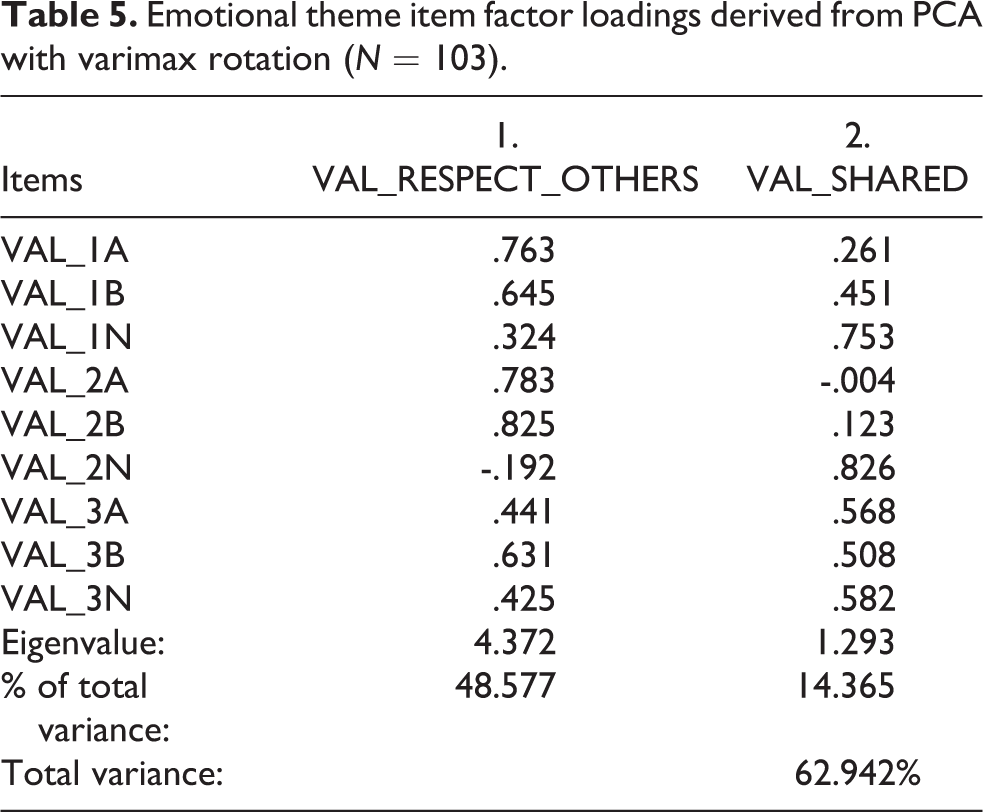
Reliability analysis conducted on the shared dimension variable VAL_TOTAL (M = 50.93, SD = 7.66) revealed a Cronbach’s alpha of α = .848. As shown in Table 5, PCA revealed two components with an eigenvalue of 1 or above. Therefore, an average score from the items that were revealed to comprise these separate components was then calculated to create two new component variables. Firstly, VAL_1A/B, VAL_2A/B and VAL_3B loaded highly on component 1. As these items pertain to identity expression, openness to experience and feelings of respect towards others values a new variable labelled VAL_RESPECT_OTHERS (M = 5.74, SD = .90) was calculated. Items VAL_1 N, VAL_2 N, and VAL_3A/N loaded highly on component 2. As this component is comprised of items from all three sub-themes, this may be interpreted as a general shared values component and a new variable labelled VAL_SHARED (M = 5.56, SD = 1.03) was calculated. The Cronbach’s alpha values of these variables were α = .841 and α = .719 respectively.
Emotional theme item factor loadings derived from PCA with varimax rotation (N = 103).
Finally, reliability analysis conducted on the four dimension variables (SOC_TOTAL, MUS_TOTAL, EMO_TOTAL and VAL_TOTAL) revealed a Cronbach’s alpha value of α = .879, indicating a strong level of agreement between these factors in measuring an overall EDM event experience construct. An average of these scores was calculated per participant and labelled as EDM_AVG, with a minimum score of 32.75 and maximum of 63 (M = 52.91, SD = 5.92).
Correlations Between Age, Frequency and Duration of Attendance, Drug-Taking, and SMEV Dimensions
One-way ANOVAs (Kruskall-Wallis) showed no significant difference between frequency of attendance at EDM events and the SMEV dimension variables (SOC_TOTAL, MUS_TOTAL, EMO_TOTAL, and VAL_TOTAL). ANOVAs between these variables and duration of attendance scores also showed no significant difference. Spearman’s rank tests conducted between age and the SMEV variables revealed age positively correlated with MUS_TOTAL (rs(103) = .20, p = .043). However, no significant correlations were found between age and the other SMEV variables. Further ANOVAs showed no significant difference between frequency of attendance at EDM events and SWLS scores, SWBS scores or PWBS scores. Spearman’s ranks tests conducted between age and well-being scores also revealed no significant correlations. As a result, frequency and duration of attendance and age were not carried over into subsequent regression analyses. Regarding drug-taking, on average, participants agreed that drug-taking positively affected the EDM experience (M = 5.41, SD = 1.65) and disagreed that it negatively affected the experience (M = 2.94, SD = 1.66). There was a significant negative correlation between PWBS_SCORE and the negatively worded item measuring the influence of drug-use on EDM experience (r s (103) = -.246, p = .012). This suggests there is a link between higher psychological wellbeing and disagreement that drug-taking negatively influences EDM events. There were no other significant correlations between the wellbeing scores and drug-taking items.
Correlations Between EDM Event Dimensions and Well-Being
The descriptive statistics and Cronbach’s alpha values for the well-being scales are presented in Table 6 below. Two-tailed tests of significance were conducted amongst the key dimension variables, their component variables, well-being scales, age, and EDM_AVG. Spearman’s Rank test was used as Kolmogorov–Smirnov tests conducted amongst key variables were significant. It was predicted that there would be a positive relationship between scores on the EDM event dimensions and all three well-being scales (H1), a positive relationship between EDM_AVG and scores on all three well-being scales (H2) and a positive correlation between scores on the social dimension and SWBS scores (H3). The following is a summary of the key, significant correlational findings in relation to the research aims
Well-being variables descriptives (N = 103).
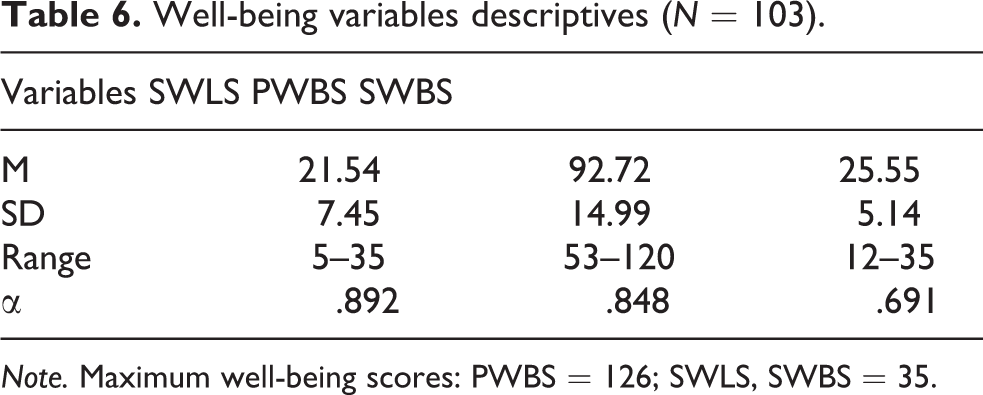
Note. Maximum well-being scores: PWBS = 126; SWLS, SWBS = 35.
SWLS scores did not significantly correlate with any of the EDM event dimension variables or EDM_AVG, suggesting EDM event attendance is not generally related to subjective well-being as measured through life satisfaction. However, there were significant correlations between SWLS scores and M_MUSICAL_DISCOVERY, rs(103) = .242, p = .014 and EMO_HAPPY_FREEDOM, rs(103) = .205, p = .037, suggesting that there may be (1) a positive relationship between the expansion of one’s musical taste through EDM event attendance and subjective well-being and (2) a positive relationship between positive affect, self-expression, and subjective well-being.
PWBS scores significantly correlated with all measures: SOC_TOTAL (rs(103) = .249, p = .011), MUS_TOTAL (rs(103) =.214, p = .030), EMO_TOTAL (rs(103) = .229, p = .020), VAL_TOTAL (rs(103) = .264, p = .007), and EDM_AVG (rs(103) =.265, p = .007), highlighting a positive relationship between EDM event attendance and psychological well-being overall. However, some individual variables (SOC_COMMUNITAS, M_MUSICAL_PERFORMANCE, VAL_RESPECT_OTHERS) did not correlate significantly with PWBS scores, and so these factors may not be as strongly associated with PWB.
SWBS scores significantly correlated with SOC_TOTAL(rs(103) = .314, p = .001), MUS_TOTAL (rs(103) = .271, p = .006), VAL_TOTAL (rs(103) = .232, p = .018) and EDM_AVG (rs(103) = .289, p = .003), suggesting there is a positive relationship between EDM event attendance and social well-being that is most strongly related to the social and musical dimensions of EDM events as well as, to a lesser extent, the shared values dimension. EMO_TOTAL did not correlate significantly with SWBS scores, indicating that the emotional dimension of EDM events was not related to social well-being. Nonetheless, one variable within this dimension, EMO_HAPPY_FREEDOM, did correlate significantly with SWBS scores (rs(103) =.222, p = .025), suggesting that positive affect and self-expression engendered through EDM events is positively associated with social well-being.
Multiple Regression Analyses
In order to determine how much variance in well-being scores EDM dimension variables accounted for, several hierarchical multiple regressions informed by the correlational analyses were carried out. Firstly, a two-stage hierarchical multiple regression was employed to determine the variance in social well-being scores. It was predicted that the social experience would account for the greatest variance in these scores. It was revealed that at stage one, the social experience contributed significantly to the regression model, (F(1, 101) = 14.309, p < .000), with an R2 of .124, accounting for 12.4% of the variation in SWBS scores. Introducing the other three EDM event experience variables explained an additional 2.2% of variation in SWBS scores. This change in R2 was not significant, (F(4, 98) = .829, p = .481). This suggests the social experience (as measured through SOC_TOTAL) is the greatest predictor variable of variance in SWBS scores. As the PWBS is made up of measures of various facets of well-being, no specific prediction was made regarding which EDM event factor(s) would contribute significantly to the regression model. As such, a forced entry regression multiple regression technique was employed with all variables entered at stage one of analysis. The SMEV dimensions significantly contributed to the regression model (F(4, 98) = 3.071, p = .02), with an R value of .334, accounting for 33.4% of the variation in PWBS scores. No individual dimension significantly contributed to the regression model alone, suggesting all dimensions of the SMEV model explain variance in PWBS scores.
General Discussion
The current study aimed to explore subjective experiences of EDM event attendance (Study 1) and analyze links between facets of EDM event participation and scores on subjective, social and psychological well-being scales using a larger sample (Study 2). A novel model that categorized key dimensions of the EDM event experience was developed from Study 1 data in order to achieve this. As such, building on the themes initially suggested by Little et al. (2018), a principal outcome of the current study is the proposal of a holistic four-factor model consisting of the social, musical, emotional, and shared values dimensions to EDM events (SMEV). The model displays a good level of internal reliability and strong correlations were found between the dimensions and their components, suggesting a framework that encompasses the typical EDM event experience was effectively utilized. The in-depth nature of interviews conducted in Study 1 highlighted a range of experiences that aligned with findings of prior qualitative research amongst EDM event attendees, namely, the importance of community and belonging, self-expression, elevated emotional states, and intense musical experiences (Little et al., 2018; Takahasi & Olaveson, 2003). The salience of these themes within the SMEV model provides evidence to further support conclusions made across existing interdisciplinary EDM research that these are core features of attendance that characterize EDM events as positive and gainful experiences.
A principal key finding was the partial confirmation of H1, which predicted positive relationships between scores on the EDM event dimensions and well-being measures, and H2, positive relationships between overall average EDM scores and well-being measures. Findings showed that psychological well-being was significantly related to all four averaged dimension variables of the SMEV model, and scores on social well-being significantly related to three dimension variables (representing the social, musical, and shared values themes excluding emotional). However, scores on subjective well-being were not significantly related to the SMEV dimensions. Regression analyses further revealed that all four aspects of the SMEV model play a role in explaining the variance in psychological well-being scores. As such, the current study begins to elucidate the principal factors of the EDM event experience that may promote well-being outcomes. Moreover, results also confirmed H3; that there would be a positive relationship between the social dimension and social well-being scores. Overall, the social experience was found to be the most salient aspect of EDM events that contributed to well-being, correlating positively with both the PWBS and SWBS measures and accounting for highest amount of variance in a hierarchical regression analysis conducted on EDM event factors and social well-being scores. Although all the SMEV dimensions were found to be positively associated with psychological and social well-being scores, the social experience correlated most strongly with social well-being and explained the greatest variance amongst SWBS scores. These findings echo the results of Packer and Ballantyne’s (2011) festival study wherein the social experience positively correlated with a composite well-being measure. The current study builds on this research as it distinctly positions EDM events as a category of musical attendance activities that, like music festivals, is characterized by a core social dimension that appears to be conducive to well-being.
In additional to the social dimension, a notable finding from Study 1 was the importance of the musical experience and the degree to which it appears to underpin other facets of attendance. Interviewees’ accounts frequently highlighted how the musical experience brought people together in a unified fashion, contributing to a sense of belonging as well as engendering heightened emotional states. This finding is particularly relevant in the context of recent research by Solberg and Jensenius (2016, 2017) which suggests that positive emotional experiences and social connectedness are facilitated through EDM promoting intersubjective embodiment and group synchronization on the dancefloor. Indeed, group synchronization to music in live contexts has been found to increase social bonding (Tarr et al., 2014) and musical analysis by Solberg (2014) outlines structural aspects of EDM that engender peak emotional experiences. Considering such research alongside the findings of the current study, it may be argued that EDM possesses genre-specific musical qualities that contribute to bringing about the positive social and emotional experiences detailed by interviewees in Study 1, and throughout existing research on EDM culture (Kavanaugh & Anderson, 2008; Lynch & Badger 2006; Takahashi & Olaveson, 2003). The shared values dimension (or ‘PLUR’ ideals) may also be seen, therefore, as a by-product of a community-oriented, emotionally positive environment that is rooted in the music. Little et al. (2018) provides qualitative evidence for the importance of EDM in contributing to emotional and social aspects of attendance, however, notably, does not position the musical experience as a central thematic category. This may be due to the limited scope of the research, focusing on a single festival. Broadening the scope to the full spectrum of EDM events, the current study builds the case that the musical experience is a central component to the EDM event experience which other aspects of attendance are fundamentally related to.
Limitations and Future Research
It must be noted that the significant relationships between EDM event dimensions and well-being scores revealed within the current study are at this stage tentative. The extent to which this model may be applicable the EDM event attendee population is limited as only seven people were interviewed and 103 surveyed. The use of a small number of interviews as the basis for the questionnaire in Study 2 also may have led to other important aspects of the EDM event experience being overlooked. For instance, a key theme of Little et al. (2018) was ‘self-reported changes’, and for Takahashi and Olaveson (2003) the theme ‘transformation/personal growth’, suggesting that a broad theme of individual growth and change may potentially have been overlooked within the current study. Additionally, Study 2 participants were predominantly male (72%), which limits generalizability of the results and may skew experiences towards being positive as gender discrimination issues affecting females in rave culture (cf. Gadir, 2016) may not have been identified. As such, it may be useful for future research to explore the validity and reliability of the SMEV model further, utilizing differing samples in order to assess its generalizability to the wider population of EDM event attendees. Further research should also seek a more balanced perspective between genders and occupations to achieve this. Nonetheless, interviewee excerpts in Study 1 support previous research by Takahashi and Olaveson (2003) that reveal that aspects of the EDM event experiences such as connectedness with others may be incorporated into to day-to-day to life for some individuals and may positively impact their well-being outside of the EDM event context. In order to determine whether EDM event attendance may have long-lasting well-being benefits there is a need for longitudinal studies that assess frequency and duration of attendance, measuring well-being outcomes of before and after a sustained period of EDM event attendance.
It should also be noted there was a small number of negative EDM event experiences identified by interviewees, however, as these were in the minority, they were not carried over into design of Study 2. As a result, there were no items on the questionnaire pertaining to these experiences and this may have biased the significant positive correlations between well-being. Despite the inclusion of two items measuring the influence of drug-taking these only assessed agreement with the notion that drugs may negatively or positively affect the experience. Further research should employ measures that assess the extent of drug-use at EDM events and potential correlations with well-being outcomes, and investigate specific instances of drug-use and how these may shape experiences. In addition, other potentially negative experiences related to consumerist elements (e.g, cost of attending, branding, dress code) could be considered in future research in light of the debate surrounding commercialization of cultural events (cf. Gauthier, 2013).
While the current study showed significant links between facets of EDM event attendance and psychological and social well-being, no links were found with subjective well-being. One reason for this might be that only one aspect of subjective well-being, life satisfaction, was assessed, through the 5-item SWLS. A more detailed measure may be needed to show links between EDM event experiences and subjective well-being. It may be fruitful for future research in this area to employ the more recently developed, comprehensive 24-item BBC subjective well-being scale (BBC-SWB, Pontin et al., 2013).
Finally, the importance of the musical dimension revealed within the current study warrants future research assessing in-the-moment musical experiences during EDM events. This has potential to shed light on the mechanisms through which EDM event experiences influence social connectedness and peak emotional states, and in turn well-being. For example, research could employ optical motion tracking methodologies to measure movement, as used within Solberg and Jensenius (2016, 2017) to further explore group synchronization and its influence on social connectedness. However, these should be carried out in a live (rather than laboratory-based) EDM event context, and with different genres since EDM subgenres differ structurally (McLeod, 2001) which may cause variations in social and emotional responses. Combining this with qualitative assessments of ravers’ social experience on the dancefloor would be useful to facilitate comparison of different styles of EDM and their influence on social cohesion and, in turn, social well-being. Further research should also seek to assess how and when strong emotional experiences are occurring on the dancefloor and whether these are related to musical aspects of EDM such as the break-routine, as suggested by Solberg (2014). Additionally, there is a need to assess the performative role of the DJ in live EDM event contexts, an integral factor of the musical experience which may influence physical and emotional responses of the audience (Gates et al., 2006; Greasley, 2017). Indeed, the current study found ‘DJ & performance’ to be an important sub-theme of the musical experience. Within this, it may also be important to consider how perceived musical preferences of different genders by DJs may affect the dancefloor, such as biases among male DJs towards playing tracks with certain musical timbres to appeal to a female audience (Gadir, 2016). Existing research provides important insight into the mechanisms of the musical experience that influence the themes of attendance found within the current study (namely, social connectedness and positive emotional states). As such, further assessment of these mechanisms with a focus on how they may engender experiences related to promoting well-being across a balanced range of demographics is warranted.
Footnotes
Appendix
Action editor
Joel Krueger, University of Exeter, Department of Sociology, Philosophy and Anthropology.
Peer review
Alexander Refsum Jensenius, University of Oslo, Department of Musicology.
Maria Witek, University of Birmingham, Department of Music.
Author contribution
Under the supervision and guidance of AEG, JWC conceived the study, researched literature, gained ethical approval, recruited participants and analyzed the data. JWC wrote the first draft of the manuscript. Both authors reviewed and edited the manuscript and approved the final version of the manuscript.
Declaration of conflicting interests
The author(s) declared no potential conflicts of interest with respect to the research, authorship, and/or publication of this article.
Funding
The author(s) received no financial support for the research, authorship, and/or publication of this article.
