




Abstract
Dengue fever is the most significant arthropod-transmitted viral disease in terms of mortality and morbidity, affecting at least 50 million people around the world. It is commonly recognized as “breakbone” fever as it is mostly associated with severe muscle and joint pain. The objective of the study was to evaluate and assess the levels of selected vitamins and hormones in serum of dengue patients from Faisalabad, Pakistan. Estimation of serum levels of vitamins D3 and K was carried out through spectrophotometer, while concentration of serum hormones, angiotensinogen and thrombopoietin, was determined through enzyme-linked immunosorbent assay (ELISA) kit method. Hematological blood parameters were also investigated. Hematological parameters significantly (P < 0.05) differ in dengue fever patients and normal control subjects. Vitamin D3 level was found significantly (P < 0.05) decreased in test group (dengue patients) compared to control group (healthy individual). Vitamin K level was also reduced in test group compared to control group, but this reduction was nonsignificant (P > 0.05). Among the tested hormones, angiotensinogen level was found significantly (P < 0.05) lower in test group, while thrombopoietin was nonsignificantly (P > 0.05) higher compared to control group. In conclusion, the results of the current study demonstrated the significance of tested vitamins and hormones along with blood parameters in monitoring the dengue infected patients.
Introduction
Dengue fever is a viral disease caused by dengue virus that belongs to the genus Flavivirus in the family Flaviviridae. The virus is transferred to humans mostly by the bite of female mosquito Aedes aegypti. Dengue virus (DENV) is a single-stranded RNA virus with a genetic makeup of about 11,000 nucleotides in length. Dengue fever is caused by IV antigenically related but genetically distinctive viruses (DEN I-IV), and all IV serotypes usually result in mild febrile sickness which probably develops to dengue shock syndrome and dengue hemorrhagic fever (DHF).1,2 Dengue virus infection is an illness with a wide clinical picture ranging from asymptomatic to an undifferentiated fever to the more serious form of DHF. 3
Thrombocytopenia and plasma leakage are important complications of dengue fever infection, which results to disturbance in thrombopoiesis and increased destruction of platelets in circulation. Bone marrow has a significant role in suppression of hematopoietic system and inducing thrombocytopenia occurred during dengue viral infection. TPO (thrombopoietin) is the main regulatory hormone maintaining the adequate count of thrombocytes and megakaryocytes in circulation. Significant increase in TPO level has been found in patients with low circulating level of megakaryocytes and platelets.4,5 Angiotensinogen is a glycoprotein, produced by the liver and released into the circulation. Due to lowered blood pressure, angiotensinogen is acted upon by renin and then converted into angiotensinogen-I which is further converted into angiotensin-II, a physiologically active form of renin angiotensin system and have vasoconstriction effect regulating the fluid volume and mineral balance in body fluids. 6
Vitamin D3 plays an important role in mediating the immune system. It increases the phagocytic capacity of macrophages and induces antimicrobial peptide gene expression, thus contributing to innate immune responses. 7 Vitamin D3 is powerful immunomodulator affecting both innate and adaptive immune responses. Its deficiency is mainly associated with increased risk of cancer, influenza, tuberculosis, and human immunodeficiency virus infection. Vitamin D3 also reported to influence the expression of DENV receptors in immune cells. 8 Bleeding, one of the main problems experienced in dengue fever, contributes to worsening morbidity. 9 The significance of vitamin K for hemostasis is established from the fact that deficiency of vitamin K is a critical, life-threatening situation due to excessive bleeding. 10 Vitamin K has a pivotal role in the relationship between liver and the coagulation system as it is essential for the synthesis of functional and active forms of a number of coagulation factors and inhibitors by the liver. To the best of our knowledge, blood serum levels of vitamins and hormones have not been documented in dengue patients before. So, in the current study, an attempt was made to assess the blood serum levels of selected vitamins and hormones in dengue fever patients.
Materials and methods
A total number of 30 adult individuals including 15 dengue patients and 15 healthy volunteers without sex and age restriction were recruited in this research study. The research plan was approved by the Institutional Research Scrutiny Committee, University of Agriculture, Faisalabad. All subjects gave informed, signed consent to participate in the study. The known dengue viral patients already diagnosed at Allied Hospital, Faisalabad, were included in the study as test group, while the healthy individuals from University of Agriculture, Faisalabad, were included as control group.
Sample collection and processing
Blood samples (5 mL) of infected individuals were collected from Allied Hospital, Punjab Medical College, Faisalabad, Pakistan, and healthy volunteers from University of Agriculture, Faisalabad. About 2 mL of blood was collected in serum separating tubes, and remaining blood was collected in ethylenediaminetetraacetic acid (EDTA) coated tubes. After collection, the clotted blood samples were centrifuged at 4500 r/min for 15 min, and then serum was collected in Eppendorf tubes. Sample processing and analysis were performed in the Bio-Medical Research laboratory, Department of Biochemistry, University of Agriculture, Faisalabad. The dengue viral infection was reconfirmed in the test group individuals through immunochromatographic method.
Hematological analysis
Hematological parameters, including hemoglobin concentration, red blood cell (RBC) count, hematocrit, mean corpuscular volume (MCV), mean corpuscular hemoglobin (MCH), mean corpuscular hemoglobin concentration (MCHC), white blood cell (WBC) count, and platelet count, were determined according to Patel et al. 11
Determination of vitamins and hormones
The serum levels of vitamins D3 and K were determined with the help of spectrophotometer, 12 while commercially available enzyme-linked immunosorbent assay (ELISA) kits were used for the determination of angiotensinogen and TPO. 4
Statistical analysis
The obtained data were analyzed by one-way analysis of variance (ANOVA) to determine the significance of results using SPSS version 22 (SPSS, Inc., Chicago, IL, USA). Mean ± standard deviation (SD) concentrations of selected biochemical parameters in blood and serum of dengue patients were calculated using Microsoft Excel version 2007. 13
Results
In the current study, we documented the hematological profile along with other biochemical markers in dengue patients. The hematological parameters showed alterations with significant (P < 0.05) reduction in hemoglobin concentration, RBC count, hematocrit, and MCV in dengue patients (test group), while no significant (P > 0.05) variation was observed in MCH, MCHC, and Red cell distribution width coefficient of variation (RDW-CV) in both the test and control group cases. Total WBC count was found significantly (P < 0.05) increased in dengue patients compared to healthy individuals in control group. A significant (P < 0.05) reduction in platelet count was also observed in dengue patients than in healthy individuals. Results of hematological parameters have been given in Table 1. The values are represented as mean ± SD.
Mean ± SD values of hematological parameters in study subjects.

SD: standard deviation; RBCs: red blood cells; MCV: mean corpuscular volume; MCH: mean corpuscular hemoglobin; MCHC: mean corpuscular hemoglobin concentration; WBCs: white blood cells.
PCV- Packed cell volume, HCT- Hematocrit
Significant at P ≤ 0.05; ns = nonsignificant (P > 0.05).
We in the present research work found significant (P < 0.05) variation in vitamin D3 level, while no significant (P > 0.05) variation was observed in vitamin K level in study subjects. Our results in the current study showed significant (P < 0.05) reduction in vitamin D3 level of dengue patients as compared to healthy subjects, while level of vitamin K was found to be reduced nonsignificantly (P > 0.05) in dengue virus infected individuals.
Among the selected hormones including angiotensinogen and TPO studied in the current research, variations in these hormone levels were observed. Angiotensinogen level was found significantly (P < 0.05) decreased in dengue virus infected individuals in comparison with healthy subjects. In our study, nonsignificant (P > 0.05) increase in TPO level was observed in dengue patients as compared to healthy controls which may be due to low circulating level of platelet count and megakaryocytes. The results, as mean ± SD of vitamin and hormone levels, are presented in Figure 1.
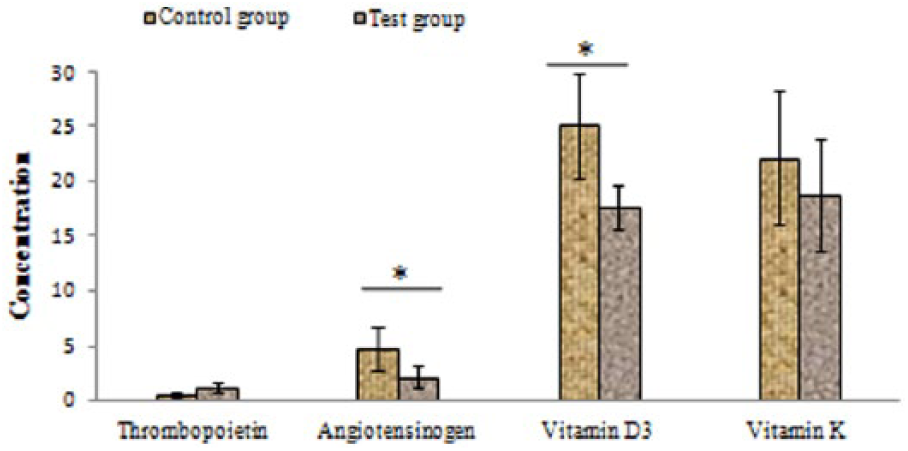
Mean ± SD of hormone (angiotensinogen and thrombopoietin) and vitamin (D3 and K) levels in control (healthy individuals) and test (dengue patients) groups.
Discussion
Dengue is a self-limiting serious febrile sickness followed by a phase of acute defervescence, in which patients may progress to a severe form. Severe infection is characterized by increased vascular permeability, decreased blood volume and blood pressure, hemodynamic disturbances, and shock. 14 Our research work herein is one of the first study to assess the biomarkers, whose level is directly or indirectly controlled by liver. Hematological profile is a good indicator of the physiological status of the patient. 15 In this study, we documented the hematological profile along with other biochemical markers in dengue patients. The hematological parameters showed alterations with significant reduction of RBCs, platelets, hematocrit, MCV, hemoglobin together with a significant increase in WBCs, while no significant variation was observed in MCH, MCHC, and RDW-CV in both the test and control group cases. Our results revealed significantly lowered platelet count in dengue patients than healthy controls. Chandra et al. 16 reported lowered platelet count in their study and suggested that decreased level of antioxidants may contribute to oxidative destruction of platelets during dengue fever.
Deficiency of vitamin D3 may increase the risk of acquiring viral infections such as influenza, respiratory infections, and human immunodeficiency virus. Vitamin D3 has also been reported to have antiviral effect. 17 Our results showed significant reduction in vitamin D3 level during dengue fever as compared to healthy subjects, while level of vitamin K was found to be reduced nonsignificantly in infected individuals. Previously, there is no report available on estimation of vitamin K in dengue patients. Our study herein is the first to estimate the level of vitamin K in dengue patients. Alagarasu et al., 8 in their study, determined vitamin D3 level in dengue patients where they found an increased level of vitamin D3 in dengue patients. Sánchez-Valdéz et al. 18 reported that administration of vitamin D3 to the dengue patients improved overall clinical condition and reduced the duration of signs and symptoms of dengue fever.
TPO is a glycoprotein hormone produced by the kidney and liver, which controls the production of platelets. TPO is the main regulatory substance of thrombopoiesis and megakaryocytes to maintain sufficient platelet count in circulation. 4 In our study, nonsignificant increase in TPO level was found in dengue patients as compared to healthy controls which may be due to low circulating level of platelet count and megakaryocytes. Our study also suggests a positive correlation between TPO level and thrombocytes count in dengue patients. Angiotensinogen level was found to be very low in dengue patients as compared to control subjects. There was no report available on determination of angiotensinogen in dengue patients. Further research should be taken to study these parameters in dengue patients.
The study concluded that hematological profiling can be a useful indicator in assessing the disease severity and helpful in disease management especially dengue fever. Early diagnosis of dengue is important for provision of special care, which ensures marked reduction in the morbidity. Present study suggests that altered levels of vitamins and hormones are associated with dengue fever which might be associated with viral load or toxicity during dengue fever.
Footnotes
Declaration of conflicting interests
The author(s) declared no potential conflicts of interest with respect to the research, authorship, and/or publication of this article.
Funding
The author(s) received no financial support for the research, authorship, and/or publication of this article.
