




Abstract
The use of plants to cure specific ailments is as antique as human civilization. These days, in the modern era, there is a growing concern by public opinion regarding the use of synthetic medicine due to their side effects and cost. These facts led to the discovery of some economical and alternative drugs with fewer side-effects. In this study, methanolic, hexane and aqueous extracts of Capparis deciduas have been evaluated for their antifungal activity against medically important fungal strains – Candida albicans and Aspergillus niger using disc diffusion method at a dose of 1.8, 2.9, 6.5, 12.6, 25, 50 and 75 (µg/mL). Zone of inhibition for antifungal activity of these extracts was compared with that of a standard drug like fluconazole. The methanolic extracts of C. decidua showed significant activity against C. albicans (minimum inhibitory concentration (MIC): 1.8 µg/mL), for hexane extracts the MIC was 2.9 µg/mL and for aqueous extracts, no MIC can be observed. C. decidua did not show significant activity against A. niger. Our finding showed that C. decidua has antifungal activity and further phytochemical analyses of these plants should be carried out to determine the bioactive ingredients that may serve as a lead in the progress of novel research activities in the pharmaceuticals industry.
Introduction
In developing countries, infectious diseases account for a large proportion of health diseases. Antibiotics since their introduction are playing an important role in fighting against these infectious diseases and greatly benefitted human life by decreasing morbidity. But, over the past few decades, due to their side effects and emergence of drug-resistant bacteria, they created a massive clinical problem for the management of infectious diseases. 1 This situation enforced the scientists to explore newer antimicrobial drugs from various sources like plants with reduced side effects and resistance. 2 There are various reports which depict the emergence of opportunistic fungal infections. 3 In earlier researches, they were known as plant pathogens, but currently they are acknowledged as a human disease–causing agent. There is an increasing awareness among microbiologists and clinicians regarding the importance of infection caused by these opportunistic fungi. 4 Fungal infections (Aspergillosis and candidal), especially candidal infections, are the real hazard for human beings for two reasons, that is, they cause blood-borne infections and develop resistant against several well-known antifungal medicines like Amphotericin B and fluconazole. Aspergillus is a common fungus and usually present in outdoor and indoor atmospheres. Every day Aspergillus spores are inhaled by most of the individuals without being affected. However, in a person who has debilitated immune systems or lung disease may lead to the development of disease known as aspergillosis. Candida albicans another genus of fungus is pathogenic to mankind. 5 The spectrum of illness includes allergic reactions, lung infections and infections in other organs. Consequently, due to the long-term use of these antifungal agents/antibiotics, the susceptible candidal species die while the resistant species tend to proliferate themselves, causing serious problems for the hosts. 6 In an effort to increase the range of antibacterial drugs from plant resources, Capparis decidua commonly called as Kirir belongs to the family Capparaceae has been selected. Traditionally, it is used to cure many diseases. The ‘Hakims’ used this plant to prepare various Unani medicines. 7 In this study, investigation of methanolic, hexane and aqueous extract of C. decidua against pathogenic fungi was carried out to determine the scientific basis for the traditional practice of this medicinal plant and to generate data as a new source of the antifungal agent for which little data exist.
Materials and methods
Collection of plant material
The whole plant with roots was collected from Baghdad-ul-Jadeed Campus and identified by our taxonomist Mr M Warris. The fresh weight of C. decidua was 15 kg. The plant root was chopped and shade dried for 25 days to get 7.700 kg of dried C. decidua root material (51.4% water content). The plant was powdered and soaked in 10 L methanol for 1 week and then it was filtered. The process was repeated twice and the total solvent used was 29 L. Rotary evaporator was used for solvent evaporation. Dried methanolic extract (81 g) was obtained and used for further fractionation. Soaking and fractionation of plant was done in commercial grade solvents/chemicals (i.e. methanol, ethyl acetate and petroleum ether). In 50 mL of distilled water, 15 g of dried methanolic extracts were dissolved. To get hexane extracts (2.14 g), petroleum ether (hexane) 500 mL × 3 was used for extraction purpose. The methanolic, hexane and aqueous extracts were prepared in seven concentrations, which were 1.8, 2.9, 6.5, 12.6, 25, 50, and 75 µg/disc (Table 1).

Antifungal assay
Media preparation
Yeast peptone dextrose agar (YPDA) media was prepared for the antifungal screening on solid media using 10 g of yeast extract and 20 g of peptone, glucose and agar. These ingredients were dissolved in 1 L of distilled water and sterilized by autoclave. After sterilization media was transferred to autoclaved Petri plates and permitted to solidify at room temperature.
Culture preparation
C. albicans and Aspergillus niger were inoculated into freshly prepared YPDA media by streaking loop to make the culture. To avoid contamination for other cultures, sterilization of streaking loop was done on the flame by making it red hot. The cultures were prepared in the pathology lab of Quaid-e-Azam Medical College Bahawalpur. A small amount of culture was shifted to 2–3 mL distilled water in a screw-capped tube with few glass beads (1 mm in diameter) and to make a homogeneous suspension of fungal culture it was shaken for 5–10 min. The culture was incubated at 28°C and 37°C for overnight culturing with constant shaking to favour the yeast and hyphal growth of C. albicans, respectively.
Antifungal screening
In this system, the antifungal activity of C. decidua was investigated against fungal strain of C. albicans and A. niger using disc diffusion method. 8 A separate dose of different concentrations (1.8, 2.9, 6.5, 12.6, 25, 50 and 75 µg/mL) was added to each disc to check their antifungal properties. After this, at 28°C, the culture was incubated for 48 h. Under the similar condition, control experiments were carried out. Results were documented by measuring the zone of inhibition in mm.
Determination of minimum inhibitory concentration
The different extract exhibiting the zone of inhibition of 15 mm or more was considered significant and selected for the determination of their minimum inhibitory concentration (MIC) by disc diffusion method. 9
Results
The results of the antifungal activity revealed that C. decidua has a good inhibitory effect on C. albicans than A. niger (Table 1). The hexane extracts of C. decidua were also applied to C. albicans and found the MIC was 2.9 µg/mL. C. decidua showed an increase in the inhibitory concentration in a dose dependent manner (Table 1). The aqueous extracts of C. decidua did not show antifungal activity against C. albicans (Table 1).
The microscopic examination was done by preparing the slides of each concentration followed by microscopic examination along with the positive control. C. albicans cells are diploid, but after C. decidua treatment, the cells are completely dead when observed under the microscope (Figures 1 and 2).
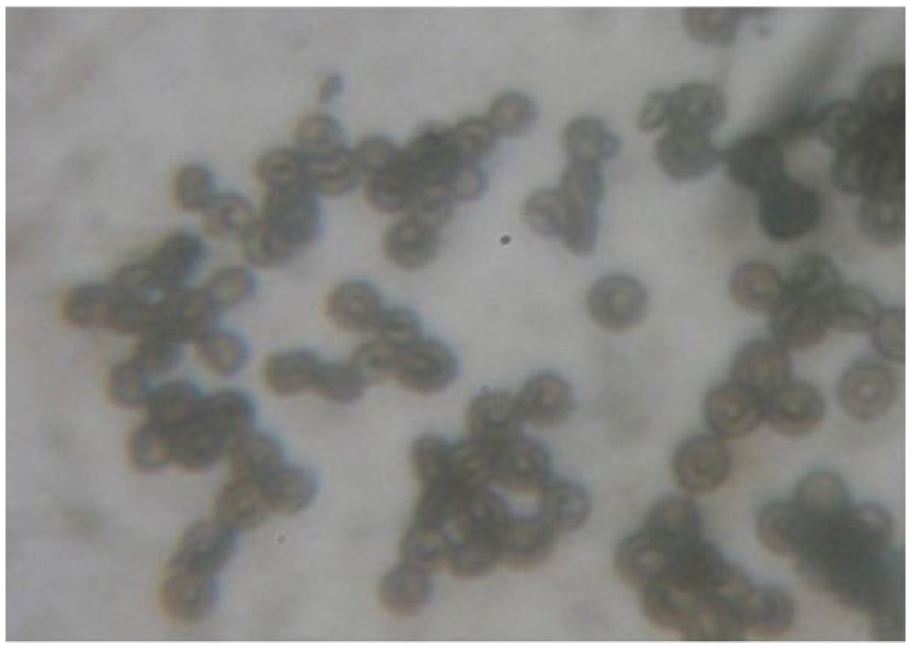
Cells of Candida albicans before Capparis decidua treatment under 40×.

Microscopic analysis of Capparis decidua examining anticandidal activity under 40×.
Discussion
Research studies shows that plant posses antioxidants, antihypertensive, antidiabetic and antibacterial characteristics and can be used in a variety of conditions.10,11,12 Keeping above evidences in mind we have selected C. decidua. The methanolic extract of this plant was prepared and then fractionated with hexane and ethyl acetate to obtain hexane, ethyl acetate and water extracts. The prepared extracts were tested at different concentrations (seven concentrations of methanolic extract, that is, 75, 50, 25, 12.6, 6.5, 2.9 and 1.8 μg doses per disc. While the hexane, ethyl acetate and water fractions were tested on 12.6, 6.5, 2.9 and 1.8 μg doses per disc) for antifungal activity against C. albicans and A. niger strains, and MIC was determined using disc diffusion method.
The antifungal activity of these extracts were compared with standard antifungal drug fluconazole. The negative control showed negative results while the positive controls fluconazole showed results against the strains (Table 1). The crude methanolic extracts of C. decidua roots showed no activity against A. niger in any of the seven concentrations, that is, 75, 50, 25, 12.6, 6.5, 2.9 and 1.8 μg doses per discs (Table 1). The crude methanolic extracts of C. decidua roots showed zones of inhibition against C. albicans (tested in triplicates) at 75, 50, 25, 12.6, 6.5, 2.9 and 1.8 μg/mL doses per discs, and the zones of inhibition were 43, 18.7, 9.3, 4.0, 3.0, 2.2 and 1.3 mm, respectively. These results clearly show the dose-dependent inhibition of fungal strains (Table 1). The hexane extracts of C. decidua were also applied on C. albicans at 12.6, 6.5, 2.9, and 1.8 μg doses per disc and the observed the zones of inhibition were 6.34 mm and 3.1 mm, 0.47 mm, Nil mm, respectively (Table 1). It was found the MIC for the hexane extracts of C. decidua was 2.9 µg/mL, and with the increase of dose, there is an increase in the inhibitory concentration (Figure 1). The aqueous extracts of C. decidua did not show antifungal activity against C. albicans (Table 1). The higher statistical differences in the activity of the root extracts of C. decidua at higher doses were observed as compared to fluconazole on C. albicans. So, C. decidua was significant for the C. albicans and non-significant for the A. niger.
The microscopic examination was done by preparing the slides of each concentration followed by microscopic examination along with the positive control. C. albicans cells are diploid, but after C. decidua treatment cells have lost their shape, they were squeezed and dead when observed under the microscope at 40× (Figures 1 and 2). The methanolic extracts of C. decidua showed significant activity against C. albicans (MIC = 1.8µ g/mL), for hexane extracts the MIC is 2.9µ g/mL and for aqueous extracts, no MIC can be observed. C. decidua did not show significant activity against A. niger. C. decidua was significant for the C. albicans and non-significant for the A. niger as compared to standard drug (fluconazole). However, to use this as an antifungal agent, further phytochemical analysis and isolation and structure elucidation of antibacterial active ingredients are necessary to assess the efficiency of the crude extracts. The current results will formulate the base for selection of plant species to discover new potential bioactive elements.
Footnotes
Declaration of conflicting interests
The author(s) declared no potential conflicts of interest with respect to the research, authorship and/or publication of this article.
Funding
The author(s) received no financial support for the research, authorship and/or publication of this article.
