



Abstract
Can f 5 allergy and possible cross-reactivity with human semen in which there are significant amounts of prostate-specific antigen (PSA) are particularly interesting aspects of allergy to dog. The objective of the study was to confirm cross-reactivity between human PSA and Can f 5 in a study of canine sensitised women. A total of 100 women (aged 18–73, 41 on average) with a positive history of animal fur allergy or positive skin prick tests to canine allergens were selected. Levels of Immunoglobulin E (IgE) specific to Can f 1, Can f 2, Can f 3, Can f 5 were determined. Patients with increased concentration of sIgE Can f 5 were selected for further inhibition testing using polystyrene microplate ELISA test coated with human PSA. In the studied population, allergy to Can f 5 dominated (52.3% of patients with increased concentration of canine-specific IgE were allergic to this allergenic component). In all analyzed cases, the concentration of IgE Can f 5 decreased after incubation on the ELISA plate coated with human PSA. The minimum decrease in concentration was 10.44%, the maximum was 37.73%, the average decrease was 21.6%. No statistically significant influence of the presence or absence of allergenic sIgE Can f 5 in blood serum on the occurrence of symptoms after intercourse was found. The study confirmed the moderate ability of Can f 5 to cross-react with human PSA sIgE, which may be clinically significant in some women. At the same time, symptoms of an allergy to male semen do not constitute a typical clinical presentation of allergy to Can f 5.
Keywords
Background
Sensitization patterns for inhalant allergens differ in patients across Europe. Canine allergy is an important problem for clinicians. According to a large 2009 study by Heinzerling et al. 1 conducted on 3034 patients from 17 centers in 14 European countries, the average frequency of positive skin prick tests (SPT) with canine allergens was 27.2%, with the highest number of positive SPTs with these two types of allergens noted in Odense in Denmark (56.0%), and the lowest in Vienna, Austria—16.1%.
Canine allergens (Latin: Canis familiaris) are widespread and relatively well described. Early studies with allergen extracts showed the presence of at least 28 proteins that may act as allergens, of varying clinical significance. 2 Determination of levels of IgE specific for canine allergen components in the blood serum is currently possible with the use of semi-quantitative methods (ImmunoCap ISAC, Faber, ALEX), and highly sensitive quantitative methods (ImmunoCap Singleplex).
Those currently available for assay, and well-characterized are:
The human seminal plasma contains many proteins with potential sensitising ability.
Can f 5 allergy and possible cross-reactivity with human semen in which there are significant amounts of prostate-specific antigen (PSA) are particularly interesting aspects of allergy to dog. The described homology between proteins at the level of 55%–60% may be related to IgE-dependent reactions after contact with semen after sexual intercourse in women allergic to dog hair. 6
The issue is very interesting, but the knowledge about the relationship between allergy to Can f 5 and allergic reactions after sexual intercourse and, even more so, possible difficulties in getting pregnant, is based on case reports.7,8 There are no studies that would confirm the clinical relevance of Can f 5 cross-allergy in women allergic to dog allergens.
Material and method
100 women (aged 18–73, 41.23 on average) with a positive history of animal dander allergy or positive skin prick tests to canine allergens were recruited from patients of the Outpatient Clinic and Ward of the Clinic of Allergology, Clinical Immunology and Internal Medicine in Bydgoszcz.
Exclusion criteria were as follows: serious, chronic diseases, and patients on medication that could impact the results of this study, known impaired lung function of other cause than asthma, and ongoing or complete allergen-specific immunotherapy to furry animal.
Thirty patients (average age 37, aged 18–65) with negative allergy observation tests were included in the control group.
The study took place between February and December 2019. The size of the study population was established prior to conducting the study and was based on previous studies concerning allergy to fur animals, as well as the financial support received for the research.8–12
A detailed allergological history was taken from each patient, and a physical examination was conducted along with a skin prick test with extracts of common perennial allergens, including canine allergens, using the Allergopharma set.
Patients from both the control group and the test group had their blood samples taken to assess total levels of IgE and allergen-specific IgE to canine allergens. Levels of IgE specific to available allergen components of canines (Can f 1, Can f 2, Can f 3, Can f 5) were also determined.
All immunological determinations were performed with the use of the highly sensitive immune-fluorescent ImmunoCap method (Thermo Fisher Scientific). Levels of IgE were marked as increased when they exceeded 0.35 kU/l, in line with common practice in the field.
Patients with increased concentration of sIgE Can f 5 were selected for further experimental and immunological assessment.
Statistical analysis: Mann–Whitney and Kruskal–Wallis test, with Dunn test post hoc analysis and two-way ANOVA where used. Analyses were prepared using the R software, version 3.3.1 and GraphPrism 9.1.0.
The study was approved by the Bioethical Committee of Collegium Medicum in Bydgoszcz and was assigned the classification number of KB 134/2017.
The study was funded by the Scientific Grant for Young Scientists grated by Collegium Medicum in Bydgoszcz, grant number MN-3/WL/2018.
The authors declare no conflict of interest in regards to this research.
Assessment of IgE cross reactivity between human PSA and Can f 5 using the experimental solid phase model
Currently, no standardized method is available to assess cross-reactivity in patients allergic to fur animal allergens. Based on the determination of IgE against specific allergen components, it can be approximated whether a given protein demonstrates a high homology to other molecules, but this provides indirect evidence of the presence of cross-reactivity only. The aim of the present study was to prove directly that cross-reactivity between Can f 5 and human PSA exists.
For this purpose, an experimental model was used, based on a polystyrene microplate ELISA test (ALPCO; Total Prostate-Specific Antigen ELISA (ref. 25-PSAHU-E01)) coated with goat anti-human PSA antibody. The plate was then coated with human PSA. For this purpose, 100 µl of ROCHE calibration solution (total PSA CalSet II; ref. 04485220 190) containing human PSA at a concentration declared by the manufacturer of 58.5 ng/ml was added to test wells. Human PSA of known concentration was used for calibration purposes. The PSA concentration in the calibrator used was 84.75 ng/ml as measured with the ALPCO kit used in the experiment. The prepared plate was then incubated at 4°C for 24 h in order to immobilize PSA from the calibrator on walls of test wells of the plate. After this time, the calibrator was removed and wells were rinsed 3 times with distilled water to remove any unbound residues. Thanks to the procedure performed, a microplate coated with human PSA was obtained. This was then used to block anti-Can f 5 IgE in test sera with human PSA bound to the walls of microwells of the polystyrene plate.
The initial concentration of anti-Can f 5 IgE was determined in the serum of tested patients. Then, 100 µl of patient serum was added to each well of the polystyrene plate, pre-coated with human PSA. The prepared plate was incubated at 4°C for 24 h. After this time, test sera were collected from microwells and the concentration of anti-Can f 5 IgE was determined in each of them. It was assumed that some of anti-Can f 5 (IgE) antibodies from the test sera were bound by PSA immobilized on walls of microplate wells, which should reduce the concentration of anti-Can f 5 (IgE) in the test sera relative to the baseline value.
After incubation with test sera and after collecting sera, the plate was washed 5 times with distilled water and the concentration of PSA bound in each test well of the plate was determined according to the procedure provided by the manufacturer of the test (ALPCO). This was to determine if PSA concentration after blocking differed from the baseline PSA concentration in the calibration material used. A decrease in PSA concentration from the baseline would indicate that PSA immobilized on walls of the test plate was partially blocked by anti-Can f 5 (IgE) from the patient’s serum, making it inaccessible to anti-PSA detection antibodies.
The study design is shown in Figure 1.
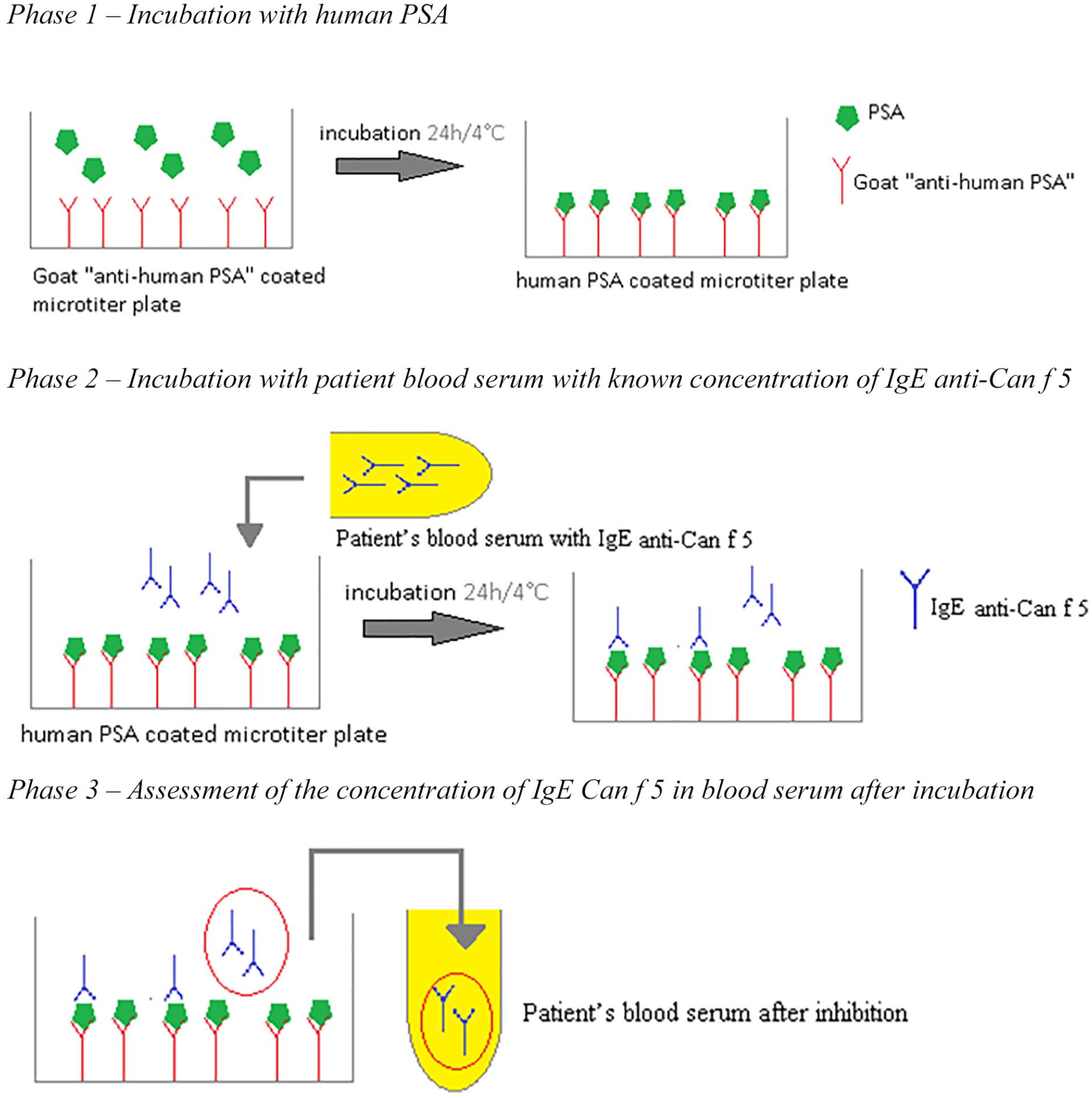
Experimental solid phase inhibition model.
Results
In 100 women (aged 18–73 years, 41.23 on average) with a positive history of symptoms following exposure to animal fur allergens or positive skin tests to canine allergens, increased concentration of IgE specific for the canine allergen extract was found in 65 patients (65%).
Results of specific IgE levels determined using the ImmunoCap method are presented in Table 1.
The number of patients allergic to canine allergen components.

The analysis of coexistence of allergy to several allergen components in one patient is an interesting aspect. In the studied population, allergy to Can f 5 dominated (52.3% of patients with increased concentration of canine-specific IgE were allergic to this allergenic component). The distribution of patients allergic to individual allergenic components is shown in Figure 2. It is worth noting that in the studied population there was no case of isolated allergy to Can f 2. All patients allergic to Can f 2 were simultaneously allergic to Can f 1. A total of 11 people showed an isolated allergy to Can f 5 (32.5% of the total number patients allergic to Can f 5). Another 20 patients were additionally allergic to Can f 1.

Co-occurrence of sensitizations to different canine allergen components (number of patients).
The correlation of concentrations of individual allergen components is presented in Table 2.
Correlation between sIgE to dog allergen extract and allergen components.

There is a strong correlation between the concentration of IgE specific for the canine allergen extract and Can f 1. The concentration of Can f 5 is less strongly correlated with the concentration of IgE specific for the remaining canine allergen components.
Inhibition test with human PSA
Of 34 Can f 5 allergic patients, the actual IgE Can f 5 inhibition experiment with human PSA was performed on 31 subjects. In 3 patients, the test was abandoned due to the insufficient volume of serum remaining after immunological determinations. The characteristics of the patients included in the inhibition test and results of the inhibition test are presented in Table 3.
Characteristics of the group subjected to inhibition tests and the result of the inhibition test.

In all analyzed cases, the concentration of IgE Can f 5 decreased after incubation on the ELISA plate coated with human PSA. The minimum decrease in concentration was 10.44%, the maximum was 37.73%, the average decrease was 21.6%. The decrease in Can f 5 level after inhibition measured in individual patients is shown in Figure 3.

The concentration of IgE Can f 5 before and after solid-phase inhibition with human PSA in each individual case. The inhibition was statistically significant (two-way ANOVA; P < 0.05).
To confirm that the inhibition assay methodology used actually caused binding of sIgE Can f 5 to PSA, a determination of PSA concentration on the ELISA plate was performed after incubation with patients’ serum. It was confirmed that PSA was blocked by antibodies present in the serum of patients—results are presented in Table 4.
Concentration of PSA after inhibition with Can f 5 sensitized serum.

In the tested group there were no women who reported severe adverse effects following sexual intercourse. Eleven women reported burning and discomfort after intercourse that resolved spontaneously. There was no statistically significant influence of the presence or absence of specific IgE Can f 5 in blood serum on the occurrence of the above-mentioned symptoms was found.
Discussion
To our knowledge, this is a first study to assess cross reactivity of Can f 5 and human PSA in dog sensitized patients with an experimental model of inhibition test. Also it is a first study to compare inhibition results and clinical data in a significant population of women.
Allergy to dog is a significant problem in developed countries. In Poland, according to the 2012 TNS Poland survey, 48% of Poles have a pet, and in this group as much as much as 83% are dog owners, and 44% are cat owners (http://www.tnsglobal.pl/archiwumraportow/files/2014/11/K.073_Zwierz%C4%99ta_w_polskich_domach_O10a-14.pdf).
In our previous study of 56 patients (both women and men) allergic to dogs, sensitization to the Can f 1 component was the most frequent—increased levels of IgE were found in 64.3% of patients sensitized to canine allergen components. Sensitization to Can f 5 was found in 52.4% of patients. 10 Bjerg et al. 11 found that out of 218 patients (39%) 85 were sensitized to Can f 1, and 102 (46.8%) to Can f 5. Sensitization to Can f 2 occurred extremely rarely as monosensitization, which was confirmed by our findings (1 patient in the research group).
The difference in the number of patients sensitized to Can f 1 and Can f 5 in our current study population may be associated with multiple factors, including age of the population, different pattern of sensitization, the fact that our study took place several years later, or the fact that it included only women.
Basagaña et al. 12 published a report analyzing results of immunological tests in 70 patients with confirmed dog allergy. In this group the increased level of IgE specific for Can f 5 occurred in 47 patients (67%), with 37% of patients sensitized only to Can f 5 and not to any other allergen component. IgE specific for Can f 1, Can f 2, and Can f 3 were found in 29 (41.4%), 10 (14.3%), and 14 (20%) patients, respectively.
González-de-Olano et al. 8 examined 27 women allergic to dogs and the main allergen determined in this group turned out to be Can f 5, to which 22 of 27 patients were sensitized (81.4%). This result seems to be more consistent with our findings and supports the hypothesis that women could be more predisposed to Can f 5 sensitization than men.
There is more evidence that Can f 5 is a frequent cause of allergy to dogs. In a study by Villalta et al. 13 a total of 1403 ISAC 112 (Thermofisher scientific) were examined retrospectively. About 268 had positive IgE to at least one of the available animal allergens, 183 (69.02%) showed IgE against Can f 5, and 106 (57.92%) were sensitized exclusively against Can f 5.
Hypersensitivity reaction to semen is diagnosed when local allergic symptoms appear after contact with semen, while they are absent if a condom is used. There are reports indicating that these symptoms may cause problems in conceiving, due to the inability to have unprotected intercourse. Several interesting cases of patients presenting symptoms of HSPH (human seminal plasma hypersensitivity) have been reported. 6 In majority of cases, allergy to semen is the IgE-dependent response to proteins contained in seminal plasma. In 2007 a 28 kDa protein was identified as a cause of anaphylactic reaction in a 38-year-old woman, whose symptoms developed directly after sexual intercourse. Immunoblotting SDS-PAGE with seminal plasma from the patient’s husband and protein was identified as PSA. 14 Wolthers 15 reported a case of a female patient with HSPH diagnosed at the age of 18. In this case, symptoms spontaneously resolved over the course of a 5-year follow-up.
The diagnosis of semen hypersensitivity remains controversial. Although prick by prick test are extensively described as a way to diagnose sensitization in case of rare allergens, when commercial allergen extract for skin prick testing is not available. 16 Tal et al. 17 suggested that the observed local reactions after skin prick tests or intradermal tests with semen samples could be non-specific because of the presence of prostaglandins exerting a vasodilatory effect in semen. Reduced skin reaction was observed after male premedication with acetylsalicylic acid (ASA) that is an inhibitor of COX, and lead to reduced synthesis of prostaglandins and their reduced level in semen.
An important aspect of this research is the attempt to prove existence of cross-reactivity between human PSA and Can f 5. Canine prostatic kallikrein and human PSA share substantial structural similarity (55%–60% sequence identity). Mattsson et al. 18 described the Can f 5 allergen component and demonstrated that in three of four patients’ blood serum samples inhibition test demonstrated an extensive cross-reactivity.
Inhibition tests have been used for many years in allergology to prove cross-reactions. So far, in the Department of Allergology, Clinical Immunology and Internal Medicine, we have used the Single Point Highest Inhibition Achievable assay (SPHIAa) model, described by D’Avino et al. 19 and Bernardi et al. 20
In general, it is performed by incubating a patient’s serum with the allergen extract of known protein concentration, and then evaluating the decrease in the concentration of a specific IgE, compared to a control serum diluted to a comparable concentration. In this way, it was possible to confirm the cross-reaction of Art v 1 and 3 of mugwort in a patient allergic to sunflower seeds and Art v 1 in a patient allergic to mango.21,22 An experimental model based on a solid phase ELISA plate has now been used to confirm cross-reactivity of IgE Can f 5 with human PSA. It is an original model developed by our team. Its effectiveness was confirmed by it having demonstrated the inhibition of sIgE Can f 5 in blood serum and PSA blocking on the ELISA plate.
Boquete et al. 23 presented a similar inhibition model to prove cross reactivity between mite and shrimp. In this experiment plastic microtiter plates (Immulon IV; Dynex Technologies, Chantilly, Virginia) were coated with C. arcuatus extract and incubated overnight. Several dilutions were made from raw shrimp and C. arcuatus extract. Each dilution was incubated with the serum pool for 2 h at room temperature. Afterward, 100 mL was transferred to the shrimp-coated plate and incubated overnight. After washing, 100 mL of peroxidase-labeled anti-human IgE (Ingenasa) was added and allowed to stand for 30 min at room temperature.
There were no patients in the study population who would report severe symptoms after sexual intercourse that could be attributed to semen hypersensitivity. Discomfort after sexual intercourse was not significantly more common in women allergic to Can f 5 compared to women allergic to other canine allergenic components. The symptoms were discomfort, burning sensation and pain in the vaginal area. None of the women required pharmacological treatment after sexual intercourse. Symptoms associated with sexual intercourse are common in general population. Multiple factors, such as general health of the patient, chronic illnesses, psychological disorders, and socio-cultural factors, alone or in combination can be attributed to the development of psychosexual dysfunctions.24–26 Further research would be necessary to confirm a possible immunological source of symptoms inpatients. Without histopathological assessment we are not able to exclude allergic inflammation in the mucosa of the genital track, gathered with Can f 5 cross sensitization, even in asymptomatic patients.
Our present study confirmed cross-reactivity between Can f 5 and PSA. At the same time, the percentage of inhibition was variable, and ranged from 10.44% to 34.73%. This result confirms that homology between proteins, although present, is moderate. The clinical presentation of patients and moderate results of the inhibition test indicate that cross-allergy with human PSA manifested by an allergic reaction to semen and the occurrence of symptoms after sexual intercourse could be of importance in some patients, but it was not a typical clinical presentation of allergy to Can f 5.
There are a few limitations of this study. Although it was well conducted, with a wide range of diagnostics including skin prick tests and serum concentration of total IgE, specific IgE and IgE directed against currently available canine allergen components (ImmunoCap), results were based on only 100 female patients. The age range is wide, which could influence the history of sexual activity and fertility. There was a number of women that were not sexually active during our study and some of them did not yet try to get pregnant, which made it impossible to assess fertility problems in the whole population. An interesting objective would be to access the concentration of IgE or IgG specific to human PSA. The results could be compared with the concentration of sIgE Can f 5. Unfortunately, at present, the evaluation of sIgG/sIgE PSA can be performed only in an experimental model which was not a part of this research. The main conclusions are based on the solid based ELISA inhibition test. The methodology was experimental and not standardized. There is a theoretical possibility, that the sIgE Can f 5 specific epitope on human PSA is partially blocked by goat anti-human PSA, although, due to geometry of PSA that is unlikely. The patients included to this research were female due to hypothesis, that Can f 5 allergy may lead to symptoms of human seminal plasma sensitization. An interesting aspect for further research would be to compare the results of an inhibition assay in male and female patients.
Extended research is needed to explain the true nature of PSA related HSPH and the influence of Can f 5 sensitization on infertility.
Conclusions
Can f 1 and Can f 5 are the most common sensitizing allergen components in the population of females allergic to dogs. Can f 5 is a particularly interesting allergen present primarily in male dogs. The study confirmed its moderate ability to cross-react with human PSA sIgE, which may be clinically significant in some women. At the same time, symptoms of allergy to male semen do not constitute a typical clinical presentation of allergy to Can f 5.
Footnotes
List of abbreviations
CRD—Component resolved diagnosis
Authors’ contributions
NUS: study design, research material collection, interview with patient, obtained consent, prepared manuscript, given final approval of the version to be published; and agrees to be accountable for all aspects of the work related to its accuracy or integrity. RA: interview with patients, evaluated and corrected the manuscript, given final approval of the version to be published; and agrees to be accountable for all aspects of the work related to its accuracy or integrity. MZG: study design, performed immunoassay, given final approval of the version to be published; and agrees to be accountable for all aspects of the work related to its accuracy or integrity. KL: study design, performed immunoassay, given final approval of the version to be published; and agrees to be accountable for all aspects of the work related to its accuracy or integrity. ZB: study design, evaluated and corrected the manuscript, given final approval of the version to be published; and agrees to be accountable for all aspects of the work related to its accuracy or integrity.
Availability of data and materials
The dataset supporting the conclusions of this article are included within the article.
Declaration of conflicting interests
The author(s) declared no potential conflicts of interest with respect to the research, authorship, and/or publication of this article.
Funding
The author(s) disclosed receipt of the following financial support for the research, authorship, and/or publication of this article: The study was funded with Collegium Medicum in Bydgoszcz Scientific Grant for Young Scientists number MN- 3/WL/2018.
Ethical approval and consent to participate
A permission from the Collegium Medicum in Bydgoszcz, NCU Committee of Bioethics KB 134/2017 was obtained for the study. In addition, all patients gave their written informed consent on the participation in the study.
Consent for publication
All authors consented to the publication of the manuscript
