




Abstract
Background
Mixed martial arts is a sport that has recently enjoyed a significant increase in popularity. This rise in popularity has catapulted many of these “cage fighters” into stardom and many regularly use social media to reach out to their fans. An interesting result of this interaction on social media is that athletes are sharing images of their radiological examinations when they sustain an injury.
Purpose
To review instances where mixed martial arts fighters shared images of their radiological examinations on social media and in what context they were shared.
Material and Methods
An Internet search was performed using the Google search engine. Search terms included “MMA,” “mixed martial arts,” “injury,” “scan,” “X-ray,” “fracture,” and “break.” Articles which discussed injuries to MMA fighters were examined and those in which the fighter themselves shared a radiological image of their injury on social media were identified.
Results
During our search, we identified 20 MMA fighters that had shared radiological images of their injuries on social media. There were 15 different types of injury, with a fracture of the mid-shaft of the ulna being the most common. The most popular social media platform was Twitter. The most common imaging modality X-ray (71%). The majority of injuries were sustained during competition (81%) and 35% of these fights resulted in a win for the fighter.
Conclusion
Professional mixed martial artists are sharing radiological images of their injuries on social media. This may be in an attempt to connect with fans and raise their profile among other fighters.
Introduction
Mixed martial arts (MMA) is, as the name suggests, a mixture of several different martial arts including boxing, Greco-Roman wrestling, Brazilian jujitsu, Muay Thai, judo, kickboxing, karate, and taekwondo. It is sometimes referred to as “cage fighting” as the competitors often fight inside an octagonal ring surrounded by a tall wire fence. The sport has enjoyed increasing popularity over the last number of years especially in North America where the Ultimate Fighting Championship (UFC) is based. This rise in popularity has catapulted these “cage fighters” into stardom and many regularly use social media to reach out to their fans as well as taunt their upcoming opponents, often simultaneously.
An interesting result of this interaction on social media is that athletes are sharing images of their X-rays and other radiological examinations with their fans when they sustain an injury. These injuries often occur during training and as a result a fighter may have to cancel or postpone an upcoming fight. By providing their radiological images of their injury to their fans, it appears that the fighter is trying to persuade the public that their injury is genuine so as not to appear weak and/or cowardly with an upcoming fight looming. Others upload images of their injuries that were sustained during a fight. By doing this, it offers the fighter an opportunity to provide an excuse for a loss. It can also be a way to display bravery if they were able to continue fighting with a significant injury, and in cases where the fighter is able to win, it can make the victory all the more impressive.
The sharing of radiology images by athletes on social media is not a phenomenon that is unique to MMA alone. Examples from other sports, such as American football, soccer, rugby, cycling, and even gymnastics, exist. In these cases, the response to these images by fans is usually sympathetic, wishing the athlete a speedy recovery.
The aim of this study was to review instances where professional MMA fighters shared images of their radiological examinations on social media.
Material and Methods
An Internet search was performed using the Google Images® function of the Google search engine (Google Inc.). Search terms included “MMA,” “mixed martial arts,” “injury,” “scan,” “X-ray,” “fracture,” and “break.” Radiological images that were linked to social media accounts of professional MMA fighters or came from articles which discussed injuries to professional MMA fighters were examined, and those in which the fighters themselves shared a radiological image of their injury on social media were identified. By using Google Images®, articles without radiological images were not examined at all and were completely excluded.
The data extracted included the type of injury, the type of imaging modality shared, whether the injury was sustained during training or competition, whether the fighter won or lost the fight, and the social media platform on which the image was shared.
Results
Breakdown of the various injuries sustained.

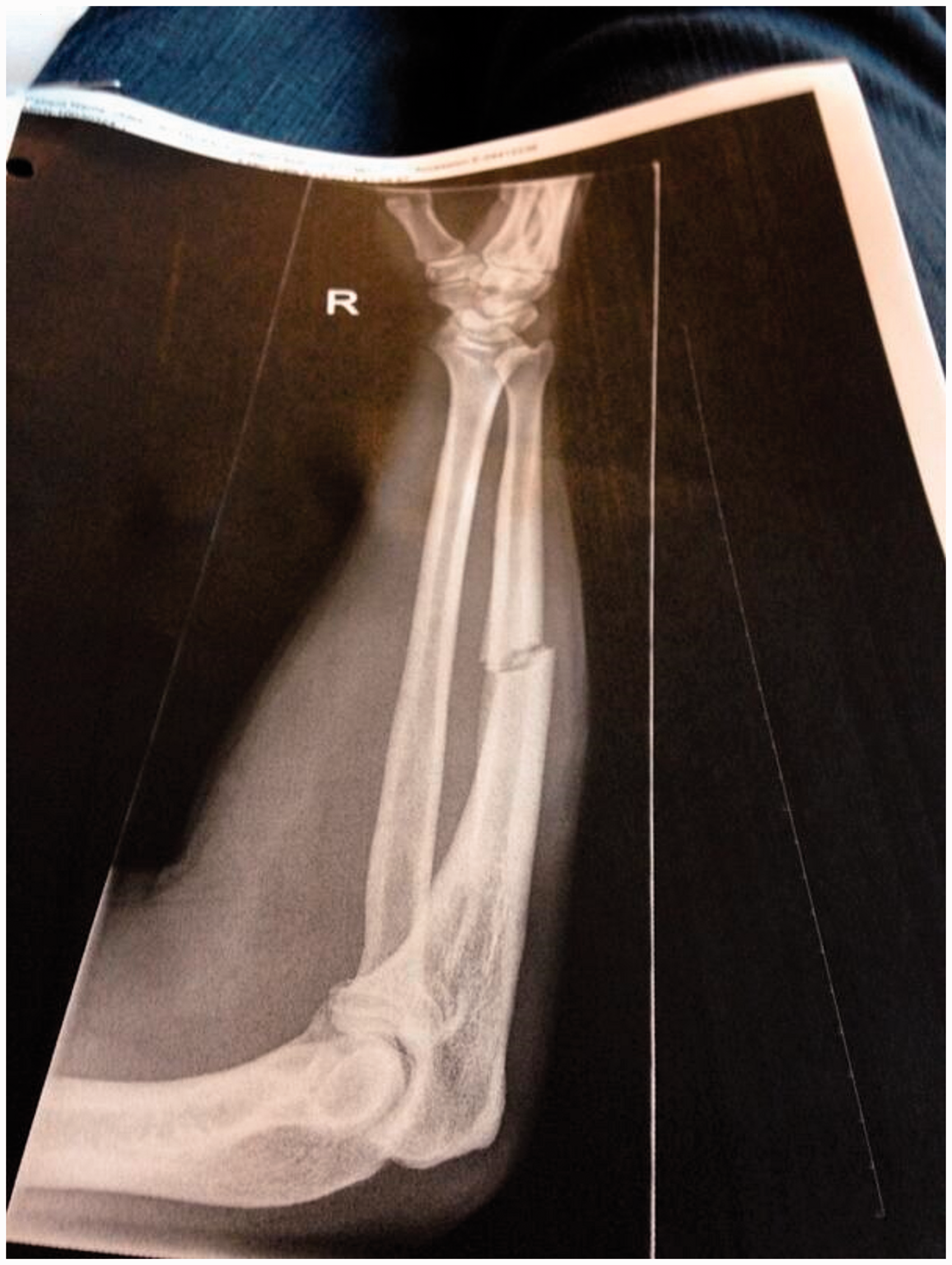
An X-ray image uploaded on social media by an MMA fighter of a transverse fracture through the mid-shaft of their right ulna.
Discussion
The aim of this study was to examine cases in which injured MMA fighters shared radiological images of their injuries with their fans. Sport has become widely commercialized and MMA is no different. Fighters often get a bonus commission from the pay-per-view earnings from a big fight. The more popular a fighter is, the more money they can potentially earn. Social media has become a powerful tool to allow athletes to easily connect and communicate with their fans from the safety and comfort of their own home. Uploading a radiological image of their injury seems to help serve this purpose.
Radiological images of fighters, often dramatic and severe injuries, should emphasize to fans the danger of the sport and hopefully cause people to reconsider taking part in a sport that can lead to such devastating outcomes. However, in some cases it can have quite the opposite effect. The seemingly invincible nature of these fighters is drawing people into the sport. The response by fans to images such as the CT of the depressed frontal bone fracture of Evangelista Santos with a caption of “I’ll be back soon” include those that commend Santos for his bravery in the ring and fans eagerly await his return with anticipation (1).
The images that were included in this study were from athletes who had uploaded and shared copies of their scan on social media themselves. It is also worth keeping in mind that there is a potential for these same images to be “leaked” online without the fighter’s consent. This would, of course, be gross a violation of the patient’s right to confidentiality. It is important to remember that while these are elite, professional athletes, they are also patients in this situation and their right to patient confidentiality should be treated with the utmost regard at all times.
In conclusion, professional MMA fighters regularly share radiological images of their injuries on social media. This may be in an attempt to connect with fans and raise their profile among other fighters.
Footnotes
Declaration of conflicting interests
The author(s) declared no potential conflicts of interest with respect to the research, authorship, and/or publication of this article.
Funding
The author(s) received no financial support for the research, authorship, and/or publication of this article.