



Abstract
The Taliban 2.0 in Afghanistan took the world by surprise. This article investigates how this event was seen differently in varied contexts, such as neighboring Pakistan. Our research shows epistemological pluralism in Pakistan, i.e. how different groups use different ways of knowing (epistemology), being (ontology), and valuing (axiology) to explain and analyze Taliban 2.0. Conceptually, the paper draws on insights from the relationality theory to demonstrate the reasons behind such epistemological pluralism. The theory of relationality provides the grounds for epistemological pluralism, i.e. the mixed sentiments and feelings among respondents about the Taliban 2.0 in Afghanistan. Our research reports the perspectives of nine selected civil society activists about Taliban 2.0 in Afghanistan and its implications for Pakistan. The respondents were interviewed during the second quarter of the Taliban administering Afghanistan. Some called it the victory of Islam, the freedom of Afghans from foreign occupation, and the protection of the Pakistani border from Indian proxies. Others were worried about the risks of increased extremism and terrorism in Pakistan, including the rise of banned organizations like Tehrik-e-Taliban Pakistan. This study intends to document the interviewee civil society activists’ suggestions to the State of Pakistan for dealing with Taliban-ruled Afghanistan.
Introduction
Following the Taliban agreement with the U.S. on 29 February 2020 (Tariq et al., 2021), U.S. President Joe Biden reiterated the decision to withdraw U.S. troops from Afghanistan to end the two-decade-long war, the longest war fought by the U.S. (Tariq et al., 2020). However, while the U.S. and NATO troops were on their way out, the Taliban expanded their territory. They gained control of Kabul on 15 August 2021 with minimal resistance from the previous government. The world was shocked by the almost instant takeover of Afghanistan by the Taliban (Taliban 2.0 hereafter). A few people and groups, such as the right-wing religious parties and political leaders in Pakistan, celebrated Taliban 2.0. For example, former Prime Minister Imran Khan applauded Afghans for “breaking the shackles of slavery.” His special assistant Raoof Hasan wrote on Twitter that “the contraption that the U.S. had pieced together for Afghanistan has crumbled like the proverbial house of cards … a virtually smooth shifting of power [from Ghani's] corrupt government to Taliban rule” (Ellis-Petersen and Baloch, 2021). Ellis-Petersen and Baloch (2021) also noted other statements, such as Asad Durrani, former chief of Pakistan's intelligence agency named Inter-Services Intelligence (ISI), saying, “The masses will be happy the Taliban took over Afghanistan … Concerns are mostly among the privileged classes who will be deprived of their loot and clout to exploit the poor … The problem is that the Taliban do not intend to influence politics or ideology in Pakistan, but it is entirely up to us if we want to adopt their victorious model.”
Khan (2021) concludes five key reasons why some Pakistanis have positive sentiments about the Taliban 2.0: (1) the removal of foreign forces’ presence from the region; (2) the nullified influence of India in Afghanistan, which was perceived to be a substantial security risk for Pakistan; (3) potential reduction in Indian support for anti-state elements inside Pakistan such as Baloch Liberation Army; (4) extended possibilities of the China Pakistan Economic Corridor (CPEC) towards Central Asia crossing through Afghanistan; and (5) no more “do more” demands from the U.S. to fight Taliban factions inside Pakistan.
On the other hand, many Pakistanis have been worried about this political shift in Afghanistan and perceive various risks for Pakistan (Siddique, 2021). The collateral damage to the economy and stability through increased militancy and fragile politics is still going on (Hamid, 2020). Zahid (2021) noted that Taliban 2.0 would accelerate sectarianism in Pakistan as those militants who fled to Afghanistan owing to military operations will return to Pakistan and continue their terrorist operations. Zahid highlights the ties between the Taliban in Pakistan (Tehrik-e-Taliban Pakistan - TTP) and Lashkar-e-Jhangvi (LeJ), which may result in increased attacks on minority communities of Shia and Hazara.
We briefly reviewed the associated history to better understand the relationship between Afghanistan and Pakistan. Since its establishment, Pakistan has had fragile relationships with Afghanistan, except when the Taliban ruled Afghanistan in the 1990s. The underlying reasons for such tenuous relationships include Afghanistan refusing to recognize the establishment of Pakistan in 1947, a dispute over the border between both countries drawn by the British colonizers, and the training and support of Mujahideen fighters against the Soviet Union back in the 1980s (Threlkeld and Easterly, 2021). Although the Taliban group was established in 1995, “most Taliban leaders were Mujahideen” in the 1980s (Meirison, 2021: p. 29). Pakistan shares a 1200 km border with Afghanistan called the Durand Line, which divides people of close historical, ethnic, cultural and family ties on both sides (Hanif et al., 2021). “Between Afghanistan and Pakistan, the borders cross people rather than the people crossing borders”, said Asfandyar Wali Khan, the leader of a Pashtun nationalist political party in Pakistan (Isani, 2020). The Durand Line was agreed upon between the Afghan ruler in 1947 and the British Empire, but it became the basis of hostile relations between both countries. The tensions between the two countries grew when Afghanistan became the only country objecting to Pakistan's membership in the United Nations (UN). Afghan President Daud Khan tried to normalize relations with Pakistan in 1976, but the Soviet invasion of Afghanistan in 1979 redirected the whole scenario. That is when Pakistan's engagement with the Taliban started, further complicating the relations between both countries. (Hanif et al., 2021)
Theoretical underpinning
Relational theory emphasizes that we can only understand reality relative to other objects. In other words, what is considered support to the Taliban in a given context can only be understood in a meaningful way by taking account of a host of other social factors, which include but are not limited to: what are the dominant views about helping others, especially those who share the same religion or group affiliation, for example belonging to a marginalized group; what are the historical and geopolitical realities in a given society; what kinds of official and non-official policies are in place to protect marginalized populations; what are the power struggles; and what avenues of raising one's voice are available? Thus, the full meaning of a phenomenon can only be understood with regard to the economic, political and social context. In short, relational theory directs us to pay special attention to the broader relationships within historical, socio-economic, socio-religious and cultural contexts. This is especially necessary when we are looking to describe and define a variety of social behaviors that can otherwise be labeled under one heading.
Relational theory challenges conventional sociological ideas about self, autonomy, independence and competition and emphasizes understanding the context in which we live our lives, thereby proving that expectations and definitions are informed by the historical and cultural context in which we live. Thus, when talking about religious support, it is crucial to understand the wider context. International media uses a single epistemic approach to describe Taliban support as religious support instead of looking at a host of relational issues when analyzing some Pakistani groups’ response to Taliban 2.0. Considering relational issues can highlight why such depiction often leads to enhancement of the problem rather than seeking solutions to a variety of issues that concern the daily lives of the country's citizens. To sum up, the relational theory framework directs our attention away from isolated introspection of social behaviors toward an exploration of the dynamics of human relationships and their effects on what is defined as socio-religious support of phenomena.
Research questions
Our study analyzes the reactions of Pakistani civil society to the event of Taliban 2.0 on 15 August 2021 in terms of potential impacts on Pakistan and the associated response by Pakistan to the Taliban government in Afghanistan. It is among a few studies that synthesize the perspectives of sampled Pakistani respondents about Taliban 2.0 and analyze the implications for Pakistan. The respondents in this study were asked about their perceptions and views around the following broader research questions. (1) How do the people in Pakistan perceive the Taliban? (2) In what ways will the Taliban 2.0 impact Pakistan? (3) How should Pakistan respond to Taliban 2.0?
This paper is organized as follows: first, the qualitative research methods explaining the study settings and data collection processes; second, the thematic analysis procedures adopted in this study; third, content analysis findings supported by the quotes from respondents; and fourth, discussion of the perceptions of selected study respondents about the impacts of Taliban 2.0 on Pakistan and how the Pakistani State should respond. The last section covers the conclusions, implications of this study and potential areas for future research.
Methods
The interview technique is well known and commonly considered in qualitative research (Bryman, 2016; Keeley et al., 2016). A personal interview involves a researcher and the research respondent discussing a specific topic in detail (Bell et al., 2022). A semi-structured interview guide comprising nine questions was developed after an extensive review of the literature about sentiments and statements in Pakistan about Taliban 2.0. The interview sample was drawn from Pakistani national civil society activists working on diverse advocacy projects in Pakistan. Civil society represents “organized, formal and informal structures that have a presence in public life[, …] encompasses a range of different actors, including coordination bodies, problem-driven advocacy organizations, and others … civil society is considered to exist in the space between markets, public authorities, and private lives, or the space in a society where collective citizen action takes place” (Tjahja et al., 2021).
A purposive sampling technique was used to reach the study respondents, who were identified through referrals and recruitment announcements through Facebook. Political knowledge of Pakistan's internal security affairs and associated factors of neighboring countries like Afghanistan were the inclusion criteria to select the participants for the interview. The data was collected during the second quarter of Taliban administering Afghanistan, i.e. January to February 2022. In total, 16 potential respondents expressed their interest in being interviewed. Nine interviews were completed as seven potential respondents dropped out after an initial briefing on the research questions. Security concerns were the primary reason for their refusal to continue participating in this study. The remaining nine interviews were conducted after the respondents’ consent to voluntarily participate and satisfaction of their concerns about anonymity. We obtained ethical permission for this study (no. FSS/SOSREC/02/2021-447). However, we kept the name of the research ethics committee anonymous to prevent any potential security issues for the staff at the research ethics committee.
The interviews were conducted virtually via Zoom meetings. Each interview started with a brief introduction of the researchers and a briefing on this study's purpose. The interview guide comprised three sections: first, the introduction; second, the consent form; and third, open-ended questions. The researchers focused on keeping the interviews interactive while inviting the respondents to share examples from their experiences and knowledge. The average time taken for each interview was 60-80 min. Since the respondents did not allow recording owing to security concerns, the researchers took detailed notes of the interview conversations, which were later transcribed as interview transcripts. To ensure the interviewee's anonymity, the transcripts were assigned codes (R1, R2, …), and pseudonyms were given to each respondent. Finally, the fully anonymized transcripts were reviewed for a thorough content analysis following the development of a synopsis for analysis.
Analysis
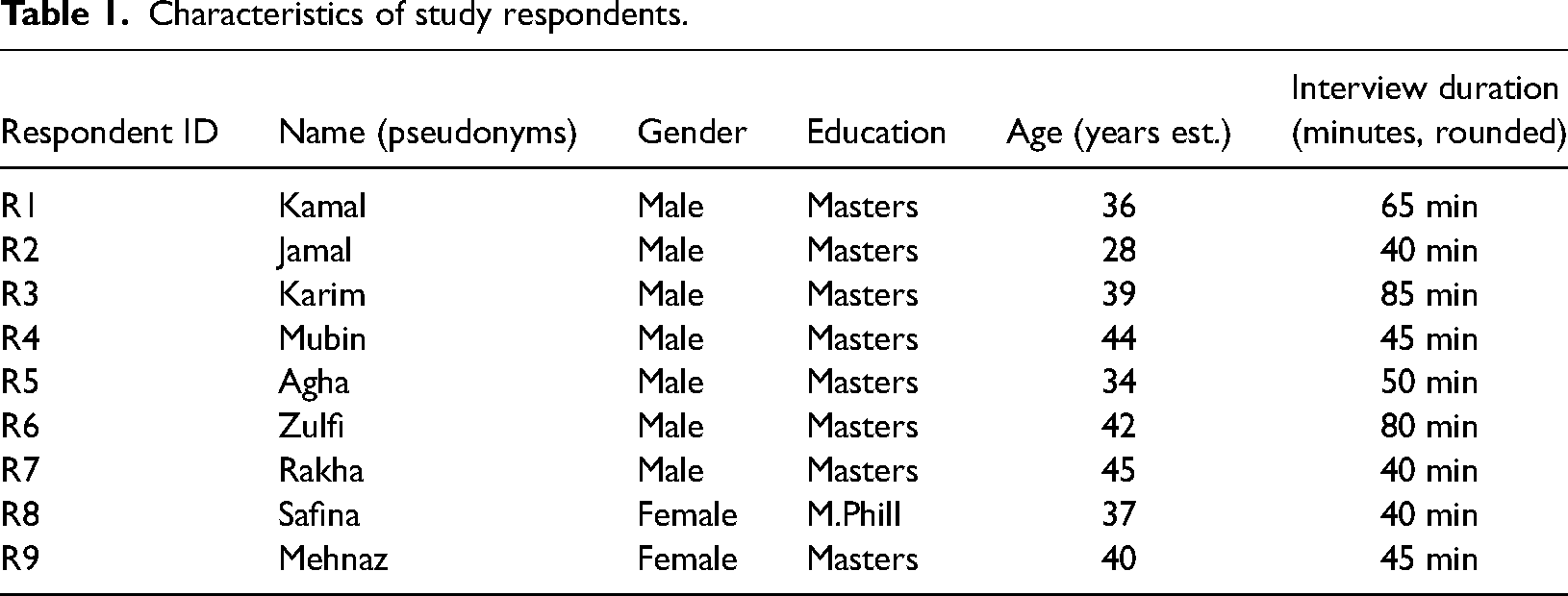
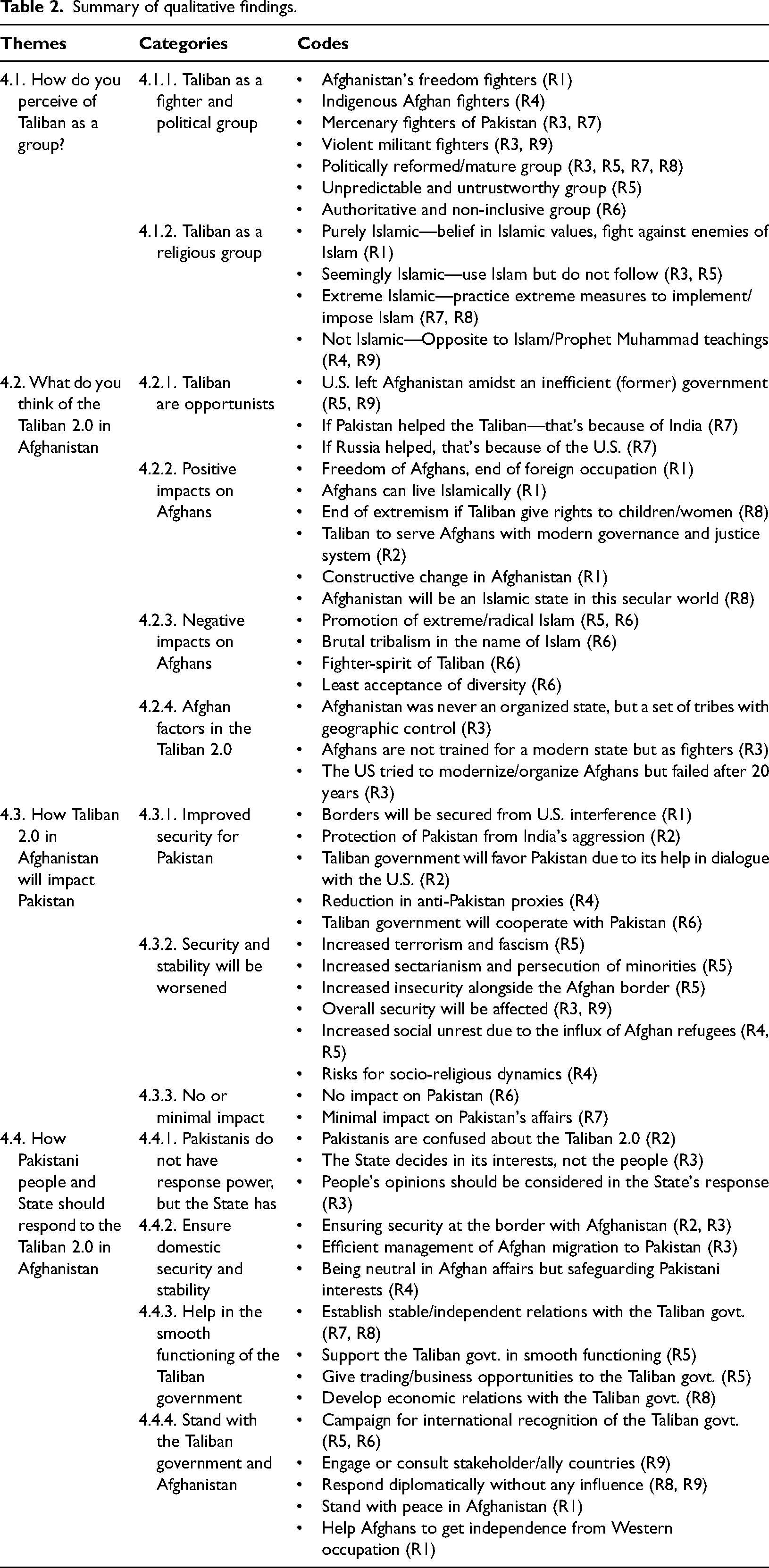
At the analysis stage, each interview transcript was classified into gender, working sector and education level. The respondents were not asked about their affiliated organizations or geographic identifiers to maintain their anonymity. All researchers read the transcripts multiple times during the data coding and categorization. Inter-coder reliability was ensured to achieve consistency in the findings of this study (Lange, 2011). The transcripts were analyzed using NVivo version 12 (QSR International) to identify categories and themes. Content analysis is a widely accepted technique in qualitative research methods, which systematically analyzes the content to identify themes of findings (Zikmund et al., 2013; Drisko and Maschi, 2016). Thematic content analysis in this study used specific steps: first, familiarity with data via reading and re-reading transcripts; second, categorizing and coding; third, identification of themes (Table 2); fourth, explanatory connections; and fifth, theorizing how the respondents of this study saw the Taliban 2.0. Table 1 depicts the characteristics of the study respondents and Table 2 presents themes and categories that emerged from the analysis of selected civil society activists’ perspectives on Taliban 2.0. Themes and categories are described further using verbatim quotes from respondents by indicating codes such as R1, R2 and R3 for respondents 1, 2, and 3, respectively.
Characteristics of study respondents.
Summary of qualitative findings.
Findings
The data analysis highlighted the potential impacts of Taliban 2.0 on Pakistan. The respondents’ suggestions on how Pakistan should respond to this political shift in Afghanistan indicate a vast difference in opinions. There were varied perspectives on this political shift in Afghanistan, particularly in neighboring countries like Pakistan. The in-depth analysis of the interview transcripts highlights five key themes about how Taliban 2.0 has been seen in Pakistan. The respondents shared their insights about the Taliban as a group, how they viewed the Taliban 2.0, and from which sources they got news about the incident. They also expressed their views about the potential impacts of Taliban 2.0 on Pakistan. The respondents provided varied suggestions on how the Pakistani State should respond to the changed regime in Afghanistan. We have divided the emergent themes into additional categories and a range of codes extracted from interview transcripts.
Perceptions about the Taliban
The Taliban as a fighter and political group
The respondents of this study perceived the Taliban as a fighter group with political interests and categorized the fighter aspect into several types. One respondent viewed the Taliban as an indigenous Afghan fighter group that has been fighting for the freedom of Afghanistan for two decades. Taliban is an Islamic group who proved themselves as freedom fighters through their 20 years of struggle, Kamal (pseudonym, here onwards) said. They [Taliban] have retaken Afghanistan through their determination [of fight] acting upon religious and cultural values.
Four respondents of this study believed that the Taliban had become a politically more reformed and mature group which would result in their better ruling of the country this time. For example, Rakha said “Their [Taliban's] behavior might be changed this time”. Safina added, They [Taliban] have improved compared to the past. they gave the interview to a female anchor [immediately after retaking the country]. This is a sign of being well educated, and they are showing respect for female freedom now.
Two respondents named the Taliban as trained fighters of Pakistan who have been reaping support from the Pakistani State. For example, Now, Taliban are more politically mature than previously, or their Master or Leader is more mature politically this time, Karim said.
Some respondents reported having negative perceptions of the Taliban and viewed them as an authoritative and non-inclusive group that is unpredictable and untrustworthy. A respondent named them a militant group that uses violent strategies to meet their goals: Like an actor will continue acting, Taliban will remain fighters. They are definitely paid, getting money from somewhere. Their economy relates to fighting. If they do not get money, they will not fight. (Karim)
One respondent was concerned about the Taliban's violent approaches and said Taliban is basically a militant group that follows the violent approach to meet its goal. They want to rule with the power of swords [brutal violence] and do not have human grounds at all. (Mehnaz)
Taliban as a religious group
The respondents of this study were asked whether they see the Taliban as a religious group specifically. Most respondents saw a religious aspect, either positive or negative, attached to the Taliban. In contrast, some respondents categorized the Taliban at different levels as being an Islamic group. However, the majority of respondents called them non-Islamic. A respondent referenced Islam and Prophet Muhammad while responding that the Taliban is a non-Islamic group. No, I do not think the Taliban is an Islamic group. If we see our Islamic history, our Prophet chose the peaceful way and ensured [people] have equal rights without discrimination. (Mehnaz) They [Taliban] used Islam in their promotions, but they do not subscribe to Islamic teachings in their work. They practice Islam less than 5% but portray more than 100% [stating] they are following Islam in their war, but they are not. Islam is the cover of their fighting [they use Islam as a cover to justify their violent strategies to hold on to power]. (Karim)
While referencing Islamic values, two respondents were concerned about the extreme nature of the Taliban's religious views. They argued that the Taliban promoted extremism.
Not sure about the current situation. Islam, as a religion, is all about moderation. Last time, they [the Taliban] were not moderate Muslims. Islam asks for rules to follow, but they [the Taliban] made it so hard for people to follow. So, they are not moderate at all. For example, [Pakistani] people regret welcoming them to Pakistan. It is uncertain for now how they will act for this time. (Rakha)
Another respondent said similar. Yes, [Taliban is] an Islamic group, but the fault is [their] extremist ideology which is not allowed in Islam. (Safina)
On the other hand, a few respondents viewed the Taliban as an Islamic group that believes in Islamic values and fights with the enemies of Islam.
Taliban seem like a purely Islamic group that believes in Islamic values and Afghanistan's cultural norms. Their belief to fight against the enemies of Islam is one of their key traits of being Islamic. (Kamal)
Another respondent further reiterated that: Taliban has called themselves a religious group who propagate [for the] implementation of Shariah in Afghanistan. In their previous rule of 1996 to 2001, they demonstrated following the Islamic traditions. (Agha)
Thoughts on Taliban 2.0 in Afghanistan
When asked about their thoughts on Taliban 2.0 in Afghanistan, the respondents’ answers were of four different types.
Taliban are opportunists
Amidst the US leaving the country in the hands of a fragile government, the Taliban sought an opportunity to dominate the political dynamics by force. Taliban took over because there was a weak government. For the last 20 years, it could not develop or train the army to ensure the defense of the country. So basically, the Taliban got the advantage of it. (Mehnaz) Our government or State has already set a perception that India influences Afghanistan; that's why Pakistanis were happy that India left Afghanistan. This is evident in Indian media, which is angry that it happened because of Pakistan. Indians are using this narrative to influence the world's opinions. (Rakha)
Positive impacts on Afghans
A few respondents viewed the Taliban 2.0 as positive for the Afghans. For example, one respondent argued that the Taliban would serve Afghans with modern governance and justice system. Another respondent viewed that it has freed the Afghans from foreign occupations, allowing them to live according to Islam and bringing a constructive change in Afghanistan. This takeover of Afghanistan has brought freedom of Afghans from foreign occupiers and will help Afghans to live according to Islamic beliefs, make their decision freely and without any influence from America and its Western allies. (Kamal)
Negative impacts on Afghans
On the other side, two respondents were concerned about the rise of extremism and brutal tribalism in Afghanistan under Taliban 2.0. They thought that the Taliban would promote Islam's extreme and radical image with the least acceptance of diversity and change. I hate Taliban for three reasons: 1. Firqa Waraana Islam [an extreme version of Islam], 2. Qabaili Rawayaat, which they use in the name of Islam [use of tribal traditions in the name of Islam], and 3. Jangjoo tabiat [fighter nature]. These three factors composite their role of influence in Afghanistan. In that, the difference of opinion and diversity is less accepted. Their [ideologies] have no room for the inclusion of diversity in the society. (Zulfi)
Afghan factors in Taliban 20
A respondent expressed his views on the dynamics of Afghans as a nation and recalled that Afghanistan was never an organized state but a set of tribes controlling different geographic regions. He further argued that Afghan fighters are not trained for the modern State. Afghanistan was never an organized state. It is just a set of tribes. Afghans are not trained for a modern state. So, none of the fighting groups can present that [modern State] in front of the world [as] these tribes are not on the principles of the modern State. The US tried for 20 years through all means, but Afghans could not become a modern state or country due to tribalism. It will take a very long time for Afghanistan to adopt modern principles. (Karim)
Opinions about the impacts of Taliban 2.0 on Pakistan
Improved security for Pakistan
Four respondents of this study viewed that the Taliban 2.0 in Afghanistan will benefit Pakistan in terms of improved security. They referenced the presence of India and the U.S. in Afghanistan during the previous government as an insecurity factor for Pakistan which they hoped to be over after the Taliban's 2.0. Pakistan will benefit from Taliban takeover of Afghanistan because its boundaries will be safe from American interference. Taliban governance structure in Afghanistan will be in the interest of not only the Afghans but also Pakistan. (Kamal) Taliban takeover of Afghanistan will certainly impact positively upon Pakistan as it will protect Pakistan from India's aggression from Afghanistan land. Since the Pakistani government and military have played a vital role in bringing the Taliban to the table of dialogue with Americans, the Taliban's government in Afghanistan will be in favor of Pakistan, but if the Taliban continue to be in positive behavior after taking over. (Jamal) It [Taliban 2.0] will be better than the previous government of Ghani and Hamid Karzai because those governments were working on the guidance of India, which was not in the interest of Pakistan. (Zulfi)
Security and stability will be worsened
Three respondents of this study shared their concerns that Taliban 2.0 will worsen Pakistan's security and stability. A respondent recalled Pakistan's military operation against the Taliban in Pakistan and said that. Taliban takeover in Afghanistan can create many security issues for Pakistan in future as they have many followers here [in Pakistan] … Taliban could be a significant risk to [Pakistan's] security in the future. What our State did with Taliban in the past [allowing NATO bases in Pakistan and military operations against them within Pakistan], they may not forget and see the appropriate time to respond to that. (Mehnaz) I am not very much hopeful for positive results. Afghanistan is a battlefield, and people there [Afghans] are connected to Pakistan as their relatives live here [in Pakistan]. (Karim)
One respondent was concerned about the potential rise in religious extremism and terrorism, which could severely affect the religious minorities in Pakistan.
There will be terrorism, fanaticism, and religious extremism in Pakistan because Taliban's ally in Pakistan will raise their voice for the same system in Pakistan, which will cause problems for religious minorities. (Agha)
No or minimal impact on Pakistan
While analogizing anti-Taliban Afghans to anti-Pakistan, a respondent expressed his optimism about minimal or no impact on Pakistan. He said. I am optimistic that it [Taliban 2.0] will not affect Pakistan as we thought. It was expected that militants would emerge in Pakistan again, but the Taliban's statements on no support to terrorists have helped those factors not to emerge in Pakistan. [So] the fear of terrorism from Afghanistan is less. Those Afghans who are anti-Pakistan, are at the extreme… and are also anti-Taliban. (Zulfi)
Currently, we cannot say anything about how their [Taliban] government will be … Let us see how they make the government. They may make the government solely or include other parties or groups too. (Rakha)
How Pakistani people and State should respond to Taliban 20
Amidst changed political and regional dynamics, the respondents’ perspectives on the response of Pakistani people or the State to Taliban 2.0 are grouped under the following categories.
Pakistanis do not have the power to respond, but the State has
When asked about the potential response of Pakistani citizens to Taliban 2.0, the respondents of this study stated that people are either confused about it or cannot think of a response. Tackling with Taliban government is related to the interior and exterior policy [of Pakistan], and the Pakistani nation does not get the information or importance of state affairs. The State may have their reasons, but people may have different opinions. (Karim)
Pakistani people are still confused about the Taliban retaking Afghanistan. (Jamal)
A respondent reflected on celebrating the Taliban 2.0 in Afghanistan for two reasons: (1) the Taliban's framing of implementing Islam in Afghanistan; and (2) India no longer being able to use Afghan land against Pakistan. He said.
Our people [Pakistanis] are emotional in two ways; one for Indian enmity and second for religious attachments. As Taliban said that they would implement Islam which Pakistanis liked. Second, India had held [in Afghanistan] around 26 offices to act against Pakistan, so Pakistanis are now happy that India will not act from there against Pakistan. People should not overreact for now [about Taliban 2.0] but see how Taliban's government work, then celebrate if they are doing well. (Rakha)
Ensure domestic security and stability
Regarding domestic security and stability, the respondents’ opinions varied between cautious and affirmative. Three respondents viewed that while being neutral in Afghan affairs, the State of Pakistan should ensure security at its border with Afghanistan and efficiently manage the migration from Afghanistan. Pakistan should not compromise on border protection as a Taliban spokesperson said they do not like the fence on the border. I think Pakistan should not compromise on border security. And, if Afghans come to Pakistan, they should not have permission like previously to go anywhere in Pakistan. There should be some visa management system and protocols for their stay in Pakistan. (Karim)
Help in the smooth functioning of the Taliban government
Three respondents reflected on how Pakistan can help the Taliban 2.0 with government operations. They viewed that Pakistan should not only establish independent relations with the Taliban government but also help them through business and economic opportunities. Taliban shall be supported to administer their country, and they shall be given the opportunity to have trade with Pakistan. (Agha)
Stand with the Taliban government and Afghanistan
The respondents also shared their views on Pakistan's potential response to Taliban 2.0. I think Pakistan should deal with it [Taliban 2.0] diplomatically and give priority to its [Pakistan's] public interest. (Mehnaz)
I think the Pakistani State is doing good. The US has been ignoring Pakistan for years, and India is threat to Pakistan. To meet that threat, Pakistan needs to have a position [as] Afghanistan fights have a direct impact on Pakistan. Afghanistan peace is in the interest of the region. (Zulfi)
Another respondent took that to further higher-level politics and suggested that Pakistan should take this incident as an opportunity to an alliance with its like-minded states.
Pakistan has to choose between its real friends and enemies. Since the Taliban's takeover of Afghanistan has defeated the Americans, which have protected Pakistan's borders. Now Pakistan has to support China to figure out China's economic access to Central Asia through Afghanistan. (Kamal)
The same respondent, who suggested allying with like-minded countries (as above), also suggested the State of Pakistan shift its economic and political cooperation from the U.S. and Western countries to China, Russia, Turkey, and Iran. He said.
Pakistan should stand for peace in Afghanistan and support its independence from Western or American occupation. This will help Pakistan to get closer to regional powers such as China, Russia, Turkey, and Iran. Pakistan should be an obvious part of the block of countries standing against America, India, and Israel. Strong anti-American or anti-Western position of Pakistan will help strengthen Pakistan's position not only in the region but will also improve its bilateral and multilateral relations with its like-minded countries. (Kamal)
Discussion
Although all the respondents of this study belonged to civil society, they reported varied insights about the Taliban and their taking over Afghanistan. The respondents’ perceptions of the Taliban as a group were divided into being violent and authoritative and a politically reformed group who fought for Afghan freedom. Like the respondents of this study, Isani (2020) also reported on the resistance and fighting nature of Pashtuns, the majority ethnicity comprising the Taliban group, and argued that Pashtuns have never accepted foreign rule, whether that was the British or the U.S.-led NATO. Since the Taliban claim to fight for Islam, the respondents of this study were also asked to share their views on whether the Taliban represent Islam or not. Most of the respondents of this study perceived the Taliban as a non-Islamic group using its political aspirations in the name of religion.
The respondents also viewed the Taliban as an opportunist group who overranthe territories amidst the U.S. leaving Afghanistan in fragile governance. The Taliban figured out that the former government of Ashraf Ghani would not be able to fight with the Taliban, which resulted in minimal resistance to Taliban 2.0. The respondents also touched upon the foreign support for Taliban 2.0 and pointed to India's heavy presence in Afghanistan as a reason for Pakistan's support of the Taliban. According to the respondents of this study, Afghanistan's domestic political factors paved the way for Taliban 2.0. Some respondents viewed Afghanistan as an unorganized state, and Afghans as not being ready for a modern democratic state.
However, respondents’ views about Taliban 2.0 were not homogenous. Some called Taliban 2.0 a constructive change in Afghanistan which has freed Afghans from foreign occupation and will allow Afghans to live according to Islam and their cultural values. This group of respondents was optimistic that the Taliban could govern Afghanistan as a modern state where Islamic values will be practiced amidst a secular world, whereas the other group of respondents was worried about Taliban 2.0. Their concerns were the increase in brutal tribalism, extremism and terrorism in the name of Islam. Siddique (2021) also reported similar trends in Pakistan, where some people worried about the resurgence of extremism and violence, while others celebrated Taliban 2.0, although all societies have groups that disagree on issues and there is never a complete consensus in any society. Siddiqui further notes that although Pakistan was an ally in the U.S.-led war on terror and facilitated the U.S. invasion of Afghanistan in 2001, it has never been disconnected from assisting the Taliban either through providing sanctuaries to the Taliban leadership and their families or facilitating medical treatment of Taliban fighters injured by U.S. attacks inside Afghanistan. Siddiqui's observations need to be analyzed within the broader cultural context of societal, cultural and religious norms where the injured and displaced need to be looked after. Islam as a religion promotes mercy and encourages people to take care of the injured and sick.
Our study shows that there were mixed views about the impacts of Taliban 2.0 on Pakistan. Those who viewed the potential effects positively focused more on factors such as the prior intervention of foreign forces and missions in Afghanistan, which in their opinion, would not be the case in Taliban 2.0. They held the view that India and the U.S. would no longer be able to interfere in Pakistan's security using Afghanistan as a pretext. In their opinion, this could significantly reduce the anti-Pakistan proxies in the region. During the last two decades, the U.S. relied more on India's role in diplomacy and reconstruction in Afghanistan (Zia, 2020). It formed a bridge to Afghans who resonated more with Indian culture, political ideologies and friendly association (Brenner and Wallin, 2021). However, Pakistan would not want India to hold ground in Afghanistan (Malik, 2021). Pakistan took India's presence in Afghanistan as a serious security challenge, viewing India's presence in Afghanistan as a strategic encircling of Pakistan, threatening its safety (Ejaz and Abid, 2021).
The respondents of this study were optimistic that the Taliban government would cooperate with Pakistan as Pakistan has helped them to form a dialogue with the U.S. on the withdrawal of the NATO mission from Afghanistan. Khan (2021) reported that the last two decades were tough on Pakistan regarding controversial political leadership and terrorism across the country. The gears were shifted around 2018 when Islamabad facilitated peace negotiations with the Taliban, which has been acknowledged occasionally by former U.S. President Donald J. Trump.
Riedel (2021) reported that the incident of Taliban 2.0 was received with joy among hardline religious factions in Pakistan, such as Jamiat Ulema Islam (JUI) and banned terrorist organizations like the TTP. Ellis-Petersen and Baloch (2021) documented various statements by hardliners in Pakistan, such as the TTP, stating the incident was a “blessed victory”. Ellis-Petersen and Baloch argue that if we ignore the TTP's statement as a banned organization in Pakistan, the celebrating statements that came from various other religious factions were quite promising. For example, Pakistani lawmaker Mufti Abdul Shakoor, a leader of JUI, said that “the Taliban are acting like a protective barrier for Pakistan, making sacrifices for defending Pakistan”. A Pakistani Pashtun cleric rejoiced, “I want to say it out loudly: The Taliban practically controls Afghanistan now because it is popular among the people … Who else would have defeated America only with the force of arms? Even if we cannot support them, we should not oppose them because it equals enmity with Pakistan”. The hardline Islamist ideologies have already started reemerging in Pakistan, rejoicing at the Taliban's claims of establishing an Islamist government in Afghanistan. A hardline Islamist cleric in Tirah Valley in Pakistan issued a decree immediately after the Taliban 2.0 banning music and photography in his valley, along with asking women to ensure that they were veiled. He warned: “If any financial or physical harm comes [to visitors to the area] because of [new rules’] violations, they will be responsible” (Siddique, 2021).
Many participants of this study were worried that Taliban 2.0 would increase extremism, fascism and terrorism as the extremist factions in Pakistan would glorify the Taliban. Hence, religious minorities will be at higher risk of insecurity, sectarianism and persecution. Religious minorities in Pakistan already face incidents of prejudice and persecution (Akram et al., 2021). Ellis-Petersen and Baloch (2021) also documented the worrisome statements of Pakistanis about Taliban 2.0, such as that by Mohsin Dawar (a member of the Pakistan National Assembly), “The more momentum that Taliban gains in Afghanistan, the greater the consequences that will be faced by Pakistan. It is noted that Mohsin Dawar has also been a leader of the Pashtun Tahaffuz Movement [PTM] and continues to be in a closer relationship with the PTM (Akhtar, 2021). TTP and Taliban have the same ideology and would not ever separate from each other.” However, as our study highlights, such optimism was not shared unanimously by all Pakistanis. A Pakistani journalist specializing in the country's Islamist fundamentalism said that “the Islamist political parties and jihadist groups in Pakistan are celebrating the American withdrawal from Afghanistan as their victory, but many people are concerned about the negative impact of the evolving situation in Afghanistan on their country's security” (Siddique, 2021).
Those cautious of the Taliban 2.0 expressed their worries by equating the Afghan Taliban as an extended entity of TTP, which caused heavy bloodshed in Pakistan through a range of suicide attacks in public places during 2008–2016 (Khan, 2021). Although the Afghan Taliban claimed that their Pakistani counterpart is a different group that does not have allegiance to the leadership of the Afghan Taliban, there have been murky relationships between the two (Riedel, 2021). The cautious group of Pakistanis is also concerned about the risks of further sectarianism and glorification of Taliban resistance to promote religious radicalism in Pakistan. “[Those] projecting [Taliban 2.0] to be a win for Islam and a defeat for America [reflect] a domestic sentiment which is very pro-Islam and very anti-West”, said Neha Ansari, a Washington-based counterterrorism analyst. “This is going to be a Pakistan-friendly government that Pakistan will be at peace. They can guarantee peace because Afghanistan now has a government that listens to them or is friendly to them”, Ansari added (Saeed and Oliver, 2021). A few respondents in this study also expressed similar thoughts.
Regarding recommendations, the respondents of this study held the view that the Pakistani people do not have a role in deciding how to respond to Taliban 2.0. A few respondents argued that the Pakistani State should ensure security at the border with Afghanistan, effectively document and manage the migration of Afghans, and be neutral in Afghan affairs. The world is concerned about Afghanistan under Taliban 2.0 concerning humanitarian catastrophes, extremism and terrorism in neighboring countries, particularly Pakistan (Tariq et al., 2020). Meanwhile other respondents suggested that Pakistan should help the Taliban government for its international recognition by engaging like-minded countries. For example, Pakistan's then High Commissioner to Canada, Ameer Khurram Rathore, rejected allegations of Pakistan helping the Taliban 2.0, but urged the world to engage with the newly formed Taliban government in Afghanistan (MacDonald, 2021). Threlkeld and Easterly (2021) reported that both countries (Afghanistan and Pakistan) would need to negotiate with each other to attain regional stability, peaceful coexistence and the overall well-being of their citizens. The respondents of this study also suggested establishing economic and trade ties with the Taliban government to help run Afghanistan's economy.
Conclusion
This study concludes that in Pakistan there are mixed feelings about Taliban 2.0. The respondents of this study had varied insights about the Taliban and Taliban 2.0. Our research demonstrates that the varied responses from respondents concerning Taliban 2.0 cannot be put together under one banner, i.e. across-the-board support for the Taliban owing to religious reasons or Islamic fundamentalism, or vice versa. The diversity of responses is best understood by looking at the epistemological pluralism that underlies how the average Pakistani in their specific context relates to history and geopolitical events. There is no doubt that religious and ethnic similarity does play an essential role in some responses where respondents thought that fellow Muslims should not be left alone in dire times. However, the diversity of reactions clearly shows that religious affinity is not the only lens used to analyze Taliban 2.0. Tensions with the powerful and often intrusive neighboring India are important in how people in Pakistan view Taliban 2.0. The mistrust of the U.S. and how it has used Pakistan for its interventions in Afghanistan was highlighted in the responses. Therefore, we contend that looking at the Pakistani public and civil society's support for or opposition to Taliban 2.0 needs to be analyzed within the broader relational issues and not just through the lens of supporting religious fundamentalism.
The purpose of any small sample size qualitative study is not to make broad generalizations. Our study follows the same trend. Our goal is to provide the readers with an in-depth understanding of various views of Pakistani civil society on Taliban 2.0. It is interesting to note the diversity of thoughts and the reasons behind the support or worries about Taliban 2.0. The findings of this study have significant implications for the security sector of Pakistan as it highlights local views about the potential impacts of neighboring Afghanistan under Taliban 2.0. The study draws special attention to people's worries about extremism and terrorism flowing from Afghanistan under Taliban 2.0 and the increased insurgency and sectarianism in Pakistan. This study suggests the need for further in-depth research on the latest dynamics of violent extremism in Pakistan since the Taliban 2.0 in Afghanistan.
Footnotes
Declaration of conflicting interests
The authors declared no potential conflicts of interest with respect to the research, authorship, and/or publication of this article.
Statements
This study was ethically approved by an established research ethics committee.
Funding
The authors received no financial support for the research, authorship, and/or publication of this article.
