




Abstract
The article explores the shifts in Sino–Iraqi relations since the 1950s. The article's question is: Is China and Iraq's relationship witnessing a turning point characterised by more dependency and engagement? The article explores Sino–Iraqi interdependence throughout the last six decades through primary and secondary resources, including official documents, data on trade and Chinese and Iraqi outlets. It employs Nye and Keohane's complex interdependence to evaluate Sino–Iraqi dependency. The article finds that Sino–Iraqi interdependence was non-existent between the 1950s and 1975. At the end of the 1970s, some initial elements partially emerged but did not fully materialise; these faded in the 1990s, and since 2003 complex interdependence has gradually emerged. The bilateral relationships pre-2003 made provision for the development of the ties. This has not been without challenges, particularly from Iraq. The study shows the role of the oil sector in Sino–Iraqi interdependence, the uncertainty and extent of China's Belt and Road Initiative in Iraq and the conflicting official and public debates around it.
Introduction
The article evaluates Sino–Iraqi economic and political relationships, focusing on diplomacy, trade, energy, the Belt and Road Initiative (BRI) in Iraq and Iraqi reactions regarding the latter. The article studies the bilateral relationship before the toppling of Saddam Hussein in 2003 and prior to China's growing involvement in the Middle East – serious engagement began at the end of the 1970s (Yetiv and Chunlong, 2007: 200) – and compares it to post-2003. The article relies on primary resources such as Baghdad's and Beijing's official documents and statements and secondary resources, including academic papers that examine Sino–Iraqi relations before 2003 and data from financial databases to illustrate financial and energy rapports. Additionally, Iraqi and Chinese outlets provide insights on debates regarding Sino–Iraqi relations.
The article conceptualises China and Iraq's relationship by applying Nye and Keohane's theory of complex interdependence. The theory's key three characteristics and conditions – namely multiple channels between states, states’ disorganised issues within their agendas and the supremacy of economic factors over force – explain how the relationship has continued despite geopolitical and Iraqi domestic upheavals. The article finds four phases of Sino–Iraqi relations: 1958–1975, the end of the 1970s to 1990, 1991–2003 and post-2003. The article argues that Sino–Iraqi relations have grown slowly since the rapport's establishment, and interdependence materialised post-2003, coinciding with China's economic rise in the 2000s. Since the inception of the relationship between 1958 and 1975, trade has sustained, and agreements were signed, but without the presence of complex interdependence's conditions. It was not until the mid-1970s and particularly the 1980s that some fractional elements of interdependence emerged as Iraq was China's top arms customer in the region and China engaged in Iraq's construction projects. This incomplete dependency trend was hindered during the UN sanctions on Iraq in the 1990s, yet China signed major contracts in this period. The three first phases eased the fourth phase of interdependence between China and Iraq. Since 2003, China has gradually become Iraq's top oil buyer, and Iraq has relied on importing various goods from China; simultaneously, Iraq became a top oil supplier to China. Iraq has become dependent on the revenues for its budget from China's oil market.
The lack of colonial legacies between China and Iraq, China's economic rise and the US's lack of a long-term commitment in the region (Sassoon, 2018: 149) push Iraq towards other powerful states, including China. However, Iraq and China's interdependence is not absolute. Some Iraqis, such as PM al-Kadhimi, do not want to distance Iraq from the West or be dominated by China. At the time of writing, the new PM, Mohammed al-Sudani, in October 2022 is forming a cabinet that is expected to lean more towards China. Moreover, pro-and anti-BRI activists underline the lack of consensus regarding the extent of China's involvement in Iraq. While Iraq wants to sustain relations with its largest oil importer and investor, Baghdad tries to diversify foreign investments and quietly but inconsistently pushes against China's asset acquisition in the oil sector. The article presents theoretical and empirical research on Sino–Iraqi rapports. It is structured in five parts: complex interdependence, the establishment of Sino–Iraqi relations, Sino–Iraqi relations post-2003, Iraq's oil sector and China and the BRI and Iraq.
Complex interdependence
This article applies complex interdependence to explain Sino–Iraqi relations. Some International Relations and International Political Economy scholars apply complex interdependence to explain how economic statecraft and state instruments shape countries’ relationships, foreign policy and geopolitics. Complex interdependence has been applied to China's ascendence. Macikenaite (2020) applied complex interdependence, focusing on China's foreign policy, economic growth and interactions with other countries. Other scholars utilised the theory to explain China's relationships with specific countries and international organisations such as the Philippines (Rabena, 2018), Pakistan (Hussain et al., 2020), the European Union (Sattich et al., 2021), the United States (Mouritz, 2021) and Saudi Arabia (Gater-Smith, 2017).
The notion of economic interdependence appeared at the end of the 18th century, pioneered by Immanuel Kant, who was a leading advocate (Russett et al., 1998: 441). Thereafter, the idea of economic interdependence remerged in Norman Angell's international theory and his work The Great Illusion in 1909. Angell believed that economic interdependence restricts governments’ decisions to go to war. Other like-minded scholars, including Muir (1932) and Delaisi (1922), argued that global interdependence is a result of a process of the exchange and internationalisation of the global economy (Baldwin, 1980: 471–500). IR functionalist and neo-functionalist scholars in the 1950s and 1960s, such as Haas (1958, 1964), argued that expanding interstate linkages in one area stimulates cooperation in other areas (Barbieri, 1996: 30). In 1972, Cooper's paper on economic interdependence focused on the importance of economic issues in foreign policy, the relationships between particular states and the value of currency on economic transactions between regions and states (Cooper, 1972: 159). Nye and Keohane (1978) presented the theory of complex interdependence in their seminal book Power and Interdependence. Angell's, Haas's and Cooper's ideas contributed to Nye and Keohane's theory.
Nye and Keohane indicated that interdependence in international politics is characterised by reciprocal effects among states or actors. They argue that coordination is critical to prevent any probable tumult in the world economic system. Interdependence usually results from international transactions and movements of money, goods, people and messages across international boundaries (Nye and Keohane, 2012: 7). Interdependence is not symmetrical, suggesting that situations are not evenly balanced in mutual dependence. There are asymmetries of interdependence that often deliver sources of influence for actors in their dealings with one another (Nye and Keohane, 2012: 8). The type of item or message matters in analysing interdependence. For instance, a country that relies on energy resources from another country is more dependent than a country that imports perfume (Nye and Keohane, 2012: 8).
Nye and Keohane (2012) provided three main characteristics and conditions for complex interdependence: multiple channels between states, disorganised issues within agendas of interstate relationships and economic superiority over force and military. Firstly, multiple channels connect societies, including formal ties between government and non-governmental elites and transnational organisations such as multinational banks and corporations. Non-governmental actors are important as they can influence a government's policies. Private actors’ movements in the two countries, such as money, goods, people and messages, are also included (Moravcsik, 2009: 249). Since formal ties’ inception between Baghdad and Beijing, the relationship has continued, excluding a short period during the US-led invasion of Iraq. Some of the Sino–Iraqi rapports extend to relations with ruling political parties in Iraq. China's ties with the ruling political parties in Iraq and the Kurdistan Region of Iraq (KR-I) include the Kurdistan Democratic Party (KDP) and Patriotic Union of Kurdistan (PUK) (Aziz and Shareef, 2022). In addition to the increase of Sino–Iraqi trade post-2003, Chinese state-owned firms have been building commercial ties and communication lines through official – such as the Iraqi Ministry of Oil – and non-official channels, such as the leaders of major Shia factions, which could provide access and facilitate permissions to oil fields (MECRA, 2022).
Secondly, the agenda of interstate relationships consists of multiple issues that are not arranged in a stable hierarchy. The absence of hierarchy among issues means that military and security do not consistently dominate the agenda. Complex interdependence posits that the agendas are shaped by the international and domestic challenges and influenced by economic growth and increasing interdependence (Nye and Keohane, 2012: 27). China's economic growth and its need for energy and investment opportunities shape its proactive engagement towards the oil-rich states, including Iraq (Öğütçü and Ma, 2007: 18). Meanwhile, Iraq's financial needs make Iraq dependent on China's oil market. Nye and Keohane (2012: 27) argued that discontented domestic political groups would politicise issues and push more issues once considered internal into the interstate agenda. This assumption applies to some Iraqi actors post-2003 who have been divided over China's increased engagement in Iraq, including Iraqi anti- and pro-BRI activists and political figures. The latter prioritises Sino–Iraqi relations and pushes for more bilateral commitments, including those related to the BRI.
Thirdly, the minor role of military force is when economic collaboration prevails between two countries engaged in a complex interdependence situation. While military cooperation and collaboration exist between the actors engaged in interdependence, especially when there is a common enemy, economic and social resources can play a dominant role in shaping relationships (Nye and Keohane, 2012: 20–23). During the Iran–Iraq war (1980–1988), Iraq was China's top arms importer in the region; this was viewed as a trade or transactional matter rather than a security alliance, as China provided Iran with similar weapons (Gill, 1998). Post-2003, Sino–Iraqi relations have been driven by economic cooperation, yet the war on Daesh pushed both countries to sign limited security agreements.
The establishment of the relationship between the PRC and the Republic of Iraq
Since the formation of the Republic of Iraq and the People's Republic of China's (PRC) official relationship in 1958, complex interdependence's three characteristics and conditions did not fully materialise due to the limited and nascent bilateral relations. Nevertheless, some economic and political ties developed in this period that paved the way for future closer relations post-2003. The Republic of China recognised the Kingdom of Iraq in 1942, and their relationship was minimal. Since the foundation of the PRC in 1949, China's Mao Zedong (1949–1976) has applauded nationalist and liberation movements globally. After the military coupe in 1958 in Iraq led by General Abd al-Karim Qasim that toppled the monarchy and pro-British government, Iraq left the western-supported Baghdad Pact, and a nationalist government was formed and headed by Qasim (Gulmohamad, 2021: 4). China welcomed the change and viewed Iraq as an anti-imperialist country. The PRC extended official recognition to Iraq on 16 July 1958, and diplomatic relations were established. China appointed Chi-feng as an ambassador to Iraq, and after 18 months, Baghdad appointed Abd al-Haq Fazil as its ambassador to China (Emadi, 1994: 3315). In 1958, Iraq and China signed their first trade agreement (al-Hayali, 2015: 43). Despite Iraq's coupes in 1963 (Qasim was killed) and 1968 (which paved the way for the Ba’athists’ rise), trade activities continued. China imported Iraqi dates and oil, supported nationalising key Iraqi industries, including oil and manufacturing enterprises, and provided Chinese-made cars to Iraq (Emadi, 1994: 3315).
Between 1960 and 1964, four trade agreements were signed and shared committees were established to follow up with the agreements. China sought to provide Iraq with alternative trade options beyond the West (Al-Hayali, 2015: 43). China helped Iraq obtain machinery and facilitated manufacturing fair exhibitions such as the China Economic Rebuilding Exhibition in Iraq. Sino–Iraqi trade increased from several hundred thousand US dollars at the end of the 1950s to more than US$6 million in 1962 (Al-Hayali, 2015: 43).
Some political actors in Iraq adopted Mao's ideology and challenged the status quo in Baghdad. These included a faction (Komalah Ranjdaran) within the PUK at the time of its emergence, a Kurdish political party that was created in 1975. The PUK's leader Jalal Talabani, who was inspired by Maoist and Marxist ideas, visited China in 1955 and met Premier Zhou Enlai when he was a politburo member of the KDP (MacDonald, 2017; Shareef, 2016: 82). Another actor was a faction within the Iraqi Communist Party headed by Amer Abdullah and Bahauddin Nuri (Emadi, 1994: 3316). The rapports between non-ruling factions and China go beyond the formal ties between governments.
Sino-Soviet ideological and geopolitical rivalries in the region moulded Sino–Iraqi relations. The defeat of Iraq, Syria and Egypt in the 1967 Israeli–Arab war brought China closer to Iraq. This was partly due to Iraq's attempt to be less reliant on poor-quality arms from the Soviet Union, to reduce Soviet influence and to increase its trade with other countries (Rand, 1980: 4). Iraq's relations with the Soviet Union dwindled due to the Ba’athists’ ascent in 1968 that ushered in close ties with China and France (Emadi, 1994: 3316). In 1971, Iraq and China signed two economic and technical agreements (Degerald, 2018: 52). In the 1970s, China succeeded in sustaining coordinal relations with Iraq in spite of Moscow's pressure on Baghdad to reduce its ties with China (Sassoon, 2018: 150–151). This coincided with China's shifting interests and its new economic and political orientations after the death of Mao in 1976 and the ascendance of Deng Xiaoping in 1978. Xiaoping's era witnessed the attraction of foreign direct investments and the development of export industrialization sectors (Murphy, 2022: 255). In 1979, China offered to work on construction, agriculture and transportation projects in Iraq. In the 1980s, under Xiaoping, China began to open up and engage with the rules of the liberal international order (Graaff et al., 2020: 192). During this time, Iraq and China signed seven trade, economic and technical agreements and memorandums (Al-Hayali, 2015: 44). In this decade, China was involved in major projects, including bridges in Baghdad and Mosul, sports halls in Baghdad, a highway in northern Iraq and a wool-washing and -spinning mill in Kifri, and provided a loan of US$40 million payable over 10 years from 1984 (Emadi, 1994: 3316; Lee, 2013: 77).
In the 1970s, China sold weapons to Iraq, and in the 1980s Iraq became one of China's top customers during the Iran–Iraq war. Military equipment included combat aircraft (J-6 and J-7), tanks (Type-59 MBTs), anti-ship missiles HY-2 Silkworm and pieces of artillery and military materials, namely lithium hydride (Bitzinger, 1992: 88–94). China had a neutral position regarding the Iran–Iraq war, and during the eight-year war, nine percent of Iraq's weaponry came from the PRC valued at US$4.2 billion (Bitzinger, 1992: 87). During the 1980s, the trade and economic relationship continued building upon contracting industries signed in the late 1970s. In 1987, Iraq had become one of China's top markets for labour, valued at US$657.67 million, and China had contracting projects valued at US$670.04 million. During the war, many Chinese labourers remained in Iraq (Calabrese, 1992: 472). From 1979 to 1986, nearly 22,000 Chinese labourers were signed to more than 140 projects in Iraq (Lee, 2013: 41, 42). By 1985, China had 444 contracts in various construction projects amounting to US$1.53 billion, and by 1990, China had 662 contracts valued at US$1.98 billion (Hoh, 2021: 33).
Sino–Iraqi ties during the second Gulf war
In 1990, the US-led Kuwait liberation military campaign (Desert Storm) undermined China's position in the Middle East. In August 1990, China supported UN Security Council Resolutions 660 and 661 that imposed sanctions on Iraq, but it didn’t support Resolution 678 to go to war against Iraq. China preferred diplomatic means and refused to participate in Kuwait's liberation (Calabrese, 1998: 360). China depicted the war as ‘a struggle between global and regional hegemonisms’ and that the US pursues to ‘dominate the world’ (Harlan, 1992: 447, 454). The UN sanctions on Iraq had a costly effect on China's trade with Iraq; Chinese foreign ministry spokesperson Li Junhua indicated the loss of US$2 billion in arms exports and US$7 billion for the entire bilateral trade (Calabrese, 1992: 477; Lee, 2013: 80).
China called on Iraq to comply with UN resolutions; nevertheless, China expressed strong reservations regarding many of the UN Security Council measures. China called to ease the sanctions as they had taken a significant toll on the Iraqis. The UN sanctions restricted China and the commercial ties notably reduced. Sino–Iraqi trade plummeted from around US$158 million a year in the 1980s, to around US$5.52 million during the 1990s’ UN sanctions before the Oil-for-Food Programme (see Table 1). China avoided the cutting of the relationship. Trade resumed in 1996 through the UN's Oil for Food Programme, and Saddam's regime had several deals with China (Hoh, 2021: 33). In 1997, China's al-Waha company that consisted of the China National Petroleum Corporation (CNPC) and China North Industries Corporation (NORINCO) signed a 22-year sharing production contract for al-Ahadab oil field in Wasit province (1.4 billion barrels). Under this contract, China would develop the oil field after the sanctions lifted (Downs, 2006: 18). Al-Ahadab and other projects were stalled due to the 2003 invasion.
Iraq's oil exports to China and China's exports to Iraq (US$).
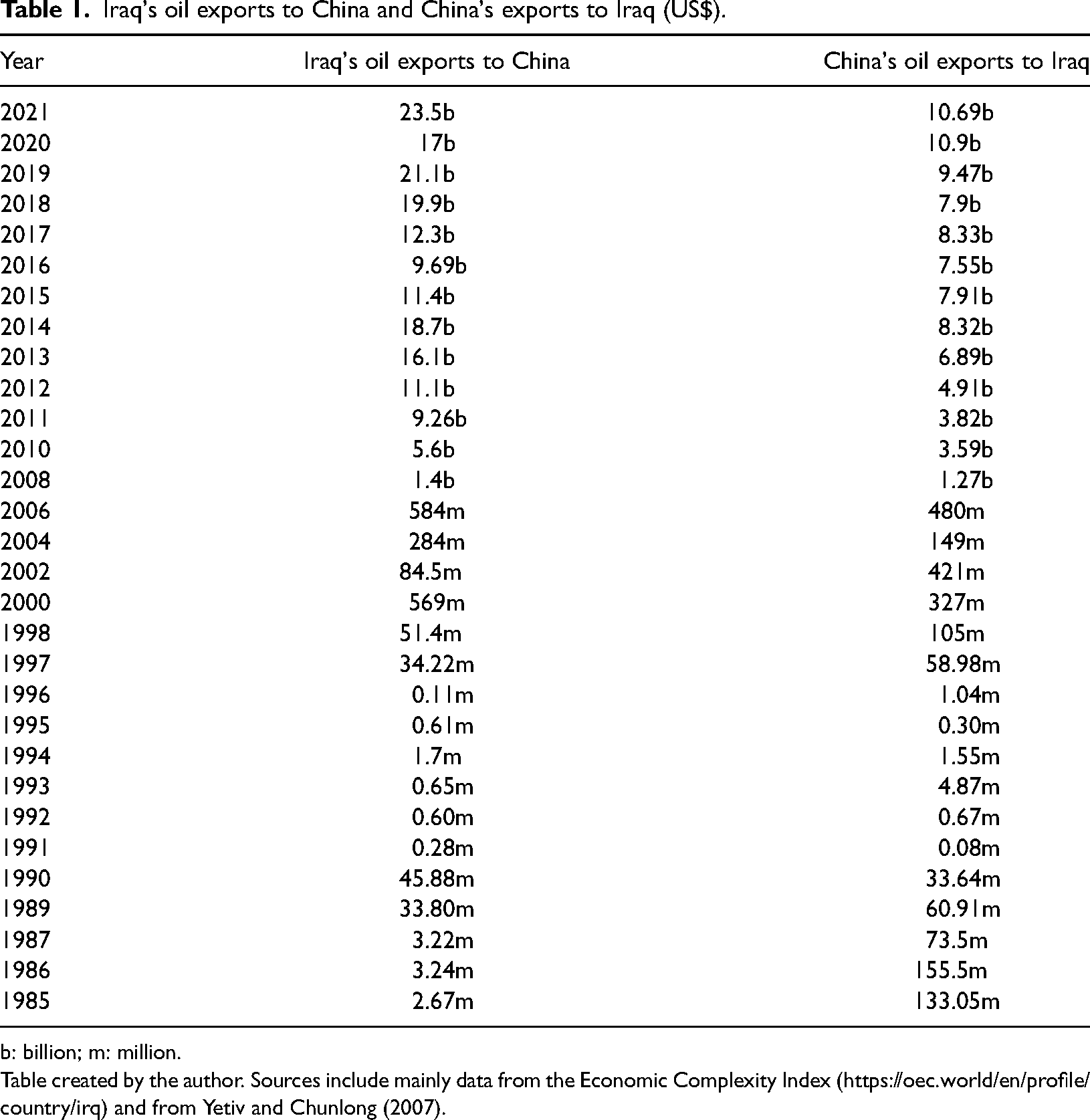
b: billion; m: million.
Table created by the author. Sources include mainly data from the Economic Complexity Index (https://oec.world/en/profile/country/irq) and from Yetiv and Chunlong (2007).
The Sino–Iraqi relationship's leap post-2003
The post-2003 era has witnessed the emergence of the three conditions of complex interdependence, and underlines Sino–Iraqi dependency. This includes reviving multiple channels through rapidly increasing engagement including governments, elites and enterprises. Both states’ agendas have been shaped by the countries’ needs, and various agreements were signed. Baghdad and Beijing have prioritised interactions in the oil sector and then infrastructure.
In March 2003, China expressed its grave concerns about the US-led invasion of Iraq and its implications (Ministry of Foreign Affairs of the PRC, 2003b). China's concerns about missing out on lucrative projects steered China to support Iraq's new political process swiftly. In July 2003, a few months after the US invasion, China welcomed the establishment of the Iraqi Governing Council of Iraq (IGC). This interim governing body served under the US-led Coalition Provisional Authority (CPA). In August 2003, Jalal Talabani, the President of the IGC and the secretary-general of the PUK, visited China (Ministry of Foreign Affairs, 2003a). State Councillor Tang Jiaxuan met Talabani and stated that China was ready to assume a positive role in Iraq's reconstruction. Jiaxuan put forth a five-point proposal for the reconstruction of Iraq (Xinhue, 2003). On 23 October 2003, China attended a conference on Iraq's reconstruction in Madrid; it promised to cancel Iraq's debts to China and donated US$24 million (Associated Press, 2004).
In March 2004, Muhammad Bahir al-U’loom, the President of the IGC, visited China and met the Chinese President Hu Jintao. Jintao said: ‘China is ready to take an active part in Iraq's reconstruction’ (Chinese Ministry of Foreign Affairs, 2003a). These visits aimed to provide reassurance to China as multiple projects and contracts had been stalled or cancelled (including oil agreements signed in 1997). During these visits, the Chinese government's statements asserted Iraq's sovereignty, particularly the independence of Iraq's foreign policy. China re-opened its embassy in July 2004 and the Chinese foreign minister Li Zhaoxing underlined China's support to the Iraqi interim government (June 2004–April 2005) and stabilisation in Iraq (Xinhua, 2004). In 2004, Iraq appointed PUK affiliate Mohammad Saber Ismail as its ambassador to China.
In July 2007, Iraqi President Talabani visited China and met President Jintao. Both countries signed four agreements, including one that cancelled some Iraqi debt to China – in 2010, China cancelled 80 percent of the debt, which was US$8.5 billion (AFP, 2010). The agreements involved cooperation regarding economic and technical issues and human resource training programmes (Ministry of Foreign Affairs – PRC, 2007). Jintao said, ‘the China-Iraq friendship goes back more than 2000 years, to the time when the ancient Silk Road linked the two peoples together’ (Embassy of the PRC in the USA, 2007).
In July 2011, PM Nouri al-Maliki visited China and met Premier Wen Jiabao, President Jintao and business leaders. Jiabao said: ‘The Chinese government will encourage companies to establish a long-term and stable relationship on oil and natural gas supply … China will … actively participate in Iraq's infrastructure construction’ (Ministry of Foreign Affairs the PRC, 2011). Ali al-Dabbagh, an Iraqi government spokesperson, said that Iraq asked China to set up a fund to help with Iraq's reconstruction (Radio Free Europe, 2008). These notions paved the way for Iraq's engagements with China, including the BRI in Iraq.
Iraq's oil sector and China
Interdependency has been underlined by the oil sector as China relies on Iraqi oil and Iraq depends on China's purchase. Since 2003, China has gradually increased its economic engagement with Iraq (see Table 1). China is diversifying its energy supply chains and suppliers – China has reduced its reliance on the Organization of the Petroleum Exporting Countries’ (OPEC) oil from 65 percent in 2011 to 50 percent in 2021 (Liu et al., 2021; Workman, 2022). Nonetheless, Iraq is gradually climbing the ranking of China's major energy suppliers. In 2021, Iraq became the third largest oil supplier to China; it supplies around 10 percent of China's oil market share, after Saudi Arabia (17.4 percent) and Russia (15.5 percent) (Salem, 2022; Workman, 2022). Post-Saddam, Chinese pre-2003 oil deals were renegotiated by al-Maliki's government, particularly the al-Ahdab deal. In 2006, Iraqi Oil Minister Hussein Shahristani said: ‘Iraq welcomed Chinese oil companies to participate in the reconstruction of the Iraqi oil industry’ (Xinhua, 2006). In 2009, the Iraqi cabinet approved Chinese firms’ resumption (Offshore Technology, 2021). Since 2009, Iraq's share in the US oil market has gradually reduced – excluding a few months in 2017 and 2018 (US EIA, 2022). Simultaneously, Iraq cannot rely on the EU's oil market share due to the EU's diversification strategy and cap on oil imports from the Middle East (El-Kholi, 2018: 183). Therefore, China is an essential customer and vital revenue generator.
Chinese firms and oil companies have been pursuing foreign asset acquisition overseas in rich sites with natural resources such as oil and raw materials. China's strategy includes acquiring equity shares in operating companies and buying medium-sized companies that secured exploration and production rights (Moreira, 2013: 131). In November 2008, Chinese state-owned CNPC secured the first major oil (service) contract in Iraq at a value of US$3 billion to develop the 1 billion-barrel al-Ahdab oil field for 23 years partnered with Iraq's State Oil Marketing Organization (SOMO) and China North Industries Corporation (Rasheed, 2009). The terms of this deal differ from the pre-2003 contract, as China was entitled to a certain percentage of the oil field's revenue. In the new contract, CNPC won’t receive a share of the oil; it receives service charges of US$6 per barrel which gradually reduces to US$3 (CNN, 2008). CNPC overtook western oil companies in securing Iraq's first oil project. In June 2009, CNPC secured a second deal (technical service) for Rumaila's oil field which is shared with British Petroleum (PB), SOMO and Iraq's South Oil Company (SOC) (NS Energy, 2009). CNPC's third deal was in December 2009 to develop the al-Halfayah oil field that was shared with France's Total, Malaysia's Petronas and SOC (Reuters, 2012). CNPC's fourth achievement was buying 25 percent of equities from ExxonMobil (60 percent) in 2013 for West Qurna 1 oil field; in 2014, CNPC's equities increased to 32.7 percent (CNPC, 2018).
Other major Chinese energy firms also pursued deals in Iraq. In May 2010, the China National Offshore Oil Corporation (CNOOC) – which shares 63.5 percent – Turkish Petroleum Corporation and Iraq's Missan Oil Company signed a deal to develop Missan's three oil fields for 20 years (CNOOC, 2010). Another key example is China's Petrochemical Corporation (Sinopec) which bought the Swiss Addax Petroleum Corp, which had a contract with the Kurdistan Regional Government of Iraq (KRG) for Taq Taq oil field in the KR-I. Sinopic's inheritance agitated Baghdad as Baghdad doesn’t approve of international oil companies’ deals with the KRG without its consent and authorisation. However, in 2021, Sinopic won a 25-year contract to develop Iraq's Mansuriya gas field with a 49 percent stake (MEED, 2021a).
Although Iraq is the second largest oil producer in OPEC and holds the fifth largest proved oil reserves at 145 billion barrels, since 2013, some western oil companies such as Shell, Exxon Mobile and Occidental Petroleum have begun to relinquish their interests. The western companies’ exit is due to OPEC's agreement to reduce oil production and insecurity, including militias extorting foreign oil companies (Zidane, 2020). Other companies, such as BP, and Russia's Lukoil, expressed their consideration of withdrawal. These moves have concerned Baghdad partly because of the Chinese willingness to buy western oil companies’ shares, which means China will become more dominant in the oil sector. While al-Kadhimi's government leant towards Iraq's engagements with western companies, it didn’t publicly show unsettlement regarding China's ascendancy in the oil sector. Baghdad tacitly tried to persuade western companies such as BP to stay in Iraq and not sell their shares. The Iraqi Oil Ministry thwarted three prospective oil deals for Chinese firms in 2021 (New Arab, 2021). However, in 2021 between 40 to 44 percent of Iraq's oil was sold to China. Mazhar Mohammed Salih, Iraqi PM's advisor, said: ‘China is the first market for the Iraqi oil exports and a small portion of these exports is the dues of oil service contracts for Chinese companies operating in Iraq’ (FaidhiDri, 2021).
China has expanded its projects in Iraq to include renewable energy, such as PowerChina's deal to build solar power plants with a capacity of 2000MW (MEED, 2021b). While Iraq is struggling to attract western companies, viewing the latter as a complete withdrawal for the Chinese firms is an exaggeration. In September 2021, France's TotalEnergies signed a US$27 billion contract to develop oil, gas and solar energy plants in Iraq (AFP, 2021).
The Belt and Road Initiative and Iraq
In December 2015, Iraqi PM Haider al-Abadi signed memorandums of understanding for a comprehensive strategic partnership with China and for Iraq's participation in the BRI during a two-day visit and met President Xi Jinping. Jinping stated that in this new strategic partnership, China will be involved in Iraq's reconstruction and projects, including ‘energy, electricity, communication and infrastructure’. Jinping tied this to China's BRI. Iraq's participation in the BRI was founded on oil in exchange for reconstruction, investment and development (Zidane, 2019). Al-Abadi stated that Iraq would ease investment procedures for Chinese enterprises (Qian, 2016: 42).
The BRI, officially launched in 2013 by Xi Jinping, is described as the world's largest infrastructure programme. It seeks to increase global connectivity across Asia with Africa and Europe via land and sea through production, trade and supply chains, cooperation and economic growth. The BRI develops an interdependent market for China and grows China's economic and political power (Jie and Wallace, 2021; Schulhof et al., 2022). The BRI was touted by former President Jiang Zemin's 1999 strategy of ‘going out’ and China's need to participate in globalisation, and it was also articulated by President Jintao (Johnson, 2014). Iraq is located at a crossroads of BRI's Silk Road Economic Belt and the 21st Century Maritime Silk Road. Both are critical for China's access to western Europe. A 2015 memorandum includes the ‘understanding on participation in building the economic Belt of the Hareer Road and the Maritime Hareer Road of twenty-first century’ in Iraq. The Hareer Belt and Road has a couple of lines that go through Iraq and connect China to Europe (Rawabet Center, 2017). A line starts in China, goes through Central Asia and Iran and enters Iraq from the West. Al-Faw port which is located in Basra and lies on the Persian Gulf, connects Iraq to the BRI's networks. In 2021, construction began in al-Faw port and on one of the routes called Al-Harir (Silk) Tunnel in Basra's southern port (Iraqi News Agency, 2021). The US$2.7 billion deal to construct the Silk Tunnel and al-Faw port has been given to South Korea's Daewoo (Muhsen, 2022). This reflects Baghdad's efforts to diversify foreign companies’ involvement.
Regarding the military, between 2003 and 2014 there was no cooperation. In December 2015, Iraq and China signed a military cooperation agreement which coincided with Iraq's willingness to participate in the BRI that year. Iraq purchased arms, namely Chinese-made combat drones CH-B4 (rainbow) and FT-9 guided missiles that were used against Daesh. There have been talks between officials on Iraq purchasing surface-to-air defence missile systems, helicopters and fighter aircraft (Al-Bayan Center, 2018; Shafaq, 2022). China's military firms support Iraq by developing drones, machine guns, mortar shells and military communication equipment (Al-Farttoosi, 2022). Iraq's military purchases from China in the 1980s exceeded the current volume.
Since 2015, on multiple occasions, top Chinese and Iraqi officials have met and endorsed the BRI. On 24 April 2017, Iraqi foreign affairs minister Ibrahim al-Jafaari met Chinese foreign minister Wang Yi. Yi appreciated Iraq's support for the BRI (Minister of Foreign Affairs of the PRC, 2017). In May 2018, Iraq and China signed a trade cooperation framework agreement. China's investments in Iraq have increased steadily. In 2018, China's investments reached US$20 billion, mainly in the oil sector (Rudaw, 2018).
The 2015 memorandums were partly activated by Iraqi PM Adel Abdul al-Mahdi's visit to China in September 2019. Al-Mahdi signed eight economic and financial agreements with China, including a comprehensive trade agreement and a programme known as oil for reconstruction for 20 years (Khalil, 2021). These agreements included Baghdad and Beijing setting up a joint investment fund to finance reconstruction projects (such as dams, ports, railways, airports and schools) in Iraq by Chinese companies. This programme allows Chinese firms to work for an exchange of 100,000 barrels per day, around 10 percent of what Iraq exports to China (Muhsen, 2020). Al-Mahdi stated that Iraq requires that China not monopolise projects in Iraq, and Chinese firms can cooperate with international firms (Zidane, 2019). In 2019, Iraqi officials discussed joining the China-based Asian Investment Infrastructure Bank (AIIB). In August 2021, Iraq applied to join the AIIB, and in December 2021 it was accepted (AIIB, 2021; Xinhua, 2019). This channel provides financial support for Chinese-led projects in Iraq.
The 2015 BRI memorandum wasn’t followed by Iraqi officials because of Iraq's war on Daesh, anti-corruption protests and the challenges of approving memorandums in the Iraqi parliament because of a lack of transparency (al-Nawab, 2019). In May 2021, Mustafa al-Kadhimi became the PM, and he rejected accusations by some Iraqi media and the Iraqi pro-BRI activists of disregarding the implementation of the BRI's projects (Baghdad Today, 2022). While this cabinet sought to send the message that Iraqi projects are not dominated by China, some Chinese projects were developed. In 2021, China's construction contracts reached US$10.5 billion which is considered the highest construction work for China abroad. This year, among the BRI countries, Iraq received the highest investments in the oil and gas sector from China (White and England, 2022). In 2022, as part of the oil for reconstruction agreement, several infrastructure ventures are still at the initial stages, including building 1000 schools by PowerChina and Sinotec, rehabilitating Iraq's Nasiriyah International Airport by China State Construction Engineering Corporation and building 90,000 houses in Baghdad's Sadr district, 1000 healthcare facilities and electric power stations such as the one in Basra by PowerChina (Rogers, 2022; Zawya, 2022). However, Iraqi pro-BRI activists argue that the aforementioned projects are not core BRI projects, that the Iraqi government is paying lip service to the public and that Baghdad does not seek to be part of the BRI. Iraqi pro-BRI activists want Iraq to elevate the memorandums into strategic agreements and execute major BRI projects. Pro-BRI activists objected and demonstrated when the construction of al-Faw port was given to South Korea.
In contrast, anti-BRI activists and some media outlets reject China's projects and firms in Iraq. They claim that China is monopolising projects and Chinese firms are not creating job opportunities for locals. Their resentment led to demonstrations such as those in Dhi Qar in 2022 (Al-Omran, 2022). Additionally, small armed groups target and extort Chinese firms and personnel (Shafaq, 2021). These movements hindered some of the progress of Chinese projects.
The BRI's projects in Iraq add a critical layer to the new era of the bilateral relationship post-2003. The key distinction between the BRI and other aspects of the relationship is that the ties have broadened beyond the oil sector and trade to almost every sector; from infrastructure and logistics to healthcare and renewable energy. While the BRI sets the scene for further political relations, the bilateral relations are not without hurdles. These impediments include some Iraqi actors who are distrustful of China's involvement in Iraq, the perception that Chinese-led projects offer limited opportunities to create jobs for locals and Iraq's political instability.
Sino–Iraq relations have progressed since 2003 as trade increased between Iraq and China. For example, in 1998, Iraq exported oil to China at a value of US$51.4 million, and Iraq imported goods at a value of US$105 million. In 2011, Iraq exported oil to China at a value of US$9.6 billion, and Iraq imported goods at a value of US$3.82 billion. Over the following 10 years, this has at least doubled (see Table 1). Post-2003, China's share of Iraq's total trade increased gradually; in 2004, Iraq's percentage of export to China was 1.71 percent, and by 2020 it had reached 29.1 percent (see Table 2). The continuous increase in trade and China's and Iraq's reliance on oil and its revenues respectively underline the economic dependence.
Iraq's percentage of export to China.
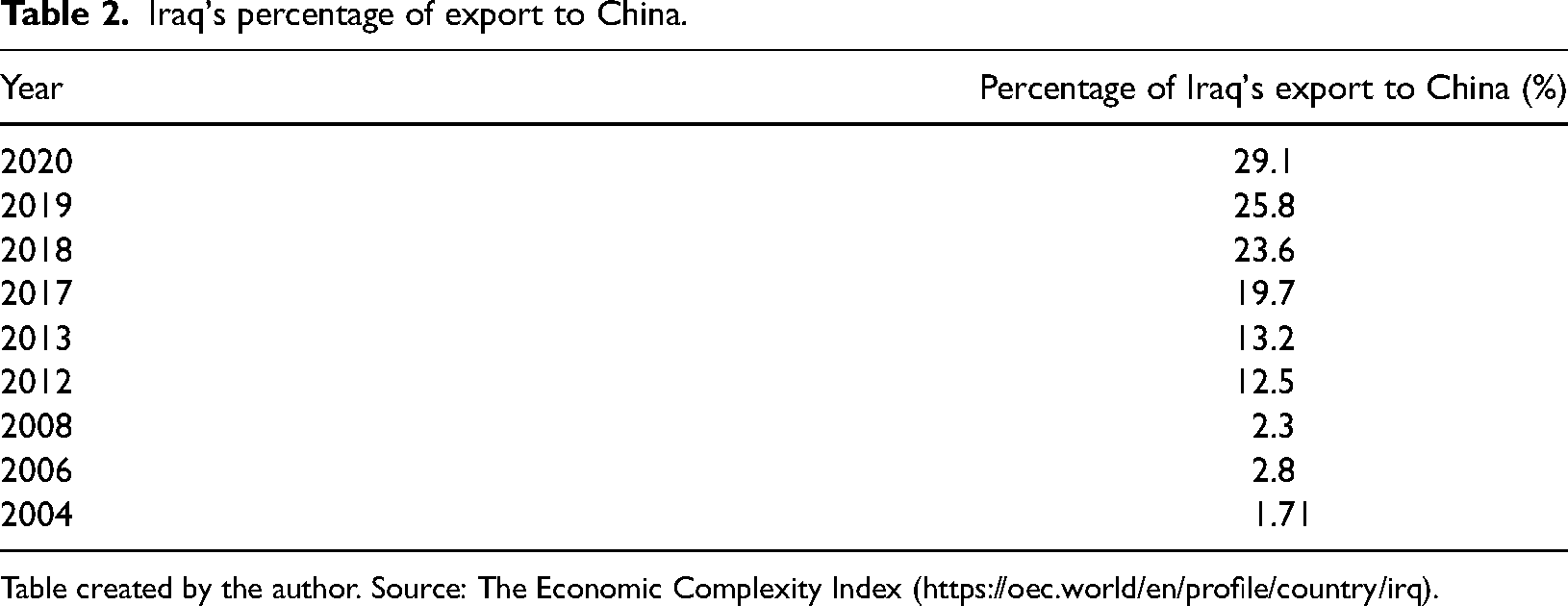
Table created by the author. Source: The Economic Complexity Index (https://oec.world/en/profile/country/irq).
Conclusion
Since 1958, Sino–Iraqi relations have undergone four phases. In the first phase (1958–1975), Sino–Iraqi relations endured low economic and diplomatic rapports, and complex interdependence's three conditions did not have strong presence. The second phase between the end of the 1970s and 1990 witnessed Baghdad's substantial weapons purchases, increased trade and Chinese firms and ventures in Iraq, and some partial elements of characteristics of complex interdependence began to appear but did not fully appear. The third phase from 1991 until 2003 is divided into two segments. The first segment was when economic ties were almost ruptured from 1991 to 1996 due to the UN sanctions on Iraq. The second segment was when the UN oil for food programme revived economic relations, major energy agreements were signed and the three conditions of complex interdependence did not occur. The fourth phase is the new era that shows complex interdependence's conditions at their full capacity. Post-2003, China became the first foreign country to build ties with Iraq's oil ministry, and China's interests were driven by the energy sector. Gradual Chinese engagement in Iraq, including through the oil for reconstruction programme, facilitated more oil and non-energy Chinese companies’ involvement. Post-2003 Sino–Iraqi ties have taken a turning point as the bilateral relationship is experiencing dependency and engagement, particularly in the energy sector. While Iraq is one of China's top oil suppliers, it is currently dependent on China's oil market because it relies on oil revenues.
For China, Iraq is geopolitically and strategically important as it lies on the BRI's vital routes and networks. China’s need for fossil fuels, and Iraq's lucrative opportunities, have shaped China's pro-active engagement. Nevertheless, Iraq's long-lasting instability does not lure a wide range of Chinese companies such as those in the Gulf Cooperation Council's states. Sino–Iraqi relations are at a juncture that either develops to a comprehensive rapport and both countries become more dependent – Iraq embraces all BRI projects and elevates its agreements – or the status quo remains where ad hoc deals and acquisitions can deliver optimal returns without long-term commitment.
Footnotes
Declaration of conflicting interests
The author(s) declared no potential conflicts of interest with respect to the research, authorship, and/or publication of this article.
Funding
The author(s) received no financial support for the research, authorship, and/or publication of this article.
