




Abstract
Democratic backsliding by incumbents is one of the most prevalent forms of backsliding in recent global trends of democratic erosion. Understanding the attitude of voters toward backsliding incumbents is crucial because popular support is the basis of legitimacy for these incumbents. This article studies voter attitudes in the Philippines, where democracy was subverted by the incumbent president, Rodrigo Duterte, who served from 2016 to 2022. Specifically, we examine the validity of the claim that Filipino voters are acquiring a “taste for illiberal rule” made by some scholars. First, we analyzed the survey data regarding the support for various types of political systems, where part of the data comes from our originally commissioned survey at the Social Weather Stations. Second, we explored Pulse Asia's longitudinal survey data on martial-rule support. Our investigation of these survey data did not find substantive support for the “taste for illiberal rule” proposition. Further, we argue that Filipino voters are contingent supporters of illiberal politics while supporting the procedural principles of democracy at the baseline.
Introduction
Democratic backsliding has been a global concern since 2000 (Diamond, 2015). Recent studies have found that the backsliding caused by the actions of elected incumbents, or what Bermeo (2016) called executive aggrandizement, is the most prevalent mode of backsliding (Svolik, 2020). The Philippines’ Rodrigo Duterte joins the list of other leaders and nations that have seen incumbent-led backsliding, including the presidents of various countries, such as the USA's president Trump, Hungary's Orban, and Turkey's Erdogan.
Understanding voter attitudes becomes particularly important regarding incumbent-led backsliding. This is because voters are important players in bringing about this mode of backsliding (in contrast with military-led breakdowns). In incumbent-led backsliding, voters elected the incumbents in the first place. In many cases, once elected, these incumbents maintained popular support while attacking institutions of democracy (Przeworski, 2019: 187). In particular, President Duterte is an unprecedented type of president in Philippine history in the sense that voters elected him knowing that he would implement illiberal policies, and then voters highly approved of his presidency despite his attacks on democratic norms and institutions. Unlike one-party or authoritarian military regimes, voters could have shown their dissatisfaction through opinion polls. In this regard, analyzing voter attitudes toward democracy under the Duterte era becomes particularly important.
We re-examine the claim made by some scholars that Filipinos voters under the Duterte presidency are turning illiberal, that is, having attitudes that support non-democratic politics, including disregard for individual liberty, human rights, and an accountable government (Garrido, 2021; Kusaka, 2019; Thompson, 2019). 1 Most notably, Garrido (2021: 13) claimed that Filipinos are “developing a taste for the illiberal rule.” We interrogate this proposition from three viewpoints. First, we review the existing studies and circumstantial evidence; we show that there is a considerable number of studies that cast doubt on the illiberal voter thesis.
Second, we provide the results of our newly commissioned survey about voter preferences over various political systems. According to the December 2021 survey we commissioned at the Social Weather Stations (SWS), Filipinos’ support for illiberal (non-democratic) political systems has returned to pre-Duterte levels, suggesting that Filipinos are not becoming illiberal towards the end of the Duterte era.
Third, we analyze a set of data collected by a local survey firm, Pulse Asia, on the support for martial law, and find that the overall support level remained consistent across the Arroyo, Aquino, and Duterte presidencies. Moreover, the Duterte era's support for martial law saw greater variability than that under his predecessors, depending on the political climate when the survey was conducted. Based on these analyses, we argue that Filipino voters are not becoming illiberal, but they are contingent supporters of illiberal rule.
This article primarily contributes to studying the Philippines’ democratic backsliding by offering an alternative view of the elite–voter relationship. Extant studies have provided a detailed description of the backsliding processes, focusing either on Duterte's actions (e.g. Rafael, 2021; Thompson, 2021) or on voters (e.g. Arguelles, 2019; Warburg and Jensen, 2020; Curato, 2016; Garrido, 2021; Kusaka, 2017). Emphasizing the voters’ side, this article elucidates the dynamics behind the Duterte-era backsliding. An important existing interpretation is that Duterte rode on his popularity to attack democratic institutions while turning voters illiberal (Garrido, 2021). However, we claim that Filipino voters only contingently support illiberal politics while supporting baseline democracy. This article also contributes to the growing body of empirical examination of Filipino political values (e.g. Kenny and Holmes, 2020; Pernia, 2021) by adding new data on political system support surveys.
We begin by explaining the illiberal Filipino voter thesis and our rebuttal based on our review of existing studies. Subsequently, we provide two types of new empirical examinations of the liberalism thesis based on surveys: (i) one empirical examination concerns voter preference over various political systems, and (ii) the second empirical examination involves support for the martial-law rule. Finally, the conclusion section discusses our argument's theoretical and future implications.
Democratic backsliding, Duterte's popularity, and support for democracy
The illiberal voter thesis under the Duterte era
Duterte's presidency is regarded as the illiberal turn in recent Philippine politics (Thompson, 2019). As Figure 1 illustrates, the Liberal Democracy Index (LDI), which measures to what extent a country adheres to liberal democratic principles, has declined since the Duterte presidency started. This decline reflects the incumbent's attacks on media, civil society, and constitutional bodies mandated to provide checks on the executive, such as the Commission on Human Rights.
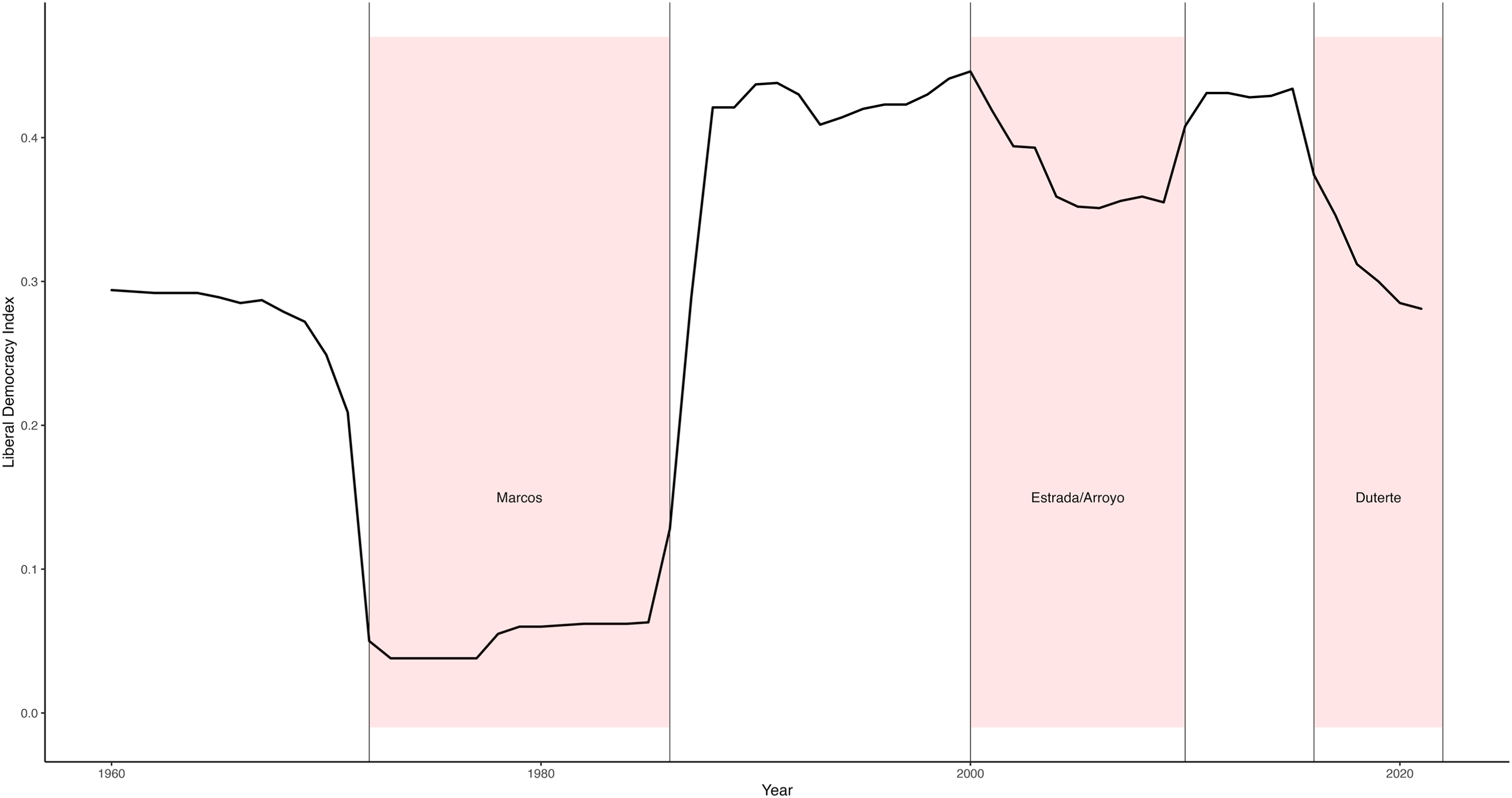
The trajectory of Philippine democracy.
Cast in the post-independence Philippine political history, the Duterte era's backsliding is qualitatively different from the previous rounds of backsliding. First, it was voter-initiated. For example, in the case of Marcos's dictatorship, voters elected Marcos as president in 1965 and 1969. However, Marcos did not publicly pledge to enforce martial law in the 1965 or the 1969 campaign. Moreover, the declaration of martial law in September 1972 came abruptly, using the threat of communist insurgency as justification. The decline in LDI scores during the Estrada and Arroyo eras was mainly due to the president's political scandals.
In the case of Duterte, voters elected him into office, although he explicitly and repeatedly claimed that he would not respect liberal democratic principles, such as human rights. For example, during the 2016 election campaign, he publicly said, “If I become president, there would be no such thing as bloodless cleansing [of criminals],” suggesting that he would take extra-judicial measures to combat crime (Correlas, 2016).
Second, in the case of Duterte, voters overwhelmingly supported him while the country's democracy was eroding, unlike in the cases of Estrada and Arroyo. Figure 2 shows the net satisfaction rates (percentage of those who are satisfied minus those who are dissatisfied with the president's performance) taken by the SWS from 1986 to 2022. During Estrada and Arroyo's democratic backsliding, which was mainly caused by the president's involvement in corruption, voters quickly showed their dissatisfaction in opinion polls. However, voter satisfaction with Duterte remained relatively high until the end of his term. This happened not only amid his numerous attacks on democratic norms but also despite a series of corruption scandals involving his cabinet members and business cronies.
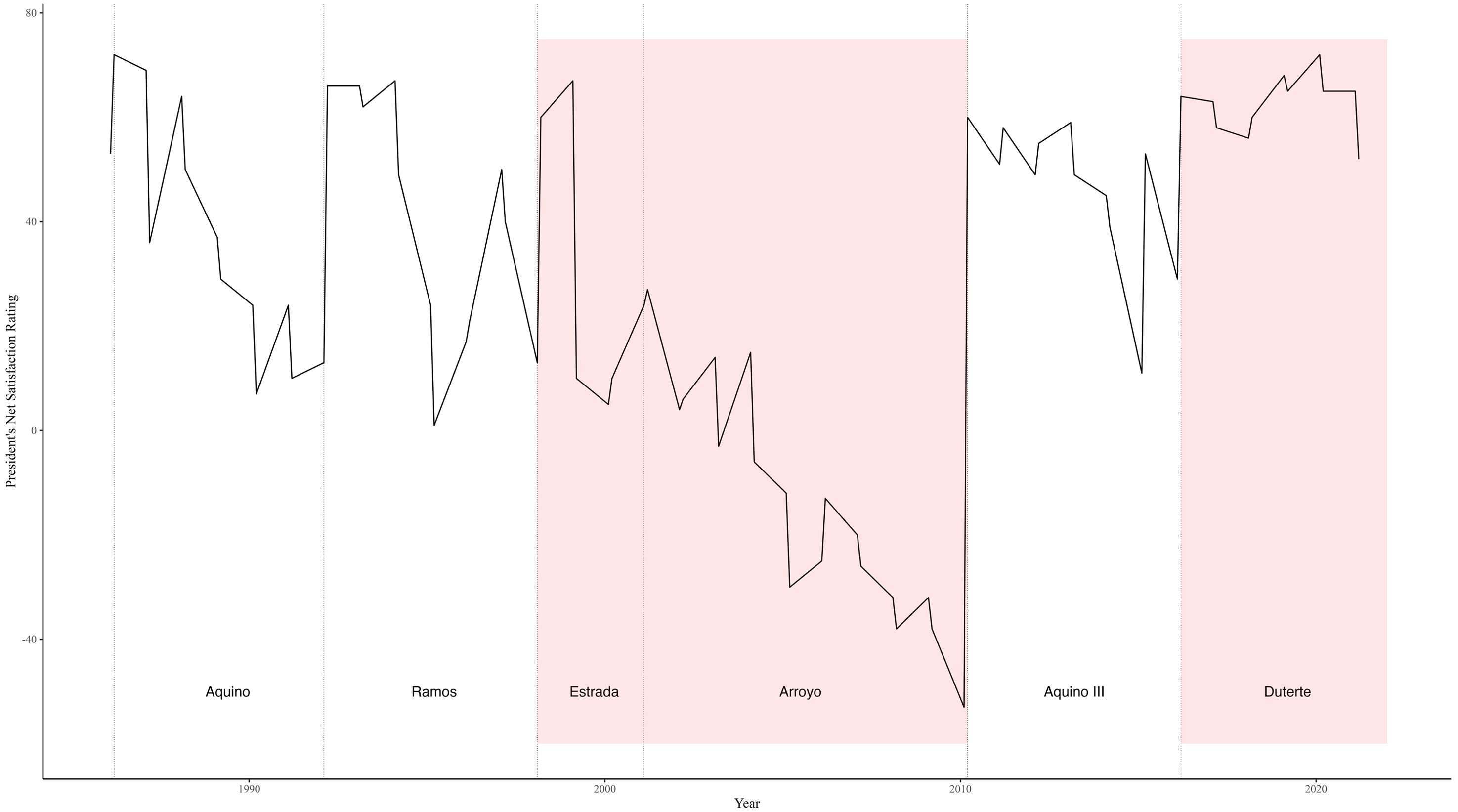
Net satisfaction rates of Philippine presidents, 1986–2022.
To summarize, Duterte is an unprecedented type of president in Philippine history. Voters elected him knowing that he would implement illiberal policies, and voters highly approved of him despite his attacks on democratic norms and institutions. Unlike one-party or authoritarian military regimes, voters could have shown their dissatisfaction through opinion polls. In this regard, analyzing voter attitudes toward democracy under the Duterte era becomes particularly important. Are Filipino voters willingly abandoning democracy and becoming illiberal?
Scholarly writing on this question appears to have transformed throughout the Duterte presidency. For example, one study conducted before the emergence of Duterte concludes that Filipino middle-class voters have an “ambivalent” relationship with democracy (Webb, 2017, 2022). Based on the focus-group interviews conducted in 2010, Webb (2017, 2022) concludes that Filipinos would simultaneously say “yes” and “no” concerning democracy. In another study based on the interviews of Metro Manila middle class between 2009 and 2014, Garrido (2020) extended his insights to characterize Duterte's era voters as “contingent” supporters of the president. The author (Garrido, 2020) argued that voters evaluated Duterte “in relation to the politicians around him and preceding him,” and “his election had about as much to do with the discrediting of other presidential contenders and disappointment with the previous administration as it did with the appeal of Duterte's politics” (Garrido, 2020: 4).
Several years into the Duterte presidency, a new tone of interpretation began to emerge. This change is perhaps best articulated by Garrido (2021: 13), who stated that Filipinos are “developing a taste for the illiberal rule,” a seeming contradiction of his earlier work.2 Moreover, other Philippine scholars provide a similar interpretation. For example, Kusaka (2019) pointed out that “a majority of Filipinos have come to embrace an authoritarian ‘discipline’ that limits both their freedom and their lives” after observing the results of the 2019 midterm elections. Similarly, Thompson (2019) characterizes the Duterte-era Philippines as an illiberal democracy whose president has constructed a strongman political model. It should be emphasized that these characterizations are concerned with voter preference for the political regime or system types and not simply their opinions of the incumbent president.
The justification for the illiberal voter thesis mainly comes from the following observations. First is the phenomenal rise of Duterte as a presidential candidate in 2016. His official campaign started later than the other major candidates because he substituted for another candidate who officially registered his candidacy in October 2015. Once he began campaigning, his popularity increased from less than 10% to about 30%, finally garnering 39% of the votes and winning the race. Previous studies (Arugay, 2016; Teehankee, 2017) concluded that Duterte's victory was primarily due to voters’ frustration with the previous administration. The previous administration failed to bring about substantive reforms on issues such as corruption (e.g. Arugay, 2016; Teehankee, 2017; Thompson, 2019). In addition, scholars argued that Duterte's emphasis on discipline also appealed to voters (Curato, 2017; Kusaka, 2019).
Second, Duterte's high approval rating once in office was interpreted as an indication of voters turning illiberal. As shown in Figure 2, since he assumed office toward the end of his term, Duterte's net satisfaction rate was above 50% in most cases. Based on the SWS methodology, his score was either “excellent” (70% and above) or “very good” (50% to 69%). Furthermore, the Duterte war policy on illegal drugs also received a continuously high approval rating (Kenny and Holmes, 2020).
Third, in the waves of surveys on preferred types of political systems, an increasing proportion of respondents supported non-democratic forms of government. For example, Garrido (2021) points out this trend, relying on the Philippine leg of the World Values Survey (WVS) taken in 2002, 2005, 2010, 2014, and 2018. The relevant questions include support for the rule by non-elected actors such as the military and experts and rule by an (elected) strong leader who does not have to bother with the legislature. In the survey taken during the Duterte era (around 2018), the percentage of respondents who supported the strong leader rule increased from 33% to 42%, and support for military rule rose from 28 to 44% (Garrido, 2021: 8–9).
In sum, Duterte's electoral victory, his consistently high approval rating, and the growing support for non-democratic rules in the longitudinal surveys are the grounds upon which one can argue that Filipino voters are becoming more illiberal.
The grounds for doubts
This article attempts to provide a counter-argument to the illiberal voter thesis. Before providing our empirical analyses in the next section, this subsection discusses suggestive evidence based on existing studies and available information.
First, although Duterte won the 2016 election, his victory does not mean that most voters supported this illiberal candidate. While Duterte won 39% of the votes, two major candidates who represented the liberal democratic inclination garnered 43% of the votes in total. The two major candidates were Manuel Roxas of the Liberal Party (LP) and Grace Poe, who ran as an Independent, winning 23% and 21% of the votes, respectively. Furthermore, although votes may not be directly “transferable” from one candidate to another, if the reported negotiation attempts to unite the Roxas and Poe camps had succeeded, their supporters could have urged consolidation of their forces. As a result, Duterte may not have been a winner. Admittedly, Duterte's popularity as a presidential candidate soared toward the end of the campaign period. At the time of the May 2016 election, one can interpret that most voters preferred a liberal politician to become the next president.
Second, Kenny and Holmes (2020) provide suggestive evidence that support for Duterte does not necessarily mean support for the non-democratic political system. In their surveys conducted in 2016 and 2017, they did not find statistically significant relationships between the support for martial law rule and respondents’ populist attitudes and belief in charisma, two factors believed to be behind Duterte's popularity.
Third, Kasuya et al. (2022) reported that many voters pretended to support Duterte. In the list experiment conducted in March 2021, they found that about 39% points out of 89% support for Duterte's performance was inflated by the presence of respondents who pretended to support him. Although this study only captures a snapshot of the situation around early 2021, and the results are highly context-dependent, the sizeable presence of what they call “pretenders” suggests that voters are not entirely convinced of Duterte's illiberal politics. Primarily the poor, the Mindanaoans, and those who believed Duterte was prevalent in their neighborhood tended to overreport their support.
Our fourth point is based on our observation of the 2022 presidential election. An additional indication that questions the illiberal turn thesis is that in the 2022 presidential race, none of the major contenders publicize that they will continue the Duterte-style war on illegal drugs, which is to arrest or kill drug suspects without due process. For example, the front-runner in the pre-election surveys, Ferdinand “Bong Bong” Marcos, Jr., stated that if elected, he would place the war on drugs as one of the central policy issues but would take a different approach. His approach was diagonal to the Duterte style, focused on arresting “big time” dealers and treating drug users as patients rather than criminals (Pedrajas, 2022). Presuming that candidates gauge what voters want to hear, such positioning indicates that an illiberal stance on the drug issue does not appeal to voters.
The above discussion indicates that re-examining the illiberal voter thesis has merit. Against this backdrop, the next section provides two types of empirical data, which form the basis of our claim that Filipino voters are not becoming illiberal.
Empirical examination of the illiberal voter thesis
Support for various political systems
Comparative scholars used the survey data to argue that many countries’ citizens are turning away from democracy (Foa and Mounk, 2016, 2017). This type of analysis primarily relies on the questions found in the WVS, which asks respondents whether alternative kinds of political systems are excellent or inefficient for governing the respondents’ countries. The alternatives are “a strong leader who does not have to bother with parliament and elections,” “experts, not the government, made decisions according to what they think is best for the country,” “army rule,” and “a democratic political system.” As discussed above, Garrido (2021) extensively used these WVS questions to argue for the illiberal Filipino voter thesis.
Note that the WVS question does not define what democracy means, so respondents can interpret it as they wish. The other question items are relatively clear about the types of political systems referred to because leadership description is included in the question. For example, Webb (2017, 2022) reported that the middle-class Metro Manila Filipinos interviewed equate democracy with “freedom” rather than a political system run by elected leaders, as most political scientists would define it. In this concern, interpreting the levels of support for “a democratic political system” is problematic.
Figure 3 reports Filipino respondents’ preferences for these four types of political systems, as surveyed in the WVS waves, except for the last one. We newly commissioned the last round from the SWS, a polling firm that had conducted the past rounds of WVS surveys for the Philippines.
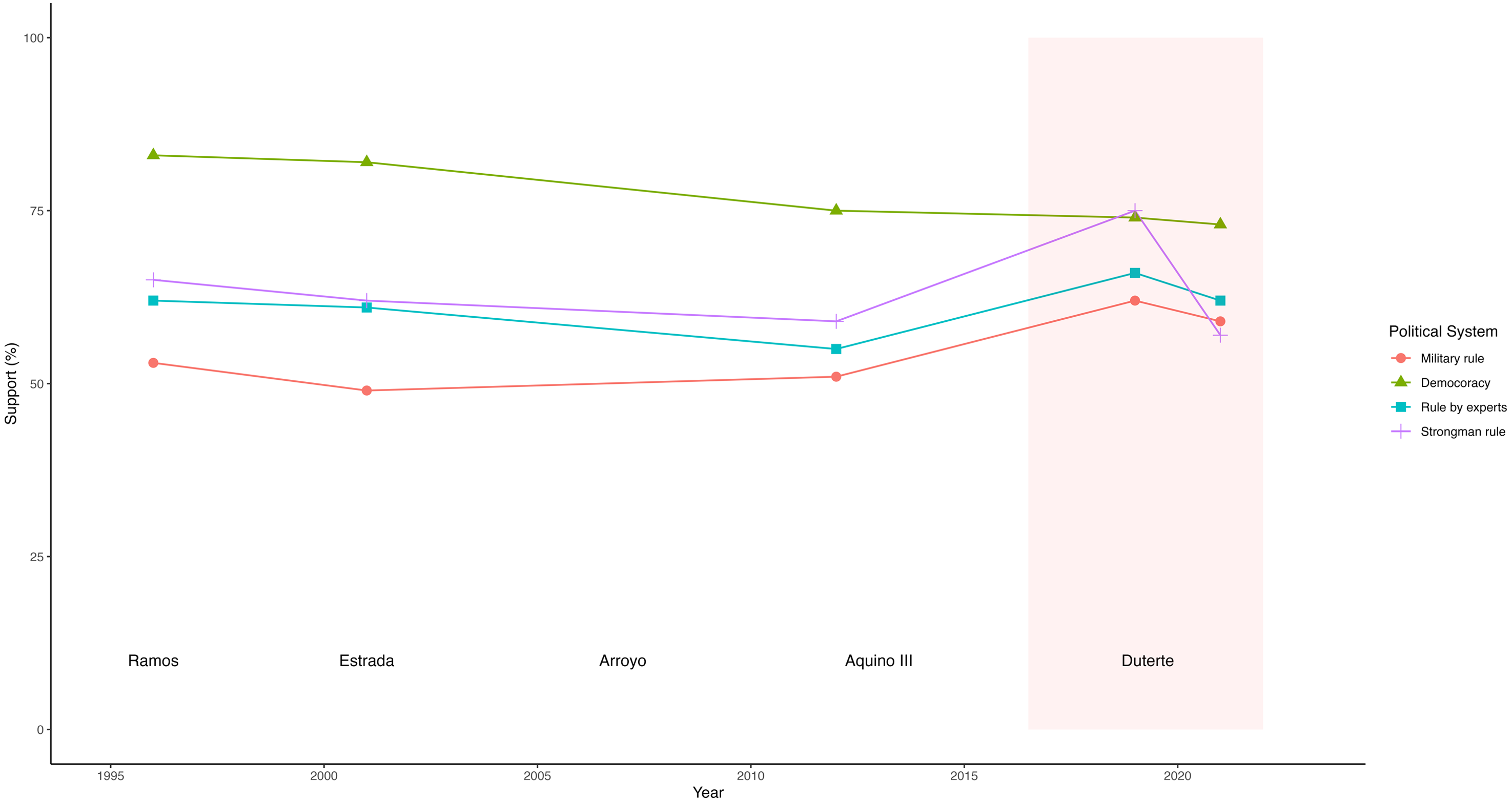
Voter preference over various types of political systems.
During the Duterte presidency, two survey rounds were conducted: one in December 2019 as part of Wave 7 and the other in December 2021. The first-round results form the basis of Garrido's (2021) assessment that Filipinos are becoming illiberal. Compared to the previous surveys taken in 1996, 2001, and 2012, the 2019 survey indeed shows increased support for the non-democratic forms of political systems, especially support for a strongman rule. Respondents’ support for Duterte likely boosted their preference for this type of political system. Pulse Asia's presidential approval survey reported that 87% of respondents approved of his performance as president (Rappler, 2019).
However, the 2021 survey we newly commissioned paints a different picture from the 2019 results. Noticeably, the support for a strongman rule returned to the levels previous to the 2019 results. Preference for the other two non-democratic systems, namely those ruled by the army and experts, also declined, although the difference is not as stark as the support for a strongman rule.
It is possible to interpret that respondents would most associate the strongman rule with Duterte's ruling style among the alternative regime types. According to the Pulse Asia survey, Duterte's approval rating declined from 81% around the end of 2021 to 72% at the end of 2021 (Pulse Asia, 2021). This change suggests that the respondents’ support for illiberal rule reflects support for Duterte, not ideological formation. In other words, Filipinos are not becoming illiberal and consequently supporting Duterte; Filipinos have supported Duterte but not necessarily because they preferred illiberal rule.
In sum, our exploration of the regime-support question indicates that it is likely a mischaracterization to say that Filipinos are becoming illiberal. We may have concluded otherwise if we only saw the WVS data up to the 2019 rounds. However, the 2021 data revealed that the level of support for illiberal politics returned to the pre-Duterte era.
Support for martial law rule
In this subsection, we examine the levels of voter support for another type of non-democratic system, martial law rule. The Philippine Constitution empowers the president to declare martial law, placing the entire or parts of the country under military control. Three presidents have used this power in the post-independence Philippines: (i) Ferdinand Marcos Sr. placed the whole country under martial rule from September 23, 1972, to January 17, 1981; (ii) Gloria Macapagal-Arroyo placed the Maguindanao Province under martial rule from December 3 to 5, 2009; and (iii) Rodrigo Duterte placed the Mindanao region under martial rule from May 23, 2017, to December 31, 2019. Pulse Asia has included the question about martial law support in its regular quarterly surveys since 2001.
Figure 4 shows the plot of martial law support across different administrations from 2001 under Macapagal-Arroyo to 2022 under Duterte. The solid line smooths scatter plots to help discern time trends. The shaded area indicates an interval range of 95% confidence.
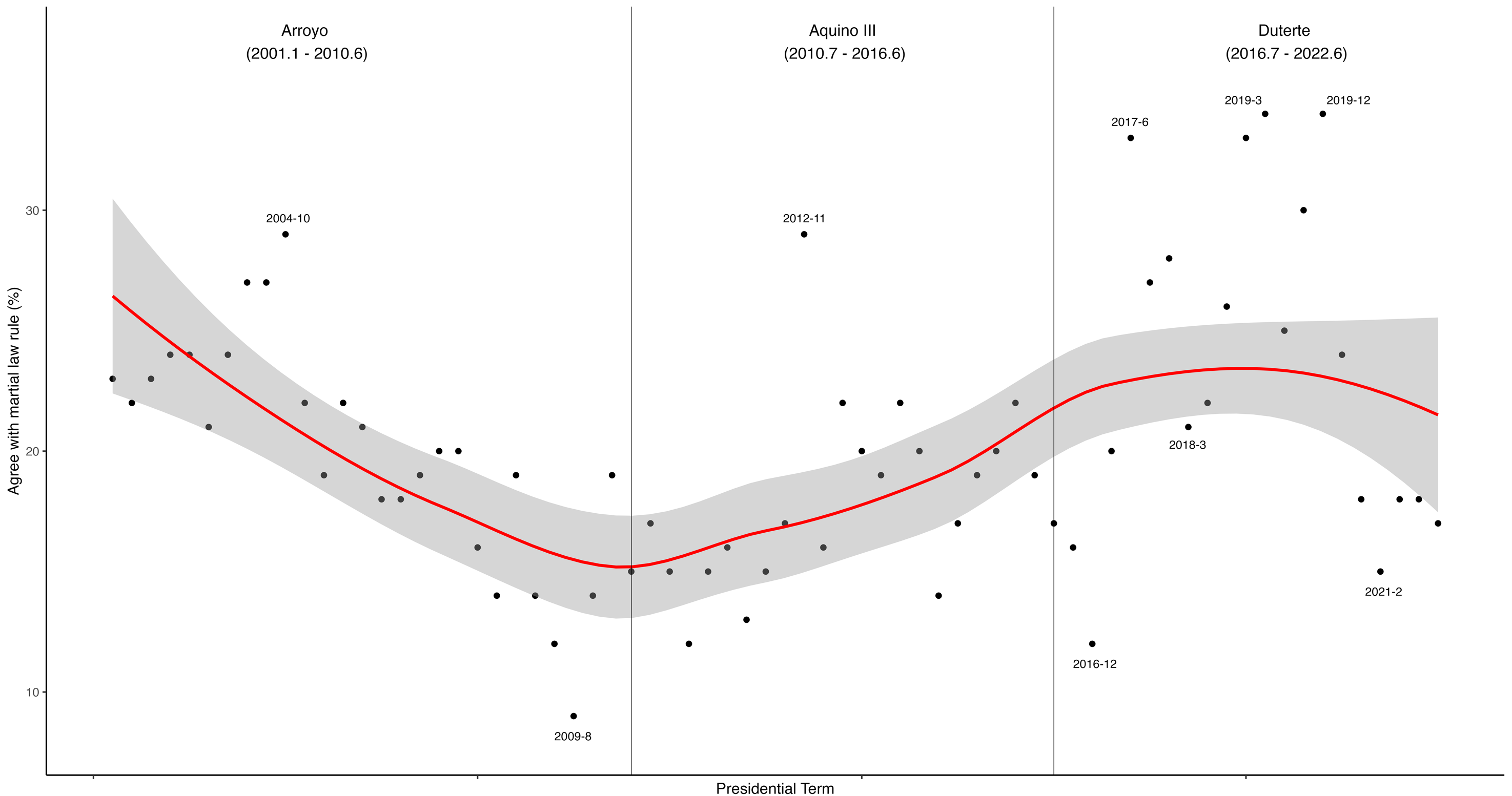
Support for martial law rule.
Figure 4 highlights two critical points. First, the overall level of support for martial law did not increase from 2001 to 2022 during the Duterte era. The level of support declined during the presidency of Aquino III and then increased under Duterte. However, the support for martial law during the Duterte era was about the same as during Macapagal-Arroyo's presidency. In other words, we do not observe an increasing voter support trend for this illiberal rule. At the level of political discourse, Duterte has frequently mentioned the possibility of imposing martial law in Mindanao and throughout the entire country. He also threatened martial law if the drug war met with opposition (BBC, 2017) or if lockdown restrictions were violated during the pandemic (Teehankee, 2020). However, Figure 4 suggests that Duterte's martial-law rhetoric did not sway voters.
Second, the level of support for martial law during the Duterte era exhibits more significant variability than the terms of previous presidents, as indicated by a broader interval range of confidence. Around the time he began his presidency, the support for martial law was at one of its lowest points (12% in December 2016). According to a survey, the support for martial law dramatically increased after the “Siege of Marawi,” which was a battle in May 2017 between the Philippine government and the militants affiliated with the Islamic State that took place in Marawi city, the capital of Lanao del Sur province and part of the Bangsamoro Autonomous Region of Muslim Mindanao. The July 2017 survey recorded 33% support for martial law. The Marawi conflict lasted five months, and the city was declared liberated in October 2017. Voter support for martial law quickly returned to a below-average level, scoring 21% in March 2018.
One may suggest some reasons for the decline of martial-law support in March 2018. News headlines frequently reported Chief Supreme Court Justice Lourdes Serano's impeachment by the House of Representatives and the quo warrant petition for her removal issued by the Office of Solicitor General, two bodies filled with Duterte allies. Furthermore, Justice Serano was known for her criticism of Duterte's martial law and human rights abuses. Duterte's attempt to remove her from the bench was viewed as politically motivated (Villamor, 2018). In addition, many journalists and human rights groups exposed brutal extra-judicial killings related to Duterte's war on illegal drugs, especially after the killing of 17-year-old Kian Delos Santos triggered “massive condemnation” of Duterte's drug war (Gavilan, 2018).
The increased martial-law support in 2019, especially the survey rounds in March and December (34% respectively), could reflect increased reporting on martial law, which was extended to December 2019. Additionally, other reasons behind the sharp decline between March and December 2019 (25% in the June survey) can also be speculated. For example, in June, there was headline news about Filipino fishermen harassed by a Chinese vessel. Duterte's remark downplaying the incident “disappointed many” by appearing to take the Chinese side (Esguerra, 2019). In addition, the corruption scandal involving the state health insurance company Philhealth further inflamed public discontent.
While we cannot point out concrete incidences behind the plunge in support for martial law in the February 2021 survey (15%), we posit that the administration's incompetence—the mishandling of the pandemic, allegations of corruption among allies, and unpopular foreign policy that seeks appeasement with China—became evident to many voters so that they now disagree with the president's favorite pep talk emphasizing order and discipline.
In sum, we could not find an increasing level of support for illiberal politics as represented by the attitude toward martial-law rule during the Duterte presidency. Further, our analyses found that respondents adjusted their level of martial-law support depending on the political developments when the survey was taken, including extra-judicial killings, sovereignty issues in the West Philippine Sea, signs of corruption, and heavy-handed politicking. These findings lead us to argue that Filipinos are not turning illiberal but are contingent supporters of illiberal politics.
Discussion and conclusion
The analyses of the aforementioned survey data do not support the argument that Filipino voters are turning illiberal under the Duterte presidency. Our rationale for this assessment is mainly based on two types of original analyses. One is that toward the end of the Duterte administration, the level of support for a strongman rule declined to the level of the pre-Duterte era. The other reason concerns the voter attitude toward martial-law rule. We showed that the overall support level has not increased, and its variability has been far more pronounced during Duterte's presidency than during that of his predecessors.
Instead of becoming illiberal, we argue that Filipinos have been contingent supporters of illiberal politics while maintaining support for democracy at the baseline. They might render support to illiberal actions of the incumbents under some circumstances that they deem justifiable. Voters, however, withdrew their support for illiberal politics relatively quickly when political circumstances changed, as we saw in the survey data on martial-law support.
Our notion of contingent supporters of illiberalism is similar to Garrido's (2020) argument about contingent support for Duterte. Although his primary interview data were obtained before Duterte's rise (between 2009 and 2014), Garrido's characterization of middle-class Filipino voters is consistent with what we discerned from our survey data analyses for Filipino voters at large. Furthermore, Garrido emphasizes the contingent nature of voter preferences and assesses that the middle class's disappointment with the previous administration provided an opening for illiberal politics. Our recent data analyses indicate that this opening is closing toward the end of Duterte's term. High expectations about the government of discipline and order are long gone. Faced with the failure of his drug war, mishandling of the pandemic, and persistent corruption he promised to eradicate in 2016, voters are turning against the illiberal political system they once supported.
Meanwhile, our argument differs from Webb's ambiguous democracy supporter thesis (2017, 2022). We maintain that the baseline attitude of Filipino voters is in favor of rule by elected leaders. In this regard, voters usually say “yes”—and only in some circumstances “no”—to democracy, but they do not say “yes” and “no” at the same time, as Webb conceived.
Filipino voters appear to have bounced back to support democracy toward the end of the Duterte administration. One irreversible consequence of Duterte's illiberal rule is the damage done to institutions of liberal democracy, from the courts, constitutionally created bodies to check executive power, to the media. Consequently, the continued weakening of institutions leaves voters vulnerable to unchecked abuses of power and political actors, clans, and dynasties who can continue to be in power with impunity. In this regard, voters’ contingent support for illiberal policies has an undesirable long-term impact. Furthermore, weak institutions exacerbate the democracy's failure to deliver public goods and equal gains in development. Finally, efforts to repair and enhance political institutions are ever more critical in the post-Duterte era.
Footnotes
Acknowledgements
The authors thank Aries Arugay, Mark Thompson, the managing editor of AJCP, and the participants of the online workshop on Democratic Backsliding in Southeast Asia organized by the V-Dem East Asia Regional Center on March 29 and 30, 2022 for their valuable comments. Ronald Holmes of Pulse Asia kindly shared with us the martial law question data used in this article.
Declaration of conflicting interests
The author(s) declared no potential conflicts of interest with respect to the research, authorship, and/or publication of this article.
Funding
The author(s) disclosed receipt of the following financial support for the research, authorship, and/or publication of this article: This work was supported by the Murata Science Foundation, Suntory Foundation, and Keio University (Academic Promotion Fund).
