




Abstract
What explains popular support for military dictatorship? Existing literature on democratic breakdowns focuses on addressing support for democratic collapse but not subsequent authoritarian regime. This article explores pro-dictatorship sentiment before and during the military dictatorship in Thailand. It uses social media data to analyze support for the antidemocratic mobilization of the People’s Democratic Reform Committee (PDRC) and the subsequent military dictatorship, which lasted from 2014 to 2019. It argues that support for military dictatorship prior to and after regime installment was qualitatively different both in sentiment and type of support. Prior to the coup, pro-dictatorship support was unified by antigovernment sentiment, while following the coup pro-regime support was contingent upon policy preferences of different groups. These findings fill a gap in the literature on regime change, which tends to be focused on explaining support for democratic collapse and remains silent on this support in its aftermath. This study may present the first-ever evidence of pro-dictatorship support following a collapse of democracy.
Why do ordinary people in democratizing states want dictatorship? Who supports military dictatorship and why? Do pro-dictatorship supporters maintain their support once dictatorship is installed? The phenomenon of anti-democratic mobilization is real and has been witnessed more frequently in important countries, such as Brazil, Egypt, Bangladesh, Turkey, and Thailand. Opposition movements in Egypt successfully called for a military intervention that resulted in the removal of a democratically elected president, Mohamed Morsi, in 2013. Tamarod, one of the key anti-Morsi movements, rallied members to shore up support for the military-backed government of Adly Mansour, despite the autocratic nature of the regime. In Honduras, what started as an anti-government movement led to a coup d’état when a group of soldiers broke into a presidential palace and forced President Zaleya to resign. Thailand had seen large-scale successful mobilization of anti-democratic forces prior to both the 2006 and 2014 military coups (Sinpeng 2021). Yet, we know less about the extent to which pro-dictatorship support and sentiment remains once democracy collapses. Additionally, more research is needed to better understand how social media contributes to democratic collapse as anti-democratic movements have become more adept at leveraging digital technologies.
Despite this increasing occurrence, existing literature cannot help us to make sense of how antidemocratic movements develop in emerging democratic countries. Since the third wave of democratization in the mid-1970s, little scholarly attention has been paid to popular mobilization against democratic governments, or democracy more generally. Images of ordinary people rising up to challenge oppressive regimes and eventually toppling their dictators give us hope and optimism (Huntington, 1993; Kim 2003; Schock, 1999). The fall of the Berlin Wall, set in motion by protests across the Eastern Block; prodemocracy movements against President Estrada in the Philippines; protests against dictatorial Indonesia and Burmese rulers; and the 2011 Arab Spring all remind us of the “people's power” in the collapse of authoritarian regimes. Yet, on closer inspection, popular movements have contributed to the loss of democracy in countries like Bangladesh, Fiji, the Philippines, Thailand, Honduras, and Egypt in the past decade. As such, not all political movements are pro-democracy. Moreover, not all anti-democratic movements contribute to a democratic collapse. Some democracies are able to survive despite popular movements that push for regime change.
There is also a real gap in the current studies on political transitions to dictatorship that take social media seriously. Much of the existing literature on political regimes and media and communication focuses on the contribution that digital media makes in political transitions to democracy, and the entrenchment of authoritarian regimes (Lim 2012; Pearce and Kendzior, 2012; Tufekci and Wilson, 2012). This article seeks to fill this empirical gap through the case of Thailand by providing rich and compelling research at the micro level on how democracy fails, and the contribution that social media plays in its downfall. Implications from this study are relevant to many developing countries around the world whose citizens are increasingly distressed and disenchanted by democracy and who take up their frustrations on social media. Some are dreaming of an alternative future in which life seems more orderly and secure, even if they must concede some of their hard-earned freedoms. Those having grown up in authoritarian times still have fond memories of the good old days. Such authoritarian nostalgia has already been on the rise in Asia, as preferences for strong unelected leaders and military intervention in politics grow.
To examine how and why this is the case, this article uses social media data to analyze support for the antidemocratic mobilization of the People's Democratic Reform Committee (PDRC) and the subsequent military dictatorship, which lasted from 2014 to 2019. Following the 2014 military putsch, which the PDRC saw as a success, the movement had to find a new identity and purpose postcoup. Although not making a causal argument, the article seeks to understand why people supported the PDRC not just before the coup but also after the military government had been installed. It draws on an original dataset based on 15 million Facebook data points on all the activities of the five most popular pro-dictatorship pages in Thailand for a three-year period following the May 2014 coup. I refer to these in this study as the “pro-dictatorship groups” as they mobilized largely in opposition to an elected government and demanded military intervention to topple it. Social media provides a new way to gather political preferences. Recent studies examining the accuracy of data extracted from social media in comparison to traditional public opinion polls reveal social media data to closely approximate polling data (Ceron et al., 2014; Skoric et al., 2020). Mining social media data is also increasingly being used to measure mass preferences in authoritarian regimes where accurate mechanisms for detecting public opinion are largely absent or seriously flawed (Qiang, 2011). This study therefore fills a gap in the literature on regime change, which tends to be focused on explaining support for democratic collapse and remains silent on this support in its aftermath. How do people justify military dictatorships once they have been installed, and why do they support such a regime? The empirical findings from this study may present the first-ever evidence of pro-dictatorship support following a collapse of democracy.
By comparing social media data among PDRC key groups during the PDRC mobilization one year prior to the May 2014 coup, the findings suggest important differences in preferences before and after the military putsch. Anti-Red Shirt and antigovernment sentiment, to speak generally, was the most important uniting factor for PDRC's antidemocratic mobilization across all key support groups, not royalism. Other motivating factors varied across groups; but again, royalism was the least prominent feature of all groups’ preferences. The social network analysis of pro-dictatorship groups during the military dictatorship also demonstrates significant divides across groups. First, the low interaction rate within the pro-dictatorship networks implies a vertically strong but horizontally weak base in support of the regime. Second, the promilitary supporters were motivated by ideological and not material-based preferences. Third, the mapping of anti- and promilitary communities suggests polarization during the dictatorship period and very little evidence of national reconciliation, this being the primary objective of the military junta. In sum, only relatively small groups of pro-dictatorship supporters were anti-democratic, suggesting that the majority of supporters of the coup were “contingent authoritarians.”
The article is divided into four parts. The first part covers the literature review on social media and democratic breakdown. The second part outlines the study's methodology and provides justification for the social media data-mining tools used. The third part discusses the results from the precoup sentiment analysis of the PDRC and findings from the postcoup analysis of the same groups within the PDRC that were behind the 2014 coup. Social network analysis of pro-dictatorship networks during the military dictatorship is also analyzed. Lastly, implications of the social media data analysis of PDRC networks before and after the coup are outlined.
Social media and democratic breakdown
Social media is a game changer in understanding antidemocratic politics in democracies. It is a tool for anti-democratic mobilization and expansion of anti-democratic voices. It can make coups cheaper. Popular mobilization increases and polarization magnifies through social media; combined, these radically reduce the costs of mounting a coup. Ironically, by providing a new avenue for people to express their opinion and participate in politics, social media entrenches and sometimes worsens polarization—keeping societies divided rather than bringing them together. It gives the masses the very weapon most likely to deepen the conflict. Unlike other forms of mass communication tools like television or print, social media creates a “participatory culture” in which users are transformed into active participants and producers of content (Jenkins, 2006). Social media users can generate, share, edit, and produce whatever information and content they want; and they can do this at will. Social media is therefore an instrument in itself for empowering anti-democratic voices and allowing them to galvanize popular support for dictatorship. If we agree that today democracy is under attack in more ways than one, then social media must be added to the list of factors that heighten its vulnerability.
Up until recently, social media was heralded as the “liberation technology”: it empowers activists and ordinary people the world over to fight against oppressive regimes, it keeps governments accountable to their actions, and helps to increase civic and political participation (Diamond and Plattner, 2012). Successful uprisings from the Arab Spring to Hong Kong have fostered early optimism that platforms like Facebook and FireChat can expand numbers of the politically engaged, particularly those previously disengaged from formal politics. Scholars who subscribe to this view that social media can mobilize new sections of society into politics have been encouraged by the rise of political engagement among youths in North America and Europe, whose participation in formal politics had long been in decline (Vromen et al., 2016).
Despite a long list of contributions that social media can make toward strengthening democracy, it also has a dark side. This article demonstrates empirically, through the rise of the PDRC and its subsequent contribution to the 2014 coup d’état in Thailand, that social media did not counter anti-democratic attitudes online. Instead, it amplified these and, moreover, helped antidemocratic factions to gain control of the broader movement and dictate its anti-democratic agenda. Analysis of political engagement by both the PDRC and the Red Shirts also shows that social media perpetuates political polarization and societal divisions by further sowing the seed of discord. Facebook groups under study demonstrate strong echo-chamber effects whereby like-minded individuals only talk to one another and rarely engage with those with opposing views—dampening any opportunities for neutralizing anti-democratic attitudes. The mobilization of nearly a quarter of a million protesters on the streets during the 2013–2014 Bangkok Shutdown was also largely facilitated online (Sinpeng, 2020). All in all, social media did far more to strengthen the antidemocratic attitudes and facilitate anti-democratic mobilization than it did to contain them.
The major contribution of this article is the explanation to the puzzle of why we observe a successful antidemocratic movement in a middle-income country where social media has hastened democratic decline. The incorporation of social media in this article serves primarily to demonstrate the positive impact that it has had on both the anti-democratic mobilization and coup prospects for Thailand. While not advancing any causal claim here, this article provides an empirically rich analysis of the role that social media plays in advancing non-democratic discourse and mobilizing mass movements which seek to overthrow an elected government. This serves to fill an empirical gap in the study of social media and political regimes insofar as it directly and comprehensively discusses the ways in which social media can contribute to democratic breakdown.
Data and methodology
Thailand serves as a crucial case to examine online sentiment toward a dictatorship not only because it recently experienced a transition from a democracy to a military government but also because the pro-dictatorship supporters were largely networked on Facebook through the PDRC movement. Previous research on the mobilization of the broad pro-dictatorship PDRC movement demonstrates the central role played by Facebook in expanding and mobilizing popular support for the military putsch (Grömping and Sinpeng, 2018; Sinpeng, 2017). There is a focus here on the postcoup authoritarian regime precisely because so little is known about the motivations and sentiment among these supposed supporters of the regime. This article is especially interested in groups that have been in favor of such regime change for the simple reason that in the climate of an authoritarian regime they are more likely to express their sentiment online than are opposition groups. Facebook is an appropriate site of inquiry especially in cases where the pro-dictatorship groups are networked online for engagement and mobilization. It means that this social media platform already plays a key role in inducing regime change and should thus remain an important and relevant site of support for the new authoritarian regime following democratic breakdown.
The key questions addressed in this article are the following:
What type of discourses are present within the pro-dictatorship networks before and after the coup? Do the motivations for supporting military dictatorship vary, and if so, how? Are the motivations for supporting military dictatorship following a coup different from or similar to pro-dictatorship support? If they are different, how?
Data was collected in two tranches. The first constitutes the precoup data, which includes the top 200 comments of all Facebook posts on the pages of the five most popular pro-dictatorship groups during the period of May 22, 2013 to May 22, 2014—one year preceding the coup. The second tranche of data was collected between May 23, 2014 and May 23, 2017, constituting a period of three years following the military coup. There is an assumption here that groups that were supportive of military intervention would also be supportive of the successive authoritarian regime. The popularity of these pages was measured by the overall number of “likes” on Facebook (Table 1). The public pages of Suthep Thaugsuban, the People's Democratic Reform Committee, V for Thailand, Thailand Informed, and Army Supporter were thus selected.1 All five of these groups formed part of the PDRC that helped bring down the elected government of Yingluck Shinawatra in the May 2014 coup. Note that groups that were part of the offline PDRC mobilization, such as the STR, are not included here—not because they were insignificant to the pro-dictatorship networks, but because their pages online were not popular in comparison to others. Again, the main emphasis here is on online sentiment via Facebook, which means that some groups that were crucial offline but not popular online are thus excluded.
Key Facebook page statistics (postcoup).
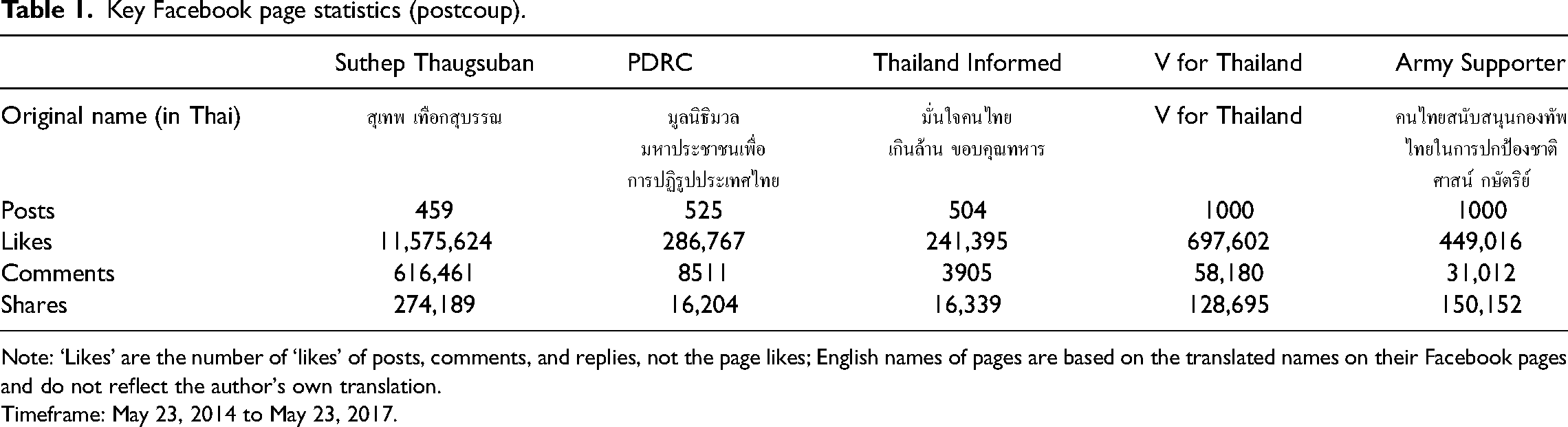
Note: ‘Likes’ are the number of ‘likes’ of posts, comments, and replies, not the page likes; English names of pages are based on the translated names on their Facebook pages and do not reflect the author's own translation.
Timeframe: May 23, 2014 to May 23, 2017.
Facebook data were extracted directly from Facebook using R, Graph API, and specifically the Rfacebook package developed by Pablo Barbera (Barbera, 2017). The entire dataset contained approximately 15 million data points, which included all posts by the page administrators, page “likes,” comments, replies to comments, “likes” of comments, and shares for the postcoup period. Together these pages generated 3488 posts, 13.3 million “likes,” 585,579 shares, and 718,069 comments. An additional 246,288 comments drawn from the top 200 from the precoup period were also collected to render a comparative analysis between the pre- and postcoup periods. Comments became the focus of the text analysis as they are considered the most active and nuanced expression of a user's sentiment on Facebook. Unlike “liking” or sharing, comments included texts that could be further analyzed. Following this, a database of the top 200 comments for each post for all five pages was created in a separate file for manual text analysis. Although R was used to extract this data, Python had to be used to analyze the Thai text because the only natural language-processing algorithm for Thai is available in Python. The biggest problem with the Thai language in any kind of computational text analysis is word segmentation because the language does not have natural spaces between words like Romance or Germanic languages. The ThaiNLP package offers six algorithms for word segmentation and all six were run to manually examine their accuracy. Algorithms with the highest accuracy were chosen. Stop words were also then removed from the data.
Text analysis was performed both quantitatively and qualitatively in three stages. First, to get a rough sense of important words in the comments section of the Facebook pages, a keyword count package was run on Python. Words were counted by their frequency and then ranked from high to low. A list of the top 10 most frequently used words was produced for each page (Table 2). The results provide some indicator of potential issues that were heavily discussed in each of the pages. For both Suthep and the PDRC, discussion about Suthep personally—with reference to kamnan and “uncle”—dominated. This likely related to his being ordained as a Buddhist monk immediately following the coup. As for V for Thailand, it was difficult to discern exactly what may have dominated the page's discussion, but it could be inferred that it was antigovernment. For Thailand Informed, many of the comments seemed to refer to its followers’ nationalistic pride, and for Army Supporter, their love for the army and the monarchy (Table 3). This keyword count method can inform us on the frequency of term usage, and gives a very rough idea—at times, vaguely so—about the issues that might dominate the page comments. On their own, the word frequencies are insufficient evidence of what might be discussed as they do not compute which certain terms are likely to occur with what others—they merely rank terms and their frequencies.
Ten most frequently used words, May 23, 2014 to May 23, 2017.
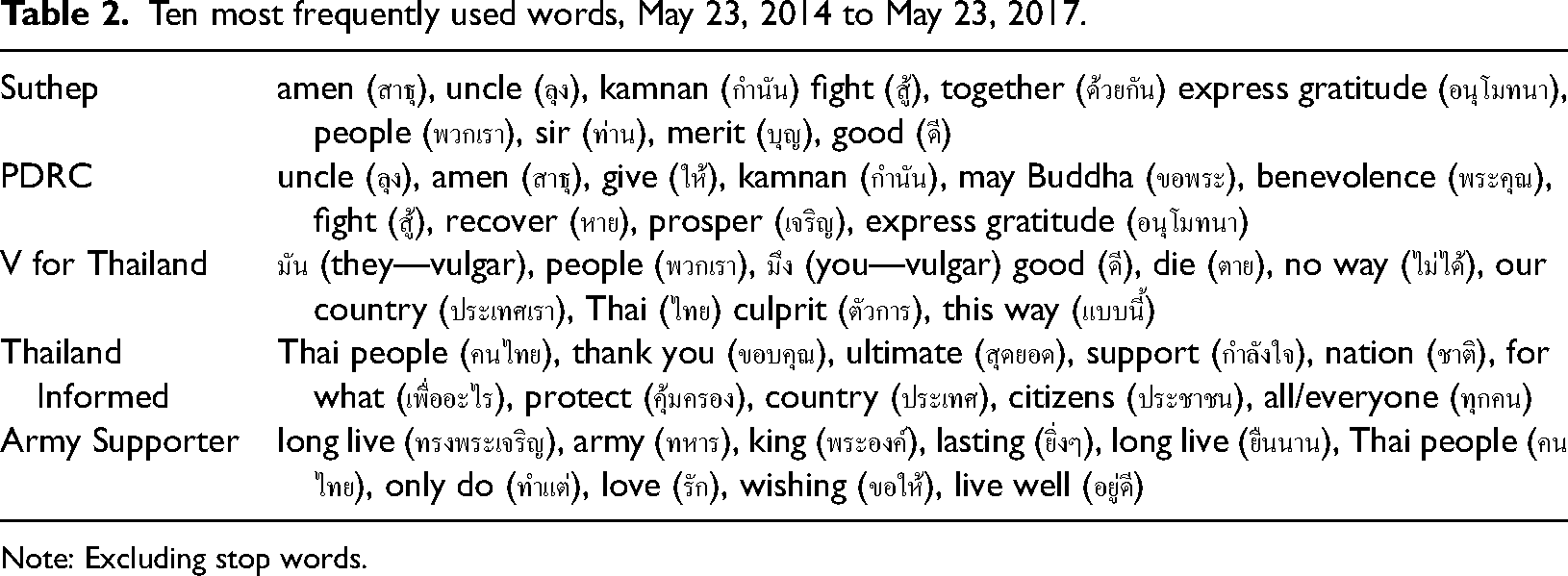
Note: Excluding stop words.
Top key words per topic, topic probabilities, and sentiment (precoup).
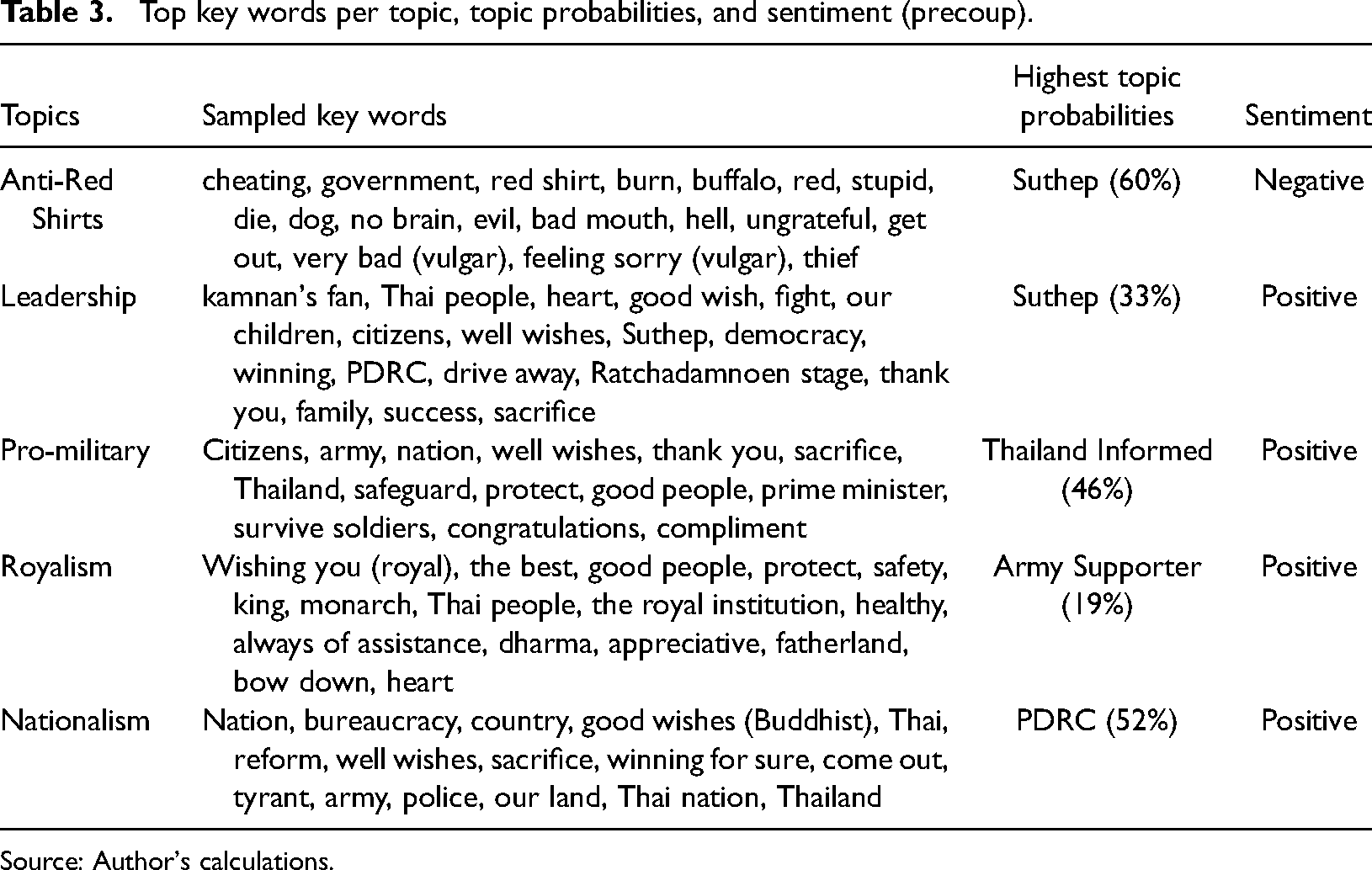
Source: Author's calculations.
To better understand what users of these pro-dictatorship pages were talking about, including what might be driving the discourse for dictatorship support precoup and postcoup on Facebook, a more in-depth analysis of comments was needed. To achieve this, I performed topic modeling on the complete set of comment text across the five Facebook pages to examine which “topics” might be fueling the discourse. Topic modeling is a prevalent machine-learning method in the natural language-processing area. The topic-modeling algorithms statistically analyze a big collection of documents (corpus) in order to extract a number of “topics” that represent the document in an abstract way. Each topic is a probability distribution over all words in the vocabulary that shows how likely the words will be used together in a document. Therefore, the “topics” generated by the topic-modeling algorithm show words that often occur together, although these may or may not be interpreted as meaningful word clusters by a human reviewer. In this study, the Thai Facebook comments form a corpus for the topic modeling, where each individual comment is treated as a document, and 10 topics are extracted using the Latent Dirichlet Allocation topic-modeling algorithm3 using the open source Python machine-learning library—Scikit-Learn.4 Through this approach, the top 30 most salient terms were computed and the relevance matrix computed to form the 10 most likely topics and their probability for term co-occurrence for each page. A list of the top 10 topics per page was then produced.
To improve the quality and saliency of topics further, a manual text analysis was performed to make sense of the topics identified through Latent Dirichlet Allocation. For each of the posts made by the page administrator, the 200 most popular comments were extracted using R. The most popular comments were those receiving the highest level of interaction (liking, sharing, commenting, replies). Manual checking allows for more accurate interpretation of topics that are grounded in possible contexts and specific events surrounding the use of certain words. For instance, on the topic of “democracy,” there can be a number of different interpretations as to what each page discussion inferred about democracy. The associated terms for this topic include “politicians,” “election,” “vested interests,” and “bad.” Without manually checking the top comments, one could perhaps infer that V for Thailand, an antidemocratic movement, views elections as illegitimate in Thailand because of corrupt politicians. Through manual verification, one can assign a positive or negative sentiment toward the topic and confirm or unconfirm the topic interpretation. In the case of V, the majority of comments that discussed the issue of democracy referred to the opinion that elections do not equate with democracy—especially in the Thai case where they considered politicians to be bad and not legitimate even when elected.
Results and discussion
What can millions of Facebook data points tell us about motivations to support the PDRC movement? Opposing the Red Shirts, which the PDRC saw as represented by the incumbent, Yingluck Shinawatra, was the single most important reason for supporting the PDRC. Anti-Red Shirt sentiment was also the only common category of topics, other than royalism, shared by all five pages (Figure 1). Topic-modeling analysis shows that 60 percent of comments posted on Suthep's page could be categorized as anti-Red Shirt, with 52 percent for Army Supporter, 31 percent for Thailand Informed, and 8 percent for the PDRC. Suthep's page was the most popular of all pages, amassing 2.5 million likes just before the coup, and the fact that more than half of all the top comments on his page were about opposing the Red Shirts speaks volumes about how much hatred the PDRC supporters had toward its adversaries.
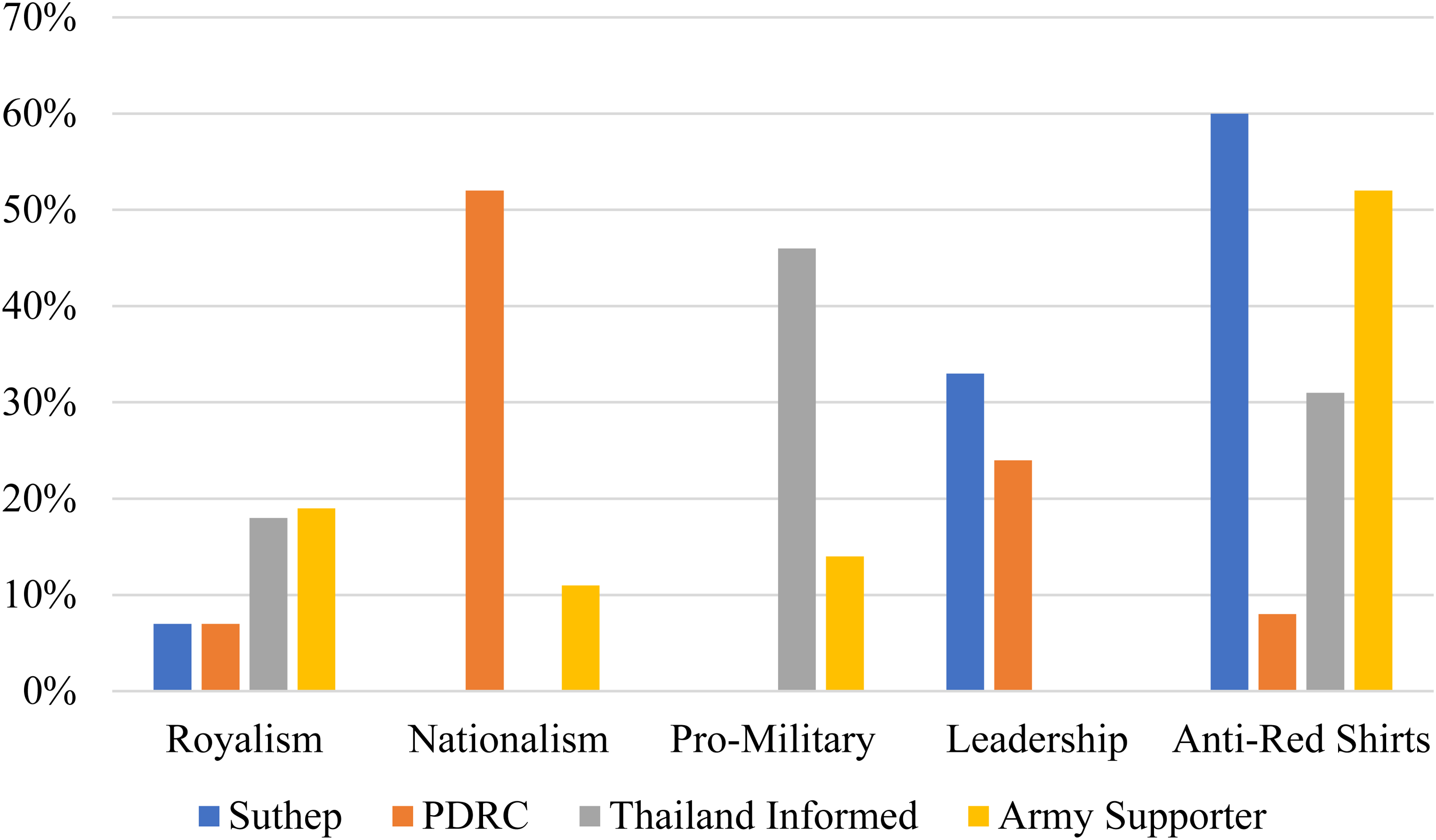
Results of topic probability by page for the year preceding the 2014 coup (May 22, 2013 to May 22, 2014).
Examining more deeply the choice of words most frequently used within the anti-Red Shirt topic, the analysis shows that most of the terms associated with the “Reds” were derogatory and personal. Terms such as “buffalo,” “stupid,” “no brain,” “dog,” and “evil” were used to describe the Red Shirts. These keywords have long been used at both PAD and PDRC rallies and protests, and corresponded well with how the Yellow Shirts saw themselves as superior, more educated, more moral, and more worthy of being citizens of Thailand and the rightful group to have a say in who should govern. The Red Shirts are, on the other hand, “subhuman,” and neither sufficiently educated nor good enough to matter in Thai society. The Red Shirts are immoral and ungrateful and therefore undeserving of being treated as members of Thai society. The PDRC anti-Red Shirts sentiment represents a continuation of the sentiment expressed by the PAD, both at the leadership and grassroot levels.
Royalism is another topic that is shared by all support groups of the PDRC, albeit at a much lower level than anti-Red Shirt topics. This is the most surprising result of the precoup PDRC sentiment analysis since royalism is the very banner that was used to unite all groups opposing the government to form the PDRC. If relying solely on speeches made by the leaders as evidence of what the PDRC support base looked like, we would have likely overestimated the royalist sentiment among PDRC supporters. This content analysis shows that royalism did not feature prominently across the top five most popular PDRC Facebook groups before the coup. Figure 1 clearly shows that discussion on royalism featured in less than 10 percent of all the top comments on Suthep's and PDRC's pages, as those which constituted the majority of Facebook conversations on the PDRC at the time. A manual check of keywords associated with royalism suggests that most words were associated with King Bhumibol's birthday on December 5, with people posting their happy birthday wishes to the king via Facebook. The manual investigation of keywords also suggests that citing their love for the monarch as a reason for mobilizing with the PDRC was not at all prevalent across any of the popular online PDRC networks.
There is clear divergence across the five Facebook groups on other topics discussed by their supporters. One-third of the comments on Suthep's page and one-quarter on the PDRC Facebook page were about glorifying the leadership of Suthep. This is of no surprise since the PDRC page is administered by the same team that also managed Suthep's page and comments tended to be in response to page posts. But the comments of both pages did not exactly align: the PDRC's comments were heavily slanted toward nationalism topics, with keywords such as “our land,” “our nation,” “country,” “Thai nation,” “Thailand,” and “nation” being very prevalent.
The fact that the promilitary sentiment is only concentrated among the comments of the Army Supporter and Thailand Informed suggests that popular support for the military as an institution important to Thai politics is not widespread even among the supporters of the movement demanding a coup. Promilitary sentiment is instead highly prevalent only in Thailand Informed, which constitutes the smallest number of “likes” across all five groups. A manual verification of promilitary comments also reveals that the sentiment tends to be general toward the military institution and not necessarily directly related to its role in politics. Nonetheless, the key terms associated with support for the military were well aligned with how Thais were brought up to believe in the military institution: “army,” “protect,” “safeguard,” “sacrifice,” and “survival.” The military has long been understood as the protector of the Thai nation and these very words captured well the justification given by the military leaders for the May 2014 coup.
Did the sentiment among PDRC key groups on Facebook change after the coup? Are they still supportive of the military government whose takeover of power they facilitated? I conducted a similar analysis of all the comments on the five Facebook pages discussed in the earlier section with the addition of V for Thailand as a sixth page for analysis. The time frame of this postcoup analysis ran from May 23, 2014 to May 23, 2017—constituting a period of three years since the military coup. Online content and text analysis are an excellent way to uncover popular sentiment in a dictatorship like Thailand because there is no other reliable alternative to measure the pulse of the populace on political issues. Moreover, because these groups, in theory, are most likely to support the military government, there is less concern that the people would be too afraid to comment.
The results show a serious break from the precoup sentiment patterns across all five pages. There is no longer a unifying theme across the pages, as both anti-Red Shirt and royalism sentiments were not prevalent in any of these pages. Indeed, anti-Red Shirt sentiment as a defining feature of precoup PDRC sentiment dropped off altogether for most pages, except for a small portion of the conversation on Suthep's page and a larger portion on V for Thailand's page. The disappearance of the anti-Red Shirt-related conversations in most pages of the PDRC network suggests that Yingluck's removal from power eliminated the biggest threat to the nation—the Red Shirts—from the PDRC perspective. While the Red Shirt supporters were still around, the government in place would no longer be the de facto leader of the Red Shirt movement.
The findings from the topic modeling and manual comment analysis show a great variation across five pages in their emphasis on each topic discussion (Figure 2). There were six salient topics overall: royalism, nationalism, promilitary, policy issues (rubber, sugar, constitution, and corruption), leadership, and anti-Red Shirts. Out of these six, no single topic had a high enough probability of saliency and relevancy for all pages. Royalism and promilitary sentiment seemed to be shared across four pages. The saliency of these two topics also varied widely across the five pages, with royalism being highly salient for Army Supporter but far less so for V for Thailand. Some topics, such as policy issues, were relevant to some pages but not to others.
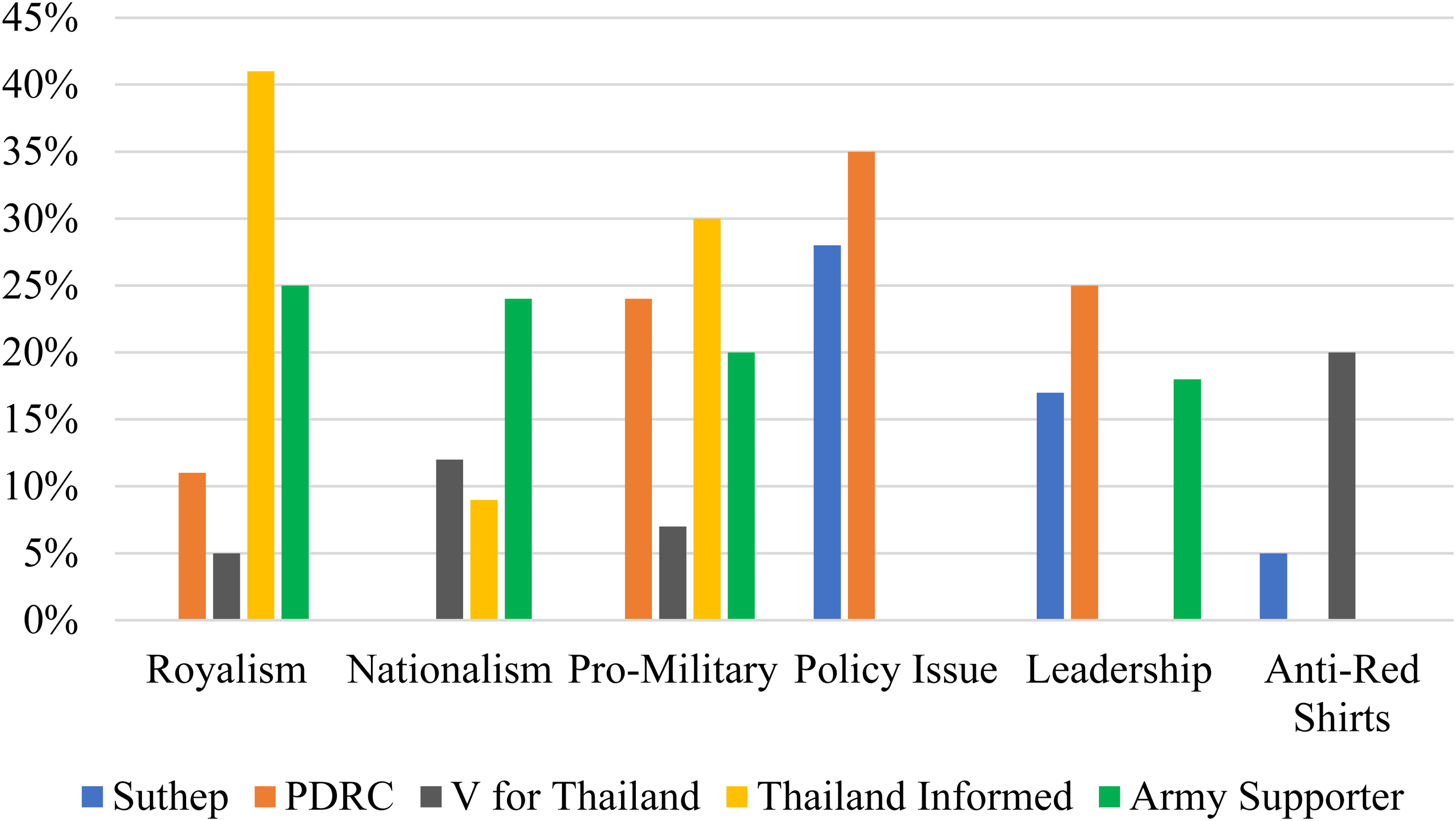
Results of topic probabilities by page during Prayuth Chan-o-cha government (May 23, 2014 to May 23, 2017).
The seemingly united PDRC-led opposition movement that successfully called for a military intervention to end democracy back in 2014 has shown considerable cracks since the coup. This article provides methodologically innovative empirical evidence for such cracks by mapping the motivations, sentiments, and networks of the most popular pro-dictatorship groups in the first three years following military rule. The online population is targeted in this study not only because the online networks of supporters on Facebook were instrumental to the PDRC opposition movement prior to the coup but also because the offline environment made it hostile for the public display of dissent. While the online environment is not friendly for most antijunta or antimonarchy remarks, this study specifically examines groups that are most likely to be junta-friendly, monarchy-loving, and supportive of the military-backed authoritarian government. Thus, the key questions this article is concerned with are those regarding the motivations, sentiments, and networks of the pro-dictatorship networks after the coup and whether or not there has been much variation across groups. The fragmentation of sentiment within the PDRC networks also indicates the diversity of the PDRC movement. Without the ultimate unifying theme of being anti-Red Shirt, as that which predominated in much of the PDRC conversations before the coup, the PDRC movement diverged in both the content of its conversations and in sentiment toward the PDRC movement itself.
The final analysis performed with the Facebook data is social network analysis. This approach allows us to better understand the qualities of the pro-dictatorship networks over the course of the three years following the 2014 coup. Given what we know about the nature of the opposition forces prior to the coup, we would expect the pro-dictatorship networks to be moderately united with some degree of community overlap. The generation of networks from the Facebook data resulted in five networks, variously colored, corresponding to the number of pages. I then created the one-mode “user co-comment” networks as previous analyses over the same three-year period. These networks depict users (nodes) and comment activity (edges), whereby an edge between two users means that they both commented at least once on any post within a given network over the three-year period. The clustering of nodes can suggest that there is a lot of within-page commenting by the same users. The overlapping of nodes can however suggest a high occurrence of co-commenting across pages. These one-mode projections of the networks provide a different picture of the pro-dictatorship movement on Facebook, because the focus is on users and their comment activity rather than “likes.” As discussed previously, commenting requires more effort and is more involved than simply “liking” a post. Comments also contribute differently to the spread of dictatorship support discourse in the postcoup environment, given that users can read each other's comments, interpret and learn from them, and engage in discourse by adding their own comments. Therefore, these networks provide specifically interesting perspectives on user (co)participation and discourse dynamics within each page and across the entire movement-level network.
The social network analysis of the co-commenting across five pages shows the greatest overlap between the pages of Suthep and the PDRC (Figure 3). This is hardly surprising given that Suthep is the leader of the PDRC and there are several cross-postings between the two pages, with the sharing of page administrators. The clustering patterns of commenters on other pages, however, seem separate from one another, suggesting a low degree of cross-page commenting. V for Thailand, Thailand Informed, and Suthep commenters are well clustered together, which means a high occurrence of within-page commenting—an indicator of a close community. The clustering of commenters on the PDRC page was moderate, while for Army Supporter it was sparse. This indicates that the latter's network was far from being a close-knit community in comparison to other groups.

Co-commenting across five networks. Note: (Red) Thailand Informed; (Green) Army Supporter; (Purple) PDRC; (Orange) Suthep; and (Yellow) V for Thailand. Source: Author's calculations.
The findings of the text and social network analysis produce three key results. First, the discourse and sentiment of those supporting the pro-dictatorship groups vary widely in the postcoup environment. Contrary to popular belief, there is no single unifying motivation that is shared equally across the pro-dictatorship movement. Royalism was used as a convenient ideology to unite the fragmented networks of the opposition prior to the coup. This has created an illusion that opposition forces were largely motivated by loyalty to the monarchy. This study has shown that some groups, such as Army Supporter and Thailand Informed, were far more overt in their support of the monarchy than others. Data from Suthep's and the PDRC's pages, which cumulatively represent the bulk of the coup supporters online, show they were far less engaged in discussion of the monarchy. The topic of royalism did not even register as significant among the networks of Suthep—the leader of the pro-dictatorship opposition. V for Thailand, one of the first opposition groups to publicly exhibit its discontent with the Yingluck government, was barely motivated out of a concern for the monarchy. Such low levels of discussion about the monarchy for some of these groups were surprising, especially because the much-revered and beloved King Bhumibol Adulyadej died in October 2016 and the entire nation was in mourning for the following 12 months. One would expect much of the discussion on any of the pro-dictatorship groups, if they were indeed motivated by royalism, to be about their monarch, as vocalizing royalism was generally encouraged by the military regime in power. But the text analysis paints a different picture. Moreover, the discussion over their support of the military—and by extension their overall sentiment toward the then military government—also varies widely. The two groups that were most royalist were also the most promilitary, and by the same token groups that were least royalist were also the least promilitary. The same goes for nationalism among both Thailand Informed and Army Supporter, as the two groups mostly likely to express their national pride and be concerned about sovereignty.
The most surprising finding related to the emergence of policy issues as focal points of discussion for those in the Suthep and PDRC supporter groups. The fact that the text analysis brings to the fore the importance of public policy and constitutional issues involving rubber, sugar, combatting corruption, and the constitutional drafting process is a strong indicator that PDRC and Suthep supporters may have been largely motivated by specific sets of policies rather than more amorphous ideological stances like royalism or nationalism. In retrospect, however, looking at how the Democrats had helped mobilize grassroots support for the PDRC and for Suthep personally, it was clear that Democrat-voting southerners were massively mobilized, especially offline, to support the opposition movement prior to the coup. Particularistic policies on rubber and sugar disproportionately affect southern Thai economies more than elsewhere. Beyond the regional issue, the constitutional drafting comments were highly aligned with the discontent toward Suthep and the broader PDRC movement—suggesting that there was growing unhappiness with Suthep as leader as well as with the broader PDRC movement more generally.
The postcoup social media analysis suggests that there are three broad categories of pro-dictatorship supporters in postcoup Thailand: (1) royalists-nationalists; (2) identity-driven protagonists; and (3) policy-driven contingent supporters. The most conservative and ideologically driven groups are the royalists-nationalists, represented by the networks of Thailand Informed and Army Supporter. Supporters in this group are the most loyal to the military dictatorship—having justified the pivotal role of the military in safeguarding the monarchy and the nation. Their overwhelming gratitude toward the military—even three years on—is noted in their comments regarding the military being “brave,” “selfless,” “smart,” and “good.” Their communication patterns associate their promilitary sentiment strongly with their love of the monarchy and the nation. The second group, driven by identity politics, is represented by V for Thailand. Much of their comments on Facebook were about their identity being in opposition to the Red Shirts, the Thaksin regime, and majoritarian politics. Their sentiment toward “the other” was overwhelmingly elitist—labeling them as “stupid,” “buffalo,” “dog,” and “easily duped.” Electoral politics, to them, was merely a way for otherwise very corrupt politicians to lure uneducated country bumpkins (the Red Shirts) to sell their votes. V was not at all promilitary and their positive sentiment toward the institution held only insofar as the military was the only institution able to rid the country of its “evil doers” (the Shinawatras). They rarely discussed policy issues, which means that their support of the current military dictatorship was likely shaped by their overarching concern over the loss of political power and influence to the enfranchised and mobilized Red Shirts. The third group—the largest one of all—was largely policy driven. Their support for the coup and subsequent military-installed government is contingent upon certain policies or agendas being activated in their favor. They are the least committed to the military and are not particularly royalist. Their discussion about their disappointment toward Suthep, their regret for supporting the PDRC, and their overall dissatisfaction with the 2017 Constitution indicates what may be a withdrawal of support for the causes of the coup and the military as a legitimate government on a whole.
The social network analysis demonstrates the fragmentation and the insularity of the pro-dictatorship networks. Not only were the networks of these groups largely separate, but cross-group communication was low. The exceptions were the PDRC and Suthep networks, which were very similar. The insularity of their communication patterns meant that the benefit of communicating with other groups—even those likely to be similarly minded—was very limited. Users in these groups preferred to comment within their own pages and not on networks of similar groups. This potential echo-chamber effect across these Facebook pages of similar-minded groups means there was a lost opportunity to build a stronger and more frequent cross-group communication that might have helped to strengthen horizontal connections across networks.
The precoup and postcoup sentiment comparative analysis reveals three key features about the PDRC online networks. First, royalism was not a prominent sentiment among PDRC online supporters—either before or after the coup. Royalist sentiment is strongest among the royalist-nationalists, exemplified in the Thailand Informed and Army Supporter groups, which constituted a minority of the PDRC online support base. This suggests that while leaders of both the PAD and the PDRC had long exploited the pro-monarchy agenda to gain popular support, royalism was not the main driving force for why people supported the PDRC online, bar for a minority few. But these staunch royalist groups were vocal and thus crucial to pushing the royalist agenda within the broader PAD and PDRC movements. Even after the passing of the much beloved and revered King Bhumibol, the constellation of conversation regarding the king on most PDRC pages was related only to his passing or to his birthday and evoked little engagement with the PDRC movement beyond those explicit events.
Second, PDRC mass support for the military coup was largely concentrated around their anti-Red Shirt dissent; this masked other reasons for wanting to drive out Yingluck through whatever means necessary. The postcoup analysis demonstrated some aspects of what the PDRC wanted once the Red Shirts were no longer in charge, and these reflected different support bases within the PDRC. Groups that were royalist and nationalist were supporting the military government from an ideological perspective, while others continued to demand that measures be implemented so that once an election was called, a Red Shirt-aligned party could not return to dominate Thai politics. But most comments were policy-related and largely negative, indicating that support for the PDRC and the coup more generally was contingent upon the new government's performance in delivering public goods.
Third, the growing discontent within large sections of the PDRC Facebook conversation reflected the disappointment in both the PDRC as a movement and Suthep as its leader, on following through with reforms as per their campaign “reform before election.” The conversation labeled under the “discontent” category, which occupied 25 percent of comments on Suthep's Facebook page, shows how unhappy the supporters were that Suthep had, in their view, turned out to be just like any other politician: lying, badly behaving, power grabbing, and disappointing. Such negative sentiment toward Suthep was again visible in policy-related conversations that demonstrated deep disappointment with the PDRC and with Suthep as its leader. Further analysis would be required to investigate whether the growing discontent is observable on Facebook conversations relating to Prime Minister Prayuth Chan o-cha. Promilitary sentiment, however, did not seem to waver, and in some cases grew, in the postcoup environment. The more conservative hardline groups, such as Army Supporter and Thailand Informed, had more positive conversations about the military after the coup, with keywords such as “bravery,” “sacrifice,” and “protect,” than in the precoup period. This undercurrent of promilitary sentiment within the PDRC, even if among the less popular groups, still signified military support despite growing discontent with the military's policies and governance.
Conclusion
Social media plays a crucial role in mobilizing support for dictatorship, both in democratic and authoritarian regimes. Social media data also make visible the variety of motivations for dictatorship support before and after the regime. Through a comparison of precoup and postcoup Facebook conversations of the PDRC's largest groups, the analysis shows a real divergence in the issues that mattered to different groups of supporters. Contrary to the prevailing notion that a military government would be necessary to “protect the monarchy,” royalism was neither the driving force of support across groups nor what united them. Instead, some groups were motivated by their desire for particular policies; others were pro-dictatorship for ideological reasons. It was clear that there was a genuine decline in support for dictatorship among the majority of the PDRC supporters, with much of their discontent stemming from economic and policy issues. The policy-driven discontent did not, however, correlate with precoup conversations about notable policy demands. Instead, in the precoup period PDRC conversations were overwhelmed with hatred toward their adversary—the Red Shirts—to the extent that their genuine reasons for supporting the PDRC were never actually expressed.
The divergent and contradictory identity of the PDRC in the postcoup period underscored how disunited and fragmented the PDRC support online was, even among those who seemed to be the “core” supporters of the PDRC. Before the coup, opposition to the Red Shirts served to unify the movement. But once removed, it became clear how loosely organized the PDRC really was, with a negligible unifying theme and growing internal discontent and disunity. The thin thread that held the PDRC and former PAD forces together broke apart and completely dispersed in the run-up to the March 2019 election. These findings underscore how social media helps to deepen our understanding of grassroots dictatorship support, both in democratic and authoritarian times. This study contributes to the growing literature on social media and authoritarian resilience by advancing empirical knowledge toward understanding the evolution of dictatorship support during both democratic and authoritarian times and the role of social media in mediating such sentiment. The creative use of methods drawn from the computational social sciences also contributes methodologically to the literature on authoritarian regimes. Support for dictatorship is nuanced, complexed, and dynamic and requires more research outside of the Thai case to draw generalizability to these findings.
Footnotes
Declaration of conflicting interests
The author(s) declared no potential conflicts of interest with respect to the research, authorship, and/or publication of this article.
Funding
The author(s) received no financial support for the research, authorship, and/or publication of this article.
