



Abstract
The present study aims to give insight to the experiences of nursing students during 3 years of clinical practice. The focus is on challenges and adaptations during their first 2 years of study because of the COVID-19 restrictions, as well as on how they perceived the differences between digital and physical presence of teachers in clinical practice during their last year of studies once the pandemic receded. A qualitative approach was used to analyse responses to open-ended questions from 47 third-year undergraduate nursing students at a Norwegian University. The study was reported according to Consolidated Criteria for Reporting Qualitative Research (COREQ) guidelines. The analysis revealed two main themes: 1) an uncertain learning universe and 2) receding pandemic and restrictions. Three subthemes were identified within theme one: changes in clinical practice; fear of being sick; and taking responsibility. Within theme two, two subthemes were revealed: physical meetings and the receding pandemic. The findings indicate that students experienced uncertainty in their learning environment both during and after the pandemic, heightened by concerns of virus exposure, ultimately increasing their responsibility for self-directed learning. Insufficient clinical practice time and limited patient interactions were sources of stress, impeding students’ ability to meet curricular learning objectives. When pandemic restrictions were eased, students reported feeling more at ease and less burdened.
Introduction
In March 2020, the World Health Organization (WHO) declared the novel coronavirus outbreak a global pandemic. 1 WHO recommended social distancing, use of face masks and frequent washing or sanitising of hands to prevent or reduce the spread of the virus. 1 In Norway, the government implemented stringent public health measures during the pandemic, including social distancing, widespread testing and contact tracing, isolation and quarantine protocols, as well as temporary lockdowns of various sectors such as education and health services. 2
Educational institutions physically closed down, and digital teaching, supervision and communication replaced regular classroom courses and face-to-face interaction. Norwegian nursing school programmes were forced to develop innovative digital teaching strategies. This included establishing new ways of partnership and collaboration with clinical practice sites to ensure that students meet the learning outcomes specified in their pre-existing curriculum. 3 These new teaching strategies presented several challenges for nursing students in clinical practice periods. 4 Nursing students faced integration of virtual simulation tools and modified on-site supervision protocols, which sometimes led to reduced hands-on training opportunities. 4
The bachelor's degree nursing programme in Norway is governed by a national framework in which full-time undergraduate nursing students complete their degree in 3 years. The curriculum is equally divided between theoretical courses and clinical practice. 5 During clinical practice, students are required to meet specific learning outcomes to successfully complete each period. Students are assigned a supervisor who is a registered nurse. This supervisor provides guidance and support throughout the clinical practice period. Students meet with their supervisor and a teacher from school for an introductory conversation once the practice period starts. A supervisor will usually guide one or two students. The teacher performs visits in clinical practice and, together with the supervisor, carries out formative and summative evaluations of the student at midterm and end of the clinical practice period. Additionally, teachers participate in reflective groups of approximately eight students, providing a forum to discuss experiences and obstacles during their clinical placements.
Background
Several changes in the students clinical practices were implemented following the onset of the COVID-19 pandemic. Changes included, among others, a reduction in the number of clinical practice hours and restrictions for teachers to visit students on-site. Examples of other changes within the Norwegian context are provided in Table 1.
Temporary regulation from the Ministry of Education in Norway during the time of the COVID-19 pandemic (2020).

Nursing students experiences and challenges during the COVID-19 pandemic have been studied previously.6–10 High stress levels and fear of getting COVID-19 are some of the challenges students experienced. 11 Other studies focused on nursing students learning experiences during the COVID-19 pandemic.6,9 For example, Song and Kim 8 found that students who spent a lot of time in an alternative clinical practice experienced increased anxiety over clinical decision-making skills compared to students who had ordinary clinical practice. Loneliness amongst students was also found during the pandemic.7,12 Hysing et al. 12 highlighted that loneliness was common among Norwegian full-time students’ with a considerable increased in the condition from 2014 to 2018. Ulenaers et al. 13 reported that, during the COVID-19 pandemic, nursing students felt a strong need to be heard, prepared and supported during clinical periods. Their study emphasises that, despite efforts by nursing schools and clinical sites to support students, experiences of loneliness were described. 13 During the pandemic, nursing students reported stress, anxiety over potential infection, feelings of uncertainty and loneliness, difficulties with concentration, and worries related to grades, exams, obtaining their nursing licence and their future careers. 6 However, and despite these important studies, we have found limited information about: 1) how nursing students experienced 2 years of clinical practice while interacting digitally with teachers instead of meeting them face to face; 2) nursing students experiences once the pandemic was retreating; and 3) how students perceived the physical presence of teachers in clinical practice during their last year of studies. This information could provide insights into how the pandemic impacted students learning journey and how they navigated the challenges of their education.
Aim
This study aims to give insight to the experiences of nursing students during 3 years of clinical practice, focusing on challenges and adaptations during their first 2 years because of the COVID-19 restrictions, as well as on how they perceived the differences between digital and physical presence of teachers in clinical practice during their last year of studies once the pandemic receded.
Methods
This study uses a qualitative reflexive method to study nursing students’ reflections on their clinical practice periods during the COVID-19 pandemic and once the pandemic was receding. We analysed the data using qualitative thematic analysis as proposed by Braun and Clark.14,15 This approach has evolved since 2006, and the specific term reflexive thematic analysis is now employed.14,15 The members of our research team are registered nurses, with academic degrees ranging from lecturer to professors, each bringing diverse experiences in qualitative research to enrich the analysis.
We used a six-step thematic content analysis involving: 1) immersion in the data by reading it thoroughly and taking notes; 2) generation of a list of themes from observed ideas; 3) identification of overarching themes and organisation of subthemes; 4) critical review and revision of themes as needed; 5) naming of themes to capture their essence; and 6) written publication based on the analysis process.14,15 This approach to qualitative analysis is systematic and flexible.14,15 We followed the recommended steps to generate patterns, meanings and insight within the data. However, we have been attentive to their reflexive perspective when engaging with the data material throughout the analysis process. We used the Consolidated Criteria for Reporting Qualitative Research (COREQ) checklist. 16
Participants and setting
Participants were third-year nursing students at a large University in Norway. In total, 183 students were eligible for participation and 47 agreed to share their experiences. All participants were 18 years of age or older. The demographic distribution revealed that 91% of the respondents were female. Moreover, 96% of participants had been engaged in healthcare employment alongside their academic studies. Further information about the participants’ working experience is provided in Table 2. Three of the investigators had a connection to the bachelor's program while the study was conducted. However, none of the investigators taught in the students third year of education, nor followed them in practice.
Participants’ work experience in different types of health institutions.

Data collection
Eligible students received information about the study one week before it started. This information was distributed by email through the online learning platform used by the University. Together with this information, was a link to SurveyXact™ (www.rambollxact.com), an advanced online data collection tool designed to create, manage and analyse data. SurveyXact™ ensures data security and places a strong emphasis on the anonymity and confidentiality of respondents. We asked students to answer two open-ended questions to reflect on their experiences during practical studies over the 3-year period as bachelor students, their perceptions of all three years of pandemic restrictions and its impact on their clinical practice periods (Table 3). We also collected background information regarding age, gender, healthcare experience and work in healthcare services while pursuing nursing education. Data collection period lasted for 4 weeks, and four email reminders were sent to eligible students.
Research questions to the participants.

Data analysis
Students` reflections on the open-ended questions were organised and analysed using thematic analysis as outlined by Braun and Clarke.14,15 The analysis started with each author reading all answers individually and coding the data manually before meeting to discuss initial codes in accordance with thematic analysis. Several meetings were conducted to discuss codes and themes. Answers to the open-ended questions were closely examined to identify common themes and patterns of meaning that came up repeatedly. Meaningful concepts were then grouped together in categories with the same meaning. Because all of the investigators had access to the data, they could verify interpretations and quotes. Consensus was achieved after several discussions.
In our analysis, we saw no difference in terms of age or clinical experience; therefore, age and experience are not included in the quotes. Table 4 provides an insight into the analytical process.14,15 To show that we use the width of our data material we present the results according to “P” (for participant) plus a number.
Illustrative quotation, subthemes and themes from the analysis.

Rigour and trustworthiness
The pillars of trustworthiness in qualitative research explores the intricate details of human behaviour, attitudes and experiences. Transferability, dependability and confirmability ensure trustworthiness. 17 The credibility of the study was established by using informants’ verbatim transcripts and by coding the various stages of analysis as recommended.14,15 Transferability of the data was enhanced by providing detailed descriptions of the research context, setting and participants. Dependability was achieved by asking all informants the same questions and using material only from participants who completed the two questions. If they answered only one question, they were excluded.
Ethical considerations
We consulted the Norwegian Agency for Shared Services in Education and Research (SIKT), which is the advisory body on privacy and research ethics for research involving healthcare professionals. 18 According to SIKT, because student participation was voluntary and data from the study were collected using the anonymous function of SurveyXact™, there was no need for ethical approval. Nevertheless, all students were given information about the study and the research questions in advance, about voluntary participation and about confidentiality.
Results
The analysis revealed two main themes: 1) an uncertain learning universe and 2) receding pandemic and restrictions. Three subthemes were identified within theme one: changes in clinical practice; fear of being sick; and taking responsibility. Within theme two, two subthemes were revealed: physical meetings and the receding pandemic (Figure 1).
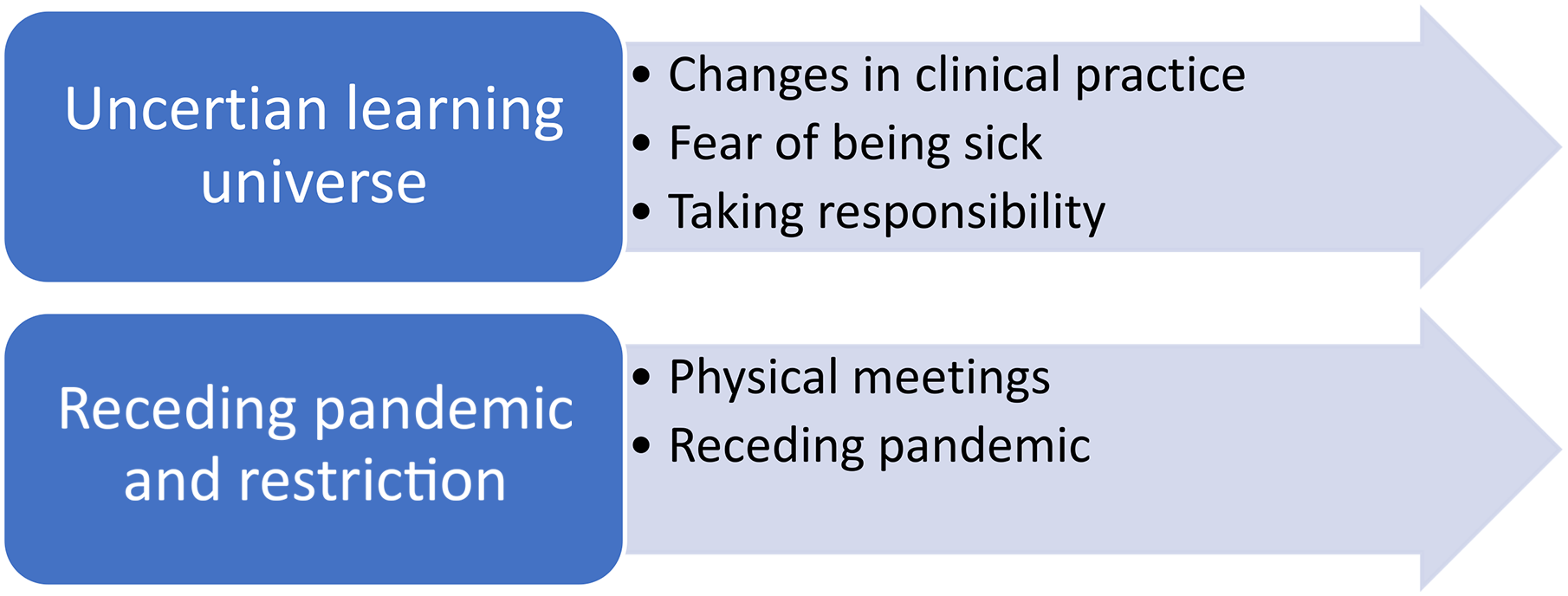
Main themes and subthemes from the analysis.
Uncertain learning universe
The analyses indicated that the students experienced an uncertain learning universe, especially during the first 2 years of nursing studies. These uncertainties affected both their theoretical studies and their clinical practice periods. Clinical practice periods were described as a hybrid situation characterised by reduced time in clinical settings combined with either online teaching or simulation-based university training.
The first subtheme, changes in clinical practice, was mentioned by most informants. Students expressed insecurity about their clinical practice being approved by the university and their struggles fulfilling learning outcomes. Students reported concerns about reduced learning outcomes that would consequently leave them poorly prepared for working as. One student wrote: “We were not fully qualified bachelor's students. I didn’t experience my education as an easy journey” (P8).
Although some students reported struggling to achieve concrete learning goals, they tried to maximise their time in clinical practice: We didn’t waste a single moment, and we really made the most of those 4 weeks. Our nursing supervisors supported us and wanted us to learn as much as possible. We were given our “own” patients [already] from week 2 to speed up the learning process. (P16)
Within the second subtheme, informants reported fear of becoming sick. This included not only fear of being infected by the COVID-19 virus but also fear of infecting patients’ they encountered: “I have never been so stressed, sad and have cried so much, with this cruel pressure of being in practice every day, doing well in exams and feeling guilty about being social with others” (P9).
Taking many precautions to avoid the virus was stressful and made the learning environment even more uncertain: “There has been a significant focus on infection prevention routines, and patient safety. But they forgot about us, this has led to loneliness and isolation. I feel a lack of student community and cohesion. We haven't been able to share experiences or support each other” (P51). As a result of the pandemic and the importance of maintaining distance, there were learning situations in which the students were not allowed to participate in, including clinical procedures, meetings, and reports. Some students expressed feelings of being a burden or unwanted as a student in clinical practice because they were seen as a potential source of virus spreading. As one student wrote: “I was not allowed to attend meetings or watch reports, because then there were too many [people] in the room” (P7). Other students expressed gratitude for the way supervisors took care of them in this tough situation: “In general, supervisors in practice seem to have been solution-oriented” (P25).
Within the third subtheme, informants expressed the importance of taking more responsibility for their own learning. As they encountered fewer learning situations and had less patient contact, meeting their clinical supervisor was more valued. Several students described the importance of having a clinical supervisor who was able to provide opportunities to achieve learning outcomes: “There was little space in the nurses’ station and no focus on or understanding [regarding] the student's need for inclusion and support” (P45).
The students referred to strict rules during the COVID-19 pandemic, saying that health personnel had to stay home if they had symptoms of sickness. Students reported that clinical practice settings were usually understaffed and that they wanted to provide extra help to care for patients. Other informants reported high work pressure and felling they had to fit the role of an employee rather than the role of a nursing student who needed to focus on learning situations: They were understaffed due to sick leave of the staff during the pandemic and because of this I clearly became [part of the] workforce in home care practice in the last year [of nursing studies], and this made me miss many educational situations. (P4)
Several students wrote about an enhanced understanding of the daily work, responsibilities, and tasks of nurses during a pandemic. The majority of respondents indicated that they gained substantial knowledge about infection control within clinical settings. Students saw this as particularly important knowledge to be applied in case of future epidemics: “We got to experience being students during a pandemic and really got an insight into how this affects the healthcare system – which is a unique experience” (P42).
Receding pandemic and teachers physically present in clinical practice
In Norway, the pandemic was receding and most of the COVID-19 restrictions were reduced and removed in February 2022. This happened when the informants were in their sixth semester of clinical practice in home care nursing. The analysis showed that, for the students, receding pandemic meant that they still had a high focus on infection control, at the same time as they had increased contact with patients, fellow students, supervisors, clinical practice staff and teachers from the university. Although society were rescinding, several infection-reducing measures continued in health institutions.
Within the context of rescinding the pandemic, the first subtheme we identified was the importance of physical meetings. The analysis revealed that, during the first 2 years of the pandemic, teachers were not permitted to visit students at their practice site. As society began to recede from pandemic restrictions, teachers were granted permission to accompany students during their clinical practice. Prior to this change, supervisors in clinical practice played an even more critical role ensuring students well-being and sense of security. The supervisors served as in-person contact for the students while teachers could only communicate with them through digital platforms: We received regular messages from teachers [telling us] that it is our own responsibility not to get sick and to stay out of quarantine. We have also been told to isolate ourselves during practice. I know of several students who have suffered the consequences of this, I myself have developed eating disorders as a consequence of self-isolation and a lot of time alone. (P32)
Some students enjoyed digital teaching and benefited greatly from it while others felt the quality of teaching was lower and they missed classroom interaction: I felt that there were parts that weren’t taught properly, as one would do in a proper classroom teaching setting, and that is sad. Still, I think the little we had was good. (P23)
After the receding, students discovered that meeting teachers in person was important, for their psychological well-being and stress reduction. One student wrote: It's nice to meet the teacher before [clinical] practice. Then we knew early on that we had someone who supported us and who cared. I didn’t think it was that important, but I found that it reduced stress before I went into clinical practice. (P5)
After the receding of the pandemic, the informants were able to resume their social life and reconnect with family and friends. At the same time, they could interact more closely with fellow students and teachers, both before and during the clinical practice period in the home care service. One informant expressed it this way: “In the third year, I observed that guidance improved as teachers were given the opportunity to visit clinical practice, allowing them to meet and get to know the students personally” (P2). The majority of participants conveyed that this provided security and contributed to a lower stress level. One student expressed: “It was so much better to have the teacher meet us in our clinical practice. It was something we didn’t have at the first hospital practice when the need was greatest” (P9). Another student wrote: “I have experienced that physical meetings with teachers and fellow students were positive and helped in terms of trust, communication, and the experience of guidance in general” (P31).
As the quotes indicate, the students shared positive experiences of participating in physical group guidance together with teachers from the university. The analysis revealed that these interactions were particularly meaningful for the students personal development in the context of the receding pandemic. Students emphasised the value of face-to-face meetings with teachers because these contributed to professional growth, enhanced “teacher–student” relationship, promoted closer connections, and boosted students’ confidence in their learning process.
Discussion
The primary aim of the present study was to give an insight to nursing students’ experiences during three-year of clinical practice, focusing particularly on the challenges and adaptations needed because of the COVID-19 restrictions. We also explore how students perceived the receding pandemic and the differences between digital and physical presence of teachers in clinical practice in their last year of studies. We have organised the discussion around four headings.
Challenges due to changes in clinical practice
Nursing students clinical practice periods were drastically reduced, especially during the first 2 years of the COVID-19 pandemic. Questions about whether they could achieve their learning outcomes and stay healthy to fulfil their practice periods were factors of uncertainty that led to increased stress levels among students. We found that students were concerned about not reaching the expected level of knowledge. Clinical practice periods normally vary from 7 to 10 weeks. During the COVID-19 pandemic, nursing home practice was reduced to 4 weeks. Hospital practice, which was usually 16 weeks, was reduced to 8 weeks (Table 1).
Public health emergencies are known to have a negative psychological impact on nursing students. 19 and the elevated stress levels and sense of uncertainty among nursing students during the pandemic have been documented in several studies.8–10 Our findings support these findings by showing students descriptions of high stress levels that made a negative impact their social life. We are also able to present the pressure nursing students experienced when trying to achieve their learning outcomes in a reduced amount of time, because of the pandemic restrictions. It is therefore important for supervisors and teachers to know how pandemics can affect students stress levels.
In line with Powers et al., 20 our findings demonstrate that the pandemic caused substantial changes in nursing education and loss of clinical experience. Reduced practical experiences among students can lead to uncertainty in the learning environment as highlighted by Song and Kim. 8 Their study revealed that students who experienced reduced or compressed clinical practice exhibited higher levels of stress and increased anxiety when making clinical decisions. The analysis also revealed that most of the informants had a fear of getting sick and practised self-isolation to avoid becoming sick and spreading the virus. Other studies have illustrated that psychological challenges such as loneliness were well-known during nursing education even before the COVID-19 pandemic. 12 In our study, nursing students reported a narrowing of social contact that led to increased feelings of loneliness, especially during the first 2 years of university. Loneliness can affect students’ ability to collaborate and communicate effectively with clinicians in clinical settings and collaboration is a key component of nursing practice. Lack of collaboration can affect learning outcomes.
Through the analysis, we identified students’ adaptation to changes in clinical practice and in learning contexts and were able to expose how they took increased responsibility for their learning. Some students relied on their supervisor seeing them and helping them to find good learning opportunities, whereas others stepped in as part of the workforce.
New roles: new opportunities for students
Our data show that students wanted to contribute to patientcare and to assist healthcare staff, which would foster a sense of belonging. The desire to make a positive impact during challenging times is supported by others who found that some students valued taking responsibilities in their new role. 10 The importance of being part of the staff is also supported by Henshall et al. 21 who reports workplaces becoming a special community during the pandemic and allowing nursing students’ to make a meaningful difference. As staff had to stay home due to sickness or quarantine during the pandemic situation, clinical units were often understaffed. This lead to the remaining healthcare providers having to be responsible for more patients than usual and being unable to provide needed nursing care. 22 This opportunity to make a difference in a new and exploratory learning situation was also found by Bjørge et al. 10 who reported that some students’ appreciated being able to take responsibility in this new role. The new situation gave nursing students a unique insight into nurses’ responsibilities.
On the other hand, as students take on several responsibilities and more patients, there is less time for reflection. This can lead to knowledge gaps and a lack of understanding about the importance of communication between patient and student. When students have time to reflect on their clinical experiences, they learn better. 22 Supervisors should therefore evaluate students to determine whether they are capable of taking on more responsibility or whether they need to have more time for reflection. As teachers were not allowed to visit places of clinical practice, supervisors were forced to take this important task.
Missing the presence of teachers in clinical practice
Before the COVID-19 pandemic, nursing students, supervisors and teachers would meet in person to discuss, reflect on and evaluate students learning outcomes in clinical practice. Once the pandemic started, teachers were not allowed to visit students in clinical practice. It has been reported that teachers in Sweden had to adjust to the COVID-19 pandemic without guidelines or procedures, as well as with little time to prepare. 6 Our results show that in Norway, digital meetings replaced physical contact between teachers, supervisors and students during the first 2 years of the pandemic. According to students’ responses, these changes were not beneficial for their learning or social wellbeing.
Universities needed to continue educating future nurses during the pandemic. Students missed the physical presence of teachers and formal- and informal interactions with them. During their first 2 years of clinical practice, they also lacked opportunities for physical joint guidance and reflective group sessions together with other students. A previous study by Hysing et al. 12 indicated that nursing students experienced increased loneliness even before the pandemic. In our study, students had to further isolate, and their social interactions with teachers and peers were replaced by more formal digital meetings.
Isolation and loneliness were described as challenging and led to high stress levels and unhealthy coping mechanisms. Supervisors took on a larger responsibility for helping students achieve their learning outcomes and supporting them in coping with fears and loneliness. In addition to experiencing the pandemic in their workplace, supervisors had to shoulder this greater responsibility. This raises the question of how supervisors can be better prepared in the future to handle increased responsibilities and how teachers can support them in this preparation. Ulenears et al. 13 found that students had a strong need for support and preparation during clinical practice amid the pandemic. Our findings suggest that teachers and peers are crucial to the social support system in this context.
The importance of being present in supervision
In the students third year of studies, the government reduced and gradually removed restrictions. By this time, most of the population of Norway was protected by vaccines against COVID-19. 23 The analysis revealed that most informants expressed a sense of relief and joy when the pandemic was receding. When teachers were allowed back into clinical practice, some of the responsibilities that the supervisors had assumed were lifted.
The analysis exposed decreasing stress levels reported by nursing students as restrictions were removed. Students reported finding it easier to communicate and to express emotions in face-to-face interactions after the receding pandemic. This aligns with findings by Langegård et al. 24 who observed that the pedagogical transition to distance education reduced the opportunities for social interactions during the learning process. After the receding pandemic, the students in this study reported experiencing increased physical contact. Teachers were able to meet students’ supervisors in person, whereas communication during the pandemic was digital. Digital communication can sometimes be interpreted differently than intended. Our findings show that, although teachers encouraged students to isolate to prevent illness, the students perceived this as overwhelming pressure, which increased their stress levels. Edmondson and Daley 25 highlight that digital communication may threaten people's perception of psychological security and result in not asking questions and thus reducing their own learning opportunities.
Our findings suggest that, once the pandemic receded, our informants became more confident and had several learning opportunities through physical meetings, communication, relationship-building and physical supervision. It might be possible to assume that physical interaction with supervisors and teachers play a central role in supporting and guiding nursing students before and during clinical practice. Physical meetings may reduce students stress levels and improve their learning outcomes. Teachers and supervisors should therefore encourage and strive to have physical meetings with students even in pandemic situations.
Despite some students adapting well to the changes in clinical practice that arose from COVID-19, others found the situation demanding. These struggles may be linked to the results presented by Smith et al. 9 showing that students with sufficient resilience were less likely to experience psychological distress during the pandemic. Our findings may indicate that some of our informants had insufficient resilience to handle challenges arising in their clinical practice and lacked strategies to cope with the uncertainty brought by the pandemic. Our study shows the importance of clinical supervisors and teachers in guiding nursing students during clinical practice. A joint effort between university and clinical settings can help students manage complex and uncertain situations and provide necessary guidance to help them achieve their learning outcomes. Supervisors and teachers should also attempt to identify students’ resilience levels to provide targeted support for those students who face challenges in a pandemic context.
Nursing students should combine knowledge, skills and attitude in their clinical practices. The simultaneous development of technical and non-technical skills requires direct contact with patients. 26 In a pandemic situation, clinical supervisors may find the workload and the amount of pressure greater than usual. The extent of supervision and guidance in clinical practice may vary as nurses focus on patient care rather than nursing students learning outcomes. 27 This may be experienced by students as an additional stressor.
Strengths and limitations
Our study has limitations, including a self-selecting sample, anonymous open-ended questions and the impossibility to ask follow-up questions to obtain a deeper understanding. In the analysis process, we reflected about questions we had wished to ask students; however, these students had ended their education shortly after answering the open-ended questions. Therefore, there was not possible to conduct qualitative interviews. Of 183 nursing students invited to participate, 47 agreed to share their experiences. These answers were rich and students shared both good and challenging experiences that reflected a diversity of encounters.
The experiences of students from one university are not representative of the experience of all nursing students across Norway. However, the fact that the findings of the present study are echoed in the wider literature and by real-world experiences of nursing students supports the quality of our data and its analytical process. While three of the investigators were affiliated with the university where the study was conducted, it is important to note that none of them were involved with the students either during their third year of education, nor in their practical experiences. This minimises the potential influence on the study results.
Conclusions
Nursing students faced several challenges during their clinical practice periods during COVID-19 and once the pandemic was receding. Their learning universe was perceived as uncertain because of the fear of becoming ill and because of an increased responsibility for their own learning. It became clear that supervisors played a decisive role supporting and guiding students through the pandemic. Students and clinical supervisors strove to ensure optimal learning outcomes. In a pandemic situation with restricted access to clinical sites, the supervisors’ responsibility for following up students will increase. Therefore, it is important to be aware of the extended role supervisors have on such critical situations at the same time as ensuring proper patient care.
At the receding of the pandemic, students reflected on the value of having physical interaction with teachers in terms of supervision, reflection and evaluation situations.
Implications for teachers and clinical supervisors
Our finding suggests the need for further research into the role of supervisors during pandemic and other situations that changes access and roles of teachers and supervisors.
During the pandemic, simulation training was used as a substitute for some of the clinical practice. However, our findings indicate that students did not derive significant educational benefit from these simulations. This feedback urges educational institutions to re-evaluate and enhance the design and delivery of simulation when in-person clinical placements are restricted to ensure that simulations can serve as effective complements to traditional education methods.
Lastly, our research points to interesting findings where students, in light of the restrictions they faced, underline the importance of meeting teachers for supervision, reflection and evaluation, in clinical practice. This is an area that should gain more attention because nursing education seems to increase digital supervision to save time and costs.
Footnotes
Acknowledgements
We sincerely thank the students who participated in this study for their time and for sharing their experiences.
Author contributions
SET, LPE, TG and BMK contributed to the study conception and design. SET and LPE collected the data. All authors conducted the analysis, original draft and/or review. All authors commented on subsequent versions of the original and revised manuscript and read and approved the final version of the manuscript submitted for publication.
Data availability statement
The datasets used in this study are available from the corresponding author upon reasonable request.
Declaration of conflicting interests
The authors declare that they have no known competing financial interests or personal relationships that may have influenced the work reported in this paper.
Ethical statement
This study did not collect sensitive personal information and therefore did not require formal approval from an ethics committee. Participants received written information about the study through their school email and could withdraw their consent to participation at any time. None of the participants withdrew their consent. Student participation consisted of a web questionnaire and was voluntary and anonymous.
Funding
No financial support was received for the research, authorship and/or publication of this article.
