




Abstract
Assessing students' suitability for the nursing profession is the nurse teachers' responsibilities. Clinical placements serve as typical arenas for conducting such assessments. Nurse teachers collaborate closely with nurse mentors during student assessments, and they also receive student-related concerns from mentors. This study aims to explore nurse teachers' experiences with suitability assessments in clinical placement, including how nurse teachers handle and assess suitability concerns reported by nurse mentors. This study is an explorative qualitative study. Focus group interviews was conducted, using a semi-structured interview guide and vignettes. The study included 15 nurse teachers from three universities in Norway who conduct student follow-up in clinical placement. The study was reported in accordance with the SRQP checklist. The analysis identified three themes: 1) introducing questions about suitability has a high threshold, 2) building a solid case for ‘the system’ and 3) responding critically to concerns from the practice field. Suitability assessments impact nurse teachers on a personal level. Nurse teachers express a critical attitude toward reports originating from the practice field. They want to investigate concerns independently and assist students in moving forward. The effort put into building solid cases sometimes leads to critical views of the system.
Introduction
To become qualified nurses, students are subjected to assessments in theoretical courses and clinical placements. They must perform according to expected learning outcomes, complete assignments and have satisfactory attendance. In addition, a more personal component of student assessment is required, focusing on behaviour, personal qualities and professionalism. This can be described as ‘suitability assessment’, a term that includes concepts such as fitness to practice, safe behaviour and professional behaviour. 1 Internationally, this kind of assessment is regulated in various ways. In the UK, as in many other countries, this is regulated within the profession through fitness-to-practice guidelines provided by the professions regulatory. 2 In Norway, suitability assessment is regulated outside the profession through legislative regulations aimed at higher education, covering several professions. 3 Despite differences in concept and the guidelines applied, concerns about student suitability should be reported within the educational institution, activating protocols to further assess the suitability of the student in question and determine whether the student must be excluded or can proceed in the programme.
In 2018 and 2019, Norwegian educational institutions received 46 and 77 reports, respectively, concerning nursing students’ suitability. 4 Given that there are over 5000 nursing students enrolled annually in Norway, concerns have been raised about the numbers of reported concerns being too low, potentially allowing unsuitable candidates to enter the profession.4–6
Suitability has been suggested to be formative in nature, implying that professional suitability can be learned and behaviour can be changed. 7 However, determining when students should be allowed to continue their education in the hope of improvement and when to take a decisive stance remains challenging. Concerns about suitability are often raised during the clinical component of education, in which students are observed and assessed during their daily work with patients. In clinical placement, nursing students are assigned a mentor for mentoring and supervision. In this study, ‘mentor’ refers to a registered nurse working in clinical placement who facilitates learning and assesses students. Although worries about a student’s suitability are often identified by mentors or other staff members during clinical placement, it is the educational institution that is formally responsible for handling and following up such reports. Ultimately, the educational institution determines whether a student is suited for the profession. The practical handling and follow-up of specific reports on individual students often falls to nurse teachers employed by the university, who oversee students during clinical placement.
The World Health Organization (WHO) 8 recognises the critical role of nurse teachers in preparing candidates for the profession. The formal demands on nurse teachers vary across countries. 9 The core competencies for nurse teachers, outlined by the WHO, 8 suggest that they must facilitate learning, such as supporting students in relating theory to practice, while also assessing their performance both on campus and in clinical learning settings. Patricia Benner proposes, in her formation theory, that nurse teachers, beyond facilitating learning, should actively contribute to students’ growth. Through a formation process, nursing students develop a professional identity by gaining insights into what constitutes good nursing practice. 10 This formation occurs via what Benner calls apprenticeship, which includes the embodiment of skilful, cognitive and ethical experiential learning. According to Benner, clinical placement is an important arena in which students are given the opportunity to gain the required skills and gradually learn what safe nursing requires of a practitioner. 11
In a large project report, Haycock-Stuart et al. 12 emphasised the importance of having thresholds for reporting student concerns about their suitability, specifying that any concern reported to the educational institution must be serious. However, determining when to cross that threshold and report concerns remains challenging and depends on how assessors interpret seriousness. 13 Consistent documentation is essential when questioning student suitability. 14 Documenting and reporting student concerns become particularly challenging if there is no concrete evidence of breached rules. 15 A recent review by Natterøy et al. 1 showed that assessing students’ suitability can be perceived as having both a personal and an intrusive character, and this is understood as a complex assessment consisting of various factors, such as students’ attitudes, behaviours and competence. Nurse teachers experience discomfort when they encounter uncivil or unprofessional students, regardless of whether they are novices or experts in their role. 16 Hughes et al. 17 identified that in cases of possibly failing students, assessors tend to give students the benefit of the doubt. They fear negative responses from students and find the organisational process surrounding their decision challenging. Failing students have been categorised as stressful and lonely, 18 leading nurse teachers to occasionally blame themselves and question their own competence. 19
When students study in clinical placements, nurse teachers and mentors collaborate on student assessment and follow-up. Nurse teachers also play a central role in supporting mentors who supervise students. 20 For instance, mentors need support from the nurse teachers to ensure that assessments are performed in accordance with the requirements from the nursing educational programme. 21 Mentors often reach out to nurse teachers when they have concerns about students.22,23
This study aims to explore nurse teachers’ experiences with suitability assessments in clinical placement. The research question asked were as follows:
(1) How do nurse teachers handle and assess suitability concerns in clinical placement? (2) How do nurse teachers react to the suitability concerns reported by mentors in clinical placements?
Method
Design
This study has a qualitative design, and the data were collected through focus group interviews. Focus groups are valuable when researchers seek to understand participants’ perspectives and feelings while exploring complex topics in specific contexts. 24 In the interviews, a semi-structured interview guide was used, in combination with vignettes (Table 1). Vignettes are short stories presenting scenarios or situations with hypothetical characters. 25 They are often used in semi-structured interviews. Vignettes allow researchers to explore actions in specific contexts; clarify peoples’ judgements, beliefs and meanings; and do so in a less personal manner than talking about direct experiences. 26 In addition, vignette approaches may provide insights into decision-making processes. 27 We used the checklist Standard for Reporting Qualitative Research (SRQP) 28 when reporting this study (Supplementary file).
The vignettes.
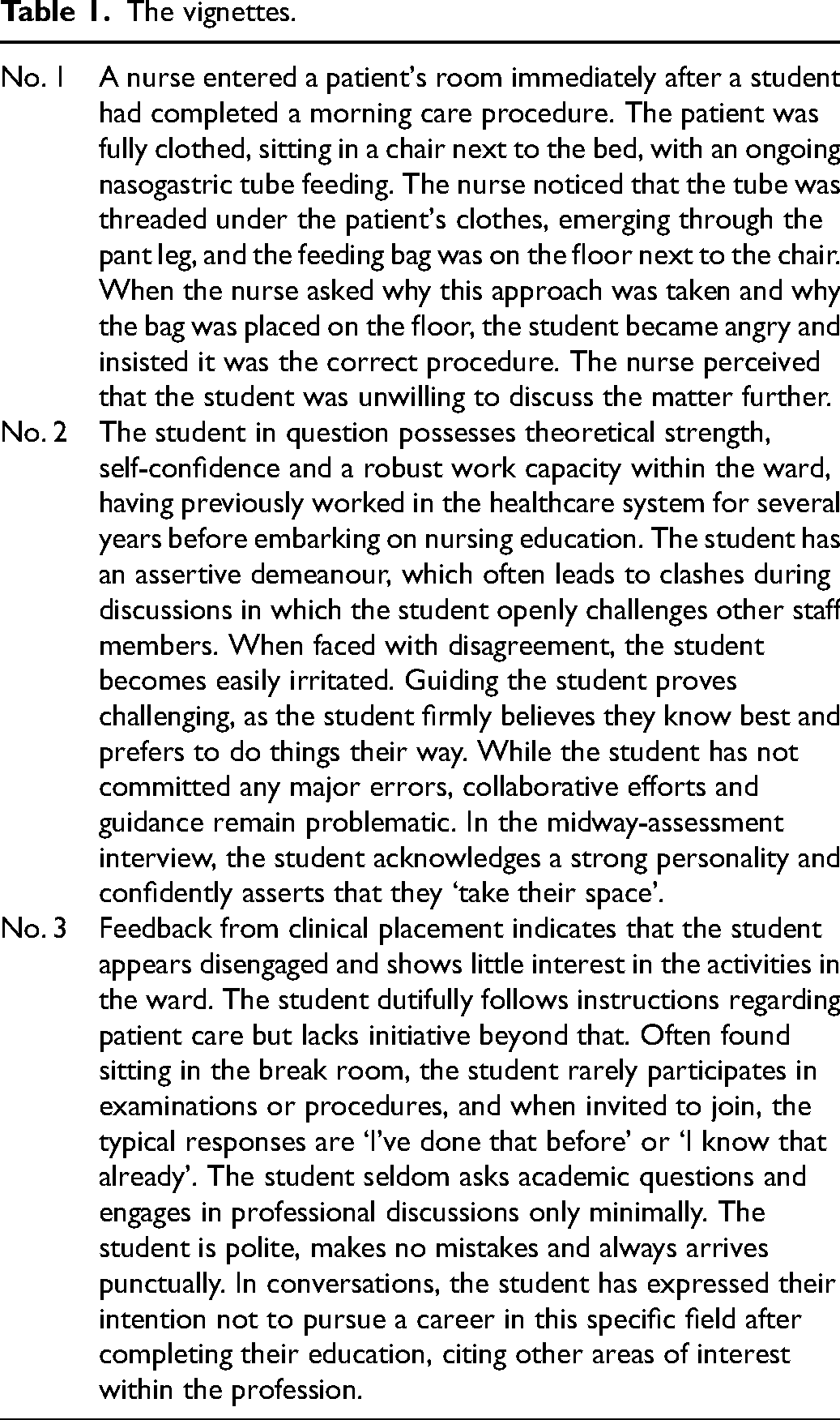
In this study, three vignettes were used to address how to assess and handle concerns from practice. Two of the vignettes (1 and 3) were developed based on findings derived from a recent study by Natterøy et al., 22 which identified borderline cases reported by mentors in clinical placement. Vignette 2 is based on the researchers’ own experience. In accordance with St Marie et al., the vignettes were validated. 29 First, an expert on suitability, an institutional suitability manager, provided critical feedback on the vignettes. Second, the vignettes were piloted in a focus group consisting of five nurse teachers from one university, which was conducted by first author in September 2023. The pilot interview confirmed the vignettes’ recognisability and function based on the interview guide. The pilot interview was not audio recorded or used as data material. However, impressions and notes from the interview were used as a ‘tuning fork’ during the analysis process as a form of validation. This is in accordance with Malterud, who states that what the researcher learns along the way is also empirical data that can be included in the development of knowledge. 30
Participants and setting
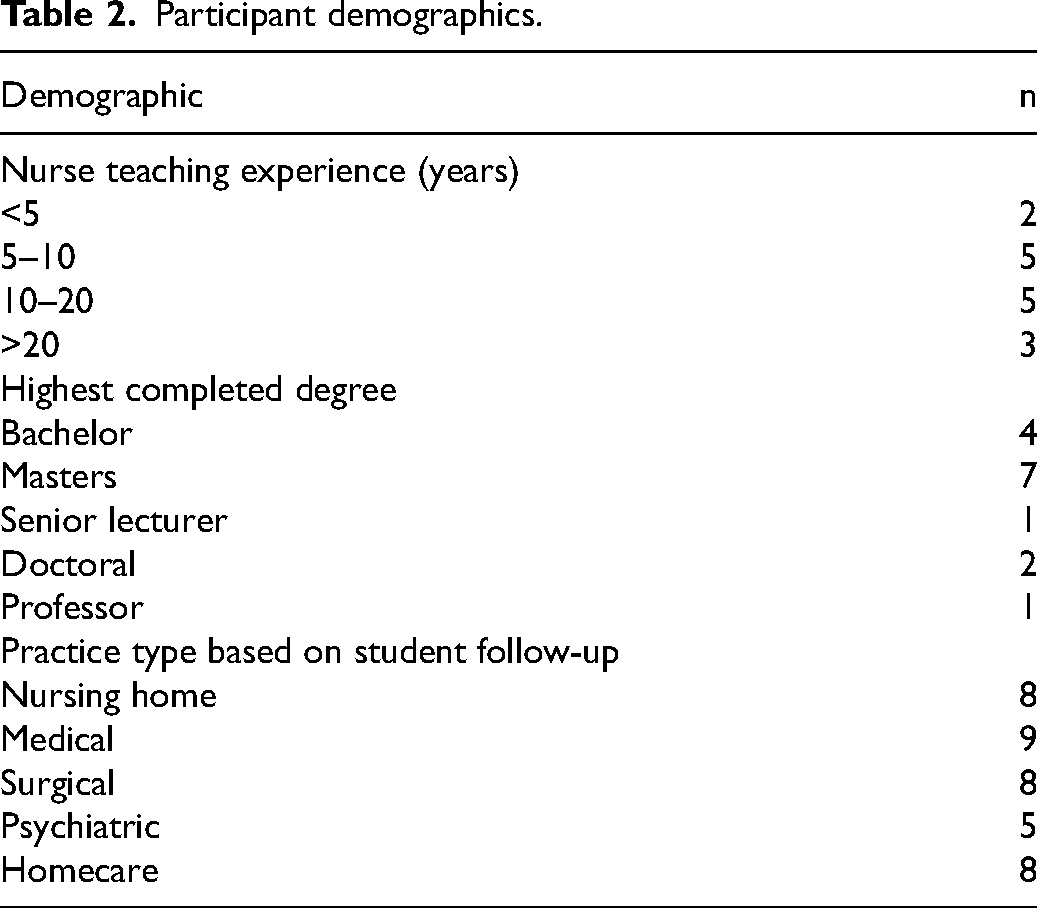
In this study, we included registered nurses with a minimum of 2 years of experience as nurse teachers. In total, 17 nurses agreed to participate. Due to acute illness, two nurses withdrew at short notice. Three focus group interviews were conducted, with five participants in each group. The participants included two men and 13 women, who were from one district and two urban campuses in Norway, separated by long geographical distances. All fields of clinical placements were represented. See Table 2 for demographic information. When recruiting participants, leaders among the institution's faculty were contacted to request their approval before interviewing their employees. At one university, a PhD student assisted in recruiting participants by asking their colleagues to take part. At two universities, the first author was given the names and email addresses of potential participants by their most direct leader and recruited them through email. Several potential participants declined invitation to participate due to lack of experience with suitability cases.
Participant demographics.
Data collection
The focus group interviews were conducted by the first author in October and November 2023, in designated meeting rooms at the participants’ institutions. Before beginning the interview, the participants were informed that the intent of the study was explore their experiences and opinions, not reach a consensus about what was right or wrong. All interviews lasted approximately 2 hours. They were audio recorded and then transcribed by the first author. During the first section of the interview, the participants were asked open-ended questions from the interview guide. During the last section of the interview, the vignettes were handed out on paper to each participant, one at a time, followed by questions from the interview guide.
The participants came prepared to talk about suitability; however, the vignettes contributed to new reflections and discussions. These vignettes were immediately recognised by some participants, while they were unrecognisable to some. The interviewer took notes under and immediately after the interviews, documenting instant impressions, dynamics and reactions. After conducting the interviews, the research team appraised the data and their information power, as proposed by Malterud et al. 31 We evaluated the data material as having high information power, as 1) it could answer the specific and narrow aim of the study, 2) the participants’ knowledge and experience were appropriate given the aim of the study, 3) it was sufficient in terms of supporting the analysis and conclusions, 4) the participants were active in the interviews, providing high-quality data, which was also enriched by the vignettes, and 5) there were sufficient data to perform a careful thematic analysis.
Analysis
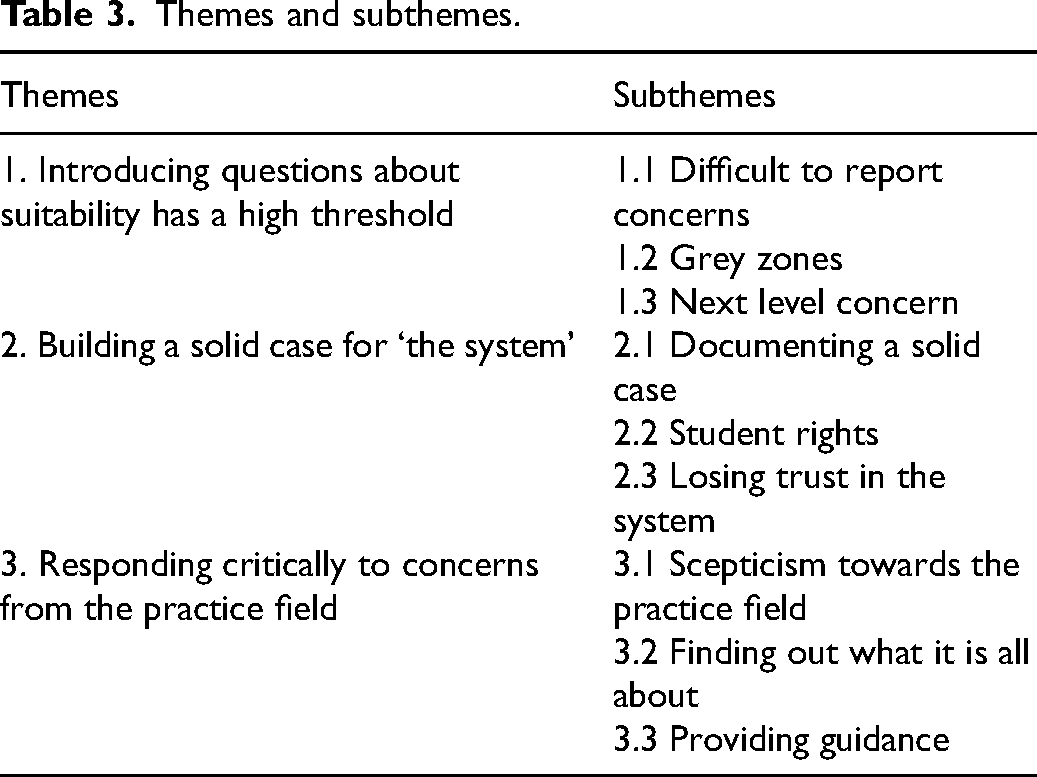
The data analysis was performed using Braun and Clarke's reflective thematic analysis. First, the authors became familiar with the data material by reading it. 32 In the process of coding the data, the first author, in close dialogue with the remaining authors, used NVivo software 33 to extract codes that were then organised in tables in Word. Though the interviews could be categorised as having two sections, those before and after the vignettes were presented, all the data were coded and analysed together. However, the research questions led the analytic work, and the vignettes contributed to answering the second research question. All authors were engaged in generating the initial themes and then developing and reviewing them. We did this by first discussing the codes in the tables and then continued to formulate them in writing. This was an analytic process of moving between the data material, tables and written text. During this process the authors had several meetings where this was discussed and developed. Ultimately, it allowed us to define and name the themes, resulting in six subthemes and three main themes. The first author wrote the preliminary report, which then was developed and finalised in close collaboration with the co-authors.
Ethics
The study was registered and approved by the Norwegian Centre for Research Data (no. 919712) and the faculties at the participants’ institutions. All participants were given written information about the study beforehand, along with information about the opportunity to withdraw at any time. Information was also provided orally before beginning the interview, and an opportunity to ask questions was provided. The participants were informed that the research team worked in nursing education at another institution. All data were anonymised, including identifying features of the student examples. Information about participants and research data were stored on a secure research server. The participants were urged to respect their co-participants and not disclose any information or experiences shared by the other participants in the interviews.
Results
Three themes and nine subthemes were identified in the data analysis (Table 3). At the beginning of the interviews, the nurse teachers spoke freely about suitability and their experiences with student cases. The concept of a suitability assessment was well known to all in terms of both the regulations and the procedures for reporting concerns. Suitability was frequently a subject at staff meetings, and specific cases were discussed with leaders or colleagues in private. The participants referred to the institutional suitability manager as a knowledgeable resource for advice or information.
Themes and subthemes.
Introducing questions about suitability has a high threshold
When asked about assessing suitability and reporting concerns, many described these as a huge and demanding responsibility. However, most participants expressed that this process eventually became easier, and some said that maturing in the role was a key factor in that regard. Many of the nurse teachers expressed that they had the students’ best interest at heart: ‘I think it comes more naturally for me to help them, rather than to say that it is not good enough, even though I know it's my damned duty’ (Focus Group 3, P13). Several used the word ‘courageous’ when describing what reporting students required of them. They reported numerous factors to call for courage, such as the emotional impact reporting students had on them, the fear of reactions from students in terms of treats or violence, the fear of feeling guilt and the fear of making the wrong decision.
Most nurse teachers found it difficult to decide between failing students during clinical placement and reporting concerns about suitability. Ultimately, many felt it was easier to fail students than report concerns about suitability, sometimes to protect one's own feelings: ‘It is easier assessing them academically because, there, you have some criteria that are much easier to relate to, and it doesn’t feel as personal’ (Focus Group 3, P14).
The participants referred to some cases as clear, often those involving drugs, threats or violence. They described other cases as unclear, and some used the term ‘grey zone’ cases to describe those. Such grey zone cases were described as challenging to assess, and many stated that it was difficult to say exactly what the problem was. Several highlighted the fact that reporting concerns about suitability was especially challenging when students were strong theoretically. Some reported challenges connecting their concerns to the criteria in the suitability regulations: One student had a bit stiff manner, a bit correct maybe. Did the procedures correct and asked good questions, but maybe not that empathic. Something wasn’t right, but it wasn’t that obvious. What should you pin it on, if you can use the phrase ‘pin it’? Something just wasn’t right. (Focus Group 2, P7)
The nurse teachers clearly remember the grey zone cases and continue to evaluate their decisions and approach years afterwards. In this context, some stated that, in retrospect, they should have reported concerns about suitability in several such cases: I had a third-year student that we found out didn’t show up for work, tried to sneak away, altered the shift plan. There were a lot of absences. We had many conversations with the student, which resulted in them failing clinical placement. But there were other things that should have been reported in terms of suitability concerns. I see that now. (Focus Group 2, P6)
Building a solid case for ‘the system’
Many emphasised the necessity of a solid case when reporting concerns. Otherwise, the case might fall through. The teachers highlighted the importance of providing substantial documentation, preferably with clear examples of misconduct or obvious breaches in proper behaviour. Some also experienced that the need for solid documentation gave rise to an ethical dilemma of choosing between waiting for clear examples to document and stopping students before any serious breaches occurred. I just have to wait because I have to have examples. I must let it go as far as possible so I can document it. If not, the student can say, ‘No, no, that didn’t happen.’ ‘Well, no, that is because I intervened.’ It is really difficult, that balance. (Focus Group 3, P12) They have a lot of rights, and they should have legal protection, but sometimes, I think that it doesn’t make sense. The fact that they get new chances and new chances, and every single loophole benefits the students. (Focus Group 2, P4) And I feel sick to my stomach that we are required to send them out into practice again because they should get another chance. I think it is a tremendous responsibility to allow people to go on in the practice field. (Focus Group 3, P11) One year later, the student was back again. There was no ruling. And then there was another round. Again, a year later, the student showed up in class. We lose all illusions that it works. Why do we even bother? (Focus Group 3, P15)
Responding critically to concerns from the practice field
In the data material, both before and after the vignettes were introduced, we identified that the nurse teachers approached reports from the practice field critically, emphasising the need to make their own enquiries. When the nurse teachers were presented with the vignettes, which represented student cases that mentors had described as borderline, most responded with a certain scepticism. They questioned the concerns and pointed to many potential challenges in the practice field: ‘Well, we expose them to all sorts of things in clinical placements’ (Focus Group 3, P15). Several highlighted the variation in the practice field, such as different workplace cultures and nurse shortages, with the latter being especially prevalent in nursing homes. The lack of resources in the practice field offers little time for mentoring, and some commented on the assessment grounds: How much have they actually seen? The basis for assessments isn’t always that good. Busy wards, large staff turn-over, sick leaves and changes in shift plans. In some periods, it can be hard for students to get follow-up. (Focus Group 2, P9)
What is their story, that nurse and that student? What kind of communication have they had leading up to this? Could it be that that the student experienced the mentor as critical all the time and the mentor picked at everything that could be picked at…? (Focus Group 3, P11)
When presented with student cases, a prominent principle that the nurse teachers talked about was to talk to the student and hear their version of the story. They would not react to reports from the practice field alone. They needed to investigate the situation themselves. Many stressed the importance of talking to the students alone, creating a safe space in which the students could elaborate on their perspectives. Several highlighted the necessity of being honest and direct in such conversations. As a reaction to the first vignette, one nurse teacher said, ‘This student might even have experienced another colleague working at that ward who did the same thing’ (Focus Group 3, P14).
As a response to the second vignette, another nurse teacher said the following: No major mistakes have been made, but cooperation and guidance are challenging. That can be due to many things. It can be the student, how the person appears and so on, but it could also relate to communication in general. What feedback has been given? (Focus Group 3, P15)
Some highlighted a tension in the vignette in which the student was very assertive: that it is good when students have opinions, express themselves, and are engaged. But at the same time, they must show the ability to regulate their emotions and adjust to the setting they are in. Many understood the need to allow students to make mistakes if they learned from them, showing the ability to correct their behaviour in accordance with guidance.
Discussion
In the following paragraphs, we discuss the nurse teachers’ experience with handling suitability assessments and concerns.
Nurse teachers’ conflicting roles and responsibilities
The findings shows that the nurse teachers experience conflicts concerning their roles and responsibilities; they aim to help students progress and succeed while also making evaluations according to set standards. The nurse teachers also experience having a responsibility towards the practice field, finding it morally challenging, to burden it with students who are not sufficiently safe to be there. Averlid and Salinas reported that the nurse teacher's role in supporting students in their learning is pedagogical and that they are also responsible for student assessments being fair and accurate. 9 The nurse teachers included in our study were committed to educating qualified students. The aim of the Norwegian suitability regulation is to ensure that students have the necessary prerequisites for safe practice. 3 Despite having in-depth knowledge about the regulation and their role in enforcing it, the nurse teachers included in our study expressed little concern about patient safety. Their understanding of their responsibility seemed to be directed at the students and clinical staff, not at patients. In a study about managing at-risk students during clinical placement, Rodger and Juckes reported on nurse teachers’ being concerned about patient safety, but that the focus of nurse teachers’ responsibility is students and mentors. 34
The nurse teachers were concerned with students having good clinical learning experiences, which is in line with Benner's apprenticeship model. Benner emphasised the importance of facilitation and mentoring students by creating supportive and challenging environments. 11 A central feature of the apprenticeship model is time, suggesting that knowledge and expertise are acquired over time through practical experience. 10 The nurse teachers were torn between mentoring and enforcing guidelines, which points towards a tension described in Benner's theory. They aim to nurture students’ development, but they occasionally consider reporting suitability concerns or, perhaps, sending underqualified students into the practice field. Knowing what to do and how to do it seems to be a core problem for nurse teachers in our study.
Handling concerns: nurse teachers’ critical approach
Our findings show that the nurse teachers were critical towards the information reported from the practice field. The nurse teachers are dependent on mentors’ observations because they themselves do not necessarily follow up on students closely and, therefore, may not be able to identify concerns about student suitability. 9 Research has indicated challenges related to communication between mentors and nurse teachers. It has been reported that mentors fear that the university or nurse teachers will overturn their decisions to fail students.35,36 The nurse teachers included in our study showed no sign of wanting to overturn the mentors’ assessment; rather, the nurse teachers take the mentors’ concerns seriously. However, the nurse teachers are determined to investigate the matter thoroughly themselves. By directing their attention towards the student, the concern is addressed immediately.
Many claimed that expressing concerns about suitability was a very serious matter and a potential intrusive reaction. As compared to doing so, failing students based on their academic and clinical performance is a less dramatic way to deal with students who create such concerns. This implies a high threshold for reporting concerns about suitability, which has also previously been proposed in research.1,13 We know by previous research that nurse teachers find it difficult to address underperformance on the part of students and possibly failing them.17,37 However, it is not a given that a high threshold for reporting concerns is a limitation. According to the Norwegian legislative regulation, the most important means of assessing suitability are the educational programme; formal demands, such as failing practice placements or exams; or other, informal means of action. 38 This suggests that reporting concerns about suitability is a final option after all other measures have failed. Consequently, we can understand the reluctance to report concerns about suitability and the choice to, instead, fail students as a legitimate way of managing suitability assessment. Requiring students to redo clinical placement prolongs their education, providing more time to form them into suitable candidates for the profession, which is in line with Benner's formation theory.10,11 However, there comes a point at which it is necessary to put one's foot down and report suitability concerns to shift the case onto a more formal track and potentially direct the student out of the nursing programme. This is where Benner's theory may be insufficient. The notion of students constantly being in a formation process is challenging in grey zone cases and does not necessarily provide guidance regarding when to stop those students. Nurse teachers experience suitability as ‘next-level’ serious, which may imply a suspicion that viewing students as being in a formation process is more of an excuse than a functioning perspective.
Writing reports and feeling frustrated
The nurse teachers experienced a strong demand for documentation in cases of suitability concerns. This is also recognised in previous research.14,39 The personal effects that reporting concerns had on the students seemed to be of importance. The nurse teachers expressed frustration towards the entire system. In the Norwegian system, when a suitability concern is reported, the sender is no longer part of the case. 38 It seems as if several participants in our study found that element stressful. When they did not receive any feedback on their documentation, they felt that there was no response to their efforts. Assessors who experience appropriate support felt enabled to successfully navigate the complexities of clinical assessment. 17 In our interviews, the nurse teachers referred to some cases from years ago, and they seemed to still ponder them. More information and feedback might be experienced as supportive after reporting concerns about suitability, reducing frustration and making the process more transparent for those who take on the responsibility of reporting concerns.
Limitations
During the recruitment process, several individuals declined to participate because of a lack of experience with handling suitability cases. The researchers’ impression was that these individuals declined because they believed the study aimed to interview nurse teachers with extensive experience in suitability cases and reporting concerns, which was not the case. Although they were informed that a variety of experienced teachers was desirable, many chose not to take part. This may have affected the results given that some participants may have had greater interest in the suitability theme than the average nurse teacher. However, in the interviews, there was variation in the experiences described regarding both being nurse teachers and handling concerns and the data material showed a diversity of perspectives.
When performing focus group interviews, it is recommended to have a moderator and an assistant moderator. 24 We originally planned to have two researchers attend the first interviews, but due to illness, one had to pass on short notice. However, because the interviews were planned and the first author had experience with performing interviews and leading group discussions, we decided to carry on as planned.
Conclusion
Suitability assessment is well known to nurse teachers. Assessing students affects nurse teachers on a personal level, and reporting suitability concerns is particularly challenging, as this is seen as serious and invasive. Questioning students’ suitability somewhat opposes the nurse teacher's main task of helping students to develop and progress through their education. When nurse teachers hear of concerns about students based on clinical placement, they feel compelled to investigate. A critical attitude towards reports from the practice field was revealed in this study. Nurse teachers take concerns from mentors seriously but emphasise the need to investigate independently. They address the problems and obtain the students’ version before guiding them forward. The nurse teachers are honest and direct in their approach, using mirroring and question strategies to stimulate students’ self-reflection and self-awareness. When assessing and potentially reporting concerns about students’ suitability, nurse teachers emphasised the need for providing substantial documentation, preferably with clear examples of misconduct or other breaches in behaviour. The need to build solid cases made them critical of the system, as they received no response to their efforts. Providing feedback to the nurse teachers after they report concerns might increase their motivation to conduct this type of work.
Supplemental Material
sj-docx-1-njn-10.1177_20571585241267741 - Supplemental material for Navigating concerns about students’ suitability: Exploring nurse teachers’ perspectives in a qualitative interview study using vignettes
Supplemental material, sj-docx-1-njn-10.1177_20571585241267741 for Navigating concerns about students’ suitability: Exploring nurse teachers’ perspectives in a qualitative interview study using vignettes by Cathrine Selsvold Natterøy , Bodil Tveit and Anne Raustøl in Nordic Journal of Nursing Research
Footnotes
Acknowledgements
The authors thank the participants for sharing their time and experiences.
Author contributions
Cathrine Selsvold Natterøy: Conceptualisation, methodology, investigation, formal analysis, writing—original draft. Bodil Tveit: Conceptualisation, methodology, formal analysis, review & editing, supervision. Anne Raustøl: Conceptualisation, methodology, formal analysis, review & editing, supervision
Declaration of conflicting interests
The authors declared no potential conflicts of interest with respect to the research, authorship, and/or publication of this article.
Funding
The authors received no financial support for the research, authorship, and/or publication of this article.

Supplementary material
Supplementary material for this article is available online.
References
Supplementary Material
Please find the following supplemental material available below.
For Open Access articles published under a Creative Commons License, all supplemental material carries the same license as the article it is associated with.
For non-Open Access articles published, all supplemental material carries a non-exclusive license, and permission requests for re-use of supplemental material or any part of supplemental material shall be sent directly to the copyright owner as specified in the copyright notice associated with the article.
