



Abstract
Nursing research plays a pivotal role in advancing healthcare practices and guiding the nursing profession. Given its global impact, understanding the unique characteristics of individual countries is important for identifying and comprehending the successful components of nursing research infrastructures. The aim of the present study was to analyze nursing research articles indexed as Swedish in the Web of Science Core Collection from the database's inception to the time of data collection. A search string was developed and employed to find relevant publications. Original research and review articles, indexed as Swedish and written in English, were included. Using a bibliometric and content analytical approach, evaluations of both research publications and their corresponding topics were conducted. A total of 7213 articles were included. The most prolific authors were part of extensive networks, as were the most productive higher educational institutes. International co-authorship made up 32% of all publications. The findings reveal comparably high productivity among Swedish nursing researchers, likely attributed to international collaborations as well as collaborations between universities and university hospitals. The research spanned diverse clinical and nursing-specific areas. The most cited articles focused on methodological or conceptual aspects. Current research topic trends encompass health literacy and telehealth/digital health.
Introduction
Nursing research plays a pivotal role in advancing healthcare practices, improving patient outcomes, and shaping the future of the nursing profession. Given the global impact of nursing research in general, it is important to explore the unique contributions of individual countries and particular infrastructures. 1 Sweden has emerged as a prominent contributor to nursing research, reflecting the country's progressive healthcare system that has had an early focus on person-centered care, evidence-based practices, and a holistic approach to healthcare delivery. 2 Although there has been a general increase in research output, there have been limited evaluations through large-scale bibliometric studies to discern the specific trends in the growth of research articles in Sweden. Bibliometric evaluations indicate that international collaboration in nursing research is primarily led by high-income countries, such as Sweden. Understanding and sharing successful elements that facilitate research in these countries are therefore important for global research equity. 3
In the mid- to late 1990s, there was a relocation of mid-length nursing programs from nursing colleges operated by county councils to Higher Education Institutions (HEIs) in the public sector. 4 This shift led to a stronger focus on conducting and publishing research in English. It also resulted in a more systematic rollout of PhD programs in nursing. The current nursing program in Sweden comprises 180 higher educational credits (equivalent to 3 years of full-time studies) and 25 HEIs provide the program. During the 2019/2020 academic year, over 4500 nursing degrees were granted, and approximately 16,000 students were actively enrolled in nursing programs. 5 Some of the largest HEIs within nursing include Umeå University, Uppsala University, Karolinska Institute, University of Gothenburg, and Lund University. In 2022, 30 individuals graduated with a PhD specifically in Nursing (not counting those with a nursing degree graduating with a PhD in other disciplines). Many, if not most, nursing PhD dissertations in Sweden have shifted from monographs to compilations, consisting of a couple of articles and a thesis frame. This structure for a PhD degree in nursing is not uniform across countries; in fact, PhD degrees in nursing differ substantially in terms of research and publication requirements. There are also global differences in requirements for academic faculty positions in HEI nursing departments, whether they necessitate PhD, MSc, or BSc level qualifications. 6
Through bibliometric analysis, a method using statistics to study academic publishing, the intention is to provide a comprehensive overview of certain key characteristics in Swedish nursing research. This bibliometric and content analysis will examine key studies, methodologies, and trends to inform the broader international nursing community. Although bibliometrics in nursing is emerging, there are identified gaps, including the underutilization of Big Data analysis. 7 While recent studies on nursing research have gained popularity, 8 this paper addresses a specific gap by focusing on a particular country, Sweden, known for a remarkably high per-capita nursing research output. 2
Methods
Bibliometrics, originating in library and information science, involves quantitatively analyzing publications to identify patterns, trends, and assess the impact of authors and institutes. Using a bibliometric analytical and mapping approach, research publications, citations, reference information, and article contents were evaluated. This process also involved creating networks based on citation and author analysis. 9
Search strategy
The corpus of publications used in this study was retrieved from the Web of Science Core Collection on 19 November 2023. See Table 1 for an overview of the search procedure. Web of Science was selected because it is an extensive and curated database aggregator, providing high-quality bibliometric information (e.g. various metadata parameters), with a generally low frequency of database errors and duplicated records, as well as comparably good coverage of nursing research. 10
Search strategy operationalized in Web of Science.
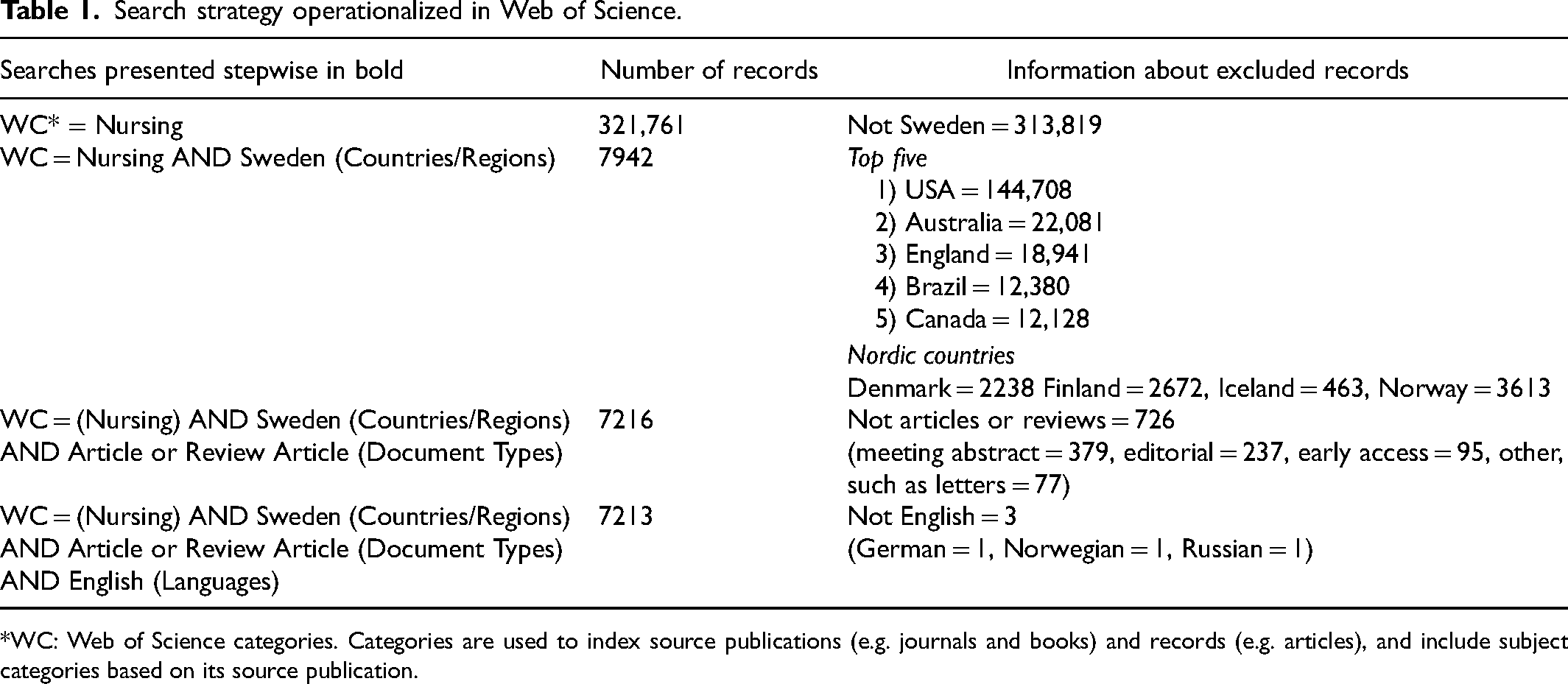
*WC: Web of Science categories. Categories are used to index source publications (e.g. journals and books) and records (e.g. articles), and include subject categories based on its source publication.
Data analysis
Before conducting the main analyses, the metadata quality of the obtained records was assessed. This involved scrutinizing for unidentified data (e.g. missing titles) and duplicate records. In addition, author and affiliated institute names were standardized to mitigate potential confusions relating to spelling of names, abbreviations, and initials. Bibliometric and content analyses were used to understand the published research articles. While bibliometric analyses focus on the bibliographic data (e.g. numeric data, such as publication year, number of publications, citations), quantitative content analyses were used to evaluate commonly used words or terms indicating research areas, topics, and methodological approaches. Quantitative content analysis has a long tradition in bibliographic and media research.11,12
As such, several metadata parameters, on various levels, were used. For corpus-level analyses, the total number of publications and the total annual publication growth rate were assessed. The total annual publication growth rate quantifies the yearly percentage variation in the number of publications during a specified timeframe. 13 For document-level analysis, article titles, abstracts, keywords, publication year, citations, and references were used. Citations and author names, as well as affiliated institutes, were used to analyze networks and clusters, elucidating social and intellectual knowledge structures.
For content analyses, besides ‘Author keywords’, ‘KeyWords Plus’ were used, which consist of terms or phrases that frequently appear in the titles of a record's references. They are assigned through a special algorithm in the Web of Science. In the absence of keywords, noteworthy words can also be extracted from article titles or their abstracts. These analyses contribute to the understanding of the conceptual knowledge structure, as the might indicate prevalent or emerging research topics. The analysis of abstracts, keywords, and titles has shown to be a valuable approach for uncovering variations in nursing research topics. 8
Bibliometrix was used for analyses. It is an R statistical programming language package designed for research in bibliometrics, which involves graphing, mapping, and analyzing scientific research output on various levels (e.g. author, publication, and institution level). 14 The biblioshiny app in bibliometrix was used to create graphical and visual representations of data. In the field of bibliometrics, visual presentations are considered particularly important, as it increases accessibility as well as accuracy by avoiding reducing data into oversimplified data points. 15
Results
Of the 7,213 included records comprising the corpus, the completeness of bibliographic metadata was deemed suitable for bibliographic analyses. The records were published between the years 1978 and 2023. The annual publication growth rate during this period was just over 14% (14.33%). The number of articles first started to markedly increase in the mid-1990s, with a few more notable increases in 2005 and then in 2012 (see Supplementary Figure 1). The included articles were published in 157 different journals. The top three journals where most of the articles were published were the Scandinavian Journal of Caring Sciences, the Journal of Clinical Nursing, and the Journal of Advanced Nursing. These journals also exhibit a continued upward trend, indicating a sustained increase in publications from Swedish nursing scholars.
Authors, affiliations, and networks
In total, 10,224 individual authors were represented in the corpus. The average number of co-authors per article was approximately 4 (3.96), and only 299 (4.1%) articles were authored by a single individual. Assessing scholars individually based on their frequency of appearances as authors or co-authors, it was found that among the top 10 most prolific authors, six were women and four were men. International co-authorship constitutes almost one-third (32.18%) of all documents. In addition, most of the top prolific authors were themselves affiliated with institutes outside Sweden, such as the most and second most prolific authors, with neighboring country Norway, and the third most prolific author with Australia and the Netherlands. Analyzing international collaborations, most collaborations appear to occur in Europe (Figure 1). Seven out of the top 10 collaborating countries are in Europe, with Norway ranked first. The second and third most frequent countries, however, are the USA and Australia.
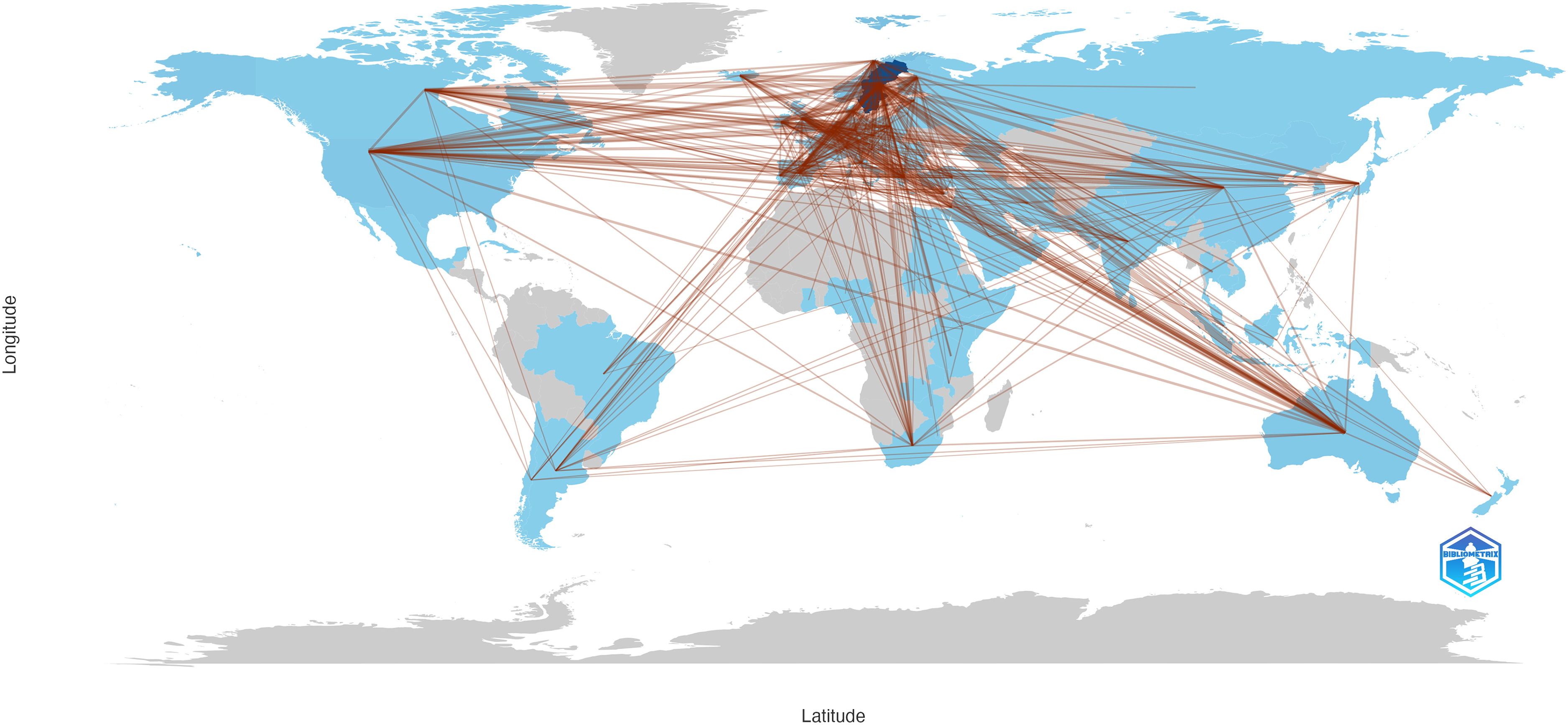
Country collaboration map. Showing the most frequently collaborating countries for Swedish-based or Swedish-affiliated nursing researchers.
The frequency distribution of affiliated institutes (i.e. for all authors, including co-authors, for each paper) showed that the most common HEIs were in order: Karolinska Institute, Gothenburg University, and Linköping University. These institutes exhibited a continued general upward trend. As depicted in Figure 2, various clusters of collaborating networks exist both within and across institutes. The two major nursing research institutes – the Karolinska Institute (brown cluster) and the University of Gothenburg (green cluster) – collaborate extensively with their respective university hospitals, namely Karolinska University Hospital and Sahlgrenska University Hospital. The network map also reveals dense collaborations among institutes in close geographic proximity. For the Karolinska Institute, examples include collaborations with institutes in the Stockholm or Uppsala area (e.g. Uppsala University Hospital, Sophiahemmet University). Similarly, for the University of Gothenburg, many collaborating institutes are proximally located within western Sweden (e.g. University West, University of Borås).
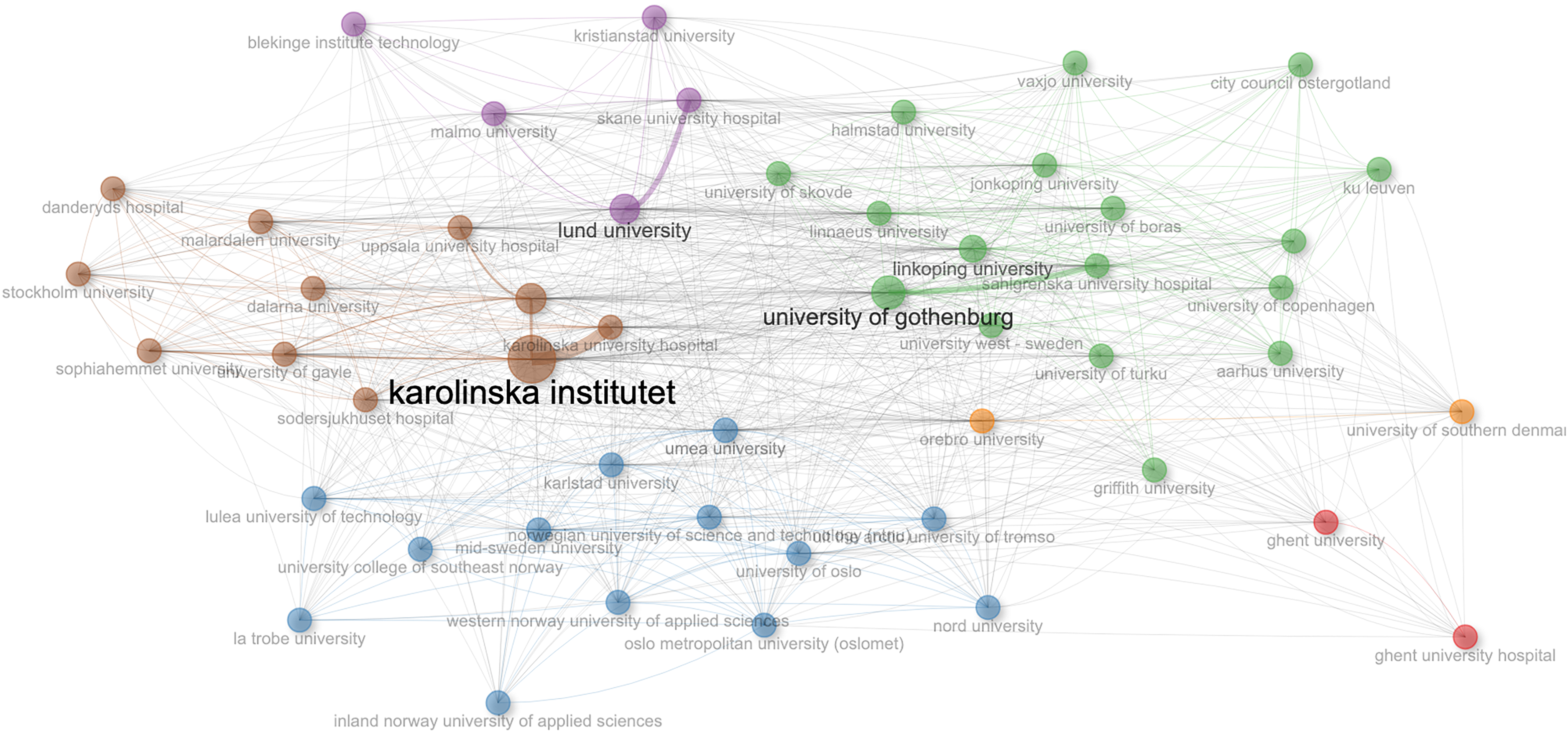
Collaborating networks. Based on authors affiliated institutes. Limiting network to 50 nodes and using Walktrap as clustering algorithm.
Articles and research topics
Of all 7,213 included articles, the most globally cited article (i.e. the number of citations received from other publications indexed in Web of Science) is, by a significant margin, an article by Graneheim and Lundman published in 2004 describing the concepts and procedures pertaining to conducting qualitative content analysis. 16 At the time of data collection, the article had been cited 10,724 times by other publications in Web of Science. This can be compared to the second most cited publication, which had been cited 1346 times. Interestingly, the top five articles were all methodological or conceptual in scope. The top two were about qualitative content analysis,16,17 the third most highly cited was about a phenomenological hermeneutical method for researching lived experiences. 18 The fourth was about the person-centered care concept and its philosophical underpinnings, 19 and the fifth about a theory of self-care in the context of a chronic illness. 20
To shed light on prevailing research areas and themes, co-occurrence networks were constructed using common terms identified from article titles or the titles of referenced articles. Within these networks, clusters emerged based on the frequency of terms appearing together (i.e. co-occurring). The initial map, derived from terms in the titles of referenced articles (Supplementary Figure 2), revealed three clusters. The second map, based on terms from the articles’ titles (see Supplementary Figure 3), unveiled five clusters. The maps exhibited overlap, collectively indicating that significant concepts in the research were associated with care and caring (co-occurring with terms like ‘experiences’), patients (co-occurring with terms like ‘pain’), nursing (co-occurring with terms like ‘clinical’ and ‘students’), and evaluation (co-occurring with terms like ‘assessment’ and ‘scale’). Moreover, the first map distinctly showcased a primary research focus on midwifery, as central interconnected terms included ‘pregnancy’, ‘childbirth’, and ‘birth’.
The evolution and transformations within research concepts and topics over time involved evaluating prevalent article keywords per year. As depicted in Figure 3, during the period spanning the late 1990s to the early 2000s, terminology associated with specific illnesses or diseases, such as ‘carcinoma’, ‘AIDS’, ‘dysphagia’, and ‘lower-back pain’, was conspicuous. This prevalence may not only reflect temporal conceptual trends but also be attributed to the concentration of influential researchers and research groups within the field of Swedish nursing research. During this period, a lack of extensive research activities allowed a select few researchers to exert significant influence on the prevailing research landscape, some of whom focused specifically on certain conditions. Around the same time, there were concepts and phrasings that might now seem outdated, such as ‘moral development’ and ‘demented patients’.
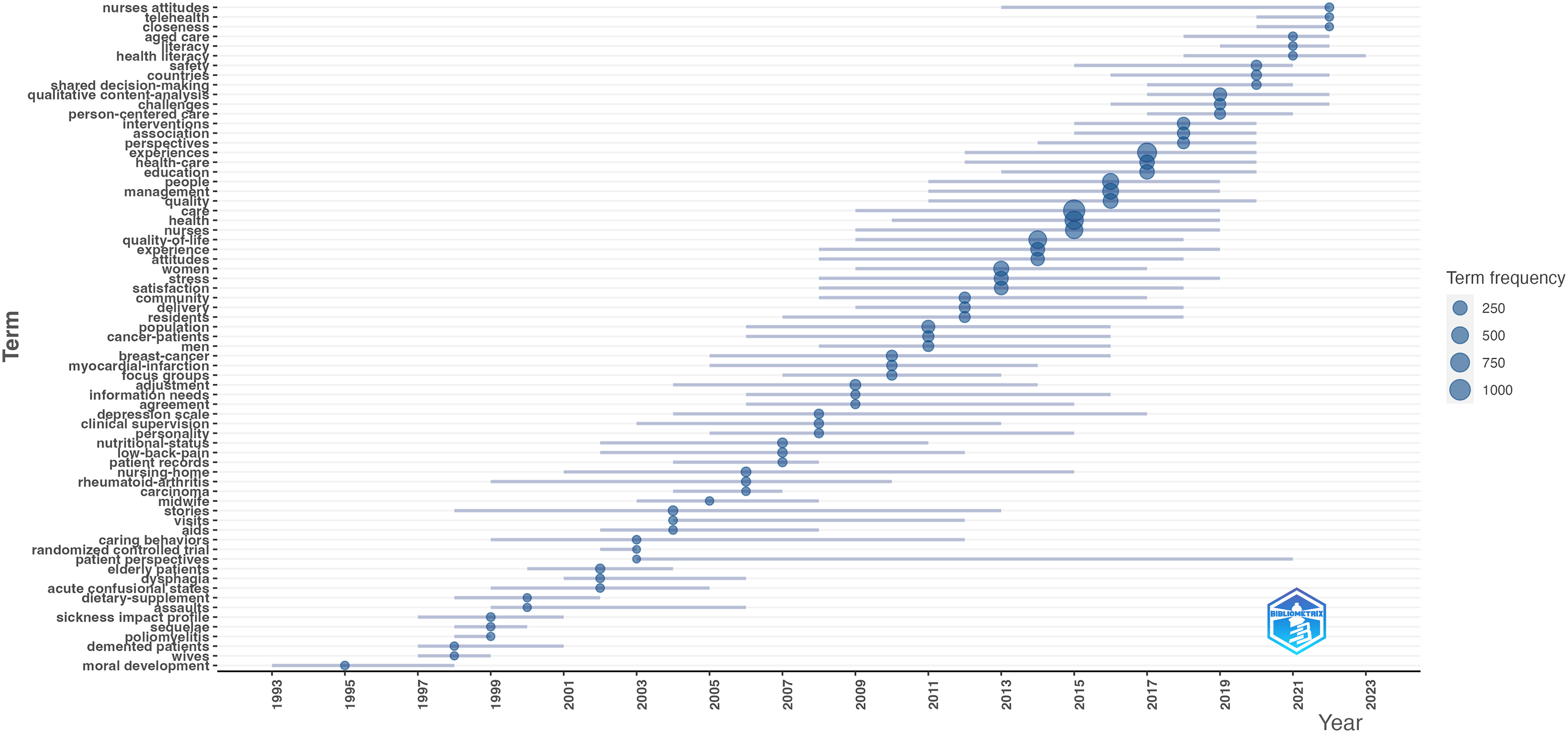
Trend topics as expressed by KeyWords Plus.
Subsequently, between 2010 and 2013, there was a shift in focus towards concepts such as ‘quality of life’, ‘stress’, and ‘satisfaction’. This shift reflected studies that concentrated on developing self-rated quality-of-life instruments in various nursing practice areas, as well as a heightened emphasis on nurses’ working conditions.
In more recent years, approximately between 2020 and 2023, frequent terms included ‘literacy’, ‘health literacy’, and ‘telehealth’. This indicates an evolving research landscape, showcasing a growing interest in these areas within the context of Swedish nursing research (see Figure 3).
Discussion
The aim of the present study was to analyze nursing research articles published and indexed as Swedish in the Web of Science Core Collection from the database's inception to the time of data collection. Consequently, characteristics of Swedish nursing research publications – such as author and institute collaborations, journals, and citations – were identified, revealing publication patterns related to prolific authors and institutes, between-country cooperation, research content, and trending topics. Overall, the results show a steady increase in nursing research output from Sweden since the mid-1990s. This corresponds to the shift in the mid- to late 1990s when the then nursing colleges were transformed into HEIs operating under the public sector. 4
Swedish nursing researchers tend to be relatively productive, considering per-capita research output, with nearly the same number of articles as the other Nordic countries combined. Collaboration appears to contribute to research output, as only 299 (4.1%) of all articles were authored by a single individual. This finding is not surprising, given that nursing is closely aligned with the field of medicine, and collaborative research practices are more common. This is in contrast to disciplines like humanities, where the tendency to have fewer authors per article is a more common practice. 21
National collaboration, and even more so, international collaboration, appeared to be a key factor contributing to research output. The countries with the most collaborations were Norway, the USA, and Australia. This aligns with research indicating extensive international collaboration among the top productive countries and may be attributed to the higher citation rates of internationally authored publications compared to those authored by individuals from a single country. 22 While there are different methods to assess the influence of publications in research and within a specific research field, the most direct measure of impact remains citations. 23
The top five articles were all methodological in nature, delineating analytical procedures or discussing conceptual issues. This goes in line with research showing the existence of silos in nursing research, i.e. such that topic-specific studies might be less cited as they tend to stay within specific disciplines (e.g. mental health nursing). 24 Methodological articles have a larger potential reach, within the realm of nursing researchers, but even outside of it, if the method employed is valued also by researchers in general.
The results showed that among the top five most common publications, two had notable ties to Sweden as their founding editors and current editor-in-chiefs were based in Sweden, namely the Scandinavian Journal of Caring Sciences and the International Journal of Qualitative Studies on Health and Well-being. In addition, the Journal of Advanced Nursing (JAN) was one of the most frequent journals in the corpus, which is noteworthy as it is ranked as a top-tier nursing journal. This aligns with previous research, indicating that some of the most prolific nursing researchers tend to publish in top-tier journals. 25 Nevertheless, in this study, publishing in JAN appeared to be experiencing a somewhat declining trend relative to the more pronounced increase observed for the other most frequent journals.
A successful element promoting research dissemination could be found in the current Swedish nursing PhD programs, typically structured as article-based compilation dissertations. Recent research indicates a growing global trend favoring manuscript-based doctoral dissertations. 6 These programs play an important role as platforms for honing research skills and disseminating study findings on an international scale.
Moreover, nurses with a PhD not only contribute to academia but can also enhance clinical environments. They advance evidence-based practices, and design and deliver clinical training, thereby elevating overall clinical standards. 26 Notably, this study reveals substantial clinical involvement among the largest author-institute networks, demonstrating that the most prolific HEIs collaborated extensively with their respective university hospitals.
The results revealed distinct knowledge domains within the research output. One domain related to providing care for patients, emphasizing personal experiences, health, support, as well as specific disorders and symptoms, exemplified by oncology nursing, cardiovascular nursing, and pain management. Another domain pertained to midwifery and childbirth. This is not surprising, as in Sweden, one must first become a registered nurse (graduating with a BSc in nursing) and then pursue advanced-level education to become a midwife. Consequently, most midwives have a nursing background. The findings underscore that midwives in Sweden constitute an authoritative profession responsible for midwifery research and development. They operate autonomously, delivering care throughout the stages of pregnancy. 27
Another domain highlighted nursing profession-specific aspects, featuring terms relating to clinical and practice-oriented aspects, along with words associated with educational aspects such as students. 28 In addition, there was an area dedicated to methodological aspects of evaluations, incorporating terms such as scale, psychometric, and questionnaire. Nursing researchers in Sweden appear to frequently conduct evaluations of translated instruments and scales. Further, in some of the studies, focus was on instruments developed by Swedish researchers, one example being the Person-Centered Climate Questionnaire. 29
Research trends indicate that earlier studies were disease-specific, the second wave focused more on quality of life and nurses’ job satisfaction, and more recent developments revolved around telehealth and health literacy. These findings align with previous research. A bibliometric analysis, evaluating six specific nursing journals, revealed that nurses’ working conditions were a hot topic during the time corresponding to the second wave in the study’s corpus, i.e. around the years 2012–2013. 25 A study evaluating global nursing research showed that quality of life and nursing education were indeed common topics between 2009 and 2020. 3 The focus of recent Swedish nursing research on telehealth and health literacy is also in line with a general shift in healthcare, moving away from a focus on urgent and emergency care towards health prevention and promotion. 5
Strengths and limitations
The present study has some limitations. First, employing alternative bibliographic databases such as PubMed might have yielded somewhat divergent results due to variations in indexed journals, differences in subject/discipline categorizations, and standards for country and affiliated institution names. 30 Still, within the Medline databases, including PubMed, the absolute coverage rates are generally comparable, and observed variations can primarily be attributed to the updating speeds of specific database providers.10,31 However, Web of Science might have certain limitations when it comes to identifying the oldest (i.e. earliest) research publications.13,32 Still, this study did not focus on records published before 1978 (the earliest record in this study), and such publications would likely not influence the general tendencies and main findings of this study.
It should be mentioned that the Scopus database was also considered. However, initial comparisons between bibliographic records in Web of Science and Scopus regarding nursing research categorized as Swedish showed that Scopus seemed to have a less precise approach as several authors who were listed as the most prolific within ‘nursing’ were in fact not in nursing but in other fields (particularly nutrition). 32 Furthermore, a lesser-known fact is that specific database coverages can also vary depending on the particular institutional subscription. 10 Thus, since only one institutional account was used for this study, it is possible that somewhat, albeit probably only slightly, different results in terms of identified bibliographical records could have been obtained. In addition, the content analysis concentrated exclusively on abstracts, keywords, or titles of information sources. Consequently, the findings could have been different if complete publications (article files) were used for analysis. Although the content analysis aimed to reduce interpretative bias by primarily employing descriptive and visual methods, there remains a possibility of some bias influencing the outcomes. 30
Implications
The contribution of this study lies in the potential transferability of identified successful Swedish nursing research patterns to other countries and contexts. As the global healthcare landscape evolves, a nuanced understanding of successful research paradigms becomes imperative for nurses and healthcare professionals seeking to implement evidence-based practices. Although the quantity of research articles has increased steadily, including in the most recent years, more focus could be placed on improving the quality. Moreover, this study contributes to the ongoing dialogue surrounding nation-specific and cultural influences on nursing research, promoting cross-cultural collaboration, thereby enriching the global discourse surrounding nursing research.
Conclusions
This study indicates that Swedish nursing researchers are highly productive, considering the size of the country. Success factors include extensive national and international collaborations. The national commitment to research and innovation, initiated in the mid- to late 1990s and evidenced by publicly funded research studies, seems to have fostered a relatively stable environment for nursing scholars. This has contributed to a dynamic field that offers valuable insights into patient care, domestic and international collaboration, and the evolution of nursing practice. Findings also reveal that Swedish nursing research has been conducted in various clinical and profession-specific areas, employing a range of different methodologies. Notably, the most globally cited articles were all focused on methodological or conceptual aspects, such as qualitative data analysis and the concept of person-centered care. Current research trends include topics such as health literacy and telehealth/digital health.
Supplemental Material
sj-png-1-njn-10.1177_20571585241227583 - Supplemental material for Swedish nursing research: A bibliometric and content analysis revealing author and institute collaborations, impact, and topics
Supplemental material, sj-png-1-njn-10.1177_20571585241227583 for Swedish nursing research: A bibliometric and content analysis revealing author and institute collaborations, impact, and topics by Christopher Holmberg in Nordic Journal of Nursing Research
Supplemental Material
sj-png-2-njn-10.1177_20571585241227583 - Supplemental material for Swedish nursing research: A bibliometric and content analysis revealing author and institute collaborations, impact, and topics
Supplemental material, sj-png-2-njn-10.1177_20571585241227583 for Swedish nursing research: A bibliometric and content analysis revealing author and institute collaborations, impact, and topics by Christopher Holmberg in Nordic Journal of Nursing Research
Supplemental Material
sj-png-3-njn-10.1177_20571585241227583 - Supplemental material for Swedish nursing research: A bibliometric and content analysis revealing author and institute collaborations, impact, and topics
Supplemental material, sj-png-3-njn-10.1177_20571585241227583 for Swedish nursing research: A bibliometric and content analysis revealing author and institute collaborations, impact, and topics by Christopher Holmberg in Nordic Journal of Nursing Research
Footnotes
Conflict of interest
The author declares that there is no conflict of interest.
Funding
The author received no financial support for the research, authorship, and/or publication of this article.

Supplemental material
Supplemental material for this article is available online.
References
Supplementary Material
Please find the following supplemental material available below.
For Open Access articles published under a Creative Commons License, all supplemental material carries the same license as the article it is associated with.
For non-Open Access articles published, all supplemental material carries a non-exclusive license, and permission requests for re-use of supplemental material or any part of supplemental material shall be sent directly to the copyright owner as specified in the copyright notice associated with the article.


