



Abstract
Registered nurses with a doctoral degree are important for the quality of care, nursing education, and nursing research. Still, postgraduate career paths are criticized for being too vague. To enable career path development, mapping of the current situation appears fundamental. The objective was therefore to chart the current professional positions and work conditions and to explore the future career aspirations of registered nurses with a doctoral degree in Sweden. A cross-sectional survey study was conducted including 118 participants, all nurses with a doctoral degree earned between 2016 and 2022. This study is reported in accordance with STROBE. The participants reported a significant change from hospital-based positions before doctoral studies, towards university-based positions after graduation. This is clearly in contrast to their expressed aspiration to hold a shared position, remaining in contact with the clinical context. In conclusion, a national collaboration is needed and wanted regarding career opportunities for registered nurses with a doctoral degree in Sweden. Furthermore, career paths within nursing science need to be established within the clinical context.
Introduction
Over the past two decades, the number of registered nurses (RNs) holding a doctoral degree (PhD) has increased. 1 After graduation, nurses with a PhD have multiple career options.1,2 For example, they may pursue an academic career within a university-based position or a hospital-based clinical career, or a combination of the two (shared position). Further, nurses with a PhD may pursue careers as experts or managers in the governmental or private sectors. Regardless of which of those careers they pursue, they contribute with clinical nursing expertise and a nursing perspective. For instance, hospital-based nurses with a PhD contribute with scientific knowledge to the design and implementation of evidenced-based care. 1 In addition, they can serve as a resource and mentor for other RNs and healthcare professionals, as well as for patients and relatives.1,3,4 As for university-based nurses with a PhD, they are crucial for the education of nurses and for producing nursing research that is meaningful for the care provided.3,4 Significantly, nurses with a doctoral degree who have a shared position between clinic and university are described as an important bridge between the two by implementing research in practice while simultaneously applying clinical expertise to university-based pursuits. 2
Despite the multiple career options for RNs with PhDs, postgraduate career paths for nurses with a PhD have been criticized for being vague or even non-existent,5–8 in particular for RNs with a PhD aspiring to a shared position.2,8 In comparison with medical doctors and dentists, whose clinical academic trajectories are well established, with research possibilities embedded in their career development, 2 studies show a shortage of career opportunities and postdoctoral positions in accordance with the desires of nurses with a PhD.6,7,9 Further, there is a lack of visible academic leadership and organizational support within the clinical context, outside university,6,10 as well as a lack of academic culture and mentoring. 11 This, and the absence of career paths combining hospital- and university-based work, has been reported as a reason why hospital-based nurses with a PhD stop undertaking research after graduation.3,11 In addition, it might lead to feelings of anxiety during their PhD studies about having to move away from clinical work, in order to pursue their academic ambitions. 1 Similarly, university-based nurses with a PhD feel that their competence does not clearly benefit patients. 8 Instead, they would have wanted to develop and improve the clinical care for the patient through the parallel advancement of their academic and clinical skills. As a result, a clarification of what possible career paths there are, as well as the development of those career paths, has been requested in order to fully make use of the resources that nurses with a PhD possess within clinical nursing expertise and education in nursing research. 1 This is important, not only for the specific nurses, but also for the quality of care, the nursing education, and nursing research, as well as for the nursing profession. 3
In Sweden today, the number of RNs holding a PhD degree is approximately 1,700, which is not more than 1% of the nursing workforce. So far, there is neither any registration of, nor any overview describing the career paths of RNs with PhDs in Sweden. In addition, the possibilities of postgraduate career paths for nurses with a PhD are still undefined on a national level, which makes the development of such career paths difficult. Therefore, the objective of this study was both to chart the current professional positions and work conditions and to explore the future career aspirations of registered nurses with a doctoral degree in Sweden.
Method
The present study was designed as a cross-sectional study to explore current positions and future career aspirations among RNs that earned their PhD degree between the years 2016 and 2022 from Swedish universities. The checklist for strengthening the reporting of observational studies in epidemiology (STROBE) was used to assure the method and analysis. 12
Questionnaire
A digital questionnaire was developed by the authors for the purpose of this study in order to chart current professional positions and work conditions as well as the sociodemographics of the participants. The questionnaire was constructed and distributed using Sunet Survey at Malmö University and consisted of 13 questions with both multiple choice and free-text responses. The questionnaire was discussed within the research group and pre-tested by two nurses with a PhD during the development stage, for continuous feedback.
Participants and recruitment process
For RNs to be included in the study, their dissertations should be listed in the national register provided by the Swedish Society of Nursing (www.swenurse.se) and have been published between the years 2016 and 2022. The recruitment and inclusion process were divided into three steps. In the first step, during 2022 (the last version of the list was drawn on 19 September 2022), 527 names were identified from the national register. As the register possibly included different healthcare professionals (not RNs) with dissertations relevant for healthcare sciences, a review of the names was done manually by the authors, in the second step, to identify RNs on the list and to further search for contact details.
Not owing to the inclusion criteria, 253 names were excluded in step 2 (Figure 1). In all, 274 persons were invited to participate in the study and 143 persons completed and returned the questionnaire. In the third step, another 25 were excluded due to the exclusion criteria (e.g. not being a RN), as stated by themselves in the survey, leaving a total of 118 persons included in the study (response rate of 43%).
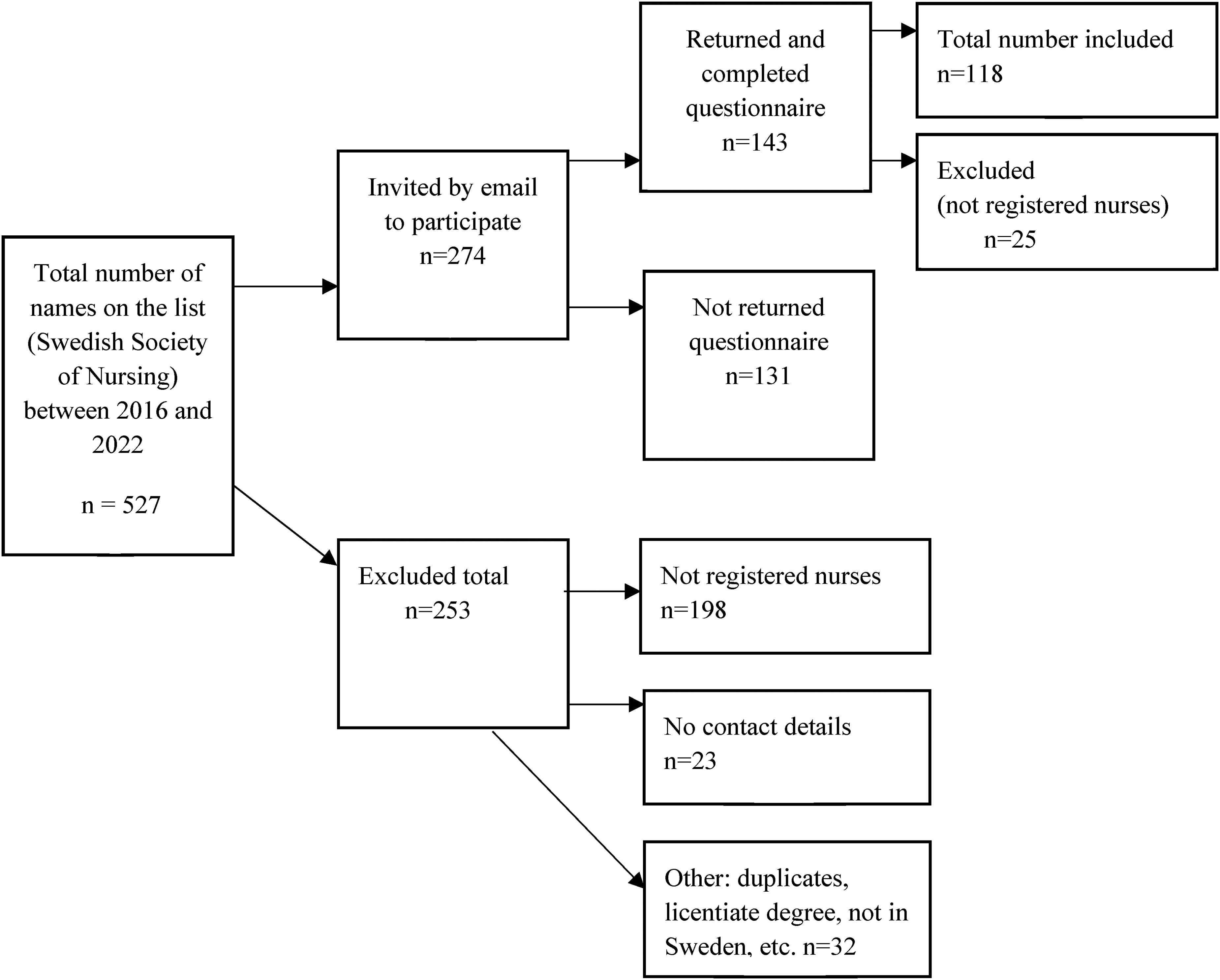
Flow chart of the recruitment and inclusion process.
Data collection
The RNs with PhDs eligible for the study were contacted by email with information about the study and a link to the survey, during October 2022. Three reminders were sent out, after 1, 2, and 4 weeks, to the non-responders.
Data analysis approach
The characteristics of the participants with professional positions and work conditions were analyzed with descriptive statistics. Frequencies and percentages were calculated for categorical variables. Continuous variables were calculated as range, mean, and standard deviations. To analyze changes in proportions for nominal data, the non-parametric McNemar chi-square test was used, and a p value < 0.05 was considered statistically significant. The statistical calculations were done with the Statistical Package for the Social Sciences (SPSS version 27; IBM Corp., Armonk, NY, USA). A free-text analysis was done manifestly, inspired by summative content analysis, 13 to find patterns and describe different meanings in the material. Two of the authors analyzed the answers separately, followed by discussion and revision between them. The result was then reviewed and discussed within the whole group of authors.
Ethical considerations
Information about the study, including the study aim and purpose, was given to participants in writing before entering the survey. The participants were also informed that all responses were anonymous, that no personal identifiable data would be collected, and that, once submitted, their responses could therefore not be withdrawn. The information text ended with a statement that participants, by beginning the survey and entering their answers, automatically consented to the use of their submitted replies in the study. An advisory opinion was sought from the Swedish Ethical Review Authority, and no ethical approval was needed (Reg. No. 2022-02251-01).
Results
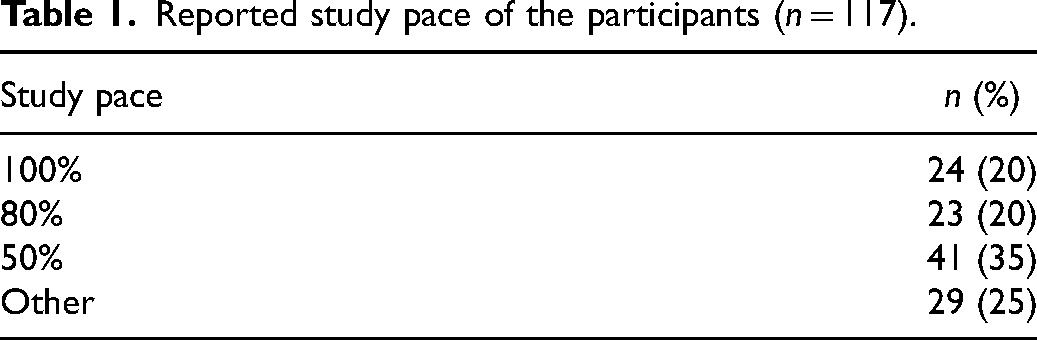
A total of 118 individuals from the national register reported being RNs and having a PhD within nursing care or health science and were thus included in the analysis. The participants had a mean age of 51 years (SD 8.1, range 33–79) and 105 (89%) were women. There were different study paces, with half-time studies being most frequently reported, although 80% and 100% were almost equally distributed (Table 1). The participants reported having earned their degree at 17 different universities in Sweden, distributed from Umeå in the north to Malmö in the south, the distribution thus being nationwide.
Reported study pace of the participants (n = 117).
Employment before, during, and after PhD studies (Figure 2) was divided differently at the separate time points, with a decreasing number having hospital-based positions after doctoral studies than before. In contrast, the trend towards university-based positions was increasing and almost doubled in percent, indicating a transfer towards such positions for the RNs after obtaining the doctoral degree. Positions reported as ‘other’ among the nurses were positions such as leaders, within care or project development, or patient safety coordinators. A few also reported working at a national level after graduation, for example at the National Board of Social Affairs and Health or with the public health authorities.
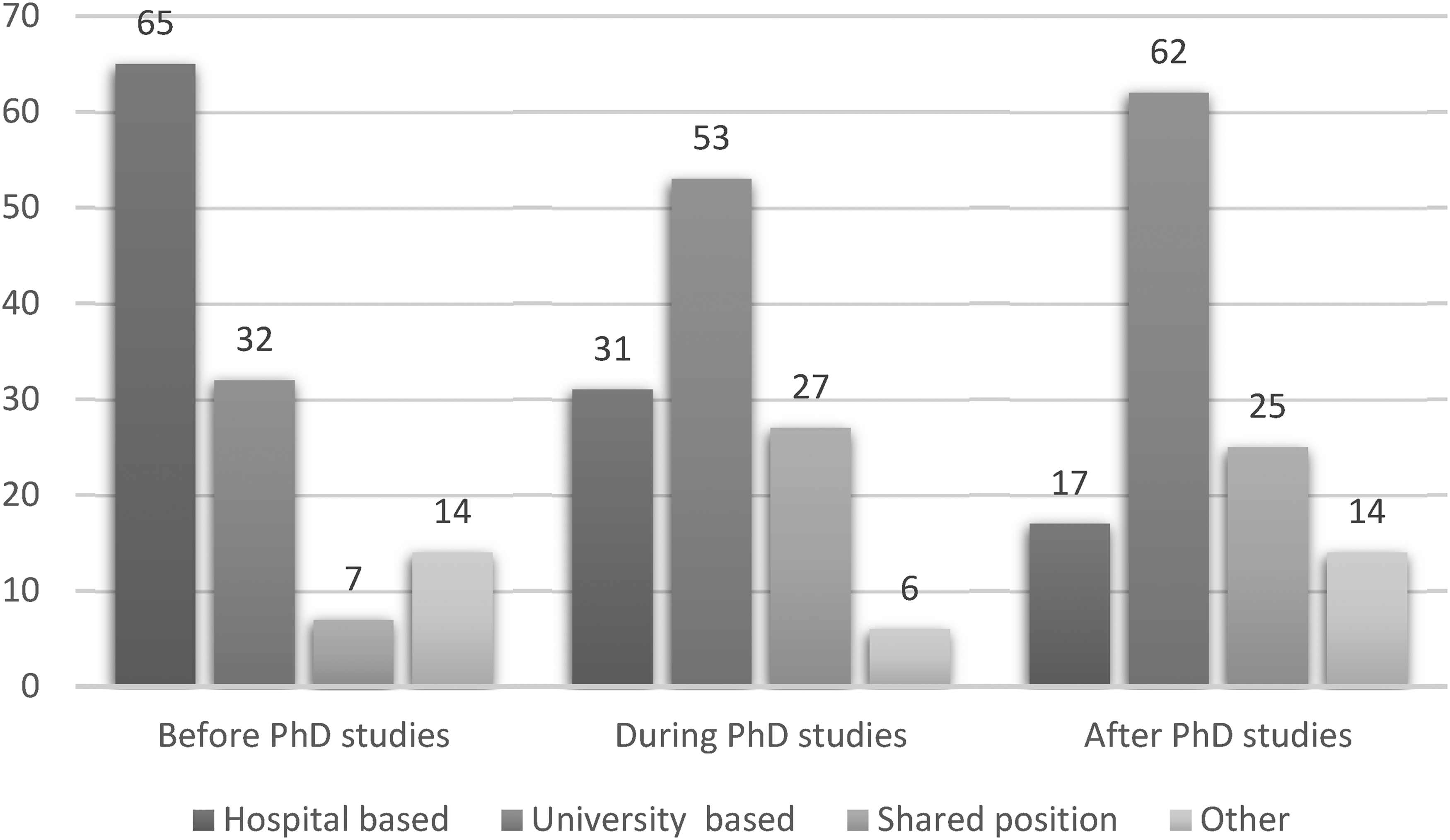
Distribution of the registered nurses employed in hospital-based, university-based, shared, and other positions before, during, and after PhD studies, reported in number and percentages: n = 118 before and after PhD studies and n = 117 during PhD studies.
The analysis showed a significant change in proportion between the different positions before and after PhD studies for the participants (Table 2).
Change in proportions between positions before and after PhD studies.
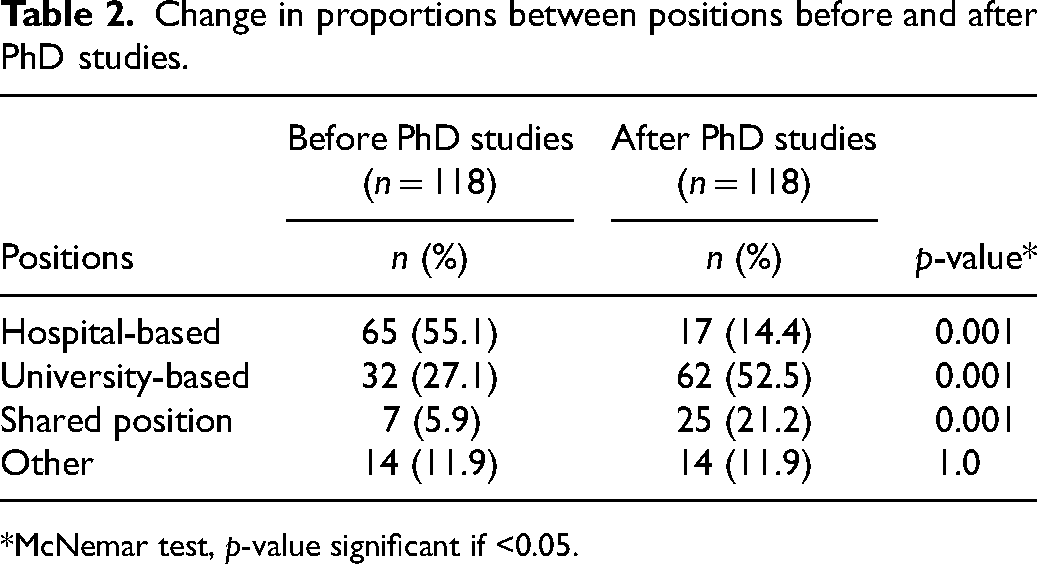
McNemar test, p-value significant if <0.05.
Current work conditions
Regarding the reporting of current work conditions, there was a clear difference between hospital-based and university-based positions. Hospital-based positions were mainly reported as consisting of leadership or working with general patient-care development. Working clinically in daily care was also mentioned, along with conducting research, both individually and in research groups, although research time was sometimes reported as limited.
University-based positions mainly consisted of teaching and educational assignments combined with research. A variety of academic career paths were mentioned, comprising different academic positions, such as lectureship, program management, and assistant professor, with various amounts of time for individual research.
Future career aspirations
After graduation, 59 (48%) participants experienced having more than one alternative position to choose from for a future career. More than half of them (n = 37) reported choosing between university- and hospital-based positions, but within that group, many (n = 16) also mentioned that if they chose a hospital-based position the fact that they had a PhD would not be considered, i.e. they would go back to their former position, working clinically.
The free-text question about their thoughts relating to future career aspirations, was answered by 100 of the 118 participants. In general, there were requests for established time for research and for the establishment of national consensus and collaboration regarding career opportunities, which were reported as lacking, mainly within the clinical context. Regardless of their professional position, they also lacked a structure for research collaboration within the organizations where they worked.
In total, 50 participants aspired to obtain a shared position working in both a hospital- and a university-based context, such as a clinical lecturer position. However, they recognized difficulties regarding the probability of having two employers, which is why they would prefer having a shared position with only one main employer. Another aspect of shared positions that was mentioned was the lack of resources in clinical settings, which, they anticipated, could result in them having to cover for absent colleagues.
Of the participants, 37 reported aspiring to a hospital-based position with research opportunities, but they also experienced a lack of interest from the hospitals. For such positions to be possible, the participants stated that defined career paths within the organization were required, as well as established structures for nursing researchers, which were experienced as currently lacking.
Discussion
The study charted the current professional positions and work conditions of registered nurses with a doctoral degree in Sweden. Furthermore, the aim was also to explore career aspirations within the group. Findings showed a significant change from hospital-based positions before graduation to university-based positions after graduation. Despite this, free-text answers reveal career aspirations that contrast with the shown transfer in positions. The participants described a desire to be able to combine an academic career with a clinical position, although they identified several barriers to achieving this.
First, one of those barriers was described as a lack of resources, experienced as hindering shared or clinical positions. Still, the participants were clearly interested in maintaining a partly hospital-based position, remaining close to the patients. This aligns with previous international studies, where the nurses described how their interest in research was driven by their desire for improvements to patient care. 8 The results of this study are important in that they illuminate how aspirations and possibilities collide for this group of highly qualified nurses due to structural barriers. Regarding the evidence highlighting the benefits of nurses with a PhD working in a clinical care context, facilitating, and implementing evidence-based care,1,14 the barriers the nurses experience appear crucial to address both locally, nationally, and internationally. Furthermore, there is a need for nurses prepared at doctorate level to mentor, supervise, and educate nurses in the future to conduct research needed to develop evidence and improve care delivery. 14
Second, defined career paths for hospital-based and/or shared positions were reported as missing. It was also seen as unclear how this should be arranged regarding employment contracts. It was therefore suggested that the need for national consensus and collaboration regarding career opportunities must be addressed. Today in Sweden, every region and hospital seem to have an individual solution, which could be counterproductive. For example, in Australia a lack of standardized career paths for nurses has been shown to result in a multitude of differently named positions, creating confusion and ambiguity in expectations. 15 Distinct actions to promote scientific careers in nursing have previously been identified and advocated for to shape trajectories for nursing researchers, 16 though there is a need for this to be done in a standardized way. In addition, there are needs for the nurses to be prepared for their expected roles after graduation, 17 which is in line with having well-defined career paths16,18 generating an understanding within the organizations. 18 Furthermore, this study mentions that a supportive collaboration between clinical settings and universities regarding shared positions could be beneficial for developing future career paths that are sustainable, which also has been noticed previously internationally. 17
The third reported reason for nurses with a PhD to transfer to university-based positions was that hospital-based positions were hindering rather than facilitating in pursuing a career within research. Instead of an opportunity to develop an individual career as a researcher, the participants working in a hospital-based position reported having positions in leadership, developing clinical routines, and working clinically. This is in line with research showing nurses with a PhD developing guidelines 19 or serving as consultants regarding, e.g. literature searches or interpretation of research, rather than undertaking research themselves. 1 Despite some nurses with PhDs having allocated time to conduct their own research, many were primarily tasked with supporting the research of colleagues. 1 Hence, it seems like nurses with a PhD researching competence, which is of importance for the future of nursing research and education and therefore for the nursing profession, are underused. 3 Moreover, the question arises to what extent nurse managers understand and know what the doctoral degree contributes to in the clinical context. It has previously been shown that research-active clinicians are associated with decreased mortality, 20 which is why more nurses with a higher academic degree should be considered beneficial in a clinic. However, without the hospital managers valuing and understanding the advantage of nursing research being conducted and led by nurses in close contact with the clinic, the difficulty for nurses with a PhD to hold hospital-based positions remains. Research exploring the knowledge and attitudes among nurse managers in the clinical context, regarding academic educations within nursing, could be beneficial in further understanding and developing standardized career paths for nurses holding a PhD within hospital-based and shared positions.
Methods/limitations
The fact that there is no complete register in Sweden of RNs holding a PhD degree makes it difficult to achieve a full inclusion of the study population. The data collection in this study is generated from a national register provided by the Swedish Society of Nursing. Since the register is based on voluntary registration it might not be complete, but it was considered the best option for identifying the study population. This, as well as the fact that contact information was not found for all the assumed RNs on the list, can be regarded as a limitation. In addition, the register did not include RNs exclusively. To ensure proper inclusion, a manual review of the names and professions on the list was carried out, as well as including one question in the questionnaire that addressed the participants’ professions. The response rate of 43% in the current study should be considered acceptable for an online survey and is higher compared to similar studies 21 ; it could, thus, be considered representative for the sample.
The survey used in the present study was limited to 13 questions, based on the research questions for the study, and it can therefore only present a general description of the career situation for the nurses holding a PhD, which makes transferability limited. Interpretations of the result other than through manifest analysis were therefore not regarded as advisable. To answer questions more in depth regarding why and how career choices were made and which facilitators and barriers the nurses with a PhD experienced in their career, after graduation, a qualitative study is recommended.
Conclusion
Nurses with a PhD have clinical nursing expertise and are educated to undertake nursing research, competences that are known to benefit the quality of care and therefore essential for the future of the nursing profession, research, and education. However, the current professional positions and work conditions of nurses with a PhD are not in accordance with their career aspirations. Nurses with a PhD desire a hospital-based career, yet this study shows how they, in contrast to their aspirations, move away from the clinic during their PhD studies in favor of university-based positions. Several structural gaps and barriers need to be addressed to facilitate for nurses with a doctoral degree to combine academic and clinic careers. For example, national collaboration and consensus regarding career paths after graduation are requested, and future career solutions should be presented in a standardized and structured way. In addition, a future improvement in the collaboration between clinic and university is called for, together with an increased knowledge and understanding within the clinical context of the competency and benefits of nurses holding a PhD.
Footnotes
Author contributions
All authors have made substantial contributions to all of the following: (1) the conception and design of the study, the acquisition of data, or the analysis and interpretation of data; (2) the drafting of the article or the critical revision for important intellectual content; and (3) the final approval of the version to be submitted.
Data accessibility statement
The data that support the findings of this study are available from Malmo University, but restrictions apply to the availability of these data, which were used under license for the current study, and so are not publicly available. Data are, however, available from the corresponding author upon reasonable request and with permission of Malmo University.
Conflict of interest
The authors declare that there is no conflict of interest.
Funding
The author(s) disclosed receipt of the following financial support for the research, authorship, and/or publication of this article: This work was supported by the Svensk Sjuksköterskeförening (grant number Florence Nightingale fund).
