



Abstract
Initial harmonization has been found within nursing education in the European Union member states, but with a need for the establishment of further, well-defined standards. The aim of this study was to describe and analyze the main content of nursing education expressed in national guidelines in the Nordic countries, seen as comparisons between the countries and to the European Federation of Nurses Associations (EFN) Competency Framework. A qualitative deductive research method and content analysis were applied to analyze 20 documents, using the EFN Competency Framework as a theoretical framework and analysis matrix. The study was performed in line with the Standards for Reporting Qualitative Research (SRQR) checklist. Variations in structure between the included countries was seen and evident uniformity was lacking. There were differences, e.g. the number of European Credit Transfer and Accumulation System (ECTS) credits needed for a degree that needs to be further explored in relation to the quality of education and the competence of newly qualified nurses. There is a question of whether the EU Framework corresponds to the need for nursing competencies for today and the future. Homogenization of guidelines and structures might facilitate further development and deeper collaboration between the Nordic countries, thereby leading to enhanced patient safety and care quality.
Keywords
Introduction
Education and continuous professional development can facilitate the development of an educated, competent and motivated health workforce, 1 which can support populations’ well-being and healthy lives. 2 There are globally recognized challenges in current healthcare services, e.g. during the next decade approximately 9 million additional nurses will be needed in the global health workforce.2,3 Adequate nurse staffing and organizational support for nursing are crucial for both nurse retention and the improvement of care quality. 4 In an attempt to rectify the current skills shortages seen and to ensure sustainable growth and resilience, the European Union (EU) has introduced various initiatives and targets with the aim of improving and making higher education more relevant. 5 For example, those institutions that provide nursing education have been tasked with ensuring that graduates have the specific skills and knowledge needed to work in the nursing profession.6,7 European standards for nursing education have been proposed whereby care quality can be standardized and free movement within the EU labor market can be improved. 8 Nevertheless, differences between EU member states regarding the nursing workforce still exist, and the role that higher education institutions can play in supporting and developing the status of the nursing discipline and profession should be investigated. 3
Background
During the last few decades, significant educational reforms have been undertaken to promote mobility between EU member states, e.g. the Bologna Declaration and the European Education Area (EEA) initiative. The goal of such measures has been to standardize educational systems, education and training requirements, and the recognition of academic qualifications between EU member states.5,9 In one study of the similarities and differences in nursing education frameworks between EU member states, researchers found initial harmonization but the need for the establishment of further, well-defined standards. 8 In a study of nursing education in the Scandinavian countries in relation to the Bologna Declaration and various EU Directives, researchers found more similarities than differences between the included Scandinavian countries regarding the programs/curricula seen. 10 In one study of clinical nursing education in five Nordic countries, researchers found that the structure and content of clinical education were similar but that the methods to meet the needs of a new nursing generation were lacking and suggested the development of new teaching and reflective structured assessment methods. 11 In one discussion (opinion paper) of EU Directives in relation to nursing education in Nordic countries, it was concluded that current EU regulations should be modified to better suit the manner in which healthcare is organized in the various EU member states. 12
Educational programs for specific healthcare domains have been investigated in previous research, e.g. anesthesia nursing education, 13 public health nursing,14,15 and paramedic education.16,17 In one study of public health nursing education in the Nordic countries, researchers found the need for collaborative projects, clinical placement exchanges, joint (inter-institutional) Master's degree projects, and academic staff collaboration relevant to education and research. 14 In another study of public health nursing education set in Norway, researchers found that nursing literature comprised only a small portion of the content of the curricula used. 15 In one investigation of paramedic education in four Nordic countries, researchers concluded that a harmonized curriculum model for Bachelor's level degrees in paramedic medicine would enable further and more comprehensive collaboration between EU member states. 16 In an examination of education for professionals in emergency medical services (ambulance care) in Finland, Sweden, and Belgium, researchers concluded that the establishment of a core curriculum was possible. 17
EU Directives for nursing education
The Bologna Process was introduced in 1999 as a quality assurance system, through which the quality and relevance of learning and teaching between EU member states could be assured. 9 The purpose of the Bologna Process was to ensure mutual recognition of qualifications and learning periods in higher education throughout participating EU countries. 9 Further, the European Qualifications Framework aims to make national qualifications comparable and understandable in EU countries. 18 The Qualifications Framework plays an important role in increasing the transparency of qualification systems to enhance professional development and mobility across borders. 5 As delineated in EU Directives (2013/55 EU), education for nurses responsible for general care should consist of full-time time studies for a minimum of 3 years and include at least 4600 h of both theoretical and practical studies, expressed as European Credit Transfer and Accumulation System (ECTS) credits. The theoretical studies must be at least one-third and the practical studies (clinical practice) at least half of the total hours (2300 h, 90 ECTS). The theoretical studies of such education should consist of professional knowledge, skills, and competencies. The practical studies of such education should consist of learning through teamwork, leading, and organizing direct patient contact.7,19 Based on EU Directives,7,19 the European Federation of Nurses Associations (EFN) have developed a Competency Framework to serve as guidelines for EU member states concerning the competencies required for nurses. 20
Nursing education in the Nordic countries
Nursing education in the Nordic countries is regulated by pertinent higher education laws, which are based on EU Directives (2005/36/EC; 2013/55/EU) and relevant decrees, guidelines, regulations, etc. issued by the ministry responsible for such education in each country. As per EU Directives, those institutions that provide nursing education are responsible for the content and quality of the education. 7 Although not EU member states, Iceland and Norway are participants in the Bologna Process and member countries in the European Higher Education Area (EHEA) and have agreed to the European Qualifications Framework. 9 There are differences in the length and number of ECTS credits of nursing education within Nordic countries e.g. Denmark = 210, Finland = 210, Iceland = 240, Norway = 180, and Sweden = 180 ECTS.
The aim of the present study was to describe and analyze the main content of nursing education expressed in national guidelines in the Nordic countries, seen as comparisons between the countries and to the EFN Competency Framework.
The research questions were as follows:
How are national guidelines for Bachelor's level nursing education in each of the Nordic countries structured? What are the similarities and/or differences between the structure of each Nordic country's national guidelines in main content (headings and competencies) for Bachelor's level nursing education in comparison to the EFN Competency Framework?
Methods
A qualitative deductive study design with a descriptive approach was used for the document analysis, to clarify the current situation of nursing education in the included Nordic countries in terms of possible similarities and differences in the structure and main content, seen as headings and competencies of national guidelines.21,22 Data, consisting of documents from open available resources, were analyzed using content analysis. 23 The study was performed in line with the Standards for Reporting Qualitative Research (SRQR) checklist. 24
Context
This study was performed as part of a Nordic research project (Nordic Nurse Competence Study) and conducted from November 2021 to March 2022, concerning all five Nordic countries (Denmark, Finland, Iceland, Norway, and Sweden). The inclusion criteria for the documents were as follows: 1) up-to-date; 2) relevant to existing guidelines for nursing education in the EU and included Nordic countries; and 3) corresponds to national guidelines in the included Nordic countries relevant to Bachelor's level nursing education. The exclusion criteria were a focus on specialist education and/or correspond to Master's level education. No limitations were set on the number of documents or on the language of the documents included in the data material.
Data collection
The first author collected the data from openly available sources. Moreover, research group members from each included Nordic country shared relevant data material. The data material was sorted into categories based on origin: 1) European Union directives (2005/36/EC; 2013/55/EU), regulations, and/or documents relevant to nursing education; 2) national directives, regulations, and/or guidelines for nursing education; 3) professional associations’ guidelines and/or webpages for nursing education; and 4) study (educational) program content (e.g. descriptions of study programs, curricula, course descriptions, etc.).
Data analysis
Deductive content analysis was used to analyze the documents. 23 The EFN Competency Framework was employed as a theoretical framework and analysis matrix, with EFN Competency Framework competency areas (main headings and subheadings) forming the categories and subcategories used during content analysis. 23 The competency areas included in the EFN Competency Framework are: Culture, ethics, and values; Health promotion and prevention, guidance, and teaching; Decision-making; Communication and teamwork; Research, development, and leadership; Nursing care (theoretical education and training); and Nursing care (practical-clinical education and training). 20
In the first step of the content analysis (step 1), general background information about nursing education for each included Nordic country was described, based on information taken from national directives, regulations, and/or guidelines and/or professional associations’ guidelines and/or webpages and/or selected university/educational institution webpages relevant to nursing education (e.g. curricula, course descriptions, etc.; hereafter “national guidelines”). In step 2, the EU Directives for nursing education were described as well as the structure of national guidelines for nursing education in each included Nordic country, with country descriptions based on information taken from national guidelines and understood as main headings originating from the theoretical framework, i.e. EFN Competency Framework competency areas. In step 3, a comparison of the structure and main content of national guidelines for nursing education in each Nordic country in comparison to the EFN Competency Framework for nursing education was performed, with descriptions understood as main headings and subheadings originating from the theoretical framework, i.e. EFN Competency Framework competency areas. In step 4, an inter-country comparison of the structure, headings, and competencies of national guidelines for nursing education in each Nordic country was performed, with descriptions understood as main headings and subheadings originating from the theoretical framework, i.e. EFN Competency Framework competency areas. The analysis process, steps 1–4, are illustrated in Figure 1.
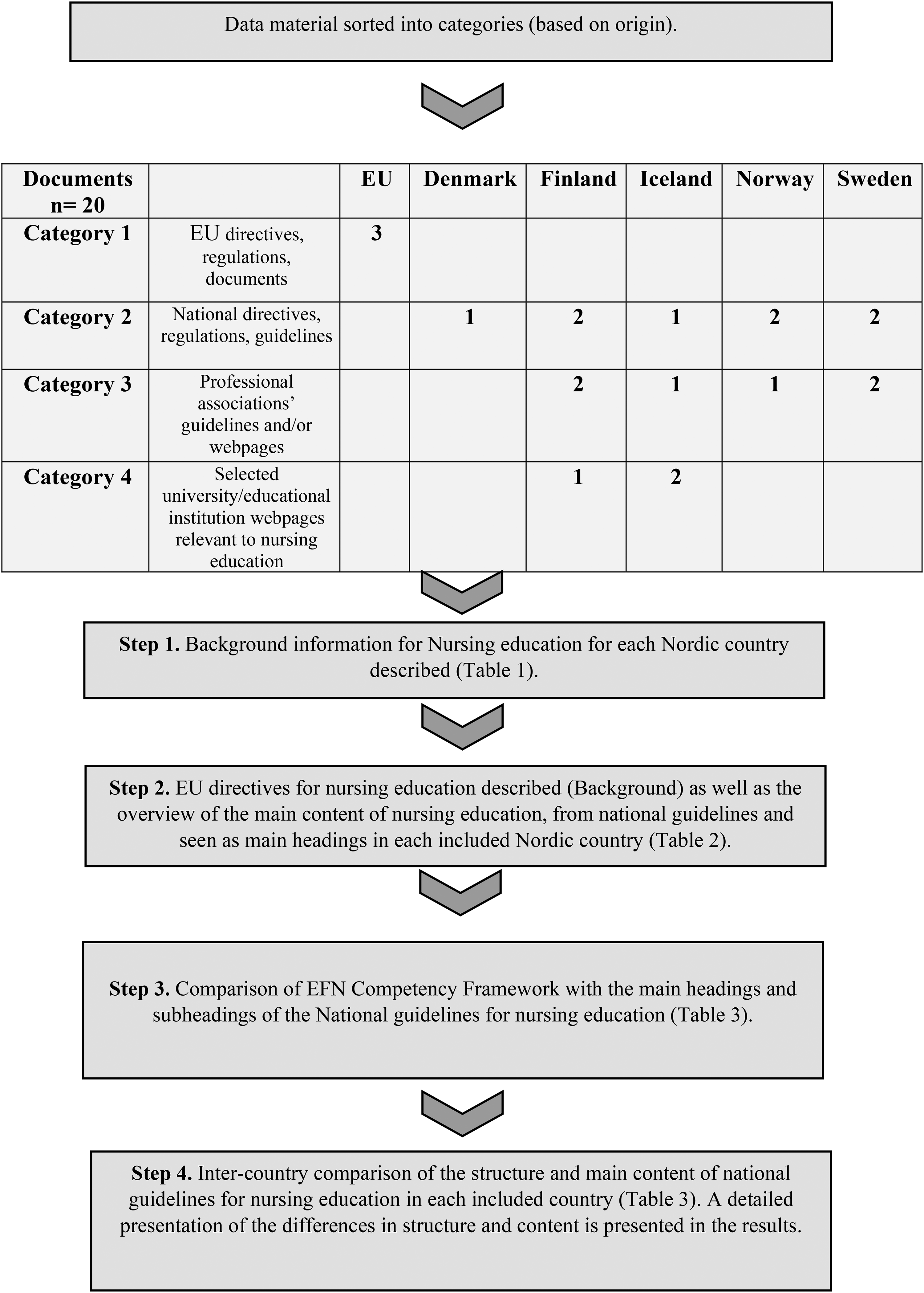
Overview of the content analysis process.
Ethical considerations
Good scientific practice was followed throughout the course of the research project.25–28 Only official documents in original languages from openly available resources were included.
Results
A total of 20 documents from different origins were explored and analyzed. To facilitate analysis, the knowledge, skills, and formal qualifications (competence) for training for professional nurses responsible for general care as delineated in EU Directives were ascertained. An overview of general background information about the nursing education programs in the included countries was generated, seen as ECTS credits, qualification (title), type of educational institution (level), approximate number of graduates per year, and what emphasis is placed on (Table 1).
General background information about nursing education programs in the Nordic countries.
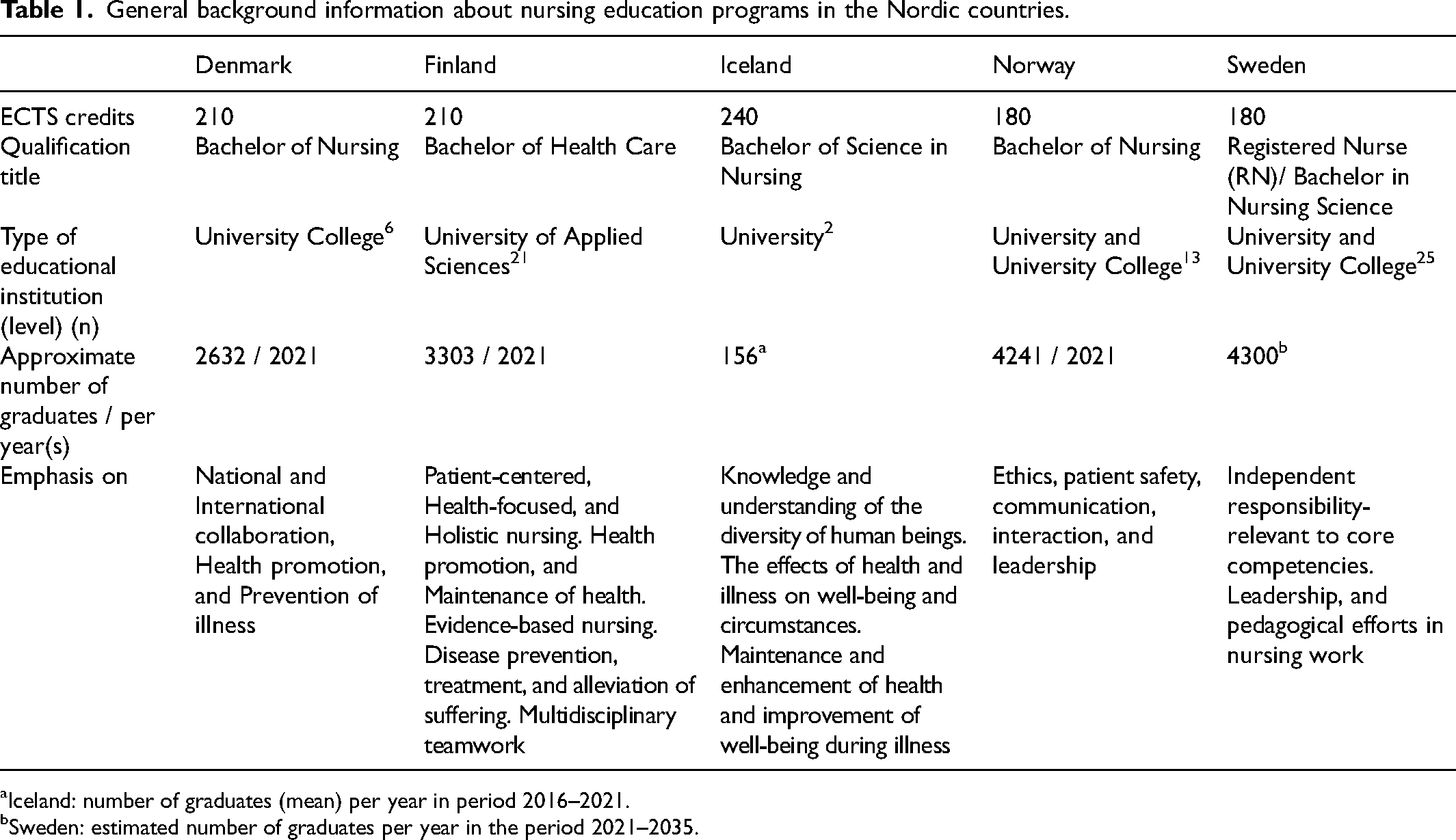
Iceland: number of graduates (mean) per year in period 2016–2021. bSweden: estimated number of graduates per year in the period 2021–2035.
An overview of the main content of nursing education in the included countries (theoretical framework main headings) was also generated (Table 2).
Overview of the main content of nursing education, from national guidelines and seen as main headings.
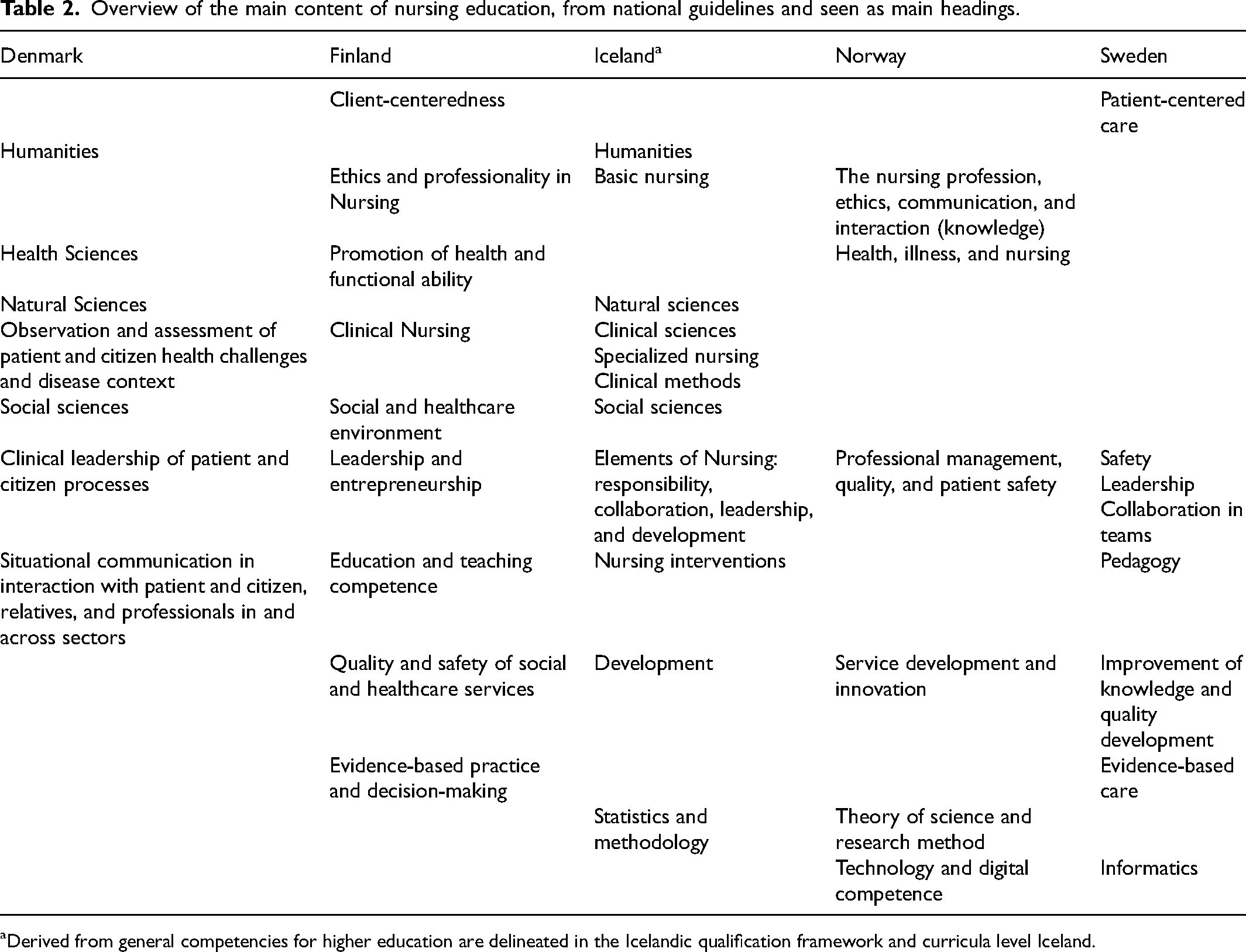
Derived from general competencies for higher education are delineated in the Icelandic qualification framework and curricula level Iceland.
The structure of national guidelines in comparison to EFN Competency Framework (theoretical framework main headings and subheadings) was even generated (Table 3).
Comparison of EFN competency framework with the main headings and subheadings of the national guidelines for nursing education.
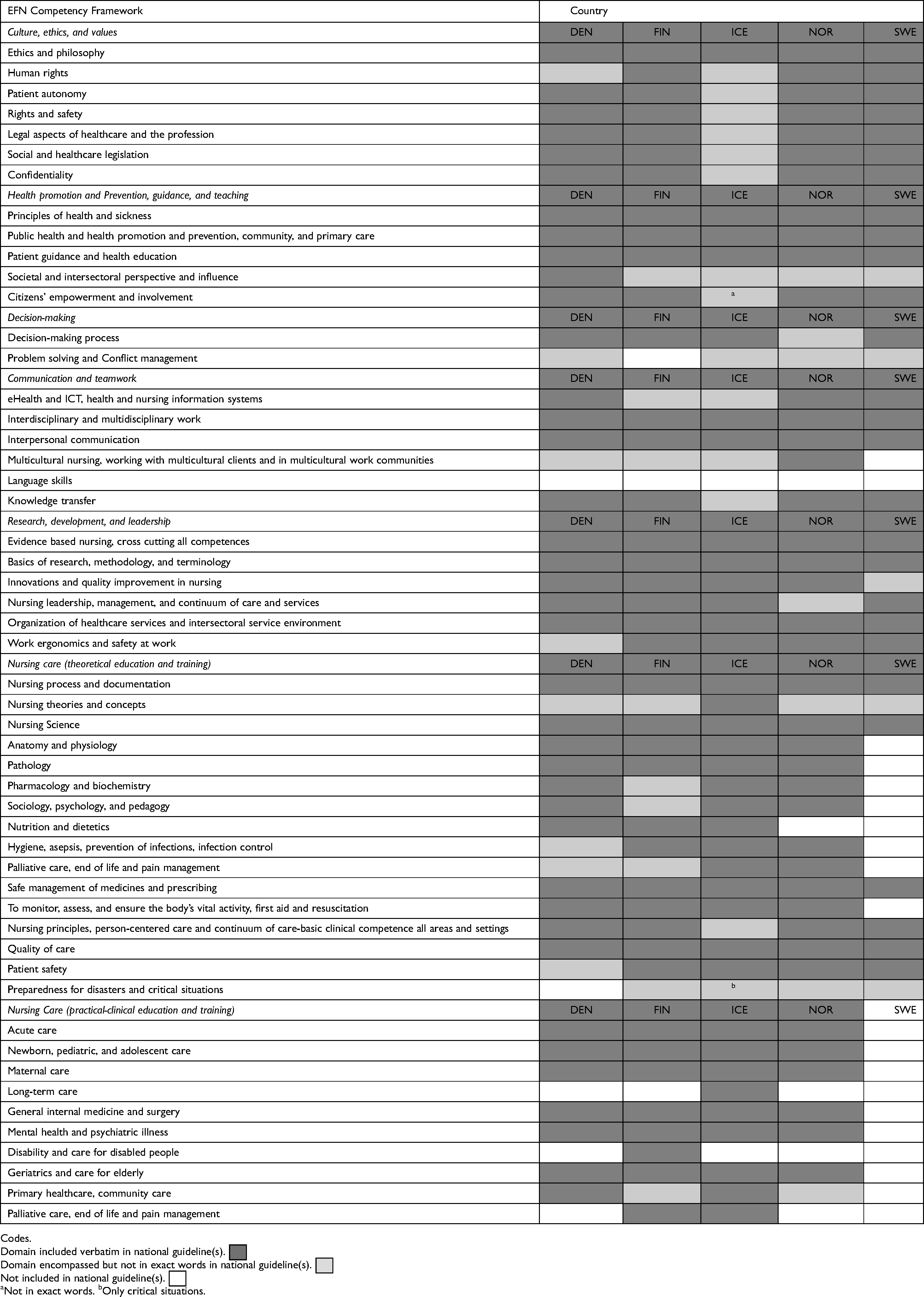
All included countries were seen to have national guidelines, with the exception of Iceland; in Iceland, general competencies for higher education were found to be delineated in the Icelandic qualification framework. The structure of the national guidelines of each included Nordic country was seen to be generally comparable to EU Directives for nursing education. For example, with the exception of Sweden, the included countries were seen to separately specify practical and clinical competencies. However, differences between the included countries were seen, e.g. regarding the structure of the main content of national guidelines, main headings and subheadings, and/or the organization of such could differ. Below follows a detailed presentation of the differences in the structure of the main content (headings and competencies) that emerged from the content analysis, organized in accordance with EFN Competency Framework main headings and including further detailed discussion relevant to EFN Competency Framework subheadings (EFN Competency Framework competency area subheadings in quotation marks; additional/unique country-specific competency area headings/subheadings without quotation marks and/or in parentheses).
Culture, ethics, and values
“Human rights” was listed in the national guidelines from Finland, Sweden, and Norway but was not listed in national guidelines from Denmark and Iceland. “Patient autonomy” was listed in the national guidelines from Denmark, Finland, Sweden, and Norway but not Iceland. “Rights and safety,” “Social and healthcare legislation,” and “Confidentiality” were not listed as main headings or subheadings in the national guidelines from Iceland but were listed as part of course-level curricula content (under Elements of nursing: Responsibility, collaboration, leadership, development).
Health promotion and Prevention, guidance, and teaching
“Societal and intersectoral perspective and influence” was not listed in those exact words in any national guidelines. Instead, various different synonyms were used, e.g. interdisciplinary or interprofessional collaboration (e.g. Initiate and contribute to interdisciplinary, interprofessional, and cross-sectoral collaboration (Norway)) or quality and improvement work. “Citizens empowerment and involvement” was listed in the national guidelines from Denmark, Finland, Sweden, and Norway but was not explicitly listed as a main heading or subheading in national guidelines from Iceland.
Decision-making
“Decision-making process” was listed in the national guidelines from Denmark, Iceland, Finland, and Sweden but not Norway, where instead decision-making was described under Theoretical nursing principles and practical training. “Problem-solving and Conflict management” was listed in documents from all included countries, although in various ways. For example, general reference was made to problem-solving and conflict management in national guidelines from Norway (e.g. Preserve life and health in the event of major accidents and in crisis and emergency situations), Denmark (Independent clinical decision-making and communication situationally), and Iceland (Ethical principles and ability to make decisions about ethical issues). Problem-solving was listed in national guidelines from Sweden (Critical thinking, problem-solving skills, and timeframes) but no reference was seen to conflict management. Conflict management was obliquely listed in national guidelines from Finland (Acute care, under Clinical nursing) and Norway (Acute crisis support).
Communication and teamwork
“Communication and teamwork” was not listed in those exact words in any national guidelines; various different synonyms were instead used. “eHealth and ICT, health and nursing information systems” was listed in the national guidelines from all countries, although to varying extents. For example, in the national guidelines from Finland, eHealth (Health care in virtual environment) was listed but not ICT, while, conversely, in the national guidelines from Iceland, ICT (Employ the best information and computer technology to the benefit of each patient and colleagues) but not eHealth was listed. “Interdisciplinary and multidisciplinary work” and “Interpersonal communication” were listed in the national guidelines from all countries.
“Multicultural nursing, working with multicultural clients and in multicultural work communities” was listed in the national guidelines from Norway (e.g. Cultural competence and cultural understanding). The concept of multiculturality was listed through the use of different synonyms and in varying contexts in national guidelines from Denmark (Ethics and religion), Finland (Client-centeredness), and Iceland (Nursing and cultural diversity) but there was no mention of such in the national guidelines from Sweden.
“Language skills” was not listed in those exact words in any national guidelines yet was obliquely listed in the national guidelines from Sweden (Ability to explain and discuss treatment and document both orally and in writing, under General principles of nursing). “Knowledge transfer” was listed in the national guidelines from Denmark, Finland, Sweden, and Norway but not in those exact words in the national guidelines from Iceland (under Elements of nursing).
Research, development, and leadership
All EFN Competency Framework subheadings for this main heading were clearly listed in the national guidelines from all five included countries, although different synonyms and varying contexts were discerned. For example, regarding “Innovations and quality improvement in nursing,” the word “innovation” could be included in national guidelines in a heading or, as in the national guidelines from Sweden, synonyms could be used. As another example, regarding “Nursing leadership, management and continuum of care and services,” in the national guidelines from Norway, the word “leadership” was not explicitly listed but instead synonyms such as “management” and “collaborative” were used (Management and organization of the health service, under Professional management, quality and patient safety; Plan and carry out collaborative processes: patients, relatives and service providers, under The nursing profession, ethics, communication and interaction).
“Work ergonomics and safety at work” was somewhat listed in national guidelines from Finland (e.g. Safety and risk management), Iceland (e.g. Communication, safety, and health education), Norway (Patient and user safety, under Safety), and Sweden (Risk-consciousness, under Safety). Ergonomics but not safety at work was listed in the national guidelines from Denmark (Ergonomics, under Health Sciences).
Nursing care (theoretical education and training) and Nursing care (practical-clinical education and training)
“Nursing care (theoretical education and training)” and “Nursing care (practical-clinical education and training),” i.e. theoretical studies and practical studies (clinical practice), were listed through the use of different synonyms and in varying contexts and to varying degrees in the national guidelines from Denmark, Finland, Iceland, and Norway but was not listed in the national guidelines from Sweden. For example, theoretical studies and practical studies (clinical practice) were listed separately in the national guidelines from Norway but were not listed separately in the national guidelines from Sweden. As further examples, regarding “Pharmacology and Biochemistry,” biochemistry was not listed in the national guidelines from Finland; “Sociology, psychology and pedagogy,” psychology was not listed in the national guidelines from Finland and Norway. Regarding “Hygiene, asepsis, prevention of infections, infection control,” hygiene but not the word asepsis was listed in the national guidelines from Denmark (under Microbiology: hygiene, bacteriology, virology, parasitology). Regarding “Palliative care, end of life and pain management,” palliative care was listed in the national guidelines from all countries but pain management was not listed in the national guidelines from Denmark and Finland.
“Nutrition and dietetics” were listed in the national guidelines from Denmark, Iceland, Finland, and Sweden but not Norway. “Nursing theories and concepts” was most explicitly listed in the national guidelines from Iceland (Basic theories and concepts in the discipline of nursing and employment of that knowledge in nursing practice, under Elements of nursing: Responsibility, collaboration, leadership, development) in comparison to the other countries, where synonyms, etc. were seen (e.g. Scientific theory and research methodology (Norway); Knowledge-based practice (Sweden)). “Preparedness for disasters and critical situations” was not clearly listed in connection with clinical competencies in nursing in the national guidelines from Denmark and Iceland. “Disability and care for disabled people” was only listed in the national guidelines from Finland. “Long-term care” was only listed in the national guidelines from Iceland.
Additional country-specific (unique) competency areas
Religion was listed in the national guidelines from Denmark (Ethics and religion, under Humanities). Nurses’ work and career development and Psychosocial support of patients were listed in the national guidelines from Finland. Sexual and reproductive health, Chronic diseases, and Nursing care for the chronically ill were listed in the national guidelines from Iceland. Global challenges, Status and rights of the Samí people, and Plan and carry out projects were listed in the national guidelines from Norway; Norway was the only country to encompass indigenous people's status and rights in the national guidelines for nursing education.
Technology and digital solutions for the purpose of supporting patients’ and relatives’ resources, Coping opportunities and participation and Insight into the development and use of technology and digital solutions on the individual and system levels, were listed in the national guidelines from Norway. Ethical aspects of eHealth, Self-awareness and empathic ability, and timeframes (Critical thinking, problem-solving skills and timeframes), Conditions in society that affect children's, women's, and men's health, and Knowledge of male violence against women and violence in close relationships were listed in the national guidelines from Sweden.
Discussion
From the inter-country comparisons, similarities between how the national guidelines for the included Nordic countries were structured were seen to exist, e.g. certain (like) competencies were listed, although their context and/or inclusion as main headings or subheadings varied. Still, some differences were noted regarding how clearly or in what detail competency areas were listed and/or whether they were delineated in regulation and/or on the professional association(s) and curricula/study program(s) levels. There were also differences regarding theoretical studies and practical studies (clinical practice), which could be grouped or listed separately. Although general uniformity was seen regarding the structure of main content (headings and competencies) of the national guidelines for the included Nordic countries, detailed comparison was difficult.
Overall compliance with EU regulations was seen. However, as noted above regarding the inter-country comparisons, variety relevant to structure, i.e. the context and/or inclusion of competencies as main headings or subheadings, was discerned. Given that the exact wording of competency areas was often not replicated, there was a need to interpret the data; such interpretation could perhaps be considered somewhat subjective. For example, as seen in the inter-country comparisons, Patient-centeredness was listed as a main heading in the national guidelines for all included countries except Iceland. Nevertheless, one could perhaps interpret the data in a different manner and find that patient-centeredness was listed in the national guidelines for Iceland, as Ethics of health care and/or humanities. The curricula level was only explored for Iceland because the data for Iceland were derived from general competencies for higher education delineated in the Icelandic qualification framework. Accordingly, extrapolating, one could argue that most competency areas might be represented on the curricula level – if one were to look. Subsequently, one can argue that most of the main headings and subheadings included in the EFN Competency Framework, e.g. pain management as seen in “Palliative care, end of life and pain management,” were in fact encompassed in the various national guidelines examined to some degree (on the curricula level, etc.) though may not have been interpreted as being included.
While the aim of the Bologna Process was to ensure the mutual recognition of qualifications and learning periods in higher education throughout participating EU member states, 5 further standardization of nursing education in the EU is needed.8,10 It is possible that the variety related to the structure of national guidelines discerned from the data in this study could be linked to a provision in EU Directive 2013/55/EU, in which it is stated that the providers of nursing education should ensure that graduates possess the specific skills and knowledge needed to work in the nursing profession.6,7 This may explain the further inter-country differences discerned regarding the emphasis of the educational programs (Table 1), structure, and possible differences in the content on the curricula level. It is debatable whether the differences in the length of nursing education in the Nordic countries in terms of ECTS credits (180–240) may be due to the different professional roles and responsibilities of nurses in the different countries. Furthermore, it should be investigated whether programs consisting of more than 180 ECTS have a higher quality of education than programs consisting of 180 ECTS, or whether newly graduated nurses from countries with a nursing education based on more than 180 ECTS have higher competence than newly graduated nurses from countries with an education based on 180 ECTS. Theoretical and practical studies (clinical practice) need to be clearly stated, to facilitate comparisons between courses and to enhance equality. While it was possible to discern the inclusion of more detailed requirements on the professional association(s) and curricula/study program(s) levels, uniformed professional clinical competence requirements were still nonetheless found to be missing.
To improve free movement within the EU labor market and ensure that nurses possess relevant competencies, 8 the criteria for nursing education should be reviewed. As seen in this study, there are similarities between the included Nordic countries regarding the structure of nursing education. However, there are even differences, e.g. the number of ECTS credits and qualification title. While one can question whether it is possible to “homogenize” knowledge, competencies, and skills to such an extent that they become easily transferable between countries – including transferable qualifications – it is nonetheless clear that further, detailed, and up-to-date directives are needed.
From the findings, we also discerned the existence of additional, country-specific (unique) competency areas that were not seen in the EFN Competency Framework, e.g. Psychosocial support of patients (Finland) and Self-awareness and empathic ability (Sweden). As seen in previous research, in the future new nursing skills and roles will be needed in healthcare.3,11 With the aim of improving the care and treatment that nurses provide (i.e. nurses’ competency), the Nordic Nurses’ Federation also advocates the safeguarding and improvement of nurses’ skills in conjunction with societal development. 29
Adopted in 2015, the EFN Competency Framework was developed as a tool whereby understanding of the competency that general care nurses should possess, as delineated in EU Directives, could be better disseminated and those institutions providing nursing education could be guided. 20 However, in the seven years since its adoption, extensive and rapid change within the healthcare sector has transpired, e.g. digitalization. 30 An additional focus on and/or inclusion of competencies related to eHealth, Artificial Intelligence (AI), and ethics on the curricula level might be beneficial. However, while possible because of the autonomy that universities and/or other educational institutions enjoy, non-uniform implementation may increase differences and lead to further difficulties. Even the need for the reform of EU Directives relevant to requirements for practical studies (clinical practice) in nursing education has emerged; EU regulations should be modified to better suit the manner in which healthcare services are organized in various countries. 12
We discerned an evident need for further research on how professional requirements for nurses can be modified and uniform guidelines for nursing education developed so as to improve and ensure that nursing education is of the same standard throughout all EU member states. The need for improved opportunities for both prospective and professional (working) nurses to engage in research and an examination of the requirements delineated for nursing education should be undertaken. At a minimum, standardized qualifications and improved cooperation relevant to nursing education (e.g. instruction/teaching) in the Nordic countries should be striven for, so as to improve collaboration between the Nordic countries.
Methodological considerations
Qualitative methods are suitable for analyzing all types of written material and 23 conducting document analyses within Health Sciences.21,22 The qualitative content analysis process allows a description of a phenomena or situations by reducing data, grouping data, and forming categories. 23 Content analysis was utilized in this study, as it allows for the analysis of different open data sets with dissimilar contents in qualitative research. 23 A deductive approach was utilized as the EFN Framework is theoretically defined and described. 23 Documents that were considered to provide the best possible knowledge on the topic 23 formed the basis for deciding which data should be included. The data material consisted of documents from different origins, which can be considered a limitation. However, the documents were grouped by origin to ensure transparency, which can be considered a strength. Each included country had a representant in the research group and the research group members reviewed all included documents and all phases of the analysis process and the research findings, including language differences, which can be considered a strength. The inclusion of data from different origins, levels, and years was considered necessary because detailed information on the national regulation level is, at this moment, limited. The difference in the length and the number of ECTS credits of nursing education between the Nordic countries is well known, which makes comparison difficult and can also be seen as a challenge in research. The study was performed in line with the SRQR checklist, to ensure quality. 24 By using checklists and focusing on transparency in the description of the research methods, the quality of the research can be assessed and ensured. 21
Conclusion
Overall compliance with EU regulations was seen. All of the competency areas delineated in the EFN Competency Framework were seen to be listed in the included Nordic countries’ national nursing education guidelines. Nevertheless, some structure and main content (headings and competencies) varied between the included countries and, as such, clearly evident uniformity was lacking. There were notable differences in the number of ECTS credits needed for a degree and qualification titles. The difference in the length and number of ECTS credits in nursing education between the Nordic countries in relation to the quality of education and the competence of newly qualified nurses needs to be further investigated. By reforming the EU Framework to correspond to nursing competencies that are needed today, nurses are better prepared through education. Homogenization of guidelines and structures might facilitate further development and deeper collaboration between the Nordic countries, thereby leading to an organization of nursing education that enhances patient safety and care quality and better meets the demands of both current and future healthcare.
Footnotes
Acknowledgments
We thank the Nordic Nurse Competence Study project group members for their contribution to this research. We also thank Cynthia Sandström for her expertise in the English language.
Author contributions
LE: Conceptualization, methodology, formal analysis, investigation, data curation, writing – original draft, visualization. CS-L and SW: Methodology, validation, resources, writing – review and editing, supervision. AA, HST, MHS, JH: Validation, resources, writing – review and editing. LF: Methodology, validation, resources, writing – review and editing, supervision, project administration. All authors have approved the version to be submitted.
Conflict of interest
The authors declare that there is no conflict of interest.
Funding
This research received no specific grant from any funding agency in the public, commercial, or not-for-profit sectors.

ANALYZED DOCUMENTS
Eriksson E, Korhonen T, Merasto M and Moisio E-L. Sairaanhoitajan ammatillinen osaaminen. Sairaanhoitajakoulutuksen tulevaisuus-hanke, 2015. [The nurse's professional competence. The future of nursing education project.] Ammattikorkeakoulujen terveysalan verkosto ja Suomen sairaanhoitajaliitto ry. Porvoo: Bookwell Oy.
Finnish Nurses Association. Nurses and Nurse Education in Finland. https://www.nurses.fi/nursing_and_nurse_education_in_f/ (accessed 8 February 2022).
Finlex. Government Decree on Universities of Applied Sciences, 2014. (1129/2014; English). https://finlex.fi/en/laki/kaannokset/2014/en20141129 (2014, accessed 21 February 2022).
Finlex. Ammattikorkeakoululaki 14.11.2014/932, 2014. [University of Applied Sciences Act]. https://www.finlex.fi/fi/laki/ajantasa/2014/20140932 (accessed 21 February 2022).
Icelandic Nurses’ Association. Icelandic Nurses’ Association Code of Ethics, 2022. https://www.hjukrun.is/english/ethics/ (accessed 22 February 2022).
Icelandic legislation 15 September. Edition No 144b, Higher Education Act 2006 No 63 13, 2015. https://www.government.is/media/menntamalaraduneyti-media/media/frettir2015/Thyding-log-um-haskola-oktober-2015.pdf (2015, accessed 8 February 2022).
Lovdata. Forskrift om felles rammeplan for helse-og sosialfagutdanninger, 2017. [Regulations on a joint framework plan for health and social sciences educations]. https://lovdata.no/dokument/SF/forskrift/2017-09-06-1353 (accessed 22 February 2022).
Lovdata. Forskrift om nasjonal retningslinje for sykepleierutdanning, 2019. [Regulations on national guidelines for nursing education]. https://lovdata.no/dokument/SF/forskrift/2019-03-15-412 (accessed 22 February 2022).
Ministry of Education and Children. Higher Education Act No 63/2006. https://www.government.is/media/menntamalaraduneyti-media/media/frettir2015/Thyding-log-um-haskola-oktober-2015.pdf (2015, accessed 8 February 2022).
Ministry of Education and Culture. Ammattikorkeakoulut Suomessa, 2022. [Universities of Applied Sciences in Finland]. https://okm.fi/ammattikorkeakoulut (accessed 12 April 2022).
Ministry of Education and Research. Executive Order on the education for professional bachelor in nursing, BEK no. 804 of 17/6/2016. https://www.retsinformation.dk/eli/lta/2016/804 (accessed 25 April 2022).
Norwegian Nurses’ Association. Yrkesetiske retningslinjer. [Professional Ethics Guidelines]. https://www.nsf.no/etikk-0/yrkesetiske-retningslinjer (accessed 22 February 2022).
Nurses and Nurse education in Finland. Suomen Sairaanhoitajaliitto ry. www.nurses.fi (2022, accessed 8 February 2022).
Regulations on a joint framework plan for health and social sciences educations. Ministry of Education, 2017–0955. https://lovdata.no/dokument/SF/forskrift/2017-09-06-1353 (2017, accessed 22 February 2022).
Retsinformation. Bekendtgørelse om uddannelsen til professionsbachelor i sygepleje, BEK nr 804 af 17/06/2016. [Executive Order on the education for professional bachelor in nursing, BEK no. 804 of 17/6/2016]. https://www.retsinformation.dk/eli/lta/2016/804 (accessed 25 April 2022).
Swedish Council for Higher Education. The Higher Education Ordinance (1993:100). https://www.uhr.se/en/start/laws-and-regulations/Laws-and-regulations/The-Higher-Education-Ordinance/ (accessed 23 February 2022).
Swedish Council for Higher Education. The Swedish Higher Education Act (1992:1434). https://www.uhr.se/en/start/laws-and-regulations/Laws-and-regulations/The-Swedish-Higher-Education-Act/ (accessed 23 February 2022).
Swedish Higher Education Authority UKÄ. Sjuksköterskeexamen. [Nursing exam]. https://www.uka.se/statistik--analys/analys-och-uppfoljning/prognoser-for-behovet-av-hogskoleutbildade/halso--och-sjukvard-samt-social-omsorg/sjukskoterskeexamen.html (2021, accessed 12 April 2022).
Swedish Nurses’ Association. Kompetensbeskrivning för legitimerad sjuksköterska. [Competency description for a registered nurse]. https://swenurse.se/publikationer/kompetensbeskrivning-for-legitimerad-sjukskoterska (2017, accessed 23 March 2022).
Swedish Nurses’ Association. Omvårdnad/Utbildning. [Nursing/Education]. https://swenurse.se/om-oss---profession-vision-politik/kunskapsomradet-omvardnad/utbildning (accessed 23 February 2022).
The Universities and University Colleges Act. Regulations on national guidelines for nursing education, Adopted by the Ministry of Education and Research on 15 March 2019 on the basis of Act no. 15 of 1 April 2005 on universities and colleges (Universities and University Colleges Act) § 3–2 s paragraph. https://lovdata.no/dokument/SF/forskrift/2019-03-15-412 (accessed 22 February 2022).
University of Akureyri, UGLA intraweb. Nursing studies, BS, 240 ECTS (Curriculum). https://ugla.unak.is/kennsluskra/index.php?tab=nam&chapter=namsleid&id=640050_20206&namskra=1&kennsluar=2020 (accessed 22 February 2022).
University of Applied Sciences. Koulutukset, Sairaanhoitaja (AMK). [Education, Nurse (Polytechnic)]. www.Ammattikorkeakouluun.fi/koulutukset/ (accessed 20 February 2022).
University of Iceland, UGLA intraweb. Nursing (prior curriculum, LAT exam), BS, 240 ECTS. https://ugla.hi.is/kennsluskra/index.php?tab=nam&chapter=namsleid&id=820256_20216&kennsluar=2021 (accessed 22 February 2022).
Vipunen – Education Statistics Finland, 2021. Ammattikorkeakouluissa suoritetut tutkinnot. [Degrees completed at Universities of Applied Sciences]. https://vipunen.fi/fi-fi/_layouts/15/xlviewer.aspx?id=/fi-fi/Raportit/Ammattikorkeakoulujen%20tutkinnot%20-%20amk.xlsb (accessed 12 April 2022).