



Abstract
Ward rounds are crucial for the exchange of information among healthcare professionals to achieve joint planning and shared decision-making in healthcare to enhance patient safety. The aim of this study was to describe the content and structure of ward rounds focusing on interprofessional collaboration on an internal medicine ward at a university hospital in Western Sweden. An inductive qualitative approach was used to explore 13 participatory observations of ward rounds (sitting/team rounds). Qualitative content analysis was used. The analysis revealed one category, titled interprofessional teamwork, that utilises all available resources, which consisted of three subcategories: usefulness of specialist competencies, collaboration for patient safety, and leading healthcare to achieve goal fulfilment. It was also found that the participating specialists’ competencies were not being optimally used before patients were discharged from the hospital. Therefore, communication and leadership skills were revealed as ways to improve interprofessional teamwork to achieve goal fulfilment and patient safety regarding care and treatment issues on the ward. We found that reversing the order of ward rounds to start with the sitting round followed by the team round (i.e. hybrid distance participation methods), with the same ward round leader who has skills in leadership and interprofessional teamwork, could eliminate the need for healthcare providers to repeat questions and tasks (i.e. double work) on their ward rounds. Second, patient involvement is grounded in collaboration, and can be emphasised through person-centred care to facilitate patient safety during hospital stays.
Keywords
Introduction
Ward rounds are crucial for the exchange of information among healthcare professionals to achieve joint planning and shared decision-making in healthcare.1,2 There are different types of ward rounds, such as multidisciplinary, consulting, pedagogical, ‘post-take’, sitting, and walking rounds, which aim to gather and share information among staff regarding patients’ treatment, examination/test results, care activities, and discharge plans. 3 Swedish hospitals commonly use sitting rounds, where staff on the wards focus on medical issues, while team rounds (health professionals) focus on rehabilitation issues. 1
Research has shown that nurses’ involvement during ward rounds facilitates interactive and pedagogical interprofessional collaboration as well as fewer medical errors, such as medication errors. 4 Furthermore, team members find the ward round experience more welcoming when nurses with broad health perspectives are ward round leaders when compared to physicians, who steer towards medical content, which limits the participation of other healthcare professionals.2,3 However, collaboration within the healthcare team (e.g. nurses with physicians or healthcare professionals with nurses) could be problematic due to a lack of professional understanding between team members. 3 Therefore, the use of interprofessional learning during ward rounds could help improve interprofessional collaboration to achieve an overview of a patient's health condition.2,3
Interprofessional teams have specified goals and provide a variety of knowledge to achieve high-quality healthcare. The integration of professional knowledge and skills requires mutual respect between team members, 5 as having an appreciation of a healthcare profession (e.g. individual or work) can facilitate a sense of team spirit among healthcare professionals who are in collaboration. However, communication among team members can be challenging, 6 which is why strong, coordinated, and communicative clinical leadership is deemed to be able to achieve efficient teamwork. Therefore, it is important that decision-making processes are grounded in broad, interprofessional perspectives rather than only physicians’ medical viewpoints. 7 The structure of ward rounds can influence communication as well as cooperation between healthcare professionals and patients. For example, nurses commonly summarise care activities based on patients’ narratives and documented measurements and treatment activities, while physicians make decisions that are in line with patients’ medical issues. 8 However, participating healthcare professionals often lack input during ward rounds, thus joint planning and shared decision-making opportunities are limited. 3 Meanwhile, patients’ lack of confidentiality when sharing a room can have an influence on patient participation, especially when walking rounds are used. 9 Therefore, person-centred care (PCC), which is an ethical approach used in the collaboration between healthcare professionals that promotes partnership through teamwork, can be highlighted as a way to achieve high-quality healthcare.10,11 In addition, documentation via care plans within medical records that include both patients as experts on their own health (i.e. their lived experience) and healthcare professionals’ knowledge and skill (i.e. evidence-based knowledge) can promote partnerships to achieve patient safety. 12 Content and structure of ward rounds are described as significant, a kind of working tool to perform high quality of healthcare. However, there are a limited number of studies regarding how interprofessional collaboration is performed due to patient safety. 1 Patient safety is grounded in a range of disciplines with different methods and traditions, different aspects of quality of care such as quality improvement (IQ) using healthcare incident reporting systems to increase standardisation, eliminate waste and improve of efficiency. The World Health Organization (WHO) patient safety curriculum is one example to ensure high quality of care. 13
Participation and involvement in joint planning and shared decision-making processes can be promoted based on an individual's situation, thoughts and ideas, while interprofessional collaboration can be emphasised as a key factor in ensuring patients’ safety, health, and well-being. 14 By utilising different perspectives, clinical leadership and pedagogical skills can help achieve interprofessional collaboration within a hierarchical organisational structure such as healthcare.11,15 However, communication strategies can be difficult to manage during ward rounds when knowledgeable healthcare professionals are involved,1,8 especially according to the PCC approach, where partnership is crucial.9,12,14 Therefore, this study develops the knowledge on interprofessional collaboration during ward rounds to contribute to the understanding of high-quality healthcare in Sweden.
Aim
To describe the content and structure of ward rounds focusing on interprofessional collaboration towards patient safety on an internal medicine ward at a university hospital in Western Sweden.
Methods
Design
Standards for Quality Improvement Reporting Excellence (SQUIRE 2.0) were used to support and judge the trustworthiness/validity of the current study findings. 16 This study used qualitative content analysis with an inductive approach to answer the objective, which focused on interprofessional collaboration. 17
Settings
This study was conducted on an internal medicine ward with 15 beds at a university hospital in Western Sweden, which was mainly staffed by registered and assistant nurses (RNs, ANs = 41). Other healthcare professionals such as physicians (DRs), occupational therapists (OTs), physiotherapists (PTs), speech therapists (STs), dietitians, and specialists/consultants (CTs) were involved on the ward but were employed in other departments at the hospital. The ward treated acute diseases/ill-health, for example, stroke. Two types of ward rounds were used: sitting rounds (n = 4–5: RNs, ANs and DRs) that focused on medical matters, and team rounds (n = 8–12; different healthcare professionals) that focused on rehabilitation issues (e.g. medicine or social sciences); patients do not attend above ward rounds.
Sample
This study was based on strategic selection to obtain wide variation of interprofessional collaboration, sitting (health professionals, ward level, gather and share information among staff regarding patients’ treatment, examination/test results, care activities, and discharge plans) and team rounds (health professionals, hospital level, gather and share information regarding interprofessional treatment and rehabilitation plans), Monday to Friday. The sample size was decided due to qualitative methodology and time restrictions (10 weeks, Bachelor thesis). The participants (health professionals, no patients) were observed (participatory observation) to provide information about interprofessional collaboration. The inclusion criteria for data collection were health professionals who worked on one internal medicine ward at a university hospital (RNs, ANs, DRs, OTs, PTs, STs, and CTs), and who attended sitting and/or team rounds (over six days, Wednesday–Wednesday, in October 2020). The exclusion criteria were nurses (RN, AN) who were employed on other wards, health professionals (DRs, OTs, PTs, STs, CTs) employed at other hospitals, and students who participated in ward rounds on the specific ward during the data collection. 17
Data collection
The healthcare professionals who participated in the sitting and team rounds (over six days in October 2020) were informed about the study's background, aim, and method, with a focus on the voluntary and confidential nature of participation before data collection took place, thereafter, informed consent was obtained. A total of 13 observations of ward rounds were conducted from seven team rounds (8–12 participants/round) and six sitting rounds (4–5 participants/round). One sitting round was excluded due to a lack of informed content among the team members. The data collection (participatory observation) was performed by two of the authors using observation forms including actors (who), collaboration (involvement), tasks (what/question), organisation (planning) inspired by person-centred approach (partnership, narrative, documentation). The sitting rounds lasted 5–10 min, while the team rounds were longer, at 15–40 min, which resulted in a total of 55 min of sitting rounds and 2 h and 36 min of team rounds. During the observations, field notes were taken for all observed ward rounds (n = 13); however, audio recordings were only used in three (n = 3) of the rounds due to a lack of informed consent due to the recording procedure. After each day of data collection, the notes and audio recordings were divided by a round shape . 17
Data analysis
The text data from the field notes and the audio recorded ward rounds were analysed in line with manifest qualitative content analysis.18,19 First, all data (field notes and audio recordings) were read/listened to and re-read/re-listened to by all authors (individually and together) to provide an overview of the content. Thereafter, the data analysis was continued in detail to formulate condensed meaning units that consisted of sentences of (one to three) illustrated observed events during the ward rounds concerning interprofessional collaboration. Then, the meaning units were condensed to manage the large amount of data. The condensed meaning units were given a code (label) that captured the content of each meaning unit and then analysed and grouped with similar content to discover patterns. A total of 23 different codes were found. Then, subcategories were described based on the patterns that contained data content according to the interprofessional collaboration. Finally, the data were sorted and analysed to avoid non-specific content fitting into more than one category or having no category affiliation. This resulted in three subcategories, while one category contained all collected data in relation to the interprofessional collaboration.18,19
Ethical considerations
This study followed scientific soundness built upon ethical considerations 20 regarding its design, sample, data collection, and data analysis. The results are presented at the group level, and do not contain personal information, in line with both Swedish law 21 and guidelines for research within the humanities and social sciences. 20 In addition, research permission was obtained from the head of department at the hospital; therefore, ethical consideration can be described as fulfilled in this study. Moreover, qualitative content analysis is a well-known scientific method used in healthcare to understand a complex phenomenon such as interprofessional collaboration. Two different ward rounds were observed (participatory observations) to facilitate the variation of events and participants without planning or correcting routines; that is, by utilising post-constructed narratives. Moreover, verbal information (regarding the study's background, aim, and methods) was given to participants before the data collection, and permission was granted by the head of the department (meso level) as well as the first-line manager on a specific ward (micro level). In addition, informed consent that focused on voluntary participation and confidentiality was obtained from all participants (health professionals, no patient participation) before the observations took place on the ward. Data confidentiality (regarding the data collection, data analysis, and results) was a main concern in this study, and all data were collected, stored (on password-protected computers), and analysed by all authors without any possibility of others accessing the data. The results are presented at the group level, and do not contain personal information;20,21 therefore, ethical consideration can be described as being fulfilled in this study.
Results
The results (Figure 1) consisted of four categories; one main category (interprofessional teamwork that utilises all available resources) and three subcategories (usefulness of specialist competencies, collaboration for patient safety, and leading healthcare to achieve goal fulfilment).
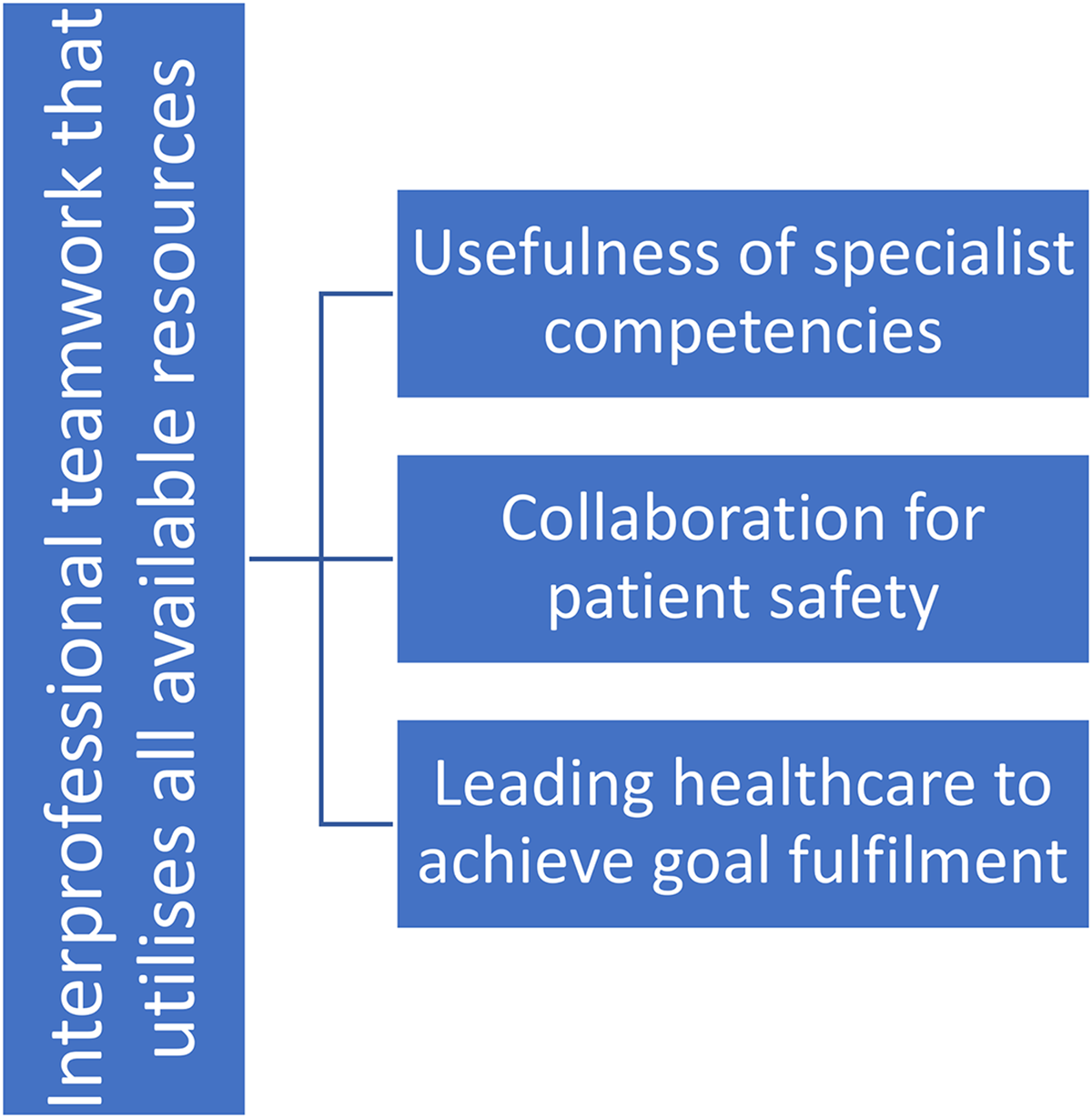
Overview of category and subcategories.
Interprofessional teamwork that utilises all available resources
This main category showed that the structure and content of the ward rounds concentrated on the usefulness of specialist competencies that focus on medicine, which revealed why other healthcare professionals’ skills, as well as patients’ experiences, were given limited attention during the ward rounds before shared planning and joint decisions were made. Two different ward rounds were conducted: sitting rounds (n = 4–5: RNs, ANs and DRs) that focused on medical conditions, and team rounds (n = 8–12: PTs, OTs, speech pathologist (SPs), DRs, RNs, ANs and CTs) that mostly discussed rehabilitation issues.
Collaboration for patient safety was described as utilising problem-solving to decrease medical errors to improve patient safety. Moreover, communication platforms such as a whiteboard on the wall (in the nursing office or conference room) and IT systems (such as medical records) provided an overview of inpatients’ diagnoses, risks for infection and falls, healthcare burdens, care plans, planned dates of discharge, and/or transfers to other healthcare providers during the ward rounds.
Leading healthcare to achieve goal fulfilment included communication skills to improve the working environment through efficient teamwork. Specific Latin terminology and abbreviations were accepted and commonly used, and leadership skills helped to improve efficiency during ward rounds by enhancing productivity regarding inpatients’ health and well-being.
Usefulness of specialist competencies
This subcategory focused on both medical issues and the limited use of other healthcare professionals’ skills as well as patients’ experiences during the ward rounds in relation to shared planning and joint decision-making processes. The observations showed variations in the participation among different healthcare professionals during the ward rounds regarding discussions and decisions. Routines concerning care and treatment activities were viewed in terms of professional hierarchies. The main discussions concerned medical conditions, which included medical matters as vital parameters, such as the National Early Warning Score (NEWS), and why other healthcare needs did not receive enough time and/or attention. The staff sometimes rushed through the patients that did not require medical examination, and did not provide enough attention or discussion regarding their rehabilitation and/or nursing tasks. The observations also showed that medical matters could be difficult to handle due to the lack of hospital beds and limited involvement from the participating healthcare professionals. For example, some medical matters took much time to discuss, and were often performed using one-way communication approaches, such as a monologue, from the participating DRs, especially during sitting rounds, which resulted in some social matters being neglected. Ward rounds that have a one-sided perspective (i.e. medicine) often occur when DRs make up the majority of the healthcare professionals, and this leads to passivity among team members.
Depending on the patients’ complex health needs, different specialist competencies were highlighted, but not always used, due to the lack of time and/or lack of available healthcare professionals, such as dieticians and STs during the ward rounds. The lack of specialist competencies delayed decision-making processes, which resulted in patients’ health problems being unsolved and/or having to be rediscussed in the following ward rounds. The limited use of knowledge and skills resulted in additional work, such as referrals, which needed to be conducted in another department, thus creating double work for the DRs and nurses during the ward rounds. Moreover, the CTs who were employed at the hospital level were not always available during the ward rounds. The presence and availability of healthcare professionals provided opportunities for joint planning by utilising their different knowledge and skill sets to achieve patients’ health and well-being. For example, all patients had established care plans that used input from the relevant healthcare professionals before the next patient was discussed. The observations also revealed the usefulness of having different healthcare professionals’ knowledge and skills in both decreasing the risk of falls and accelerating the patients’ health and well-being. The healthcare professionals’ knowledge and skills also facilitated problem-solving and resulted in synergistic effects; that is, interprofessional teamwork.
However, the patient perspective was viewed from the viewpoint of the participating healthcare professionals – mostly the nurses (RNs and ANs) – who were in daily contact with the patients. Therefore, the patients’ wishes were filtered from the healthcare professionals’ perspectives, and the planning and decision-making processes were carried out without direct patient involvement. The observations showed that the patients’ voices were more prominent during the sitting rounds (n = 3–4) when compared to the team rounds (n = 6–10), who were informed of a lack of contact with a specific patient. In sum, the use of interprofessional teamwork clarifies the need for specialist competencies that utilise all available resources to achieve patient safety.
Collaboration for patient safety
This subcategory was described as problem-solving to decrease medical errors to enhance patient safety. According to the observations, collaboration for patient safety during the ward rounds differed due to patients’ needs and possible outcomes to solve complex health problems. All team members informed each other about the patients’ health, needs, and medical history. Updated summaries and verbal reports contributed to the exchange of information among the participating team members during the ward rounds. Interprofessional teamwork was emphasised as coordinating healthcare throughout the chain of care (hospital–municipal care providers).
The observations showed that interprofessional collaboration required relationships among the team members to achieve patient safety, and a common overview of the patients’ health status was conducted before shared decision-making was made. Limited discussions within the team occurred when senior DRs supervised younger DRs during the ward rounds. However, the DRs attempted to involve all team members by asking questions and listening to different healthcare professionals’ viewpoints regarding specific patients’ health status, such as their activities of daily living (ADL), vital parameters, and pharmacological status.
During the ward rounds, the team members emphasised their frustration when there were dysfunctional IT systems (e.g. communication problems between different healthcare providers’ IT systems) that were used on the ward to provide an information exchange between hospital–municipal care providers. They also highlighted the barrier between the hospital's electronic medical records and other caregivers’ documentation systems as causing high workload (i.e. double work), since information needed to be documented twice due to technical problems. Moreover, the team members emphasised the wasted time when medical errors occurred, such as pharmacological treatment that contained two prescriptions for the same drug to the same patient that was signed by DRs, and when prescriptions needed to be redone in the next ward round, which had a negative impact on interprofessional collaboration as well as patient safety.
In addition, rehabilitation issues required interprofessional collaboration regarding discharge from the hospital; that is, patient aftercare. Therefore, the ward rounds were structured around the patients’ self-care, and educational perspectives were discussed among the participating team members. This learning environment during the ward rounds increased the joint planning and care activities by educating the healthcare professionals on supporting patients and conducting new or unfamiliar care activities and treatments that were decided on during the ward rounds. Collaboration during the ward rounds caused a synergy effect based on interprofessional teamwork, which facilitated patient safety by utilising all available resources through joint planning and shared decision-making processes.
Leading healthcare to achieve goal fulfilment
This subcategory included communication skills to improve the working environment to achieve more efficient teamwork. The observations found that the DRs (at least two involved/round) acted as natural leaders during the ward rounds (team and sitting rounds) by starting and ending discussions on patients’ health situations. The DRs informed the participating healthcare professionals on how and when to become involved in discussions regarding the patients’ health and well-being. The use of Latin terminology helped enhanced teamwork related to medical matters, especially among the DRs. Meanwhile, rehabilitation and nursing tasks were viewed as being more demanding to manage during interprofessional collaboration. The ongoing and detailed medical discussions among the DRs resulted in a lack of time, and the decisions regarding the patients’ discharge needed to be repeated (in both the team and sitting rounds). For example, a DR decided to discharge a patient before their rehabilitation was discussed with the involved healthcare professionals due to the patient's balance and walking condition; subsequently, the discharge was delayed. Therefore, a firm and clear leadership style that utilised joint interprofessional planning was highlighted as facilitating a healthy working environment by using all available resources to ensure patient safety.
The need for leadership skills was further highlighted in the management of the high workload that was experienced by the participating team members. For example, clear communication facilitated a healthy working environment by using instructions that were a result of shared decision-making, and the suggestions for action were discussed with the participating team members. Thus, broad and deep decisions were built upon evidence-based healthcare. In addition, the incorrect use of terms was highlighted, such as a ‘sister’ for a nurse and an ‘eye doctor’ for an ophthalmologist. Therefore, communication skills during the dialogue with team members during the ward rounds was viewed as a significant tool that enabled efficient interprofessional collaboration and sped up the discharge process. An example of clear communication skills was observed as follows. The ANs started to inform a patient about their health situation, but were interrupted by a distraction or a team member. Accordingly, the DRs, as the leaders of the ward rounds, used verbal and non-verbal communication to both decrease the disruption and efficiently complete the task at hand by forcing the discussion back to the original track by using firm and clear clinical communication.
In addition, the observations showed that unplanned breaks, such as telephone calls, questions that were unrelated to the ward round discussions, alarms, and teaching activities, as well as the shortage of healthcare professionals, impacted the participating healthcare professionals’ attention during the ward rounds. Another disturbance was the provision of irrelevant information, such as an extensive background or measurements that were unimportant for a specific patient's health problem, which contributed to wasted time during the ward rounds. Overall, these disturbances caused a stressful working environment wherein some patients’ health statuses were rushed through without satisfactory collaboration among the participating team members. Therefore, leadership skills that used dialogue were emphasised; for example, by asking questions instead of giving answers. During the ward rounds, leading healthcare to achieve goal fulfilment occurred when all participating team members were involved in the planning, decision, and implementation of care and treatment activities; that is, when there was efficient interprofessional collaboration within a healthy working environment.
Discussion
The aim of this study was to describe interprofessional collaboration during ward rounds. Utilises all available resources could be analysed as goal fulfilment of patient safety via the use of specialist competencies during collaboration. Competence from all healthcare professionals is needed4,7,12,14 when conducting high-quality healthcare during ward rounds. Therefore, clear clinical leadership11,15 that is conducted in a trusting environment can be used as a tool to facilitate interprofessional collaboration3,5,7,14 by a synergy effect that is grounded in the differences in knowledge, skill, and experience among the team members.
The observations revealed that the need for teamwork was emphasised to prevent medical errors, for example, in the control of prescriptions before drug administration, 22 which highlighted why improvement regarding patients’ pharmacological treatment was needed to reduce drug errors. One possible solution to this issue could be to improve the content and structure of the ward rounds by recording patients’ prescriptions on whiteboards as well as the continued promotion of teamwork by the ward round leaders. Content and labels need to be clearly written on whiteboards to eliminate the cause for doubt and guide team members on the ward rounds to facilitate patient safety. 23 Moreover, the whiteboards could also be computerised to facilitate distance participation during ward rounds 5 so that the healthcare professionals employed at other care units could participate when needed instead of being physically on the ward but having to ‘wait’ to be involved, according to their specialist competencies. 1 For example, in the observations, several team members (n = 6–10) participated during the team rounds, but the majority of the decisions were discussed and made by the DRs (n = 2–4); thus, most of the team members did not participate in the medical decision-making.3,8,24,25 Therefore, distance participation methods could utilise the specialists’ competencies when needed to eliminate team members’ passive non-participation. Accordingly, the previous research 26 has highlighted that leadership that facilitates distance participation, such as via commercial digital software, and video calls, in relation to ward rounds could be a viable option for the involved team members, patients, and relatives. 27 However, one reported obstacle concerns the lack of physical and eye contact due to distance working methods. Furthermore, the knowledge and skills regarding the use of specific technology have also been highlighted; therefore, educational perspectives need to be managed, such as by providing instructions and IT support from hospital administrations. Overall, it would be useful to conduct ward rounds via distance participation methods to facilitate the present and available team members when their knowledge and skills are needed, as it would eliminate the need for them to have to passively listen to irrelevant questions or tasks (i.e. utilise efficient working methods). Moreover, since distance participation methods require continuity, ward rounds must be well-structured towards partnerships that focus on interprofessional collaboration.25,26
Regarding the content and structure of the ward rounds, another issue concerns how patient care and treatment can be addressed to avoid repeated work during different ward rounds. Organisation and leadership at the ward level can benefit from the clarification of healthcare professionals’ competencies in medicine, nursing, and rehabilitation in order to facilitate both time-saving and the possibility of becoming involved in shared decision-making processes that are grounded in interprofessional collaboration.8,14,24,25 One suggestion could be to start with a sitting round that focuses on medical perspectives, such as disease and treatment issues, followed by a team round that focuses on health and well-being (i.e. social sciences), such as rehabilitation and social aspects towards self-care, in preparation for patients’ discharge. 7 Moreover, ward round leadership could be discussed in terms of interprofessional collaboration. Research 28 has shown that nurse-led rounds contribute to the improved discovery of early signs of complications such as infection or pressure ulcers, thus improving patient safety. Furthermore, the uniform organisation and management of ward rounds improves the planning and decision-making processes; therefore, leadership skills are beneficial for effective ward rounds.11,15,26,28 Since the team members cover a variety of knowledge and skills, the ward round leader can benefit from social science backgrounds to facilitate interprofessional collaboration. To maintain continuity within the different ward rounds and update information and relations regarding patients’ health statuses, research has shown that well-trained nurses (RNs) 28 can be utilised as the leaders of both ward round types. Moreover, Benner 29 theory could be useful in defining an expert nurse who could both manage broad perspectives in multiple knowledge areas, and includes the patient as the expert of their lived experience.10,12,14,25,30 Therefore, since nurses (both RNs and ANs) are in daily contact with patients’ health problems, nurse-led ward rounds could offer continuity regarding care and treatment discussions.25,28 Meanwhile, the exclusion of both healthcare professionals and direct patient involvement contributes to important information being excluded in planning and decision-making, such as that which regards social aspects.7,14,24 In addition, research 25 has emphasised that DRs’ self-determination becomes reduced during ward rounds because of their shift in focus between the patients’ medical conditions and social perspectives regarding the patients’ health and well-being.
This study's observations found that the participating nurses (RNs and ANs) attempted to express the patients’ experiences and wishes during the ward rounds without the patients’ participation.4,6,9,31 Differences have been found in healthcare professionals and patients’ views regarding shared decision-making,8,31 and interprofessional collaboration that utilises a broader perspective and is in line with PCC has been emphasised.10,14,25,30,32 In order to implement and develop a PCC approach, patients’ wishes should be considered in person rather than through a filtered healthcare professional's perspective,10,14,30–32 as within healthcare, partnership is emphasised (e.g. evidence-based professional expertise and patients’ lived experience) as a means to achieve high-quality care. Moreover, patient involvement facilitates a patient's feeling of being acknowledged and cared for, which creates a trusting environment in which patients can both ask questions and receive answers during ward rounds.4,6 Furthermore, ward rounds can facilitate patients to be moved to rooms that enable their participation in interprofessional collaboration. The observations also revealed the usefulness of conducting ward rounds via distance participation methods, such as multi-party calls via commercial digital software on tablets, smartphones, or smart TVs, to facilitate the present and available team members when their knowledge and skills are needed. Distance participation methods could help eliminate their passive participation during irrelevant tasks on the ward rounds. Moreover, research has shown that PCC10,12,30,32 reduces hospital stays and improves a patient's health status when they are acknowledged and included as an expert within the healthcare team. Therefore, interprofessional collaboration can be described as a tool that improves patient safety 13 by utilising broad perspectives in multiple knowledge areas.5,7,8,14,24,25,33,34 Accordingly, partnerships among team members 31 can facilitate an exchange of information, such as explanations of care activities and treatment, in preparation for a patient's discharge. During ward rounds, the discharge processes are managed by covering different aspects of healthcare, which impact self-care as well as other healthcare providers.7,34 However, when medical issues are the main focus of ward rounds, there is limited time to discuss social and/or rehabilitation issues, thus, the effectiveness of broader clinical communications should be improved.23,24,27,31,34–36 For example, healthcare professionals begin their duties by visiting new patients or patients with specific health problems, in line with their specific competencies, before the ward rounds are conducted, rather than waiting to verbally receive second-hand reports from other team members. Simultaneously, they perform health checks such as of balance, movement, nutrition, vital parameters, and prescriptions related to medical matters (drugs, measurements, etc.). Therefore, this involvement in the patients’ daily health statuses could result in a healthy working environment where team members can better control and plan their daily tasks without wasting time waiting for verbal information from other healthcare professionals, who may be occupied. Daily contact (e.g. face-to-face or distance participation methods) can offer a satisfactory working environment (e.g. via planning and control) as well as patient safety through partnerships with team members (including the patients) by utilising personal communication, viewed from each healthcare professionals’ perspective, that is not filtered by another team member's viewpoint or experience.
Limitations
This study utilised an inductive approach with a qualitative content method, and strategically selected two ward rounds that were conducted by healthcare professionals to answer the study's objective. However, the data collection was conducted at only one ward/hospital, which limits the credibility and transferability of the results regarding settings other than a specific hospital ward; thus, future research is needed. In addition, the observations were conducted over a short time period (six days); therefore, an increased number of observations conducted over a longer time period would contribute to an increased variation in the healthcare professionals’ experiences. Moreover, all observations were performed by two authors, who conducted field notes (n = 13); however, audio recordings were only used in three of the rounds due to a lack of informed content from a participating team member (no patient involvement). Meanwhile, this study used a well-known scientific method18,19 in collaboration with a senior researcher; therefore, trustworthiness, 17 grounded in ethical considerations20,21 based on participant voluntariness, confidentiality in data handling, and the utility aspect of the results, was highlighted as a guarantee for a high-quality study. In addition, this study followed Swedish laws and regulations20,21 due to healthcare providers improvement for high quality of care, therefore no ethical approval from regional or local ethical review boards were needed. However, ethical considerations,20,21 such as study information, voluntariness of participation, confidentiality in data handling, and the utility aspect of the results, were followed throughout the study, therefore, the results can be described as scientifically sound.
Conclusion and clinical implications
Results from the study highlight collaboration of available resources (specialist competencies) to ensure patient safety. Ward rounds that utilise trained healthcare professionals who have leadership skills could facilitate interprofessional collaboration to achieve patient safety. According to the content and structure of the ward rounds described herein, this study recommends that they should start with a sitting round (on the ward) followed by a team round (hybrid ward/distance participating methods) using the same trained nurses as the leader in both ward rounds to improve continuity and eliminate the need for team members to repeat questions and tasks (i.e. to avoid duplicated work tasks). In addition, digital ward rounds (via commercial digital software) could provide broader professional participation, leading to a more efficient structure of the ward rounds. These recommendations could facilitate interprofessional collaboration due to RNs’ educational background, which includes medicine, nursing, and social sciences, as this could facilitate interprofessional collaboration as well as PCC by focusing on partnerships that utilise joint planning and shared decision-making processes in healthcare.
In future, qualitative studies regarding patients’ experiences of ward rounds would add to the knowledge of efficient working methods for patient safety. Another research area could be a quantitative study that compares ward rounds at different care units/hospitals by measuring outcomes (e.g. health, well-being, and length of hospital stay) in relation to the use of or involvement of competencies (i.e. medicine or social sciences) among the participating team members, patients, and/or relatives.
Footnotes
Acknowledgements
The authors would like to acknowledge Sahlgrenska University Hospital, Department of Internal Medicine, Mölndal, Sweden and Institute of Health and Care Sciences, Sahlgrenska Academy, University of Gothenburg, SE-405 30 Gothenburg, Sweden.
Funding
This research received no specific grant from any funding agency in the public, commercial, or not-for-profit sectors.
Conflict of interest
The authors declare that there is no conflict of interest.
