



Abstract
Persons with advanced dementia disease (ADD), here labelled PADDs, are shown to preserve parts of their self, which has opened up possibilities for involving them in their own care and establishing strategies for improving their communication with the surrounding world. Using the well-known theory of human development proposed by Erik and Joan Erikson, here labelled EJET, can operate as an efficient structure for formal caregivers to support PADDs in reclaiming their space. However, very few studies have used EJET as a framework in improving formal caregivers’ competence and the quality of care. This article aims to demonstrate the feasibility of applying EJET in the care of PADDs through two examples of successful application of this framework in interacting with PADDs in residential care settings. The examples demonstrate the significance of competent caregivers and the important role of tailoring nursing care plans to specific situations of the PADDs in their present and previous developmental phases.
Introduction
Despite the amount of knowledge generated in understanding advanced dementia diseases (ADD), there is a large gap in knowledge related to its implications for care. Often, persons with ADD (PADDs) have been regarded as having lost their ‘self’, but studies have revealed that parts of the self are intact, even though other parts are damaged.1,2
Working as a formal caregiver in residential care settings in Sweden, and in some other countries, often does not require relevant training or experience.3,4 The environment and caregivers may hinder or assist PADDs in preserving their selfhood or may damage it. Therefore, it is vital to adopt an effective and feasible model in providing care for PADDs. One of the suitable theoretical foundations for supporting nursing staff in tailoring care for each PADD is the theory of Erik and Joan Erikson (EJET). EJET provides a valuable structure for promoting quality care for PADDs through giving insight into their experiences and battles in each phase of development and in how to understand and support them in their life journeys. Moreover, EJET takes the whole life of a PADD into account.
The importance of using developmental theories such as EJET in the care of PADDs has been emphasized in the literature. However, most of the studies are conducted in fields other than nursing, 5 and few have focused on crises.6,7 A systematic literature review 8 identified only two research groups that have applied EJET to dementia care, including Kihlgren and Ekman. Nonetheless, nurse researchers have rarely utilized all stages of the theory in nursing interventions. Except the two examples that are discussed in this article, we have found only three other published nursing studies in the databases that considered all EJET stages in their design. Only one of these focused on PADDs. 9 Holm et al. 9 found that involving PADDs in a storytelling intervention, based on EJET, improves the communication of PADDs with others. Our article calls for the utilization of EJET in educating and training formal caregivers of PADDs by presenting two examples of empirical studies in the field. We demonstrate with concrete examples that it is possible to make a substantial improvement in quality of dementia care for PADDs through a structured education based on a comprehensive theoretical framework such as EJET. No other study has used EJET in increasing the competence of nursing staff and improving quality of dementia care. The general assumption that it is futile to attempt to improve the strengths of PADDs as well as, equipping the formal caregivers with no academic relevant education to implement a theory, might have contributed to undervaluing their competence. An attempt to simplify EJET, making it concrete and achievable, showing how all stages of the theory are connected and more importantly how to implement it in the context of dementia care is of immense value. The importance gets sharpened to target the efforts in care of PADDs who are still underrepresented in interventional studies.
The aim of this article was to demonstrate the feasibility of applying EJET in the care of PADDs through two studies. First the theoretical framework is described, followed by describing how to implement it as an intervention in the form of training and supervising caregivers. Then two exclusive empirical studies that have applied the theory when communicating with PADDs are described and discussed. To make it tangible and applicable, concrete examples of real care situations relevant to each stage of EJET are provided to show how the intervention can improve PADDs’ strengths and the quality of dementia care.
Erik and Joan Erikson theory (EJET)
One way to provide person-centered care for PADDs is to begin from EJET, which explains humans’ development over time, 10 depending on solving psychosocial/developmental crises throughout life. Negative outcomes of earlier crises would result in an adverse prognosis for later ones. There is a crisis during the first years of life, and so on, until old age. During each stage of development, it is up to the person to find a balance between opposing forces and to resolve previous crises. For each stage, Erik and Joan Erikson specify a basic strength or weakness that arises from a successful versus unsuccessful resolutions of the crises. EJET describes the eight stages: 1) Basic trust versus basic mistrust; 2) Autonomy versus shame and doubt; 3) Initiative versus guilt; 4) Industry versus inferiority; 5) Identity versus role confusion; 6) Intimacy versus isolation; 7) Generativity versus stagnation; and 8) Integrity versus despair. 10 (pp.55–61) When a person succeeds or fails to solve any of the eight crises, the respective psychological strengths/weaknesses appear: 1) Hope/withdrawal; 2) Will/compulsion; 3) Purpose/inhibition; 4) Competence/inertia; 5) Fidelity/repudiation; 6) Love/exclusivity; 7) Care/rejectivity; and 8) Wisdom/disdain (See Figure 1).
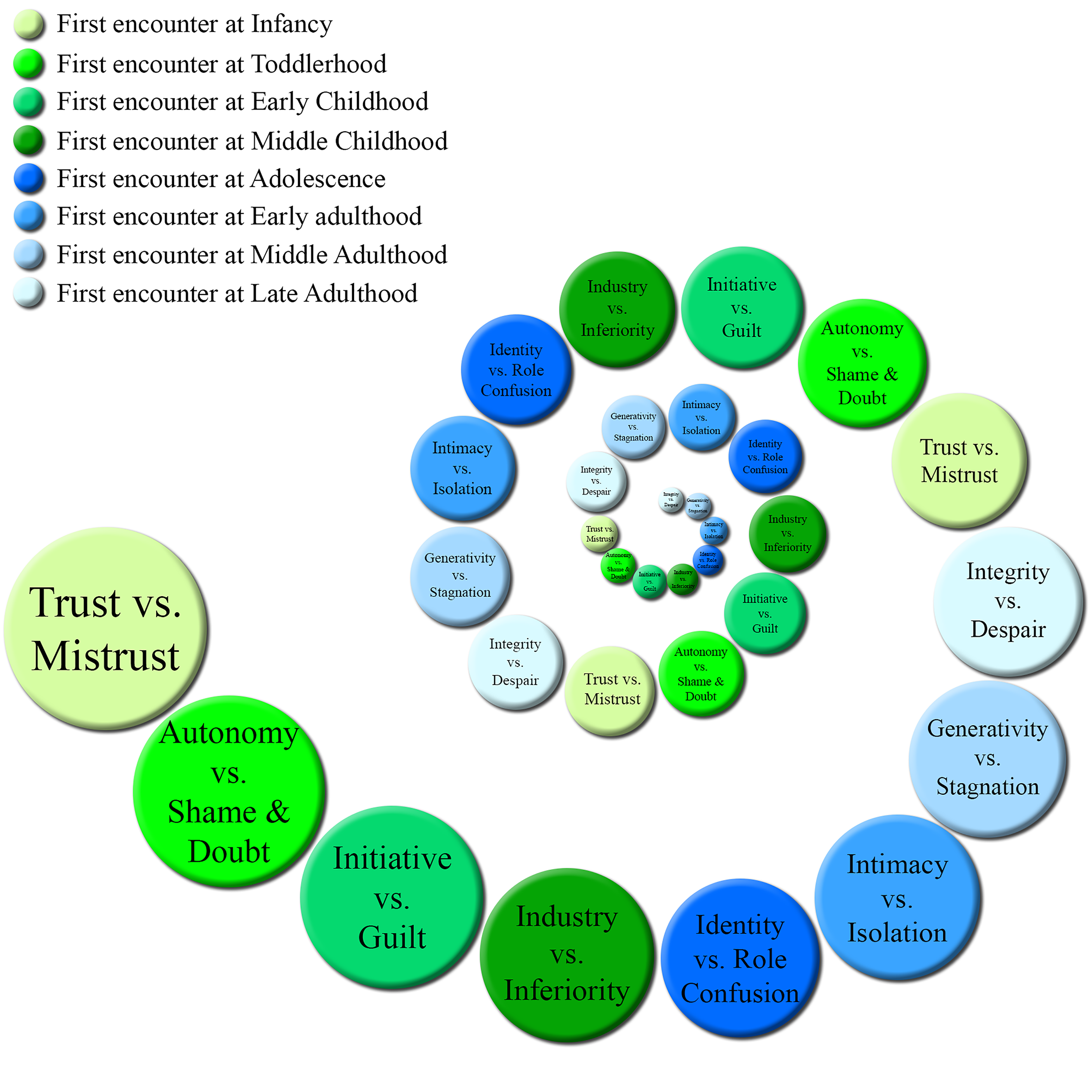
Erik and Joan Erikson theory (EJET).
EJET, with its eight stages, has been used to describe human development in older persons.11,12 Joan Erikson described the ninth stage of development, 6 when very old persons may reach the stage of gerotranscendence (GT), i.e. shifting from a rational and materialistic vision of life towards a transcendent and cosmic vision, experiencing fewer borders between before, now, and then, and between life and death. 6
Ideas about the ninth stage of development, including GT, have been used in studies about community-dwelling older persons.13,14 Challenges in life can be solved when older persons have previously learned and integrated the skills they use. In this way, autonomy can be maintained. 15
Intervention through training and supervising caregivers according to EJET
Applying EJET means that, for every care act, the caregivers strive for the PADD to experience trust and autonomy, to dare to take the initiative and use their skills, to experience being treated as a person, to feel connected with the caregiver, and to feel valuable and experience life on the whole with integrity, i.e. with wholeness and meaning. Each care act is adjusted to each PADD's abilities. It is important to include concrete examples of activities performed by caregivers that assist persons in overcoming the negative poles of the crises in training programs (examples discussed below).
There are only two research projects that have successfully applied EJET in studying the interaction between PADDs and caregivers, 16 and in monolingual and bilingual communication between PADDs and caregivers in two Swedish residential care settings, 17 which are presented here. In both studies, the interactions of caregivers and PADDs during morning care were video-recorded and analyzed using a phenomenological hermeneutical method. 18 The collected data included interviews, observations, multiple instruments, medical examinations and records. The studies are discussed in light of EJET and in relation to other studies.
Kihlgren et al. (1992–2002) applied EJET to study caregivers’ interaction with PADDs during morning care, and how their strengths and weaknesses 16 were affected. The intervention started with the provision of a one-week training program to the caregivers, then they were supported to implement their new knowledge during the following three months. A similar ward, located in another care setting for PADDs in the same city, was chosen as a control ward. The caregivers in the intervention ward were educated in different aspects of aging, ADD, communication, and environment, among others, within an integrity-promoting care plan. The care situation was assessed before and after the intervention and compared with the control group by documenting care activities and care relationships through video-recordings. Kihlgren 16 used EJET to frame the training and also in analyzing the data. Kihlgren studied crises 1–8 and strengths and weaknesses as well.
EJET, adjusted to dementia care (cf. Norberg and Sandman 19 ), framed the training, including topics such as ADD, communication, and human integrity. The caregivers were instructed in getting to know the PADDs through learning their life stories and talking to their relatives. Further, to improve their own communication skills, they learnt how to accommodate PADDs’ communication difficulties and facilitate their experience of wholeness and meaning (integrity).
The mentoring support included the researcher visiting the ward three to four times weekly and stationing a research assistant at the ward for three months. Caregivers were given opportunities for reflection and discussion regarding the care.
At the beginning of the study, patterns judged to be negative or intermediate dominated, whereas, after the training, the positive examples did. The findings showed major distinctions in the intervention group compared to the control group. After being trained in EJET, caregivers communicated in a more positive way with the PADDs as competent partners and showed humanity and respect. They supported PADDs’ attempts to act and created more opportunities for them to participate in decision-making. Both caregivers and PADDs initiated more verbal contact. The PADDs displayed increasing ability in performing everyday life activities and carried them out in intimacy. For example, they appeared to trust their caregiver, were autonomous, demonstrated rich initiative, and were industrious, mainly in their communication with caregivers. The least improved qualities were generativity and integrity, whereas intimacy increased notably. 20
In EJET, strengths and/or weaknesses are basic qualities in a person's personality that emerge as a person either succeeds or fails in resolving crises. Interpretation of how PADDs disclosed their personality through interactions and behaviors during morning care sessions in the intervention group revealed positive resolutions of crises in the form of strengthened qualities in their personalities, as a consequence of positive resolution in all eight stages of EJET (cf. Erikson and Erikson, 10 and Erikson 21 ).
Ekman et al. (1993–2005) applied EJET to study communication between caregivers who spoke Swedish and Finnish, or only Swedish, and PADDs who had Finnish as their mother tongue and thus sometimes regressed to speaking Finnish. The caregivers were video-recorded when performing care activities for PADDs during morning care sessions and interviewed about the communication problems. The caregivers were asked to concretely describe their care relationship with the PADDs, including how they perceived PADDs’ reactions to the care situations. Ekman 17 used EJET only in analysis of the collected data and places. Ekman's study placed the main focus on crises.
The findings showed that the bilingual caregivers were more able to communicate with the PADDs, especially in relation to crises 1–6 and 8. Monolingual caregivers had to rely on more transcultural non-verbal communication as they could not understand the PADDs’ verbal communication when they switched to speaking Finnish. The PADDs appeared to most easily respond to non-verbal communication and show confusion when they received double messages. 17 Monolingual and bilingual caregivers’ communication with bilingual PADDs was analyzed in light of EJET to determine which caregivers’ activity endorsed or hindered resolving the crises, as indicated by the PADDs’ reactions. 22 Monolingual caregivers’ communication was mainly negative and did not promote the crises resolutions, while the communication of bilingual caregivers was multidimensional and supported solving the crises. It seemed that monolingual caregivers understood the PADDs less. The crises concerning trust, autonomy, industry, and intimacy were most sensitive to the caregivers’ language. Solving the crisis identity versus identity confusion was supported by both monolingual and bilingual caregivers. When caregivers’ appropriate ways of communicating promoted integrity, the PADDs displayed sudden function, such as initiating a dialogue and commenting about the situation.
Solving crises and developing strengths
The following concrete examples of real care situations are mainly replicated from Kihlgren et al., 23 and Ekman et al., 22 Both observed PADDs regarding crises 1–8.
Resolution and irresolution of the crises
Trust versus mistrust that leads to the strength ‘hope’, versus the weakness ‘withdrawal’
Resolution of the crisis occurs when the caregiver expresses an expectation that the PADD can choose and act, while she is ready to help. If a caregiver wants to get close to the PADD, she tries to physically position herself at the same level as the PADD. The PADD seems to trust the caregiver.
The strength, HOPE. The PADD shows: ‘I hope, I dare’. Hope is shown vaguely, by participation (without expressing enthusiasm) and seems to be more obvious when it is lacking.
Irresolution of the crisis occurs when the caregiver mostly acts without talking. She does not try to talk to the PADD or show non-verbal signs, but instead takes over the activity from her. The PADD does not show trust.
The weakness, WITHDRAWAL. The PADD breaks eye contact and seems unreachable. Resignation and hopelessness are obvious elements of her facial expression and bodily posture.
Autonomy versus shame/doubt that leads to the strength ‘will’, versus the weakness ‘compulsion’
Resolution of the crisis occurs when the caregiver shows that the PADD has choices. She lets the PADD act undisrupted. The PADD takes this opportunity sometimes and, at other times, expresses inability and expects the caregiver to act in ways that the PADD has chosen herself.
The strength, AUTONOMY. The PADD shows: ‘I wish’, a will of his own, answers yes or no when asked, tries to do what caregiver has asked him to do, or refuses.
Irresolution of the crisis occurs when the caregiver never helps the PADD to choose or do something on her own. The caregiver decides. She orders the PADD what to do. ‘Now I will put on your sock! Lift your foot, please! Now I have put on your sock!’ A caregiver undresses the PADD, then helps her to sit on the toilet naked. The PADD shivers with shame. The PADD seems to vary between being passive or indifferent and being loud and aggressive. She shows being ashamed and doubtful.
The weakness, COMPULSION. The PADD shows: ‘I dislike’, e.g. shows dissatisfaction with the caregiver's proposal, although she does what she is told to do.
Initiative versus guilt that leads to the strength ‘purpose’, and the weakness ‘inhibition’
Resolution of the crisis occurs when the caregiver uses verbal and non-verbal communication cues to show her expectation that it is OK for the PADD to take the initiative in choosing and in doing something. The PADD is richer in initiatives, she, for example, chooses clothes, and interacts.
The strength, PURPOSE. The PADD shows: ‘I do’ verbally or in her attempts to perform an activity with a short-term aim, such as taking the towel and drying herself.
Irresolution of the crisis occurs when the caregiver does not create opportunities for the PADD to act by herself or even express herself verbally. The PADD may act ‘inappropriately’, for example, instead of washing herself, she starts to clean the washbasin. The PADD seems guilty because she was not able or permitted to take the appropriate initiatives.
The weakness, INHIBITION. The PADD takes no initiatives, and is passive, either verbally or in facial expressions and gestures.
Industry versus inferiority that leads to the strength ‘competence’, versus the weakness ‘inertia’
Resolution of the crisis occurs when the caregiver urges the PADD to act by giving positive feedback. She sometimes provides adequate time to act. She tries to impute meaning to unclear communication cues. The PADD seems to act more and collaborate in carrying out activities, for example, in helping the caregiver. She seems to be an actor, not just a receiver.
The strength, COMPETENCE. The PADD shows: ‘I can’, although fragmentarily, e.g. when zipping up her skirt by either helping the caregiver or stopping her and taking over herself.
Irresolution of the crisis occurs when the caregiver prohibits the PADD from acting and does not help to provide meaning to unclear communication. The PADD shows that she feels inferior. The PADD's self-confidence seems to be damaged when she becomes aware of having performed wrongly.
The weakness, INERTIA. The PADD is inactive or behaves slowly, sluggishly, and improperly.
Identity versus identity confusion that leads to the strength ‘fidelity’, versus the weakness ‘repudiation’
Resolution of the crisis occurs when the caregiver always describes the circumstances verbally and non-verbally to the PADD, in a gentle, logical and clear way. She addresses the PADD by name, talks about personal matters and tells her who she is, where she is located and about the time. The PADD provides acceptable responses. It seems that she is oriented to time, place, person and the surrounding events. The PADD is sometimes even oriented to the researcher's role in the situation.
The strength, FIDELITY. The PADD shows: ‘I usually do it like …’, and expresses self-esteem.
Irresolution of the crisis occurs when the caregiver does not provide any explanation about the circumstances to the PADD or does not give a clear and rational explanation. The PADD appears confused, with distorted actions.
The weakness, REPUDIATION. The PADD says, ‘It is all the same to me …’ and appears apathetic and not interested.
Intimacy versus isolation that leads to the strength ‘love’, versus the weakness ‘exclusivity’
Resolution of the crisis occurs when the caregiver strives for eye contact and physical contact with the PADD. She does not disrupt her talking and tries to communicate both verbally and non-verbally. She also adapts herself to the PADD by showing similar emotions. The communication signals intimacy.
The strength, LOVE. The PADD shows: ‘I enjoy’, expressing his positive affection to the caregiver or the situation, e.g. tries to converse with her and smiles.
Irresolution of the crisis occurs when the caregiver does not show that she understands or cares about the PADD. She seems not to care about what the PADD says. The PADD does the same, for example, closing her eyes to show that she is also ignoring the caregiver. It seems that the caregiver and the PADD act without coordinating with each other. Sarcasm or even hate is noted.
The weakness, EXCLUSIVITY: The PADD dissociates herself or ignores the caregiver, staying silent after attempts to converse, or excludes the caregiver verbally.
Generativity versus stagnation that leads to the strength ‘care’, versus the weakness ‘rejectivity’
Resolution of the crisis occurs when the caregiver converses about the PADD's life history. The PADD responds by giving an account of her life journey.
The strength, CARE. The PADD shows: ‘I give’, e.g. praises or confirms the caregiver, acts to facilitate the situation.
Irresolution of the crisis occurs when the caregiver does not appear to react when the PADD expresses that she does not feel she has contributed positively to others’ lives or has ever created something positive.
The weakness, REJECTIVITY. The PADD dismisses or criticizes the caregiver, pushes away, strikes, or screams at her.
Integrity versus despair that leads to the strength ‘wisdom’, or the weakness ‘disdain’
Resolution of the crisis occurs when the caregiver converses with the PADD regarding her life, and the meaning of being old. The PADD describes something about her life, for instance, by saying that being old is part of life and that her journey up to old age has been fine.
The strength, WISDOM. The PADD exhibits: ‘I accept, I forgive’. This can be interpreted as showing wisdom, as the PADD sees the context and forgives.
This crisis seems to reflect aggregated actions in relation to previously experienced crisis. The PADD reacts negatively and exhibits despair when the caregiver behaves negatively or ambiguously, for instance, she mimics the PADD. The PADD may not wish to exist and questions why she has ended up in this condition.
The weakness, DISDAIN. The PADD expresses her contempt of the condition, or the caregiver uses harsh, disrespectful words.
Both studies16,17 showed that EJET could be effectively used in analyzing caregivers’ actions and behaviors in communicating with PADDs and the PADDs’ responses. The studies show that it was possible for caregivers with training in applying EJET to support the resolution of all crises and also help the PADDs experience strengths. Therefore, it seems worthwhile to use EJET in the care of PADDs. Since one of the studies 16 showed that helping PADDs to resolve crises also helps them to achieve strengths, the focus here is on resolving crises, which is the main purpose of applying EJET in the care of PADDs.
The caregivers need to remember the particular problems PADDs face. For example, when they know that a PADD might have lost self-confidence, caregivers should consider strengthening it in their everyday care encounters. For example, if, during a toilet visit, a caregiver witnesses a PADD's discomfort in getting undressed and sitting naked on the toilet, the caregiver should see what PADDs need during the toilet visit. The caregiver could ensure that the PADD is well covered and feels warm and safe. The central element of care is to start from what the PADDs need. Perhaps the PADD needs accompanying or physical contact but is not able to communicate her wishes and preferences.
Taking PADDs’ life stories into account helps the caregivers to understand some of their current behaviors and helps to establish more effective connections between families and PADDs. Reasonably, if caregivers help PADDs to experience more trust, autonomy, etc., their daily lives will become more positive. 13
Comprehensive understanding and reflections
Integrity-promoting care enhanced functions and promoted a sense of wholeness and meaning (integrity) among PADDs who were cared for by caregivers who had completed the integrity-promoting care training based on EJET. 15 Some improvements included better motor activities, social ability, attentiveness, and fewer signs of depression, as well as more autonomy and initiative. The PADDs also showed higher competence in communication, for example, in praising or criticizing the caregivers.
Kihlgren's 16 and Ekman's 17 studies showed that EJET could be effectively used in analyzing the caregivers’ actions and behaviors in communicating with PADDs and the PADDs’ responses. In Sweden, there is an increasing number of PADDs with mother tongues other than Swedish. The bilingual caregivers in Ekman's study 17 had mainly more positive relationships with bilingual PADDs than with monolingual PADDs. The PADDs with Finnish as mother tongue showed higher function when cared for by caregivers who spoke both Finnish and Swedish. The solution of crises was promoted by the bilingual caregivers, while it was mostly hindered by monolingual caregivers. The caregivers demonstrated that they play a big role in helping the PADDs in the resolving the crises. They created opportunities for the PADDs to make decisions, so they expressed that ‘I dare’, ‘I want’ and ‘I can’. Otherwise, it could have been a negative experience for PADDs, resulting in refusal, or protest. An interesting aspect is the caregivers’ ability, skill and understanding of the PADDs’ situation.
Caregivers getting to know the PADDs, and their life stories was important in establishing good communication. To understand how PADDs express themselves helps caregivers understand how they can help the PADDs in resolving the crises. Ekman and Norberg 24 showed that the caregivers who cannot communicate well with PADDs feel that they have lost their commitment. If they fail in establishing good communication with PADDs, they spend less time with them and reason that they do not need talk to them, 24 which in turn results in negative interaction spirals.
Caregivers are dependent on non-verbal communication when PADDs revert back to their mother tongue and caregivers do not understand what they say. This is manageable, since non-verbal communication is often transcultural. 23 Monolingual caregivers might not realize that PADDs, who may understand them, are unaware that they themselves have switched to Finnish, and thus are using an inadequate language. The caregivers might become frustrated and transfer negative emotions to PADDs. PADDs with challenging behavior were isolated by their caregivers who felt unable to help them. 25
PADDs show negative reactions or confusion when caregivers send double signals, for instance, by conveying positive messages verbally but showing negative messages non-verbally. This is in agreement with a study 26 that showed caregivers’ interaction with PADDs had impact on the PADDs’ level of performance. PADDs’ reaction to caregivers’ acts often relates to more than one crisis, the content of a sentence could, for example, concern one crisis, and the tone of voice another. 17 (p.26)
In both projects the same general picture appeared; namely, that the PADDs showed unanticipated capability when the caregivers promoted the PADDs’ integrity through a set of communication. 15 Ekman emphasizes that having enough time is important. She writes that ‘caring in mutual recognition, communion and love’ is more than using adequate techniques. 17 (p.41) She further develops this idea emphasizing the need for confirmation and communion. 22 Ekman 17 refers to Hegel 27 stating that humans become conscious of themselves by being recognized by another. Caregivers supporting a PADD by avoiding making demands on her, and confirming her as a significant and distinctive person, promote moments of lucidity. 28 Communion presupposes that the caregiver attunes to the feelings of the PADD, which opens up possibilities for sharing understanding. 29 Hansebo and Kihlgren 30 emphasize touch, eye contact, and mutuality. Adopting adequate techniques when communicating with PADDs is important. 31 When PADDs do not realize what is taking place, who is involved in the situation and what their roles are, communication becomes fragmented. Caregivers can tackle this by respecting PADDs, showing interest and acknowledging the role of PADDs in care activities. The caregivers should try to achieve a ‘mutual understanding of the shared situation’. 31 (p.366)
The importance of using EJET in the care of PADDs and caregiving practices and its feasibility have been emphasized.32–34 However, there are not many studies using EJET as a framework in designing interventions for improving quality of care.
Caregivers getting to know PADDs, and their life stories, was important in establishing good communication. To understand how PADDs express themselves helps caregivers understand whether the PADDs are successful, or they fail in resolving the crises. Ekman et al. 22 showed that the caregivers who cannot communicate well with PADDs feel that they have lost their commitment. If they fail in establishing good communication with PADDs, they spend less time with them, which in turn results in negative interaction spirals.
We call for using EJET in educating and training caregivers as well as suggesting it as a suitable theoretical foundation to support caregivers in tailoring care to each PADD. Caregivers play a crucial role in helping PADDs in resolving their psychosocial/developmental crises. The environment should be secure and supportive for PADDs to express their feeling of control, thereby maintaining autonomy and self-directedness. When the caregivers show that they have time for PADDs, they give them a feeling of being significant. 35 Caregivers should be sensitive to signs that PADDs display in search of autonomy and integrity. Each nursing care plan should include measures which assist in establishing trust, maintaining autonomy, encouraging initiative, promoting industry, preserving identity, and so on. The form and content of nursing strategies should consider the uniqueness of all PADDs and their special battle in each stage of development, and be tailored to each crisis. Prior to performing any activity, caregivers need to weigh its impact on the strength of PADDs in overcoming the crises.
Conclusions
Using Erik and Joan Erikson theory of human development can operate as an efficient and feasible framework for healthcare staff to support PADDs in their daily lives and care. This article demonstrates the significant importance of having a good care structure to foster competent caregivers. The environment and the caregivers can hinder or assist the resolution of developmental crises and the establishment of strengths for PADDs, and both can be improved by implementing EJET that enhances functions and a sense of wholeness and meaning for PADDs. The article calls for reintroducing utilization of EJET in dementia care including care of PADDs.
Footnotes
Acknowledgements
We would like to express our sincere gratitude to the late Professor emerita Sirkka-Liisa Ekman, with whom we started this study together, for her valued contribution.
Funding
This research received no specific grant from any funding agency in the public, commercial, or not-for-profit sectors.
Conflict of interest
The authors declare that there is no conflict of interest.
