



Abstract
Firefighters around the world have the ability to provide first aid before ambulance staff arrive. In Sweden, this assignment is called ‘While Waiting For the Ambulance’ (WWFA). There is limited knowledge about WWFA in rural environments, therefore the aim of this study was to describe the WWFA assignment in a rural environment from the perspective of the firefighters and the ambulance staff. A descriptive design was used with a reflective lifeworld approach, including 16 telephone interviews with firefighters and ambulance staff. The COREQ checklist was applied. A directed responsibility emerges towards affected persons with a situation-adapted attitude during alarms in a WWFA assignment. The firefighters and ambulance staff are each other’s support with a simultaneous need for support from involved organisations. To strengthen this support, training is required, consisting of interprofessional training, feedback from relevant organisations about first aid efforts and expansion of WWFA assignments. Finally, there is a need for a more coordinated picture in order to provide better conditions for future action by the organisations involved, with increased opportunities to save lives in individual local environments.
Introduction
In rural environments around the world, access to ambulance resources in an individual’s immediate area are limited. Responders like firefighters, police and home healthcare nurses are important resources if they are available, to reduce suffering and save lives when a life-threatening condition occurs.1–6 Response time is important for survival, i.e. the interval between an emergency call to the Emergency Medical Communication Center and the arrival of help at the site. When emergency medical dispatchers (EMDs) have the possibility to direct responders to perform first aid before the ambulance staff arrives, an opportunity to improve the outcome of the affected person’s situation arises.7–9
Since the 1990s, there has been collaboration between emergency medical service (EMS) and municipal rescue services in Sweden. In areas with long response times firefighters (full-time, part-time, or volunteer) carry out first aid before ambulance staff arrive, assignments called ‘While Waiting For the Ambulance’ (WWFA).5,10 These assignments are regulated by the National Board of Health and Welfare. 11 Firefighters involved in WWFA assignments undergo first aid training with cardiopulmonary resuscitation (CPR), and an automatic external defibrillator also provides safety until the ambulance staff arrive. Over the years, WWFA assignments have spread and are now present in 92% of Swedish municipalities. 10
In Sweden, since 2005 at least one registered nurse must be present in each ambulance, often with a specialist degree in ambulance-based healthcare,12,13 and frequently in collaboration with an emergency medical technician (EMT). 11 An alarm call to the Emergency Medical Communication Center (EMCC) that results in prioritising a level 1 alarm, an acute life-threatening condition leading to the immediate dispatch of an ambulance by an EMD, means that firefighters in WWFA assignments are dispatched to the site based on local alarm criteria. Based on information from the EMD, ambulance staff prepare for the assignment, 14 and they feel responsible for the affected person and the relatives in the situation. 15 When ambulance alarms involve specific situations, for example seriously ill or injured children, or when ambulance staff know an affected person personally, it causes worry and is experienced as stressful, especially for those with limited experience and knowledge.16–18 Support from colleagues is important for handling stressful experiences and for letting go of a case. 19 Full-time firefighters as first responders dispatched from EMDs describe the situations including CPR as complex, where limited information increases stress, whereas detailed information is crucial for preparedness. 20 Volunteer firefighters with high levels of exposure to trauma and who are involved in specific types of critical incidents such as being trapped in a dangerous situation or being assaulted by other people, have an increased risk of mental health problems. 21 Knowledge is limited about the experience from the point of view of firefighters and ambulance staff in WWFA assignments. Therefore, the aim of this study was to describe WWFA assignments in a rural environment from the perspective of the firefighters and the ambulance staff.
Methods
Design and research approach
In order to describe experiences of a specific phenomenon, a descriptive design with a Reflective Lifeworld Research (RLR) approach 22 was used, founded on phenomenology, 23 with the purpose of describing the essential meaning and variations of a phenomenon. 24 The phenomenon in this study was WWFA assignments in a rural environment. The methodological principles within RLR were followed: open and reflective with a ‘bridled’ understanding.22,25 That is, to be as open and true to the phenomenon as possible, with a reflective attitude, where one’s own understanding must be ‘bridled’. Take nothing for granted and not decide the indefinite too quickly, however, use an open attitude to see something new through the analysis. With this approach, the chances of gaining new knowledge increases. 24 These methodological principles are seen as a basis for validity, and the possibility to practice the principles in varying contexts.22,24,25 The study was also in line with the Consolidated Criteria for Reporting Qualitative Research checklist. 26
Context
The study was conducted in a northern county in Sweden with an area of around 100,000 km2 with a population of 2.5 persons/km2. The county is classified as having a subarctic climate, which means short summers and cold winters, where temperatures can sink to –40 degrees Celsius. 27 The county has 14 municipalities, with a total of 22 ambulances manned around the clock and one physician-manned helicopter. During 2011, WWFA assignments started up in nine municipalities in areas with more than 200 inhabitants and with a 30-minute response time until the ambulance arrived. Terms of employment among firefighters in the county’s municipalities varied at WWFA assignments: part-time firefighters with on-call service and volunteer firefighters, meaning they had no specific duty of service, but responded to an alarm if possible. In total, 200 part-time and volunteer firefighters were trained in a first aid programme. The WWFA alarm plan included life-threatening conditions such as upper airway obstruction and unconsciousness (whatever the cause) with trauma, prioritising a level 1 alarm. The nearest ambulance resource and firefighters was dispatched by an EMD. Approximately 105 WWFA assignments occur per year in the county. The number of assignments varies between fire stations. Collaboration between firefighters and ambulance staff took place during the WWFA assignments.
Selection and description of participants
Inclusion criteria for this study were as follows: firefighters employed either as part-time staff or as volunteer firefighters, ambulance nurses, and EMTs who had participated in WWFA assignments in coastal and inland areas. Information about the study was distributed to the relevant managers in the respective organisations, and written approval was obtained from all the managers involved. In connection with staff meetings, information about the study was provided both verbally and in writing, and those interested in participating were asked to contact the first author by phone or email. In all, 16 staff participated. For sociodemographic and clinical characteristics of the ambulance nurses (registered nurses with specialist degree in ambulance health care), EMTs, firefighters (part-time and volunteer), see Table 1.
Sociodemographic and clinical characteristics of ambulance nurses, EMTs, part-time and volunteer firefighters (N = 16).
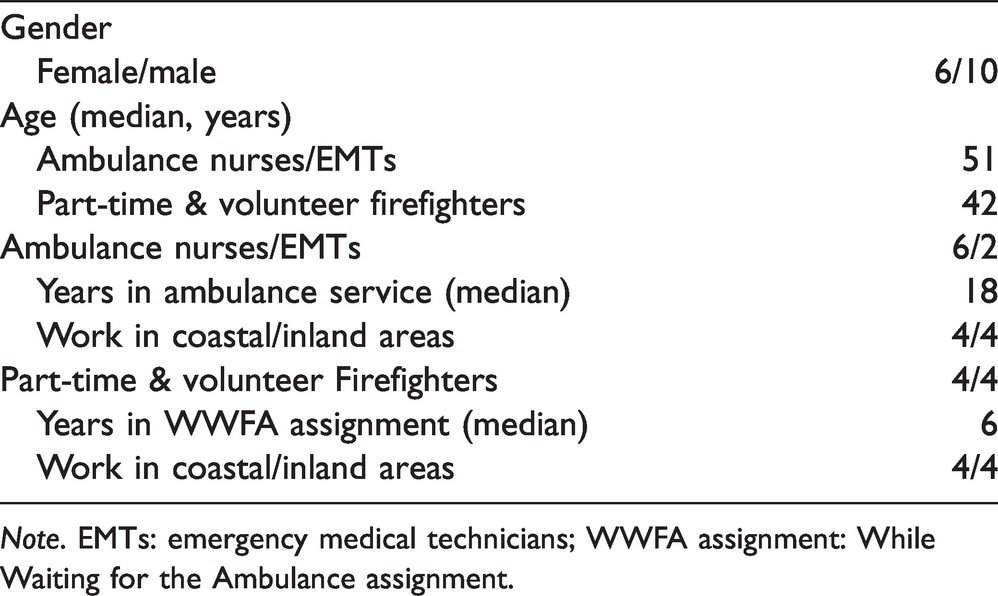
Note. EMTs: emergency medical technicians; WWFA assignment: While Waiting for the Ambulance assignment.
Data collection
Individual telephone interviews were conducted by the first author between January and May 2018. Telephone interviews were conducted either during the participants’ workdays during their service hours, on call or on a day off according to the wishes of the participants. However, participants sat in a secluded area in the work environment or at home, so as not to be disturbed. The interviews began with the following open-ended initial question regarding the phenomenon22,24 ‘Please describe your experience of WWFA assignments in a rural environment’. The informants were encouraged to tell their own stories as freely as possible, and their stories led to new follow-up questions, according to the principles of RLR.22,25 Depending on what the informant relays about experiences of the investigative phenomenon, appropriate follow-up questions are asked in order to gain as rich and detailed a description of their experience as possible, for example, ‘Please describe this in more detail’ or ‘Please give an example’.22,24 The interviews were digitally audio-recorded, lasted 45–90 minutes and were transcribed by the first author.
Ethics approval and consent to participate
The ethical principles were followed in accordance with the Helsinki Declaration. 28 Approval was obtained for the study by the Regional Ethics Review Board (2016/270-31). Before the interviews started, the information about the study aim was repeated including the fact that participation was voluntary with the right to withdraw at any time without giving any reason. Written informed consent was obtained from all participants. The interviews were coded and data presented so that confidentiality was retained. Only the first author in the study has access to the participants’ identities and interviews.
Data analysis
An RLR approach was chosen for data analysis, 22 where meanings of the descriptions were analysed. 26 The analysis was performed in collaboration by all authors; however, data were discussed and critically reviewed with the first and last authors and thereafter the co-authors. The transcribed interviews were read with an open mind several times to create an overall picture. Meaning units related to the phenomenon were searched for, and the meanings were described, then grouped together into patterns. During analysis, the described patterns were seen as figures against others in the background and vice versa. Furthermore, the patterns were combined into clusters and then related to each other with the phenomenon in focus. In this dynamic work, a movement was performed from whole to parts and back again to a new whole, i.e. from the whole interview, to meanings, to the essence and back again. This movement led to the gradual emergence of invariant meanings, the essence, the most abstract level of the phenomenon. 24 The presentation of the findings follows the principles of RLR: 22 a general description of the investigated phenomenon with an essence. Further, the variations and nuances of the phenomenon are described in four constituents with quotations from the interviews.
Findings
WWFA assignments in a rural environment aim for directedness of responsibility towards affected persons, where a lengthy arrival time to the affected person is the utmost enemy. Responsibility that simultaneously includes individual, shared and common responsibility is taken before, during and after an assignment. Double responsibility emerges, meaning a sense of responsibility for those affected persons where immediate help is provided and also for affected persons to whom help cannot be given. Responders are each other’s support, while at the same time being interdependent for the support to be given. There is a supportive function towards those involved, with a simultaneous need for responders to receive support from involved organisations. Support that includes transparency in information and dialogue facilitates mental preparation for the assignment itself and improves the care for the affected person. Regardless of circumstances, a situation-adapted strategy for varying conditions and occasions is needed. The WWFA assignment is, itself, in a grey zone between the involved organisations where strategies are lacking for the assignment.
Responsibility in various dimensions
The concept of WWFA assignments in a rural environment means responsibility in various dimensions: the individual, shared and common, with directedness towards the affected person. In terms of individual responsibility for an affected person (similar to a defence lawyer) a responder reacts when the EMCC does not dispatch a WWFA assignment according to current routines or prevailing medical conditions. An ambulance staff member said, ‘Then I need to go in as a medical nurse … override their decision’. A similar example of responsibility is to check with the EMCC that a WWFA assignment has indeed been initiated. Individual responsibility is taken when the alarm goes off. Whatever is being done is put on hold immediately in order to get to the station as quickly as possible to prepare a suitable vehicle for the alarm. When a WWFA assignment is performed by one individual, the responsibility is overwhelming for some. On the other hand, it is rewarding for others to assume individual responsibility with a clear sense of usefulness. A firefighter put it, ‘Quite simply, very much can be done on one’s own, as opposed to waiting for the ambulance which might take 1 to 1½ hours. One can confirm the alarm and give an overview’. Responsibility is taken that help arrives for the affected person, even in situations where two alarms come in at the same time, for example when a fire alarm and a WWFA assignment arrive simultaneously, and where a fire alarm is prioritised, according to WWFA alarm plan. Although responsibility is shared, an overwhelming responsibility is experienced when children are affected by life-threatening conditions or where ongoing CPR is meaningless and the wait for an arriving ambulance is over an hour long. Handing over medical responsibility to oncoming ambulance staff gives both a positive feeling and a sense of relief alongside a continued sense of common responsibility for helping relatives and assisting with practical things. Medical responsibility for an affected person is taken by the ambulance nurse as a matter of course, as is the responsibility to distribute tasks to the staff on site. The common responsibility experienced during a WWFA assignment is made clear at the end of an assignment when everyone thanks one another for their efforts. An ambulance staff member said, ‘Thank you for good cooperation’. The existence of a sense of responsibility after the ambulance’s departure is evident when firefighters help with various tasks that are both their own and shared. This is important, both for those involved in the situation and for the structure of the WWFA assignment. A societal responsibility has matured over time in responders themselves, in daring to run to and not from an incident when people need help, regardless of whether the situation is somehow professionally or privately related. A firefighter reported, ‘The WWFA assignment has made me a better person’.
Supportive function with a simultaneous need for support
The concept of the WWFA assignment in a rural environment means both a supportive function for everyone involved in the situation with a simultaneous need for support. The moment ambulance staff receive information from the EMCC that firefighters have been alerted and are on their way to the affected person, their highest peak of stress level is cut off. An ambulance staff member explained, ‘It [firefighter support] is a relief for me, and [the fact that] that the patient receives help, means both [I and the patient] are supported. It is like double relief’. Timely and clear information from the EMCC provides important support; it facilitates the mental preparation for what is expected at the location. The support provided by the firefighters’ local knowledge of the locations is also of considerable value. It means that the affected person gets help faster, and the ambulance staff receive clear directions from the firefighters on site. They feel safer and can adjust their driving speed. The dialogue between ambulance staff and firefighters provides support; they are strengthened in their commitments. A firefighter stated, ‘Contact with the ambulance staff who come on site feels really good, to be able to talk to them, [discuss] what the situation is, and ask for advice’. The firefighters’ early support in the situation means that the worst chaos has settled and a calming atmosphere is found upon arrival of the ambulance staff, where their medical skills are, in turn, valuable to everyone. With each other’s support, more advanced medical measures are initiated without any further loss of time. In addition, the support means that the affected person is transported in a safer and more dignified manner regardless of their condition. An ambulance staff member said, ‘There was an honourable handling of the body even though it was not alive’. The support present amongst firefighters in a WWFA assignment facilitates future assignments; both positive and negative events are discussed regardless of the time of day, especially when children or relatives have been affected. When an assignment has been performed by an individual firefighter, or when ordinary work takes precedence, a reflection is either performed using the individual’s strategies, or a reflection fails to take place. When support from ambulance staff is received, especially when they describe their appreciation, self-confidence is strengthened. A firefighter reported: ‘They gave me the first feedback I needed to gain some confidence in this’.
Situation-adapted approach under varying conditions
The concept of WWFA assignments in a rural environment means a situation-adapted approach to alarms and surrounding environments. For incoming alarms, there is a respectful approach, because now it is about people whose lives are in danger and time is of the essence. As one firefighter put it, ‘We know that time, time is our greatest enemy’. In an assignment, the turnaround is abrupt, from everyday lives or regular work one moment to going on an alarm to an affected person the next moment. Stress levels increase, especially during the very first alarms and when the time between WWFA assignments varies. Nevertheless, a certain amount of stress does bring added value to performance ability. Both security and safety approaches are provided by work tasks, and they are distributed before arriving at the site of the affected person. A respectful approach means observing the external and internal environment with preparedness for whatever may happen and responding to all involved. Of respecting each other’s skills and medical knowledge in the event of practical problems, a firefighter said, ‘An ambulance nurse showed us that one pupil was bigger than the other, so it was a great training opportunity in the middle of everything’. When circumstances are beyond the ordinary, a situation-adapted approach emerges. One takes a step back. The place is scanned at surface value so as not to be emotionally overwhelming. A firefighter explained, ‘You see what you need to watch for, but you don’t look … so deeply’. The uniform likewise provides such a distance; it provides a protective barrier that facilitates concentration on care, especially where children or relatives are concerned. A realistic approach means realising that most life-threatening illnesses are not possible to remedy. Feeling at peace in this realisation, a firefighter said, ‘You constantly think that you have done something wrong, … you cannot let it go, must think all the time … we did everything we could, but this time it was not enough’.
Working in a grey zone between the involved organisations
WWFA assignments in a rural environment involve working in a grey zone between all of the involved organisations with an absence of strategies when there are shortcomings and development needs. Shortcomings in managing WWFA assignments occur in more than one way. For example, due to ignorance of alarm criteria and where the assignments are available, affected persons may not receive the help they need. Tensions then arise. An ambulance staff member described, ‘If I can see on the alarm that this is a clear WWFA alarm and it is not drawn as such I get frustrated. “You are not following the guidelines of the existing alarm plans. These people need help now!”’ Similarly, there is a shortcoming when no volunteer firefighter in a rescue service is able to be present for an alarm, or when there are places where WWFA assignments are not available at all despite the need for them. Another issue is localising an affected person. Information from an EMD is not always optimal regarding the address, despite responders’ local knowledge of the area, so an affected person may therefore be difficult to find. A firefighter said, of his local area, ‘If they [EMD] say the box number, we don’t have a chance to find the address … we get a name, then we know exactly’. Similar problems arise when EMDs use abbreviations or terminology that is difficult to understand in the alarm text.
A shortcoming within WWFA assignments also has to do with which responders are authorised to administer painkillers. Tension arises for ambulance staff when the arrival time is long for an affected person in severe pain, and where the firefighters that are present do not have the medical authority to administer painkillers. Yet another challenge is maintaining current skills as well as adding new skills. When there are few alarms, tension increases due to concern about maintaining acquired skills. Practice opportunities are few, as are meetings with each relevant organisation for feedback from WWFA assignments. A firefighter explained, ‘It would be good to get feedback, but as it is now, there is no such system’. Tension and ambivalence also exist in regard to expanding technical equipment that measures vital parameters in WWFA assignments. On the one hand, additional knowledge is required, but there is concern that the focus on the affected person will be lost because it is directed more towards the technical equipment. On the other hand, higher technical knowledge leads to more measured values, which in turn provides a clearer picture of the condition of the affected person, thereby facilitating treatment.
Discussion
The phenomenon of the study was WWFA assignments in a rural environment. The main findings of the study emerge as directedness of responsibility towards affected persons and to those involved on site with situation-adapted strategies. They are each other’s support in WWFA assignments with need for external support from involved organisations, keeping in mind that a quick arrival time to an affected person is of the essence. Further, the WWFA assignment is, itself, in a grey zone between the involved organisations where strategies are lacking for the assignment.
To take responsibility for affected persons
Firefighters and ambulance staff experience a double responsibility. This can be understood as firefighters and ambulance staff feeling responsible for affected persons on site, but also for those who are not given an alarm dispatch due to varying circumstances outside their control. Taking responsibility for other people’s lives is a complicated phenomenon, but with a thoughtful perspective, care can be structured and implemented towards the affected and significant others. 29 The sense of responsibility experienced by firefighters and ambulance staff exists and persists, regardless of whether or not alarms are dispatched to affected persons. Taking responsibility takes place in several variations: it is seen by some as stimulating and personally affirming, the experience leading one to feeling like an even better person. Taking responsibility is understood as ‘being’ and ‘doing’, which means a continuous movement between these two concepts in relation to one another. 30 This can lead to ethical conflicts in some situations.29,31,32 The findings describe that, in some situations, overwhelming responsibility leads to frustration and tension, especially when lengthy CPR is in progress though the affected person is beyond all rescue and the time for arriving ambulance staff is expected to be 30 minutes to over an hour. Taking responsibility for those involved with a supportive function and considering their needs when the affected person is beyond all rescue and continued CPR is meaningless is necessary yet difficult.33,34 There is support for this, regarding guidelines for initiation or withdrawal of CPR in prehospital environments. 35 Firefighters and ambulance staff are well-trained clinically, such as in CPR skills and in solving emergency situations, but they are not trained and prepared for all emotional and ethical conflicts.31,33–36 It is appreciated by those involved when firefighters stay and talk a while after the ambulance departs with the affected or deceased person, as the grief then does not have to be carried alone but is shared in the moment. 37
To be each other's support in WWFA assignments
The findings describe the importance of being supportive towards one another, and at the same time being interdependent as the support is given. Interdependence is an underlying concept in collaborative processes, and it has been developed with two purposes in mind: serving the patient’s needs and meeting the needs of professionals. 38 Without this symbiosis, imbalance occurs at the expense of affected persons who need emergency help in their local environment. The firefighters’ medical knowledge and the ambulance staff’s knowledge differ from one another, as do their experiences and assignments. Firefighters are initially trained to respond to life-threatening situations. 11 Ambulance staff, on the other hand, have a broader variety of work, which includes both life-threatening illness situations and less serious illnesses.12,13 Regardless of this difference in medical knowledge, the firefighters’ presence at WWFA assignments helps affected persons, and their presence serves as extended hands and eyes for ambulance staff. Ambulance staff, in turn, support the firefighters in their WWFA commitments.
Need for external support in WWFA assignments
The findings describe that external support from the EMCC is important when correct information about the alarm exists. The level of mental preparation decreases and stress increases when external support is not functional.16–18,20,39–41 The findings describe the reality that not everyone’s life can be saved although everything has been done for the affected person with a sense of security and self-compassion. Self-criticism is common in prehospital situations where responsibility is taken in assessments and actions towards affected persons.21,30,41,42 In traffic accidents, first-responder firefighters and police officers have an awareness that not all lives will be saved, and this awareness comes with acceptance. 39 There are indications that there is a relationship between self-criticism and depression, but with improved levels of self-compassion, mental protection rises. 43 The findings describe that practice opportunities are few with the organisations relevant to the WWFA assignment, and feedback from WWFA assignments to the relevant organisations is missing. In order to reduce stress, feedback about the cases was requested amongst the relevant organisations to improve future assignments.20,44 Professional development about emotional regulation and empathy, along with simulations of realistic on-scene environment situations, encourage first responders as a whole.38,40,44–48
Work between organisations, in a so-called grey zone
The findings describe that working between organisations that lack strategies for shortcomings and development needs is the equivalent of working in a grey zone. In various situations, tensions arise, e.g. affected persons may not receive the help they need or there may not be the willingness to develop the assignment so that more affected persons receive emergency help in their immediate area. It remains obscure which of the organisations involved are to take command and listen to the experiences of firefighters and ambulance staff in WWFA assignments. In other words, the WWFA assignment exists in a grey zone in need of more clarity.
One aspect in the WWFA assignment, if medically trained staff arrive before an out-of-hospital cardiac arrest (OHCA) occurs, more affected persons can be helped in an earlier stage of acute life-threatening conditions. 49 Distinct symptoms such as chest pain and/or shortness of breath are important predictors of survival before a person collapses.49,50 In witnessed OHCA, typical chest pain with a median of 120 minutes appeared in 25% of 274 patients, and in 33% with a symptom period of less than 1 hour. 51 Survival rate increases sevenfold if ambulance staff arrive before an OHCA occurs, and this is a more cost-effective alternative than focusing on reducing response time to affected persons who already have OHCA. 49
The findings describe that tension arises when the ambulance arrival time to the site is long and the affected person has severe pain and the present WWFA firefighters do not have the medical authority to administer painkillers. In order to be able to administer pain relief to affected persons while waiting for ambulance staff, intranasal ketamine has been tested in various emergency prehospital situations with good results, with pain reduction and few side effects.52,53 In a future development in WWFA assignments, it would be helpful if first responders could administer pain relief to affected persons. In this study, affected persons in need of emergency help live in a sub-Arctic climate, so in order to reduce the response time, development is needed towards optimally utilising WWFA staff with different professions and knowledge in a rural environment.5,54,55 Challenges still exist to provide opportunities for new services to step in before the arrival of ambulance care and emergency services, such as supporting home healthcare and accident-prevention strategies. 55 There is room for growth within the WWFA assignment to ensure that there are strategies that bridge the grey zone between relevant organisations, addressing shortcomings and expanding organisational development.
Methodological considerations
The recruitment of participants in this study was based on the fact that information about the study was provided by managers in each organisation to relevant staff. Interested staff contacted the first author, and all interested staff participated in the study. There is no additional information available. Due to the long geographical distances in the county, individual telephone interviews were used for data collection, with a risk of data loss and impact on data quality due to lack of visual impressions. 56 An advantage to telephone interviews, on the other hand, was that they enabled a more relaxed way of sharing sensitive experiences compared to face-to-face communication.56,57 To minimise the risk of misinterpretation, all interviews and transcriptions were conducted by the first author, yet the transcripts were not returned to the participants for comments. An RLR approach22,24,25 was used as an appropriate approach for describing firefighter and ambulance staff experiences of WWFA assignments in a rural environment. The whole research group had experience in emergency care, which brings with it a risk of taking things for granted, but on the other hand lends an advantage when subject-specific questions arise. However, objectivity was strengthened by slowing down the understanding of emerging meanings without losing curiosity and seeing the otherness,22,24 meaning an emerging double responsibility. Generalisability is reasonable under similar environments and circumstances.
Conclusions and implications
Knowledge has emerged that the firefighters in WWFA assignments and ambulance staff are each other’s support. This mutual aid generates added value for the affected persons, the callers and for the first responders themselves. The willingness to help and take responsibility for affected people are also significant. In addition, there is a lack of operational development for the WWFA assignment as a whole, and there is a need for the assignment itself to be seen in a larger context, erasing boundaries between the organisations involved.
There are knowledge gaps within the recruitment of firefighters for WWFA assignments in a rural environment perspective, as well as around how digital technology can improve emergency care for both first responder and affected persons. One measure of interest is whether firefighters in WWFA assignments can connect an electrocardiography (ECG) to an affected person who has chest pain, and then send it digitally for assessment; this measure should facilitate the planning of ambulance resources in a rural environment. In areas where medical assistance is delayed, staff within home care and/or primary healthcare nurses need to assist. Furthermore, interprofessional simulated training opportunities are needed as well as feedback and support possibilities, which in turn improve the emergency care for both affected persons and first responders. Finally, there is a need for a more coordinated picture in order to provide better conditions for future action by the organisations involved, with increased opportunities to save lives in individual local environments.
Footnotes
Availability of data and materials
Transcribed interviews from participants are not publicly available, but their experiences have been described under the results.
Conflict of interest
The authors declare that there is no conflict of interest.
Author contributions
HNLJ designed the study, conducted the interviews, participated in the analyses of data and drafted the manuscript. CE designed the study, participated in the analyses of data and drafted the manuscript. AE and BF drafted the manuscript. All authors read and approved the final manuscript.
Acknowledgements
A heartfelt thanks to Kamprad Family Foundation and department of Health Science, Luleå University of Technology for economic support, in order to accomplish the study. Also, a great thank you to firefighters and ambulance staff for their willingness to share their experiences in WWFA assignments.
Funding
The study has been funded by the Kamprad Family Foundation. The foundation had no influence on the research.
