




Abstract
Given the rapid pace of change and globalization, leaders in healthcare must be educated to think globally even if they only act locally. This short article discusses the experience of a collaborative online international learning (COIL) project between the University of Iceland (UI) and the University of Minnesota (UMN) in the United States. The project was embedded into graduate courses in nursing administration and leadership. COIL courses require substantial collaboration but, when done well, COIL transforms teaching so that global awareness of students and faculty is enhanced and widens their horizons as well as their cultural sensitivity.
Introduction
Given the fast pace of change and globalization, nursing leaders must be educated to think globally even if they only act locally. Furthermore, from rapidly emerging epidemics to the health impacts of climate change, we are beginning to understand that the health of any nation is inextricably connected to the health of all humans and the planet. Future nurses must be prepared to lead global initiatives to address global health threats and partner beyond borders to create global health opportunities. The purpose of this article is to share the experience of a collaborative online international learning (COIL) project between the University of Iceland (UI) and the University of Minnesota (UMN) in the United States. The two universities have a long-standing formal relationship, including in the healthcare sciences. The project was ingrained into graduate courses in nursing administration and nursing and healthcare leadership at the two universities. COIL courses require substantial collaboration and true partnership, and, when done well, COIL transforms teaching so that global awareness of students and faculty is enhanced and widens their horizons as well as their cultural sensitivity leading to a true glocal approach.
Collaborative online international learning
COIL was based on the pioneering work of Jon Rubin, Film and New Media Professor at the State University of New York (SUNY) in the United States. 1 In many ways, COIL is comparable to the online international learning (OIL) method also being used at the University of Coventry in the United Kingdom. 2 Even though COIL and OIL are relatively new concepts used for online collaborative learning between countries, comparable older projects under different names exist within several disciplines.3,4 A review of literature did not reveal other publications or reports on the use of COIL within nursing or medicine; therefore this project appears to make a unique contribution to the growing list of disciplines using COIL (see COIL projects listed on the SUNY website http://coil.suny.edu/page/examples-coil-supported-courses).
Key elements of COIL are that two or more schools from at least two different countries co-teach using online technology and co-created learning objectives. COIL courses have a determined timeframe, preferably of a few weeks to a few months, where students follow the same course content, critically discuss their ideas and thoughts, and participate in shared assignments. The driving aim of COIL is to develop the global perspectives of students and faculty as well as their cultural competency. COIL educates future nurses to recognize when a local problem would benefit from insights, best practices, and collaboration with nurses across the globe. Students who participate in COIL experience a paradigm-shifting encounter where problems that are unique to their setting become clearer and problems shared by the global community or village are illuminated.1,5,6 This shift in worldview is especially important for nursing students who may lack previous experience with international travel or do not have significant experience with diverse cultures. Full partnership and collaboration set COIL apart from traditional international education. This offers an optimal way of developing a global approach. As stated by Nelson Mandela, ‘Education is the most powerful weapon with which to change the world’.7(p.xv) Global thinking of healthcare professionals, including cultural sensitivity, has become the requirement for safe societies, and the global approach in healthcare no longer refers to working abroad or internationally, but is primarily a shift in consciousness and awareness in how our work affects all aspects of the world. 7
Developing a COIL project
The purpose of the shared COIL courses was to prepare students to become global leaders in nursing and healthcare. The project was built on the strong foundation of an existing and long-standing collaboration between the University of Iceland (UI) School of Nursing and the School of Nursing at the University of Minnesota (UMN) in the United States. In the spring of 2014, the course coordinators (HB and TP) met for the first time during an international course hosted by the University of Iceland Faculty of Nursing. They quickly discovered a shared interest in education innovation and enhancement of global nursing leadership. Both faculties committed to be partners, embedding COIL into their leadership courses. The aim was to be ready to implement COIL during the 2016 spring semester.
Ideally COIL partners will have the opportunity for face-to-face planning of their collaboration. The importance of this step cannot be over-emphasized as much of the success is built on the relationship between faculty from two different nations and cultures. The preparation phase is extremely important for a successful COIL experience. The following need to be identified and determined: 1) the objectives and extent of the project, 2) the content and timing of the common assignments, 3) the website hosting the COIL, 4) the evaluation and grading of the common assignments, 5) the technology to be used, and 6) ways to evaluate the knowledge, growth, and partnership of the involved students and faculty. 4 A grant from the Carol Pazandak Iceland-Minnesota Travel Fund allowed this project’s faculty to meet for a few days in the summer of 2015 to complete the preparation phase.
The preparation for COIL was facilitated by Thorunn Bjarnadottir, the director of Intercultural Education at International Student and Scholar Services at the University of Minnesota. Her role as ‘cultural bridge’ helped us understand subtle assumptions in our content and approaches that could impact the success of our collaboration. This step of collaboration was crucial as we compared two separate leadership courses, from two different universities, taught on two different continents, to determine the best way to embed COIL.
Careful analysis of the curriculum in the Icelandic and the Minnesota courses where COIL was to be embedded, revealed unique content that needed to remain unchanged to ensure course objectives were met. Analysis also allowed us to discern shared content and goals.
An added challenge for this particular COIL project was that the Icelandic nursing leadership program includes two courses each taught biannually, one with emphasis on leadership taught during the even years, and the other with emphasis on management taught during the odd years; whereas the Minnesota nursing leadership course remains the same year to year. Our analysis of the syllabi revealed two common themes between the UMN course and the UI leadership course (even years), and two different common themes between the UMN course and the UI management course (odd years). We used these themes for the joint readings and assignments.
The University of Minnesota’s Doctor of Nursing Practice program offers online courses with one face-to-face week per semester. Prior to the development of the COIL project, the UI courses were land-based only. Due to the availability of an existing online platform, the COIL project was hosted within the course at the UMN, and the Icelandic students and faculty enrolled as guests. This way the Icelandic students did not pay additional tuition fees. The enrolment was still a technical challenge, however. We discovered that the UMN system did not recognize all of the Icelandic letters in enrolled names.
The schools also do not use the same web program, leading to the Icelandic faculty and students having to use both the UMN program which was Moodle and their UI Icelandic web program Ugla. When consulting with the Instructional Design and Assessment Specialist at the University of Minnesota School of Nursing she recommended that considering the time difference between the countries and possible technical challenges, it would be best to only include asynchronous COIL activities to avoid additional challenges posed by synchronous encounters.
Assignments
For the first COIL assignment, in both the even and odd years, students and faculty post a short introduction video on the UMN course site. This gives the students an opportunity to see their counterparts on the other side of the Atlantic Ocean and begin to get to know them. From their experience with COIL, Marcillo-Gómez and Desilus 8 consider the first week extremely important for students and faculty to get to know each other by sharing as much personal information as possible.
In even years, the COIL assignments focus on partnership-based care 9 and cultural competence. In the odd years, the assignments focus on teamwork and healthy work environment in healthcare. Individual students, working in their own environment, complete the assignments. They then participate in a week-long online discussion with a mixed group of eight to ten UMN and UI students to share their findings. The directions and evaluation rubrics for the joint assignments were the same between the schools, but each faculty graded their own students.
Evaluation
Pre- and post-COIL online surveys were used to identify the impact of the shared virtual learning culture and evaluate the knowledge, growth, and partnership of the involved students. 4 In the survey, students were asked about their previous experience with other languages and travelling abroad, with immigrants and or nursing and nurses in other countries. They were asked about the importance of being culturally sensitive and a global leader. Additional questions allowed them to reflect on insights they gained from taking the course, whether it had changed their thoughts about nursing as an international profession, and whether their experience of participating in a COIL course was positive or negative. The student assignments also shed light on their perspectives and intercultural development as they required students to reflect on their learning experience. At the beginning of the course, partnership between the countries and between students and faculty was emphasized as well as the fact that even through COIL may be challenging, with honest and timely communication we would collaborate to make this initiative a rich learning experience for all.
In addition to the surveys, the faculty and the technical assistants in both programs debriefed every year after the completion of the course so that benefits and lessons learned from the COIL experience could be identified. The involved faculty had a number of pre-assumptions based on their worldviews and experience. Both authors are nurses specializing in the area of nursing leadership, have travelled extensively around the world, worked with people from different countries, as well as lived in different parts of the world. We see ourselves as open-minded and innovative, believing nurses make a difference in healthcare throughout the world, and we believe in the partnership approach being a crucial factor for a sustainable future for all. Both professors have experience from international studies but under the traditional model where parties from one nation teach, and the parties from the other nation learn. COIL offers a more egalitarian approach where both nations co-create the curriculum and the assignments. Both lead the course, and both get to know each other’s students. COIL faculty model core competencies that future nursing leaders will need to solve global health challenges.
The benefits and challenges of COIL
Benefits and challenges of COIL.
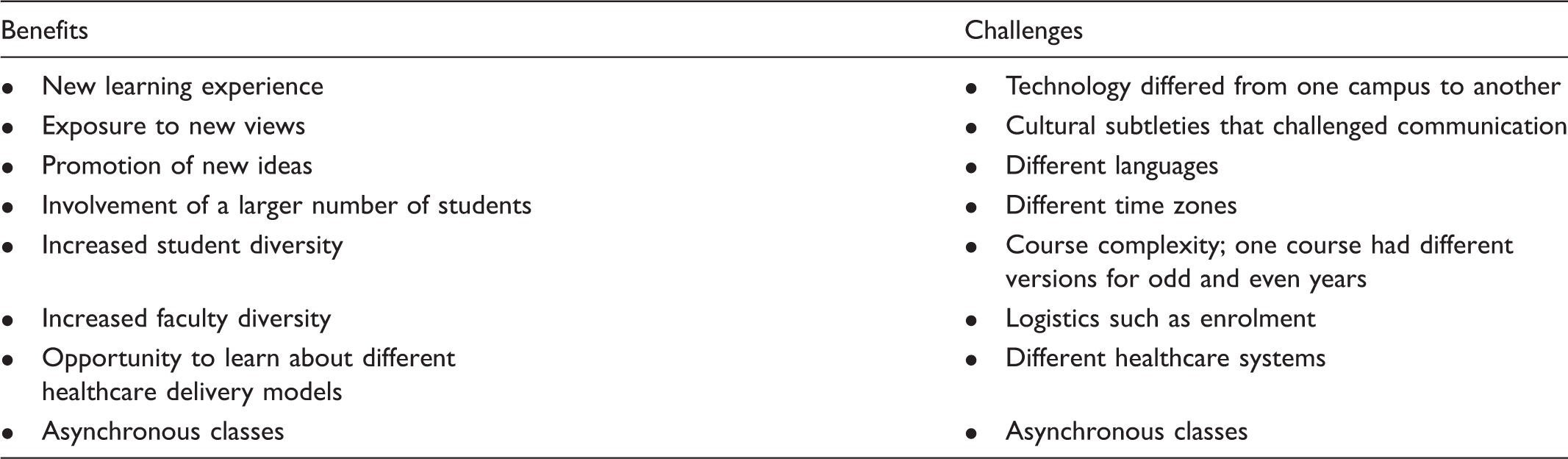
Most students from both countries said they would take another COIL course if it was offered. Students wrote that even if it was challenging and somewhat complicated, participating in a COIL course had been a rich and fun experience. Some students even said that if they were to change anything in the course they would include more COIL communication and collaboration as well as a synchronous live interface session for students to get to know each other better.
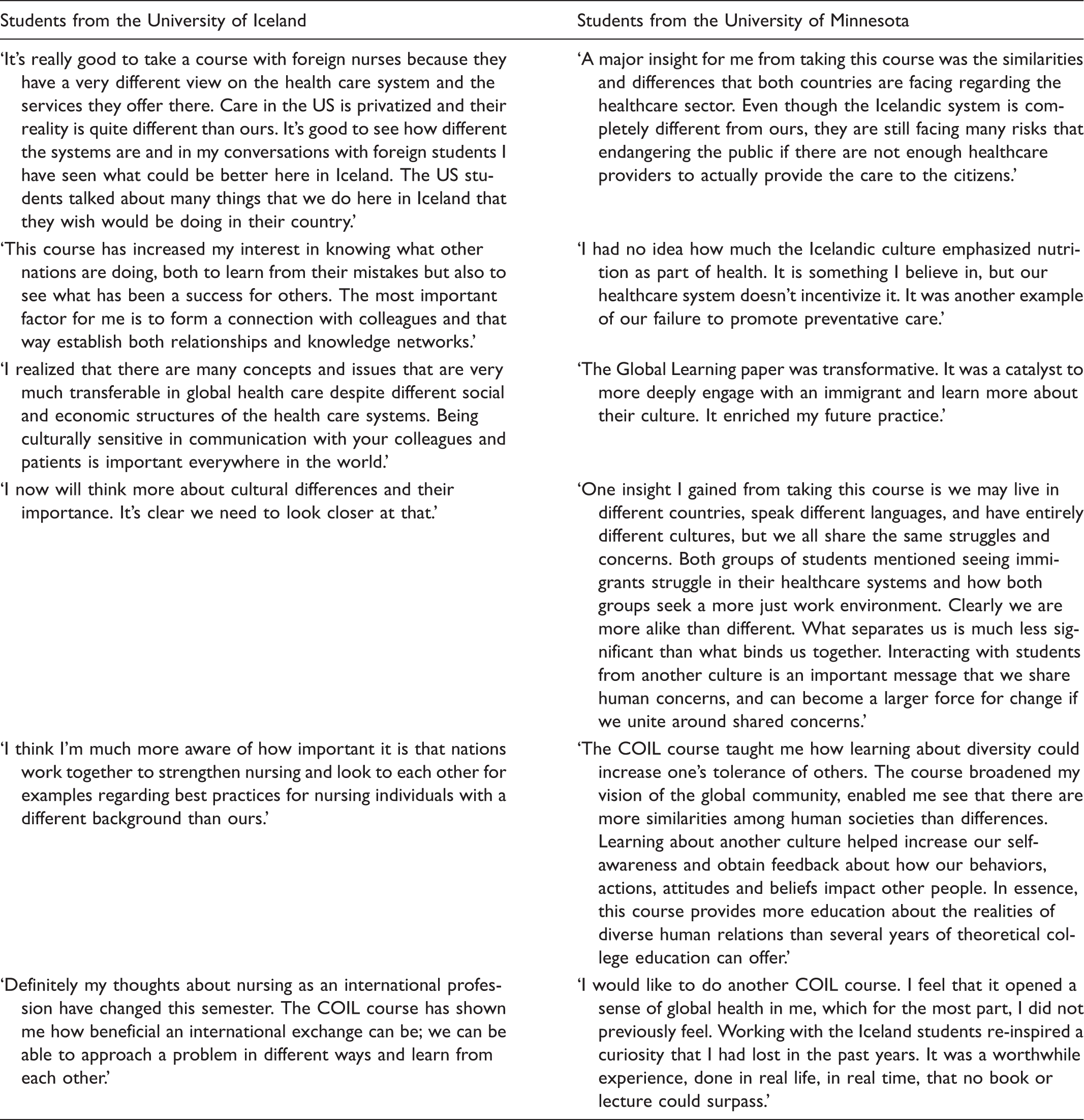
Student quotations from the post-COIL survey.
Discussion
All individuals, regardless of profession, but especially leaders in healthcare, must become global citizens. As pointed out by Brown et al., 10 new approaches must be used to educate global leaders for the future. COIL is an excellent way to transform leadership education from local to global. For small remote countries such as Iceland, which is an island located in the North-Atlantic Ocean, it is of immense value to be part of the global village. Similarly, is it immensely valuable for US students and faculty to be part of the connected world. As students noted, COIL revealed we can all learn from each other.
This project taught us that keys for successful COIL include shared goals, mutual respect and honest communication with a touch of excitement and fun. Our experience is comparable to what others have reported, 4 as students from both countries became more culturally alert global thinkers after taking the COIL course.
In conclusion, for faculty contemplating a COIL approach for their curriculum the authors want to share this message:
Fearlessly look for COIL partners in other countries. Be open to the benefits that both students and faculty can gain from international collaboration. Advance the art and science of collaborating as members of a global village. Global thinking is vital for a sustainable future for all.
For further information see: ‘Collaborative Online International Learning’, https://youtu.be/5K5JxNEEcmw.
Footnotes
Funding
This research received no specific grant from any funding agency in the public, commercial, or not-for-profit sectors.
Declaration of conflicting interests
The authors declare that there is no conflict of interest.