




Abstract
The rapidly growing number of older people with increasingly complex needs places pressure on quality of care and thereby presents a need for innovation in nursing homes. The aim of this review was to provide a comprehensive overview of the current state of evidence for the importance of leadership in innovation processes in nursing homes. A systematic search was conducted. Titles and abstracts were screened for relevance, data from full texts were extracted and reduced and quality appraisal was performed. Content analysis resulted in two categories: organizational factors associated with innovation and leadership characteristics in innovation, constructing the overall theme, ‘leadership: a key to successful innovations’. The innovations described in the included studies transform the underlying values of organizational culture. The review shows that participative, involving and innovative leadership is the key to success in innovation processes.
Introduction
Political and structural reforms, as well as cultural changes, have influenced care of the elderly over the past few decades. The rapidly growing number of older people may be seen as a challenge in the future. This could lead to an increasing need for nursing home services. Accordingly, the needs of older people living in nursing homes are becoming increasingly complex. Residents have serious illnesses, dementia and comorbid conditions. Today, nursing homes are at the same time places for long-term care residents and short-term patients in need of post-hospital rehabilitation 1 and medical treatment 2 to reduce hospitalizations. This combination places pressure on the quality of care.
As a response to the problems concerning how to provide sufficient care with frequently scarce resources, there has been an increasing interest in recent years in innovation in all sectors. In the elder care sector, innovation is related to the need for reconstruction of the welfare system due to demographic changes and economic constraints. 3 In welfare services, the concept of social innovation is used to pinpoint the importance of the human dimension in innovation processes. In social innovation, collaboration between actors is essential for success, and in these processes knowledge can be both used and created. 4 Social innovation can be understood as new ways of addressing social needs. Social innovation can be defined as ‘new solutions that simultaneously meet a social need and lead to new or improved capabilities and relationships, and better use of assets and resources’.5(p.18) This review is based on this definition, and in this article the term innovation is used in this sense. As the human dimension is important in social innovation the terms ‘innovation’ and ‘innovation processes’ are used interchangeably.
Innovations may be more or less pervasive. The term ‘incremental innovations’ represents smaller, stepwise changes, such as, for example, implementing knowledge, processes or methods in a new context. ‘Radical innovation’ is used to describe bigger and more pervasive changes that break with existing practice and create something quite different. 4
Engagement of leaders is essential to the success of innovation. 4 Theoretically, leadership style is related to organizational culture in The Competing Value Framework (CVF), a validated and commonly used instrument for studying organizational culture in healthcare settings. 6 Cameron and Quinn6(p.53) describe this framework with four different culture and leader types. Hierarchy cultures have coordinating, monitoring and organizing leaders. Market cultures have hard driving, competitive and producing leaders. Clan cultures have facilitating, mentoring and teambuilding leaders. The last one, the adhocracy culture type, is the creative and innovative one. Leaders in these cultures are innovative, entrepreneurial and visionary. Value drivers in these cultures are innovative outputs, transformation and agility.
Nursing leadership is yet not well defined. Kristiansen et al. define nursing leadership as ‘the process of influencing people to accomplish goals’.7(p.493) This means that nurse leaders are managing by making others change routines by inspiring them rather than commanding. According to Kristiansen et al., 7 the terms nursing leadership and nursing management are not synonymous but have different functions as well as different values. They claim that management has an administrative focus whereas leadership is more oriented towards relationships moving toward a common vision. Nurses working in nursing homes need special competence to meet the residents’ needs. All nursing personnel should get support from their leaders to enhance competence in order to provide high-quality care. 8 The importance of leadership in nursing homes is addressed in a systematic review. 9 In this review the authors found that job satisfaction is promoted by qualitatively good leadership. Through innovation processes a positive workplace culture were established and this ensured high care quality and well-being for the residents were promoted. The study reveals that innovation is a part of the leadership role in nursing homes. There is a need, however, for a review focusing especially on leadership and innovation.
The review
Aim
The aim of this integrative review was to provide a comprehensive overview of the current state of evidence for the importance of leadership in innovation processes in nursing homes.
Design
An integrative literature review was conducted, guided by the method developed by Wittemore and Knalf. 10 This review method summarizes past empirical literature by including studies of diverse methodologies, and thereby contributes to a presentation of varied perspectives. Integrative reviews have different purposes and include concept definitions and theory analyses.
Search methods
A systematic literature search was conducted to identify the maximum number of eligible primary sources. The search was based on an adjusted PICO method, describing population, intervention and context. 11 The databases CINAHL (EBSCO host), PsycINFO, MEDLINE and Embase were searched from January 2006 to December 2016 (search date: 16 December 2016). Since then we have received auto-alerts based on the same search terms regularly up to August 2018, but no further relevant documents were found. The search was conducted in cooperation with a librarian. The search terms were “innovation” and “nursing home”. A preliminary search with the terms “social innovation” and “leadership” was conducted but gave few relevant hits. Therefore, a broader scope was adopted. The focus on leadership was safeguarded in the later screening process. We searched the concepts alone and thereafter in combination, in titles, abstracts and keywords. To address the purpose of the review, we applied the following study inclusion criteria: peer-reviewed primary research studies that included leadership and social innovation in nursing homes, either in the title, abstract or keywords. Empirical studies of all study designs were included. Theoretical studies were not included in the review. Exclusion criteria were: studies dealing with assisted living or care facilities for the elderly other than nursing homes, studies from non-Western cultures and non-English language studies. Editorials and reviews were also excluded.
Search outcome
The results from all database searches were exported into EndNote X8. This strategy initially yielded 2050 titles with relevance to the research question. Removal of duplicates resulted in 778 articles. Screening the remaining titles and abstracts based on the inclusion and exclusion criteria reduced the sample to 28. These articles were read by the two first authors, in full text, resulting in ten articles finally being included in the analysis. The first and second authors conducted the process, first individually and then together until we reached consensus. The process of paper selection is shown in Figure 1.
PRISMA flow diagram.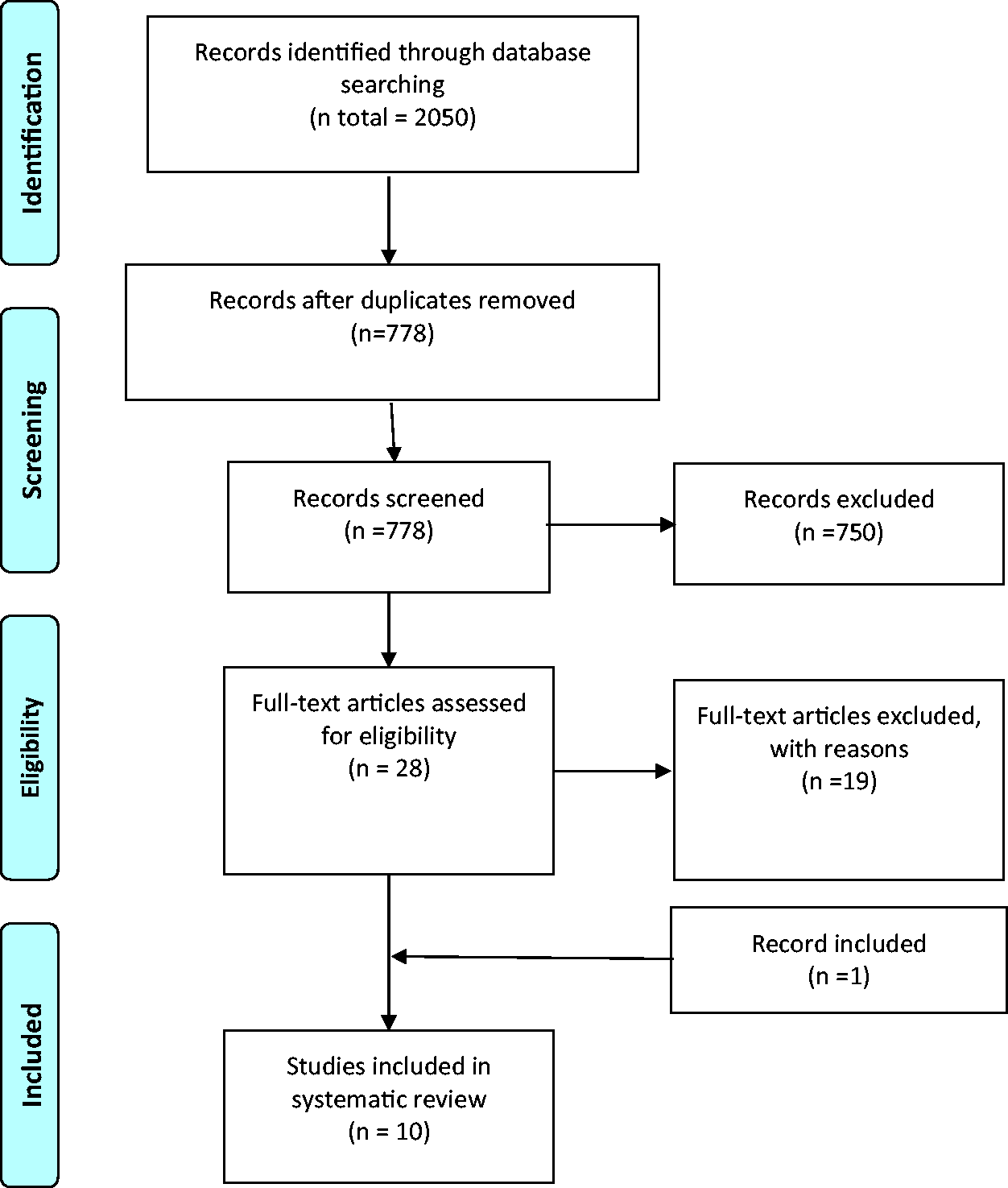
Quality appraisal
To assess the methodological quality of studies, different critical appraisal tools were used. The Critical Appraisal Skills Programme (CASP) was chosen for qualitative studies, and the Center for Evidence-Based Management (CEMBa) for quantitative studies. No studies were rejected as a result of the appraisal process.
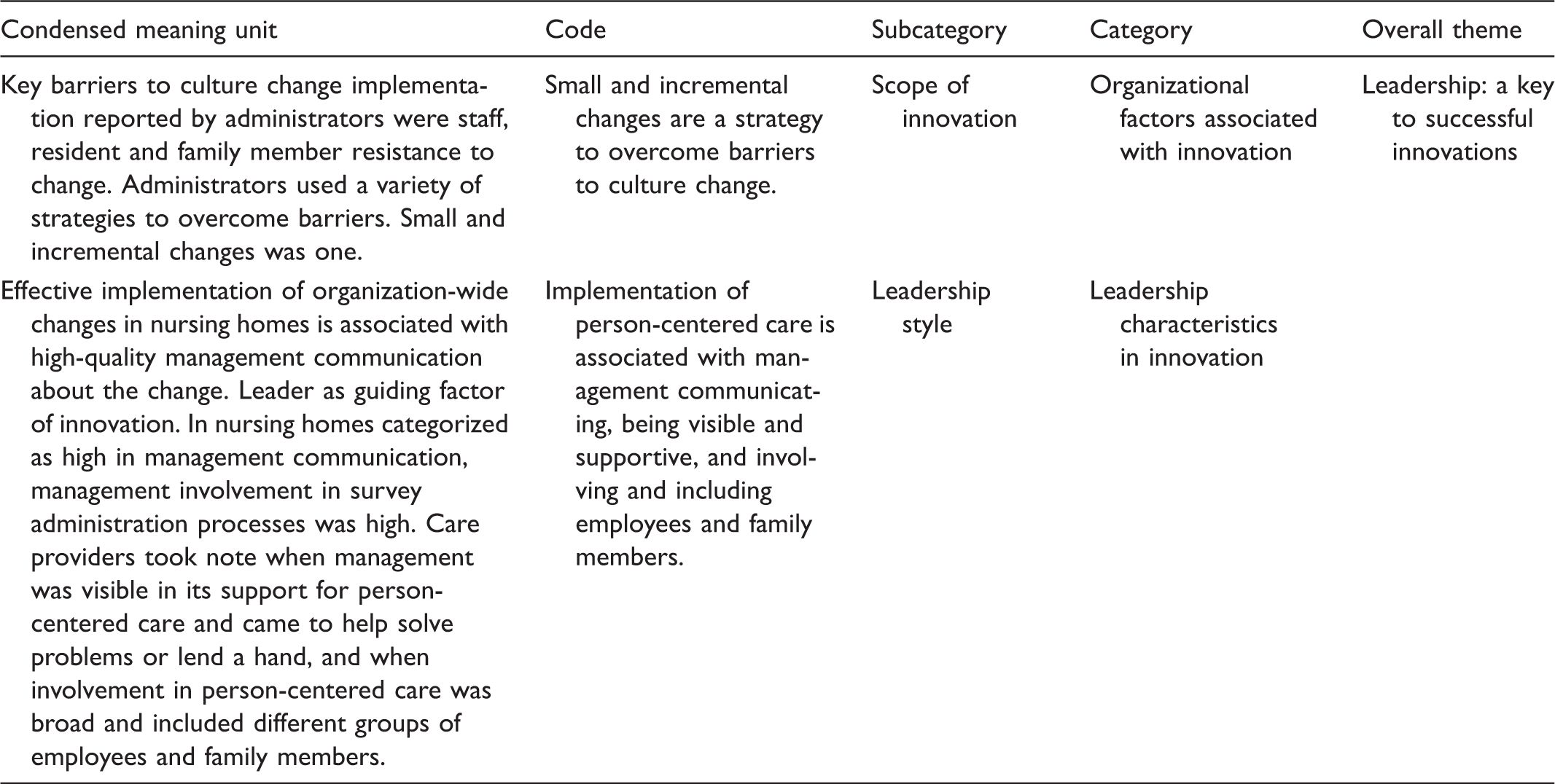
Data abstraction and synthesis
Examples of analytic steps.
Results
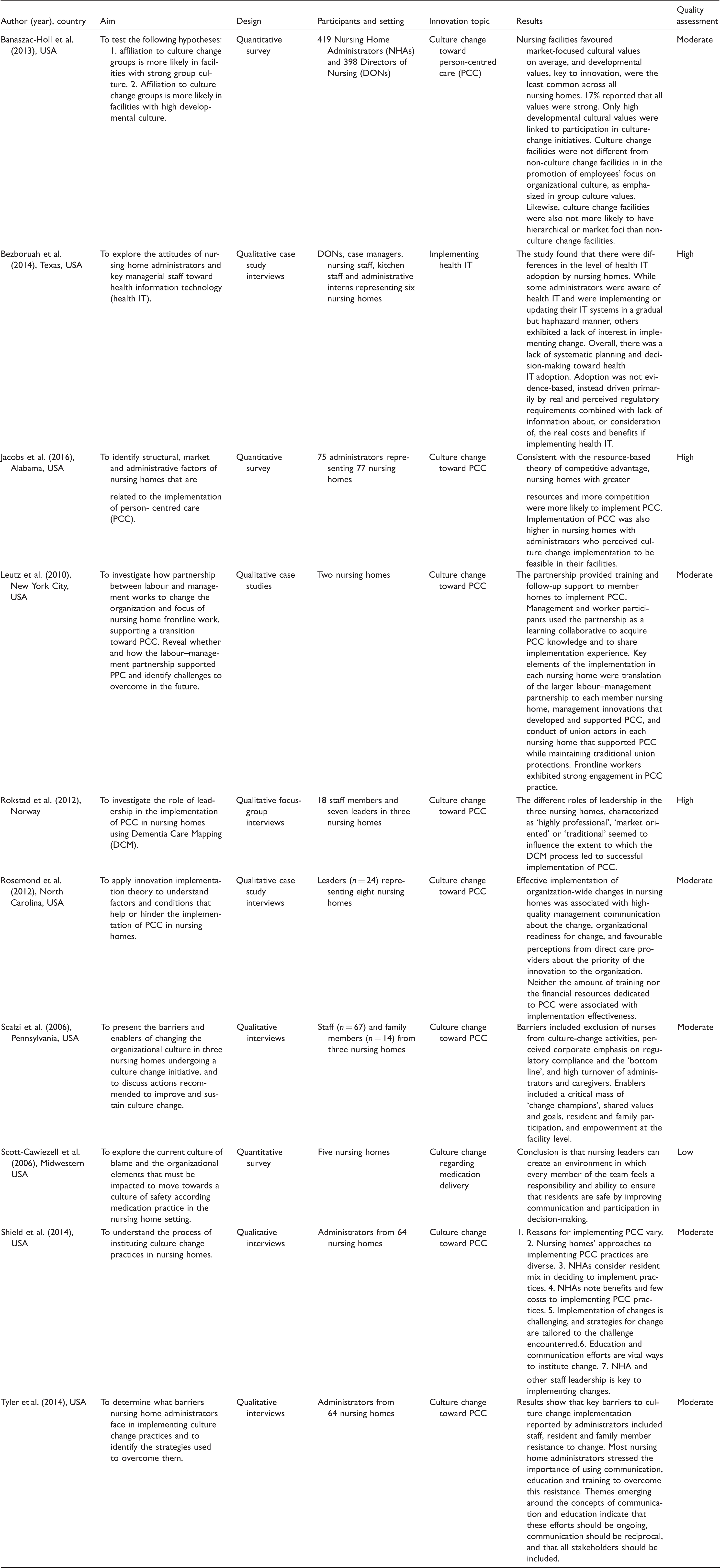
Descriptions of the studies
Characteristics of included studies.
Descriptions of the qualitative findings
Content analysis resulted in the two categories ‘Organizational factors associated with innovation’ and ‘Leadership characteristics in innovation’. These two categories constructed the overall theme ‘Leadership: a key to successful innovations’.
Organizational factors associated with innovation
Organizational factors associated with innovation is addressed in four studies. Analysis identified three subcategories: ‘Transformation of cultural values’; ‘Scope of innovation’; ‘Barriers and enablers to innovation’.
Analysis revealed cultural values underlying innovations as vital, and related both to residents, staff and environment. Culture changes processes toward PCC mean transformation of cultural values of the organization. Values underlying PCC are related to residents, staff and environment. Resident-related values focus on residents’ relationships, life experiences, abilities, and preferences, 16 resident autonomy 20 and respect, empowerment and the ability of residents to make their own choices, as well as quality of work life for staff. Environmental values were also found, such as homelike environment. 14
In the studies about culture change processes toward PCC, scope of innovation is generally wide. These processes affect organizations in a profound way. In order for culture change to come through both intra- and interfacility factors are important. 16 Practice norms must be changed radically 20 for implementation as well as there being organizational readiness for change, 16 and commitment from employees.16,20 One study, however, states that implementation could be systematic or more superficial, and that starting small was common. 18 Making small and incremental changes is a strategy to overcome barriers to culture change. 19
In some studies, enablers and barriers to implementing PCC are identified. In one study, enablers are a critical mass of ‘change champions’, management style congruent with PCC values and resident and family participation, whereas competing or conflicting intra-facility goals are barriers. 14 The importance of economic resources is left open. One study found greater resources to cause PCC practices. 20 Another found that the implementation of PCC attracts private paying clients, and that administrators noted benefits and few costs. 18 A third study, however, found that financial resources were not associated with implementation effectiveness. 16 Findings also indicate uncertainty regarding the importance of staff education and training. One study found that education efforts are vital, 18 whereas another found that amount of training was not associated with implementation effectiveness. 16 Lack of entrepreneurship and risk-taking were looked upon as barriers to implementing health information technology. 22
Leadership characteristics in innovation
Characteristics of leadership were addressed in all ten included studies. Analysis identified two subcategories: ‘Leader’s responsibility’ and ‘Leadership style’.
The responsibility of leaders in innovation processes was addressed in three studies about culture change toward PCC. Managers have to assure the quality of PCC in order for it to be maintained. 15 Leadership and decisiveness are seen as central to implementing change, 18 and administrators who perceived PCC to be feasible in their facilities were more likely to implement it. 20 In the process of adopting health information technology in nursing homes, systematic planning and decision-making are understood as responsibilities of the leader. 22
A leadership style characterized by involvement is highlighted in the studies. Leaders must involve staff and give them a chance to grow to succeed in the process of changing the culture regarding medication. 21 Analysis revealed a close connection between leadership style and culture change processes toward PCC. Developmental cultures have leaders who highlight both growth and creativity. 17 Certain attributes, such as being visible, supportive, receptive and flexible, and involving and including employees and family, 16 and being communicative16,19 are essential in leaders. Two studies focussed on the importance of a partnership between labour and management.15,18 Leadership style was generally participative, not rule bound, innovative in problem solving, and viewed risk-taking as important. This leadership style shares similar values as those implicit in culture change movements. 14 One study found that leadership in a nursing home characterized as highly professional was more successful in implementing PCC than were leaders in more market-oriented or traditional nursing homes. 13
Leadership style was also thematized in the study on implementing health information technology, 22 where a leadership style characterized by a lack of entrepreneurship and risk-taking was seen as a barrier.
Leadership: A key to successful innovations
Leadership appears to be a key to innovation processes in nursing homes. Analysis revealed a close connection between leadership style and culture change processes toward PCC. Values underlying PCC are respect for other persons, developing relationships and community, individualized residential care, and quality of work life for staff. These culture changes transform the values of the organizational culture and thereby affect the organization in a profound way. Scope of these innovations is generally wide, and to succeed in implementation, a complex set of factors must come together. Successful innovations are associated with high-quality management and a leadership characterized by involvement and partnership. Leadership style is participative. Leaders take an active part in nursing practice and serve as important role models in employee socialization when it comes to important values in the institutional culture. Furthermore, leadership style is innovative in the sense that leaders are flexible and appreciate growth and creativity.
Discussion
The aim of this review was to provide a comprehensive overview of the current state of evidence for the importance of leadership in innovation processes in nursing homes. In this review, culture change processes toward PCC were the focus innovation in a majority of the included studies. Most studies about culture change processes toward PCC generally have a wide scope of innovation, involving the whole facility and affecting the organization in a profound way. Thereby, the organizational culture is transformed toward what Cameron and Quinn, 6 in line with the The Competitive Value Framework (CVF), describe as the adhocracy culture type. This is in line with values and intentions in the PCC literature. According to Broker, 23 PCC encompasses a value base. An important factor in PCC is thus valuing human lives. Age and cognitive status are not important, but all are equal and should be treated individually. Furthermore, the focus is on the unique person, respecting the person’s own perspective. Psychosocial needs should also be met. The term PCC was introduced as an attempt to distinguish dementia care from medical and behavioural approaches. 24 Today PCC is a key principle in culture change. Both residents and staff will, by introducing PCC, be empowered, and conditions for being autonomous decision-makers are improved. 25 By focusing on PCC the nursing home culture will enhance both quality of life and care for residents. 26 It is also a culture change that enhances the community of nursing home residents and staff by innovative improvements. 25 Sterns et al. 27 document the complexity of implementing these changes. These implementations are huge reforms, and even when taking it stepwise, as a whole they can be characterized as a radical or at least quite pervasive innovations. 4 It is reasonable that leaders be deeply involved in such processes, and need to be innovative, entrepreneurial and creative. 6
Findings indicate that a leadership style characterized by involvement and partnership is feasible in innovation processes in nursing homes. Participative and innovative leadership was connected with implementation success. The question as to whether this style is favourable to facilitating changes in nursing homes more generally is not addressed in the studies of this review. Research on the question is sparse. A review shows that supportive management, characterized by increased empowerment, participation and influence, increases quality of care in nursing homes. 28 A study on influence on leadership when facilitating change in nursing homes 29 found that collaborative leadership could hamper change in one nursing home. At the same time, the study found it successful with a remote leadership style in another nursing home. A conclusion was that leadership style is important for implementing evidenced-based practice in nursing homes.
In this review, leadership style is connected to characteristics of nursing home culture. Successful innovation was connected to highly professional nursing homes, in contrast to more traditional or market-oriented institutions. This is in line with the theoretical basis of the adhocracy culture type in The Competitive Value Framework (CVF) that connects innovativeness, vision and resources to the innovative and creative leader type. 6 A study by Kristiansen et al. 7 might support this connection. The study indicates that the type of leadership feasible for PCC is under pressure. It is argued that increased managerial tasks, weak emphasis on professional values and lack of mutual agreement between leaders and their employees, may weaken the leader’s role in management in nursing homes. According to Maxwell 30 the conclusions of Kristiansen et al. 7 are logical within what she calls a ‘paradigm of leader-centric approaches to leadership’. Further, she discusses theories on leadership style, seeing employees as passive and subordinate followers. As healthcare environments become increasingly complex, Maxwell 30 argues that a theoretical approach outlined by Uhl-Bien et al. 31 would be a more suitable. These authors suggest that leadership should change from focusing on authority management toward knowledge management.
The current situation with increasing numbers of short-term patients and higher acuity focus in nursing homes 1 is not reflected in the selected studies of this review. Dumas et al. 1 ask whether the focus on creating a community is feasible for today’s nursing homes overall; a question that seems relevant and timely.
Methodological discussion/limitations
The search strategy resulted in ten included studies, which gives limited data from which to draw conclusions. This might indicate that there is a need for further research on this topic. Of the ten included articles, nine were scored moderate or high quality by using recognized critical appraisal tools. This strengthens the validity of the study. The combination of qualitative and quantitative studies may limit the comparability among the articles. At the same time the content was similar and highlighted the topic from different designs and perspectives. In addition, one of the quantitative articles scored low on quality appraisal. It was included due to nuancing the theme culture change. This may be a limitation.
It is a limitation in regard of generalizability that all but one article was from the USA. The basic values of PCC are general and not location-dependent. On the other hand, differences in organizational culture between the USA and the European/Nordic countries may be important.
None of the included studies reflected the current situation with increasing numbers of short-term patients in need of post-hospital rehabilitation and medical treatment to reduce hospitalization.
Conclusion
In the ten included studies, culture change processes toward PCC was the focus of innovation in eight studies, culture change regarding medication delivery in one study, and the implementation of health information technology in one. The strong focus on PCC reflects the situation of inhabitants suffering from dementia and addresses the aim of improving quality by transforming nursing homes into vibrant communities for all involved. The innovations described in the included studies transform the underlying values of the organizational culture and require participative, involving and innovative leadership. Leadership should change from focusing on authority management toward knowledge management. The review shows that these leadership characteristics are the key to success in innovation processes. There is a need for further research on innovation focusing on medical treatment and rehabilitation for short-term patients in nursing homes, including the importance of leadership.
Footnotes
Acknowledgements
The authors wish to thank librarian Ellen Sejersted for her excellent support.
Funding
Copyediting for this article was funded by The Research Council of Norway. Project Number: 256647
Conflict of interest
The authors declare that there is no conflict of interest.